
A full Irish breakfast is a cooked plate of rashers (back bacon), pork sausages, black and white pudding, fried eggs, grilled tomato and usually mushrooms, with brown soda bread or toast and a pot of tea. Baked beans are common but debated. In Northern Ireland, the Ulster fry adds fried soda farls and potato bread. The recipe below serves 2 (or 4) in about 45 minutes.
At home in Ireland, it’s usually just “a fry”. “Full Irish” is the name you’ll see on hotel, B&B and café menus.
Here’s what goes on the plate, what black and white pudding really are, and how to cook it all so nothing goes cold. There’s history too, though less than the legends suggest.
Jump to:
- What goes in a full Irish breakfast?
- How to cook a full Irish breakfast (recipe)
- Full Irish vs full English vs Ulster fry
- Black and white pudding explained
- A short history of the full Irish
- Where to buy Irish rashers and puddings abroad
- Is a fry really a hangover cure?
- Full Irish breakfast FAQ
- More Irish food reading
What goes in a full Irish breakfast?
There’s no official list, and every house does it a little differently. Breakfast in Irish is bricfeasta (BRIK-fas-tuh), and a fry-up is a bricfeasta friochta (BRIK-fas-tuh FRIKH-tuh). The usual parts:
- Rashers: usually back rashers, cut from the loin with a ribbon of fat. American bacon is streaky bacon from the fattier belly. A rasher in Irish is slisín (SHLISH-een, or shlish-EEN in Munster).
- Sausages: pork, two or more each. Rashers and sausages are old Dublin favourites, and the heart of Dublin coddle. A sausage is ispín (ISH-peen, or ish-PEEN in Munster).
- Black and white pudding: not dessert, but savoury sausages, sliced and fried. More below.
- Eggs: usually fried. In a 2013 breakfast survey by the meat brand Denny, reported by The Irish Times, 62.4 per cent preferred them that way.
- Tomato and mushrooms: a halved tomato, grilled or fried, and mushrooms fried in butter.
- Bread and tea: brown soda bread or toast with plenty of butter (try my Irish soda bread recipe), and a big pot of strong tea.
The great baked bean debate
Baked beans are on plenty of Irish plates, especially in cafés, but plenty of people won’t let them near the rashers. In that 2013 survey, 47 per cent said they don’t like beans touching the rest of the fry.
They’re a newcomer, too. Heinz beans were a luxury import at London’s Fortnum & Mason in 1901, and only became everyday food after British production began in 1928, says a Borough Market history. A little dish on the side keeps the peace.
Potatoes: boxty, farls and fried leftovers
In the north-west you may meet boxty, bacstaí (BOK-stee) in Irish, made from grated raw potato mixed with mashed potato and often fried as a pancake. A 2009 study by food historian Máirtín Mac Con Iomaire (roughly MAWR-cheen mok kun UM-ir-eh) and boxty chef Pádraic Óg Gallagher (roughly PAW-drig ohg) found it was probably most popular in Sligo, Leitrim, Roscommon and Longford.
Leftover colcannon or potato cakes fried in the pan are an old trick too. The same study passes on an unproven story that fried leftover colcannon became England’s bubble and squeak.
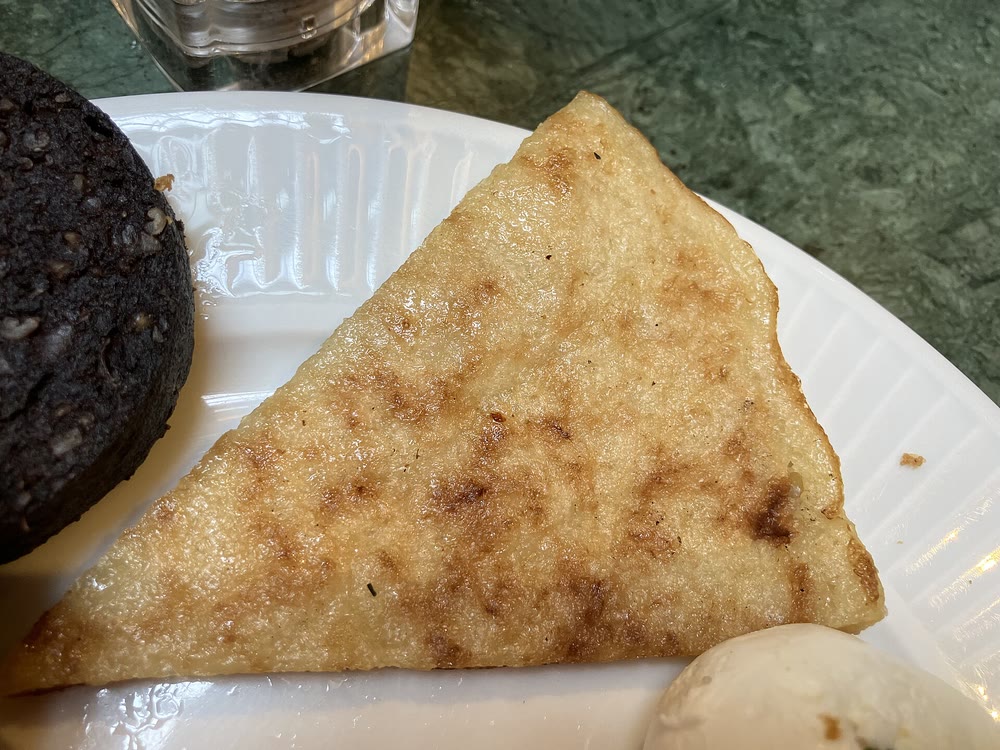
A triangle of boxty served with an Irish breakfast in Dublin. Photo: さえぼー, CC0, via Wikimedia Commons
How to cook a full Irish breakfast at home
The trick is the order. Sausages take longest, eggs take least, and a low oven holds everything in between.
Prep: 10 minutes | Cook: 35 minutes | Serves: 2 (double it for 4)
Ingredients
- 4 Irish pork sausages
- 4 back rashers (Irish rashers or back bacon)
- 2 slices of black pudding and 2 slices of white pudding, each about 1cm (½ inch) thick
- 2 medium tomatoes, halved
- 150g (5 oz) mushrooms, halved or thickly sliced
- 2 to 4 eggs
- 1 tablespoon vegetable or rapeseed (canola) oil, plus a knob of butter
- Salt and black pepper
- Optional: about 200g (7 oz) baked beans, roughly half a standard can
- To serve: buttered brown soda bread or toast, or for an Ulster fry, 2 soda farls and 2 potato farls, halved
- A pot of strong tea
Method
- Heat the oven to 100°C (about 210°F), or its lowest setting. Put in two plates and an ovenproof dish to warm.
- Heat the oil in a large frying pan over a medium-low heat. Add the sausages and cook for 15 to 20 minutes, turning every few minutes, until browned and cooked through, with no pink in the middle.
- After 10 minutes, push the sausages to one side and add the rashers. Fry for 2 to 3 minutes a side until cooked and golden at the edges, then move them to the warm dish in the oven. Add the sausages to the dish when they’re done.
- Once the rashers are out, fry the pudding slices beside the sausages for 2 to 3 minutes a side until crisp at the edges and hot through, then add them to the oven. Some puddings are sold ready-cooked and others need longer, so follow the pack.
- With the sausages done, add the butter to the pan, then the tomatoes, cut side down, and the mushrooms. Cook for 4 to 5 minutes, turning the mushrooms, and season. Warm the beans in a small pan over a low heat.
- For an Ulster fry, fry the soda and potato farls in the pan fat for about 2 minutes a side until golden. Otherwise, make the toast or butter the bread, and put the kettle on.
- Eggs last. Add a little more oil or butter over a medium heat, crack in the eggs and fry for 3 to 4 minutes, spooning hot fat over the yolks, until the whites are set. Plate up on the warm plates and serve at once.
Tips
Cooking for 4? Use two pans, or bake the sausages on a tray at 200°C (400°F) for 20 to 25 minutes, turning once, adding the pudding and tomatoes for the last 10.
Cook sausages right through. safefood, the all-island food safety body, says sausages should reach 75°C (167°F) in the centre, or be piping hot right through, with no pink left. For anyone pregnant, very young, elderly or unwell, it advises cooking eggs until the yolk is solid.
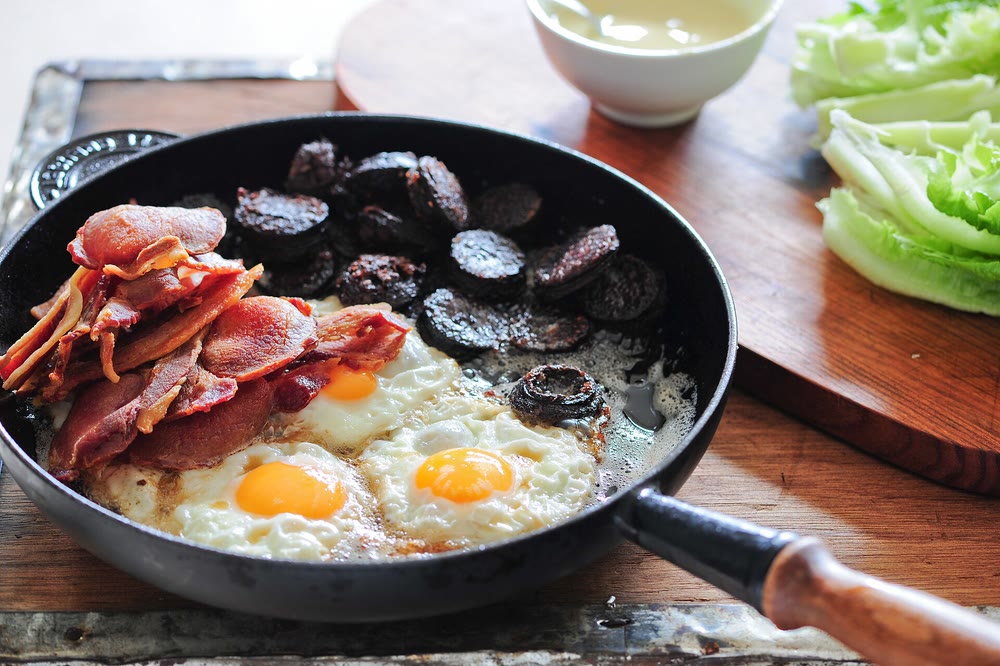
Rashers, black pudding and eggs frying together in one pan. Photo: jules (Jules Clancy), CC BY 2.0, via Wikimedia Commons
Full Irish vs full English vs Ulster fry
The overlap is huge: bacon, sausages, eggs, tomato, mushrooms, toast and black pudding are loved on both sides of the Irish Sea. The differences are in the extras.
- White pudding is usually the giveaway on an Irish plate, along with brown soda bread.
- The full English grew out of the grand country-house breakfast. Middle-class homes cut it down to bacon and eggs, sausages, mushrooms and toast, says Borough Market’s history, and beans came later.
What is an Ulster fry?
Northern Ireland’s version is all about the bread. Both soda bread and potato bread are part of an Ulster fry, notes a CCEA factsheet for Northern Ireland schools. Both are fried golden in the pan. Northern soda bread is usually shaped into farls (quarters) and cooked on a griddle, not baked as a round cake as in the Republic.
Farl is from an old Scots word, fardel, a fourth part. Potato bread is also called potato farl, fadge or slim in different parts of the North.
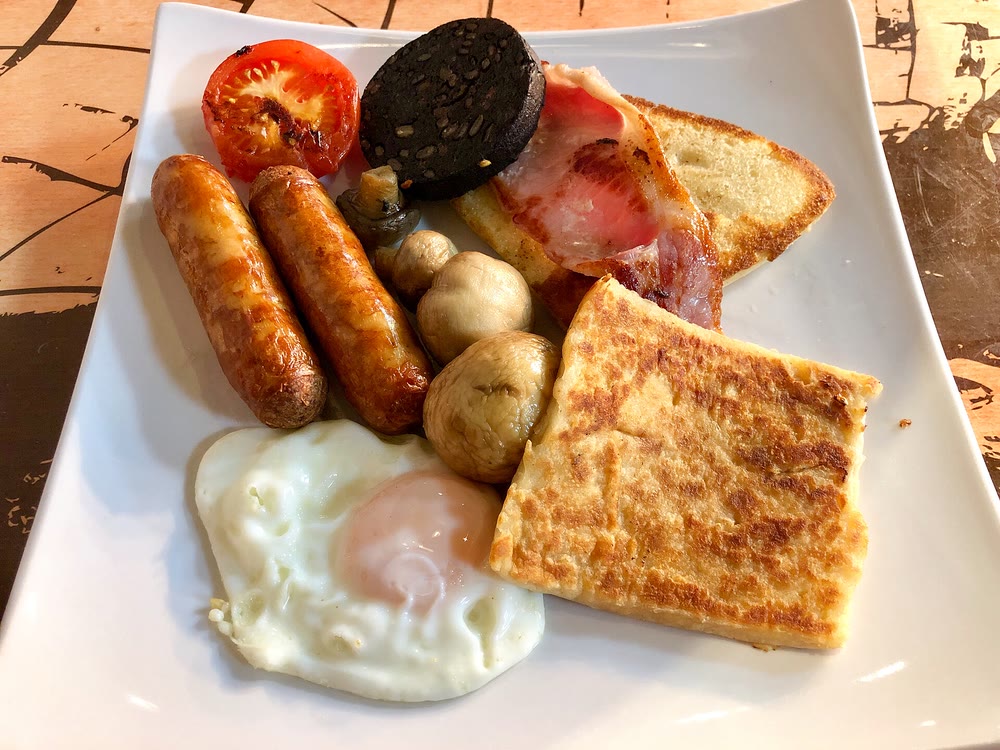
An Ulster fry in Belfast, with fried soda bread and potato bread. Photo: Kent Wang, CC BY-SA 2.0, via Wikimedia Commons
Black and white pudding explained
“Pudding” here has its old meaning: a savoury sausage in a casing. The Irish word putóg means both a gut and a pudding, says Ó Dónaill’s dictionary. Black pudding is putóg dhubh (PUT-ohg GHUV; puh-TOHG in Munster, and dhubh closer to “ghoo” in Connacht and Ulster). White pudding is putóg bhán (PUT-ohg WAWN). Watch for misspellings like “putog dubh” or “putóg bán”: putóg is feminine, so the adjective is lenited.
Black pudding
Black pudding is blood, fat, oatmeal, onions and spices in a casing. Mac Con Iomaire describes the farmhouse method in The Pig in Irish Cuisine and Culture: at the pig killing, the blood was mixed with oatmeal, flour, onions, lard and spices, filled into the cleaned intestines and boiled for an hour or so, and the puddings were shared among the neighbours who’d helped.
Recipes vary. The Irish Farmers Journal reported in 2024 that many producers now use dried blood, while Inch House in Co. Tipperary was still using fresh pig’s blood. Clonakilty’s black pudding traces its recipe to a local butcher’s shop in that West Cork town in 1880 (see my Cork facts); in 2006 The Irish Times listed its ingredients as ox blood, beef fat, onions and pinhead oatmeal.
White pudding
White pudding is the same idea without the blood: pork meat, oatmeal and spices, pale and milder in flavour. Clonakilty’s is known for its peppery kick.
Drisheen
Cork city has its own blood pudding, drisheen, from the Irish drisín (DRISH-een), which can also mean an animal’s intestine. The Oxford Companion to Food says it’s made only in Cork, from sheep’s and beef blood, with a soft texture like blancmange.
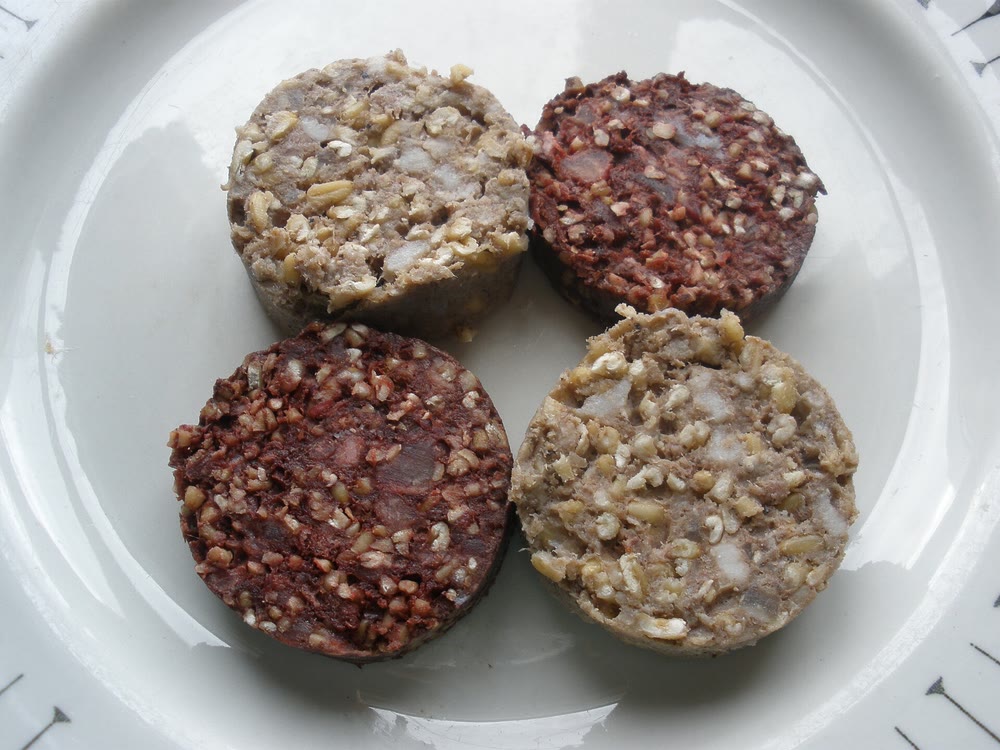
Slices of Irish black pudding and white pudding, uncooked. Photo: © O’Dea at Wikimedia Commons, CC BY-SA 4.0
A short history of the full Irish
You’ll often read that the full Irish was invented to fuel farmers for a day in the fields. The real story is patchier.
Pigs, puddings and bacon factories
Pork, ham and bacon have been part of the Irish diet since prehistoric times, Mac Con Iomaire points out. The 12th-century satire The Vision of Mac Conglinne, Aislinge Meic Con Glinne (roughly ASH-ling-eh mek kon GLIN-eh) in Irish, is full of bacon, sausages and puddings.
Commercial curing took off from the mid-18th century. Henry Denny began curing bacon in Waterford in 1820, and Limerick came to dominate the trade. It’s the same tradition that gave us bacon and cabbage.
What most people actually ate for breakfast
For most rural families, breakfast was plainer than a fry. Accounts gathered for the Schools’ Collection in the 1930s describe the old days:
- In Kilbride, Co. Meath, a 70-year-old said the chief breakfast long ago was stirabout (oatmeal porridge), with milk when there was milk to spare.
- In Shercock, Co. Cavan, people worked two hours before a breakfast of stirabout, or in summer, potatoes with salt and buttermilk.
- In Boyle, Co. Roscommon, half a day’s work was done before a breakfast of cold porridge made the night before.
Eggs were often money rather than food. Mac Con Iomaire and Andrea Cully note that from the 1820s to the 1850s, through the Famine, poor families in the west sold their eggs to pay the rent.
Bacon and eggs appear earlier on comfortable tables: Darina Allen notes a 1732 mention of fried egg and bacon as the Dean of Down’s favourite food. A folk legend even claims the pairing as Irish, after a hen roosting above the fire drops an egg into a pan of sizzling bacon. It’s a lovely story, and only a story.
Feast days were different. After the Lenten fast, Easter Sunday breakfast meant eggs, and plenty of them: folklorist Bríd Mahon (BREED) wrote that men ate six each on average.
Rashers in Ulysses
In the opening pages of James Joyce’s Ulysses, set in Dublin on 16 June 1904, Buck Mulligan calls Stephen down because “the Sassenach wants his morning rashers”. That’s their English guest, Haines: Sasanach is Irish for an English person. Later, Leopold Bloom fries a pork kidney in butter for breakfast.
B&Bs, hotels and the weekend fry
The full Irish is a fixture of Irish hotels and B&Bs, and you’ll likely be offered it wherever you stay in Ireland. Darina Allen of Ballymaloe Cookery School told The Philadelphia Inquirer in 2016 that a full breakfast can “take you right through into the evening”.
At home, it’s mostly a weekend treat now. In the 2013 survey, 66 per cent said they have a fry at least once over the weekend.
The breakfast roll
Then there’s the fry you eat with one hand: a long roll stuffed with sausages, rashers, pudding and egg. Sociologist Perry Share argued in 2011 that the “jumbo breakfast roll” rose to fame in the Celtic Tiger years, carried by the building boom, commuting and convenience stores. Economist David McWilliams named its customer, the builder eating on the go, “Breakfast Roll Man” in his 2005 book The Pope’s Children, and Pat Shortt’s comedy song “Jumbo Breakfast Roll” spent six weeks at number one in Ireland in 2006.
Where to buy Irish rashers and puddings abroad
- Irish shops and delis: ask at your local Irish club or GAA club.
- Online Irish butchers: several ship chilled or frozen; check delivery areas and packing first.
- Locally made “Irish-style”: common in the US, Canada and Australia; check the label.
- Stand-ins: back bacon for rashers, and black pudding’s cousins, Spanish morcilla or French boudin noir.
Packing rashers in your suitcase? USDA rules allow some meat into the US from countries free of certain livestock diseases, with proof of origin, but you must declare it all, and rules change. Other countries have their own, so check before you fly.
Is a fry really a hangover cure?
Plenty of Irish people swear by it, and it tops my list of the best hangover cures. The science is less kind. The HSE says there’s no cure but time, and little evidence that a fry-up helps. It suggests plenty of water, sleep and bland foods such as toast or bananas instead.
So have the fry for the joy of it, with a big glass of water.
Full Irish breakfast FAQ
What is in a full Irish breakfast?
Rashers, sausages, black and white pudding, fried eggs, grilled tomato and often mushrooms, with brown bread or toast and tea. Beans and potato are optional.
What’s the difference between a full Irish and a full English?
Very little. The Irish plate usually adds white pudding and soda or brown bread, and beans belong more to the English one.
What are black and white pudding made of?
Black pudding is blood (pig’s on the farm, though Clonakilty’s uses beef), fat, oatmeal, onion and spices in a casing. White pudding is pork meat, oatmeal and spices, with no blood.
What do Irish people call a full Irish breakfast?
Usually just “a fry”, or “a fry-up”. In Northern Ireland it’s an Ulster fry, and in Irish it’s a bricfeasta friochta.
Love this? Save it to your Pinterest board for later.
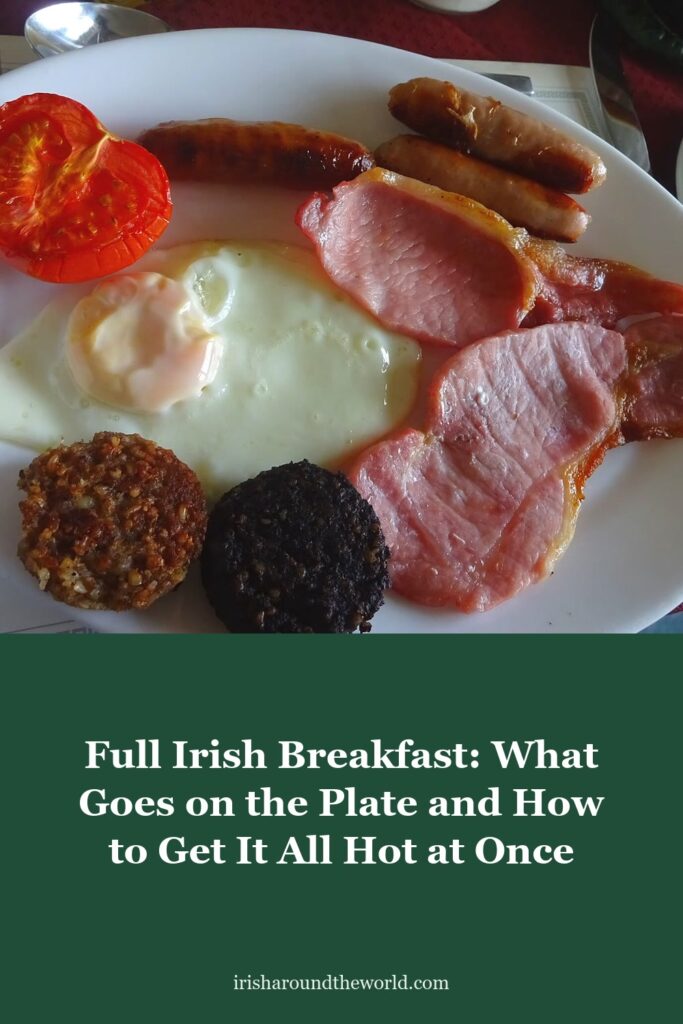
Pin image: A full Irish breakfast with grilled tomato, sausages, rashers, a fried egg and black and white pudding. Photo: Benreis, CC BY 3.0, via Wikimedia Commons
A little bit of Ireland in your inbox every Friday ☘️
The free Weekly Dose of Irish: an Irish joke, a Celtic symbol, an Irish fact, a poem and the week’s best articles in one short email. Join 9,600+ readers.
Free. One short email every Friday. Unsubscribe any time.
More Irish food reading
- Irish Soda Bread Recipe
- Colcannon Recipe: The Irish Halloween Mash That Hides Your Fortune
- Traditional Irish Bacon and Cabbage (With a Wonky Twist)
- Irish Potato Cakes Recipe By The Wonky Spatula
- 7 Best Hangover Cures, According to an Irishman
- How to Celebrate St Patrick’s Day: 36 Ideas from an Irishman
Featured image: A full Irish breakfast with grilled tomato, sausages, rashers, a fried egg and black and white pudding. Photo: Benreis, CC BY 3.0, via Wikimedia Commons.