Thank you in Irish is go raibh maith agat (guh rev MAH AG-ut). Word for word, it means “may there be good at you”. To two or more people, say go raibh maith agaibh (guh rev MAH AG-iv). For thanks a million, say go raibh míle maith agat, or simply míle buíochas, a thousand thanks. To say what you’re thanking someone for, add as: go raibh maith agat as do chabhair, thank you for your help. The usual replies are tá fáilte romhat (you’re welcome), ná habair é (don’t mention it) and go ndéana a mhaith duit (may it do you good). Thanksgiving is Lá an Altaithe.
Of all the Irish you might pick up from a grandparent, a summer in the Gaeltacht or a sign in Kerry, go raibh maith agat is probably the phrase you’ll use most.
It hides a small surprise. The everyday Irish thank-you doesn’t say “I thank you”. It makes a wish for the person who helped you, and once you see how it’s built, the rest falls into place.
It’s one line in my list of 25 Irish greetings. Here’s the full story, from Munster, Connacht and Ulster pronunciation to card wording and Thanksgiving. Most of the phrases below come straight from Ó Dónaill’s Irish-English dictionary on teanglann.ie or the New English-Irish Dictionary on focloir.ie, and the rest follow the patterns they show.
Jump to:
- How to say thank you in Irish
- What go raibh maith agat really means
- Thanking a group: go raibh maith agaibh
- Thanks a million: míle maith and míle buíochas
- Thank you for…: as and as ucht
- How to reply: tá fáilte romhat and more
- Munster, Connacht and Ulster pronunciation
- Older ways to say thanks
- How the Irish say thanks in English
- Thank-you card wording in Irish
- Happy Thanksgiving in Irish: Lá an Altaithe
- Common mistakes and the right spellings
- Thank you in Irish: FAQ
- More Irish language reading
How to say thank you in Irish
The respellings are rough guides; the dialect notes are further down.
| Irish | Say it | Meaning |
|---|---|---|
| go raibh maith agat | guh rev MAH AG-ut | Thank you, to one person. |
| go raibh maith agaibh | guh rev MAH AG-iv | Thank you, to two or more. |
| go raibh míle maith agat | guh rev MEE-luh MAH AG-ut | Thanks a million. Literally “a thousand goods”. |
| go raibh céad maith agat | guh rev KAYD MAH AG-ut | Thanks very much. Literally “a hundred goods”. |
| míle buíochas | MEE-luh BWEE-khus | A thousand thanks. |
| gabhaim buíochas leat | GOW-im BWEE-khus lyat | I thank you. Formal. |
| maith thú | MAH hoo | Good for you, or thanks. |
| GRMA | (written only) | Text shorthand for go raibh maith agat. |
GRMA was on the list of Irish text-speak that Aodhán Ó Deá of Conradh na Gaeilge gave on Newstalk, as IrishCentral reported in 2024.
Yes, please, and no, thanks
Like “thanks” in English, go raibh maith agat works for accepting and for refusing. In focloir.ie’s examples, someone offered sugar simply says “Go raibh maith agat.” To turn down tea, answer the question first:
- An mbeidh cupán tae agat? (un MEH KUP-awn TAY AG-ut): Will you have a cup of tea?
- Beidh, go raibh maith agat (BEH): I will, thanks.
- Ní bheidh, go raibh maith agat (nee VEH): No, thank you.
Irish has no single word for yes or no, so you echo the verb: beidh, “will be”, or ní bheidh, “won’t be”.
What go raibh maith agat really means
- go (guh): a little word that turns a sentence into a wish, like English “may”.
- raibh (rev): a form of bí, to be. Go raibh means “may there be”.
- maith (MAH): good. Here it’s a noun, “good” or “goodness”, and Ó Dónaill’s dictionary files thanks under maith the noun.
- agat (AG-ut): at you. It’s ag (eg), at, and tú (too), you, joined into one word.
So the sentence says “may there be good at you”. Irish has no verb “to have”, so good things, money and even love are “at” you, the same pattern as tá grá agam duit in my guide to saying I love you in Irish.
Flip the wish and it bites. Ó Dónaill records ná raibh maith agatsa (naw rev MAH AG-ut-suh), “no thanks to you”, and focloir.ie notes that go raibh míle maith agat can be ironic, like “thanks a bunch”.
The Isle of Man has the same wish. Manx says gura mie ayd (“Gurr-a-MY edd”, in Culture Vannin’s respelling), which LearnManx translates as “may there be good at you”.
Thanking a group: go raibh maith agaibh
Agat is “at you” for one person. For two or more, swap in agaibh (AG-iv). Focloir.ie’s example is handy after any party: go raibh maith agaibh as cuireadh a thabhairt dom (oss KIR-uh uh HOORT dum), thank you for inviting me.
- Go raibh maith agaibh go léir (guh LAYR): thank you, all of you.
- Míle buíochas libh (MEE-luh BWEE-khus liv): a thousand thanks to you all.
- Tá fáilte romhaibh (taw FAWL-chuh ROH-iv): you’re all welcome.
To thank someone back, stress the “you” with agatsa: go raibh maith agatsa (guh rev MAH AG-ut-suh), thank you. The -sa ending adds emphasis, just as it does in ná raibh maith agatsa.
Thanks a million: míle maith and míle buíochas
Irish is generous with its numbers. Go raibh míle maith agat, “may there be a thousand goods at you”, is Ó Dónaill’s “thanks ever so much”, and focloir.ie gives it for both “thanks very much” and “thanks a million”. A hundred will do too: go raibh céad maith agat.
The other route is the noun buíochas (BWEE-khus), thanks or gratitude. Míle buíochas, a thousand thanks, is short and warm in speech or in writing, and focloir.ie also offers mo mhíle buíochas leat (muh VEE-luh BWEE-khus lyat), my thousand thanks to you.
Notice the le (with). In Irish you give thanks “with” a person, so it’s buíochas leat to one person and buíochas libh to a group.
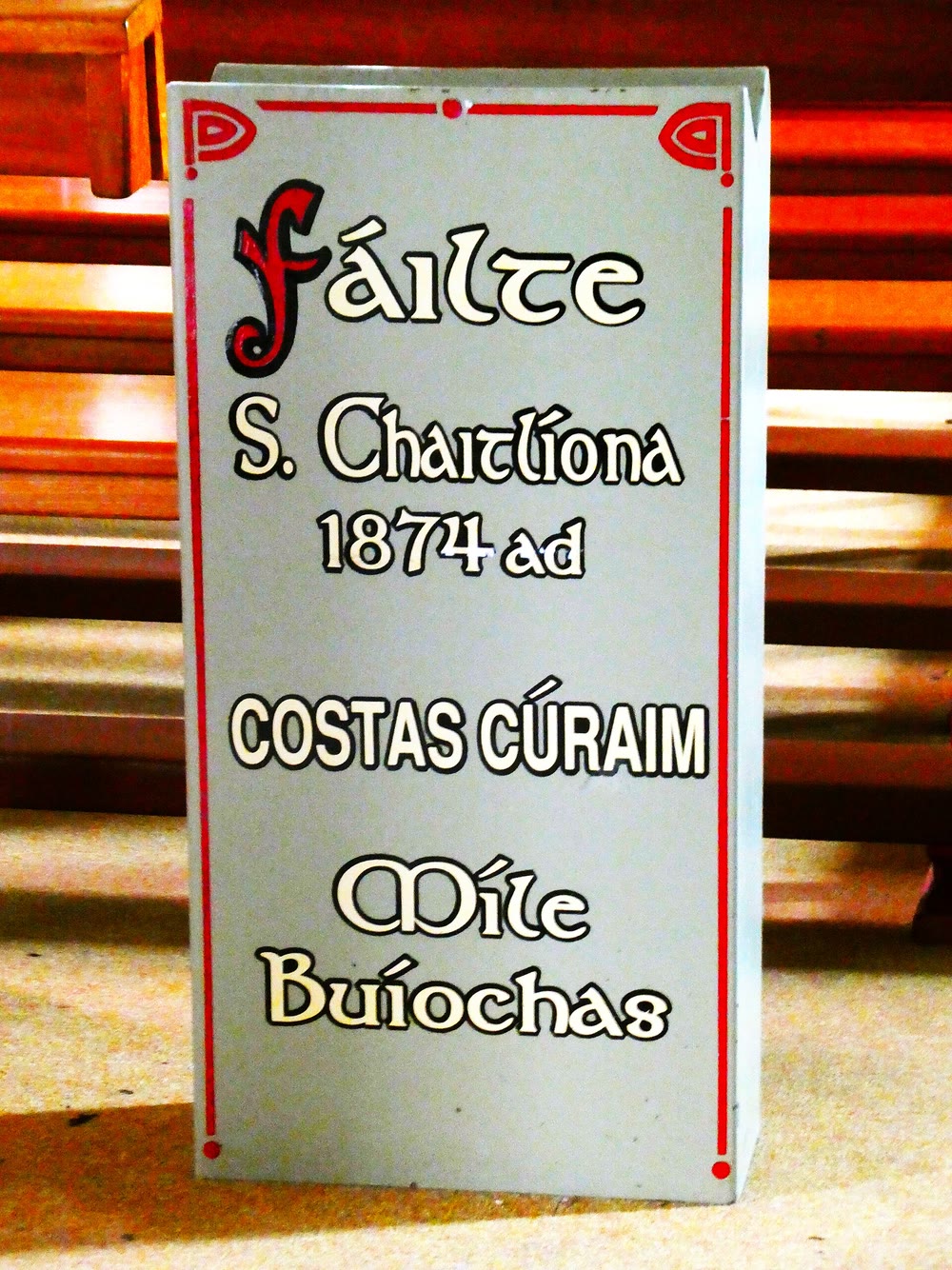
Fáilte (welcome) at the top and Míle Buíochas (a thousand thanks) at the bottom of a donations sign in the church at Ventry, on the Dingle Peninsula, Co. Kerry. Photo: Mucklagh, CC BY-SA 4.0, via Wikimedia Commons
- Tá mé an-bhuíoch díot (taw may an-WEEKH JEE-ut): I’m very grateful to you. Buíoch means grateful.
- Buíochas le Dia (BWEE-khus leh JEE-uh): thanks be to God.
- Ba mhaith liom buíochas a ghabháil le… (buh WAH lum BWEE-khus uh GHOW-awl leh): I’d like to thank… The opening for a speech, from a wedding to a retirement do.
Thank you for…: as and as ucht
To say what you’re thankful for, add as (oss), which means “for” here:
- Go raibh maith agat as do chabhair (oss duh KHOW-ir): thank you for your help.
- Go raibh míle maith agat as an mbronntanas (oss un MROON-tun-us): thanks a million for the present.
- Go raibh maith agaibh as teacht (oss CHAKHT): thank you all for coming.
After as an, the next word changes its first sound, so bronntanas becomes mbronntanas.
You’ll also meet as ucht (oss UKHT). Ucht literally means chest or breast, and as ucht means “for the sake of” or “on account of”. Ó Dónaill’s example is go raibh maith agat as ucht do chineáltais (oss UKHT duh HIN-awl-tish), thank you for your kindness, and focloir.ie gives míle buíochas leat as ucht an chúnaimh for “thanks for the help”. Both as and as ucht are correct.
How to reply: tá fáilte romhat and more
Focloir.ie lists three replies for “you’re welcome”, and Ó Dónaill adds a couple more.
| Irish | Say it | Meaning |
|---|---|---|
| Tá fáilte romhat | taw FAWL-chuh ROH-ut | You’re welcome. Literally “there’s a welcome before you”. |
| Tá fáilte romhaibh | taw FAWL-chuh ROH-iv | You’re welcome, to two or more. |
| Ná habair é | NAW HAB-ir ay | Don’t mention it. Literally “don’t say it”. |
| Go ndéana a mhaith duit | guh NYAY-nuh uh WAH ditch | You’re welcome. Literally “may it do you good”. |
| Níl a bhuíochas ort | neel uh WEE-khus urt | Don’t mention it. Roughly “you owe no thanks for it”. |
| Fáilte is fiche romhat | FAWL-chuh iss FIH-huh ROH-ut | You’re welcome twenty times over. |
Ó Dónaill’s own example is the simplest exchange: “Go raibh maith agat!” “Tá fáilte romhat!” Fáilte is the welcome of céad míle fáilte, and romhat is roimh (before) and tú (you) joined.
Munster, Connacht and Ulster pronunciation
Irish has three main dialects, named after provinces. Scholars who studied the Irish of Kerry, Cork, Waterford, Aran, Connemara and Donegal recorded the differences below; treat the respellings as rough.
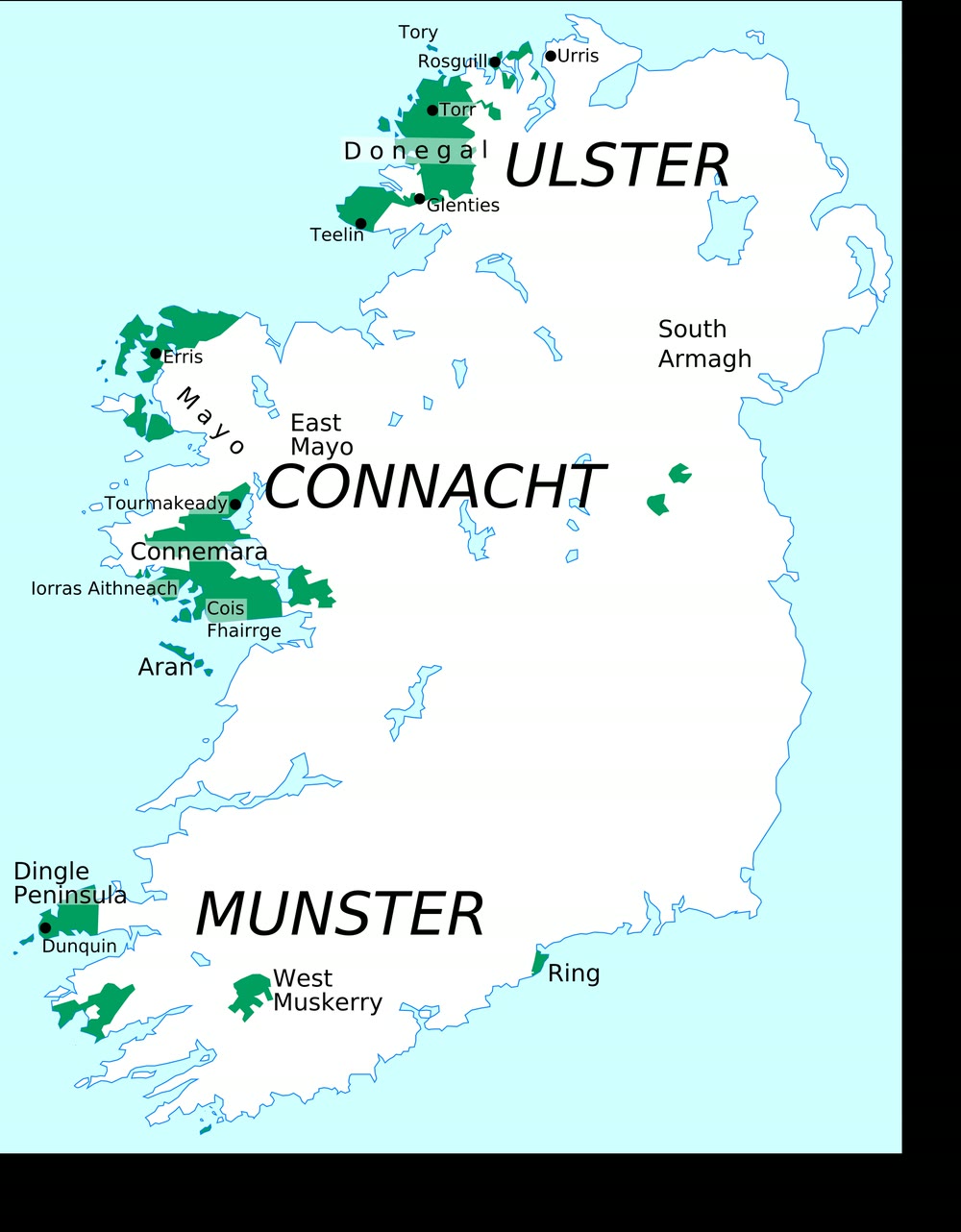
The main Gaeltacht (Irish-speaking) areas, with the provinces of Ulster, Connacht and Munster that give the three main dialects their names. Map: Angr, CC BY-SA 2.5, via Wikimedia Commons
Munster: Kerry, Cork and Waterford
- Agat and agaibh are stressed on the second syllable: guh rev MAH uh-GUT, and to a group, uh-GIV.
- In parts of Munster, such as the Ring Gaeltacht in Waterford, buíochas sounds more like BAY-khus, and older Munster writing sometimes spells it baochas.
- In West Cork’s Muskerry Gaeltacht, fáilte has been recorded closer to FAWL-huh.
Connacht: Galway and Mayo
- Raibh is often just “ruh” or “roh”, and maith is a plain MAH.
- Agat is often said agad, with a soft d, and in Connemara it can shrink to one syllable, “ahd”: guh ruh MAH ahd.
- Agaibh can sound like AG-ee, and romhat like ROOT.
Ulster: Donegal
- Donegal writers long spelled raibh as robh, which shows how it’s said: “roh”.
- Maith sounds more like English “my”, with a breathy end, and agat ends in a d: guh roh MY AG-ud.
- Buíochas has an extra little vowel: BWEE-ukh-us.
To hear real voices, teanglann.ie has recordings of maith, fáilte and buíochas in all three dialects, and abair.ie, from Trinity College Dublin, reads whole phrases aloud in synthetic voices based on the native dialects. More free tools are in my guide to learning Irish online.
Older ways to say thanks
Go raibh maith agat is itself a small wish, and some older ways of saying thanks call on God. These are in Ó Dónaill’s dictionary:
- Nár lagaí Dia thú (nawr LAG-ee JEE-uh hoo): may God not weaken you. Ó Dónaill gives it as “More power to you!”, and focloir.ie lists it under “thanks very much”.
- Go gcúití Dia leat é (guh GOO-chee JEE-uh lyat ay): may God reward you for it.
- Slán a bheidh tú (SLAWN uh VEH too): may you be well. Ó Dónaill’s example is tá mé go maith, slán a bheidh tú, “I am well, thank you”.
Thanks for charity even had its own name, altú na déirce (AL-too nuh JAYR-kuh), which Ó Dónaill translates as “thanksgiving for alms, beggar’s thanks”. In the late 1930s, a pupil at Baile Uí Dhuibhne school in Co. Kerry wrote one of these thanksgivings down, in Irish, for the Schools’ Collection.
In this version, the person given alms blesses the souls of the giver, the giver’s parents and seven ancestors, and asks God to free them of anything still held against them, such as a forgotten Mass. That’s a great deal of thanks for an act of charity.
How the Irish say thanks in English
Day to day, most Irish people say thanks in English, with a few habits of their own.
- Thanks a million. You’ll hear it constantly. It isn’t only Irish, but it matches go raibh míle maith agat so neatly that focloir.ie translates one with the other.
- Cheers. As in Britain, it’s a casual thanks as well as a toast. The Irish-language toast is sláinte, explained in my guide to how to say cheers in Irish.
“No bother” beats “you’re welcome”
The linguist Anne Barron, of Leuphana University Lüneburg, studied recorded conversations in public places in which a researcher asked people for directions and then thanked them. Irish people most often answered with “okay”, followed by “no problem” (or “no bother”) and “alright”. In her 2022 study, only 4.5% of the Irish speakers said “you’re welcome”, against 34.2% of the Canadians. An earlier questionnaire study by Klaus Schneider suggested that in Ireland, “you’re welcome” sounds formal.
Then there’s “you’re grand”, which can mean no harm done or no thanks, I’m sorted. More are in my guide to Irish slang words.
Thanking the driver
Irish people are known for thanking the bus driver as they get off. In 2015, Dublin Bus research found that 90% of its passengers always do, TheJournal.ie reported. Buses that let you out through the middle doors have made it harder: in June 2026, Emer McLysaght wrote in The Irish Times that she feels guilty for no longer saying thanks.
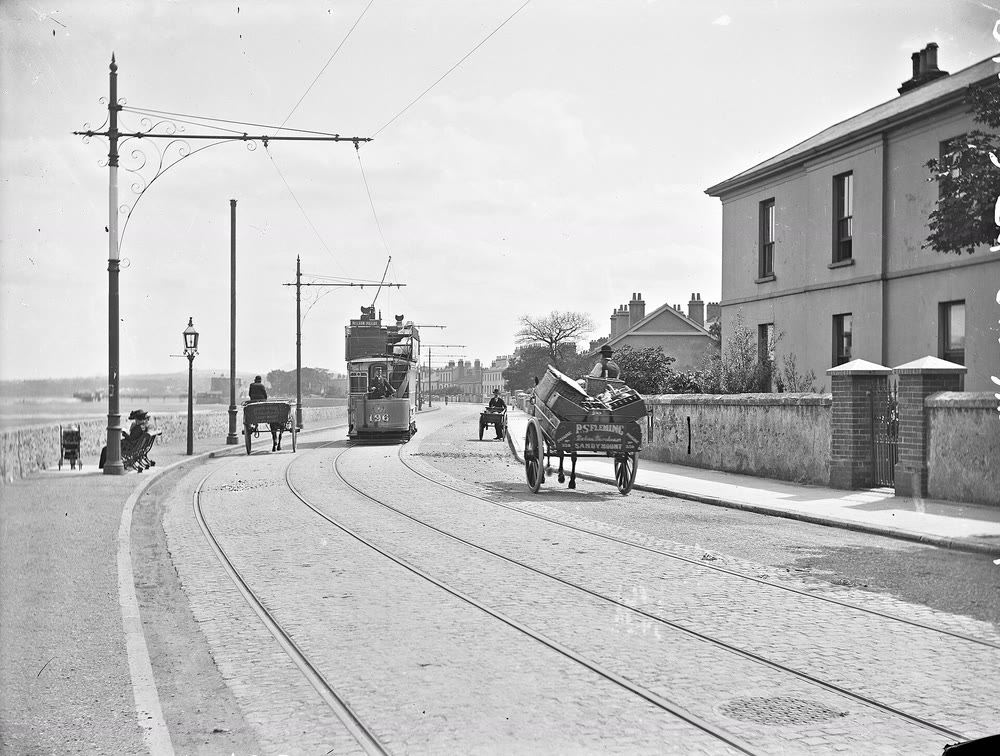
A tram on Strand Road, Sandymount, Dublin, photographed by Robert French between 1890 and 1910. Lawrence Collection, National Library of Ireland. No known copyright restrictions, via Wikimedia Commons
Thank-you card wording in Irish
A thank-you card is a cárta buíochais (KAWR-tuh BWEE-khish). Open with A chara (uh KHAR-uh), “Dear”, copy every fada exactly, and add the English underneath if the reader doesn’t have Irish.
- Go raibh míle maith agat as an mbronntanas álainn. (… AW-lin): Thanks a million for the lovely present.
- Go raibh míle maith agaibh as a bheith linn ar lá ár bpósta. (oss uh VEH lin er LAW ar BOHS-tuh): Thank you so much for being with us on our wedding day. For readings and toasts, see my Irish wedding blessings.
- Go raibh maith agat as ucht do chineáltais. Thank you for your kindness. A gentle line for thank-you notes after a funeral; for sympathy cards, see my Irish funeral blessings.
- Táimid an-bhuíoch díot as do chuidiú. (TAW-mij an-WEEKH JEE-ut oss duh KHID-yoo): We’re really grateful to you for your help. This one is focloir.ie’s own example.
- Go raibh míle maith agat, a Mhamó. (uh WAM-oh): Thanks a million, Granny. More in my guide to Irish names for grandma.
To sign off:
- Le buíochas (leh BWEE-khus): with thanks.
- Le buíochas ó chroí (leh BWEE-khus oh KHREE): with heartfelt thanks. Focloir.ie’s “with our sincere thanks” is le buíochas ó chroí uainn (OO-in), from us.
- Le grá agus buíochas (leh GRAW AG-us BWEE-khus): with love and thanks.
For Christmas cards, my guide to Merry Christmas in Irish has the greetings, with the same duit and daoibh rule for one person or many.
Happy Thanksgiving in Irish: Lá an Altaithe
Thanksgiving is an American holiday rather than an Irish one, but Irish has a name for it. The New English-Irish Dictionary gives Lá an Altaithe (law un AL-tuh-huh), the day of thanksgiving, for the US holiday, which falls on Thursday 26 November in 2026.
Altú, the root word, means thanksgiving and also grace at meals. My guide to Irish grace before meals has graces in Irish for the table, plus the story of the Choctaw Nation’s 1847 gift to Famine Ireland.
- Lá an Altaithe sona duit (law un AL-tuh-huh SUN-uh ditch): Happy Thanksgiving, to one person. It follows the same pattern as lá breithe sona duit, happy birthday.
- Lá an Altaithe sona daoibh (SUN-uh deev): Happy Thanksgiving, to everyone at the table.
- Táimid buíoch beannachtach as a bhfuil againn (TAW-mij BWEEKH BYAN-ukh-tukh oss uh wil AG-in): we’re very grateful for all we have. Focloir.ie’s own example, and a lovely line before the turkey.
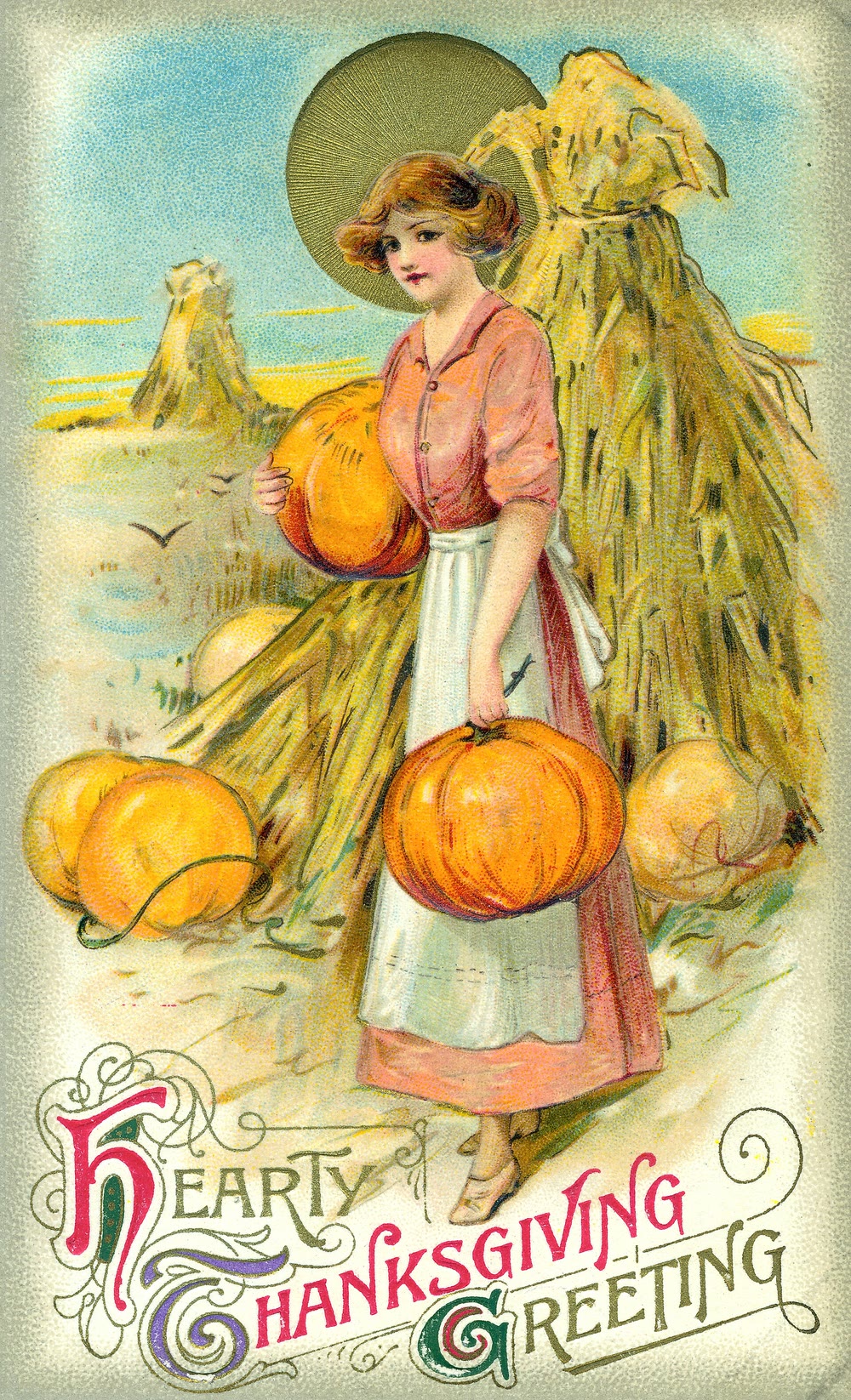
“Hearty Thanksgiving Greeting”, a postcard published by John Winsch in 1910. Missouri History Museum. Public domain, via Wikimedia Commons
If your family goes round the table saying what they’re grateful for, a child can manage this: Tá mé buíoch as… (taw may BWEEKH oss), I’m grateful for… Finish it with mo chlann (muh KHLAWN), my family, or mo chairde (muh KHAR-juh), my friends.
Common mistakes and the right spellings
- Go raibh maith agut, go ra mah agat: write go raibh maith agat.
- Mile buiochas, ta failte romhat: write míle buíochas and tá fáilte romhat, with every fada.
- Na habair e: write ná habair é. Without its fada, na is a different word, “the”.
- Mixing one and many: to a group, it’s go raibh maith agaibh as bhur gcuairt (oss wur GOO-irch), thank you for your visit. Signs sometimes say as do chuairt, but do (your) is for one person.
- Céad míle fáilte in reply to thanks: that’s the big welcome for someone arriving. To answer thanks, say tá fáilte romhat.
Thank you in Irish: FAQ
How do you say thank you in Irish?
Go raibh maith agat (guh rev MAH AG-ut), literally “may there be good at you”. To two or more people, say go raibh maith agaibh (AG-iv).
How do you pronounce go raibh maith agat?
Roughly guh rev MAH AG-ut. In Munster it’s closer to guh rev MAH uh-GUT, in Connemara guh ruh MAH ahd, and in Donegal guh roh MY AG-ud.
What do you say back to go raibh maith agat?
Tá fáilte romhat (taw FAWL-chuh ROH-ut), you’re welcome, or ná habair é (NAW HAB-ir ay), don’t mention it.
What is Irish slang for thank you?
In Irish, maith thú (MAH hoo) is a casual “good on you, thanks”, and GRMA is the text version. In Irish English, people say “thanks a million” or “cheers”, and answer with “no bother” or “you’re grand”.
How do you say thank you in Irish Sign Language?
Irish Sign Language (ISL) is a language of its own, recognised by the Irish Sign Language Act 2017, and the Irish Deaf Society says its signs aren’t the same as American or British signs. To see thank you, watch the society’s short ISL video, or join one of its ISL classes.
How do you say thank you in Scottish Gaelic?
Tapadh leat (roughly TAH-puh let) to a friend, and tapadh leibh to a group or to someone you’d address politely. Mòran taing means many thanks. In southern Argyll and on Arran, the Gaelic scholar Richard Cox notes, the usual thanks was gun robh math agad, the same wish as the Irish.
How do you say Happy Thanksgiving in Irish?
Lá an Altaithe sona duit (law un AL-tuh-huh SUN-uh ditch), or Lá an Altaithe sona daoibh (deev) to a group.
Love this? Save it to your Pinterest board for later.
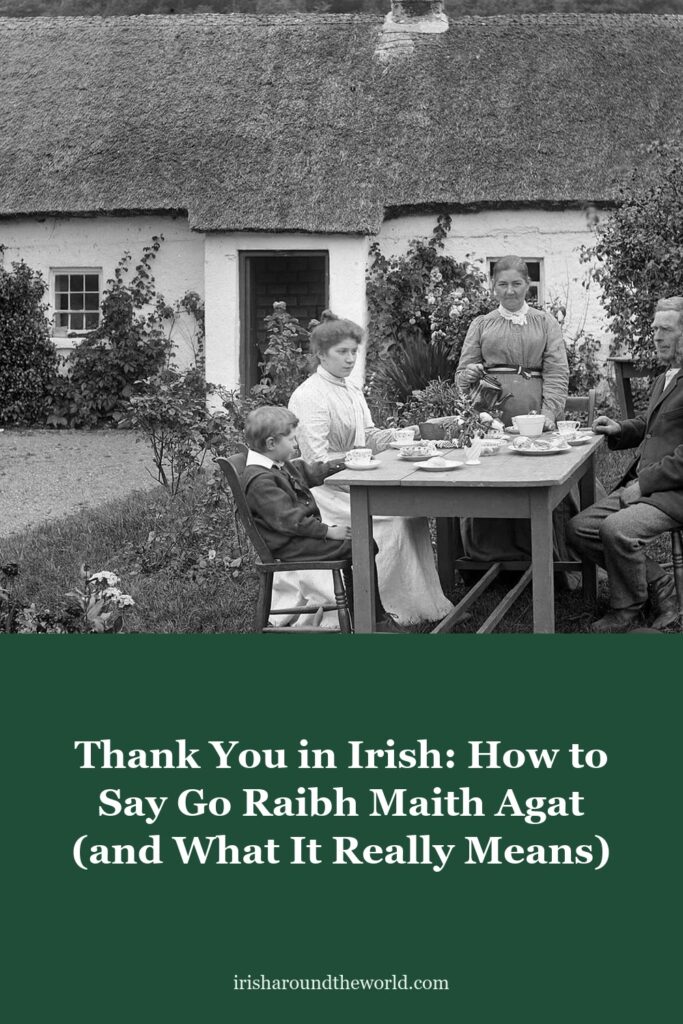
Pin image: Tea at the Glencar tea house, on the Sligo and Leitrim border, around 1900. Lawrence Collection, National Library of Ireland. No known copyright restrictions, via Wikimedia Commons
A little bit of Ireland in your inbox every Friday ☘️
The free Weekly Dose of Irish: an Irish joke, a Celtic symbol, an Irish fact, a poem and the week’s best articles in one short email. Join 9,600+ readers.
Free. One short email every Friday. Unsubscribe any time.
More Irish language reading
- 25 Irish Greetings and Birthday Wishes (With Pronunciation)
- How to Say Cheers in Irish: Sláinte, Meaning and Pronunciation
- I Love You in Irish: How to Say It, 27 Pet Names and the Film That Misspelled One
- Irish Grace Before Meals: Table Blessings in Irish and English, and Where They Really Come From
- Good Luck in Irish: Ádh Mór, Go nÉirí Leat and 30 Ways to Wish Someone Luck
- Merry Christmas in Irish: How to Say Nollaig Shona Duit (Plus 35 Christmas Words)
Featured image: Tea at the Glencar tea house, on the Sligo and Leitrim border, around 1900. Lawrence Collection, National Library of Ireland. No known copyright restrictions, via Wikimedia Commons.