The Vikings in Ireland were Norse seafarers whose first recorded raid, on an island off the Irish coast, came in 795. From 841 they built fortified ship camps, among them Dublin. Their bases at Dublin, Waterford, Wexford, Limerick and Cork grew into Ireland’s first towns, trading in silver, goods and slaves. By about 1000 they were Christian and closely tied to the Irish. They left place names like Wicklow and Howth, Irish words like fuinneog (window), and surnames like McAuliffe.
Every time an Irish speaker asks you to open the fuinneog, they’re using a word the Vikings brought. Fuinneog (roughly FWIN-yohg; fwin-YOHG in Munster) is the Irish for window. The Electronic Dictionary of the Irish Language (eDIL) traces it to Old Norse vindauga, the “wind-eye”, the same Norse word that gave English window.
The Vikings came as raiders at the end of the 8th century and stayed as traders, slavers, kings and, in time, in-laws.
I’ve told the story of Clontarf in my post on Brian Boru. Here’s the bigger picture: the raids, the towns, the slave trade, Wood Quay, the Norse words and names still with us, and the DNA claims.
Jump to:
- Who were the Vikings in Ireland?
- The first raids, from 795
- Dublin and the ship camps of 841
- Waterford, Wexford, Limerick and Cork
- Slaves, silver and trade
- Clontarf, 1014: the short version
- The Hiberno-Norse
- Wood Quay: the dig that found Viking Dublin
- What the Vikings left behind
- Where to see Viking Ireland today
- Viking facts for kids
- Vikings in Ireland FAQ
- More Irish history reading
Who were the Vikings in Ireland?
They were Norse seafarers from Scandinavia, many arriving by way of Viking bases in Scotland and the northern isles. The monks who kept the Annals of Ulster mostly called them heathens or foreigners.
The Irish word was gall (roughly GAHL; closer to GOWL in Munster), a foreigner. In history it meant a Norseman, and later a Norman or an Englishman, Ó Dónaill’s dictionary notes. In modern Irish a Viking is a Lochlannach (LUKH-lun-ukh) or an Uigingeach (roughly IG-ing-ukh), says focloir.ie. Lochlannach comes from Lochlann, an old name for Norway or Scandinavia.
The first raids, from 795
The first recorded attack comes in the Annals of Ulster for 795, when heathens burned Rechru. That was probably Rathlin Island off Co. Antrim, though some historians argue for Lambay, off the north Dublin coast.
More raids followed. Across the sea, Iona was burned in 802, and by 807 a new monastery of St Columba was being built at Kells, part of the story of the Book of Kells. In 821 raiders at Howth took many women captive, and in 824 the monk Étgal was taken from Skellig Michael and died of hunger and thirst.
Why monasteries? They held valuables and, above all, people to sell as slaves, says the National Museum of Ireland. By 837 fleets of 60 ships were on the Boyne and the Liffey. Irish kings raided churches too, as I explain in my post on Irish round towers.
A monk’s poem about the Vikings
In the mid-9th century, scribes probably at Nendrum or Bangor, Co. Down, copied a Latin grammar now kept in St Gallen, Switzerland. In its margin one wrote a short poem beginning Is acher in gáith in-nocht. Whitley Stokes and John Strachan’s 1903 translation reads:
“Bitter is the wind to-night: it tosses the ocean’s white hair: I fear not the coursing of a clear sea by the fierce heroes from Lothlend.”
On a night that wild, no raiders would cross the sea. Lothlend is an older form of Lochlann, but the National Museum thinks it probably meant Viking Scotland here.
Dublin and the ship camps of 841
In 841 the annals record a longphort, a ship camp, at Duiblinn, and another at Linn Duachaill, near Annagassan, Co. Louth. Longphort (roughly LUNG-fort) joins Old Irish long (ship) and port, eDIL explains.
The Vikings didn’t invent the place: the annals record an abbot of Duiblinn in 790. Dublin comes from Dubh Linn (DUV lin; dubh sounds closer to “doo” in Connacht and Ulster), the black pool. The Office of Public Works says the pool lay at or near today’s Dubh Linn Garden at Dublin Castle, where the Vikings kept their ships.
The Irish name, Baile Átha Cliath (roughly BAL-yuh AW-huh KLEE-uh, often just “blah KLEE-uh”), means the town of the ford of hurdles. Online it’s often misspelt without fadas, as Baile Atha Cliath.
Some may have come earlier. Four young men buried with Viking weapons under South Great George’s Street gave radiocarbon dates the excavator, Linzi Simpson, called “impossibly early” in Archaeology magazine, though such ranges are wide.
West of the town, at Kilmainham and Islandbridge, 19th-century railway builders dug into what the Irish Museum of Modern Art calls the largest Viking graveyard outside Scandinavia. Men lay with fine swords, and scales and weights suggest some were merchants. Pairs of oval brooches show Scandinavian women were buried there too, says the National Museum.
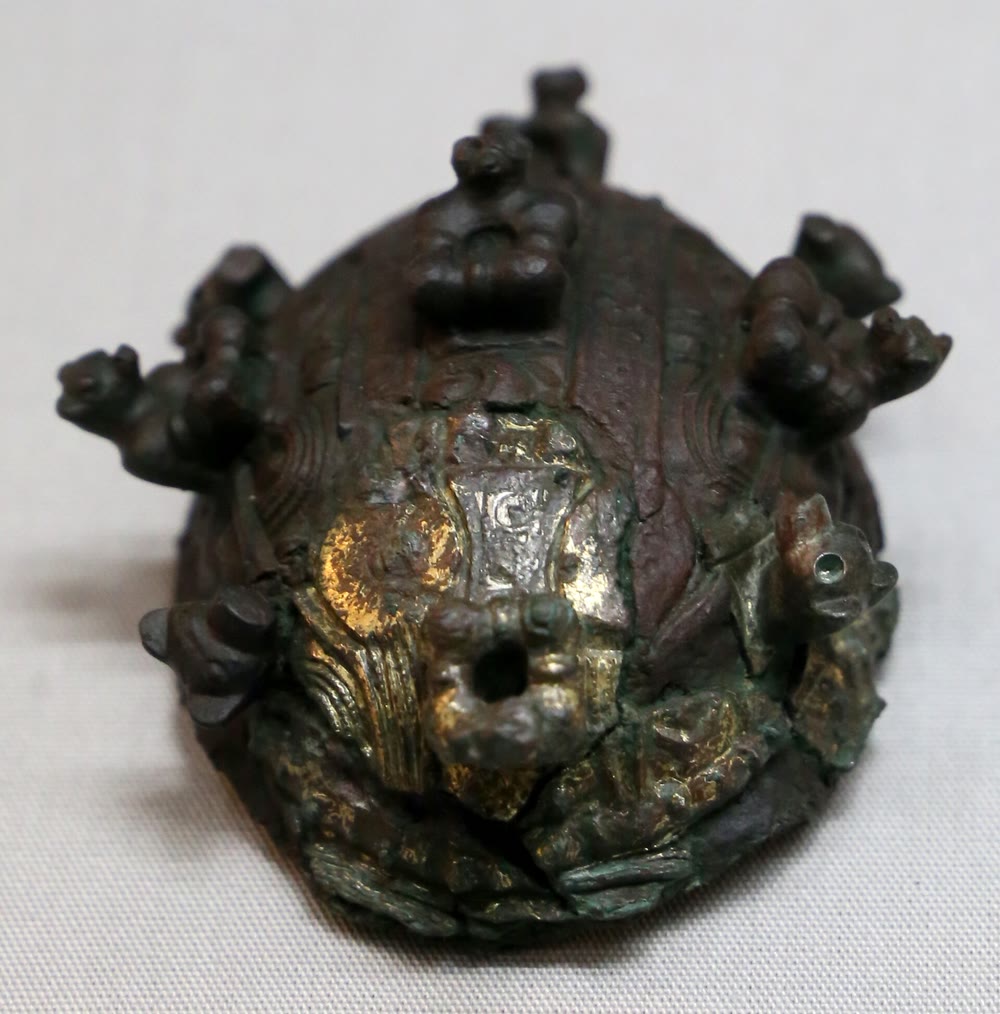
One of a pair of Viking oval brooches from Finglas, Co. Dublin, about 850 to 900, in the National Museum of Ireland. Photo: Sailko, CC BY 3.0, via Wikimedia Commons
Tuirgéis: the annals and the legend
The Annals of Ulster say that in 845 the Viking leader Tuirgéis camped on Lough Ree and burned Clonmacnoise. That same year Máel Sechnaill, king of Meath, captured him and drowned him in Loch Uair, usually identified as Lough Owel, Co. Westmeath.
By the 1180s Gerald of Wales had a better story. His Turgesius ruled all Ireland and wanted the king of Meath’s daughter. The king promised her, with 15 maidens, on a lake island, then sent 15 beardless young men in dresses, with daggers, who killed him. The annals know nothing of it.
Expelled, and back again
In 902 the men of Brega and Leinster drove the Norse out of Dublin. They returned in 917 under Sitriuc, grandson of Ímar, and in 919 killed the high king, Niall Glúndub, in battle there. Fr Patrick Woulfe traced the Ulster O’Neills to Niall (see my Niall of the Nine Hostages post).
Waterford, Wexford, Limerick and Cork
In the 10th century, Viking bases such as Dublin, Waterford, Wexford, Limerick and Cork became Ireland’s first towns, the National Museum says, though the country stayed overwhelmingly rural.
Waterford
In 914 the annals note a great new heathen fleet in Waterford Harbour. Waterford dates its founding to that year and calls itself Ireland’s oldest city. Dublin’s camp is older, but its Vikings were expelled from 902 to 917.
The Irish name, Port Láirge (roughly purt LAW-rig-uh), means Lárag’s port, and nobody knows who Lárag was. It’s often misspelt online as “Port Lairge”, without the fada.
Reginald’s Tower was built where a timber Viking fort once stood, says the Office of Public Works, though the stone tower itself is Anglo-Norman. Waterford Treasures, the city’s museums, names it after Waterford’s Viking founder; a Ragnall did lead the Waterford fleet in 918, but the link rests on tradition.
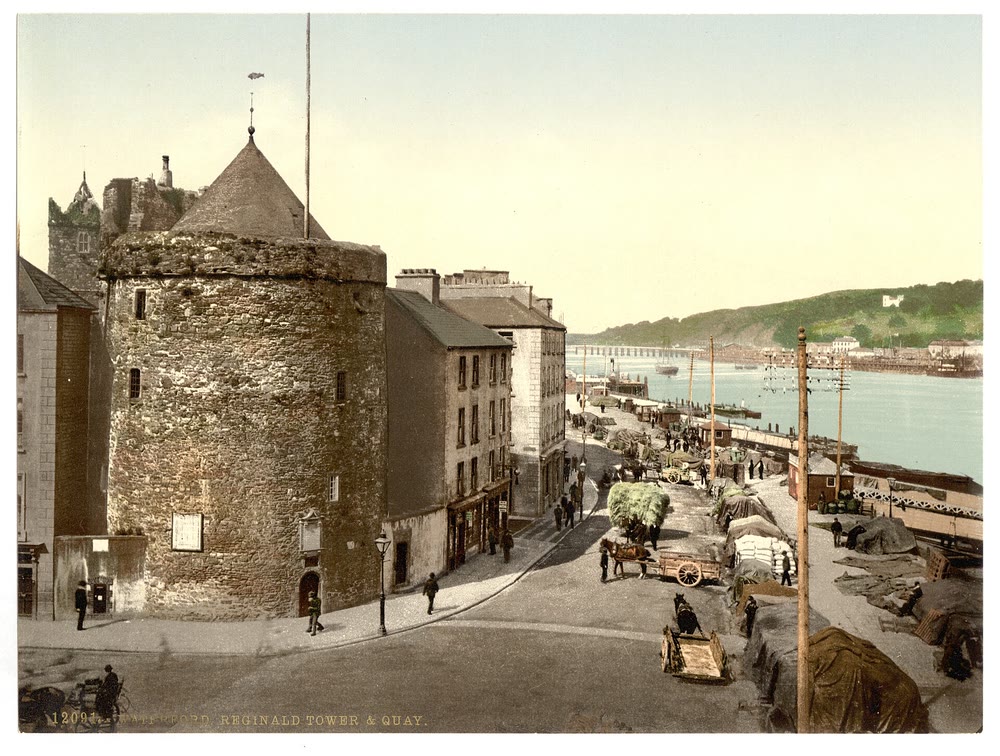
Reginald’s Tower and the quay at Waterford, a photochrom print published by the Detroit Publishing Co. before 1905. Library of Congress. Public domain, via Wikimedia Commons
Wexford, Limerick and Cork
Wexford has the thinnest early record. The Annals of Ulster name its foreigners beside Dublin’s and Waterford’s in 1088, and the Anglo-Normans took the town in 1169.
Limerick saw Viking activity in the 9th century, but the permanent settlement seems to date from 922, under Tamar mac Ailche, says Denmark’s Viking Ship Museum. That year its fleet raided Clonmacnoise. Brian Boru’s brother Mathgamain sacked the town in 967, and in the late 11th century the O’Brien kings made it their capital.
Cork, from Corcach (KUR-kukh), a marsh, and Corcaigh (KUR-kee) in Irish today, was burned by heathens in 839, say the annals. In 2018 Archaeology magazine reported 19 Viking houses of the 11th and 12th centuries at the old Beamish and Crawford brewery. The lead archaeologist, Maurice Hurley, noted that Dublin’s and Waterford’s Norse origins are better proven than Cork’s, but saw a shared culture in all three. There’s more in my facts about Cork.
Slaves, silver and trade
Slavery existed in Ireland long before the Vikings; St Patrick came as a captive. But big slave raids aren’t recorded in the hundred years before they arrived, the historian Clare Downham writes in History Ireland.
When Armagh was plundered in 869, a thousand people were killed or taken. In 871 the Dublin leaders Amlaíb and Ímar returned from Scotland with 200 ships and many captive English, Britons and Picts. Kings and bishops were seized and, it seems, ransomed; others were sold through the ports.
Irish kings joined in, Downham notes. Yet when a later Máel Sechnaill stormed Dublin in 980, he was credited with freeing all its Irish slaves. DNA studies suggest many captives ended up in Iceland. A church council in London banned selling people in England in 1102, and in 1171 the clergy of Ireland, meeting at Armagh, declared English slaves in Ireland free.
Viking traders brought silver from as far as the Islamic and Byzantine worlds, and in Ireland it was melted into brooches and arm-rings, says the National Museum. Around 997 or 998, Dublin under Sitriuc Silkbeard struck the first coins made in Ireland, silver pennies.
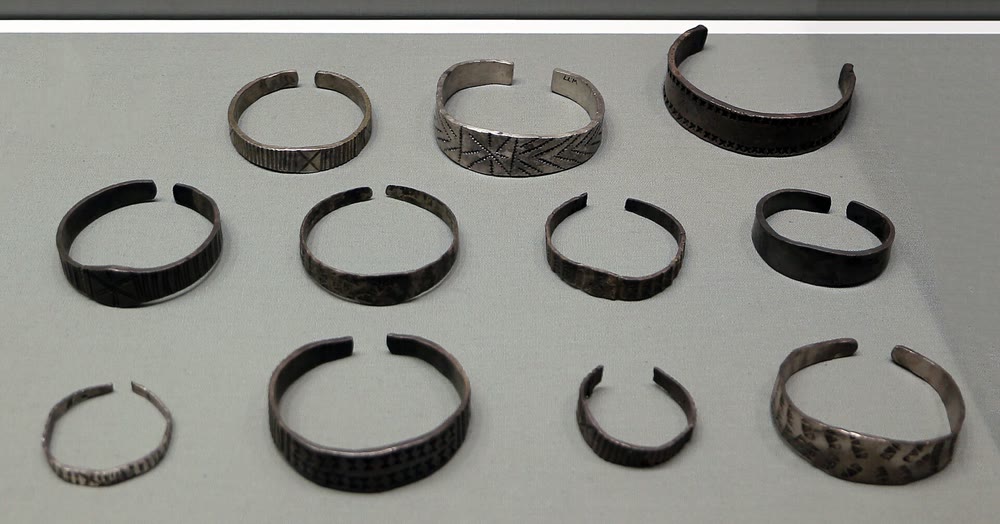
Viking silver arm-rings found in Ireland, 9th to 10th century, in the National Museum of Ireland. Photo: Sailko, CC BY 3.0, via Wikimedia Commons
Clontarf, 1014: the short version
On Good Friday, 23 April 1014, the army of Brian Boru, high king of Ireland, met the men of Leinster, the Dublin Norse and Viking allies from overseas at Clontarf. Brian’s side won, but Brian was killed.
Later legend made it the Irish against the Vikings, but there were Irish kings on both sides, and Brian had already beaten Dublin and Leinster at Glenn Máma in 999. Nor did Clontarf end Viking Ireland: the towns carried on for another 150 years.
The Hiberno-Norse
Ireland’s Vikings had become Christian by about 1000, and by then their belongings are often hard to tell from Irish ones, says the National Museum. Historians call the people of the later Viking towns Hiberno-Norse.
In 1028 Sitriuc Silkbeard, king of Dublin, went to Rome. Christ Church Cathedral says its first church was founded around then by Sitriuc and Dublin’s first bishop, Dúnán.
Tree rings show that Skuldelev 2, a 60-oared warship raised from Denmark’s Roskilde Fjord, was made of oak near Dublin about 1042. Its replica, the Sea Stallion from Glendalough, sailed to Dublin in 2007, as I tell in my Glendalough post.
In 1052 a king of Leinster took Dublin’s kingship himself, and in 1170, the annals say, Dermot MacMurrough and the men he brought from overseas destroyed Dublin. The Anglo-Norman age had begun.
Wood Quay: the dig that found Viking Dublin
Dublin’s wet, airless ground preserved what usually rots: wood, wattle, leather and cloth. From 1974 to 1981 the National Museum, led by Pat Wallace, excavated four acres at Wood Quay, beside Christ Church.
Current Archaeology counts more than 120 houses on Fishamble Street alone, and calls them the best-preserved 10th and 11th-century houses anywhere in Europe west of the Elbe. Digs here and nearby found workshops, timber paths, latrines and thousands of objects.
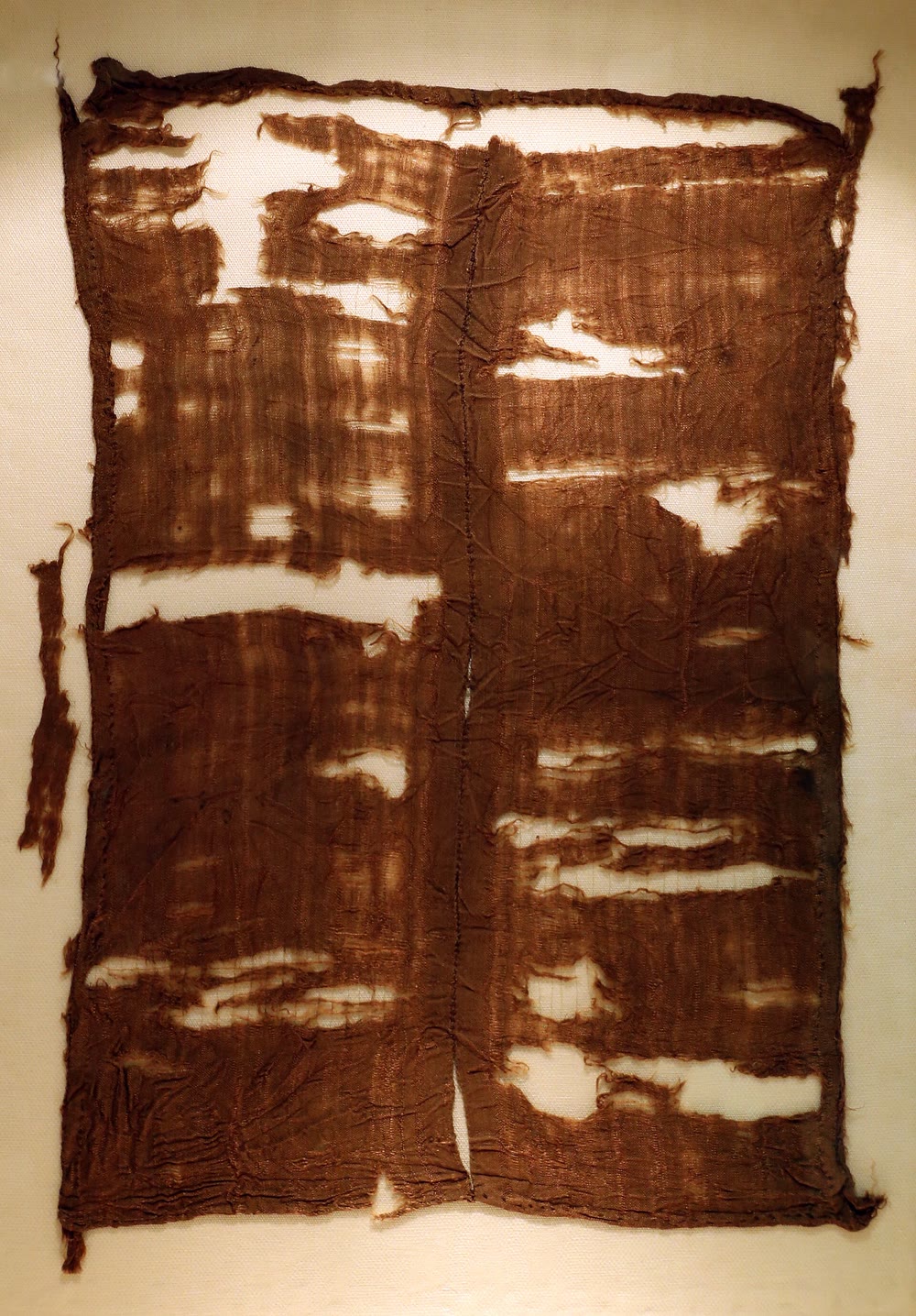
A silk head covering from Fishamble Street, Dublin, about 990 to 1010, in the National Museum of Ireland. Photo: Sailko, CC BY 3.0, via Wikimedia Commons
Dublin Corporation had chosen the site for its new offices in 1961. On 23 September 1978 about 20,000 people marched to “Save Wood Quay”, History Ireland records. The site was declared a national monument that year, but planning permission was granted on appeal in 1979.
On 1 June 1979 protesters occupied the site in “Operation Sitric”, named after Sitriuc Silkbeard; 52 held it until a Supreme Court ruling forced them out on 21 June. Digging went on until March 1981, and the Civic Offices opened in 1986.
What the Vikings left behind
Norse place names
About 30 Scandinavian place names in Ireland can be verified, says the official Placenames Database of Ireland, though a History Ireland article argues the real total may be three times that. The best known:
- Wicklow: Irish Cill Mhantáin (kill WAN-tawn), St Mantán’s church. John O’Donovan called the English name “Danish” in the 1830s. It probably ends in Norse ló, a meadow, as Arklow seems to, giving the popular but debated “Vikings’ meadow”.
- Wexford: Irish Loch Garman (lukh GAR-mun). The English comes from the Norse settlement’s name, Waesfjord, says Britannica; fjǫrðr means a fjord or inlet.
- Waterford: from Norse Veðrafjǫrðr, either the fjord of the rams or the weather-sheltered fjord; writers disagree.
- Leixlip: Irish Léim an Bhradáin (laym un VRAD-awn), the salmon’s leap, which is also what lax hlaup means. Who coined the English name is debated; the Placenames Database leans towards the Anglo-Normans, not the Vikings.
- Howth: Irish Binn Éadair (bin AY-dir), Éadar’s peak, the Étar raided in 821. An 1837 Ordnance Survey note calls the English name “Danish”, meaning Norse, for a head or promontory.
Norse words in Irish
Irish took in dozens of Norse words, mostly about ships, the sea and trade. Each of these is checked against eDIL:
- fuinneog (FWIN-yohg), window: Norse vindauga.
- stiúir (roughly SHTYOOR), rudder; also to steer: Norse stýri.
- bád (bawd), boat: Old English bát or, more probably, Norse bátr.
- trosc (trusk), cod: Norse þorskr.
- margadh (MAR-guh), market: Latin mercatus, via Norse.
- garraí (GAR-ee), garden: Norse garðr, an enclosure.
- beoir (byohr), beer: a Norse loan.
- iarla (EER-luh), earl: Norse jarl, in the annals by the 840s.
- cnaipe (KNAP-eh; KRAP-eh in Connacht and Ulster), button: Norse knappr, or possibly Old English.
Popular lists also give pingin (PING-in), penny, and scilling (SHKIL-ing), shilling, but eDIL links both to Old English instead. Its free entry for fuinneog (fuindeóc in older Irish) is a good place to start.
Surnames with Norse roots
The Norse in Ireland took Irish-style surnames. Fr Patrick Woulfe’s Irish Names and Surnames (1923) lists:
- McAuliffe, Mac Amhlaoibh (roughly mok OW-leev), son of Olaf.
- Cotter, Mac Oitir, son of Ottar, an old family of Carrigtwohil near Cork.
- McManus, Mac Maghnusa, from Magnus, a name Woulfe says the Northmen took up in honour of Charlemagne.
- Doyle, Ó Dubhghaill, descendant of Dubhghall, the dark foreigner.
A Norse name doesn’t prove Viking blood, though. Woulfe says the Cork MacAuliffes were a branch of the Gaelic MacCarthys. There’s more in my guide to Irish surnames.
Do Irish people have Viking DNA?
Some, but less than the legends suggest. In 2006 Trinity College Dublin geneticists found little Scandinavian Y-chromosome ancestry in Irish men with supposedly Norse surnames, or in the wider population. That fits fairly few Norse settlers, they suggested, and Norse towns that may have been largely Irish.
The Irish DNA Atlas (2017) found surprising “Norwegian-like” ancestry across Ireland and a mixing event around the Viking period. But it could give only an upper limit, about 20 per cent, and no lower one. So if a home test calls part of you Scandinavian, read it as an estimate; my guide to ancestry DNA kits explains why.
Where to see Viking Ireland today
Checked in October 2026; prices and hours change, so check before you go. For more of the city, try my guide to things to do in Dublin.
- National Museum of Ireland, Kildare Street, Dublin: the permanent Viking Ireland exhibition is free, with finds from the museum’s Dublin excavations at its centre.
- Dublinia: Viking and medieval Dublin in the old Synod Hall, with finds on loan from the National Museum. Daily 10:00 to 17:00 (last entry 16:00); adults €18 at the door, €16 online. You leave by the stone bridge that leads to Christ Church Cathedral.
- Dublin Castle: the Dubh Linn Garden, and the Viking Excavation, a stretch of Viking Dublin’s defences. Tickets from €8; check which tour includes the excavation.
- Reginald’s Tower, Waterford: an exhibition on Viking Waterford. Adults €5; 9:30 to 17:00 (last entry 16:15), and only Wednesday to Sunday from December to March.
- Irish National Heritage Park, Ferrycarrig, Co. Wexford: 16 reconstructed historic sites, including a Viking ship.
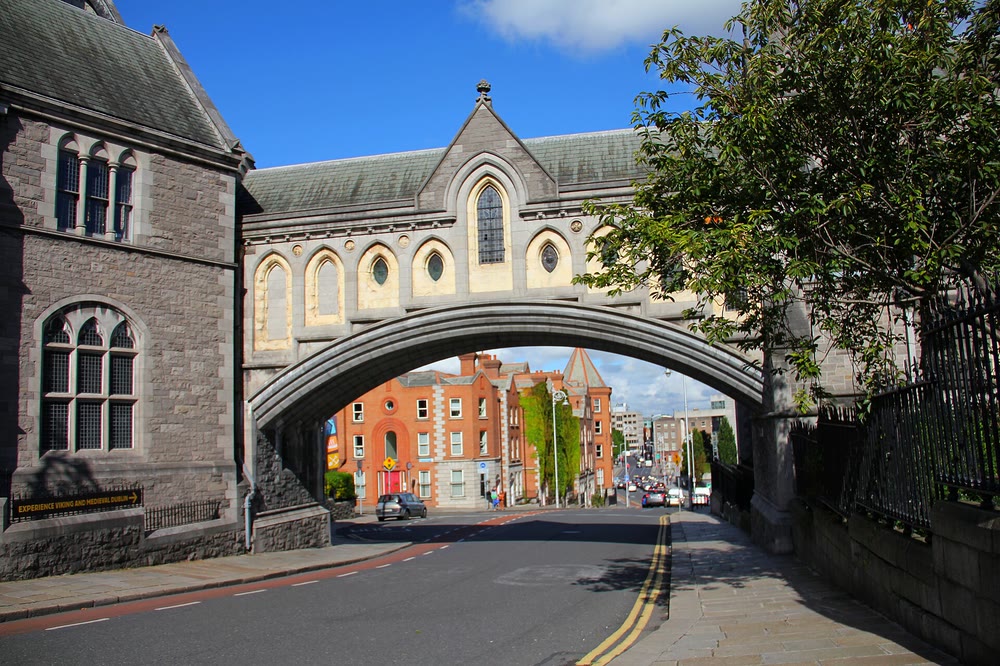
The stone bridge linking Christ Church Cathedral to the former Synod Hall, now Dublinia. Photo: J.-H. Janßen, CC BY-SA 3.0, via Wikimedia Commons
Viking facts for kids
- The first Viking raid written down in Ireland was in 795.
- In 841 the Vikings made a ship camp at Dublin. Dublin means “black pool”.
- The Vikings started Ireland’s first towns: Dublin, Waterford, Wexford, Limerick and Cork.
- Viking houses in Dublin had walls of woven sticks called wattle.
- Archaeologists in Ireland have found little wooden toy ships and board games from Viking times.
- The first coins made in Ireland were silver pennies, struck in Dublin around 997 for a Viking king called Sitriuc Silkbeard.
- The Irish word for window, fuinneog, comes from a Viking word meaning “wind-eye”.
Vikings in Ireland FAQ
When did the Vikings come to Ireland?
The first recorded raid was in 795. From 841 they built fortified camps, including Dublin.
Did the Vikings found Dublin?
They founded the town. There was already a church at Duiblinn and a ford, Áth Cliath (aw KLEE-uh), but the Viking camp of 841 grew into one of Ireland’s first towns.
Where did the Vikings in Ireland come from?
Scandinavia, mainly Norway as far as we can tell, often by way of Scotland and the isles.
Did the Battle of Clontarf drive the Vikings out of Ireland?
No. Brian Boru’s army won in 1014, but he was killed, and the Norse towns lasted until the Anglo-Normans took Wexford, Waterford and Dublin in 1169 and 1170.
What is the Irish word for Viking?
Lochlannach (LUKH-lun-ukh), plural Lochlannaigh (LUKH-lun-ee), or Uigingeach. Medieval writers more often said Gaill, the plural of gall, a foreigner.
Do Irish people have Viking DNA?
Some do, but studies suggest the Norse share is modest and hard to pin down.
Love this? Save it to your Pinterest board for later.
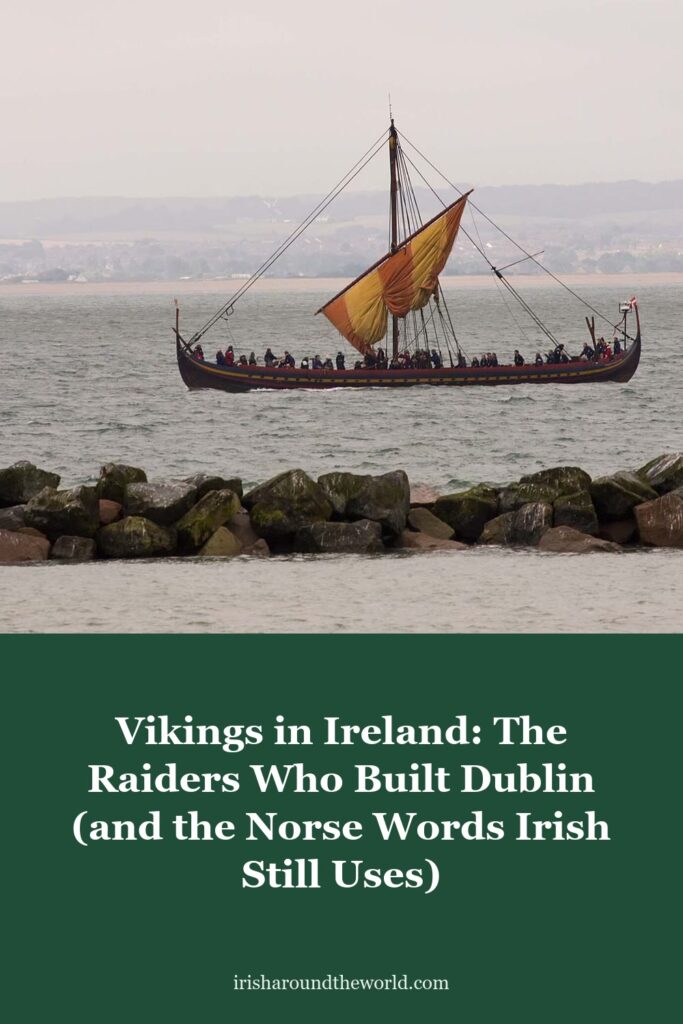
Pin image: The Sea Stallion from Glendalough, a replica of Skuldelev 2, a Viking warship built near Dublin around 1042, lowering its sail off Ramsgate, England, in July 2008. Photo: Smudge 9000, CC BY 2.0, via Wikimedia Commons
A little bit of Ireland in your inbox every Friday ☘️
The free Weekly Dose of Irish: an Irish joke, a Celtic symbol, an Irish fact, a poem and the week’s best articles in one short email. Join 9,600+ readers.
Free. One short email every Friday. Unsubscribe any time.
More Irish history reading
- Brian Boru: The High King Who Died at Clontarf on the Day His Army Won
- Glendalough: The Hermit Saint, a Blackbird and Ireland’s Valley of Two Lakes
- Irish Round Towers: Bell Towers, Viking Hideouts or Fire Temples? The Real Story
- The Book of Kells: How Ireland’s Greatest Treasure Was Made, Stolen and Saved
- Irish Surnames: Meanings, Origins and the Top 100 Names in Ireland
- Niall of the Nine Hostages: The King Who Kissed a Hag, and the 3 Million DNA Claim
Featured image: The Sea Stallion from Glendalough, a replica of Skuldelev 2, a Viking warship built near Dublin around 1042, lowering its sail off Ramsgate, England, in July 2008. Photo: Smudge 9000, CC BY 2.0, via Wikimedia Commons.