Glendalough, Gleann Dá Loch in Irish, means the glen of two lakes. In this glacial valley in the Wicklow Mountains, St Kevin lived as a hermit in the sixth century, and the monastery he founded became one of Ireland’s great monastic towns. Its round tower, about 30 metres tall, still stands among the ruined churches. Today the valley is part of Wicklow Mountains National Park. The ruins and lakes are free to explore, with easy lakeside paths and tougher mountain walks.
Picture a man kneeling in a tiny cell, one arm stretched out through the window. A blackbird lands on his open palm, makes a nest there and lays her eggs. He doesn’t move until the chicks have hatched.
That’s the best-known story about St Kevin of Glendalough, written down by the 1180s. The valley where he prayed is real, and so are the churches and the tall stone tower that grew up around his memory.
I’ve written about another monastery at the edge of the world, Skellig Michael. Glendalough is its greener cousin. Here’s the saint, his legends, the ruins, the walks and how to visit.
Jump to:
- What is Glendalough?
- Who was St Kevin?
- The legends of St Kevin
- The monastic city: what to see
- Vikings, raiders and fires
- The 1214 merger with Dublin and the long decline
- Walks: the lakes, the Spinc and the Miners’ Village
- Visiting Glendalough
- Glendalough FAQ
- More Irish heritage reading
What is Glendalough?
Glendalough is the English form of Gleann Dá Loch (roughly glan daw LOKH; in Munster Irish, gleann sounds closer to “glown”), the glen of two lakes. Most English speakers say glen-duh-LOKH.
The Upper Lake and the Lower Lake lie in a valley carved by glaciers. St Kevin founded his monastery here at the end of the sixth century, says the National Monuments Service, and Victorian visitors often called the place the Seven Churches.
The Office of Public Works (OPW) has cared for the ruins since 1875. Since 1991 the valley has been part of Wicklow Mountains National Park, Ireland’s largest land-based national park.
Who was St Kevin?
In modern Irish, Kevin is Caoimhín (KEE-veen, or kwee-VEEN in Munster). The Old Irish form, Cóemgen, means “comely birth”, according to Rev. Patrick Woulfe’s Irish Names and Surnames (1923). There’s more on saying it in my guide to pronouncing Irish boy names.
Almost everything we know comes from his Lives, in Latin and Irish, written long after his death and packed with miracles. They make him a well-born Leinsterman, taught by older monks, who fled to the head of the valley to live alone. The Latin Life has him sheltering at first in a hollow tree beside the lake. Tradition gives him seven years as a hermit before followers found him and a monastery grew.
The Annals of Ulster record his death in 618, with 622 as an alternative date. The Annals of the Four Masters say he died on 3 June, aged 120. The scholar Charles Plummer took figures like that as a sign, at least, of a long life.
His feast day is 3 June, and he’s one of the patron saints of the Catholic Archdiocese of Dublin.
The legends of St Kevin
These are legends, not history, but they show what people loved about him.
The blackbird in his hand
Gerald of Wales, the Welsh churchman who toured Ireland in the 1180s, tells it in his Topography of Ireland. One Lent, Kevin withdrew to a little hut in the wilderness. As he prayed with his hand stretched through the window towards heaven, a blackbird settled on his palm and laid her eggs there. Rather than close his hand, Kevin held it open until the young had hatched.
Gerald added that pictures of Kevin all over Ireland showed him “with a blackbird in his extended hand”, in Thomas Forester’s 1863 translation. The Irish for blackbird is lon dubh (roughly lun DUV; in Connacht and Ulster, dubh sounds closer to “doo”).
In the 1930s, a Glendalough pupil told the Schools’ Collection it happened in Reefert Church. Seamus Heaney retold it in his 1995 Nobel lecture and his poem St Kevin and the Blackbird (1996).
The angel who offered to move the mountains
In the Latin Life, an angel tells Kevin to move his monks to a site east of the lower lake, where a great city will grow. God, the angel adds, will turn the four mountains around the valley into gentle, fertile fields.
Kevin says no. He doesn’t want God’s creatures moved for his sake, and the wild animals of these mountains are tame with him and would be sad. It’s why the National Monuments Service calls him one of Ireland’s earliest conservationists.
An otter, a doe and a monster
- The otter: in an Irish Life, Kevin drops his psalter in the lake, and an otter brings it back without a letter blotted. The same Life has him drive a monster from one lake into the other.
- The doe: in the Latin Life, a doe comes down twice a day to be milked for a baby in Kevin’s care. Locals in the 1930s said he milked a deer into the hollow of the Deer Stone near St Kevin’s Kitchen.
- The lark: local tradition says he banished it, because workmen had to start their day at its first song.
Kathleen and the lake
The Latin Life has a darker tale, set while Kevin is still a student, before he reaches Glendalough. A beautiful young woman falls for him and follows him into the woods. He rolls naked in a bed of nettles, then strikes her with nettles on the face, hands and feet. She asks forgiveness and vows her life to God.
The version visitors hear is different. In 1811 Thomas Moore published his ballad “By that lake, whose gloomy shore” in his Irish Melodies. Kevin sleeps in a bed in the cliff; a woman named Kathleen tracks him there, and he hurls her from the rock into the lake. Too late, he mourns her, and her ghost glides over the water.
It’s an uncomfortable story now. In both versions the woman is a temptation to be driven off, though Moore’s ballad does scold saints for their cruel hearts. Whether Moore invented the drowning or heard it locally is unclear, but his ballad made it famous.
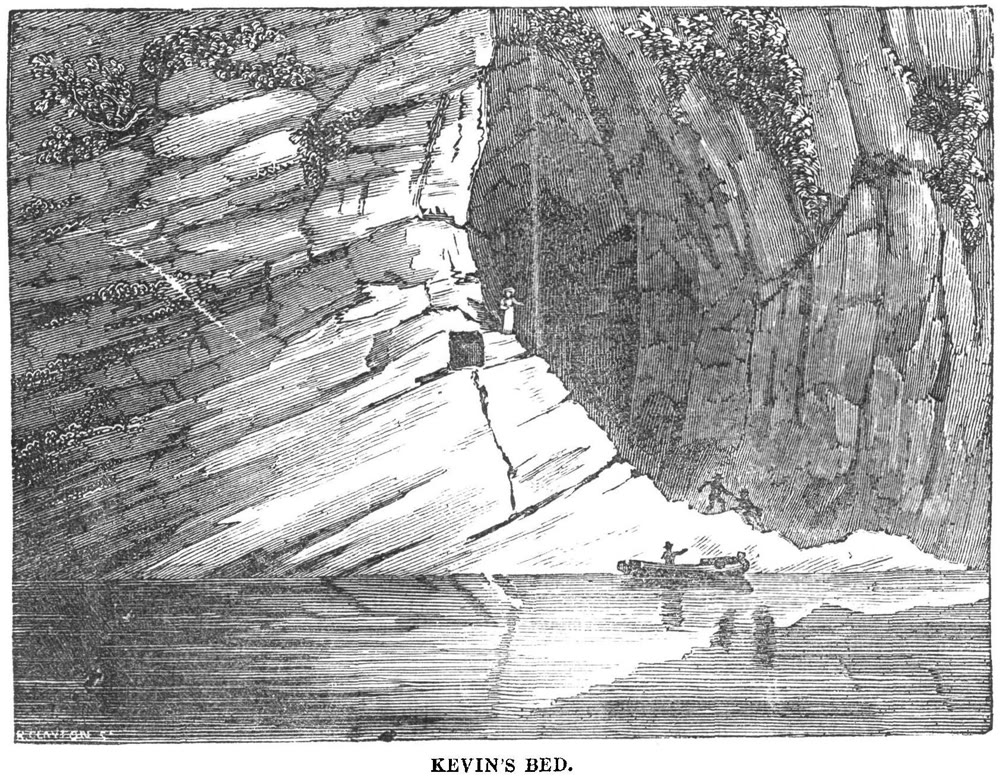
Kevin’s Bed, engraved by B. Clayton for the Dublin Penny Journal’s “Landscape Illustrations of Moore’s Irish Melodies”, 17 October 1835. Public domain, via Wikimedia Commons
King O’Toole’s goose
For comedy, there’s the tale Samuel Lover took down from a Glendalough guide, Joe Irwin, and printed in 1831. Old King O’Toole’s goose is too stiff to fly. A stranger offers to make her young again, in return for all the ground she flies over. She circles the whole valley, and the stranger turns out to be Kevin.
The monastic city: what to see
The main monastery stands near the Lower Lake, where the Glendasan and Glenealo rivers meet. It was at its most powerful in the 11th and 12th centuries, says the National Monuments Service.
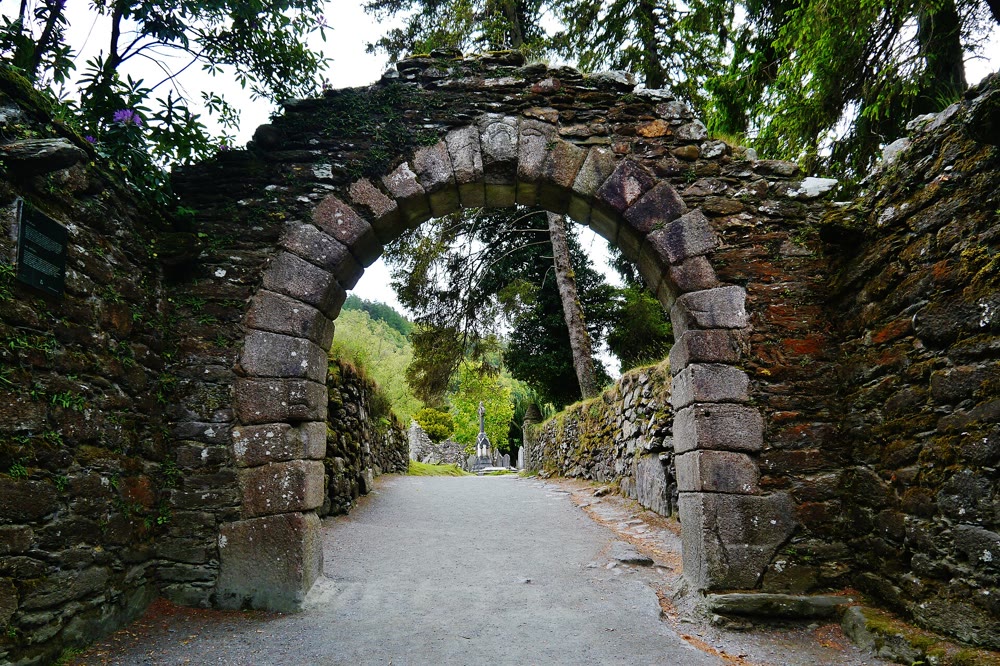
The gateway
You walk in through the only surviving monastic gateway from early medieval Ireland. It once had two storeys. Inside, a stone slab on the west wall bears an incised cross.
The round tower
The Archaeological Inventory of County Wicklow measures the round tower at 30.48 metres (100 feet), and its doorway sits more than 3 metres up. The conical cap was restored in 1876, says the National Library of Ireland.
The Irish word is cloigtheach (roughly KLIG-hakh), bell house, and it went up around 1100 as a belfry. Towers could double as strongrooms: the Annals of Ulster record a king killed inside the tower at Kells in 1076, and books and treasures burned in Monasterboice’s in 1097. The picture of monks hauling up the ladder as Vikings arrived is much harder to prove.
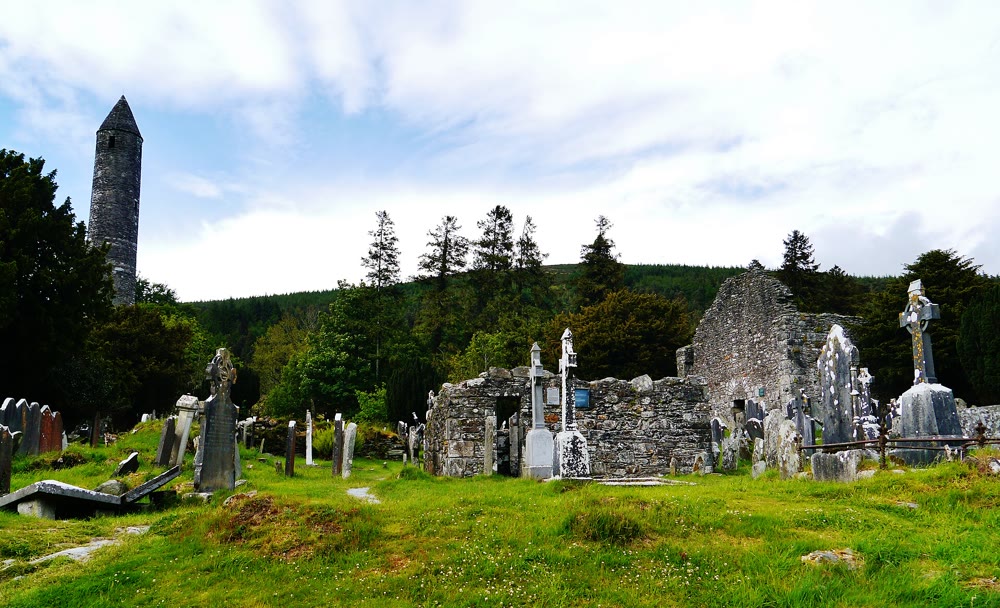
The round tower, graveyard and cathedral at Glendalough. Photo: Zairon, CC BY 4.0, via Wikimedia Commons
The cathedral
The cathedral of St Peter and St Paul is the largest building on the site. Its earliest walls use huge stone blocks; there was rebuilding in the 10th century, and the chancel was added late in the 12th. It stopped being a cathedral in 1214.
Nearby, the tiny Romanesque Priest’s House, probably 12th-century and largely rebuilt, may have held Kevin’s relics. Its name comes from local priests buried there in the 18th century.
St Kevin’s Kitchen
St Kevin’s Church is the only roofed building left at Glendalough. Its steep stone roof carries a small round belfry that looked enough like a chimney to earn the nickname St Kevin’s Kitchen.
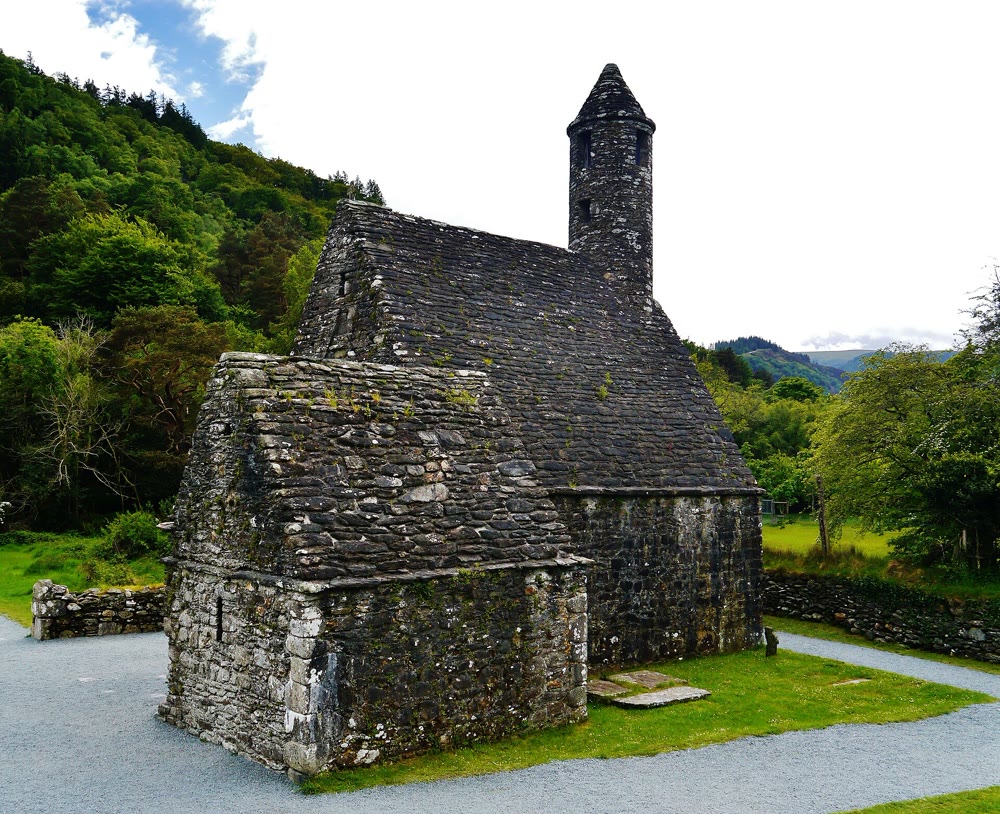
St Kevin’s Church, known as St Kevin’s Kitchen, Glendalough. Photo: Zairon, CC BY 4.0, via Wikimedia Commons
St Kevin’s Cross
This granite cross is 3.35 metres (11 feet) tall, with a solid, unpierced ring. A 1930s Glendalough pupil wrote that the biggest cross in the churchyard, probably this one, was the Wishing Cross: put your arms around it and make a wish. There’s more in my Celtic cross guide.
Around the Upper Lake
- Reefert Church: from Rífhearta (REE-ar-tuh), royal graves, the traditional burial place of the O’Toole kings. It may be 11th-century.
- St Kevin’s Bed: Leaba Chaoimhín (LAB-uh KHEE-veen), a small rock-cut cave about 9.5 metres above the lake, where tradition says Kevin slept. It may be a Bronze Age tomb or the start of a mine. You can see it from the Miners’ Road.
- Temple-na-Skellig: a little church on a ledge under the cliffs, reached only by boat. Sceilg (SHKEL-ig) means a steep rock.
East of the main site is St Saviour’s Priory, built in the 1150s, with Romanesque carving that the National Monuments Service ranks among Ireland’s finest.
Vikings, raiders and fires
A rich monastery was a target. The Annals of Ulster record Glendalough “plundered by the heathens” in 834, and the Four Masters say Viking raiders burned its oratory a couple of years later. In the 980s, the Norse of Dublin plundered it again.
Irish kings raided too. In 1013, Murchad, son of Brian Boru, plundered Leinster as far as Glendalough. The annals also record fires in 1017, 1020, 1061, 1071 and 1084, causes unknown. Glendalough kept rebuilding. Other great monasteries suffered too, among them Iona, linked to the Book of Kells.
Skuldelev 2, a 30-metre warship found in Roskilde Fjord in Denmark, was built of oak near Dublin around 1042, tree rings show. The Viking Ship Museum named its 2004 replica the Sea Stallion from Glendalough, and she sailed to Dublin in 2007. The name honours the famous valley, but the museum says only that the original was built near Dublin.
The 1214 merger with Dublin and the long decline
After Kevin, Glendalough’s most famous abbot was Lorcán Ua Tuathail (roughly LOR-kawn oo TOO-uh-hil), Laurence O’Toole, elected at 25, says the Catholic Encyclopedia (1909). He became Archbishop of Dublin in 1162, died in Normandy in 1180, and is Kevin’s co-patron of the Archdiocese of Dublin.
In the 12th-century church reforms, Glendalough became a diocese, and from 1152 it answered to the new archbishop of Dublin. After the Norman invasion, it was agreed in 1185 that the two would merge once Glendalough’s bishop, William Piro, died. He died in 1214, and Dublin absorbed the diocese.
By 1200, Glendalough was already in rapid decline, says the National Monuments Service. The English burned it in 1398, the Four Masters record, and by 1700 or so the churches had fallen into ruin.
Pilgrims kept coming. One Irish Life claims a visit to Kevin’s relics and bed earned the same forgiveness as a trip to Rome, and an 1863 English edition of Gerald mentions a “patron”, or festival, in the valley every 3 June. The Church of Ireland diocese is still called Dublin and Glendalough.
Walks: the lakes, the Spinc and the Miners’ Village
The waymarked trails start at the National Park Information Office by the Upper Lake.
- Green Road (green): 3 km loop, about 45 minutes, easy. Oak woods and a boardwalk along the Lower Lake.
- Miners’ Road (purple): 5 km out and back, about an hour, easy. Scots pine, feral goats and a view of St Kevin’s Bed.
- Spinc short route (blue): 5.5 km, about 2 hours, strenuous. Up past Poulanass waterfall to the cliff path.
- Spinc and Glenealo Valley (white): 9.5 km loop, about 3 hours 15 minutes, strenuous. Past the Miners’ Village and over the Glenealo river, with sika deer about.
- Spinc and Wicklow Way (red): 11.5 km loop, about 4 hours 15 minutes, strenuous, with a 490-metre climb.
The Spinc, An Spinc (un SPINK) in Irish, is named from a word for a crag, and some 140,000 people walk it every year. The white route above the Miners’ Village is being upgraded for five or six months from 20 July 2026; trails stay open except on a day or two of helicopter stone drops. The bronze loop to St Kevin’s Cell is closed after storm damage, but the cell’s viewpoint can still be reached.
The Miners’ Village isn’t really a village. Lead was found in neighbouring Glendasan around 1798, and the Mining Company of Ireland worked the Glendalough mines from 1825 to 1890, says the National Museum of Ireland. The local Wynne family carried on into the 1920s, and Glendasan was briefly mined again in the late 1950s. A 2012 mining-history study found the ruins were offices, stores, a forge and workshops. Miners lived in company cottages or walked in from Laragh.
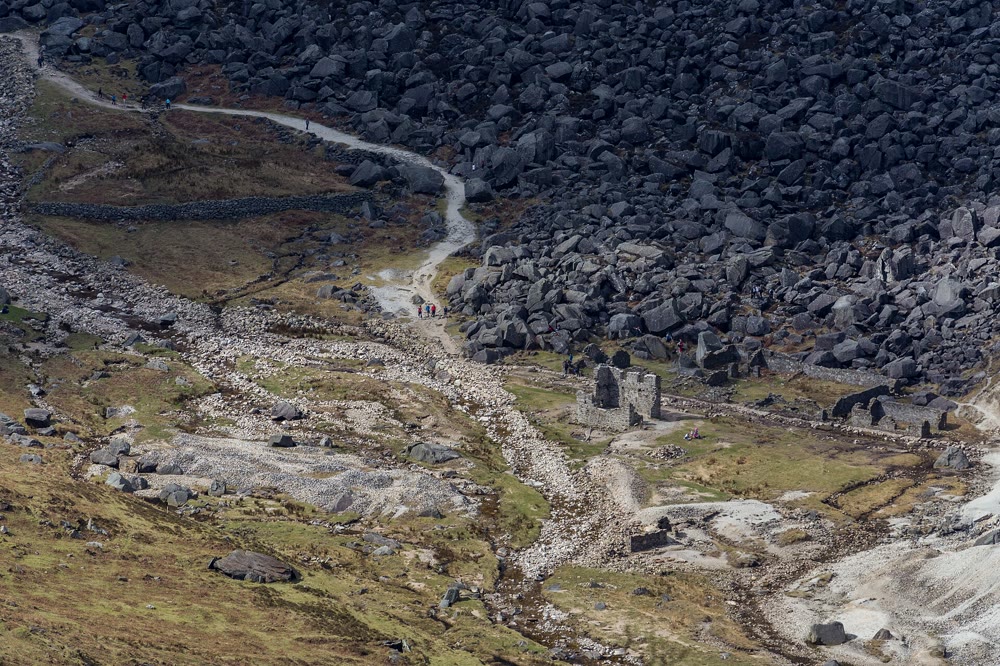
Ruins of the lead mines’ buildings, known as the Miners’ Village, at the head of the Glendalough valley. Photo: Jimmy joe jazz, CC BY-SA 4.0, via Wikimedia Commons
St Kevin’s Way is a 30 km pilgrim path from Hollywood or Valleymount, over the Wicklow Gap to Glendalough.
If you swim, take care: the lakes are deep and cold, there are no lifeguards, inflatables are banned, and there’s a steep drop close to the Upper Lake beach.
Visiting Glendalough
These details were checked in October 2026, but prices and hours change, so check Heritage Ireland before you go.
- Visitor centre (OPW): open all year except 23 to 29 December. From mid-March to 14 October, 9:30 to 18:00; in winter, 9:30 to 17:00. Last admission is 45 minutes before closing.
- Admission: the ruins, graveyard and lakes are free and open at any hour. The visitor centre charges adult €5, senior or group €4, child or student €3, family €13. Paying for its car park gets one person in free.
- Access: the visitor centre is wheelchair accessible, but the graveyard is hard going for wheelchairs. Dogs must be kept on a lead.
Parking and getting there
There are three car parks, says the national park:
- Laragh: free, run by Wicklow County Council, then a 3 km walk along the Green Road.
- Visitor centre: paid, run for the OPW, open 8am to 8pm, about 20 minutes’ walk from the Upper Lake.
- Upper Lake: paid (€5 in October 2026), run by Wicklow County Council.
Never park on the valley road’s double yellow lines: it’s the emergency route, and cars can be towed or ticketed. If everything’s full, the park suggests turning around rather than queueing. No car? St Kevin’s Bus, running since 1927, leaves from St Stephen’s Green North in Dublin; check its timetable.
When to go
Sunny weekends are busiest, so go early or on a weekday. Autumn brings the deer rut, when the park sometimes sets up telescopes on the Spinc trail. Lough Tay is about half an hour away, and Glendalough’s Upper Lake tops my list of the most beautiful lakes in Ireland. For more day trips, see my Dublin guide.
Glendalough FAQ
What does Glendalough mean?
The glen of two lakes, from the Irish Gleann Dá Loch: the Upper Lake and the Lower Lake.
How tall is the round tower at Glendalough?
About 30 metres (100 feet), with its doorway more than 3 metres up.
How much does it cost to visit Glendalough?
The ruins and lakes are free. The visitor centre charges €5 for adults (2026), and the visitor centre and Upper Lake car parks charge for parking; Laragh’s is free.
How long is the Spinc walk?
The blue route is 5.5 km, about 2 hours. The white loop through the Glenealo valley is 9.5 km, about 3 hours 15 minutes.
Love this? Save it to your Pinterest board for later.
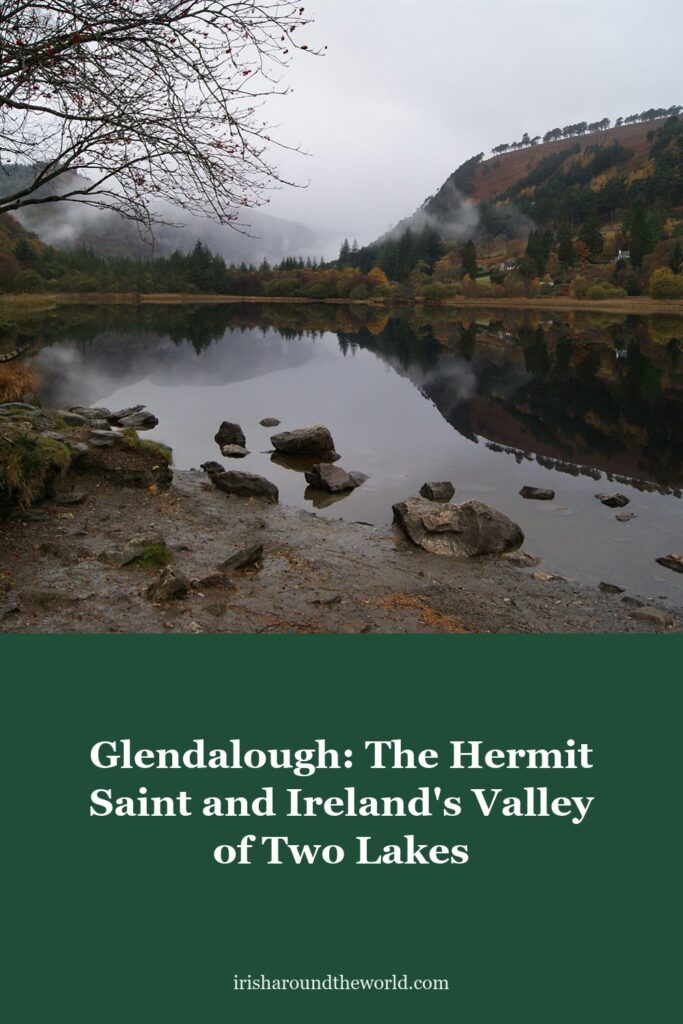
Pin image: Adapted from a photo by Bananenfalter, CC0, via Wikimedia Commons.
A little bit of Ireland in your inbox every Friday ☘️
The free Weekly Dose of Irish: an Irish joke, a Celtic symbol, an Irish fact, a poem and the week’s best articles in one short email. Join 9,600+ readers.
Free. One short email every Friday. Unsubscribe any time.
More Irish heritage reading
- Skellig Michael: The Impossible Island Monastery, From Monks to Star Wars
- The Book of Kells: How Ireland’s Greatest Treasure Was Made, Stolen and Saved
- The Celtic Cross: Meaning, History and Ireland’s Great High Crosses
- Brian Boru: The High King Who Died at Clontarf on the Day His Army Won
- Lough Tay: Why Everyone Calls It the Guinness Lake
- Irish Round Towers: Bell Towers, Viking Hideouts or Fire Temples? The Real Story
- Clonmacnoise: The Monastic City on the Shannon Where High Kings Lie Buried
Featured image: The Upper Lake at Glendalough in autumn. Photo: Bananenfalter, CC0, via Wikimedia Commons.