Anglicized Irish names are Irish names, and a few Irish words, spelled the English way. Kathleen is Caitlín, Maureen is Máirín (“little Mary”), Eileen is Eibhlín, Sheila is Síle, and Colleen is cailín, the Irish for a girl. Brian, Kevin and Deirdre are old Irish names; Siobhán, Nora and Sheila are Irish forms of Norman or Latin names. Erin, Shannon and Tara are names of places, and Kelly and Ryan are surnames. The English spellings mostly grew up in Ireland itself; the Ellis Island name-change story is a myth.
Say them out loud: Kathleen, Maureen, Colleen, Eileen, Sheila. For a lot of Irish-American families, that’s a roll call of mothers, aunts and nanas.
Every one of those names came from Irish, just spelled the English way. Colleen was an Irish word, Maureen an Irish pet form of Mary, and the other three were French or Latin names the Irish made their own centuries ago.
The first reel in this series covered the pet names a nana might call you, like alanna and mavourneen (see my guide to saying I love you in Irish). This one is about her own name. (Nana itself is English, as my guide to Irish names for grandma explains.)
Below are 25 names: the five from the reel, then 20 more that Irish-American families gave their daughters and sons, each with the Irish original, a rough pronunciation and its origin. Where a popular “meaning” doesn’t hold up, I’ll say so.
Jump to:
- The five nana names from the reel
- More girls’ names that came from Irish
- Boys’ names that came from Irish
- Made in America: names that caught on in the US first
- Why the spellings changed
- Timothy, Denis and Julia: the stand-in names
- Anglicized Irish names FAQ
- More Irish names reading
If you would rather watch than read, here are the five nana names in about half a minute.
The five nana names from the reel
1. Colleen
Cailín (KAL-een): an Irish word, “girl”.
In Irish, cailín is an everyday word for a girl or young unmarried woman (Ó Dónaill’s dictionary), not a traditional first name. English had borrowed it as colleen by 1828, says Merriam-Webster (more in my guide to English words from Irish). Munster says kah-LEEN, almost exactly the American Colleen, and Donegal clips it to KAL-in.
As a first name, Colleen caught on in America far more than in Ireland. It was in the US top 100 from 1963 to 1967, about 1 baby girl in 450 (Social Security data). Ireland’s best year, says the Central Statistics Office (CSO), was 1984: 29 girls, counting the spelling Coleen.
2. Maureen
Máirín (MAW-reen; maw-REEN in Munster): an Irish pet form, “little Mary”.
Máire (MAW-ruh) is the Irish Mary, and -ín makes it little. Fr Patrick Woulfe’s Irish Names and Surnames (1923) gives Maureen, May and Molly as its English forms. US peak: No. 88 in 1948.
3. Kathleen
Caitlín (KOTCH-leen; kotch-LEEN in Munster): an Irish form of a French name.
Caitlín is an Irish form of Catherine, from the Old French Cateline. The standard Irish for Catherine, though, is Caitríona (KAT-ree-nuh).
Kathleen was the giant of the five: No. 9 for American girls in 1949, about 1 baby girl in 67. It was big in Ireland too, at No. 23 in 1964 (CSO).
The Victorian song Kathleen Mavourneen even paired her with mavourneen, mo mhuirnín (muh VOOR-neen), “my darling”, from the first reel.
4. Eileen
Eibhlín (EV-leen): a Norman name, made Irish.
Ó Corráin and Maguire’s Irish Names (via Behind the Name) traces Eibhlín to the Norman French Aveline; Woulfe traced it to the Greek Helen, but agreed the Anglo-Normans brought it. Connacht says EV-uh-leen, Donegal EV-uh-lin, and in Munster the bh melts away: eye-LEEN, much like Eileen. US peak: No. 68 in 1943; in Ireland, No. 17 in 1964.
5. Sheila
Síle (SHEE-luh): an Irish form of a Latin name.
Síle is an Irish form of Cecilia, from the Latin Caecilia, another name the Anglo-Normans brought (Woulfe). Woulfe also noted that Síle was “generally wrongly anglicised Julia”, so a Julia in your Irish family tree may have been a Síle. You’ll see Síle translated online as “heavenly”, but no name dictionary I checked says so. US peak: No. 50, in 1963 and 1965.
More girls’ names that came from Irish
6. Noreen
Nóirín (NOH-reen; noh-REEN in Munster): an Irish pet form of a Norman name.
Nóirín is Nóra plus that little -ín (Woulfe), and Noreen was one of P. W. Joyce’s examples of -een in Irish people’s English in 1910. US peak: No. 299 in 1948.
7. Nora
Nóra (NOH-ruh): an Irish form of a Latin name.
Nóra is short for Onóra (oh-NOH-ruh), from the Latin Honoria, which came with the Anglo-Normans (Woulfe). His English forms include Honor, Honora and even Hannah, so in a family tree they may be one woman. Not every Nora is Irish: it can also be short for Eleanor (Behind the Name). Nora is back, at No. 20 for US girls in 2025, its highest rank ever.
8. Bridget and Bridie
Bríd (BREED), older spelling Bríghid: an old Irish name.
Woulfe thought Bríghid probably came from brígh (BREE), strength; Behind the Name prefers an old Celtic word meaning “the exalted one”. It was a goddess’s name in medieval Irish lore and the name of St Brigid of Kildare (see my St Brigid’s Day guide), and both sources say it was rare as an everyday girls’ name until the 1600s or later. Woulfe credits the spelling Bridget to the Swedish St Bridget. Bridie is the pet form, Bríghdín (BREE-deen) in Woulfe’s spelling.
In America in the later 1800s, “Bridget” became shorthand for the Irish servant girl, a cliché historian Margaret Lynch-Brennan examines in The Irish Bridget. It was No. 8 in Ireland in 1964, but peaked at only No. 112 in the US, in 1973.
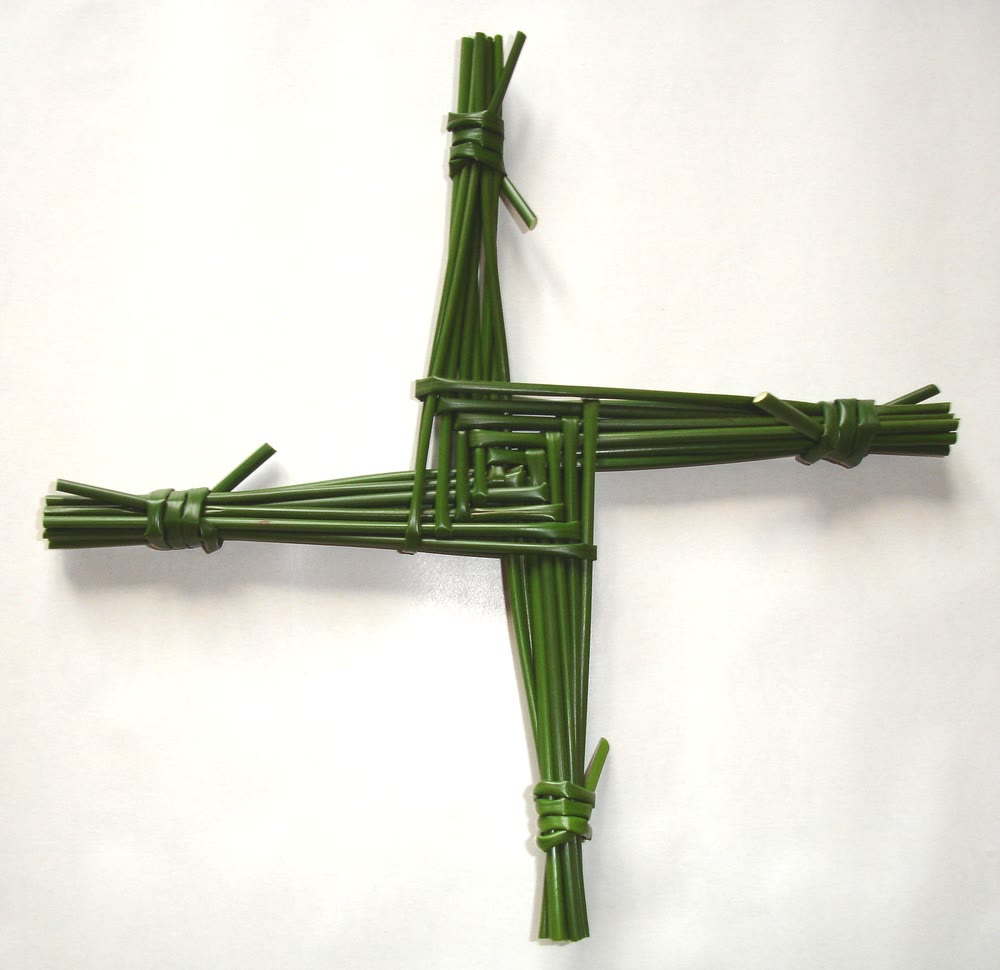
A St Brigid’s cross made from rushes from County Down. Photo: Culnacreann, CC BY 3.0, via Wikimedia Commons
9. Moira and Maura
Máire (MAW-ruh): the Irish Mary.
Woulfe lists Moira as an English form, and Behind the Name adds Maura. (The Virgin Mary is Muire, MWIR-uh.) Moira is also a Greek word for fate, by coincidence. Maura peaked at No. 468 in the US in 1964.
10. Deirdre
Deirdre (DEER-druh in English; in Irish the first d is softer, closer to JER-druh): an old Irish name from legend.
Deirdre, Old Irish Derdriu, is the heroine of a tragic tale preserved in the 12th-century Book of Leinster: the king of Ulster wants her, she flees with the young warrior Naoise (NEE-shuh), and it ends in grief (see my guide to Irish mythology). The meaning is unknown. It doesn’t mean “sorrowful”, whatever baby-name sites say; that’s her story, not her name.
Behind the Name says plays by W. B. Yeats (1907) and J. M. Synge (1910) made it a common first name. It was No. 7 in Ireland in 1966; in the US it peaked at No. 333 in 1961.
11. Maeve
Méabh (MAYV; MAYW in Connacht, MAY-wuh in Donegal), older spelling Meadhbh: an old Irish name from legend.
Medb, as Old Irish spells her, is the warrior queen of Connacht in the Táin, the Cattle Raid of Cooley. The Dictionary of the Irish Language lists an old word medb, possibly “strong” or “intoxicating” (of drink), and compares her name with it. Maeve is more a granddaughter’s name: it entered the US top 100 in 2023.
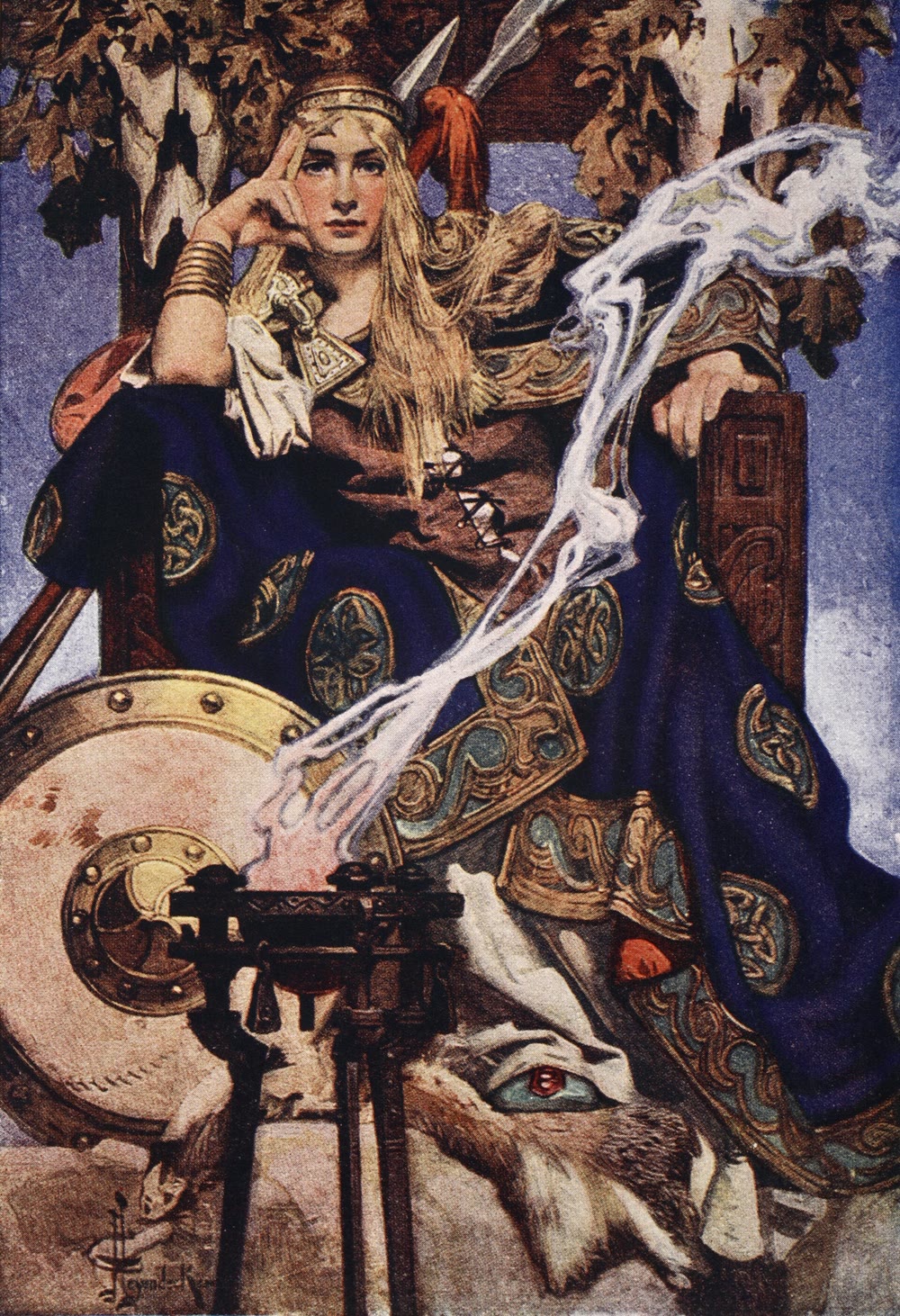
Queen Maev, painted by J. C. Leyendecker for T. W. Rolleston’s Myths and Legends of the Celtic Race (1911). Public domain, via Wikimedia Commons
12. Siobhán
Siobhán (shiv-AWN, though Connacht and Ulster make the bh more of a w): an Irish form of a Norman name.
Siobhán is Joan, from Jehanne, a Norman French form of Jeanne. Woulfe says the Anglo-Normans brought it, it has been a favourite in Ireland ever since, and its English forms are Joan, Johanna and Hannah. It’s often written Siobhan, but the fada is what makes the end a long AWN. No. 15 in Ireland in 1971; US peak No. 629 in 1979.
13. Sinéad
Sinéad (shin-AYD in Munster; SHIN-ayd in Connacht): an Irish form of a French name.
Sinéad is Jane, from the French Jeannette, a little Jeanne, so Siobhán and Sinéad are Joan and Jane in Irish dress. Often written Sinead, it was Ireland’s No. 2 girls’ name in 1975, with 825 babies, but has never made the US top 1,000.
14. Erin
Éirinn (AY-rin): a name for Ireland itself.
Éire (AY-ruh) is Ireland, and Éirinn is one of its grammatical forms (Ó Dónaill), as in Éirinn go brách (AY-rin guh BRAWKH), “Ireland forever”, the old Erin go bragh (standard Irish says Éire go brách). Some baby-name sites say Erin means “peace”; no Irish dictionary agrees. US peak: No. 18 in 1983.
15. Shannon
An tSionainn, the River Shannon (Sionainn alone is roughly SHIN-in): a river name.
In the Dindshenchas, the medieval lore of places, the river is named for Sinann, a young woman drowned while seeking the wisdom of a magic well, though the poems offer other versions too. Behind the Name thinks the river came first, its name perhaps linked to an old word for “old”. So the baby-name favourite “wise river” comes from the legend, not a dictionary. US peak: No. 17 in 1976.
16. Tara
Teamhair (TYOW-er): a place name.
The Hill of Tara in Co. Meath was the legendary seat of Ireland’s high kings, and the old word temair could mean any high place or hill (Dictionary of the Irish Language). Behind the Name credits Gone with the Wind (novel 1936, film 1939), where Tara is the O’Hara plantation, with popularizing it as a first name. US peak: No. 35 in 1977.
17. Kelly
Ó Ceallaigh (oh KYAL-ee): a surname turned first name.
Kelly is the surname Ó Ceallaigh, descendant of Ceallach (KYAL-ukh), and one of Ireland’s commonest surnames. Its meaning is uncertain: Woulfe said “war” or “strife”, and Behind the Name adds “bright-headed” and “church” as guesses. In the US, baby girls named Kelly outnumbered boys from 1957 (Behind the Name thinks Grace Kelly helped), and it peaked for girls at No. 10 in 1977.
Boys’ names that came from Irish
18. Kevin
Caoimhín (KEE-veen; kwee-VEEN in Munster): an old Irish name.
Old Irish Cóemgen means “comely birth” (Woulfe) or “beloved birth” (Behind the Name), the name of St Kevin of Glendalough. In 1923 Woulfe called it “fast becoming a popular name”. It was a US top-100 name from 1949 to 2016, peaking at No. 11 in 1963.
19. Brian
Brian (BREE-un in Irish): an old Irish name.
The spelling never changed; the sound did. It’s the name of Brian Boru, the high king killed at Clontarf in 1014, and Woulfe says Irish families have used it ever since. The meaning is uncertain, perhaps “high” or “might” (Behind the Name). No. 8 for US boys in 1970 and every year from 1972 to 1977.
20. Brendan
Breandán (BRAN-dawn): an old Irish name with a Welsh twist.
Its older form, Bréanainn, was the name of St Brendan of Clonfert, the Navigator. The twist: Behind the Name traces it to an Old Welsh word for a king or prince. US peak: No. 96 in 1999.
21. Owen
Eoghan (OH-in, often clipped to one syllable, OHN): an old Irish name.
Woulfe explained Eoghan as “well-born”; Behind the Name’s tentative guess is “born from the yew tree”. And Woulfe says it was “generally anglicised Eugene”, so a great-grandfather Eugene may have been Eoghan in Irish. Not every Owen is Irish, mind: the Welsh have Owain. Owen reached No. 18 in the US in 2022.
22. Neil
Niall (NEE-ul): an old Irish name.
The name of Niall of the Nine Hostages and of the O’Neills. Its meaning is disputed: “passion”, “hero” and “cloud” have all been suggested (Behind the Name). US peak: No. 146 in 1953.
23. Sean, Shawn and Shane
Seán (SHAWN): an Irish form of a Norman name.
Seán is John, from the Old French Jehan, a favourite of the Anglo-Norman settlers. Shane is another English form (Woulfe). In the US Shawn peaked at No. 27 (1973), Sean at No. 33 (1972) and Shane at No. 54 (1973), helped, says Behind the Name, by the 1953 western Shane.
24. Ryan
Ó Riain (oh REE-in): a surname turned first name.
Woulfe says three surnames became Ryan: Ó Riain of Carlow, one from Connacht, and Ó Maoilriain (oh mweel-REE-in) of Tipperary and east Limerick, descendants of Maolriain, “follower of Rian”. Rian is often said to mean “little king”, but nobody has proved it. Ryan shot up in the US in the 1970s, which Behind the Name links to the film Ryan’s Daughter (1970), and peaked at No. 11 in 1986, 1990 and 1991.
25. Liam
Liam (LEE-um): an Irish form of a Norman name.
Liam is short for Uilliam (ILL-ee-um), the Irish William, which Woulfe says was the commonest name of all among the first Anglo-Norman settlers. A grandson called Liam is in good company: it was America’s No. 1 boys’ name every year from 2017 to 2025.
Made in America: names that caught on in the US first
Ireland’s CSO baby-name tables start in 1964 and list every name given to three or more babies a year. Compare the Social Security baby-name data:
- Colleen: No. 93 in the US in 1965, but first listed in Ireland in 1968 (apart from three Coleens in 1965).
- Kelly (girls): in the US top 100 from 1959; first listed in Ireland in 1969.
- Shannon: No. 22 in the US in 1970; first listed in Ireland in 1974, with three girls.
- Erin: No. 38 in the US in 1975, the year Ireland first lists it, with three.
- Ryan: given to over 1,000 US boys in 1965; first listed in Ireland in 1971, with four.
Then Ireland caught up. Shannon reached No. 11 there in 1995, Erin No. 34 in 2006 and Ryan No. 6 in 2008. In a way, these names crossed the Atlantic twice.
Why the spellings changed
Spellings shifted over centuries, mostly in Ireland itself.
The little -ín became -een. Irish makes things small with -ín, so Máire becomes Máirín. In English As We Speak It in Ireland (1910), P. W. Joyce said -ín, or -een, was the one Irish diminutive that kept its sense of “little” in Irish people’s English, “constantly tacked on to Christian names”. The south, he added, says it long and stressed, and the north short. Americans say maw-REEN, with the stress just where Munster puts it.
Norman names went Irish, then English. The Anglo-Normans, who arrived in the late 1100s, brought names like Jehanne, Cecile, Honoria and Aveline. Irish made them Siobhán, Síle, Onóra and Eibhlín, and English spellings often followed the sound: Sheila is very nearly how Síle is said.
Paper was rarely in Irish. Catholic priests usually wrote baptisms in Latin, as the National Library of Ireland’s guide to its parish registers warns, so a Bríd might be written Brigida. And in Woulfe’s Irish Names and Surnames, name after name is “generally anglicised” as some English name, a sign the English forms had long been in daily use.
The Famine sent the names abroad. The Great Famine of 1845 to 1849 killed about a million people, and perhaps two million more left Ireland during and after it, taking these names with them (Encyclopaedia Britannica).
And Ellis Island? The story that inspectors changed people’s names is a myth. Shipping-line clerks wrote up passenger lists at the port of departure, and inspectors in New York checked each arrival against them, as the Smithsonian explains. When names did change, it was usually the immigrants’ own doing.
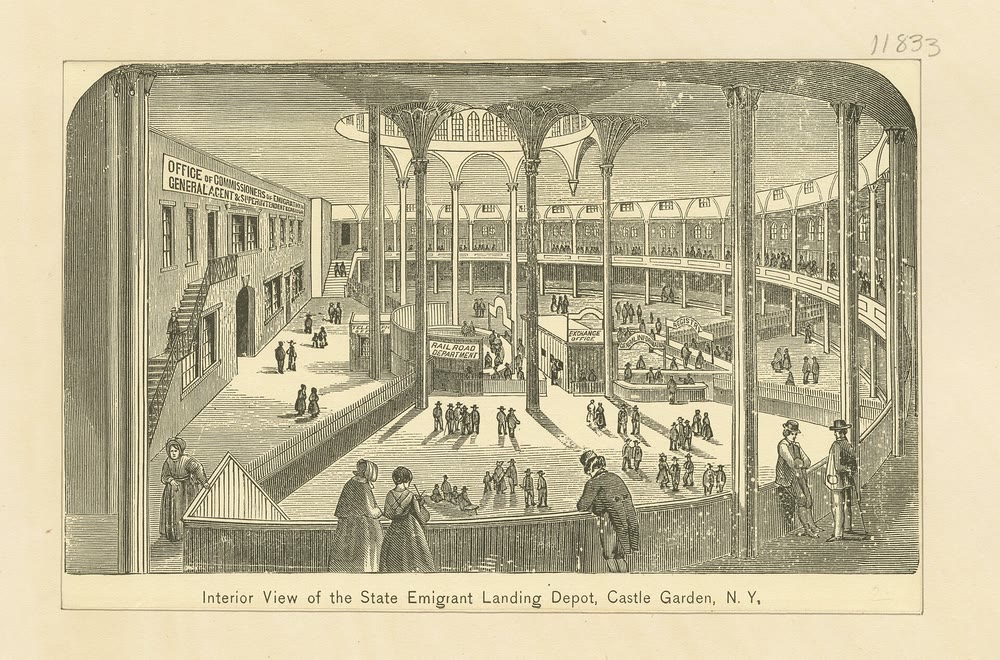
Interior view of the State Emigrant Landing Depot, Castle Garden, New York, an engraving published by Roylance and Purcell, about 1861 to 1880. New York Public Library. Public domain, via Wikimedia Commons
Timothy, Denis and Julia: the stand-in names
Here’s a twist for family-tree hunters: many Irish names weren’t respelled at all, but swapped for an unrelated English one. Woulfe records these pairs, and teanglann.ie’s English-Irish dictionary still matches most of them:
- Tadhg (TIE-g) became Timothy.
- Donnchadh (roughly DUN-uh-khuh) became Denis or Dennis.
- Diarmaid (DEER-mid) became Jeremiah, Darby or Jerry.
- Conchobhar (KRU-khoor) became Cornelius or Con.
- Domhnall (DOH-nal) became Daniel.
- Síle became Julia, Úna (OO-nuh) became Winifred and Gráinne (GRAWN-yuh) became Grace.
So an Irish great-grandfather Timothy, Jeremiah or Cornelius may have been Tadhg, Diarmaid or Conchobhar in Irish.
Names that only look Irish
Peggy is English, a rhyming pet form of Meg (Margaret) that Irish borrowed as Peig (PEG). Molly is an old English pet form of Mary, and Megan is Welsh. Even Patrick is Latin, from Patricius; Pádraig (PAW-drig) is the Irish form.
Anglicized Irish names FAQ
Is Colleen an Irish name?
It comes from Irish, but cailín (KAL-een) is just the Irish word for a girl. Colleen became a first name in America, making the top 100 in the mid-1960s; in Ireland it has always been rare.
What does Maureen mean?
Little Mary. Maureen is Máirín: Máire (Mary) plus the Irish -ín, “little”.
Is Kathleen an Irish name?
Yes. It’s the English spelling of Caitlín (KOTCH-leen), an Irish form of Catherine that came through the Old French Cateline.
Were Irish names changed at Ellis Island?
Not by the inspectors, who checked arrivals against lists drawn up before sailing. My story of Annie Moore, the first immigrant through Ellis Island, has more.
What does Erin mean?
Ireland. Erin comes from Éirinn, a form of Éire, the Irish name for Ireland. It doesn’t mean “peace”.
Love this? Save it to your Pinterest board for later.
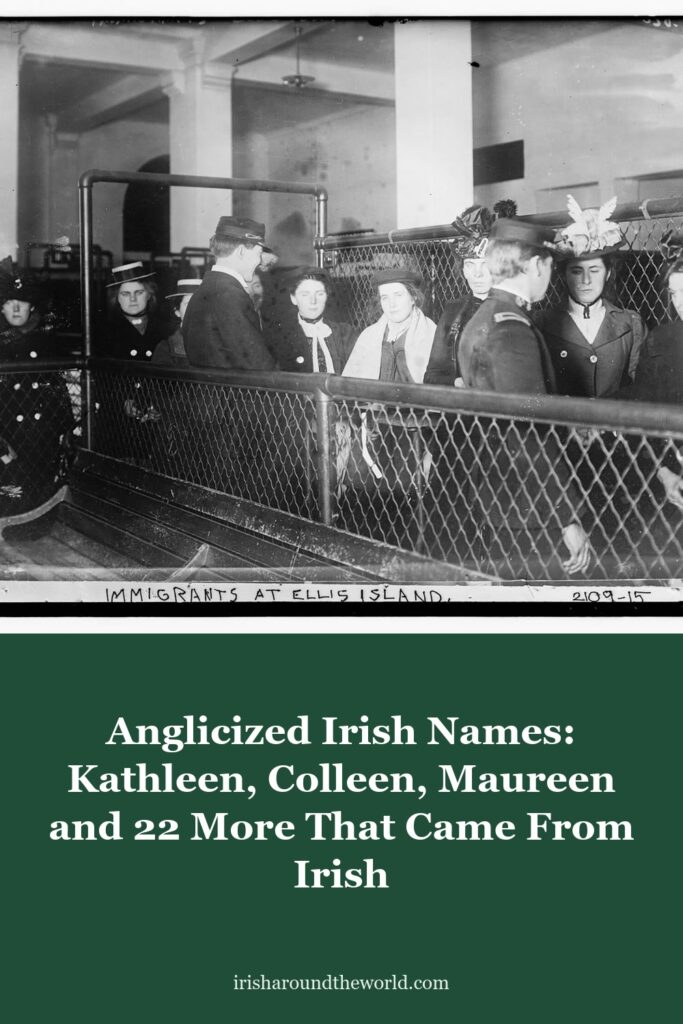
Pin image: Immigrants at Ellis Island, a Bain News Service photograph from the early 1900s. Library of Congress. Public domain, via Wikimedia Commons
A little bit of Ireland in your inbox every Friday ☘️
The free Weekly Dose of Irish: an Irish joke, a Celtic symbol, an Irish fact, a poem and the week’s best articles in one short email. Join 9,600+ readers.
Free. One short email every Friday. Unsubscribe any time.
More Irish names reading
- I Love You in Irish: How to Say It, 27 Pet Names and the Film That Misspelled One
- Irish Names for Grandma and Grandpa: Mamó, Móraí, Daideo and More (With Pronunciation)
- English Words From Irish: 27 You Use Every Day (and the Famous Fakes)
- Irish Surnames: Meanings, Origins and the Top 100 Names in Ireland
- Annie Moore: Ellis Island’s First Immigrant and the Real Story of Her Life
Featured image: Immigrants at Ellis Island, a Bain News Service photograph from the early 1900s. Library of Congress. Public domain, via Wikimedia Commons.