
Irish Christmas pudding is a dark, steamed fruit pudding made weeks ahead and served hot after the Christmas dinner, often set alight with brandy or whiskey. This recipe uses stout and Irish whiskey, serves 8 and steams for 6 hours in a 1.2 to 1.4 litre (5 to 6 US cup) basin. Make it on Stir-up Sunday, 22 November 2026, then reheat it for 2 hours on Christmas Day.
You stand over a big bowl of fruit, give it a stir and make a wish. A month later it comes to the table on fire.
This stout and whiskey pudding comes in metric and US measures, with suet or butter, in a basin or the old cloth. This is no family heirloom: the proportions are worked out from published recipes by Myrtle and Darina Allen, Edward Hayden, Kevin Dundon and Delia Smith.
For the rest of the table, see my Irish Christmas cake recipe and Irish Christmas traditions guide.
Jump to:
- Irish Christmas pudding recipe
- The old way: boiling a pudding in a cloth
- Storing and feeding your pudding
- Reheating and flaming it safely
- Brandy butter and whiskey sauce
- The coin in the pudding
- Stir-up Sunday: where the name comes from
- From plum pottage to the Irish kitchen
- Irish Christmas pudding FAQ
- More Irish Christmas reading
Irish Christmas pudding recipe
Prep: 30 minutes | Soak: overnight | Steam: 6 hours | Reheat: 2 hours | Serves: 8
Basin: 1.2 to 1.4 litres (2 to 2½ imperial pints, 5 to 6 US cups). Any heatproof bowl will do.
Ingredients
For the soak
- 150g (5¼ oz, 1 US cup) raisins
- 150g (5¼ oz, 1 US cup) sultanas (golden raisins)
- 100g (3½ oz, ⅔ US cup) currants
- 50g (1¾ oz, ⅓ US cup) chopped mixed peel
- 125ml (½ US cup) Guinness or other Irish stout
- 3 tbsp (45ml) Irish whiskey
For the pudding
- 110g (4 oz) shredded beef or vegetable suet, or 110g (1 US stick) butter, melted
- 100g (3½ oz, about 2 US cups) fresh white breadcrumbs
- 125g (4½ oz, a generous ½ US cup, packed) dark brown soft sugar or dark muscovado
- 50g (1¾ oz, a scant ½ US cup) plain (all-purpose) flour
- 1 tsp mixed spice, or pumpkin pie spice in the US
- ¼ tsp ground nutmeg
- A pinch of salt
- 1 small cooking apple (Bramley, or Granny Smith in the US), peeled and coarsely grated
- Finely grated zest of 1 orange and 1 lemon
- 30g (1 oz, ¼ US cup) chopped almonds (optional)
- 2 large eggs (Irish or UK large; 2 extra-large in the US)
- 1 tbsp black treacle (molasses in the US)
Method
- The night before, put the raisins, sultanas, currants and peel in a large bowl. Pour over the stout and whiskey, stir, cover and leave for 12 to 24 hours.
- Grease the basin with butter and put a small circle of baking paper (parchment) in the bottom.
- Add the suet (if using), breadcrumbs, sugar, flour, spice, nutmeg, salt, apple, zest and almonds to the fruit. Mix well.
- Beat the eggs with the treacle, and the melted butter if using, then stir them in. The mixture should drop off the spoon when tapped. If it’s stiff, add a splash more stout. Everyone takes a stir and makes a wish.
- Spoon the mixture into the basin and level the top, leaving about 2cm (¾ inch) of space.
- Lay a sheet of baking paper on a sheet of foil and fold a pleat across the middle, so the pudding can rise. Put it over the basin, paper side down, tie string firmly below the rim and add a string handle.
- Stand the basin on an upturned saucer in a big lidded pot. Pour in boiling water to halfway up the basin, cover and keep at a gentle simmer for 6 hours. Top up with boiling water every hour or so, and never let it boil dry.
- Lift it out, take off the wet cover and let it cool completely. Cover it with fresh paper and foil, and store it as below.
- On Christmas Day, steam it the same way for 2 hours, then turn it out onto a warm plate.
Tips
Suet or butter? Darina Allen prefers fresh beef suet to the packet kind. Edward Hayden’s stout pudding and Kevin Dundon’s pudding, both on RTÉ, use melted butter. For a vegetarian pudding, use vegetable suet or butter. Guinness no longer filters with isinglass, a fish product, but check other stouts.
Steaming time. Published times run from 4 hours to 10. Six is the middle road.
What makes it Irish? Mostly the bottle, and even that varies: Myrtle Allen used Irish whiskey, Darina Allen uses Jamaica rum. There’s no single Irish recipe.
No alcohol? Use orange or apple juice instead. It probably won’t keep as long, so store it in the fridge.
Nut allergies. Leave out the almonds and check the peel label.
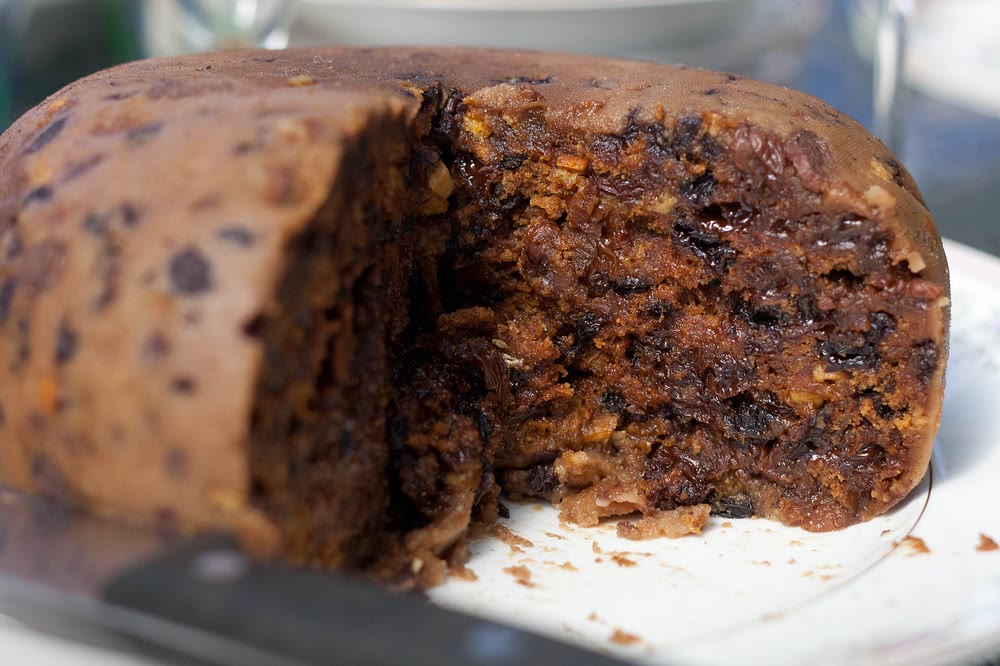
A cut plum pudding, dark and packed with fruit. Photo: Lachlan Hardy, CC BY 2.0, via Wikimedia Commons
The old way: boiling a pudding in a cloth
Before basins, puddings were tied in a cloth and boiled, which gives the round cannonball shape. This follows the Australian Women’s Weekly and Nigella Lawson’s website:
- Soak a 60cm (24 inch) square of unbleached calico overnight, then boil it for 20 minutes and rinse. Thin muslin won’t do.
- Dip it in boiling water for a minute, squeeze it out and spread it flat. Rub about 110g (a scant US cup) of plain flour into the centre to form a waterproof skin.
- Pile the mixture in the middle, gather the cloth evenly around it and tie it tightly with string, leaving a little room to swell.
- Boil it for 5 to 6 hours in a big pot, fully submerged, topping up with boiling water.
- Hang it in a cool place over a bowl until the cloth is dry, about 2 days, because damp invites mould.
- Boil it for 2 hours on Christmas Day.
Storing and feeding your pudding
Keep the wrapped pudding somewhere cool, dark and dry. Delia Smith suggests under a bed in an unheated room. In a warm house, use the fridge or freezer, and if you ever see mould, throw it out.
Hayden makes his 4 to 6 weeks ahead, and Stir-up Sunday gives you nearly five. Darina Allen says Myrtle Allen’s pudding keeps for a year, and they eat the last one at Easter.
Kevin Dundon adds a spoonful of whiskey now and then. Prick the top with a skewer, spoon over a tablespoon and wrap it again.
Reheating and flaming it safely
Delia Smith and Darina Allen steam a whole pudding for 2 hours on the day. Hayden and Dundon allow an hour, or the microwave, which suits a single slice. Darina Allen suggests frying leftovers in butter.
Mrs Beeton’s pudding reached the table “encircled in flame” in 1861. To do it safely:
- Clear the table of napkins, crackers and tinsel, tie back hair and sleeves, and keep children back.
- Turn the pudding onto a warm, heatproof plate. Keep any holly small: Darina Allen once set fire to hers, and her fringe.
- Warm 3 tbsp (45ml) of brandy or Irish whiskey in a small pan or metal ladle until just hot, then turn off the heat. Never pour from the bottle near a flame.
- Light it with a long match and pour it gently over the pudding at the table, as Delia Smith advises.
- Let the flames die out, with a pan lid handy to smother them.

Brandy butter and whiskey sauce
Brandy butter (hard sauce in the US): beat 100g (3½ oz, 7 US tbsp) soft unsalted butter until pale. Beat in 100g (3½ oz, a scant US cup) icing sugar (powdered sugar), then 3 tbsp brandy or Irish whiskey, drop by drop, as Darina Allen does. Serve it cold.
Whiskey sauce: melt 50g (3½ US tbsp) butter with 75g (⅓ US cup, packed) soft brown sugar. Add 150ml (⅔ US cup) double cream (heavy cream) and simmer for 2 minutes. Off the heat, stir in 2 tbsp Irish whiskey and serve warm.
Cream, custard or a splash of homemade Irish cream work too.
The coin in the pudding: how to hide it safely
The classic charm is a small silver coin, usually a sixpence or a threepenny bit. Food historian Annie Gray, quoted by the Royal Mint, links the sixpence to tokens hidden in the old Twelfth Cake, and says the finder could expect wealth, health and happiness.
In Ireland, hidden charms are far better recorded at Halloween, in the barmbrack and colcannon, and the 1930s pudding accounts checked here don’t mention a coin. But Robert Hume in the Irish Examiner cites a 1964 Irish Press story of a man who swallowed a sixpence from a pudding: 27 years later it began to “jump about inside him”, and he needed an operation.
Hide one with care:
- Don’t cook it in. Most modern coins contain nickel or brass, and these can react with the pudding, says Nigella Lawson’s website. It suggests 10 minutes in boiling water, then a wrap of baking paper.
- Add it last. Push the wrapped coin into the warm pudding from underneath, just before serving. The Royal Mint’s recipe card allows this, and warns of the choking risk.
- Tell everyone before the first spoonful, and never microwave a pudding with a coin in it.
- Keep it away from small children. The HSE lists coins among household choking risks.
- Check the date first. Some old Irish coins are worth real money.
For zero risk, tuck the coin under a plate instead.
Stir-up Sunday: where the name comes from
Stir-up Sunday is the last Sunday before Advent: 22 November in 2026 and 21 November in 2027.
The name comes from a prayer. The collect for that Sunday in the 1549 Book of Common Prayer opens “Stiere up we beseche thee, O Lord, the wylles of thy faythfull people”. A Dublin edition, printed in 1551, is the oldest known book printed in Ireland.
The pudding joke came later. An East Anglian glossary of 1830 grumbles that housewives were supposed to hear the prayer as a reminder to mix their mince pies, and by 1849 Brand’s Popular Antiquities has schoolboys chanting “Stir up, we beseech thee, / The pudding in the pot”. Food historian Ivan Day knew of nothing earlier than the 19th century.
It reached Irish kitchens anyway. The Irish Examiner calls it an Anglican tradition, but Darina Allen’s family stirred, wished and ate the first pudding that same evening: “our first taste of Christmas”.
You’ll also read that a medieval Church decree demanded 13 ingredients, for Christ and the apostles, and east-to-west stirring for the Magi. In 2012 Day offered $1,000 for the original text, sure it was spurious.
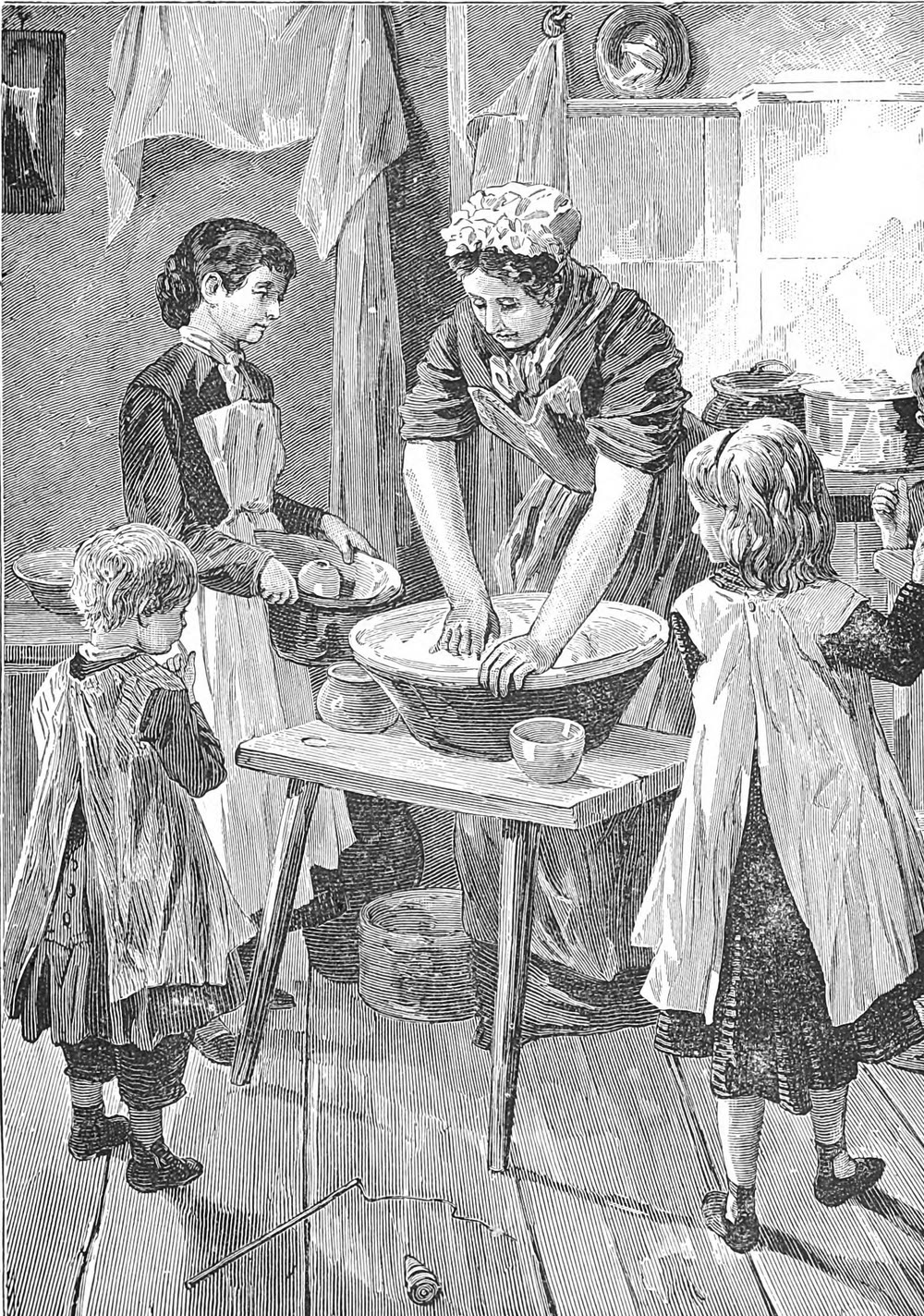
Mixing the Christmas plum pudding, from A Christmas Box of Pretty Stories, McLoughlin Bros., New York, about the 1890s. Public domain, via Wikimedia Commons
From plum pottage to the Irish kitchen
There are no plums in plum pudding. In older English, plum could mean a raisin, and Irish is plainer: Ó Dónaill’s dictionary gives maróg rísíní (ma-ROHG REE-shee-nee), literally raisin pudding.
It began as something you ate with a spoon, the usual story goes. London Museum traces it from frumenty, hulled wheat boiled in milk, to a meaty, semi-liquid “plum porridge”. Hume argues the old pottage was a different dish altogether. The pudding cloth changed things, because a pudding no longer needed an animal’s stomach or gut. The earliest written record usually cited comes from Cambridge in 1617.
The first firm link with Christmas that Day could find is from 1675, when naval chaplain Henry Teonge listed “plumb-puddings” at Christmas dinner off Crete. He found no contemporary proof that Cromwell banned the pudding, and the tale of George I as the “Pudding King” only surfaces in the 20th century.
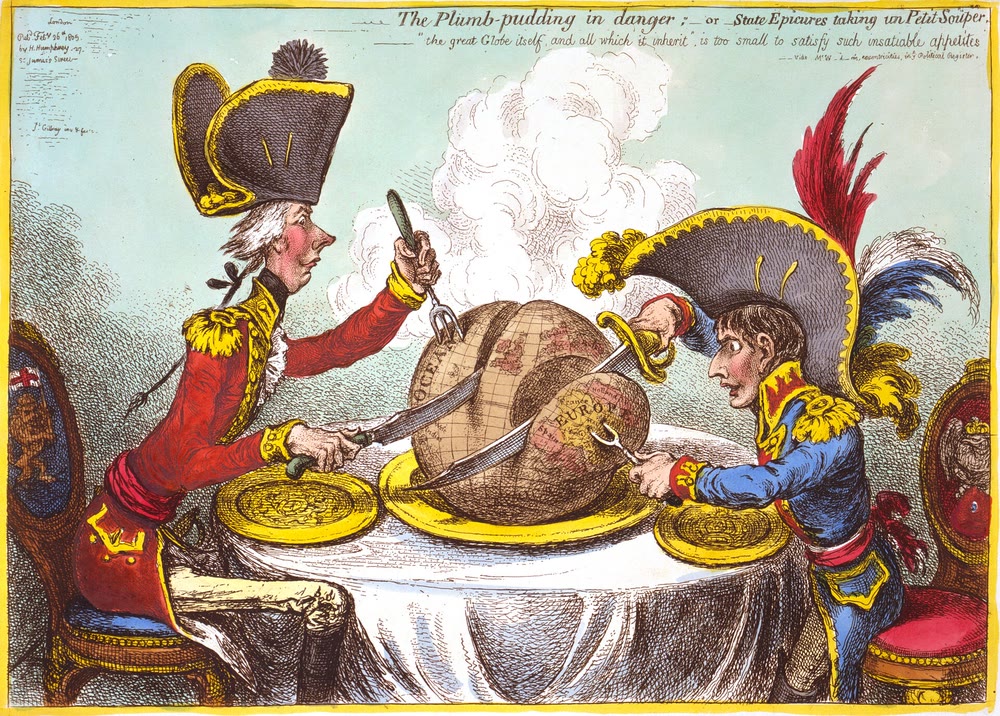
The Plumb-pudding in Danger, James Gillray’s 1805 cartoon of William Pitt and Napoleon carving up the world as a plum pudding. Library of Congress. Public domain, via Wikimedia Commons
By 1843 Mrs Cratchit was carrying hers in “like a speckled cannon-ball” in Dickens’s A Christmas Carol. Eliza Acton’s 1845 cookbook is often credited with the name Christmas pudding, though Day says the name is older.
How it reached Irish tables
I can’t give a firm date for the pudding’s arrival in Ireland. One clue: Cork food historian Regina Sexton cites the folklorist Kevin Danaher, who noted that until fairly recent times parts of Co. Wexford still served a version of the old plum porridge on Christmas Eve, as “cutlin pudding”.
Fruit, sugar and spice were once the food of the wealthy, which is why Sexton calls these sweets “socioeconomic history on a plate”. On RTÉ, Marion McGarry writes that rural families sold butter, eggs and geese in town to pay for Christmas goods.
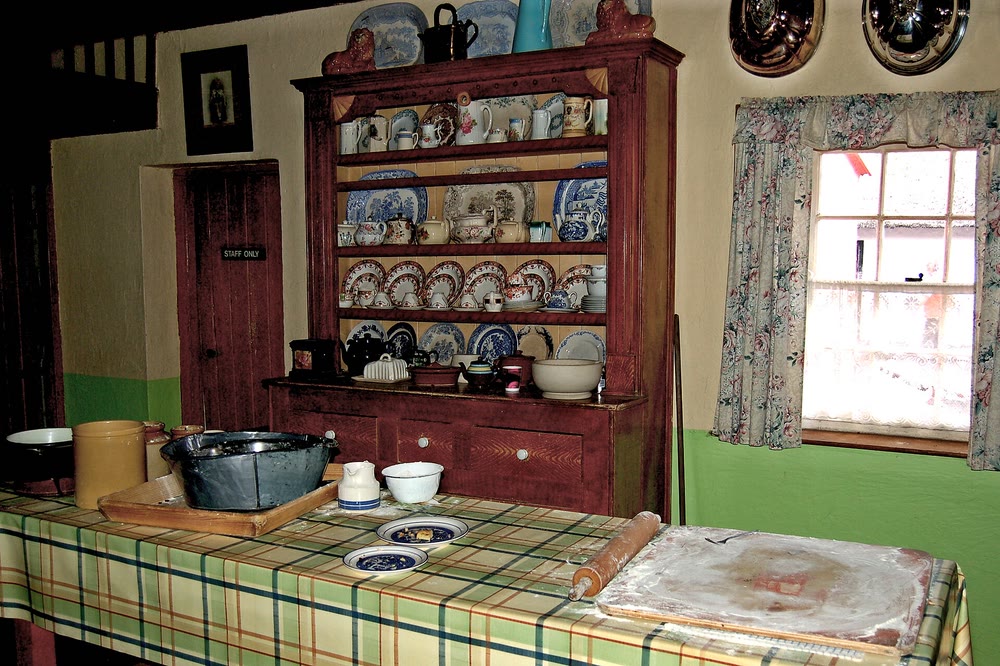
The kitchen of the Golden Vale Farmhouse at Bunratty Folk Park, Co. Clare. Photo: Joseph Mischyshyn, CC BY-SA 2.0, via Wikimedia Commons
The Schools’ Collection of 1937 to 1939 shows both sides. One entry from Clara school says turkey or goose was for everyone, “even the poor working people”, with plum pudding “if possible”. In Tinure, Co. Louth, they said that if the pudding broke in the pot they would be dead before next Christmas, one more for my list of Irish superstitions.
An account from Latsey, Co. Cavan, gives a homely origin story: an old woman’s bag burst on the way home from town, mixing up her Christmas groceries, so she tied the lot in a cloth and boiled it.
On Christmas Day 1902, on Scott’s southern journey in Antarctica, Kildare-born Ernest Shackleton pulled from a spare sock a plum pudding “about the size of a cricket ball”. They heated it in the cocoa and topped it with artificial holly.
Irish Christmas pudding FAQ
Is Christmas pudding the same as plum pudding?
Yes. Plum pudding is the older name, and Irish cooks like Darina Allen still use it.
How far ahead can you make Christmas pudding?
Four to six weeks suits most recipes, though Myrtle Allen’s keeps for a year. You can also eat it straight away, as the Allens do with their first.
Does the alcohol cook off?
Not all of it. USDA tables show most of it stays after flaming, and some even after 2½ hours of baking. Use the juice version for children, in pregnancy or for anyone avoiding alcohol.
How do you say Christmas pudding in Irish?
Maróg Nollag (ma-ROHG NULL-ug; Connacht and Ulster speakers stress the start of maróg). There are more in my list of Irish Christmas words.
Love this? Save it to your Pinterest board for later.
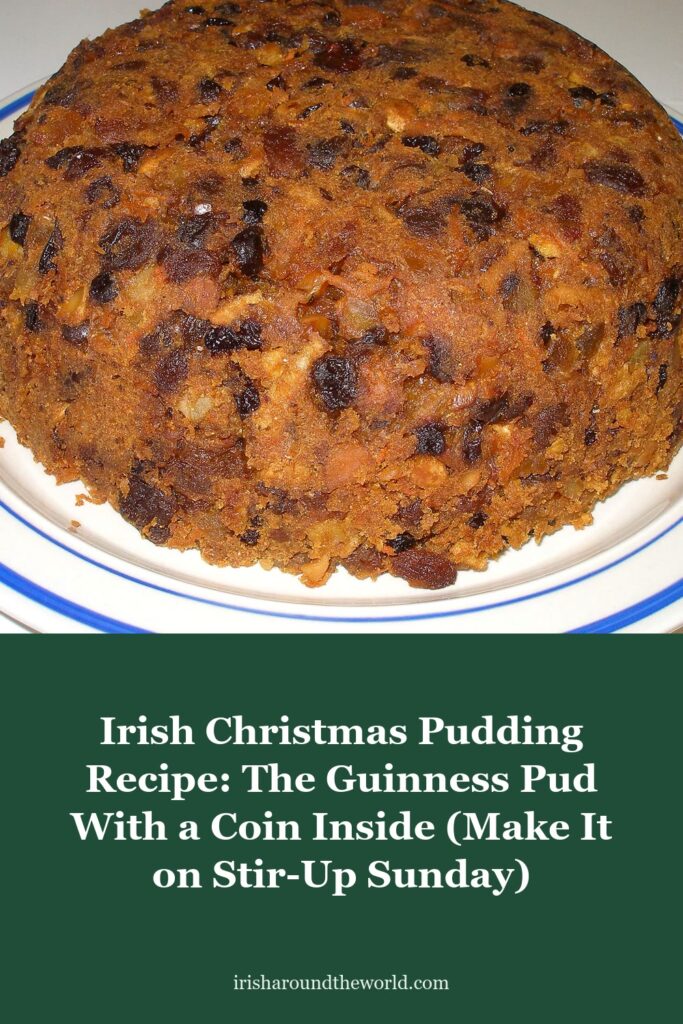
Pin image: A home-made plum pudding on a blue-rimmed plate. Photo: Dennis Sylvester Hurd, CC0, via Wikimedia Commons
A little bit of Ireland in your inbox every Friday ☘️
The free Weekly Dose of Irish: an Irish joke, a Celtic symbol, an Irish fact, a poem and the week’s best articles in one short email. Join 9,600+ readers.
Free. One short email every Friday. Unsubscribe any time.
More Irish Christmas reading
- Irish Christmas Cake Recipe: The Whiskey-Fed Fruit Cake You Make Weeks Ahead
- 18 Irish Christmas Traditions, From the Candle in the Window to the 12 Pubs
- Irish Spiced Beef: The Cork Christmas Classic (and How to Cure Your Own)
- Wren Day: The Irish Tradition of Straw Suits, Wren Boys and the King of All Birds
- Merry Christmas in Irish: How to Say Nollaig Shona Duit (Plus 35 Christmas Words)
- Barmbrack Recipe: The Irish Halloween Bread That Predicts Your Future
- Irish Porter Cake Recipe: The Stout-Soaked Fruit Cake You Never Have to Ice
Featured image: A home-made plum pudding on a blue-rimmed plate. Photo: Dennis Sylvester Hurd, CC0, via Wikimedia Commons.