The Irish Christmas candle in the window is a large candle set in a window at nightfall on Christmas Eve, often lit by the youngest child. Folk accounts say it welcomed Mary and Joseph and any stranger needing shelter. A song printed in 1827 already puts it in village windows. The popular story that it marked a safe house for priests in Penal times is unproven: the earliest telling found dates from 1952. Emigrants came to see it as the light of home, and in 1990 President Mary Robinson promised a light at Áras an Uachtaráin for them.
Picture a country road in Ireland on Christmas Eve, a century ago. There’s no electric light for miles. As the dark comes down, a small flame appears in a farmhouse window. Then another across the valley. Then another.
The folklorist Kevin Danaher was still writing about it in 1954. As a child in Athea, Co. Limerick, he was brought up a hill on Christmas Eve to see the candles lit “in every house in the parish”.
My Irish Christmas traditions guide gives that candle one short paragraph, and it deserves better. So I went back to the sources: a novelist of the 1820s, a Victorian nun’s biography, the schoolchildren of the 1930s and a President’s speeches. Some of what you’ve heard holds up. Some doesn’t. The true story, I think, is better.
Jump to:
- What is the Irish Christmas candle?
- Who lit the candle?
- What the candle was said to mean
- How old is the custom?
- Was it a signal for priests in Penal times?
- The emigrant’s candle
- Mary Robinson’s light at the Áras
- Did the Irish bring it to America?
- How to light the candle today, safely
- The Irish words
- Candle in the window FAQ
- More Irish Christmas reading
What is the Irish Christmas candle?
It’s a big candle, lit at dusk on Christmas Eve and set in a window. Marion McGarry, writing for RTÉ, describes a thick one, white or red, that lasted the season. It burned all night and was usually relit on the nights after.
In 1958 the Irish Tourist Board’s magazine, Ireland of the Welcomes, put the usual weight at a half-pound to a pound. Colours went by district: white in Limerick and Clare, pink in the Midlands, blue in parts of Dublin.
The classic holder was a hollowed turnip, often dressed in white or coloured paper, says the historian Diarmaid Ferriter in his 2017 Irish Times column, which draws on the National Folklore Collection.
Who lit the candle?
Ask the internet and you’ll get a neat answer: the youngest child lit it, and only a girl called Mary could put it out. The real story is messier, and better.
The youngest child is well recorded. Ferriter says the job often fell to the youngest, and Ireland of the Welcomes called that the usual way. Danaher’s The Year in Ireland (1972), the classic book on Irish calendar customs, is cited for the same point, though I couldn’t get the book itself. In the Schools’ Collection, the folklore written down by Irish pupils in 1937 to 1939, the youngest lights it at Boher in Co. Tipperary.
But it was never a fixed rule. In Margaret Brew’s 1885 novel The Chronicles of Castle Cloyne, only the “vanithee” could light it: bean an tí (ban un TEE), the woman of the house.
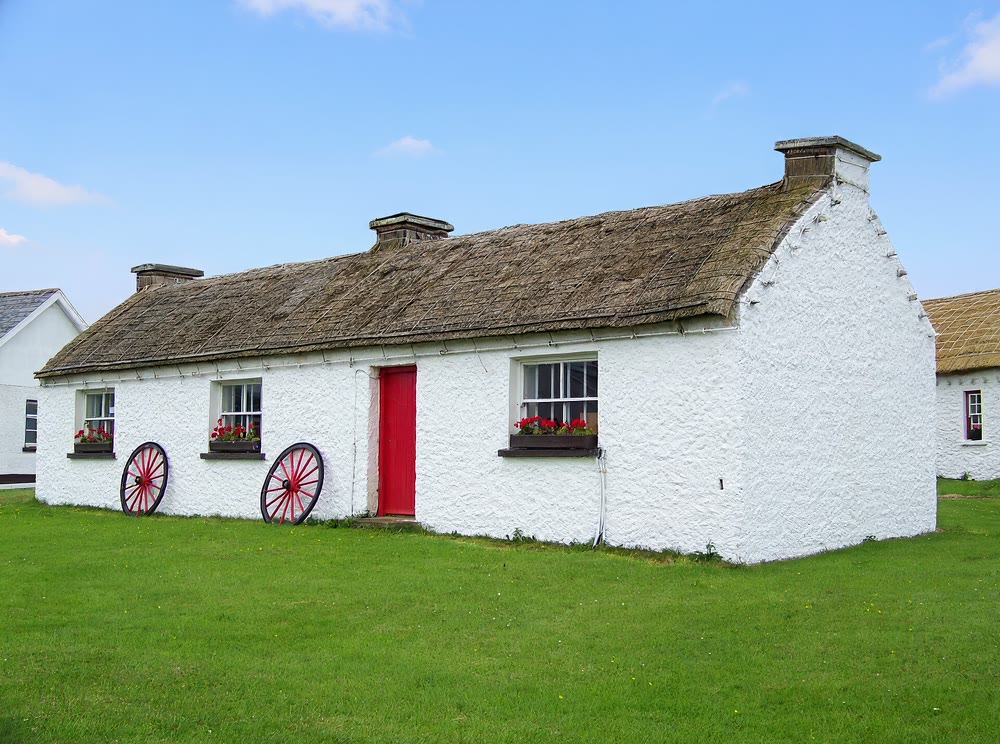
A thatched cottage with small, deep-set windows at the Glencolmcille folk village, Co. Donegal, a reconstruction of older homes. Photo: Einaz80, CC BY-SA 4.0, via Wikimedia Commons
The girl named Mary
Plenty of websites say a girl named Mary had to light it or put it out. I can’t find that in any Schools’ Collection account I could read. I did find where it may have started, and it wasn’t in Ireland.
Margaret Hallahan, later a Dominican foundress, was born in London in 1803 to Irish Catholic parents. Her 1869 biography says the family burned a large candle on Christmas Eve “which no one was allowed to snuff who did not bear the name of Mary”. Snuffing probably means trimming the wick.
Now watch that sentence travel. In 1891 The Antiquary magazine repeated it, citing the biography and not mentioning Ireland. In 1897 William Walsh’s Curiosities of Popular Customs gave it almost word for word as something done “in some parts of Ireland”. Newspapers ran it as filler by 1919. By 1955 an American children’s story has the candle lit by “either the youngest or the one named Mary”.
The Hallahans got their custom somewhere, so some Irish families may well have kept it. But the national rule looks like one household’s habit, copied from book to book.
What the candle was said to mean
Nobody ever issued an official meaning, but the same answers keep coming back.
A welcome for the Holy Family
In the accounts I’ve read, this is the commonest reason. At Kilmeedy in Co. Limerick, a pupil wrote, the candles always went in the windows to welcome Our Lord. A 1941 note from Annascaul in Co. Kerry, quoted by the National Museum of Ireland, says the Blessed Virgin passed every door that night, and that a burning candle brought blessings. On Inis Meáin (Inishmaan) in the Aran Islands, the candle went down on the floor at bedtime and burned on, so that Christ would see it through the window, RTÉ Gaeilge reports.
A welcome for any stranger
If Mary and Joseph had been turned away, nobody else should be. At Glencalry in Co. Mayo, says Dúchas’s own Christmas booklet, the candles were there to guide and invite anyone on the road with no bed for the night, and the door stayed open. Fr William Lockington, writing in 1920, called the custom a national reparation for “the insult of the closed doors of Bethlehem”.
A Clare story in the Schools’ Collection shows how much it mattered. At Dunsallagh, a poor woman’s husband went to the market on Christmas Eve and never came home, leaving her with no candle. She sat crying, and woke in the night to find a three-branched candlestick burning in her window.
A star, an omen and the dead
Brew said the flame stood for the star of the first Christmas. But it wasn’t all sweetness. If the candle went out before its time, she wrote, a death would follow in the house within the year, and Danaher is cited for the same fear. The National Museum adds that many families lit a candle for anyone they had lost that year, a close cousin of the window candles of All Souls’ Night.
How old is the custom?
Nobody knows. Here’s the paper trail as far as I can follow it.
- 1827: In Holland-Tide, the Limerick novelist Gerald Griffin prints a song with the Christmas light burning “in many a village pane”. His footnote describes a candle blessed by the priest, lit at sunset on Christmas Eve “in Irish houses”, which it was a kind of impiety to touch.
- 1841: Mr and Mrs S. C. Hall record a Cork custom: a three-branched tallow candle for the Trinity, burned to midnight on Christmas Eve, then saved against evil spirits, “except whiskey”. No window.
- 1885: Brew puts it “always in the recess of a window”, to be seen from far off: the first plain description I can find.
- 1889: The American ethnographer James Mooney finds a yard-long candle of plaited rushes on the Connemara supper table, and big coloured shop candles in Kerry. No window.
So the candle in the window goes back nearly two centuries on paper. Beyond that I can’t prove anything, and the window was never the only place: at Annascaul the candle stood on the table. If someone gives you an older date, ask for the source.
Was it a signal for priests in Penal times?
You’ve probably read this version. Under the Penal Laws, priests were hunted, so Catholic families put a candle in the window to show a passing priest he was safe. If soldiers asked, they said it was for Mary and Joseph.
It’s a stirring story and I’d love it to be true. It may even be true of some house, in some year. But it’s unproven, and here’s why.
The earliest telling I can find is American, and late. It’s in The Christmas Book (1952) by Fr Francis X. Weiser, a Jesuit writing in the United States. He gives no source. When he came back to the subject in his footnoted Handbook of Christian Feasts and Customs (1958), the priests were gone. He said only that the custom was Irish and spread from Boston, citing a 1918 work on Beacon Hill.
The older Irish sources don’t say it. Griffin wrote in 1827, with the Penal years in living memory, and his priest blesses the candle. Brew, the Halls and Mooney never tie it to priests. Lockington’s 1920 book dwells on hunted priests and on the Christmas candle, and never connects them. Searches of the Schools’ Collection bring up lookouts and Mass rocks but no candle signal, though it’s too vast an archive to swear by.
The story turns the folklore upside down. In Weiser’s telling, Mary and Joseph are the excuse given to the soldiers. Yet they’re the reason the people themselves kept giving. And a candle in every window on the same night of the year would make a strange secret signal.
The history is messier than the legend. The fear was real. In the early 1700s Bishop Hugh MacMahon of Clogher told Rome he often said Mass at night with just the householder and his wife there, writes the historian Henry Jefferies, and hosting one could cost £30 and a year in prison. But the Ulster Historical Foundation says enforcement was uneven, with priests in large areas working with “relative impunity”. There’s more in my guide to Ireland’s hedge schools.
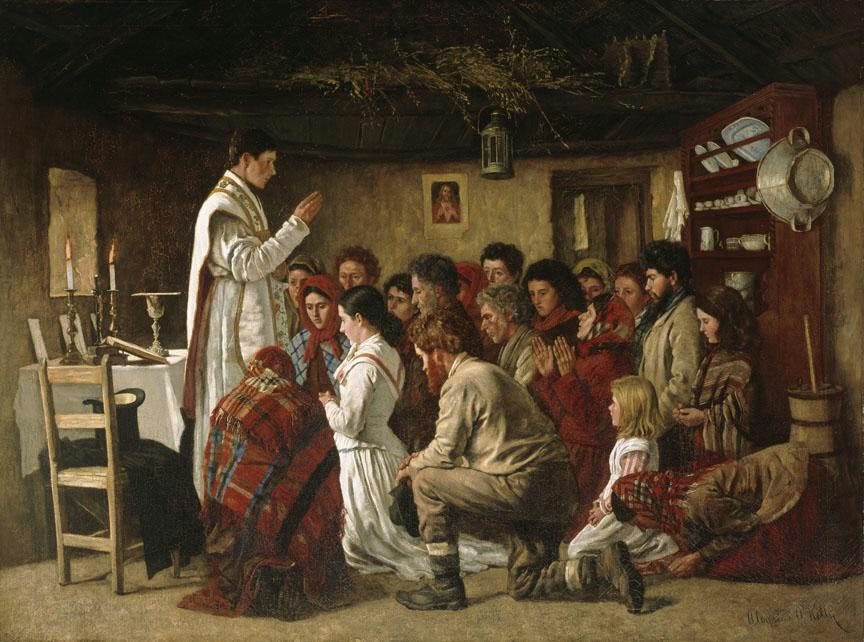
Mass in a Connemara Cabin by Aloysius O’Kelly, 1883: a station Mass in a private home, long after the Penal Laws. A Mass in a house doesn’t always mean hiding. Public domain, via Wikimedia Commons
So a night Mass in a farmhouse is real history. A Christmas candle as the signal for it isn’t recorded anywhere I can find. If you know of an older source, tell me in the comments.
The emigrant’s candle
Was the candle lit for emigrants? The 1930s accounts I’ve read don’t say so. They give it to Mary, Joseph and the stranger on the road, not to a son in Boston.
But emigration ran through Irish Christmases all the same. Few could come home, and the “American letter” often arrived in time for Christmas, the Western People recalls, sometimes with dollars inside. Families who had held an American wake knew exactly who was missing from the table.
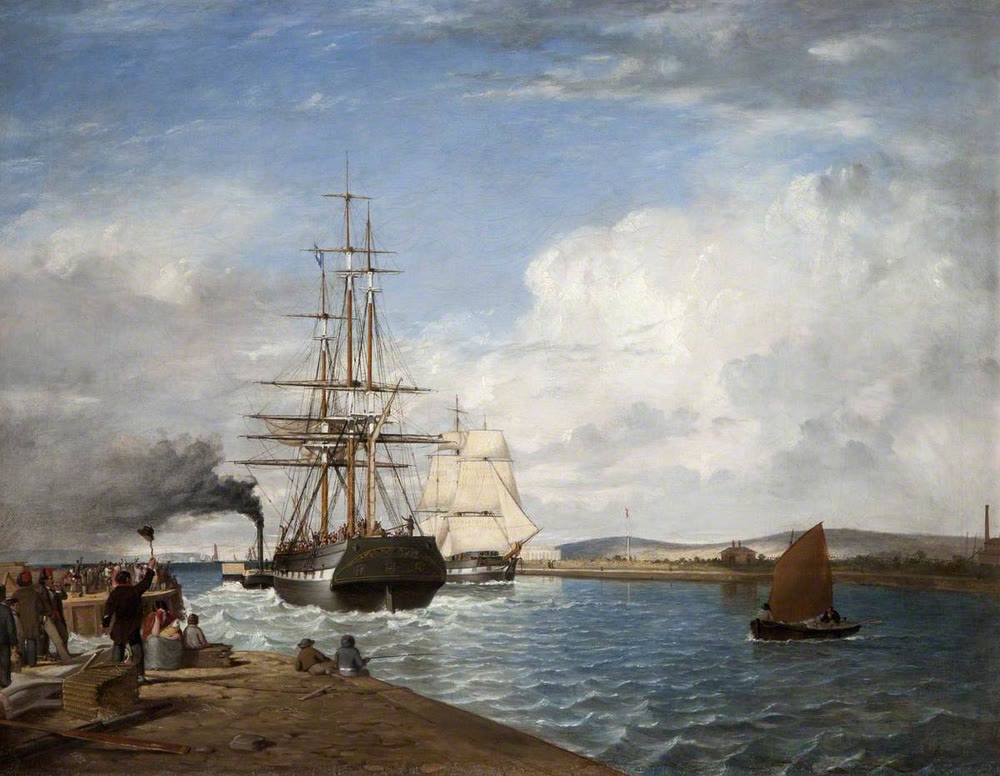
Emigrant Ship Leaving Belfast by James Glen Wilson, 1852. Ulster Museum. Public domain, via Wikimedia Commons
The writers who tie the candle to the absent mostly write from abroad. Lockington, a New Zealand-born Jesuit then leading his order in Australia, pictures the Christmas rosary in an Irish home, the mother naming each absent child. Then he sends those exiles home in their minds, from the Yukon to Argentina, up the old road to the door. “The Christmas candle lights his steps,” he writes.
In 1927 A. J. Reilly, in the American Catholic magazine The Ave Maria, pictured Irish mothers aching for children in America and Australia, “where no Christmas candle lights them home”.
A generation later, an emigrant set it down for real. Dónall Mac Amhlaigh (DOH-nul mock OW-lee) took the boat to England in 1951, worked there as a labourer and is buried in Northampton. In his diary Dialann Deoraí (1960), quoted by Tuairisc.ie, he reaches Kilkenny for Christmas and goes straight up home. “Bhí coinneal mhór na Nollag ar lasadh sa bhfuinneog,” he wrote: the big Christmas candle was lit in the window. The old lady was at the door to welcome him.
Look at that title. Deoraí (DYOR-ee), says Ó Dónaill’s dictionary, means a stranger, a wanderer and an exile. It’s one word for the person the candle was lit for and the person it came to stand for.
Mary Robinson’s light at the Áras
By 1990, Ireland was losing people again. Net emigration reached about 44,000 in 1989, says the Central Statistics Office.
On 9 November 1990, accepting the presidency, Mary Robinson promised “a light on in Áras an Uachtaráin for our exiles and our emigrants”. Áras an Uachtaráin (AW-rus un OOKH-tur-awn) is the President’s home in Dublin’s Phoenix Park. A light went into an upstairs window there, drawing, says the presidency’s website, on the old custom of a light for strangers in the night.
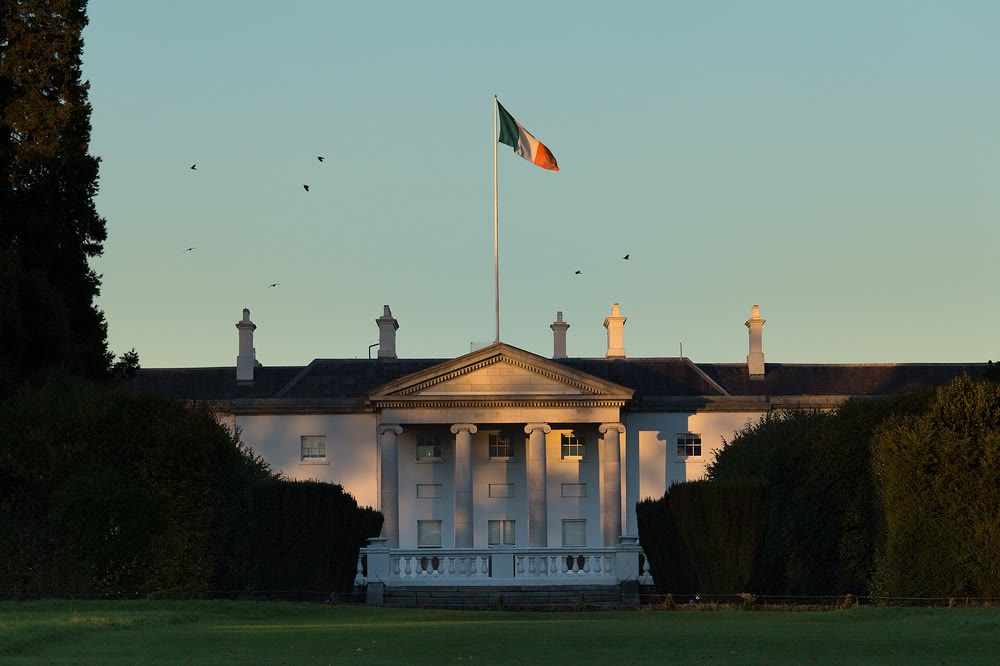
In February 1995, in her speech Cherishing the Irish Diaspora, printed in the US Congressional Record at Senator Ted Kennedy’s request, she said the light stood for “the inextinguishable nature of our love and remembrance”. Robinson later said the speech and the light were what emigrants remembered best.
The light outlasted her term. Her original travelled abroad with her and has since been shown in her home town of Ballina. At the Áras, says the presidency’s website, it gave way to a Tilley lamp, a gift to Mary McAleese at her inauguration in 1997, and Michael D. Higgins kept it going. The same page says it still shines.
Did the Irish bring it to America?
You’ll often read that Irish immigrants brought the window candle to America. That’s Weiser again, who said it arrived in the early nineteenth century. The record is messier.
The candle certainly travelled: the Hallahans had theirs in London by about 1810. But in 1916 the Kentucky Irish American said it was a pity the descendants of the Irish weren’t keeping it up in America.
The best-documented line starts on Boston’s Beacon Hill, where a Harvard divinity student, Alfred Shurtleff, is said to have lit one at 9 West Cedar Street in 1893. Accounts differ, but the neighbours took it up. In 1917 the American Red Cross asked for “a candle in every window” on Christmas Eve.
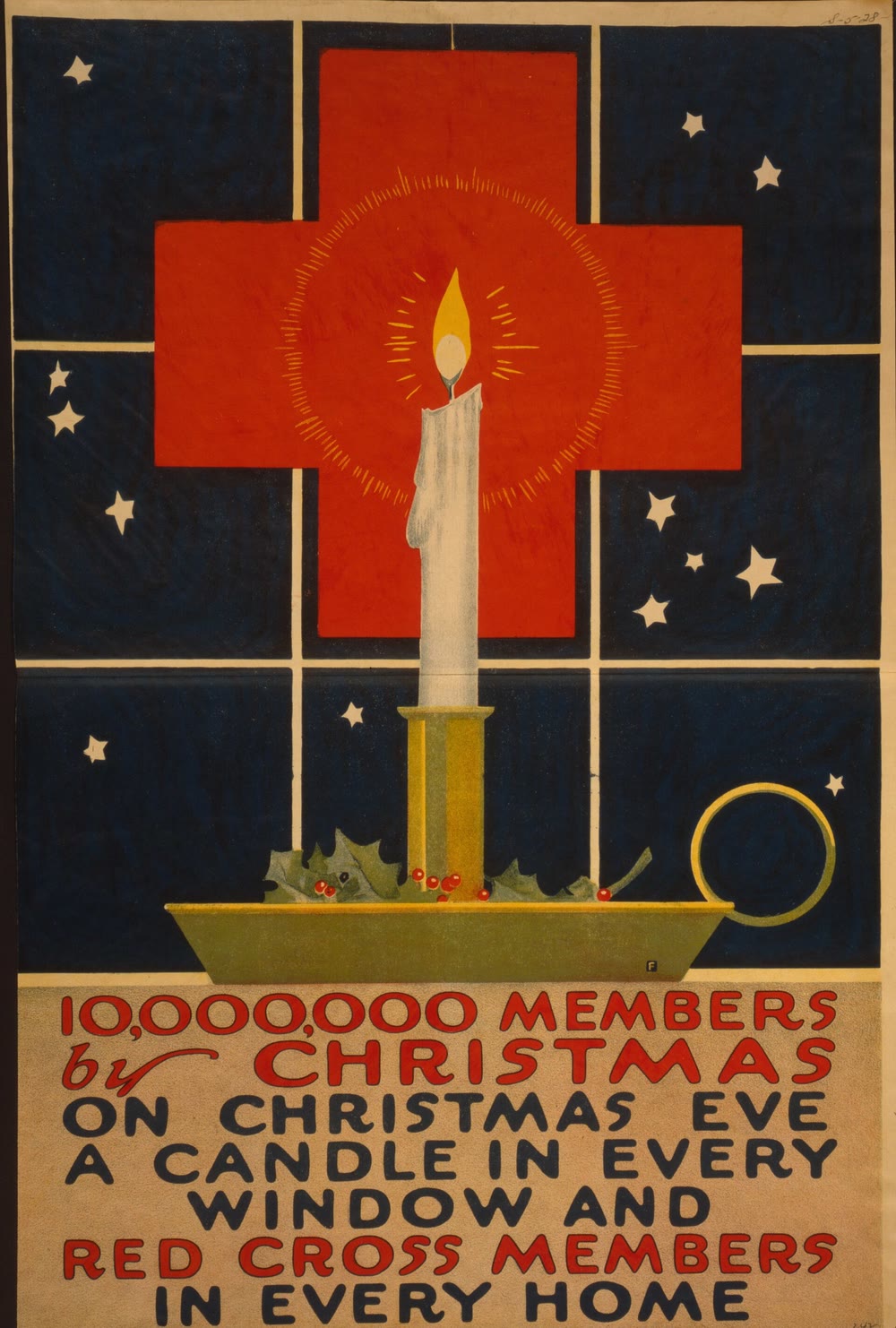
American Red Cross poster by C. B. Falls, 1917. Library of Congress. Public domain, via Wikimedia Commons
In the 1930s Colonial Williamsburg took it up, an idea credited to its landscape architect, Arthur Shurcliff, born a Shurtleff in Boston, who remembered his family’s candle.
None of this proves the Irish played no part. But the American custom has a paper trail of its own, and so far it doesn’t run through Ireland.
How to light the candle today, safely
Some Irish homes still do it, these days often with an electric light. As I’ve admitted in my Christmas in Ireland guide, it’s one tradition I never did myself, though I’ve said I’d start. If you’d like to try it, here’s how.
- When and where: at dusk on Christmas Eve, in the main window. If you like, relight it each evening until 6 January, Nollaig na mBan.
- Who: the youngest in the house, with an adult’s help.
- What to say: I can find no fixed words. An Irish Christmas blessing would suit, or a quiet Nollaig Shona, and the names of whoever is away.
A safer candle
A naked flame in a window, beside curtains and holly, is a real risk. In the United States, Christmas is the peak day for candle fires, at about two and a half times the daily average, says the National Fire Protection Association, and in three of every five the candle stood too close to something that could burn.
- Best for all night: a battery LED candle on a timer, or an electric window candle.
- If you want a real flame: use a heavy holder on a non-flammable dish, keep it at least 12 inches (30 cm) from curtains, holly and paper, and stay in the room.
- Never leave a real candle burning overnight or within reach of children and pets.
Nobody out on the road can tell the difference. And remember who it’s for. In that 2017 column, Ferriter tied the candle to people with no home in “a land of plenty”. The old accounts would have understood. The candle was lit for whoever was outside, and they left the door open too.
The Irish words
Neither Ó Dónaill’s dictionary nor focloir.ie has a set phrase for Christmas candle. Both give coinneal, candle. These forms are in real use.
- coinneal (KIN-yal): a candle. The plural is coinnle (KIN-lyuh).
- coinneal na Nollag (KIN-yal nuh NULL-ug): the Christmas candle.
- coinneal mhór na Nollag (KIN-yal wore nuh NULL-ug; mhór sounds closer to “vore” in Munster): the big Christmas candle. You’ll see “coinneal mór” online, but coinneal is feminine, so the adjective needs its h.
- fuinneog (FWIN-yohg, or fwin-YOHG in Munster): a window. Mac Amhlaigh’s sa bhfuinneog, in the window, is san fhuinneog in standard Irish.
Candle in the window FAQ
Why do the Irish put a candle in the window at Christmas?
Mainly as a welcome. Folk accounts say it lit the way for Mary and Joseph and told any stranger they’d find shelter.
Who should light the Irish Christmas candle?
Often the youngest child, though some accounts give the job to the woman of the house.
Could only a girl named Mary put it out?
That’s doubtful as a national rule. The oldest record I can find is one Irish family in London, and it’s about snuffing the candle.
Did the candle signal a safe house for priests?
That’s unproven. The earliest telling I can find is from 1952, with no source.
What is the Irish for Christmas candle?
Coinneal na Nollag (KIN-yal nuh NULL-ug), or coinneal mhór na Nollag for the big Christmas candle.
Love this? Save it to your Pinterest board for later.
Pin image: A single candle burning in the dark. Photo: Pinakpani, CC BY-SA 4.0, via Wikimedia Commons
A little bit of Ireland in your inbox every Friday ☘️
The free Weekly Dose of Irish: an Irish joke, a Celtic symbol, an Irish fact, a poem and the week’s best articles in one short email. Join 9,600+ readers.
Free. One short email every Friday. Unsubscribe any time.
More Irish Christmas reading
- 18 Irish Christmas Traditions, From the Candle in the Window to the 12 Pubs
- Merry Christmas in Irish: How to Say Nollaig Shona Duit (Plus 35 Christmas Words)
- 20 Irish Christmas Blessings and How to Say Merry Christmas in Irish
- Christmas in Ireland: What It’s Really Like (A Visitor’s Guide for 2026)
- The American Wake: Ireland’s All-Night Farewell for Emigrants to America
- Irish Christmas Songs
Featured image: A single candle burning in the dark. Photo: Pinakpani, CC BY-SA 4.0, via Wikimedia Commons.