All Souls’ Day, 2 November, is the day Catholics pray for everyone who has died; in 2026 it falls on a Monday. All Saints’ Day, the day before, honours the saints in heaven. In Ireland November is the month of the Holy Souls, with parish lists of the dead and the blessing of graves. On All Souls’ Night many homes once swept the hearth, left out water and food, lit candles in the windows and left the door unlocked for the dead coming home. In Irish the day is Lá Fhéile na Marbh.
The family Rosary is over, and all the souls have been prayed for. The door is left open, and a good fire burns on the hearth. In the kitchen there’s a bucket of spring water, freshly drawn, and plenty of food, so the dead will be warm and fed when they come back to the house they knew.
Near midnight, the head of the house rises once more, takes a white cloth and waves it after the departing souls, saying goodbye and inviting them back next year.
A schoolgirl, Eileen Fitzgibbon, wrote that down at Kilcounty school in Co. Cork in the late 1930s, from Mr T. Fitzgibbon of nearby Castletown, for the Schools’ Collection. It’s All Souls’ Night as many Irish country homes once kept it.
My Samhain guide covers Halloween. This one is about 2 November and the month that follows.
Jump to:
- What is All Souls’ Day?
- Where All Souls’ Day came from
- Who are the Holy Souls?
- Masses for the dead and the November list
- Visiting and blessing the graves
- The November plenary indulgence, explained
- All Souls’ Night: the unlocked door and the laid table
- Candles in the window
- The “salt and water” custom: what’s old and what’s new
- Prayers for the dead in Irish
- All Souls’ Day FAQ
- More Irish heritage reading
What is All Souls’ Day?
All Souls’ Day is 2 November. Its formal name is the Commemoration of All the Faithful Departed, and it’s the Catholic Church’s day of prayer for everyone who has died.
In Irish it’s Lá Fhéile na Marbh (law AY-luh nuh MAR-uv; closer to MAR-oo in much of Connacht and Ulster), the feast day of the dead, as Ó Dónaill’s dictionary gives it on teanglann.ie. Written “La Feile na Marbh”, it has lost its fadas: keep them on Lá and Fhéile, and keep the h in Fhéile.
All Saints’ Day vs All Souls’ Day
- All Saints’ Day, 1 November: Lá Fhéile na Naomh Uile (law AY-luh nuh nayv IL-uh; naomh is nearer “nee” in Connacht and Ulster). It honours all the saints in heaven, and Catholics ask for their prayers. It’s a holy day of obligation in Church law and in Ireland, and its eve is Halloween.
- All Souls’ Day, 2 November: the day to pray for all who have died, above all those Catholics believe are still being made ready for heaven. It isn’t a holy day of obligation.
In the 1930s folklore accounts, All Souls’ Night often means the evening of 1 November, though some give 2 November.
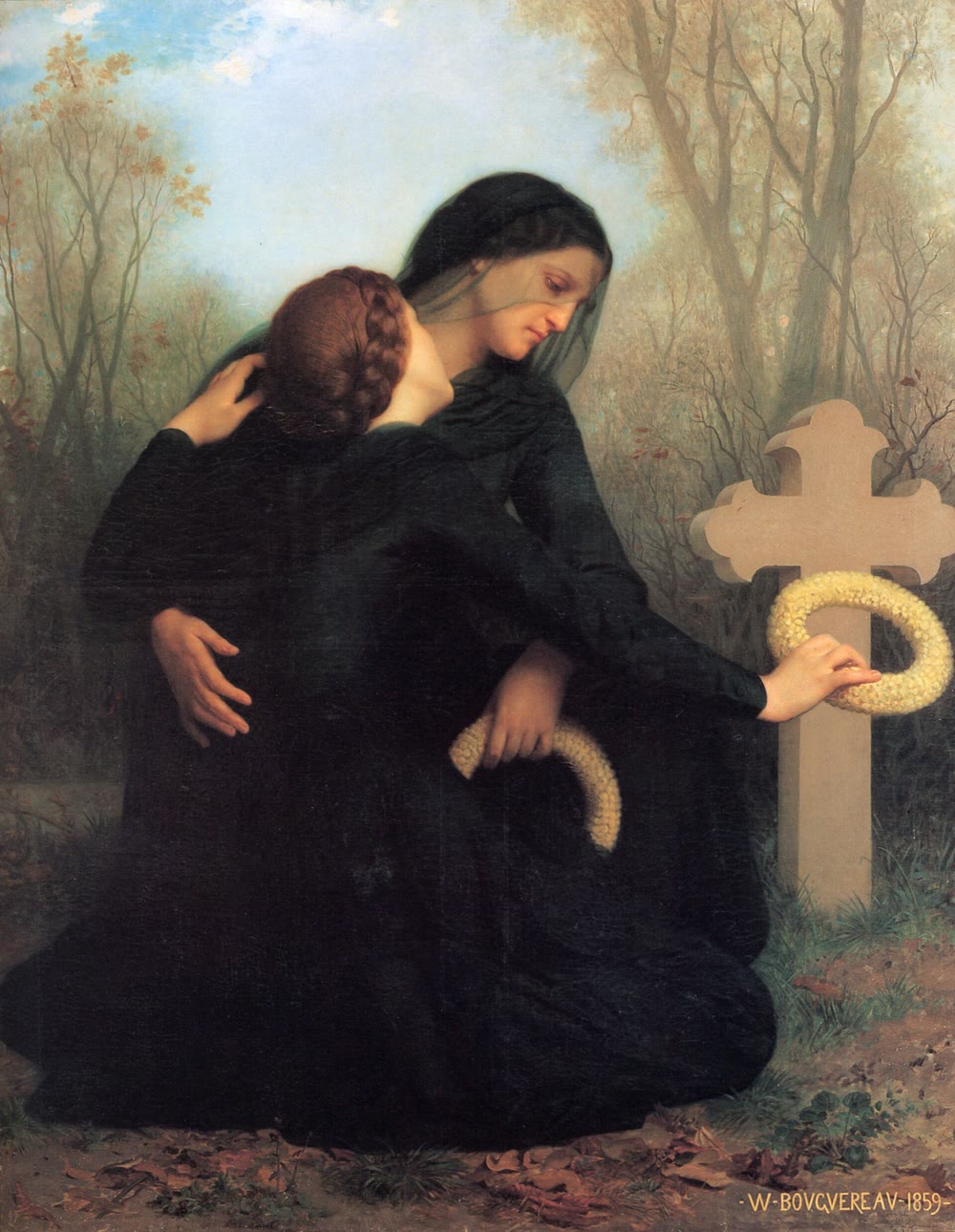
The Day of the Dead (Le Jour des morts, the French name for All Souls’ Day), painted by William-Adolphe Bouguereau in 1859. Musée des Beaux-Arts de Bordeaux. Public domain, via Wikimedia Commons
Where All Souls’ Day came from
Praying for the dead is far older than the feast: the Catechism of the Catholic Church points back to Judas Maccabeus making atonement for fallen soldiers in the Second Book of Maccabees.
Early Irish grave inscriptions often begin OR DO, short for Old Irish oróit do, “a prayer for”, followed by a name; the Electronic Dictionary of the Irish Language notes the formula is common on tombstones.
Clonmacnoise, the monastery St Ciarán founded beside the Shannon in the sixth century, has more than 700 early Christian grave slabs, says Heritage Ireland. One reads OROIT DO THUATHAL SAER: “a prayer for Tuathal the craftsman”, in R. A. S. Macalister’s 1949 reading, as the Discovery Programme records it. Another asks a prayer for Odhrán Ua hEolais; the Annals of the Four Masters record the death of an Odhrán Ua hEolais, scribe of Clonmacnoise, under the year 994.
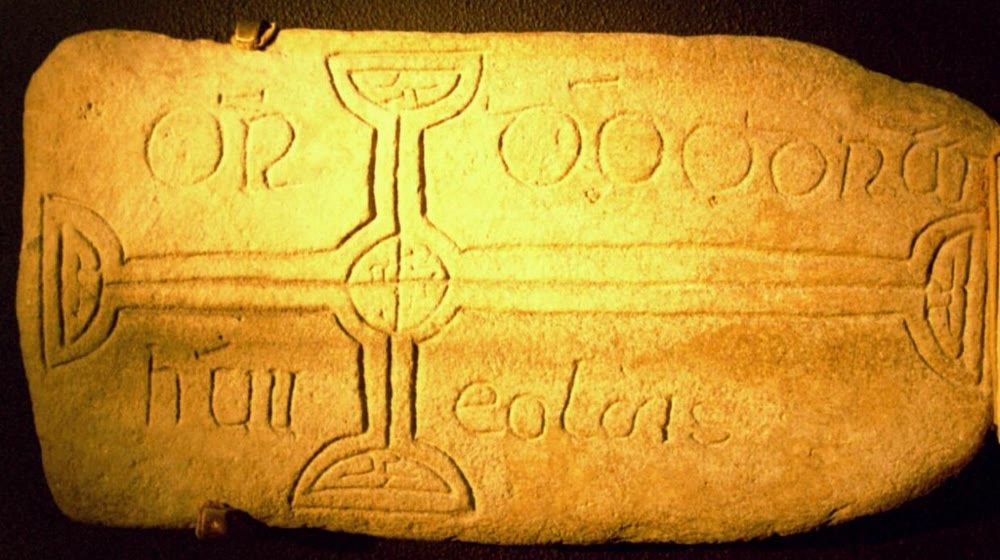
An early medieval grave slab from Clonmacnoise, Co. Offaly, carved with a cross and a prayer for Odhrán Ua hEolais. Photo: Andreas F. Borchert, CC BY-SA 4.0, via Wikimedia Commons
A single day for all the dead came later. The Catholic Encyclopedia (1907) credits Odilo, abbot of Cluny in Burgundy (died 1048), who had the monasteries under him keep a yearly commemoration of all the faithful departed. The date usually given is 998, though the encyclopedia’s entry on Odilo puts it probably after 1030. From Cluny it spread across the Western Church.
The First World War left its mark too. Priests in Spain and Portugal had been allowed three Masses on 2 November since 1748; in 1915, with so many young men being killed, Benedict XV extended that to the whole Western Church, the Diocese of Westminster explains: one Mass for any intention, one for all the dead, one for the Pope’s intentions.
Who are the Holy Souls?
In Irish Catholic speech, the souls in purgatory are “the Holy Souls” or “the poor souls”, the names the 1930s accounts use. Purgatory in Irish is purgadóir (PUR-guh-dohr; pur-guh-DOHR in Munster).
The Catechism describes purgatory as a final purification for people who die in God’s friendship but still need cleansing before heaven. The living can help them, it teaches, above all through the Mass, and also through almsgiving, indulgences and penance. The Irish bishops call November a month when Catholics traditionally pray for their dead.
Masses for the dead and the November list
The Church offers Mass for the dead at the funeral, on the third, seventh and thirtieth days after death and on anniversaries, says the Vatican’s Directory on Popular Piety and the Liturgy (2001). In Ireland the best known is the month’s mind, a memorial Mass about a month after the death, explained in my guide to Irish wake traditions. On 2 November, the Church offers Mass for all the dead.
Then there’s the November list of the dead, which Irish parishes still keep:
- Around the start of November, envelopes appear at the back of the church.
- You write the names of your dead on one and hand it back, usually with an offering, in the collection basket or at the parish office.
- The names are remembered at the Masses through November. Blackrock parish in Co. Dublin, for one, said in 2023 it also prays for them on first Fridays through the following year, and that the offerings support its clergy.
The Irish Catholic Bishops’ Conference mentions parish remembrance trees and candles for the month too. If your family is buried in Ireland and you live abroad, ask their home parish whether names can be added.
Irish has a phrase for this: Aifreann a chur le hanam duine (AF-run uh khur leh HAN-um DIN-uh), to have a Mass said for someone’s soul. Ó Dónaill also records a surprising idiom: tá airgead le hanamacha na marbh aige, literally he has money for the souls of the dead, meaning he has money to burn.
One older custom has faded. A 1930s pupil in Cappamore, Co. Limerick, wrote that people visited the churches on All Souls’ Night “to do the rounds”, believing each visit, with certain prayers, freed a soul from purgatory. It echoes the old “toties quoties” (as often as) indulgences, gained again and again in a day until Paul VI’s 1967 reform limited a plenary indulgence to once a day.
Visiting and blessing the graves
November is a month for graveyard visits. The Irish bishops’ conference lists the blessing of the graves among this season’s parish events, and a prayer on its November page blesses graves with holy water and incense.
Planning a trip home? Check the date. In much of Ireland the big annual blessing of the graves, the cemetery Mass or cemetery Sunday, is a summer event set by each parish; Fr Martin Delaney wrote in The Irish Catholic in 2015 that families build their summer holidays around it.
The Vatican’s Directory pictures families tending their graves with flowers and lamps, and asks that this grow from the bond between the living and the dead, not from superstitious fear.
The older Irish way was candlelight. In Knockaclarig, Co. Cork, a 1930s list of the year’s customs notes that on All Souls’ Night families lit candles on the graveyard wall for their dead.
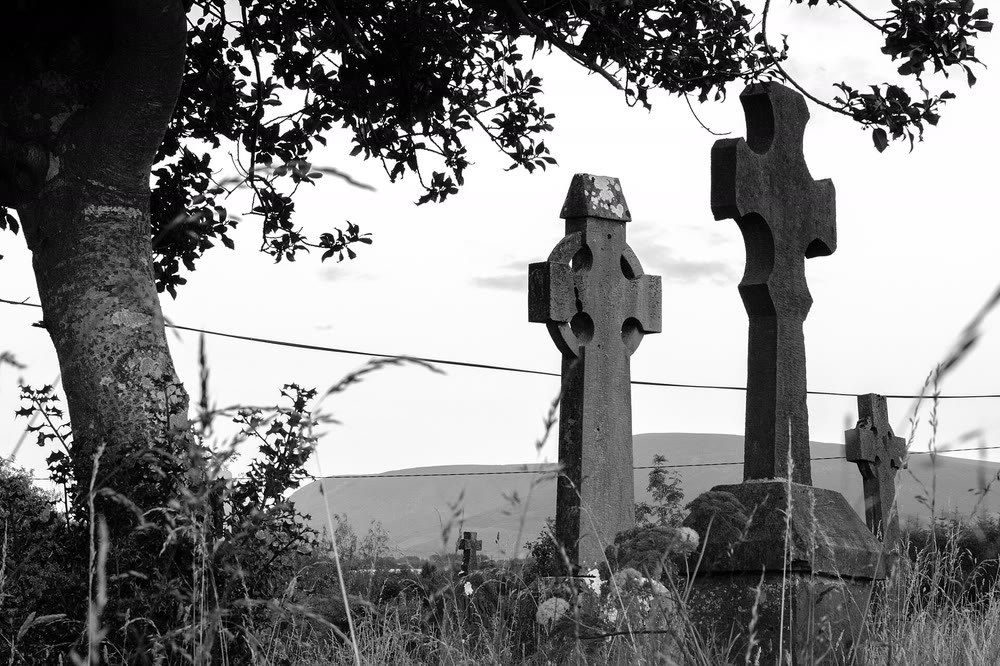
Celtic cross headstones in Freemount graveyard, near Rathmore, Co. Kerry, on an early autumn evening. Photo: Johnclynch, CC BY-SA 4.0, via Wikimedia Commons
The November plenary indulgence, explained
In Catholic teaching, an indulgence remits the temporal punishment still due for sins already forgiven; a plenary one remits all of it, and it can be offered for the dead, as Paul VI’s Indulgentiarum Doctrina (1967) sets out.
Two November plenary indulgences apply only to the souls in purgatory, as the Vatican’s Apostolic Penitentiary summed them up in 2020:
- The cemetery visit, 1 to 8 November: visit a cemetery and pray there for the dead, even silently. You can gain it once on each of those days.
- All Souls’ Day, 2 November: go into a church or oratory and pray the Our Father and the Creed. Where the bishop allows, it can be gained instead on the Sunday either side, or on All Saints’ Day.
Both carry the usual conditions: confession, Holy Communion, prayer for the Pope’s intentions (an Our Father and a Hail Mary will do) and no attachment to sin, even venial sin; otherwise the indulgence is only partial. The conditions can be met several days either side, and one confession covers several indulgences.
Covid-era decrees in 2020 and 2021 stretched both across the whole of November; those were one-offs.
All Souls’ Night: the unlocked door and the laid table
Here folk belief went beyond Church teaching. Between 1937 and 1939, national school pupils across what is now the Republic collected their elders’ lore for the Irish Folklore Commission. Many accounts, now on dúchas.ie (DOO-khus), share one idea: the dead were coming home, and the house had to be ready.
- The door: in Altachullion, Co. Cavan, the kitchen door wasn’t locked, and the family went to bed early so the house would be ready for the dead. In Aghamore, Co. Sligo, it was latched but not locked, in case any souls were wandering about.
- The fire: both accounts sweep the floor or hearth clean and leave a good fire burning.
- The table: in Banteer, Co. Cork, the table was laid with the usual supper and the tongs placed to the right of the fire, so all was ready for the departed. In Lucan, Co. Dublin, a window was left open for the poor souls, and colcannon set out on a plate. There’s more on that supper in my colcannon recipe.
- Protection: in Athboy, Co. Meath, one family kept a wooden cross wrapped in straw over the door against evil on All Souls’ Night, swapping it for a new one every eleven years.
Halloween could feel the same, as my guide to how the Irish invented Halloween explains. In Knockanevin, Co. Cork, a pupil wrote that people were afraid to go out on Halloween night, believing their dead friends were let out of purgatory for the night.
Not everyone believed it. A Cappamore pupil noted that some people thought the holy souls came back that night, while others called the idea superstition. The Church’s Directory on Popular Piety says customs like these, worldwide, often spring from a wish to keep family ties with the dead, but warns against divination and fear.
Candles in the window
Candles turn up in account after account. In Rathdowney, Co. Laois, a candle went in every window on All Souls’ Night and was left burning through the night. In Cappamore, a candle on each windowsill was lit for the souls suffering in purgatory, and people said it guided them to heaven.
In Corluddy, Co. Kilkenny, the candles were blessed ones, the blinds were raised and the doors left unlocked, since the departed were believed to visit their old homes. In Kilmakill, Co. Tipperary, the candle told the souls they were welcome and guided them on. Knockanevin added a neighbourly reason: any stranger passing in the dark could see his way.
In Ballylooby, Co. Tipperary, the custom was still faithfully kept, and in many homes the candles burned all night. It’s a cousin of the candle Irish families light in the window on Christmas Eve, as in my Irish Christmas traditions; the Corluddy and Ballylooby pupils describe both. A blessed candle in Irish is coinneal choisricthe (KIN-yul KHUSH-rik-huh).
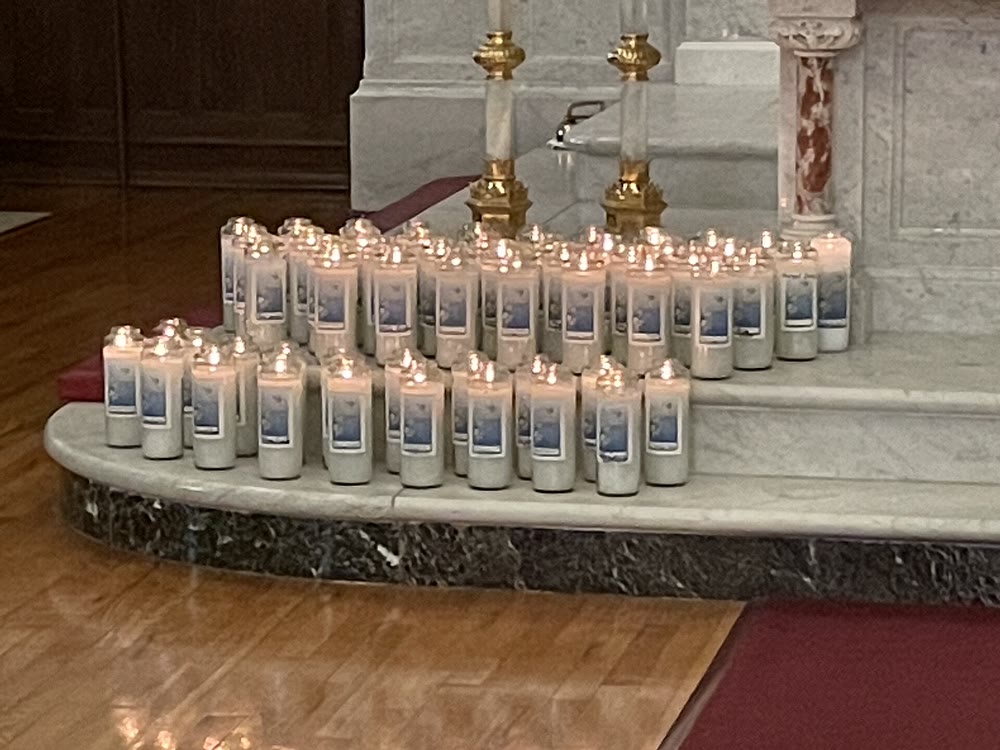
Candles lit for All Souls’ Day at St Anthony’s Church, Casper, Wyoming, in November 2022. Photo: Twillisjr, CC BY-SA 4.0, via Wikimedia Commons
The “salt and water” custom: what’s old and what’s new
The water is genuinely old. In Doonbeg, Co. Clare, a pupil’s list of beliefs says a pail of spring water should be kept in the house overnight, with the hearth swept, for the Holy Souls; it doesn’t mention November. In Lucan, a glass of water was left on the table on All Souls’ Night in case the poor souls were thirsty. In Rathcoffey, Co. Kildare, Molly Reilly’s father told her to set a basin of water down on the floor that night so the souls could bathe their feet, and never to throw water out on All Souls’ Day, or you’d throw it in their faces. A similar Halloween rule turns up in other schools; see my Irish superstitions.
The salt is harder to find. In the Schools’ Collection it mostly guards the dairy: in Knockaclarig, Doonbeg and other schools, a pinch or a grain went into milk given away, and several pupils explain why: so the house’s butter wouldn’t go with it. A search of the collection finds no salt set out for the souls. A 2021 post on the local news site Thurles.info sets a container of salt beside a bowl of spring water on the All Souls’ table, but gives no source.
Some of it is new. In “Names and Tears”, a modern All Souls and Samhain ritual by Tiffany Fae Anderson on the Unitarian Universalist Association’s website, mourners drop a pinch of salt into a bowl of water, like tears, for those they’ve lost. It’s a recent liturgy, not an old Irish custom.
And holy water has salt in its history. The Catholic Encyclopedia (1912) describes salt being exorcised and blessed for making holy water, which is what the priest uses at the blessing of the graves.
Prayers for the dead in Irish
My Irish funeral blessings guide has everyday phrases like Ar dheis Dé go raibh a anam. These are the November ones, checked in Ó Dónaill’s dictionary.
Eternal rest
Suaimhneas síoraí tabhair dóibh, a Thiarna (SOO-iv-nyus SHEER-ee TOOR DOH-iv, uh HEER-nuh): eternal rest give them, O Lord. These are the opening words of the Eternal Rest prayer in Irish. In the 1930s a pupil in Douglas, Co. Kerry, recorded them, in older spelling, at the end of a prayer said when passing a graveyard. The Latin original, Requiem aeternam, is often added to the Angelus, the Rosary and grace at meals, the Vatican’s Directory notes.
God’s blessing on the souls of the dead
Beannacht Dé le hanamacha na marbh (BAN-ukht JAY leh HAN-um-ukh-uh nuh MAR-uv): God’s blessing on the souls of the dead.
In Tullaha, Co. Kerry, Pádraig Ó Súilleabháin of Milleens gave the school a grace after meals built around this line, with go léir (guh LAYR), all, added. It blesses the dead, the Catholics in purgatory and the forebears who went before (literally “the seven ancestors”), and asks God to lift from the poor souls any stain this life left, like a missed Mass. There are more table prayers in my Irish grace before meals.
The manuscript has hanmanna, an older plural; today’s standard is hanamacha. Mind the h: after le, a word beginning with a vowel takes an h, so it’s le hanamacha, never “le anamacha”.
A few November words
- anam (AN-um): soul; plural anamacha (AN-um-ukh-uh). It’s the anam in anam cara.
- na mairbh (nuh MAR-iv): the dead. Na marbh means “of the dead”.
- Aifreann na marbh (AF-run nuh MAR-uv): a requiem Mass.
- reilig (REL-ig): a graveyard.
The Irish bishops’ November 2020 message began with this line: Ní imithe uainn atá siad, ach imithe romhainn (nee IM-ih-huh OO-in uh-TAW SHEE-ud, okh IM-ih-huh ROH-in): they haven’t left us, they’ve only gone on ahead.
All Souls’ Day FAQ
When is All Souls’ Day 2026?
Monday 2 November 2026. All Saints’ Day is Sunday 1 November.
What’s the difference between All Saints’ Day and All Souls’ Day?
All Saints’ Day (1 November) honours the saints in heaven and asks their prayers. All Souls’ Day (2 November) is for praying for all the dead.
What are the Irish traditions for All Souls’ Day?
Mass, the November list of the dead, and visiting and blessing the graves. In older times, people swept the hearth, built up the fire, left out food and water, lit candles in the windows and left the door unlocked for the dead.
Is All Souls’ Day a holy day of obligation?
No. All Saints’ Day is one under canon 1246 of Church law, but All Souls’ Day is not on the list.
How do you say All Souls’ Day in Irish?
Lá Fhéile na Marbh (law AY-luh nuh MAR-uv).
Why is November the month of the Holy Souls?
It opens with All Saints and All Souls, the cemetery indulgence runs from 1 to 8 November, and parish lists of the dead are remembered all month.
Love this? Save it to your Pinterest board for later.
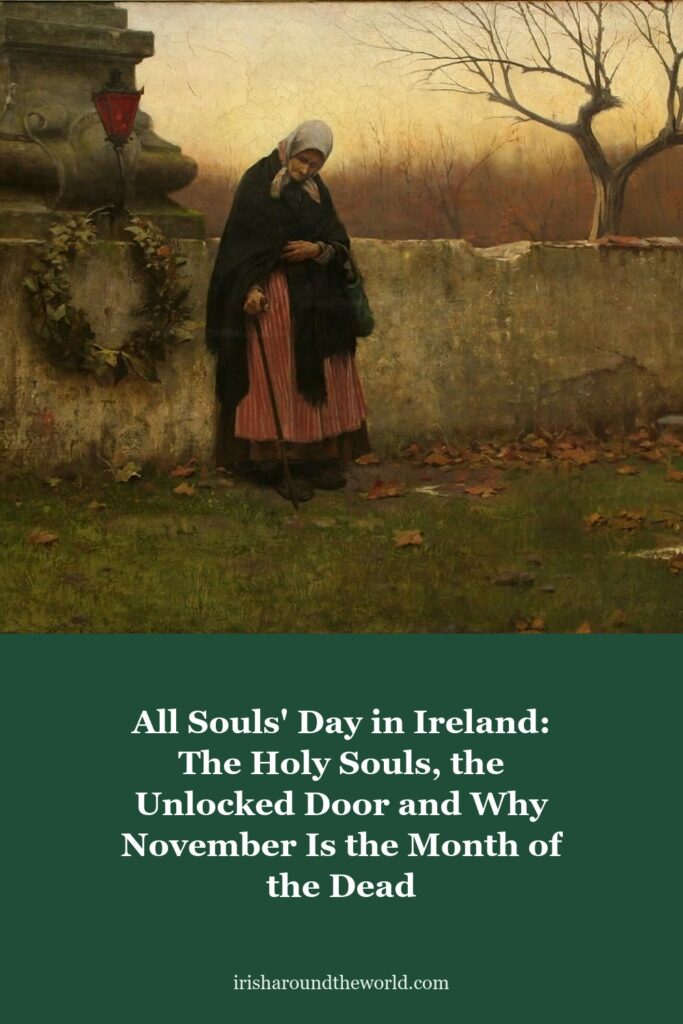
Pin image: All Souls’ Day (Na Dušičky) by Jakub Schikaneder, 1888, National Gallery Prague. Public domain, via Wikimedia Commons
A little bit of Ireland in your inbox every Friday ☘️
The free Weekly Dose of Irish: an Irish joke, a Celtic symbol, an Irish fact, a poem and the week’s best articles in one short email. Join 9,600+ readers.
Free. One short email every Friday. Unsubscribe any time.
More Irish heritage reading
- Samhain: The Night the Fairy Mounds Opened and How It Became Halloween
- Irish Wake and Funeral Traditions: Keening, Clay Pipes and What to Say
- Irish Funeral Blessings and Prayers: Words of Comfort in English and Irish, and Their True Origins
- How the Irish Invented Halloween: Samhain, Turnip Lanterns, Barmbrack and the Best Festivals in Ireland
- Irish Superstitions: 40 Old Beliefs About Luck, Death, Birds and the Fairies
Featured image: All Souls’ Day (Na Dušičky) by Jakub Schikaneder, 1888, National Gallery Prague. Public domain, via Wikimedia Commons.