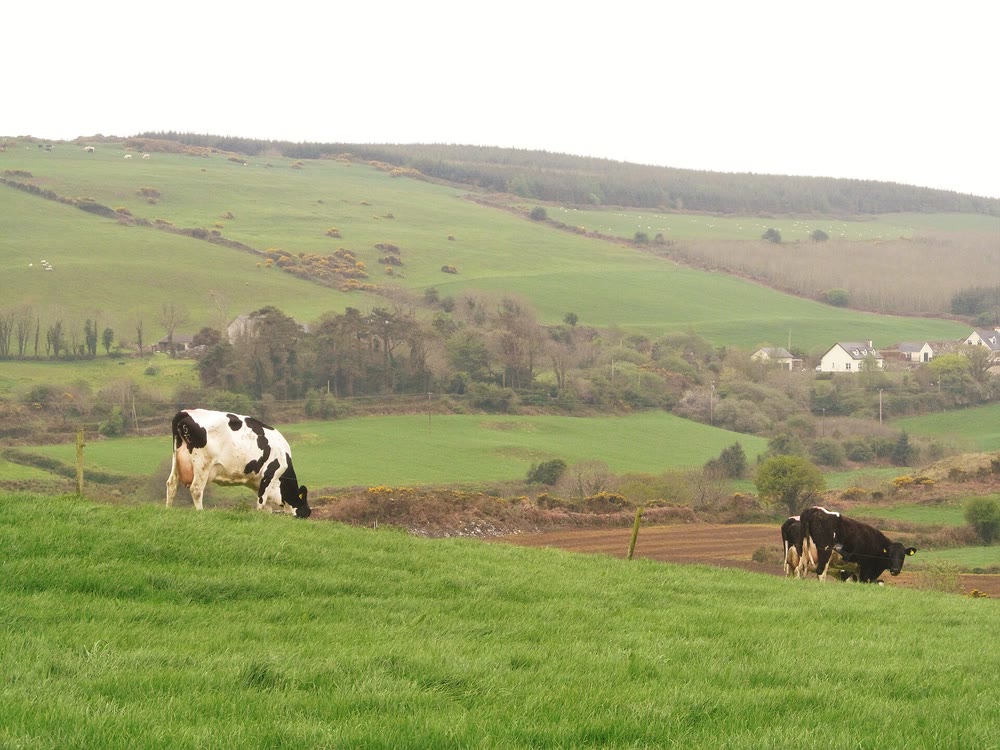
Irish butter is so yellow because of grass. Irish dairy cows average 240 days a year at pasture, says Bord Bia, and fresh grass carries beta-carotene, a natural pigment that ends up in the milk fat. The famous fat gap is smaller than you’d think: Kerrygold lists its US salted butter at 80% butterfat and its unsalted at 82%, against an American legal minimum of 80%. Grazing also makes butter softer and changes its flavour. Cork once ran the world’s largest butter market, and butter buried in Irish bogs has been dated to about 1700 BC.
Put a block of Irish butter beside a stick of ordinary American butter and you won’t need the label. One is a deep, golden yellow. The other is much paler.
Americans have noticed. Kerrygold’s US retail sales topped $1 billion for the first time in 2025, and it’s now the country’s second best-selling branded butter.
But butter in Ireland is far older than any foil wrapper. It paid rents, filled ships at Cork, frightened farmers every May Eve and lay in bogs for thousands of years. Here’s the science, the 82% claim (which isn’t quite what you’ve been told), how to bake with it, and the stories behind it.
Jump to:
- Why is Irish butter so yellow?
- Why does it taste different?
- Is Irish butter really 82% butterfat?
- How Kerrygold went abroad
- Salted or unsalted for baking?
- Cork’s great butter market
- Bog butter
- May Eve butter thieves
- Irish butter FAQ
- More reading
Why is Irish butter so yellow?
Fresh pasture is rich in beta-carotene, a plant pigment the body can turn into vitamin A. It dissolves in fat, so it moves into the cow’s milk fat and stays there when the cream is churned.
Teagasc, Ireland’s state farm and food research agency, tested this at Moorepark in Co. Cork. Researchers split 54 Friesian cows into three herds, one indoors on silage and concentrates and two out grazing. Butter from the grazing herds had significantly more beta-carotene, and Teagasc calls its colour “golden”.
How long are Irish cows really on grass?
Bord Bia, Ireland’s food board, says Irish dairy cows spend, on average, 240 full days a year at pasture and that grass makes up 95% of their diet. Both figures appear in its 2025 dairy brochure and sit behind its Grass Fed Standard, which uses audit data from its national dairy assurance scheme. Teagasc repeats the 240 days, and a 2019 estimate gave 95% to 100% of Irish dairy cows pasture access. The picture is sound, but note three things:
- It’s an industry figure, not a census. The Carbery-backed Farm Zero C project gives 241 days, varying by region, but a 2016 Irish Grassland Association booklet spoke of a 210-day season nationally.
- The cows aren’t out all year. 240 days leaves about four months indoors.
- The 95% is a pooled average by fresh weight, and it counts grass forage as well as grazing. A single herd needs only 90%. Grass is mostly water, so the share falls by dry matter: one Teagasc paper put the typical Irish diet at 96% pasture by fresh weight but 82% by dry matter.
For comparison, US organic rules demand a grazing season of at least 120 days. USDA data from 2013, cited in a 2020 review, had fewer than 3% of American milking cows mainly on pasture, and about one in five with some pasture access.
US federal law does allow “additional coloring matter” in butter, so colour alone proves little, though Kerrygold’s labels list none.
Here’s a twist. When Teagasc tried salted butters from three feeding systems on consumers in Ireland, Germany and the US, the Americans preferred the look of the butter from indoor-fed cows. The Irish and Germans preferred the deeper yellow. Familiarity, the researchers said, was the likely reason.
Why does Irish butter taste different?
Grass changes the fat as well as the colour. Milk from grazing cows has more unsaturated fat, while an indoor ration raises palmitic acid, which firms butter up. In the Moorepark study, the indoor butter was significantly harder at room temperature, which helps explain why a grass-fed block spreads so easily.
Flavour shifts too. In the three-country study, a trained US panel found a grassy note in butter from grass-fed cows and none in the concentrate-fed butter. The earlier Moorepark panel liked the grass butter’s flavour and colour better, but in the three-country study overall liking didn’t differ between the feeding systems in any country. Irish butter is different. Whether it’s better is between you and your toast.
Kerrygold’s two US butters aren’t even the same butter with and without salt. The salted lists pasteurized cream and salt. The unsalted lists pasteurized cream, skimmed milk and cultures, so it may taste a little tangier.
Is Irish butter really 82% butterfat?
You’ll read everywhere that Irish butter is 82% fat against America’s 80%. That’s only half right. Kerrygold’s own US FAQ gives 80% for its salted butter and 82% for its unsalted. Packs in other countries may differ, so check the label.
The legal floors match as well. US federal law requires at least 80% milk fat. EU law defines butter as at least 80% and under 90% milk fat, with no more than 16% water. So a salted block of Irish butter may hold no more fat than a standard American stick. The real differences are colour, texture and flavour.
| Feature | American butter | Irish butter (Kerrygold, US) | European-style butter |
|---|---|---|---|
| Butterfat | At least 80% by law | 80% salted, 82% unsalted | About 82% to 86% |
| Colour | Usually paler; added colouring is legal | Deep yellow, from beta-carotene | Depends on the cows’ feed |
| Cows’ diet | Under 3% of milking cows mainly on pasture (2013) | About 95% grass and forage by fresh weight | Varies widely by country |
How Kerrygold took Irish butter abroad
The Irish government set up An Bord Bainne, the Milk Board (roughly un bord BAN-yuh), on 17 May 1961 to build dairy exports. By 1962 its general manager was Tony O’Reilly, 26 and already a famous rugby player. Irish dairying was split among about 100 co-ops, making more milk than the country could use. His answer was one brand for all of it.
Sixty names were suggested, says Ornua, as the board is now called, and six made the shortlist: Buttercup, Shannon Gold, Leprechaun, Tub-o-Gold, Golden Farm and Kerrygold. Despite the name, it’s a national brand, not a Kerry butter: Ornua’s Kerrygold Park plant is in Mitchelstown, Co. Cork.
The brand launched in October 1962, not in Ireland but in north-west England. O’Reilly went to Manchester for it. It didn’t reach Irish shops until 1973, the year Ireland joined the EEC and Kerrygold headed for Germany.
America came later. Kerrygold cheese arrived in 1991, aimed at the Irish diaspora, and the butter followed about eight years after that.
Salted or unsalted for baking?
This matters most when the Thanksgiving pies and Christmas cakes come out. King Arthur Baking sets out clear rules that apply just as well to Irish butter:
- Butter-rich cakes and cookies: use unsalted, so you control the salt. King Arthur calls for it when a recipe has at least 4 tablespoons of butter per cup of flour.
- Only have salted? Cut the recipe’s added salt by ¼ teaspoon for every stick (8 tablespoons, 113g) of butter.
- Shortbread: use salted. The dough is so thick and dry that added salt struggles to spread through it.
- The table: salted, on warm soda bread or a slice of Irish brown bread.
King Arthur also warns that European-style butters of 82% to 86% fat can give a greasy or drier result in recipes not written for them. Kerrygold sits at or below the bottom of that range, so a straight swap should suit most home recipes.
Pasture butter is softer at room temperature, so keep it cold for pastry. Stocking up for the holidays? Kerrygold says its butter freezes for as long as 18 months and lasts a month in the fridge once opened.
Something to make? Try my Irish Christmas cake (two sticks of butter, plus a pinch of salt if yours is unsalted), porter cake with its butter rubbed in cold, or colcannon, with its melting pool in the middle.
Cork: the world’s largest butter market
Before foil wrappers, Irish butter travelled in the firkin, a wooden cask (feircín in Irish, roughly FER-keen). Its weight is disputed: accounts run from 56 to 80 pounds, and the Butter Museum’s director calls 70 defensible. The trade’s capital was Cork.
Shandon’s Butter Exchange dates from 1769, says the Butter Museum, on a site that had held a butter market since the early 1700s. (Some accounts give 1770.) A body of local traders, the Committee of Merchants, ran it, and its big idea was quality control. Inspectors judged every firkin for colour, smell, salt and moisture, then graded it from first to sixth. To head off bribes, the museum says, each of six inspectors drew lots daily for his patch of the market.
The Cork name became worth money. In 1835, a third of Ireland’s butter exports left from Cork. At its height, 400,000 or more firkins a year went through: the Irish Farmers Journal says 400,000 in the late 1870s, the museum some 440,000 in the early 1880s. Salted hard to keep, the butter sailed to England, America, Africa, Australia, Brazil and the West Indies.
That trade has a darker side. The historian Gillian O’Brien has shown that Cork’s butter, beef and pork helped supply slave ships and West Indian plantations, and that some families tied to the Cork trade owned plantations themselves.
The butter roads
The butter reached Cork along routes known as the butter roads. One of the main ones, the Old Kerry Road, runs almost straight from Castleisland in Kerry through Millstreet to the city, local historians say. John Murphy of Castleisland built it as a turnpike in the late 1740s.
Evidence given to a parliamentary committee in 1823 described a farmer covering some 70 miles with two firkins, taking no lodging: “he travels night and day”. Near Millstreet, a flat rock called the Kerryman’s Table was the traditional rest stop.
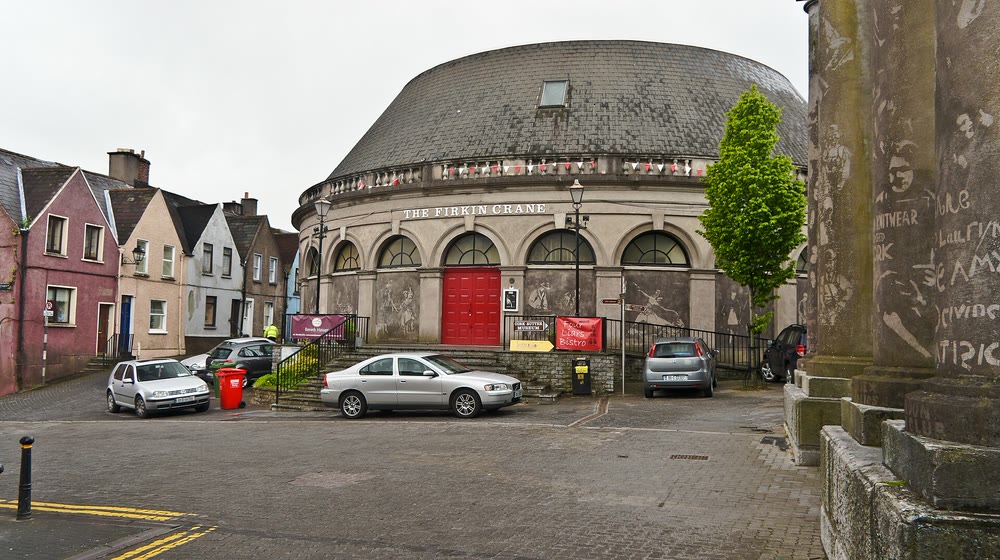
The Firkin Crane in Shandon, Cork, designed by Sir John Benson and opened in 1855. Photo: William Murphy, CC BY-SA 2.0, via Wikimedia Commons
What ended it
Tastes changed. British buyers came to prefer milder Danish and blended French butter to heavily salted Irish butter in wooden casks, and margarine undercut it at home. Co-operative creameries spread through Ireland, the first at Dromcollogher, Co. Limerick, in 1889. The Exchange closed in 1924.
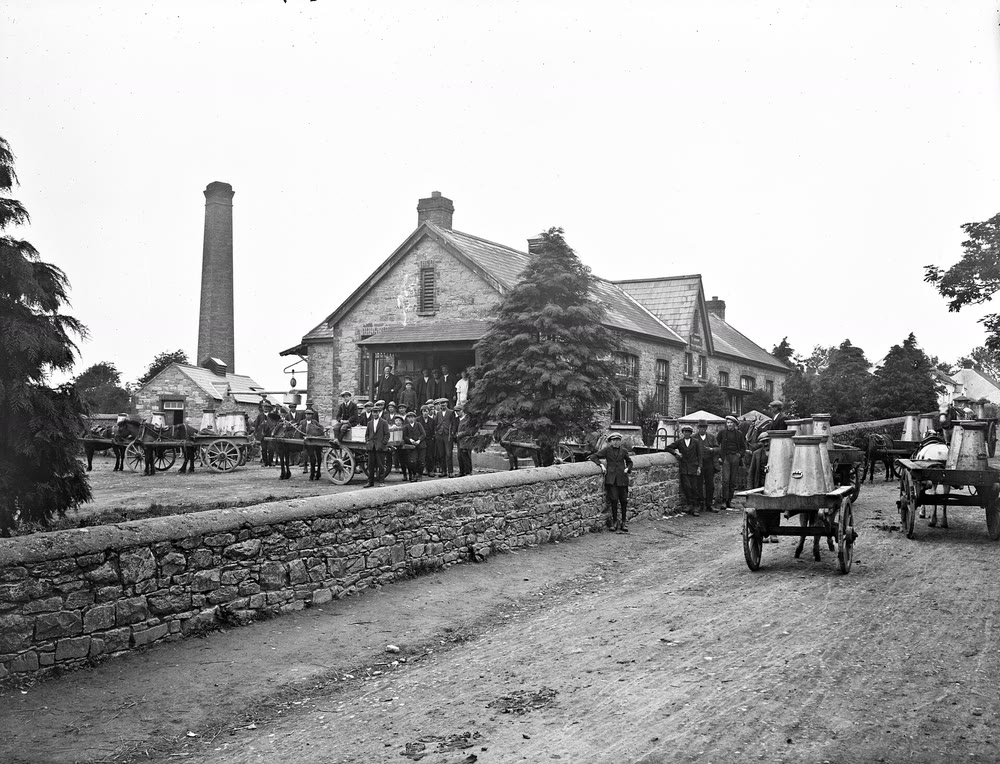
Horse carts and milk cans at Kilmacow Creamery, Co. Kilkenny, around 1924. Photo: A. H. Poole, Poole Photographic Collection, National Library of Ireland (POOLEWP 3169), no known copyright restrictions, via Wikimedia Commons
The Exchange’s columned portico still stands in Shandon, beside the round Firkin Crane of 1855, now a dance centre. The Butter Museum alongside them tells the story. Checked in November 2026: it opens daily from May to September and on fewer days otherwise, adult entry is €5, and butter-making demonstrations run on Wednesdays and Saturdays at noon. Check before you go.
Bog butter: the oldest butter in Ireland
Seamus Heaney caught it in his 1969 poem Bogland: “Butter sunk under / More than a hundred years / Was recovered salty and white.” If anything, he undersold it.
Turf cutters and drainage crews have been turning up old butter for centuries. More than 500 finds are recorded in Ireland, say Maeve Sikora and Isabella Mulhall of the National Museum. It comes in carved wooden kegs, in bark, in animal skin or with no wrapping at all, and recorded weights run up to 23kg (50 pounds). Today it’s a whitish, waxy mass with a pungent smell.
Chemists long knew it was animal fat, but nobody could prove it was butter. Then a 2019 study in Scientific Reports tested 32 samples from the museum’s collection. Of those, 26 were confidently dairy fat and three more probably so. The dates ran from about 1700 BC to the 1600s AD, a tradition of at least 3,500 years. The oldest, from Knockdrin in Co. Offaly, dates to 1745 to 1635 BC.
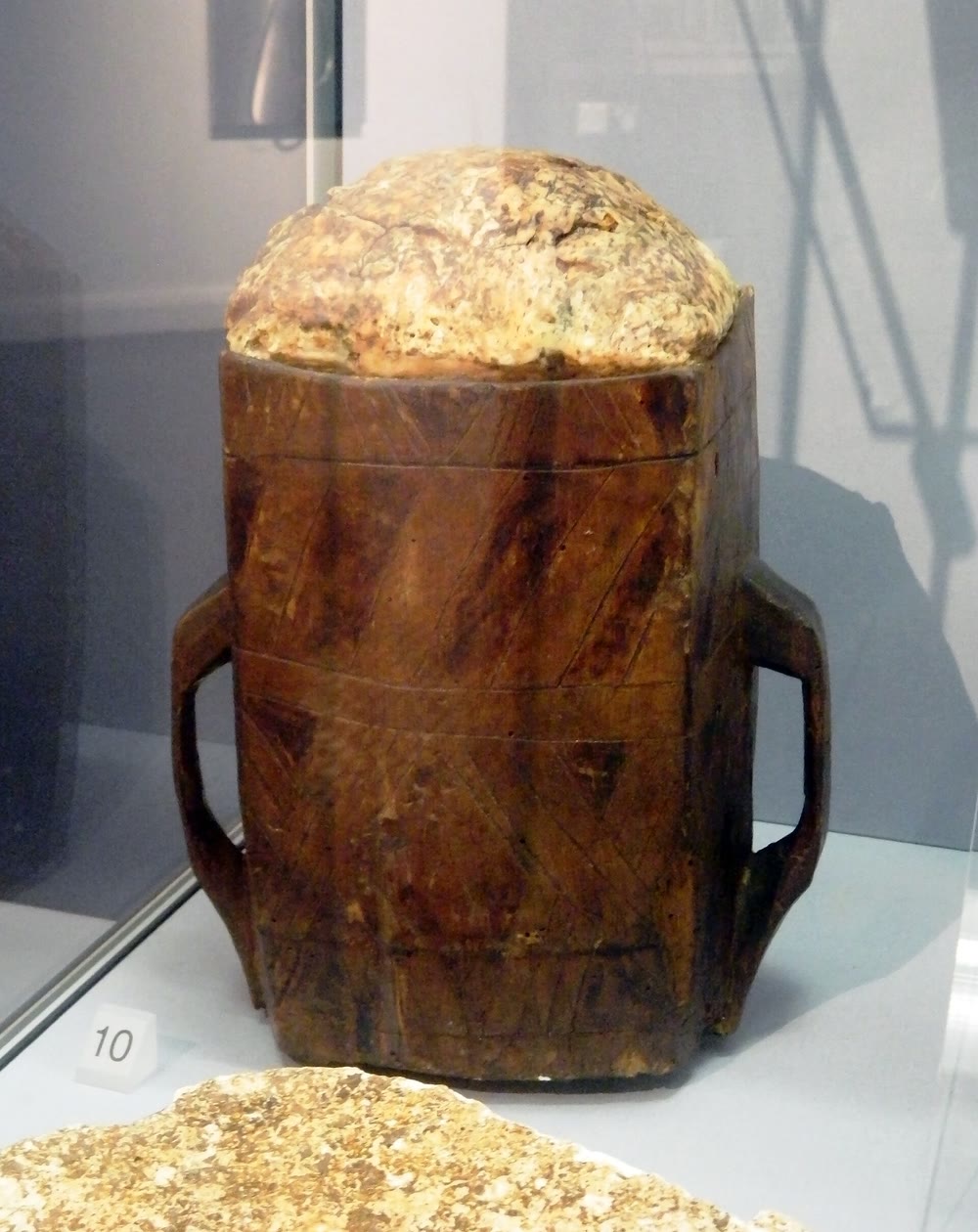
Bog butter in a carved wooden vessel, dated to the 15th or 16th century, in the Ulster Museum. Photo: Bazonka, CC BY-SA 3.0, via Wikimedia Commons
Why bury butter in a bog?
Nobody knows for sure, and the study’s authors doubt there was one reason across so many centuries. The main ideas:
- Storage: a bog is cool, wet and short of oxygen, so food keeps.
- Safe keeping: early Irish law listed butter among the food rents, and raids on butter stores were recorded, so hiding it may have been wise.
- Flavour: Thomas Dineley, an English visitor in the 1600s, described butter mixed with a kind of garlic and buried to make “a provision of an high taste for Lent”.
- Offering: the National Museum shows bog butter among the votive deposits in its Kingship and Sacrifice exhibition. Butter and gold both went into Bronze Age bogs, which the study’s authors say may be no coincidence.
That exhibition, on Kildare Street in Dublin, includes a keg from Rosberry, Co. Kildare, found in 1970: almost 13.5kg of butter dated to 360 to 200 BC.
May Eve: the night your butter could be stolen
Butter was money, and for many farm families it paid for small luxuries like tea and tobacco. That gave Ireland one of its strangest fears: that someone could steal your butter without ever touching it.
The danger time was May Eve, Oíche Bhealtaine (roughly EE-huh VYAL-tin-uh), and the dawn of May Day. (Beltane is the spelling you’ll see online; Bealtaine is the Irish.) The thief took not the butter in your dairy but its “profit”, the year’s luck in your milk.
This isn’t the world of gods and heroes in Irish mythology. Most of what we know comes from writers like Lady Wilde in the 1800s and schoolchildren’s collecting in the 1930s, so it shows farm belief in recent centuries and doesn’t prove an ancient rite.
The thief, often an old woman with few cows and too much butter, had her methods:
- Gathering the dew: trailing a rope or a briar through a neighbour’s field at dawn, chanting “all to me”.
- Taking the well: skimming a neighbour’s spring, or drawing the first water from it on May morning.
- Turning into a hare: sucking the neighbours’ cows dry. In one 1930s school account, a farmer shoots a hare among his cows and trails it to an old woman laid up with a broken leg.
The best story, told by the folklorist Shane Lehane in the Irish Farmers Journal, has a priest coming home late from a wake. He hears an old woman at her charm and calls out “and half to me!” Back at his house, the servant girl’s churn is overflowing.
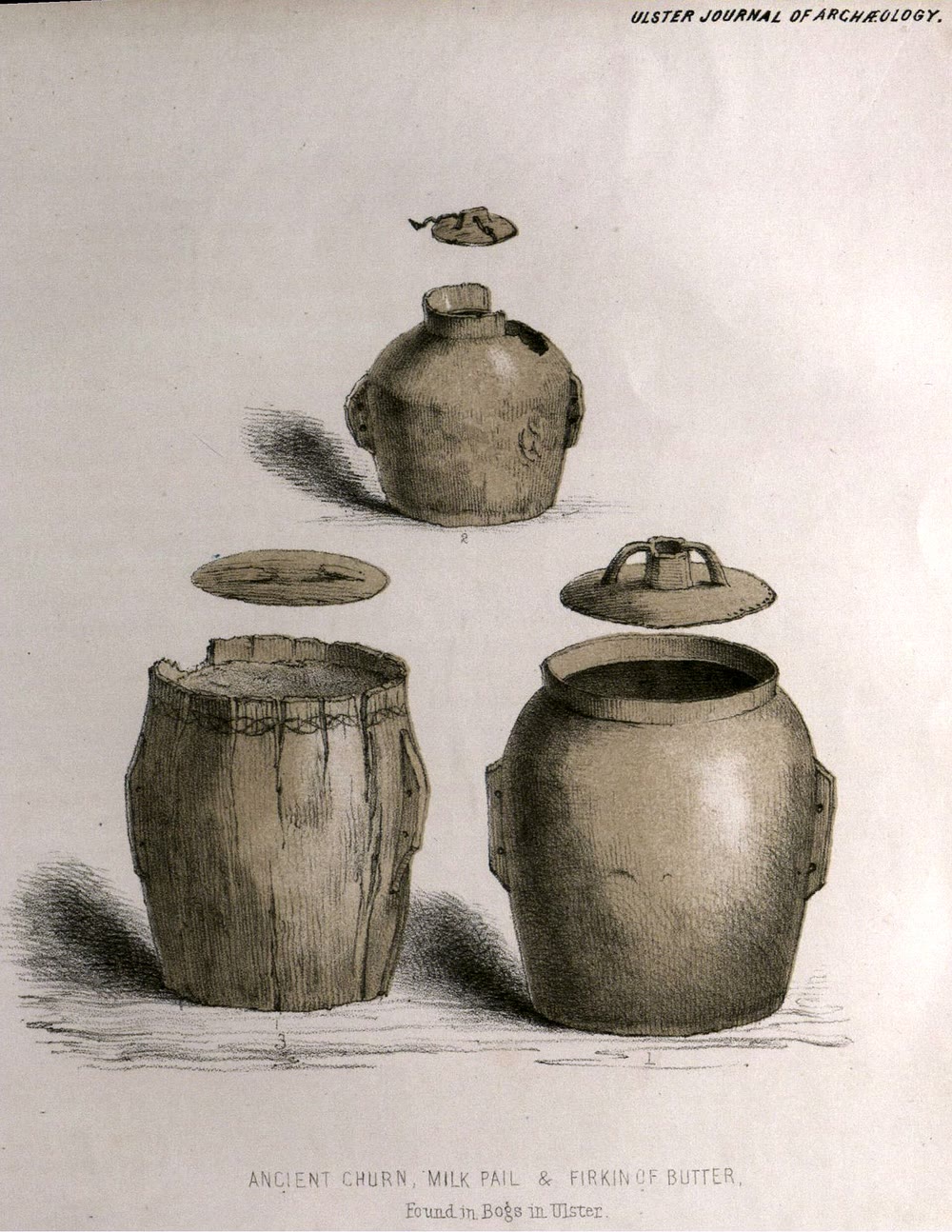
An ancient churn, milk pail and firkin of butter found in bogs in Ulster, from the Ulster Journal of Archaeology, 1859. Public domain, via Wikimedia Commons
Households fought back. Nobody gave away fire, milk or salt on May Day, Lady Wilde wrote in 1887, and a spent coal went under the churn. Rowan was tied to cows’ tails. If the butter still wouldn’t come, a plough part reddened in the fire and set under the churn was said to burn the thief, who would run to your door begging you to stop.
Anyone calling during churning was expected to give a blessing and take a turn, writes Marion McGarry, to show they meant no harm. One usual blessing was “God bless the work”, in Irish Bail ó Dhia ar an obair (roughly BAL oh YEE-uh air un OB-ir).
Suspicion fell mostly on women. There’s more in my guides to Irish witches and Irish superstitions.
Irish butter FAQ
Is Irish butter better than American butter?
It’s yellower and softer, but in Teagasc’s three-country study, overall liking didn’t change with the cows’ feed.
Is Irish butter healthier?
Pasture butter in Teagasc’s research had more beta-carotene and conjugated linoleic acid. It’s still around 80% fat, though, and that study measured the butter, not the health of the people eating it.
Why is Irish butter so expensive in the US?
It’s imported and sold as a premium product. The Irish Times reported in 2019 that Kerrygold cost on average 50% more than its main rivals, and Ornua cited renewed US tariff pressure in 2025.
Is Kerrygold really from Ireland?
Yes. Ornua is an Irish dairy co-operative, and Kerrygold says its US products come only from suppliers certified to Bord Bia’s Grass Fed Standard.
Can you eat bog butter?
Better not. In 2016 the National Museum’s Andy Halpin called it theoretically edible but not advisable. If you find some, report it to the museum, because it’s an archaeological find.
What is the Irish word for butter?
Im, pronounced roughly EEM in Cork, Kerry and Galway, and closer to IM in Mayo and Ulster. You’ll also see ime, but that’s the genitive form, as in the place name Gort an Ime, Butterfield. Salted butter is im saillte (roughly IM SAL-chuh), buttermilk is bláthach (BLAW-hukh) and a churn is a cuinneog (KIN-yohg). Ó Dónaill’s dictionary even lists im ortha, unsalted butter used in charm cures.
Love this? Save it to your Pinterest board for later.
Pin image: Gordon Hatton, CC BY-SA 2.0, via Wikimedia Commons
A little bit of Ireland in your inbox every Friday ☘️
The free Weekly Dose of Irish: an Irish joke, a Celtic symbol, an Irish fact, a poem and the week’s best articles in one short email. Join 9,600+ readers.
Free. One short email every Friday. Unsubscribe any time.
More Irish food and folklore reading
- Irish Soda Bread Recipe: The 4-Ingredient Loaf With a Cross to Keep the Fairies Away
- Irish Porter Cake Recipe: The Stout-Soaked Fruit Cake You Never Have to Ice
- Colcannon Recipe: The Irish Halloween Mash That Hides Your Fortune
- Irish Witches: Alice Kyteler, the Islandmagee Trial and Ireland’s Real Witch History
- Irish Superstitions: 40 Old Beliefs About Luck, Death, Birds and the Fairies
Featured image: Black-and-white cattle on green pasture in Co. Clare, with a limestone hill behind. Photo: Gordon Hatton, CC BY-SA 2.0, via Wikimedia Commons.