Ireland had very few witch trials. The famous cases are Dame Alice Kyteler of Kilkenny, accused of sorcery in 1324 (she escaped, but Petronilla of Meath was burned on 3 November 1324); Florence Newton of Youghal, tried in 1661; and the Islandmagee women convicted at Carrickfergus in 1711, the last witch trials in Ireland. Most Irish “witches” never saw a court. They were the butter-stealing hags of folklore, or wise women such as Biddy Early of Clare.
On Saturday 3 November 1324, a huge crowd gathered in Kilkenny to watch a woman burn. Her name was Petronilla of Meath. She had been flogged six times on a bishop’s orders, and she told the crowd she was nothing compared with her mistress, the rich, well-connected Dame Alice Kyteler.
Alice had escaped. Hers is Ireland’s most famous witch case, and one of very few. Across Europe, by a common estimate, about 50,000 people were executed for witchcraft from the 1400s to the 1700s; Ireland tried a handful.
Here are the real cases, then the witches Ireland actually worried about: butter-stealing hags and wise women. For the season’s roots, see how the Irish invented Halloween.
Jump to:
- Did Ireland have witch trials?
- Dame Alice Kyteler and the Kilkenny trial of 1324
- Florence Newton: the Youghal witch trial of 1661
- An Irish “witch” in Boston: Goody Glover (1688)
- The Islandmagee witches (1711)
- Why Ireland had so few witch trials
- The butter witch of Irish folklore
- Wise women: Biddy Early
- Irish witch myths to stop believing
- Irish witches FAQ
- More Irish folklore reading
Did Ireland have witch trials?
Yes, but very few. The historian Andrew Sneddon of Ulster University puts Islandmagee among just a few Irish witch trials between the 1500s and the 1700s. The known cases:
- 1324, Kilkenny: Alice Kyteler and her circle, before a bishop.
- 1578, Kilkenny: two people executed as witches; no details survive.
- 1661, Youghal: Florence Newton.
- 1698, Antrim: a “begging witch” reported executed, known only from a Scottish book.
- 1711, Carrickfergus: eight Islandmagee women, then William Sellor.
In 1578 the Lord Justice, Sir William Drury, reported two witches among 36 people executed at Kilkenny, put to death “by natural law, for that we find no law to try them by in this realm.” The Irish parliament passed a Witchcraft Act in 1586. Killing by witchcraft carried the death penalty. Harming people or livestock meant, for a first offence, a year in prison and four market-day turns in the pillory. Westminster repealed the Act in 1821.
Dame Alice Kyteler and the Kilkenny trial of 1324
Alice came from a Flemish merchant family in Anglo-Norman Kilkenny, says the county council’s heritage office. She married four times: William Outlaw, a banker and moneylender who was dead by 1302, then Adam le Blund of Callan, Richard de Valle and Sir John le Poer. Her son, another William Outlaw, was rich and powerful.
Her husbands’ children accused her of killing some of their fathers and bewitching others into leaving everything to her and her son. They complained to Richard de Ledrede, Bishop of Ossory, a Franciscan friar from London made bishop at Avignon in 1318 on the orders of Pope John XXII.
The charges: Robin son of Art and a robber’s skull
The fullest account is a Latin narrative written at the time, plainly from the bishop’s side, which Thomas Wright printed for the Camden Society in 1843 (read it free online). Among its seven charges, Alice and her circle were accused of:
- tearing live animals apart at crossroads for a demon called Son of Art, described as one of the poorer demons of hell;
- cursing their own husbands limb by limb at candlelit night meetings, ending “fi, fi, fi, amen”;
- boiling up powders from cockerels’ guts, worms, dead men’s nails and the clothes of unbaptised babies, in the skull of a beheaded robber;
- taking a demon lover, Son of Art, sometimes called Robin son of Art.
Robin, the record says, came as a cat, a shaggy black dog, or a dark man with two taller companions carrying iron rods. Alice’s current husband, John le Poer, was wasting away, his nails and every hair gone. Warned by a maid, he wrenched her keys from her, opened her chests and found a sack of what the bishop called horrible things.
Wright thought Son of Art probably translated an Irish name, and judged the affair most likely an attempt at extortion from a rich family.
The bishop in jail
Alice had powerful friends. Her son’s kinsman, Roger Outlaw, was Chancellor of Ireland, and the seneschal of Kilkenny, Arnold le Poer, had the bishop thrown into the prison of Kilkenny Castle. The castle constable protested that no bishop had ever been jailed in Ireland. When release came on the 18th day, Ledrede put on his robes and walked in procession to his cathedral.
Petronilla of Meath, burned on 3 November 1324
Before the king’s chief governor in Ireland, Ledrede declared Alice a sorceress and heretic, and burned her sack of powders on a bonfire in the middle of Kilkenny. Alice had slipped away; a later chronicle says she hid in the town until a wind carried her to England, and no one learned what became of her. Her son, jailed until he submitted, had to attend Mass at least three times a day for a year, feed the poor and roof much of St Canice’s Cathedral with lead.
The best-documented victim was Petronilla de Midia, of Meath, often spelled Petronella. She called Alice her mistress, and most writers call her Alice’s maid. After six floggings she confessed in public to sacrificing cockerels at crossroads to a demon she named Robert son of Art, and to acting as go-between for Alice and the demon, all learned, she said, from Alice. She refused penance and was burned.
Friar John Clyn, who lived in Kilkenny at the time, dates it to the day after All Souls, a Saturday: 3 November 1324. As far as anyone then living knew, he wrote, no one in Ireland had been put to death for heresy before her.
She may not have been the only one. The bishop’s narrative ends by saying some others of Alice’s circle were burned, while others were flogged, banished or excommunicated, or fled. None is named.
Brooms, red cockerels and a greased staff
Some famous details come later. A 15th-century compilation of annals, which Wright thought unreliable, adds nine red cockerels offered at a stone bridge, Petronilla’s daughter Basilia fleeing with Alice, and a greased beam Alice could ride. It and Holinshed’s Chronicles have her sweeping Kilkenny’s streets at dusk, raking the dirt to her son’s door. Holinshed gives her rhyme:
To the house of William my sonne,
Hie all the wealth of Kilkennie towne.
In a 1988 RTÉ telling, the storyteller Eddie Lenihan has her cell found empty, its iron lock melted. Kyteler’s Inn still trades on her name, though the link is tradition, as I explain in my guide to haunted places in Ireland.
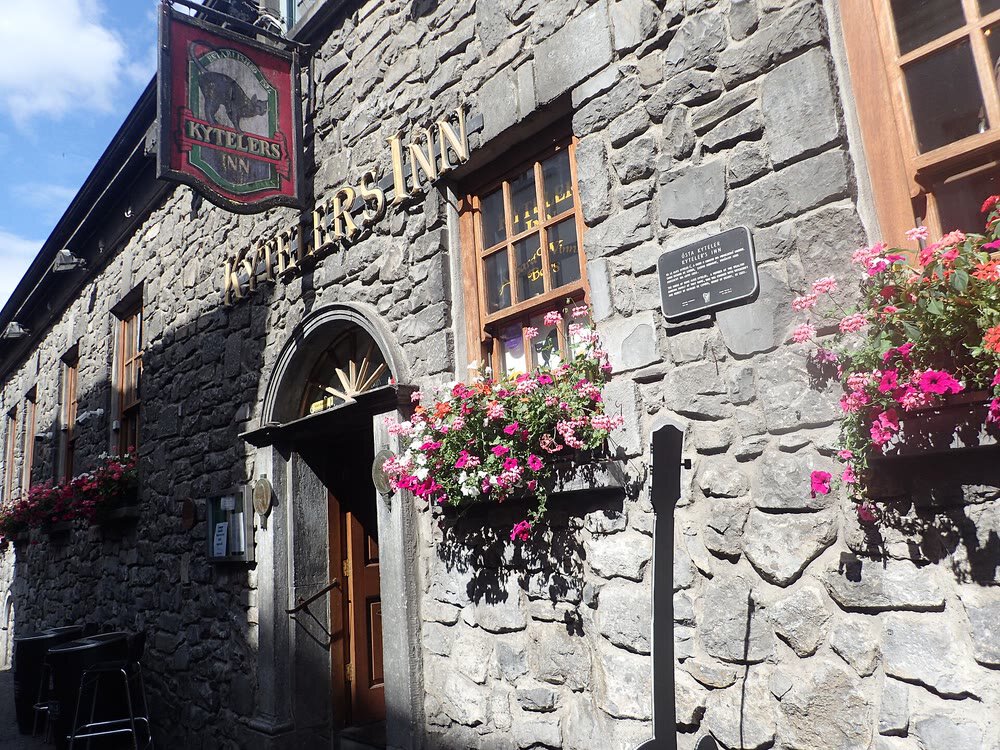
Kyteler’s Inn, Kilkenny, which tradition links to Alice Kyteler’s family. Photo: Marathon, CC BY-SA 2.0, via Wikimedia Commons
What happened next
Ledrede’s own troubles were only beginning. Accused of heresy by the Archbishop of Dublin, he fled Ireland in 1329, but regained royal favour and died, still bishop, in 1360. The Red Book of Ossory preserves sixty songs he wrote.
For the 700th anniversary in 2024, Kilkenny County Council ran talks, tours and re-enactments and planned a civic service of atonement and forgiveness at St Canice’s on 3 November. The Toil and Trouble festival grew from that year: in 2026 it runs from 29 October to 1 November, with Cailleach, a Macnas street spectacle inspired by Petronilla and Alice, on Halloween night. See my Kilkenny guide.
Florence Newton: the Youghal witch trial of 1661
One Christmas in Youghal, Co. Cork, an old woman named Florence Newton asked a servant girl, Mary Longdon, for some of her master’s salted beef. Mary refused. A week later Florence knocked the pail off Mary’s head and kissed her hard, asking to be friends.
Within a month Mary had violent fits. She vomited needles, pins, horseshoe nails, wool and straw, said small stones rained on her from nowhere, and saw Florence sticking pins in her arms. Florence was jailed on 24 March 1661.
The townsmen put her to the test. She kept stumbling over “forgive us our trespasses” in the Lord’s Prayer. Valentine Greatrakes, later a famous healer, helped test whether her hand would bleed when pierced with an awl and a lance. The mayor had a boat ready to “swim” her before she admitted she had “overlooked” the girl. Then David Jones, a townsman who sat up one night watching her cell, let her kiss his hand through the prison grate. He fell ill and was dead within weeks, blaming her.
She was tried at the Cork assizes on 11 September 1661 on both charges. The verdict is lost. The story survives in Joseph Glanvill’s Saducismus Triumphatus (first published 1681), a book meant to prove witches were real, probably from the judge’s own notes. Glanvill calls her “an Irish witch of Youghal”.
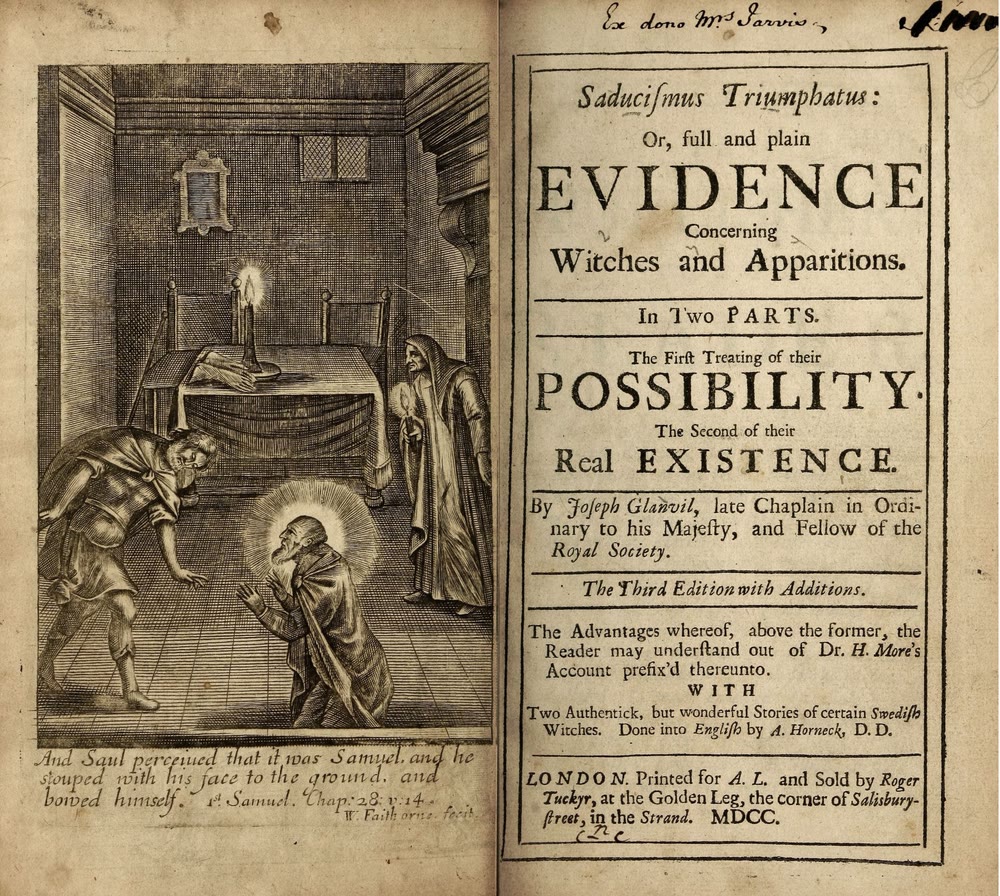
Frontispiece and title page of Joseph Glanvill’s Saducismus Triumphatus (third edition, London, 1700), the book that preserves the trial of Florence Newton. The engraving shows the biblical Witch of Endor calling up the prophet Samuel for King Saul. Public domain, via Wikimedia Commons
An Irish “witch” in Boston: Goody Glover (1688)
For Irish America, the case that hits hardest is in Boston. Ann “Goody” Glover, an Irish Catholic widow, washed and kept house for Puritan families, among them the Goodwins. In 1688, after a row over missing linen blamed on her daughter, four Goodwin children fell into fits, and Glover was accused of bewitching them.
Cotton Mather, the Puritan minister, wrote that the court got answers from her only in Irish, her native language, and that she said the Our Father in Latin readily but could never manage a line or two. She was hanged on 16 November 1688, four years before the Salem trials. In 1988 Boston City Council declared 16 November Goody Glover Day, The Irish Times reports.
The Islandmagee witches: Ireland’s last witch trial (1711)
Islandmagee is a peninsula about eight miles long on the Co. Antrim coast. In February 1711 Ann Haltridge, elderly widow of a Presbyterian minister, died there after months of stones and turf thrown at her bed by unseen hands. Days later her niece Mary Dunbar, aged 18, came to stay and showed signs of possession: fits, trances and vomiting feathers, yarn, pins and buttons.
Mary named her tormentors from her fits, and eight women from Islandmagee and nearby, among them a mother and her daughter, stood trial at Carrickfergus on 31 March 1711. They had no lawyer. Witnesses swore to knotted threads appearing on Mary’s body. Mary was struck dumb in court.
Judge Upton did not doubt the Devil was at work, but told the jury he could not see convicting on the girl’s visions alone, when the accused went to church and prayed with their families. Judge Macartney disagreed. The jury convicted all eight: a year in jail and four spells in the pillory.
Mary died in April 1711. At the summer assizes a ninth “witch”, William Sellor, husband of one of the women and father of another, was found guilty of killing her by witchcraft, a capital crime. Sneddon calls him the only male witch executed in Ireland, and argues that Mary faked her possession, which let a young woman misbehave without consequence.
The tale that a woman lost an eye to cabbage stalks in the pillory is an 1820s invention, Sneddon says. In April 2023 Mid and East Antrim Council put up a plaque to all nine, Sneddon and Victoria McCollum write for RTÉ.
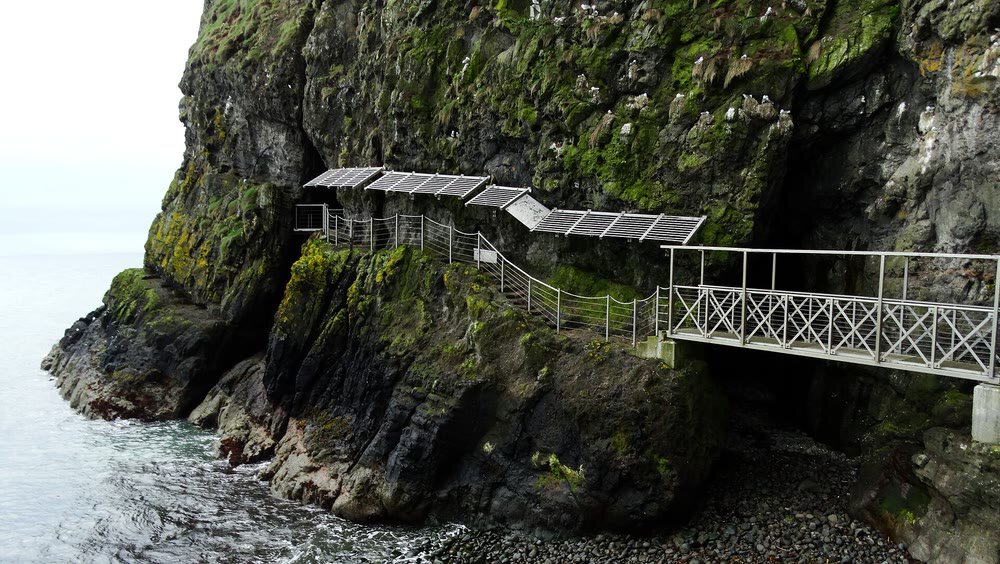
The Gobbins cliffs on the east coast of Islandmagee, Co. Antrim. Photo: Colin Park, CC BY-SA 2.0, via Wikimedia Commons
Why Ireland had so few witch trials
Historians debate it, but four reasons stand out:
- Different fears. St John Seymour, whose 1913 book was the first on Irish witchcraft, argued that the witch as the Devil’s servant took root mainly in the Anglo-Norman and, later, Protestant parts of Ireland. Gaelic Ireland feared harmful magic too, but often blamed the fairies, like those in my guide to Irish mythological creatures, or met a charm with a counter-charm.
- Courts and churches. Sneddon argues that what Ireland’s main faiths and communities believed about witches, along with the Presbyterian church and sceptical judges, kept prosecutions low.
- No pamphlets. England had a flood of sensational witch pamphlets; Seymour found almost none printed in Ireland before the 1800s.
- Settler towns. The known cases arose in Anglo-Norman Kilkenny, Puritan-settled Youghal and Presbyterian Islandmagee.
Accusations, Sneddon found, were far more common than once thought.
The butter witch: the hag who stole your luck on May morning
Ask what an Irish country witch did, and the old answer is plain: she took the butter. When the butter would not come in the churn, people suspected a neighbour had charmed it away. Such a charm is a piseog (PISH-ogue), which Ó Dónaill defines as a charm or spell and, usually in the plural, superstitions. There’s more in my guide to Irish superstitions.
The danger time was May Eve, Oíche Bhealtaine (roughly EE-huh VAL-tin-uh), half a year from Samhain. Pupils and teachers gathered stories for the National Folklore Collection in the 1930s, with titles like “Taking the Butter on a May Morning” and “Skimming the Well”:
- In Longueville, Co. Cork, a farm lost its butter. A hound chased a hare to an old woman’s window and bit its leg, and inside she sat with a bleeding leg. In the story she is put to death, and the butter returns.
- A pupil at Knockaderry, Co. Kerry, wrote down a tale of a farmer’s wife near Ardfert who was said to roll in the water used for washing feet on May night, then run out as a hare to milk the neighbours’ cows.

An Irish hare on North Bull Island, Dublin. In folklore, a hare among the cows on May morning might be a neighbour stealing your milk. Photo: AlanWolfe, CC BY 3.0, via Wikimedia Commons
Butter magic reached a court only through a charmer. In 1807 a Carnmoney tailor whose cow gave no butter called in Mary Butters of Carrickfergus. Her night-time brew of milk, pins and crooked nails filled the shut house with fumes, and by morning three people were dead. She was discharged at the 1808 assizes.
Wise women: Biddy Early and the bean feasa
Plenty of women with a name for power were never tried. Irish calls such a woman a bean feasa (ban FASS-uh), which Ó Dónaill translates as a wise woman or fortune-teller.
The most famous, Biddy Early, died on 22 April 1874 in a two-roomed cottage above Kilbarron Lake near Feakle, Co. Clare. She made cures for people and animals, kept a bottle that stories say came from the fairies, and was said to settle land disputes with them, the kind you’ll meet in my guide to fairy forts. She clashed with priests, doctors and landlords; legend says police sent to evict her stood frozen for two hours at her command.
Lady Gregory went looking for her house about 20 years after her death and heard “some calling her a healer and some a witch” (Visions and Beliefs in the West of Ireland, 1920).
You’ll often read that Biddy faced a witchcraft trial in 1865, under the 1586 Act. John Rainsford, in History Ireland, says that has never been proved, and she was certainly never convicted of anything. Besides, that Act had been repealed in 1821. Clare hurling even had a “curse of Biddy Early”, said to be lifted by the 1995 All-Ireland win; see my guide to Irish curses.
Irish witch myths to stop believing
- “Alice Kyteler was burned at the stake.” She escaped; Petronilla was burned.
- “Bridget Cleary was the last witch burned in Ireland.” Her husband killed her in 1895 believing a fairy changeling had taken her place. It was never a witch case; her story is in my changelings guide.
- “Witches were pagan priestesses.” That theory, popularised a century ago by the Egyptologist Margaret Murray, was rejected by historians. Gerald Gardner’s Wicca, begun in the 1930s, has no real link to historic witchcraft, says the historian Jonathan Durrant. Most accused witches were ordinary Christians; most of the Islandmagee women had taken Communion. For the war goddess of medieval Irish tales, meet the Morrígan.
Irish witches FAQ
Who was the most famous witch in Ireland?
Dame Alice Kyteler of Kilkenny, accused of sorcery in 1324. She fled, probably to England. In folklore, Biddy Early of Clare rivals her.
Were witches burned in Ireland?
Rarely. Petronilla of Meath was burned in Kilkenny on 3 November 1324, and the bishop’s account says some of Alice’s other associates were burned later. A Scottish writer reported a witch “strangled and burnt” at Antrim in 1698, citing a pamphlet no one has traced. Under the 1586 Act, death for witchcraft meant the usual penalty for felony, normally hanging.
When was the last witch trial in Ireland?
1711, at Carrickfergus, Co. Antrim: eight Islandmagee women on 31 March, and William Sellor at the summer assizes.
What is the Irish word for witch?
Focloir.ie gives cailleach (KAL-yukh; in Munster nearer kal-YAKH), which also means an old woman or hag, or cailleach feasa, which Ó Dónaill defines as a wise woman or fortune-teller. Don’t confuse it with the Cailleach of legend. And the standard spelling is piseog, with no fada: “piseóg” is an older spelling you’ll still see online.
Was Biddy Early a witch?
Some called her one, but she was a healer and wise woman from Feakle, Co. Clare, never convicted of anything.
Love this? Save it to your Pinterest board for later.
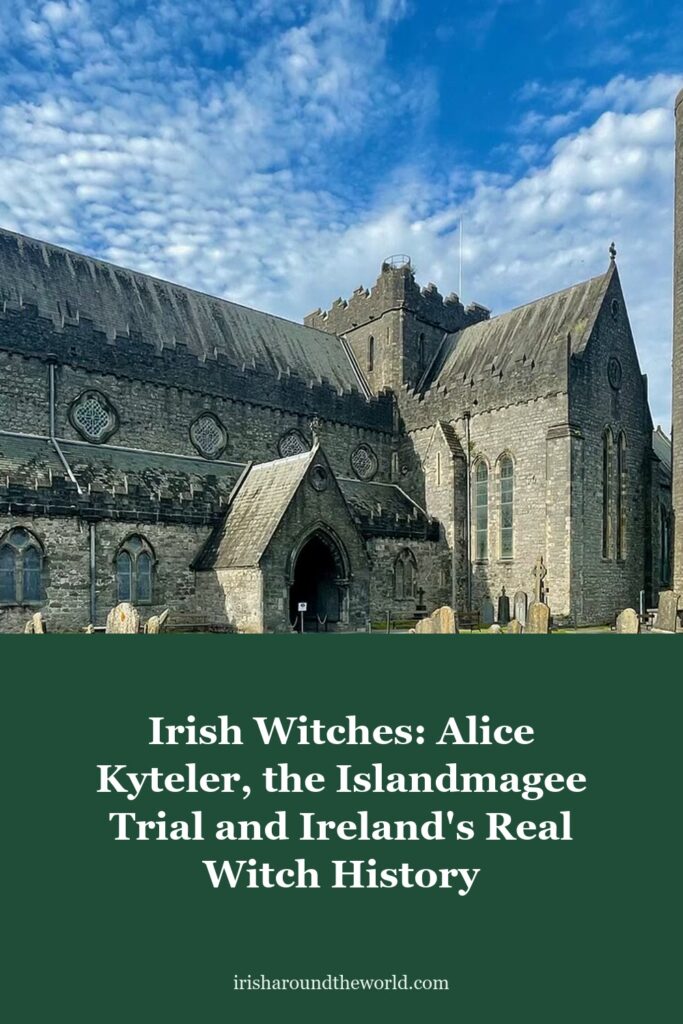
Pin image: St Canice’s Cathedral and its round tower, Kilkenny. Photo: Holger-dieterich, CC0, via Wikimedia Commons
A little bit of Ireland in your inbox every Friday ☘️
The free Weekly Dose of Irish: an Irish joke, a Celtic symbol, an Irish fact, a poem and the week’s best articles in one short email. Join 9,600+ readers.
Free. One short email every Friday. Unsubscribe any time.
More Irish folklore reading
- Changelings: The Irish Fairy Belief That Led to the Burning of Bridget Cleary
- 15 Haunted Places in Ireland: Ghost Stories, Real History and How to Visit
- Samhain: The Night the Fairy Mounds Opened and How It Became Halloween
- Irish Mythological Creatures: 23 Fairies, Monsters and Death Omens to Know
- Fairy Forts and Fairy Trees: The Irish Places You Never Disturb
- Things to Do in Kilkenny: The Perfect 48-Hour Itinerary (2026)
Featured image: St Canice’s Cathedral and its round tower, Kilkenny. It was Bishop Ledrede’s cathedral, and Alice Kyteler’s son was ordered to roof it with lead. Photo: Holger-dieterich, CC0, via Wikimedia Commons.