The Irish 12 Days of Christmas usually means Christmas Countdown, a comic record by Frank Kelly, the Dublin actor later loved as Father Jack in Father Ted. As Gobnait O’Lúnasa, he writes twelve letters to his beloved Nuala that start as polite thank-you notes and turn furious as the gifts from the old carol wreck his house and his mother’s nerves. It reached No. 8 in Ireland and, in January 1984, No. 26 in the UK. The real Irish twelve days run from Christmas Day to Little Christmas, Nollaig na mBan, on 6 January.
Your true love sends you a partridge in a pear tree. How thoughtful. You write a lovely letter to say thanks, and mention, as politely as you can, that the partridge bit your mother on the hand.
That’s how the Irish 12 Days of Christmas starts, and it only goes downhill from there. Frank Kelly’s Christmas Countdown has been a Christmas favourite on Irish radio for years, and it travelled: the single was also released in Britain, Australia and New Zealand.
Here’s the story of the record, the man behind it and poor Nuala, plus the old carol it sends up and the real twelve days of an Irish Christmas, from Wren Day to Women’s Christmas.
Jump to:
- What is the Irish 12 Days of Christmas?
- Frank Kelly: from Hall’s Pictorial Weekly to Father Jack
- Who are Gobnait O’Lúnasa and Nuala?
- How the joke builds, letter by letter
- The record: charts, RTÉ and Top of the Pops
- The original carol: a memory game printed in 1780
- The real Irish twelve days, Christmas Day to Little Christmas
- And the 12 Pubs of Christmas?
- Irish 12 Days of Christmas FAQ
- More Irish Christmas reading
What is the Irish 12 Days of Christmas?
When people talk about the Irish 12 Days of Christmas, they usually mean Christmas Countdown, a spoken comedy version of The Twelve Days of Christmas. Frank Kelly wrote and performed it, with music by Jim Doherty, who also produced the record. The single’s label credits the tune itself as traditional.
Kelly plays Gobnait O’Lúnasa, a hapless countryman who lives with his mother. Each day another present from the carol lands on the doorstep, sent by his sweetheart Nuala, and each day he writes to her about it. The thanks get thinner as the house fills up.
A note before you go looking: the words are still in copyright, so they aren’t printed here, but you can hear the whole thing in the official video further down.
Frank Kelly: from Hall’s Pictorial Weekly to Father Jack
Frank Kelly was born on 28 December 1938 in Blackrock, Co. Dublin, so his birthday fell inside the twelve days. His father, Charles Kelly, better known as CEK, was a popular cartoonist who helped found Dublin Opinion, a satirical magazine, according to The Irish Times and The Guardian.
He read law at University College Dublin but chose the stage, working as a feed, or straight man, for variety comedians such as Jack Cruise and Cecil Sheridan. His first film role, in 1969, was the prison officer who escorts Michael Caine out of jail at the start of The Italian Job.
He wrote for and appeared in the children’s show Wanderly Wagon, but Irish audiences really got to know him through Hall’s Pictorial Weekly, RTÉ’s political satire, which ran through the 1970s until 1982. His characters there included Parnell Mooney, a rural councillor in the made-up village of Ballymagash. A Jacob’s Award followed in 1974.
Then, in his late fifties, came Father Ted (1995 to 1998) on Channel 4. Graham Linehan and Arthur Mathews, who wrote the show, remembered his wild TV characters from their childhoods and suggested him for Father Jack Hackett, the hard-drinking old priest in the armchair. Fans can find more Craggy Island fun on my Father Ted quotes page.
He died on 28 February 2016, aged 77. He was survived by his wife, Bairbre, their seven children and a great many fond memories.
Who are Gobnait O’Lúnasa and Nuala?
Gobnait was born on radio. RTÉ Archives says the character began in Kelly’s sketches for The Glen Abbey Show on RTÉ radio. A favourite routine had Gobnait feeding coins into a public phone box and asking, hopefully, whether Nuala was on the other end of the line.
Gobnait
In the record, Gobnait is a man. In real life, Gobnait (roughly GUB-nit, or GOB-nit) is an old Irish woman’s name. Rev. Patrick Woulfe’s Irish Names and Surnames (1923) links it to gob, a mouth, and says it belonged to St Gobnait, patroness of Ballyvourney, Co. Cork, whose feast falls on 11 February. At the time it was still a common name in Cork, Kerry and Limerick, often anglicised as Abbey or Debby.
O’Lúnasa
Lúnasa (LOO-nuh-suh) is the Irish word for August, according to Ó Dónaill’s dictionary, so it isn’t a real surname. Said quickly, though, it sounds a lot like lunacy. RTÉ Archives and The Guardian both spell the character Gobnait O’Lunacy, while The Irish Times has used both O’Lúnasa and O’Lunasa. You’ll also see O’Lughnasa online, from Lughnasa, an older spelling of the name of the August harvest festival. If you want the Irish spelling, it’s Lúnasa, with the fada on the u.
Nuala
Nuala (NOO-luh) is the short form of Fionnuala (fin-OO-luh), which Woulfe gives in its older spelling, Fionnghuala, fair shoulder. RTÉ Archives calls her Gobnait’s beloved. We only ever hear his side of the story, so whether Nuala means well, or knows exactly what she’s doing, is left to your imagination.
How the joke builds, letter by letter
The label that licenses the recording has put it on YouTube with a cartoon video, so here it is in full. It runs about five and a half minutes.
The genius of it is that Gobnait takes the carol literally. A partridge is a real bird, with a beak. Eight maids a-milking come with cows. Seven swans need water, and the only water big enough in the house is the bath.
Even the first letter, all good manners, has to admit that the partridge bit the mother on the hand. Then the doves arrive and the birds start fighting. The vet becomes a regular caller, and each bill is bigger than the last. The five gold rings bring a moment’s relief, mostly because they aren’t more birds.
By the seventh day the swans have taken over the bathroom and turned savage, and the family can’t get in to wash. The Irish Times quoted that day’s letter, which opens on a very royal note: “We are not amused by your little joke.”
From there it’s a pile-up. The milkmaids’ cattle take over the front lawn, the drummers and pipers bring the noise, and his poor mother’s nerves give out completely. The greetings and sign-offs slide from fond to frosty to downright furious, until the last letter comes from a man left sitting among the feathers and wreckage.
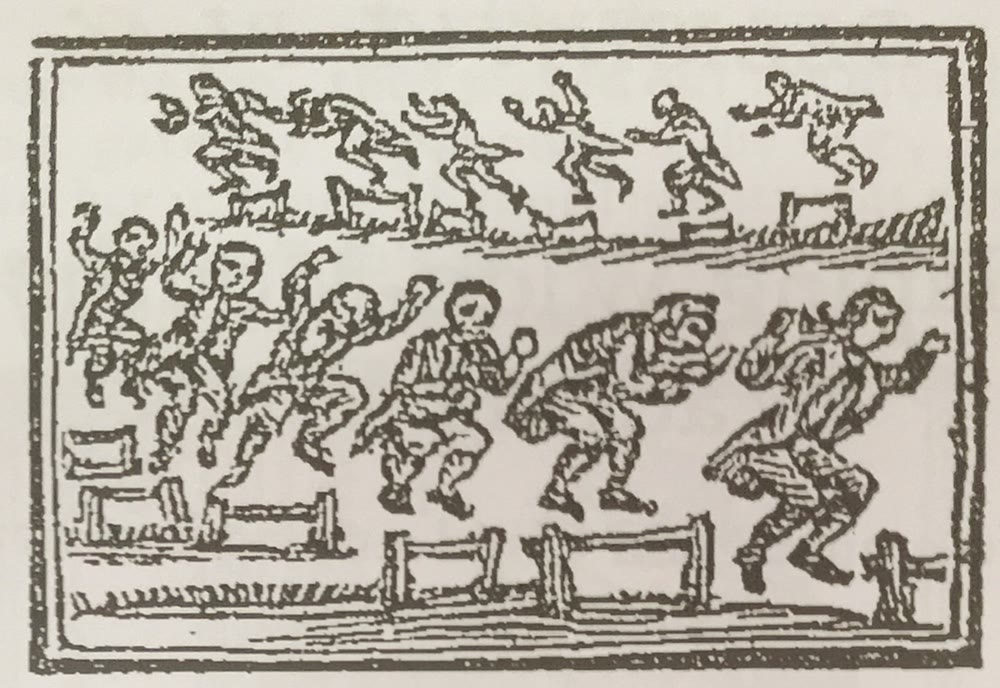
Twelve lords a-leaping, a woodcut from an early edition of Mirth without Mischief (London: C. Sheppard, about 1780 to 1800), the book that first printed the carol. Public domain, via Wikimedia Commons
And the best twist of all? The record reached Buckingham Palace. Kelly received a letter from the palace telling him the Queen, then Elizabeth II, had been highly amused, and he treasured it.
The record: charts, RTÉ and Top of the Pops
Christmas Countdown came out in Ireland on the Lunar label, and the official upload dates the recording to 1982. It reached No. 8 in the Irish singles chart, according to the Irish Recorded Music Association, the body behind the official Irish charts. The Irish Times dated the single and that chart run to 1982 in its 2016 tributes, though one report placed both the Irish and UK peaks in December 1983.
On Christmas Day 1983, RTÉ’s Home For Christmas showed Kelly performing it as Gobnait, and that clip is now in the RTÉ Archives.
In Britain, Ritz Records released it for Christmas 1983 with Kelly’s own Yuletide Moonshine on the B-side. The Official Charts Company has it entering the UK chart at No. 34 in the week to 24 December 1983, then peaking at No. 26 in the first week of January 1984.
That chart run got Kelly onto Top of the Pops on 5 January 1984. It was the show’s 20th anniversary edition on BBC One, and the TOTP Archive’s running order lists him miming Christmas Countdown on the same bill as Status Quo, Slade and Frankie Goes to Hollywood.
| Chart | When | Peak |
|---|---|---|
| Irish singles chart | 1982 (Irish Times date) | No. 8 |
| UK singles chart | December 1983 to January 1984 | No. 26 |
| UK singles chart, return visit | December 1984 | No. 54 |
| UK physical singles chart | December 2009 | No. 43 |
| UK independent singles chart | December 2009 | No. 20 |
The single also came out in Australia on EMI and in New Zealand on Festival in 1983, and in 1991 a US label of Irish records, Rego, named a various-artists Christmas collection after it: Frank Kelly’s Christmas Countdown. For more festive listening, my guide to Irish Christmas songs has the carols and pub favourites.
The original carol: a memory game printed in 1780
The Twelve Days of Christmas first appeared in print in Mirth without Mischief, a children’s book published in London by Charles Sheppard around 1780, says Andrea Immel of Princeton’s Cotsen Children’s Library. Its heading says the song was sung at King Pepin’s Ball.
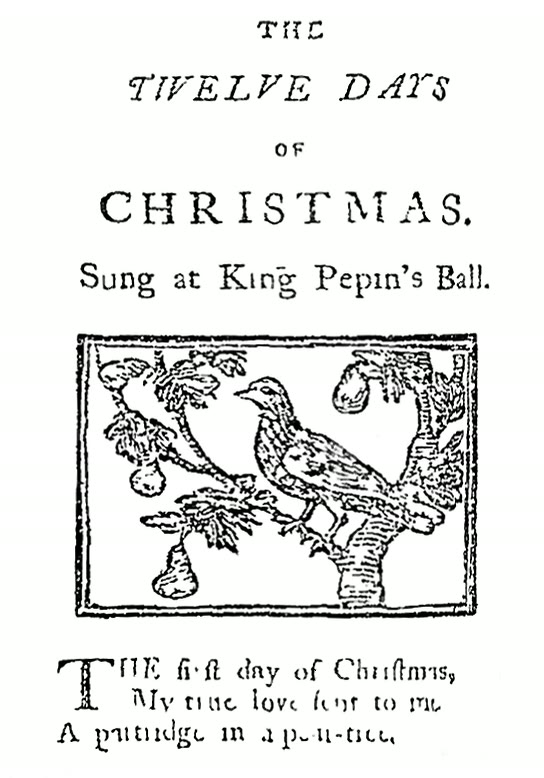
The first known printing of the carol, in Mirth without Mischief (London, about 1780), with a woodcut of the partridge in its pear tree. Public domain, via Wikimedia Commons
It was most likely a fireside game of memory and forfeits. Each player had to repeat the growing list without a slip, and anyone who fumbled paid a forfeit. The tune most of us sing came much later: the English composer Frederic Austin set the words in 1909, says Classic FM, and added the long, drawn-out “five gold rings”.
The carol piles up fast. Add every gift across all twelve verses and your true love has sent 364 presents, including twelve partridges and twelve pear trees. Gobnait got off lightly.
Is it a secret Catholic code?
You’ll often read that the carol was a hidden catechism for persecuted Catholics in England, with each gift standing for a point of faith. There’s no documentary evidence for it. The idea is modern, popularised by a 1982 essay by a priest, Fr Hal Stockert, and spread widely online in the 1990s.
Here’s the Irish twist. Stockert said the story came from letters written long ago by Irish priests, but that his notes were later lost in a flood, Deacon Steven Greydanus wrote in the National Catholic Register. Greydanus also points out that most of the supposed hidden lessons were beliefs Anglicans shared, so there was nothing to hide.
Is there a partridge in Ireland?
There is, just about. The grey partridge, Ireland’s native partridge, is red-listed by BirdWatch Ireland. Changes in farming from the 1960s wiped it out across most of the country, and in 2015 The Irish Times reported only one viable breeding group left, in Co. Offaly at Lough Boora Parklands. Since 2011, the same report said, three farmers in north Co. Dublin, working with Fingal County Council and conservation groups, have been helping it make a cautious comeback there.
In Irish, a partridge is a patraisc (PAT-rishk) and a pear tree is a crann piorraí (krown PYUR-ee in Munster; crann sounds more like “krahn” further north), both from Ó Dónaill. For more Christmas words in Irish, see my guide to Merry Christmas in Irish.
The real Irish twelve days, Christmas Day to Little Christmas
Britannica describes the Twelve Days of Christmas as the stretch from 25 December to 6 January, the Epiphany, with Twelfth Night as the eve of the Epiphany. If you count Christmas Day as day one, the twelfth day lands on 5 January; count from St Stephen’s Day and it lands on the 6th. In Ireland, 6 January has long been treated as the last of the twelve, and it’s the day the decorations traditionally come down.
The Irish for twelve days is dhá lá dhéag (roughly gaw law YAYG). The focloir.ie dictionary gives two Irish names for Twelfth Night: Oíche Chinn an Dá Lá Dhéag (roughly EE-ha hin un daw law YAYG), the night that closes the twelve days, and Oíche Nollaig na mBan, the night of Women’s Christmas. Here’s how the season traditionally unfolds.
25 December: Christmas Day
Lá Nollag (law NULL-ug). In older folk accounts, everyone was expected home, and a deep quiet settled over the day, says RTÉ Brainstorm. Then there’s the dinner, a goose or a turkey, and perhaps a dish of Irish potato stuffing.
26 December: St Stephen’s Day, or Wren Day
Lá an Dreoilín (law un DROH-leen), the day of the wren, is how Ó Dónaill’s dictionary gives St Stephen’s Day. It was a day for visiting neighbours, and the wren boys went from house to house in disguise with music. Dingle in Co. Kerry still keeps it up in style. The full story, straw suits and all, is in my guide to Wren Day.
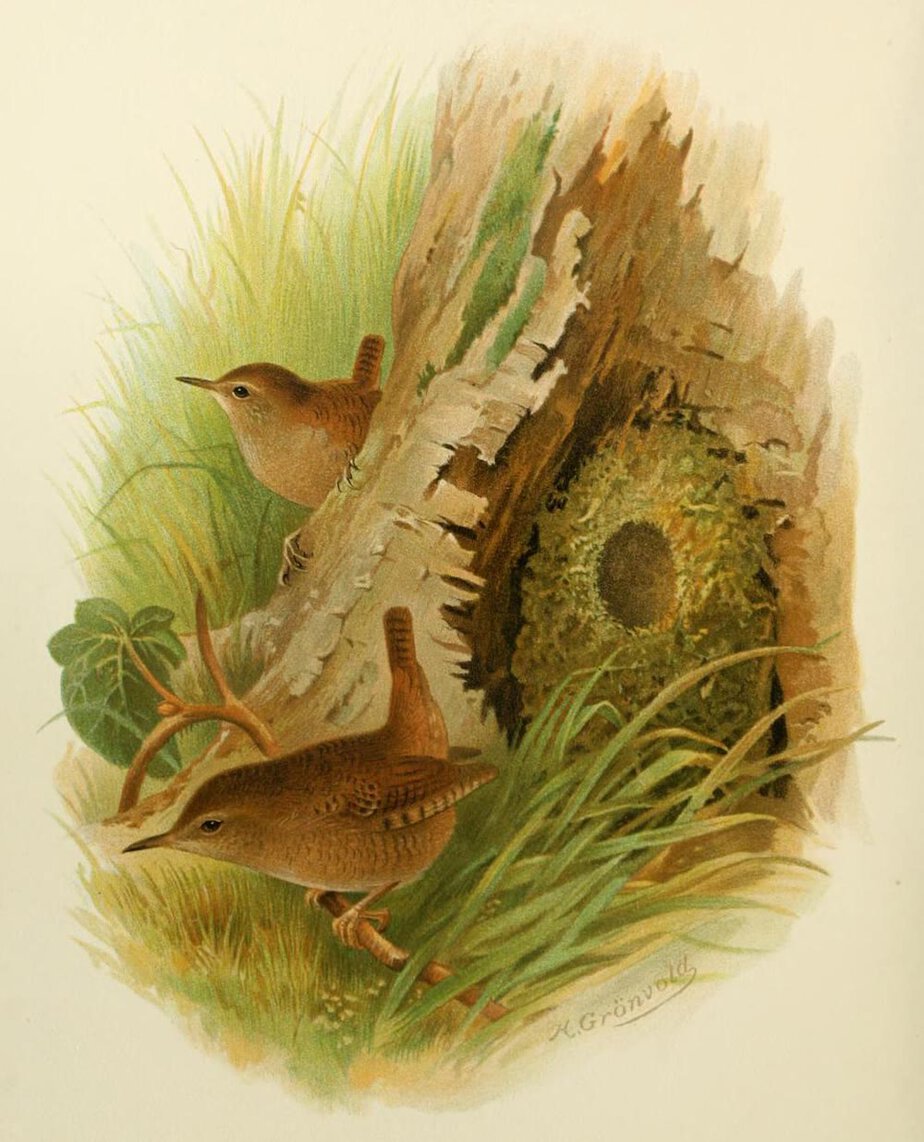
The wren, the little bird at the heart of Wren Day, with its nest, painted by Henrik Grönvold for Arthur G. Butler’s Birds of Great Britain and Ireland (1907 to 1908). Public domain, via Wikimedia Commons
1 January: New Year’s Day
The new year sits right in the middle of the twelve days. In some districts, New Year’s Day was called Lá Nollag Beag (law NULL-ug BYUG), Little Christmas, while elsewhere that name belonged to 6 January. Ó Dónaill’s dictionary gives both meanings. There’s more on bread at the door and first footing in my piece on Irish New Year traditions.
6 January: Little Christmas and Nollaig na mBan
The Epiphany closes the season. Many people call it Little Christmas, Nollaig Bheag (NULL-ig VYUG) in Irish. In Munster especially, it’s Nollaig na mBan (NULL-ig na MON), Women’s Christmas, when the women who’d done the Christmas work finally sat down with tea, cake and maybe something stronger.
Aoife Granville, a folklore lecturer at University College Cork, writes that West Kerry has kept the day for generations, and that it was common elsewhere in Kerry and Cork and in other Gaeltacht areas, while plenty of places around Ireland never marked it. Watch the spelling, by the way: it’s mBan, with a small m, not “Mban”.
Two old customs belonged to Little Christmas or the night before, depending on the place. Each person in the house lit a candle that stood for their life, and whichever went out first was said to show who would be the first of them to die, RTÉ Brainstorm records. Some also said the well water turned to wine, in memory of the wedding feast at Cana, at nightfall in some accounts and at midnight in others. So the water was brought in early, and going to the well to check was thought very bad luck.
On Inis Mór (IN-ish MORE), the largest of the Aran Islands, one islander told The Irish Times in 1998 that every house used to put twelve candles in the window that night. There’s more on the day in my guide to Nollaig na mBan.
And the 12 Pubs of Christmas?
That one’s a newcomer. The 12 Pubs of Christmas is a pub crawl: one drink in each of twelve pubs, all on the same day, usually in a terrible Christmas jumper. The Irish Times reported in December 2012 that it had been catching on since 2008. The number twelve probably nods to the carol, but nobody has proved it.
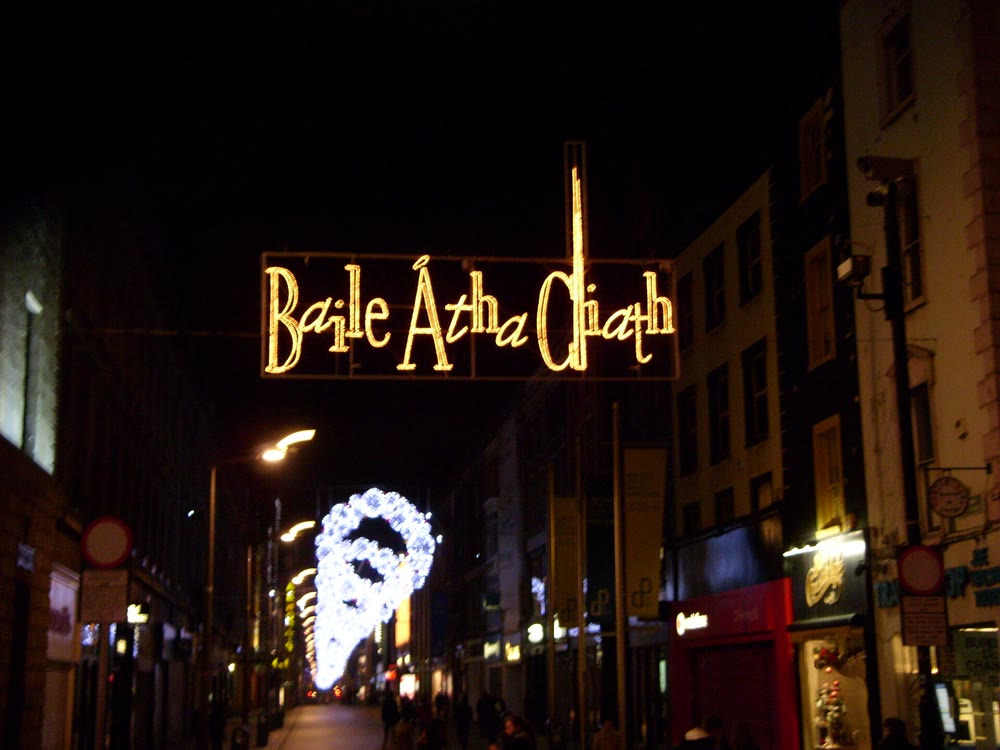
Baile Átha Cliath (roughly BLAW KLEE-uh), the Irish name for Dublin, spelled out in Christmas lights in the city centre on St Stephen’s Day, 2008. Photo: Aoduibh, CC BY 3.0, via Wikimedia Commons
If you’re tempted, my guide to the 12 Pubs of Christmas rules has the classic forfeits, where the crawl came from and how to get home in one piece. If a gentler December appeals, start with the Christmas markets in Ireland instead.
Irish 12 Days of Christmas FAQ
Who did the Irish 12 Days of Christmas?
Frank Kelly, the Dublin actor who later played Father Jack in Father Ted. He wrote and recorded it as Christmas Countdown, in the voice of his radio character Gobnait O’Lúnasa, with music by Jim Doherty.
Who is Nuala in the 12 Days of Christmas?
Nuala is Gobnait’s sweetheart, who sends him every gift in the carol. All twelve letters are written to her. We never hear her side.
When did Frank Kelly’s Christmas Countdown come out?
The recording is dated 1982 and reached No. 8 in Ireland. The UK release peaked at No. 26 in January 1984, the month Kelly mimed it on Top of the Pops.
Where can I find the lyrics?
The words are still in copyright, so the best way to enjoy it is to listen to the official upload above or buy it on The Best of Frank Kelly. Most of the fun is in Kelly’s delivery anyway.
Is Gobnait a man’s name or a woman’s name?
In real life it’s a woman’s name, borne by St Gobnait of Ballyvourney, Co. Cork. In Frank Kelly’s record, Gobnait is a man.
What are the 12 days of Christmas in Ireland?
Christmas Day to 6 January. Along the way come St Stephen’s Day (Wren Day), New Year’s Day and finally Little Christmas, also called Nollaig na mBan or Women’s Christmas.
Is The Twelve Days of Christmas a secret Catholic code?
No. The story dates from the late 20th century and has no documentary evidence behind it. The carol was first printed around 1780, probably as a memory game.
Love this? Save it to your Pinterest board for later.
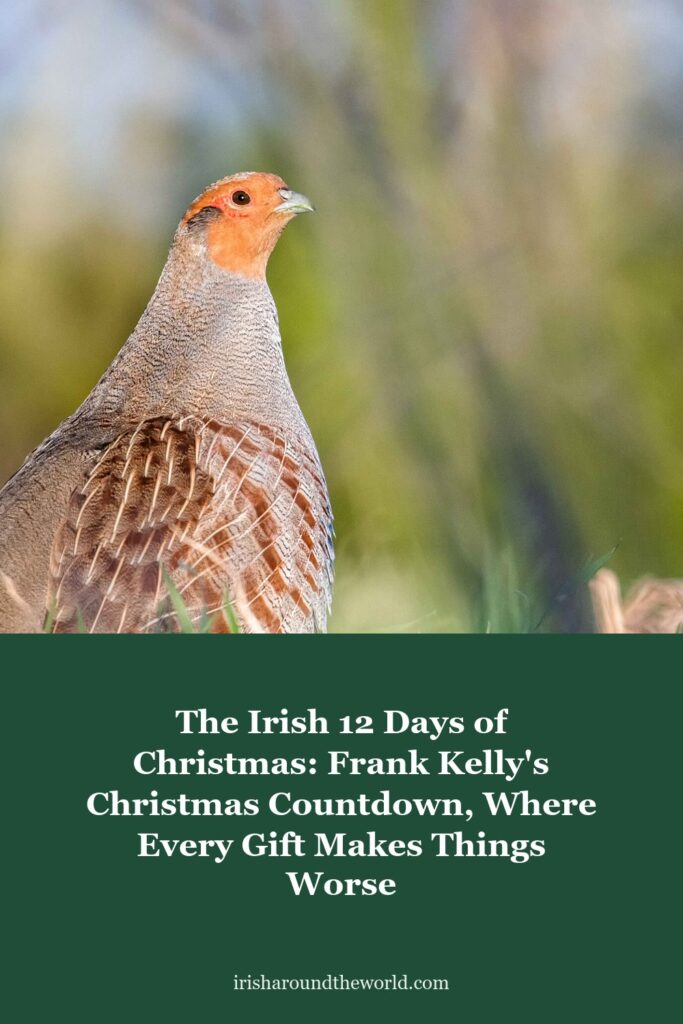
Pin image: A male grey partridge, the partridge species native to Ireland, photographed in Nouvelle-Aquitaine, France, on 31 December 2020. Photo: Tony Rinaud (TRinaud), CC BY 4.0, via Wikimedia Commons
A little bit of Ireland in your inbox every Friday ☘️
The free Weekly Dose of Irish: an Irish joke, a Celtic symbol, an Irish fact, a poem and the week’s best articles in one short email. Join 9,600+ readers.
Free. One short email every Friday. Unsubscribe any time.
More Irish Christmas reading
- Irish Christmas Songs: 15 Carols, Ballads and Pub Favourites, From the Wexford Carol to Fairytale of New York
- 12 Pubs of Christmas Rules: The Full List, Where It Came From and How to Survive It
- Wren Day: The Irish Tradition of Straw Suits, Wren Boys and the King of All Birds
- Nollaig na mBan: Women’s Christmas, the Day Irish Women Finally Get a Break
- 18 Irish Christmas Traditions, From the Candle in the Window to the 12 Pubs
- Merry Christmas in Irish: How to Say Nollaig Shona Duit (Plus 35 Christmas Words)
Featured image: A male grey partridge, the partridge species native to Ireland, photographed in Nouvelle-Aquitaine, France, on 31 December 2020. Photo: Tony Rinaud (TRinaud), CC BY 4.0, via Wikimedia Commons.