
Boxty is an Irish potato pancake made with grated raw potato, squeezed dry and mixed with mashed potato, flour and buttermilk. In Irish it’s bacstaí (roughly BOCK-stee). Its heartland runs from Leitrim, Cavan and Fermanagh to Longford, Sligo and Mayo, where it was also boiled as dumplings and baked as a loaf. This pan boxty recipe makes about 12 pancakes in under an hour, with the mash made ahead.
Boxty on the griddle, boxty on the pan. That’s how the old rhyme starts, and its last two lines carry a warning about your marriage prospects.
Boxty is the potato pancake of Leitrim, Cavan and their neighbours, and the raw grated potato is what sets it apart. The recipe comes first, then the history, the name and the rhyme.
Jump to:
- Boxty recipe (pan boxty)
- Storing and reheating boxty
- What is boxty, and where is it from?
- The three kinds of boxty
- Boxty vs potato cakes
- Where does the name boxty come from?
- The boxty rhyme
- Feast food or famine food?
- Boxty today
- Boxty FAQ
- More Irish recipes
Boxty recipe (pan boxty)
This is pan boxty in metric and US measures, following the pattern found again and again in the 1930s Schools’ Collection.
Prep: 20 minutes, plus cold mashed potato | Cook: 35 minutes | Makes: about 12 pancakes, to serve 4
Ingredients
- 300g (10½ oz) floury potatoes, about 2 medium, peeled: Rooster, Kerr’s Pink or Golden Wonder in Ireland, russets in the US
- 250g (9 oz, a heaped US cup) cold plain mashed potato, with no butter or milk added
- 150g (1¼ US cups) plain flour (all-purpose flour)
- ½ tsp bread soda (baking soda)
- 1 tsp fine salt
- 240ml (1 US cup) buttermilk, plus a splash more if needed
- 40g (3 US tbsp) butter for frying, plus extra to serve
- Optional: 2 scallions (spring onions, or green onions in the US), finely sliced
Method
- Line a bowl with a clean tea towel or a double layer of muslin (cheesecloth). Grate the raw potatoes finely into it.
- Gather up the cloth and twist it hard over the bowl until no more liquid runs out. Tip the squeezed potato into a large mixing bowl.
- Leave the squeezed-out liquid to stand for 5 minutes. A white layer of starch settles at the bottom. Pour off the water and scrape the starch into the mixing bowl.
- Add the mashed potato and mix well with a fork. Sift in the flour, bread soda and salt and mix again.
- Stir in the buttermilk a little at a time until you have a thick batter that drops softly from a spoon. You may not need it all. Add the scallions, if using.
- Heat a heavy frying pan or griddle over a medium heat and melt a knob of butter. When it foams, add about 4 tablespoons (¼ US cup) of batter per pancake and spread each to roughly 10cm (4 in) across and just under 1cm (⅓ in) thick.
- Cook for 4 to 5 minutes a side, until deep golden, crisp and cooked right through. Turn the heat down if they brown too fast.
- Keep them warm in a low oven while you cook the rest, adding butter between batches. Serve hot, with more butter.
Tips
Squeeze hard. Wet potato makes soggy, spitting boxty. A Cavan account describes a pocket-sized linen “boxty bag”, and a Leitrim one says some cooks left a heavy stone on the bag for hours.
Keep the starch. Several 1930s accounts from Longford and Offaly put the settled starch back into the mix. It helps bind the pancakes.
Mind the griddle temperature. Medium, not high: a drop of batter should sizzle steadily, not smoke. Chef Mark Moriarty, writing in The Irish Times in 2025, fries boxty gently in plenty of butter, then finishes it in the oven so the raw potato cooks through. For thick pancakes, about 10 minutes at 180°C (350°F) does it.
Variations
- Thin, filled boxty: add another 60 to 120ml (¼ to ½ US cup) of buttermilk, until the batter is like thick cream. Pour it thinly into a large pan, cook for 2 to 3 minutes a side, and fold it around leftover bacon and cabbage or Irish stew.
- Boxty dumplings: use just a splash of buttermilk to bind, and add flour until the dough is stiff enough to roll. Cut into rounds just over 1cm (½ in) thick and drop them into boiling salted water. They rise after about 5 minutes. Simmer for 35 to 45 minutes in all, then slice and fry in butter.
- Sweet boxty: some 1930s Longford cooks added currants and caraway seeds to their boxty loaves, and a Tullamore, Co. Offaly, recipe serves pan boxty with butter and sugar.
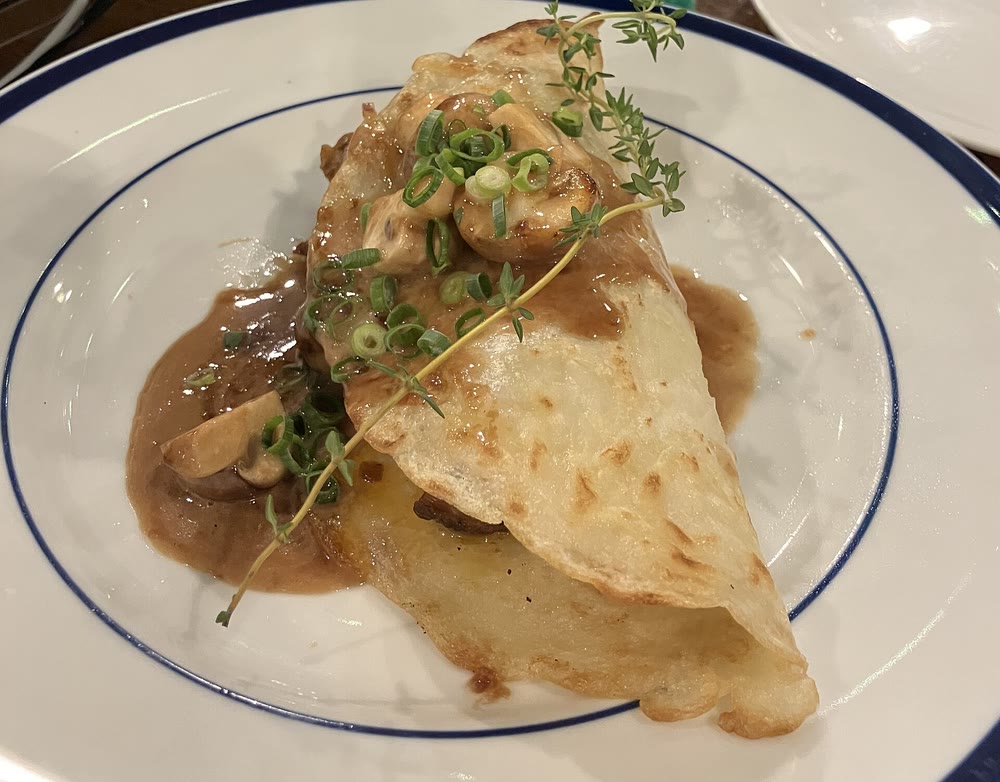
Pan boxty folded around a savoury filling, served at an Irish pub in Tokyo, 2026. Photo: さえぼー, CC0, via Wikimedia Commons
Storing and reheating boxty
The Food Safety Authority of Ireland says leftovers should be eaten within 2 to 3 days, kept in the fridge, and reheated only once, to 70°C (158°F) or higher. A buttered pan crisps them up again.
You can freeze cooked pancakes between sheets of baking paper. Penn State Extension advises using frozen cooked potato dishes within 2 to 4 weeks, as they lose flavour quickly. Don’t keep raw batter, as the grated potato turns grey and watery.
What is boxty, and where is it from?
Boxty is a pancake, dumpling or loaf made with grated raw potato. Ó Dónaill’s Irish-English dictionary defines bacstaí as bread made of raw potatoes.
In 2014 The Irish Times placed its traditional home in Leitrim, Cavan, Monaghan and north Roscommon. A BBC Northern Ireland feature from Belcoo, Co. Fermanagh, names Fermanagh, Cavan, Donegal and Leitrim, and calls it a traditional Halloween dish.
The 1930s folklore agrees. In October 2026, 2,121 transcribed Schools’ Collection pages on dúchas.ie mentioned boxty. Counted by county, three quarters came from Cavan, Mayo, Leitrim, Roscommon, Galway, Donegal, Monaghan and Sligo, and only one in twenty from Munster. (The collection doesn’t cover Northern Ireland, so Fermanagh isn’t counted.)
Down south, the same bread was usually called stampy, steaimpí (roughly SHTAM-pee) in Irish. Three quarters of the pages mentioning stampy come from Kerry, Cork and Clare.
The three kinds of boxty
An account from Cloone, Co. Leitrim, lists them neatly: pan boxty, boiled boxty (also called boxty dumplings) and the boxty loaf. Accounts from Cornagon, Co. Leitrim, and Moyne, Co. Longford, agree.
Pan boxty
In Cloone, grated potato, soda, salt, buttermilk and flour were beaten to a batter like cream and cooked on a hot pan like pancakes.
Boiled boxty
A stiff dough of squeezed raw potato, mashed potato, flour and salt was shaped into flat cakes and dropped into boiling water. A Kilmore, Co. Leitrim, recipe boils them for an hour, then serves them hot and buttered, or cold and fried in butter.
In Belcoo, two local women showed the BBC how they cut the dough into “hurleys” with a floured mug and boiled them for 35 minutes over two crossed spoons, so they wouldn’t stick, before slicing and frying them.
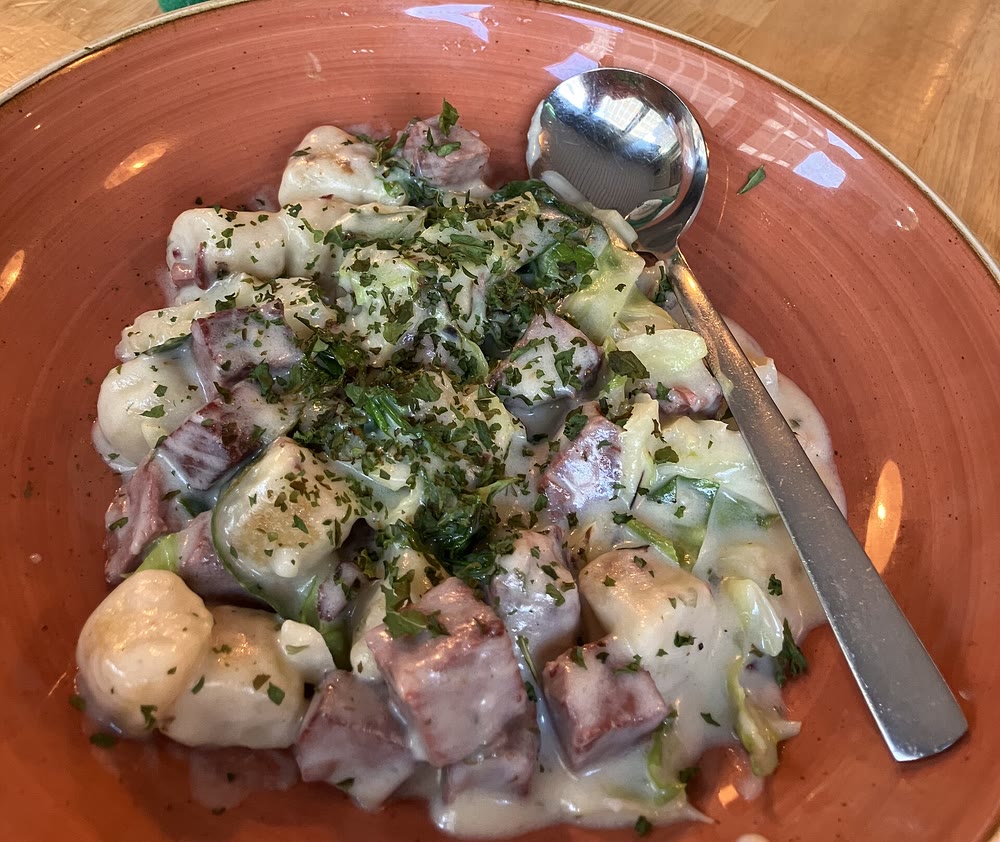
Boxty dumplings with corned beef and cabbage, served in Dublin, 2024. Photo: さえぼー, CC0, via Wikimedia Commons
Boxty loaf
The same dough was baked as a loaf. In Ballyconnell, Co. Cavan, it went into a greased pot oven hung over the fire, with hot coals on the lid, for about two hours. Once cold, it was sliced and fried in dripping for breakfast.
Boxty vs potato cakes: what’s the difference?
Potato cakes, or potato farls, are made from cooked mashed potato, butter and flour, cut into four and cooked on a dry pan, like Nicola Halloran’s Irish potato cakes recipe on this site.
Boxty needs raw grated potato. The Irish Times described it in 2014 as softer than potato cakes or farls, with crispy edges. A 1930s account from Carrigallen, Co. Leitrim, says plainly that boxty is not the same as potato cake. Ó Dónaill’s Irish for potato cake is arán prátaí (roughly uh-RAWN PRAW-tee).
Where does the name boxty come from?
Nobody knows for sure. Ó Dónaill gives the Irish as bacstaí (focloir.ie adds steaimpí), but no dictionary explains the word. In English, it’s BOX-tee.
“Poor-house bread”: arán bocht tí
The best-known theory derives boxty from arán bocht tí (roughly uh-RAWN bokht TEE), “poor-house bread”, which The Irish Times reported in 2014 as one side of a disputed origin. There are good reasons to doubt it:
- Ó Dónaill doesn’t record the phrase. His word for a poorhouse is teach na mbocht (roughly chakh nuh MOKHT), and since Irish adjectives follow the noun, arán bocht tí reads more naturally as “poor bread of a house”.
- Ireland’s workhouse system came with the Poor Law Act of 1838, and most workhouses were built from 1839 to 1843, yet by 1841 William Carleton was already calling boxty a luxury (more below).
It may well be folk etymology.
“Bakehouse”: bácús
The other suggestion you’ll see is bácús (BAW-koos, or baw-KOOS in Munster). Ó Dónaill gives it two meanings, bakehouse and pot oven, and many boxty loaves were baked in a pot oven. Tempting, but no dictionary makes the link.
That 2014 report also says bacstaí means “to bake”. It doesn’t: it’s simply the Irish noun for boxty, and “to bake” is bácáil (BAW-kawl).
Spelling: the Irish is bacstaí, with a fada on the final í; “bacstai” is a misspelling. Munster speakers tend to stress a long second syllable, so you may hear bock-STEE there, and steaimpí as shtam-PEE.
Other names: boxty was “rasp” in parts of Longford and Westmeath, and “buck bread” or “scratch” in Clare.
The boxty rhyme: “Boxty on the griddle, boxty on the pan”
The rhyme is traditional. This version was taken down in the 1930s from Seán Ó Máille, 75, of Burren, Co. Mayo:
Boxty on the griddle,
Boxty on the pan,
If you don’t eat boxty,
You will never get a man.
A school in Kilmurry, Co. Kerry, recorded the same four lines, recited as people began to eat. Many versions online say “If you can’t make boxty” instead, which turns it into a test of a young woman’s cooking.
Co. Monaghan had a proverb too: boxty was no good unless the butter was “running out at the elbows”.
Feast food or famine food? A short history of boxty
You’ll often read that boxty was a famine food. The Irish Times noted in 2014 that some say it was made from rotten potatoes, while Pádraic Óg Gallagher of Dublin’s Boxty House argued it was older, and a dish for celebrations.
An Irish luxury in 1841
The best early evidence is on Gallagher’s side. In a comic story by the Tyrone novelist William Carleton (1794 to 1869), printed in The Irish Penny Journal on 3 April 1841, four years before the potato blight, a christening breakfast is “tay, white bread, and Boxty”, plus a glass of poitín (puh-CHEEN) for the appetite. Carleton explains the bread for readers who won’t know it, calling it “this Irish luxury”.
In his telling, the best potatoes were grated on a tin grater and the pulp wrung in a sheet by two strong men twisting in opposite directions, then pressed under a weight before baking. Nearly a century later, a Schools’ Collection account from Cornapaste, Co. Monaghan, repeats his description almost word for word, a reminder that some 1930s accounts drew on print.
Halloween, harvest and Christmas
- Halloween: accounts from Cavan and Monaghan tie boxty to Hallow Eve, and one from Kilcorby, Co. Cavan, says you’d see it in nearly every house that night. More in my guide to how the Irish invented Halloween.
- Shrove Tuesday: in Larah, Co. Cavan, it was made for that night’s country-house gatherings too.
- The end of the digging: in Attymass, Co. Mayo, neighbours gathered in one house to make a feast of boxty once the potatoes were dug.
- Christmas: one Clare account says Christmas wouldn’t pass without it.
In The Irish Times in 2025, Mark Moriarty quoted folklorist Bríd Mahon’s list of supper foods for St Brigid’s Day, with boxty bread among them.
Hard times too
In Coogue, Co. Mayo, boxty was made in June and July, when the meal and potatoes were running low. Accounts from Garrafine, Co. Galway, and Clonmacnoise, Co. Offaly, tie it to the Famine and blackened potatoes; the Clonmacnoise one even says boxty was first made then, which Carleton’s 1841 story disproves.
The fairest answer is both: grating could rescue damaged potatoes in a bad year, and the same bread was a treat in a good one.
Tin graters, starch and Boxty Wallace
Most homes made their own grater, a scrap of tin pierced all over with a nail and fixed to a board, or bought one from a tinsmith. Nothing was wasted: accounts from Sligo and Mayo say the starch from the squeezed-out water stiffened linen collars and shirt fronts.
And a Monaghan account remembers Boxty Wallace, whose home was between Shercock and Knockbride, Co. Cavan, and made boxty on a machine for anyone who brought him potatoes.
Boxty today
In 2014 The Irish Times met small boxty makers in Leitrim and Cavan campaigning for EU Protected Geographical Indication (PGI) status. In April 2026, Agriland reported that the application was still with the Department of Agriculture, short of the national opposition stage.
In Dublin, Gallagher’s Boxty House in Temple Bar has served boxty since the late 1980s, and its website was taking bookings when I checked in October 2026. Its founder, Pádraic Óg Gallagher, grew up in Leitrim.
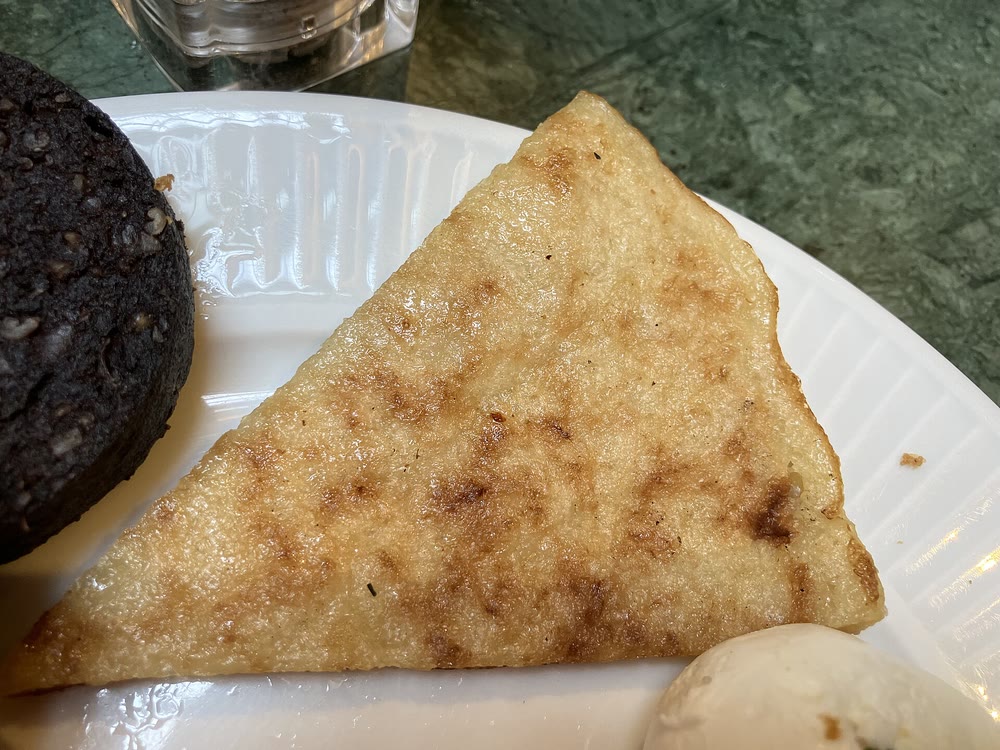
A triangle of boxty with an Irish breakfast in Dublin, 2024. Photo: さえぼー, CC0, via Wikimedia Commons
Boxty FAQ
What is boxty made of?
Grated raw potato squeezed dry, usually mixed with mashed potato, flour, salt and buttermilk, with a little bread soda, the same pairing that raises Irish soda bread.
What county is boxty from?
No single county. Its heartland is Cavan, Leitrim and Fermanagh and the counties around them, from Mayo and Sligo to Longford and Monaghan.
Why is my boxty gummy in the middle?
The pan was probably too hot or the pancakes too thick, so the outside browned before the potato cooked. Lower the heat or finish them in the oven.
Is boxty gluten-free?
Not usually, as it’s made with wheat flour. A gluten-free plain flour blend works, and The Irish Times noted a Cavan producer making a gluten-free version in 2014.
Love this? Save it to your Pinterest board for later.
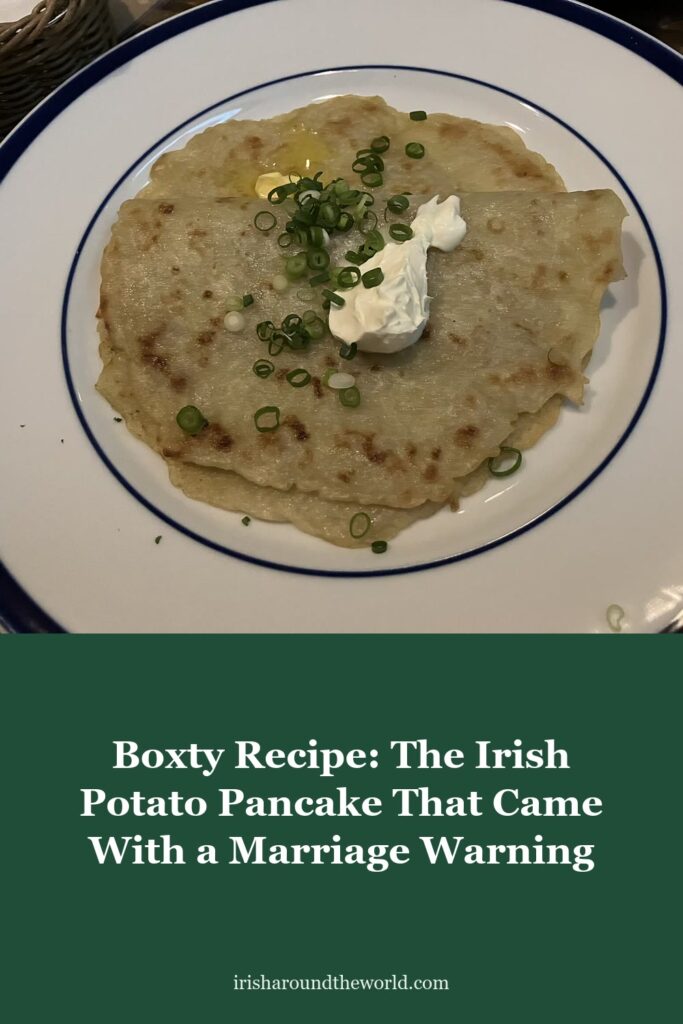
Pin image: Pan boxty with sour cream, butter and scallions, served at an Irish pub in Tokyo. Photo: さえぼー, CC0, via Wikimedia Commons
A little bit of Ireland in your inbox every Friday ☘️
The free Weekly Dose of Irish: an Irish joke, a Celtic symbol, an Irish fact, a poem and the week’s best articles in one short email. Join 9,600+ readers.
Free. One short email every Friday. Unsubscribe any time.
More Irish recipes and food history
- Colcannon Recipe: The Irish Halloween Mash That Hides Your Fortune
- Irish Potato Cakes Recipe By The Wonky Spatula
- Barmbrack Recipe: The Irish Halloween Bread That Predicts Your Future
- Traditional Irish Bacon and Cabbage (With a Wonky Twist)
- Hearty Irish Stew Recipe For The Whole Family To Enjoy
- The Irish Potato Famine (An Gorta Mór): Ireland’s Great Hunger, 1845 to 1852
Featured image: Pan boxty with sour cream, butter and scallions, served at an Irish pub in Tokyo. Photo: さえぼー, CC0, via Wikimedia Commons.