Clonmacnoise, Cluain Mhic Nóis in Irish, is a ruined monastic city on the River Shannon in Co. Offaly, founded by St Ciarán in the 540s. It became a great centre of learning and a burial place of kings, and Lebor na hUidre, the oldest surviving manuscript written entirely in Irish, was probably made there. Among its ruins are a cathedral, three high crosses, two round towers and over 700 early grave slabs. Raided by Vikings and Irish kings alike, it was wrecked by the English of Athlone in 1552.
In a quiet-water’d land, a land of roses,
Stands Saint Kieran’s city fair.
That’s how T. W. Rolleston began The Dead at Clonmacnois, his English version of an Irish poem by Angus O’Gillan: a roll call of the kings and warriors buried at Clonmacnoise.
For a thousand years this ridge above the Shannon drew saints, scribes and kings, and Viking fleets and plundering neighbours too.
I’ve written about Skellig Michael and the Book of Kells. Here’s the story of Clonmacnoise, what to look for, and how to visit. Plan ahead: the site closes for works from mid-October 2026 until 1 January 2027.
Jump to:
- What is Clonmacnoise?
- St Ciarán and the founding
- A centre of learning
- The high crosses
- O’Rourke’s Tower and McCarthy’s Tower
- The cathedral, the Whispering Arch and the kings
- Raids by Vikings and Irish rivals
- Normans, decline and 1552
- The Pope’s 1979 visit and the pattern
- Visiting Clonmacnoise
- Clonmacnoise FAQ
- More Irish heritage reading
What is Clonmacnoise?
Clonmacnoise is an early medieval monastic site on the east bank of the Shannon in Co. Offaly, about 21 km (13 miles) south of Athlone by road.
Its Irish name, Cluain Mhic Nóis (KLOO-in vik NOHSH), is usually translated as the meadow of the sons of Nós. Cluain is a meadow in Ó Dónaill’s dictionary, and mhic strictly means “of the son”.
The plural reflects an older form, Cluain moccu Nóis, used in the Annals of Ulster: moccu meant “of the kindred of”, says the Electronic Dictionary of the Irish Language. The National Monuments Service suggests the name may be much older than the monastery.
The site sits on an esker, a gravel ridge left by the Ice Age, above bog and flood meadow. Here the Shannon, a north-south highway, crossed the main east-west route along the eskers, the OPW explains. The river also divided Connacht from Meath, so kings on both banks became patrons.
With so many lay people living there, the OPW says, Clonmacnoise looked more like a town than a monastery.
St Ciarán and the founding of Clonmacnoise
The founder, Ciarán (KEER-awn; keer-AWN in Munster), was a craftsman’s son, often called Ciarán mac an tSaoir (mok un TEER), son of the wright. Ó Dónaill’s dictionary gives saor (seer; sayr in Munster) as a craftsman or mason. His feast day is 9 September.
The fullest account of the founding is the Irish Life of Ciarán, copied into the Book of Lismore in the late 1400s and translated by Whitley Stokes in 1890. Here’s its story, in my own words.
Ciarán, a pupil of St Finnian of Clonard, went looking for a home beside the Shannon. He turned down one spot as too pleasant: it would bring plenty of worldly wealth, he said, and few souls to heaven. Further on he chose Ard Tiprat, the height of the well.
There were eight in the founding party, the Life says. As Ciarán set the first post, he asked Diarmait mac Cerbaill, then a man with no following, to lay his hand over his own. Ciarán promised he would be king of Ireland by the same hour next day. That night the king, Tuathal Máelgarb, was killed. Diarmait took the kingship and gave Ciarán a hundred churches. Diarmait’s is the last feast of Tara that the Annals of Ulster record: see my guide to the Hill of Tara.
Seven months later, in his 33rd year, Ciarán lay dying. He foretold that evil men would persecute the monastery near the end of the world, and told his monks to leave his relics then, like a deer’s bones left in the sun.
So when was it founded?
The dates are a tangle. The Annals of Ulster enter the founding under 548 and Ciarán’s death under 549, but also say he died in the seventh year after he began building. Chronicon Scotorum says the seventh month. And the Annals of Ulster put Tuathal’s killing, the night of the legendary founding, in 544. So you’ll see dates from 544 to 548; the OPW settles on about 548.
A centre of learning
Heritage Ireland, the OPW’s site, calls Clonmacnoise “a University of its time”, drawing students from across Europe.
Lebor na hUidre, the Book of the Dun Cow
The great survivor is Lebor na hUidre, the Book of the Dun Cow. Ciarán’s Life says a dun cow followed him to school at Clonard, and that her hide was later kept at Clonmacnoise: anyone who died lying on it would win eternal life. Ó Dónaill’s dictionary gives the book’s modern spelling, Leabhar na hUidhre.
The Royal Irish Academy, which owns it, says it was written at Clonmacnoise before 1106, though some scholars have argued that parts were copied elsewhere and brought there. It is the oldest surviving manuscript written entirely in Irish.
Inside is the oldest surviving version of the Táin Bó Cúailnge, the cattle-raid epic starring Cú Chulainn, though it’s incomplete. There’s also the Voyage of Bran, a sea journey to the Otherworld that I cover in my guide to Tír na nÓg.
The only scribe named in it is Máel Muire mac Céilechair. The Four Masters record that in 1106 he was killed by raiders in the middle of the stone church at Clonmacnoise.
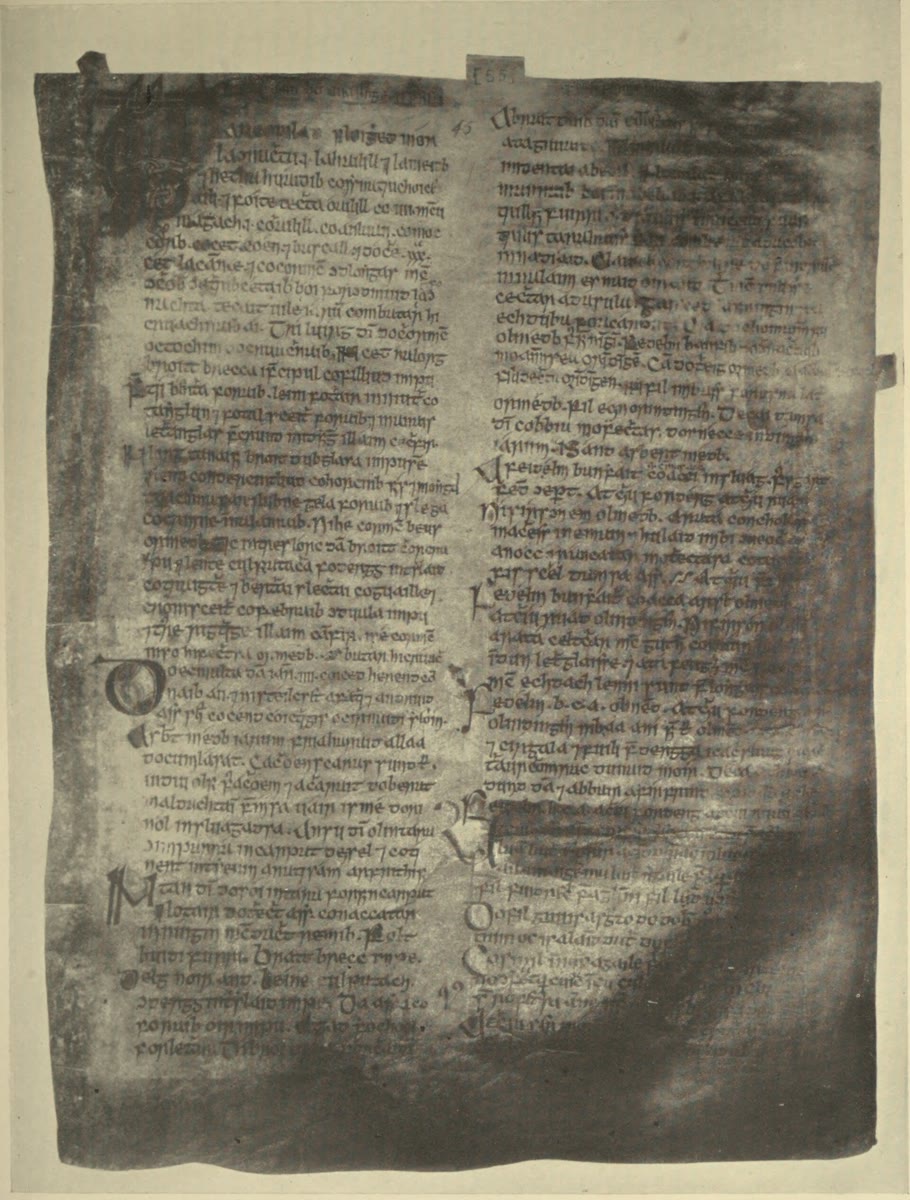
Page 55 of Lebor na hUidre, where its Táin Bó Cúailnge begins. Facsimile from Joseph Dunn, The Ancient Irish Epic Tale Táin Bó Cúalnge (1914). Public domain, via Wikimedia Commons
The book later passed to the O’Donnells of Donegal, who gave it up in a ransom in 1359 and seized it back in 1470. The Academy bought it in 1844, and you can see digitised pages on Irish Script on Screen.
The annals
The Annals of Tigernach are named after Tigernach Ua Braín, abbot of Clonmacnoise, who died in 1088; the Four Masters called him “a paragon of learning and history”. How much of them he wrote is doubted.
The high crosses
Weather was wearing the carvings away, so the three original crosses were moved into the visitor centre, with replicas on the old sites. For the wider story, see my guide to the Celtic cross and Ireland’s high crosses.
The Cross of the Scriptures
This is the masterpiece: a ringed cross about 4 metres (13 ft) tall, its shaft and head cut from a single block of sandstone about 900. It stood west of the cathedral.
Its carved panels include the Last Judgement, the Crucifixion and Christ lying in the tomb. The bottom panel on the east face is a puzzle: a cleric and a warrior, both gripping one pole. The OPW suggests they may be Abbot Colmán and Flann Sinna, high king of Ireland, who built the cathedral together in 909. Damaged inscriptions near the base appear to name them both.
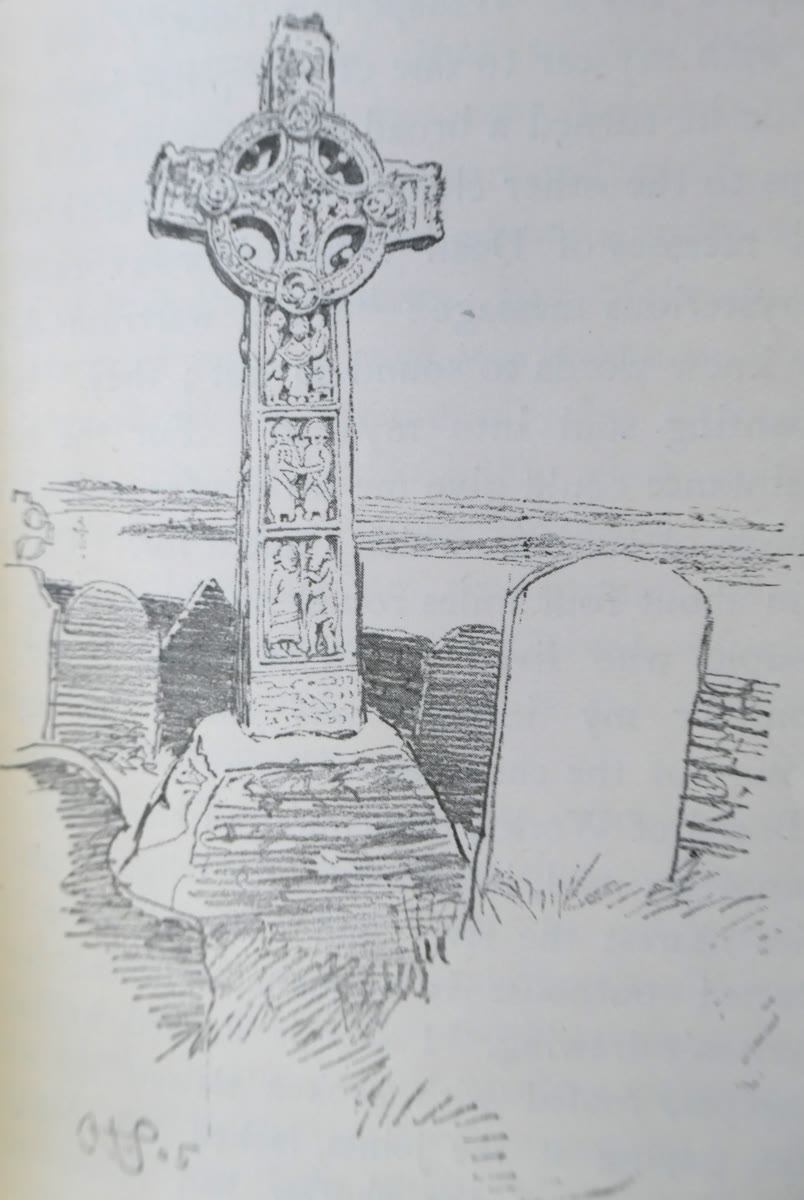
The Cross of the Scriptures, still in the open air, drawn by Hugh Thomson as “King Flann’s Cross” for Stephen Gwynn, The Fair Hills of Ireland (1906). Public domain, via Wikimedia Commons
The South Cross and the North Cross
The South Cross, about 3.7 metres (12 ft) high, is covered mostly in interlace, spirals and bosses, with a Crucifixion unusually placed on the shaft. The OPW says it may date from the early 800s; the National Monuments Service links it to Flann’s father, Máel Sechnaill, high king from 846 to 862.
The North Cross is down to its shaft and base, and the base is a reused millstone. The OPW notes that the shaft’s carving has been likened to the Book of Kells, and a date around 800 is likely.
The grave slabs
The early grave slabs, made between roughly the 700s and the 1100s, often carry a cross, a name and the letters OR DO: short for oróit do, a prayer for, a formula common on tombstones, says the Electronic Dictionary of the Irish Language.
O’Rourke’s Tower and McCarthy’s Tower
Round towers were bell towers first of all. Ó Dónaill’s dictionary gives the Irish word, cloigtheach, as a round tower or belfry: literally a bell house, from clog, a bell, and teach, a house. Clonmacnoise has two.
O’Rourke’s Tower
The big tower stands at the edge of the graveyard, looking over the river. Chronicon Scotorum records that it was completed in 1124 by the abbot, Gilla Críst Ua Máeleóin, and Toirdelbach Ua Conchobair (Turlough O’Connor), king of Connacht. In 1135 lightning struck off its head. The present top, with eight windows, is later work, the OPW says.
Why O’Rourke’s? The Registry of Clonmacnoise, a 14th-century document, credits the tower to Fergal Ua Ruairc (O’Rourke), a 10th-century king of Connacht. The antiquarian George Petrie argued in 1845 that this story grew from the O’Rourkes’ burial place nearby.
McCarthy’s Tower
The smaller tower, nearer the river, is built into a little Romanesque church, Temple Finghin, which the OPW dates to around 1160 to 1170. Unlike its big neighbour it’s complete, conical cap and all. The National Monuments Service says its fine stonework was recycled from the fallen top of O’Rourke’s Tower.
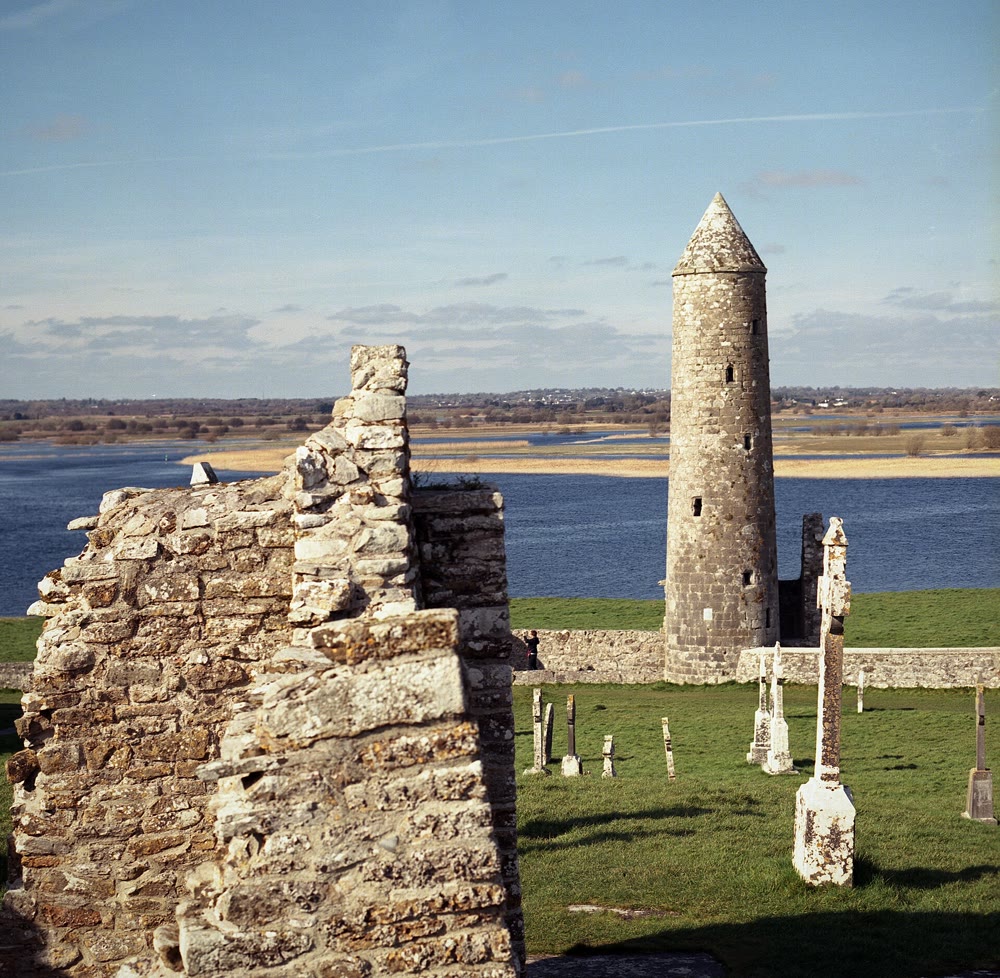
McCarthy’s Tower at Temple Finghin, with the River Shannon beyond. Photo: Rob Hurson, CC BY-SA 4.0, via Wikimedia Commons
The cathedral, the Whispering Arch and the kings
The largest church, known as the Cathedral, was built in stone in 909 by King Flann Sinna and Abbot Colmán, say the annals. Its original masonry survives mainly in the north wall.
The showpiece is the north doorway, added in the 1450s. An inscription credits the work to Odo, the dean, who died in 1461. Above the arch stand three carved saints: Dominic, Patrick and Francis.
This is the Whispering Arch. The OPW’s visitor guide says it was designed that way on purpose, because it served as a confessional.
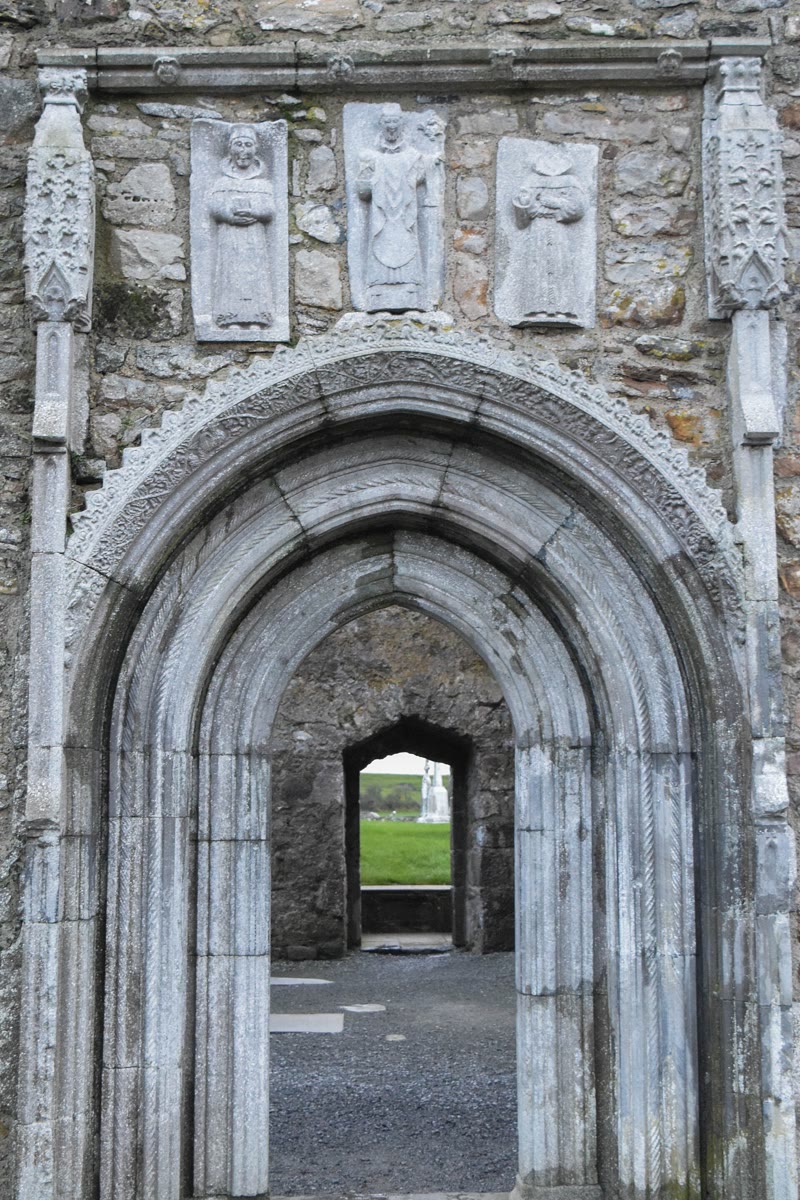
The 15th-century north doorway of the cathedral, the Whispering Arch, with St Dominic, St Patrick and St Francis above. Photo: Sarah Murphy, CC BY-SA 4.0, via Wikimedia Commons
Where the kings lie
When Diarmait mac Cerbaill was killed, in 565 by the Annals of Ulster’s reckoning, the Four Masters say his head was buried at Clonmacnoise and his body at Connor, Co. Antrim. Turlough O’Connor, who helped build the round tower, was buried beside St Ciarán’s altar in the cathedral in 1156.
Rory O’Connor (Ruaidrí Ua Conchobair), whom the OPW calls the last high king of Ireland, died at Cong in 1198 and was buried on the north side of the cathedral’s altar, the Four Masters record.
Temple Ciarán, the tiny church said to stand over the saint’s grave, measures just 3.8 by 2.8 metres (about 12 by 9 ft) inside. Over the centuries it has sunk, says the National Monuments Service, because pilgrims dug out soil from inside it, believing it could cure.
The Nuns’ Church
About 500 metres (a third of a mile) east of the main site, says the OPW guide, stands the Nuns’ Church, with a Romanesque doorway and chancel arch, both rebuilt in the 19th century. The annals say it was finished in 1167 by Derbforgaill, wife of Tigernán Ua Ruairc (Tiernan O’Rourke), king of Breifne.
The OPW’s guide calls her infamous. In 1152, the Four Masters record, Diarmait Mac Murchada, king of Leinster, carried her off from her husband, with her cattle and furniture, on the advice of her brother. She went back to Ua Ruairc the next year.
Raids by Vikings and Irish rivals
A rich monastery was a target, and the attackers weren’t only Vikings.
The Annals of Ulster record that heathens from Linn Duachaill, a Viking naval camp, plundered Clonmacnoise in 842. In 845 the Viking leader Turgéis camped on Lough Ree, upriver, and burned Clonmacnoise with its oratories.
A much later history of the Viking wars, Cogad Gáedel re Gallaib, adds that Turgéis’s wife, Ota, gave audiences, or in another reading oracles, from the altar of Clonmacnoise. Treat it as a story, not a record. There’s more on that book in my guide to Brian Boru.
Irish kings were just as ready to attack. In 833, the Annals of Ulster say, Feidlimid, king of Cashel, killed members of the community and burned its lands right up to the church door. The monks fought too: in 764 the community of Clonmacnoise defeated the community of Durrow in battle, and 200 Durrow men died.
The Annals of Ulster also record big fires, and, under 749, something stranger: ships, with their crews, seen in the air above Clonmacnoise.
Normans, decline and 1552
In 1214 the English king’s chief governor in Ireland built a strong castle just west of the graveyard. The OPW suggests it may have been deliberately destroyed as early as 1300.
From the 13th century, the OPW says, Clonmacnoise declined until it was little more than the seat of a poor bishop. Local Gaelic families kept supporting it, the National Monuments Service notes, and the cathedral’s fine north doorway belongs to that late period.
The end came in 1552. The Annals of the Four Masters record that the English of Athlone plundered and devastated Clonmacnoise and took the large bells from the round tower. Not a bell, image, altar, book or gem was left, they say, not even glass in a window. “Lamentable was this deed, the plundering of the city of Kieran,” the annalists wrote.
Temple Connor has been used by the Church of Ireland since the 18th century, and the State has looked after Clonmacnoise as a National Monument since 1877.
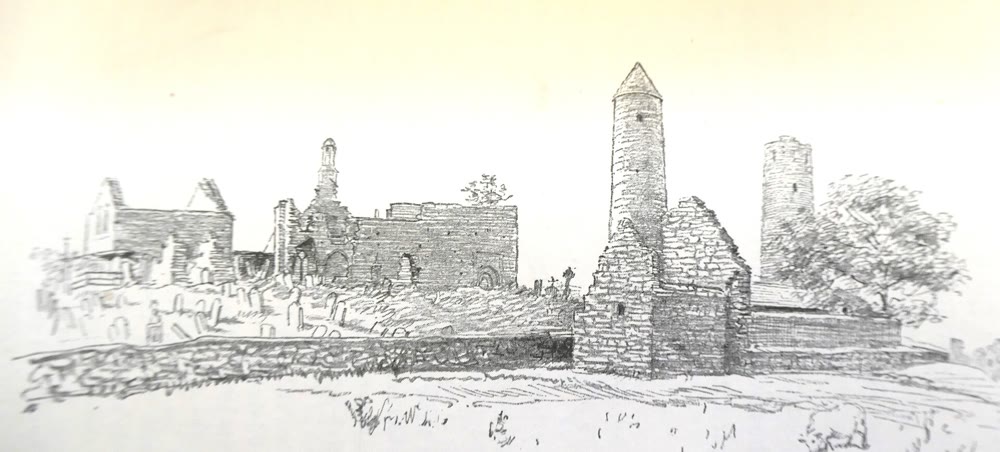
The churches and both round towers of Clonmacnoise, drawn by Hugh Thomson for Stephen Gwynn, The Fair Hills of Ireland (1906). Public domain, via Wikimedia Commons
The Pope’s 1979 visit and the pattern
On Sunday 30 September 1979, Pope John Paul II came to Clonmacnoise. In a short address he praised its thousand years of monastic life and the students and missionaries who spread its learning through Europe. He held up St Manchán’s Shrine, standing on the altar that day, as an example of its famous religious art.
Pilgrims still come for the pattern, from pátrún (PAW-troon), Irish for a patron saint or the festivities of his day. It’s held in September, on the second Sunday or on 9 September itself when possible, says the Diocese of Ardagh and Clonmacnois. The traditional prayers take about four hours, moving from St Ciarán’s Well along the old Pilgrim Road to the ruins.
Visiting Clonmacnoise
Check the OPW’s Heritage Ireland page before you travel. These details were checked on 9 October 2026.
- Closure: the whole site closes from mid-October 2026 (exact date to be confirmed) until 1 January 2027, because contractors must close the car park and there will be no safe way in.
- Visitor centre: closed for essential works, so the original crosses aren’t on view. A redevelopment with €7.8 million in funding, adding an extension and new exhibitions, was contracted in April 2026.
- Hours: in September and October, daily from 9.30am, with last admission at 5pm.
- Tickets: adults €8, seniors and groups €6, children and students €4, families €20. Individuals and small groups just walk in: there’s no online booking or guided tour. Groups of 15 or more must pre-book a guided tour.
- Parking: the OPW advises not arriving between 10.30am and 3pm, to avoid delays. Drop-offs aren’t allowed, and space for vehicles over 5 metres long is very limited.
- Getting there: drive 21 km (13 miles) from Athlone, following signs from the N62, or 20 km (12 miles) from Ballinasloe, following signs from the R357. The Eircode is N37 V292.
- On site: wear sturdy shoes for uneven ground and mind the low doorways. No drones, and assistance dogs only.
Clonmacnoise FAQ
Who founded Clonmacnoise?
St Ciarán, in the 540s. The OPW gives about 548.
Where is Clonmacnoise?
On the east bank of the River Shannon in Co. Offaly, about 21 km (13 miles) south of Athlone.
What does Clonmacnoise mean?
It comes from the Irish Cluain Mhic Nóis, usually translated as the meadow of the sons of Nós.
What is Clonmacnoise famous for?
Its high crosses, especially the Cross of the Scriptures, its two round towers, its royal graves and its scholarship. Lebor na hUidre was probably written there.
Can you visit Clonmacnoise?
Yes, normally. But the site closes from mid-October 2026 until 1 January 2027 for car park works, so check heritageireland.ie first.
Love this? Save it to your Pinterest board for later.
Pin image: Adapted from a photo by Rob Hurson, CC BY-SA 4.0, via Wikimedia Commons.
A little bit of Ireland in your inbox every Friday ☘️
The free Weekly Dose of Irish: an Irish joke, a Celtic symbol, an Irish fact, a poem and the week’s best articles in one short email. Join 9,600+ readers.
Free. One short email every Friday. Unsubscribe any time.
More Irish heritage reading
- Skellig Michael: The Impossible Island Monastery, From Monks to Star Wars
- The Book of Kells: How Ireland’s Greatest Treasure Was Made, Stolen and Saved
- The Celtic Cross: Meaning, History and Ireland’s Great High Crosses
- The Hill of Tara: Ireland’s Hill of Kings, a Roaring Stone and a Hunt for the Ark
- Brian Boru: The High King Who Died at Clontarf on the Day His Army Won
- Cú Chulainn: The Teenage Warrior Who Held Off an Entire Army Alone
- Irish Round Towers: Bell Towers, Viking Hideouts or Fire Temples? The Real Story
- Glendalough: The Hermit Saint, a Blackbird and Ireland’s Valley of Two Lakes
Featured image: a replica high cross and O’Rourke’s Tower above the River Shannon at Clonmacnoise. Photo: Rob Hurson, CC BY-SA 4.0, via Wikimedia Commons.