No, St Patrick did not drive the snakes out of Ireland: there were none to drive. Scientists find no sign that snakes ever lived here, and Roman and early medieval writers noticed Ireland’s lack of snakes centuries before anyone gave Patrick the credit. The banishment story first appears in detail in Jocelin of Furness’s Life of Patrick, written in the late 12th century, which sets it on Croagh Patrick. Ireland’s only native land reptile is the common lizard.
Ask almost anyone what St Patrick did, and you’ll hear about the snakes. He climbed a mountain, raised his staff, and every snake in Ireland slithered into the sea.
It’s a great story. There’s just one problem: Ireland had no snakes to banish. And it was about 700 years after his death before anyone wrote down that Patrick had done it.
I’ve covered the real history of St Patrick’s Day elsewhere. Here’s the snake story: the science, the first writers to notice, the monk who gave Patrick the credit, the mountain, and why America loved it.
Jump to:
- Did St Patrick really drive out the snakes?
- Why are there no snakes in Ireland?
- Ireland’s only reptile, and the “snake” that isn’t
- Snake-free long before Patrick
- When did the St Patrick snakes legend start?
- The legend, step by step
- Croagh Patrick and the snakes
- Were the snakes really pagans?
- Other St Patrick myths
- Why Americans love the snake story
- St Patrick snakes FAQ
- More St Patrick reading
Did St Patrick really drive out the snakes?
No. Patrick never claims to have banished a single snake. His own two Latin texts, the Confessio and the Letter to the soldiers of Coroticus, survive. The only serpents in either come in lines borrowed from the Book of Job, aimed at the soldiers who had killed and enslaved his new converts.
The Irish word for a snake is nathair (NAH-her), and Ireland simply didn’t have any. The story was added by later writers, one layer at a time.
Why are there no snakes in Ireland?
Blame the ice, not the saint. During the last Ice Age, Ireland was far too cold for reptiles, and most scientists think it stayed that way until roughly 10,000 years ago, National Geographic reported in 2014.
Nigel Monaghan of the National Museum of Ireland, who has studied Irish fossil collections and animal records, told the magazine: “At no time has there ever been any suggestion of snakes in Ireland.”
The land bridge question
As the ice melted, sea levels rose. Britain stayed joined to mainland Europe long enough for three snakes to cross: the adder, the grass snake and the smooth snake.
Ireland was cut off sooner, but how much sooner is still argued over. Monaghan put Ireland’s break from Britain about 2,000 years before Britain’s own split from the continent. A 2008 sea-level study by R. J. Edwards and A. J. Brooks in the Irish Naturalists’ Journal went further. It suggests Ireland was separated from Britain by about 16,000 years ago, while the climate was still cold, and finds no support for a later land bridge carrying warmth-loving wildlife across.
Either way, the snakes missed the boat. Snakes are slow to colonise new ground, Monaghan said, unlike the brown bears, wild boar and lynx that did reach Ireland. Ireland is in good company: New Zealand, Iceland, Greenland and Antarctica have no native snakes either.
Ireland’s only reptile, and the “snake” that isn’t
One reptile did make it. Ireland’s one native land reptile is the common lizard, also called the viviparous lizard (Zootoca vivipara), says the Irish Wildlife Trust. In Irish it’s earc luachra (ark LOO-ukh-ruh), according to focloir.ie, although Ó Dónaill’s older dictionary gives that name to the newt.
“Viviparous” means it bears live young, which is unusual for a reptile. It lives on bogs, coasts, grassland and uplands, and it’s a protected species under the Wildlife Act. How it got here after the ice is still unclear: a 2023 University College Cork study placed Irish lizards in the species’ western lineage but called for more sampling to trace the route.
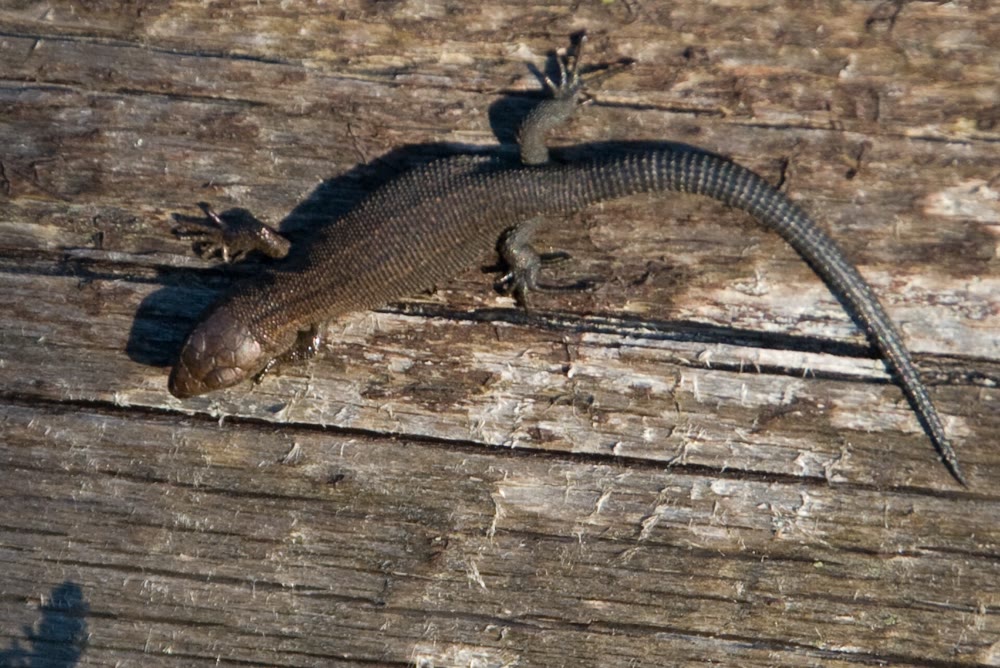
A common lizard, Ireland’s only native land reptile, in the Wicklow Mountains. Photo: BenCrowe, CC BY 3.0, via Wikimedia Commons
Leatherback turtles also count as native, the National Biodiversity Data Centre notes, but they live at sea.
The slow worm
If you ever spot a “snake” in the Burren in Co. Clare, look again. The slow worm (Anguis fragilis) is a legless lizard. Unlike a snake it can blink, because lizards have eyelids and snakes don’t, the Irish Wildlife Trust explains. Its Irish name, earcán caoch (AR-kawn KEEKH, or closer to ar-KAWN KAYKH in Munster), means roughly “blind little lizard”.
It isn’t native. The first slow worms on record in Ireland were found by a schoolboy in Co. Clare in 1972, and a zoologist described the species as new to Irish fauna in 1977, according to a 2020 study in the Bulletin of the Irish Biogeographical Society. Nobody knows how it arrived, though it’s generally assumed to have come from Britain.
Ireland was famous for having no snakes long before Patrick
- Solinus, probably 3rd century AD. This Roman writer says Ireland has no snakes, few birds and no bees. Sprinkle dust from Ireland among beehives, he adds, and the swarms will desert their combs.
- Bede, 731. The English monk says Ireland has no reptiles and no snake can survive there: snakes shipped over from Britain die as soon as they near the shore and smell the air. He says scrapings from the pages of Irish books, stirred into water, cured snakebite. He never mentions Patrick.
Medieval Irish scholars had their own explanation, and it didn’t involve Patrick either. In one version of the Lebor Gabála Érenn, the Book of Invasions, compiled from the 11th century on, a snake bites the infant Goídel Glas, ancestor of the Gaels, in Egypt. Moses heals him with his staff and decrees that no snake will harm his descendants or live in their homeland. That, the text says, is why Ireland has no snakes. Its editor, R. A. S. Macalister, judged the passage a later insertion.
Even the idea of a saint protecting an island from snakes was older. Around 700, Adomnán’s Life of Columba, written on Iona, says Colm Cille blessed that island so venomous creatures could no longer harm its people or cattle, as long as they kept Christ’s commandments.
When did the St Patrick snakes legend start?
The earliest detailed telling we have comes from Jocelin, a Cistercian monk of Furness Abbey in what is now Cumbria, England. He wrote a new Life of Patrick in the late 12th century, and his patrons included John de Courcy, the Anglo-Norman conqueror of Ulster.
In 1185, according to the Maynooth historian Niamh Wycherley, de Courcy stage-managed the finding of relics said to be those of Patrick, Brigid and Colm Cille at Downpatrick. Jocelin’s Life is usually dated to the 1180s or a little later.
Jocelin says that since ancient times Ireland had suffered three plagues: countless poisonous creatures, swarms of demons, and crowds of magicians. Patrick, carrying the staff of Jesus, gathered every venomous creature on the island to one high mountain, Croagh Patrick, once called Cruachán Aigle, and drove them over the edge, “headlong into the ocean”, while a crowd watched. He cleared the Isle of Man too, Jocelin adds, while islands that rejected his preaching still breed poisonous creatures. Edmund Swift’s 1809 translation is free on Project Gutenberg.
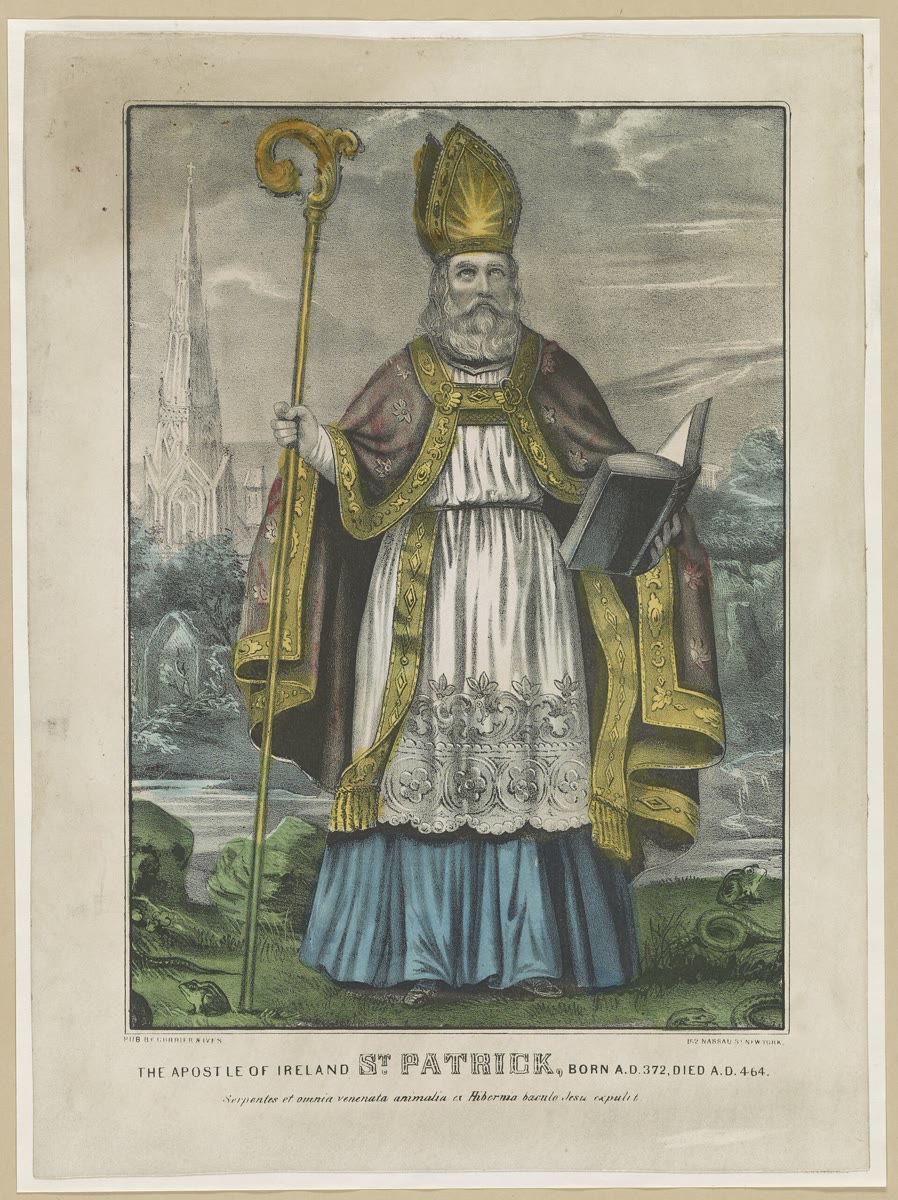
Patrick with the snakes and toads he banished, in a hand-coloured lithograph by Currier & Ives, New York, between 1857 and 1872. The Latin line says he drove the serpents and all venomous animals out of Ireland with the staff of Jesus. Library of Congress, public domain, via Wikimedia Commons
Gerald of Wales wasn’t convinced
At almost the same moment, Gerald of Wales, a Cambro-Norman churchman who came to Ireland in the 1180s, was writing his Topography of Ireland, finished around 1188. He knew the idea that Patrick and Ireland’s other saints had cleared the island of poisonous animals, and dismissed it as what seemed “a flattering fiction” in Thomas Forester’s 1863 translation. More likely, he thought, Ireland had simply never had them.
The old argument over whether the Isle of Man belonged to Ireland or Britain, he says, was settled when venomous reptiles brought there survived, so it went to Britain. And a frog found near Waterford “within my time” caused a sensation, since Ireland had none. The king of Ossory took it as an omen of the English conquest. Today the National Biodiversity Data Centre lists the common frog as native.
Gerald’s wording shows the idea was already going around. By the early 13th century, the historian Roy Flechner notes in Saint Patrick Retold (2019), the snake story had turned up in three texts written close together: Gerald’s, Jocelin’s and an anonymous Life of Patrick that survives only in fragments.
The legend, step by step
- 5th century: Patrick’s own writings. No snakes banished.
- Late 600s: Tírechán puts Patrick’s 40-day fast on Croagh Patrick. Birds pester him, but there are no snakes.
- Around 700: Adomnán’s Columba protects Iona from venomous creatures.
- 731: Bede says snakes die on reaching Ireland. No Patrick.
- Probably 9th or 10th century: the Tripartite Life has Patrick drive demons, in the form of black birds, off the mountain with his bell.
- 1180s or a little later: Jocelin of Furness has Patrick drive every venomous creature off Croagh Patrick into the sea.
- Around 1188: Gerald of Wales calls the saints’ credit a flattering fiction.
- 1630s: Geoffrey Keating wonders whether the “serpents” in Patrick’s Life were really demons.
Croagh Patrick and the snakes
Croagh Patrick, Cruach Phádraig (KROO-ukh FAW-drig) in Irish, rises 764 metres (2,507 feet) above Clew Bay in Co. Mayo. Cruach means a stack or rick, and the mountain is known as the Reek. Thousands of pilgrims climb it on Reek Sunday, the last Sunday in July, says the Archdiocese of Tuam. It’s a highlight of my Wild Atlantic Way route guide.
In the late 600s, Tírechán, a bishop from north Connacht, has Patrick come to the mountain to fast for 40 days and nights, as Moses, Elijah and Christ had done. His charioteer dies at Muiresc, now Murrisk, at the mountain’s foot. On the summit, birds trouble him, and he can’t see the sky, the land or the sea. There’s not a snake in it. Ludwig Bieler’s translation is online at the Royal Irish Academy’s confessio.ie.
The Tripartite Life, an Irish Life of Patrick probably from the 9th or 10th century, makes the birds black and demonic. Patrick sings psalms at them, rings his bell, then flings it, chipping it. After that, it says, no demon came to Ireland for seven years, seven months, seven days and seven nights.
Jocelin finally brings in the snakes: his Patrick drives them off the mountain before the fast even begins. The demon-birds still come, and Patrick banishes them with his bell.
Lough Nacorra and Lough Derg
In the 1930s, schoolchildren recorded local versions for the National Folklore Collection’s Schools’ Collection. At Brackloon school, Co. Mayo, a pupil wrote down a story from Pat Walsh of Laghloon. While Patrick prayed and fasted on the mountain, serpents came up to poison him, so he hurled his Mass bell at them and drove them into a lake, Loch na corraigh. That’s Lough Nacorra, below the mountain’s southern slopes. The account adds that a man searching for sheep later saw a tiny woman on a rock by the lake change into a serpent and plunge in.
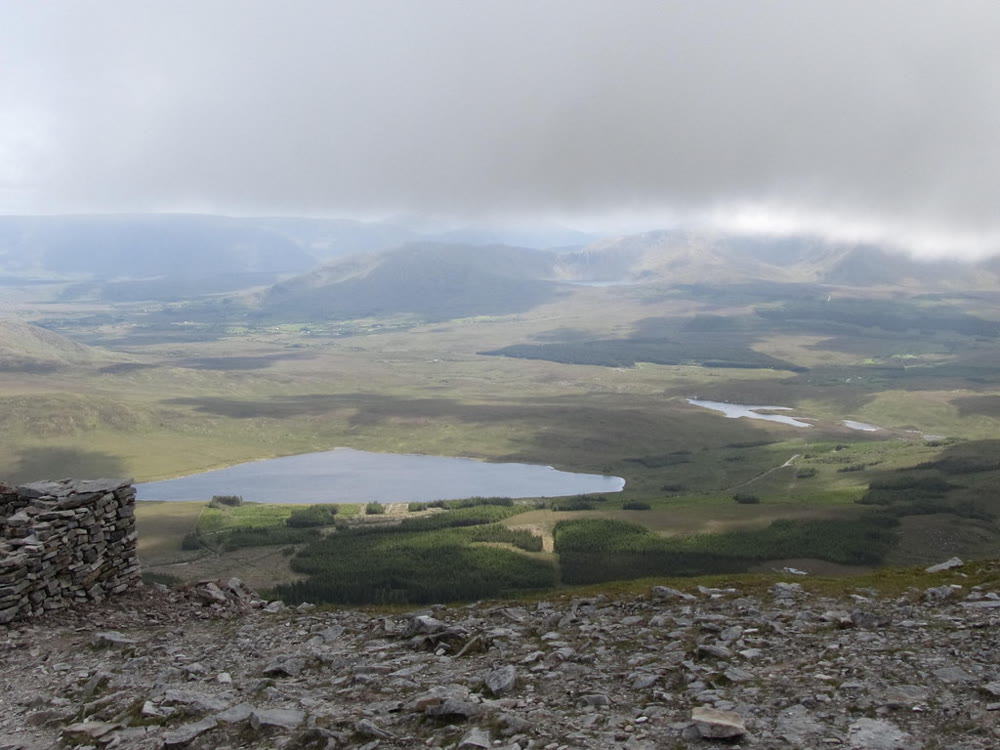
Lough Nacorra, where Mayo folklore says Patrick drove the serpents, seen from the summit of Croagh Patrick. Photo: Eric Jones, CC BY-SA 2.0, via Wikimedia Commons
Another Mayo school, Carrowniskey, recorded that the serpents Patrick banished from the Reek fled to Lough Derg in Co. Donegal, staining its water brown ever since, which the account gives as the reason for its name. Loch Dearg (lokh JAR-ug) means “red lake”. Other tellings have Patrick fight a monster there, as I explain in my guide to Irish mythological creatures. Irish calls such a beast an ollphéist (UL-faysht), which Ó Dónaill’s dictionary defines as a serpent or serpentine monster.
Were the snakes really pagans?
The most popular explanation today is that the snakes are symbolic. Serpents stand for evil in Judeo-Christian tradition, National Geographic notes, so the banishment can be read as a metaphor for Patrick’s Christianising of Ireland. The Maynooth church historian Salvador Ryan has said the snakes could be seen as a symbol of evil.
Jocelin’s text leaves room for that reading. He bundles the poisonous creatures with demons and magicians as Ireland’s three plagues, and Patrick defeats all three. When an angel named Victor first appears to the young Patrick, Jocelin explains the name by recalling that Christ gave his servants power to tread on serpents and scorpions, a line from Luke’s Gospel.
Geoffrey Keating, writing his history of Ireland in the 1630s, offered two guesses: any serpents Ireland had before Patrick weren’t venomous, or perhaps “it is the demons that are called serpents in the Life of Patrick”, in Patrick Dinneen’s translation.
None of these medieval texts says outright that the snakes were pagans or druids, and Jocelin clearly means real animals too. Reading the story as a coded purge of pagans or druids looks like a modern idea. In the US, some neopagans now mark 17 March as “All Snakes Day”, a name used by the American druid Isaac Bonewits, the Pagan news site The Wild Hunt reports. In Muirchú’s 7th-century Life, Patrick’s great showdown with the druids happens at the Hill of Tara, and there isn’t a snake in sight.
Other St Patrick myths
- He wasn’t Irish. Patrick was a Briton from Roman Britain. In his Confessio he says Irish raiders carried him off when he was about 16.
- The shamrock lesson came late. Patrick never mentions shamrock. The first published account of him explaining the Trinity with it is in Caleb Threlkeld’s 1726 book on Irish plants, which calls it a current tradition, the Edward Worth Library notes. See why the shamrock became Ireland’s symbol.
- Green wasn’t always his colour. In 1785 the Dublin Evening Post described patriots on St Patrick’s Day “dressed in true blue”. Green took over after the United Irishmen took up “the wearing of the green” in the 1790s, the historian Bryan McGovern writes. More in my St Patrick’s Day facts.
For more of these, see my 20 myths about Ireland.
Why Americans love the snake story
The US Census Bureau counted 32.4 million Americans claiming Irish ancestry in 2024, 9.5% of the population.
After the Famine, Irish Catholic immigrants faced discrimination, and celebrating St Patrick’s Day became a proud link to Irish history and culture, McGovern writes. A saint who cleared a whole country of serpents with his staff made a perfect hero for the day, and a perfect picture.
New York printmakers Currier & Ives sold that picture, snakes and all (shown above). By the 1890s it was so familiar that cartoonists used it as shorthand. In March 1895, the cover of Puck magazine dressed New York’s reform mayor, William L. Strong, as “New York’s St. Patrick”, wielding his power of removal like a crozier to drive the Tammany Hall snakes out of City Hall. In March 1909, Puck did it again, with the new president, William Howard Taft, as the saint.
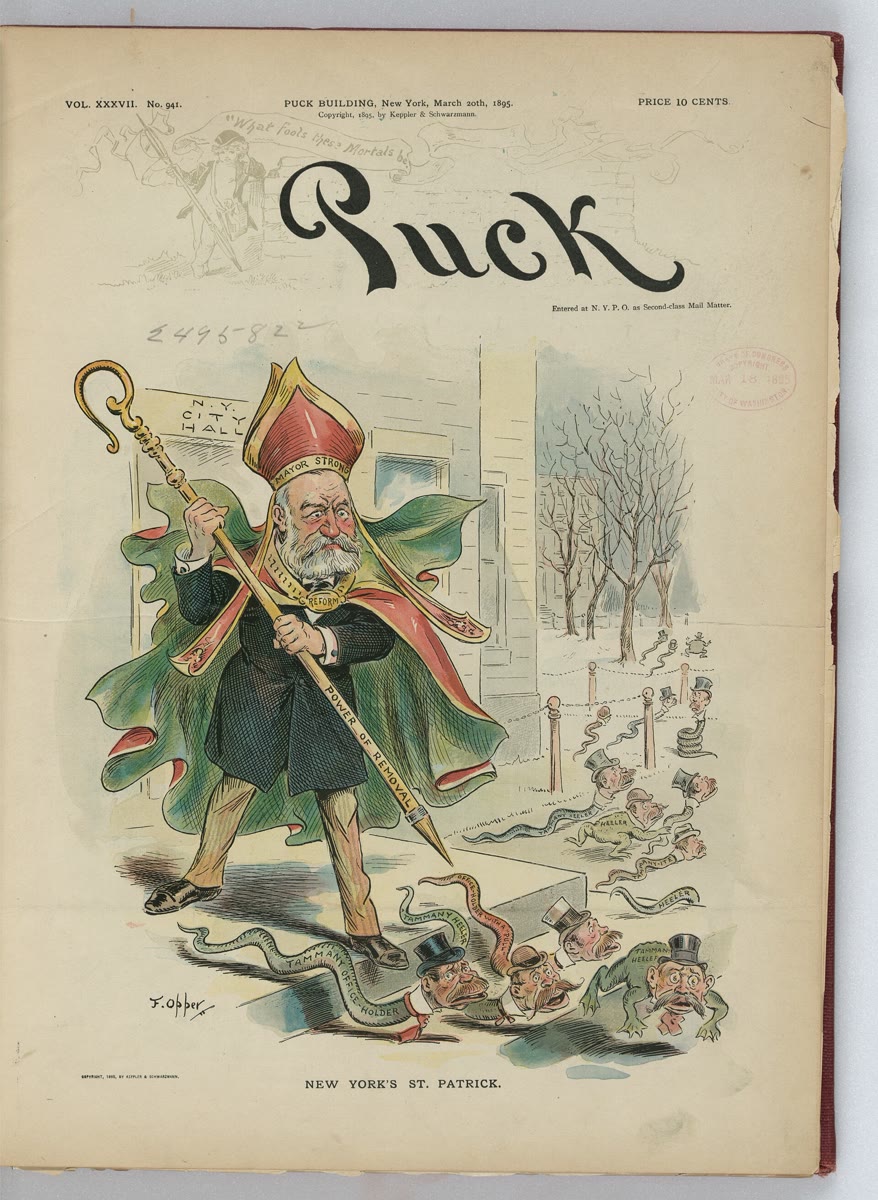
New York’s St. Patrick: Mayor William L. Strong drives the Tammany Hall “snakes” out of City Hall, cover of Puck, 20 March 1895. Cartoon by Frederick Burr Opper. Library of Congress, public domain, via Wikimedia Commons
For today’s parades, see my list of the best places to celebrate St Patrick’s Day.
St Patrick snakes FAQ
Did St Patrick really drive the snakes out of Ireland?
No. There’s no evidence that Ireland ever had snakes. The story first appears in detail some 700 years after Patrick, in Jocelin of Furness’s Life of Patrick.
Why are there no snakes in Ireland?
Ireland was too cold for reptiles during the last Ice Age, and rising seas cut it off before snakes, which spread slowly, could arrive. Britain stayed joined to Europe longer and gained three species.
Where did St Patrick banish the snakes?
In the legend, from Croagh Patrick in Co. Mayo. Jocelin has him drive them into the ocean. Mayo folklore sends them into Lough Nacorra, below the mountain, or Lough Derg in Donegal.
What do the snakes symbolise?
Many people read them as evil or paganism. That’s a reasonable interpretation, but the medieval texts don’t say so outright.
Are there any reptiles in Ireland?
Yes: the native common lizard, the introduced slow worm in the Burren, and leatherback turtles offshore.
Love this? Save it to your Pinterest board for later.
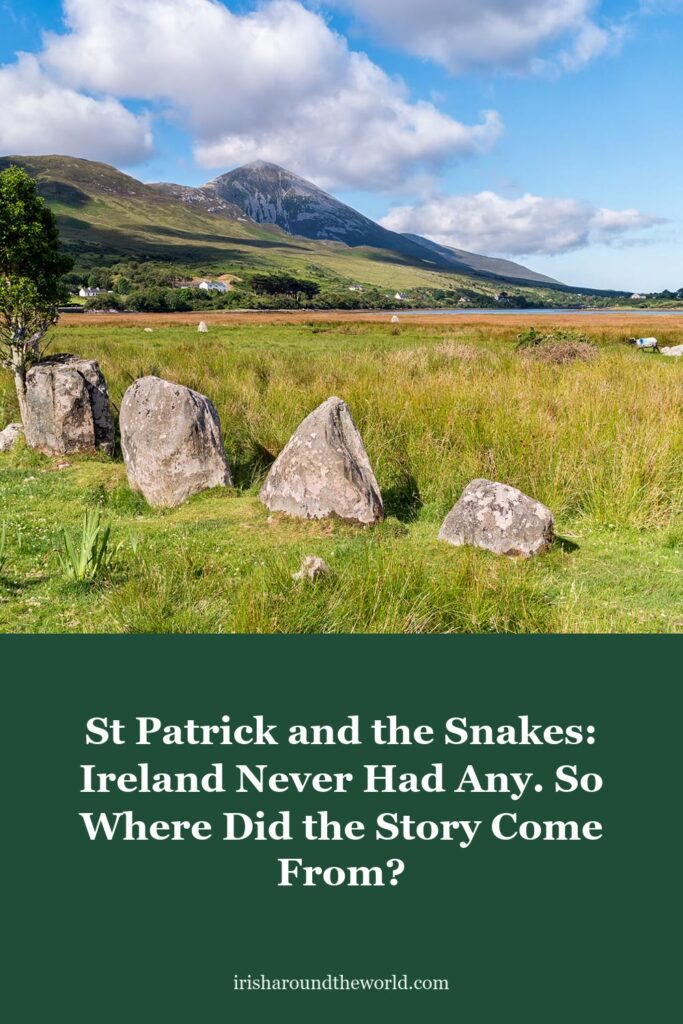
Pin image: Adapted from a photo by MickReynolds, CC BY-SA 4.0, via Wikimedia Commons.
A little bit of Ireland in your inbox every Friday ☘️
The free Weekly Dose of Irish: an Irish joke, a Celtic symbol, an Irish fact, a poem and the week’s best articles in one short email. Join 9,600+ readers.
Free. One short email every Friday. Unsubscribe any time.
More St Patrick reading
- The History of St Patrick’s Day: The Real Story (and Why Patrick Wasn’t Irish)
- 30 St Patrick’s Day Facts (and the Myths an Irishman Wants You to Forget)
- 20 Myths About Ireland You Probably Believe (And the Truth)
- Why the Shamrock Is the Symbol of Ireland and St Patrick’s Day
- Irish Mythological Creatures: 23 Fairies, Monsters and Death Omens to Know
- The Best Places to Celebrate St Patrick’s Day Around the World
- Croagh Patrick: Ireland’s Holy Mountain, Where Pilgrims Still Climb Barefoot
Featured image: Croagh Patrick from the shore of Clew Bay at Murrisk, Co. Mayo. Photo: MickReynolds, CC BY-SA 4.0, via Wikimedia Commons.