
Deireadh na Feide is a short poem in Irish by the Kerry poet Ailbhe Ní Ghearbhuigh about a whistled language once used by shepherds in Aas, a village in the French Pyrenees. In the Second World War, the poem says, it kept Jews safe, spread Resistance messages and guided lost pilots. People still remember it, but nobody can whistle it now, and no recording was made. The title means “the end of the whistle” and echoes an Irish idiom for being at your last gasp. It’s on the Leaving Cert Irish course for June 2027 and June 2028 as a common prescribed poem at both Higher and Ordinary Level.
High in the Pyrenees, shepherds once sent messages across a valley without raising their voices. They whistled, and the people below understood.
That whistled speech is the subject of Deireadh na Feide, the poem that won Ailbhe Ní Ghearbhuigh the O’Neill Poetry Prize in 2012. Now it’s on the Leaving Cert Irish course, so a generation of students is about to get to know a tiny village in south-west France.
The poem is still in copyright, so the full text isn’t here. Instead you’ll find a plain-English summary, the true story behind it, themes, techniques, key words and exam pointers. For the whole course, see my guide to the Leaving Cert Irish poems.
Jump to:
- Deireadh na Feide at a glance
- What does the title mean?
- What happens in the poem
- The real whistled language of Aas
- Themes
- Imagery and techniques
- Tone and feelings
- Key Irish words in the poem
- Exam notes and useful Irish phrases
- Who is Ailbhe Ní Ghearbhuigh?
- Deireadh na Feide FAQ
- More Irish poetry
Deireadh na Feide at a glance
- Title: Deireadh na Feide, roughly JERR-uh nuh FEDJ-uh. Billy Ramsell’s English translation is called Last Blast.
- Poet: Ailbhe Ní Ghearbhuigh (AL-va, or AL-iv-uh in Munster; the surname is roughly nee YAR-uh-vee, though in Munster Irish the ending can sound more like -vig), born in 1984 in Tralee, Co. Kerry.
- Prize and publication: it won the O’Neill Poetry Prize, for new poetry in Irish and Scottish Gaelic, in 2012, and appeared in 2016 in Tost agus Allagar (Coiscéim) and the bilingual The Coast Road (Gallery Press).
- Length: under 30 short lines of free verse, in eight stanzas of very different lengths.
- Where to read it: The Coast Road, the book named on the official list. The online magazine Specimen also publishes the Irish text with Billy Ramsell’s English translation.
- Where to hear it: the poet reads it on RTÉ Radio 1’s Arena (March 2016), and TG4 Foghlaim has a free reading and a video analysis in Irish.
Spelling it right
There’s no fada in Feide. Fead has a short vowel, and so does its genitive, feide, so “Féide” is wrong. The poet’s surname takes an h after the G, because surnames are lenited after Ní: Ní Ghearbhuigh, not Ní Gearbhuigh.
What does Deireadh na Feide mean?
Fead (roughly FAD) is a whistle, and deireadh (JERR-uh) is an end. Feide is the genitive, “of the whistle”, so the literal meaning is the end of the whistle: the whistling has stopped for good.
Irish speakers hear a second meaning too. Ó Dónaill’s Irish-English dictionary gives the idiom bheith i ndeireadh na feide, “to be at the last gasp”, worn out and nearly finished. In her Irish Times review of The Coast Road in January 2017, the poet Nuala Ní Dhomhnaill singled out the title as the poem’s great strength, because the pun lightens a very heavy subject.
Billy Ramsell’s English title, Last Blast, keeps a hint of the joke. Irish is full of phrases that don’t translate neatly, as my list of Irish words with no English translation shows.
What happens in Deireadh na Feide (summary in plain English)
Here it is in my own words.
- Stanzas 1 to 4, the memory: the poem begins in the present. To this day, people in Aas remember that long ago their shepherds whistled a language. The whistle followed the valley’s own pathway for sound, between the pastures and the village. It carried each day’s news between the shepherds and the women working in the fields round about. Nobody outside the parish could make sense of it.
- Stanza 5, the war: when the Nazis came, the whistling did three things. It kept Jewish people out of danger. It passed on news of the French Resistance secretly, by word of mouth. And it helped pilots who had lost their way to find the Spanish border.
- Stanza 6, the silence: a single line. Nobody has heard the language since.
- Stanza 7, memory without sound: the whistled language lives on in people’s memories, but nobody is able to make the sounds any more.
- Stanza 8, the ending: one stark line, “Níor deineadh aon taifead” (Ailbhe Ní Ghearbhuigh). No recording was ever made.
Notice who is missing: we never meet a single named whistler. They fade into the past, just like their language.
The real whistled language of Aas
Aas is real: a small village in the Ossau valley, in the Béarn region of south-west France, in the commune of Eaux-Bonnes.
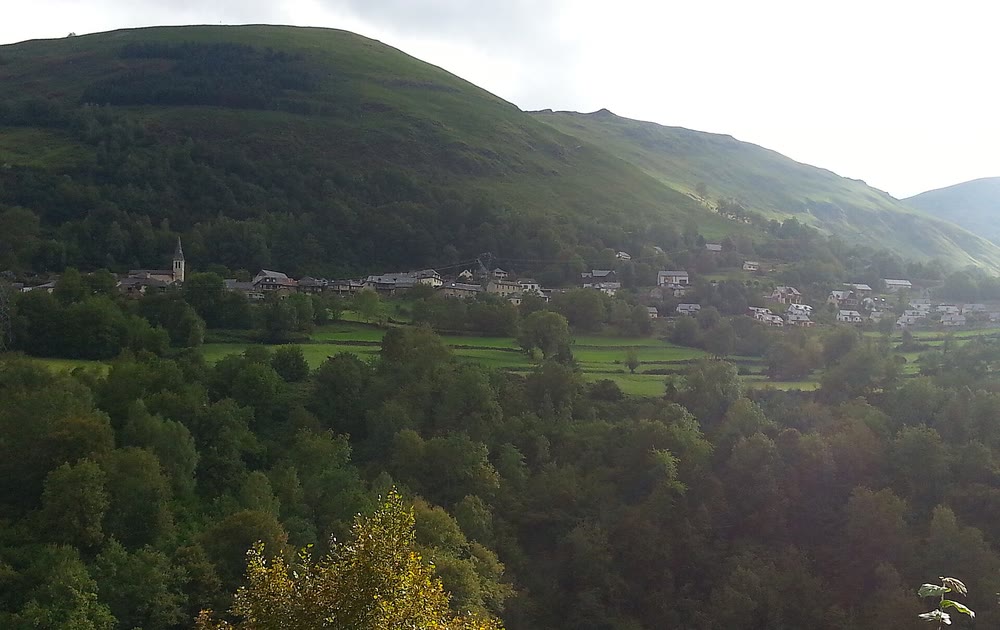
The village of Aas on its hillside in the Ossau valley, with fields below. Photo: Gilles Guillamot, CC BY-SA 3.0, via Wikimedia Commons
A whistled form of Occitan
The whistlers didn’t use a secret code. They whistled their everyday speech, Béarnese, a local form of Occitan, the old Romance language of southern France. A 2026 study by French phoneticians explains how it works: vowels become changes in pitch, and most consonants become tiny gaps or bursts of noise, recognisable mainly from the way the pitch glides in and out of them.
What the scientists found in 1959
Scientists only learned of the whistlers in the late 1950s, says the University of Pau. The French bioacoustician René-Guy Busnel began studying them in 1959 and reported, with two colleagues, in a 1961 conference paper:
- Of about 150 villagers, some 30 could still whistle. Most were men of 50 or older, and all had been shepherds as children.
- The whistles reached about 110 decibels, measured a metre away, and with a good wind could be understood up to 2 or 2.5 kilometres away. Some modern accounts claim far more, up to ten kilometres.
- People in the neighbouring hamlets neither used nor understood it, just as the poem says.
- It was already fading. The team described a vestige of a disappearing language, used mostly for a small stock of set messages about the shepherds’ flocks, homes and daily life.
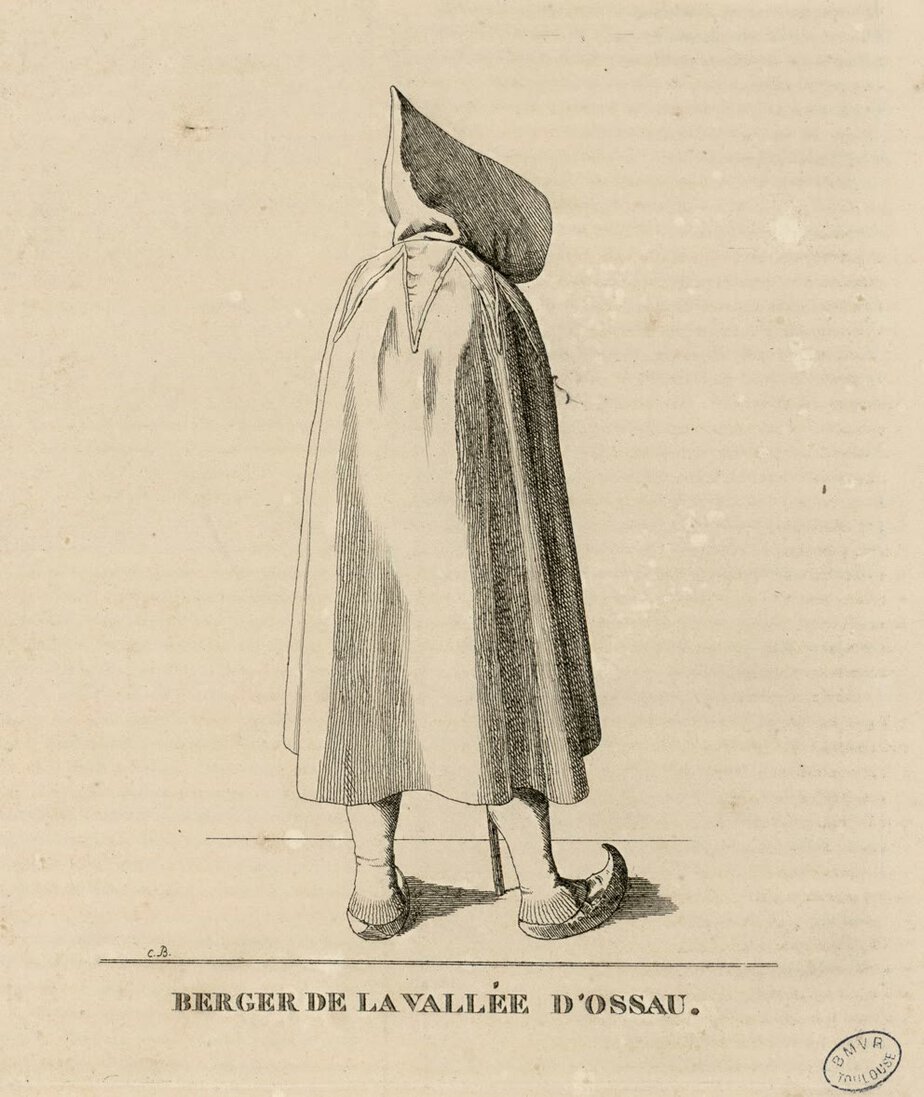
Berger de la Vallée d’Ossau (Shepherd of the Ossau valley), a print dated 1838. Bibliothèque municipale de Toulouse (Fonds Ancely). Public domain, via Wikimedia Commons
The war years
The poem’s most dramatic stanza is about the Second World War. The historian Graham Robb tells the same story in The Discovery of France (2007): the whistling’s last known use, he writes, came under the German occupation, when shepherds guided Jewish refugees, Resistance fighters and stranded airmen into Spain.
I haven’t found a historical study of the whistlers’ wartime role, so treat it as a local story rather than documented history. Escapes over these mountains are well recorded, though: the US Holocaust Memorial Museum holds a photograph of Jewish refugees crossing a Pyrenean pass into Spain around 1940.
Was it really never recorded?
Here the poem and the evidence part company. Robb, like the poem, says no recordings were ever made, but Busnel’s team did record the whistlers. Their paper analyses the recordings as sound spectrograms and describes an X-ray film of two whistlers, made at a Paris hospital to see how the sounds were produced.
A poem isn’t a history book, though. The last line works as a feeling: the living sound in the valley is gone, and no tape can bring it back.
The whistle comes back
Researchers date the death of the last traditional whistler, a woman, to 1999. By the start of this century, says the University of Pau, nobody in the Ossau valley could whistle speech any more.
Then came a revival. In the early 2010s Gérard Pucheu, founder of the association Lo Siular d’Aas, brought the technique back from La Gomera, where whistled Spanish, the Silbo Gomero, is still in use and has been on UNESCO’s intangible heritage list since 2009. From September 2015 the University of Pau offered a course in it, taught by Philippe Biu. Since 2015 it has also been taught every second week in Occitan classes at the secondary school in Laruns, in the same valley. A 2026 study says this has produced a group of young whistlers at an advanced level, although they learned in a classroom, not on the mountain.
TG4 Foghlaim’s summary calls the language dead and beyond revival, which is how the poem leaves it. But most of the revival came after the poem was written, which gives Higher Level students a good question: is the whistle really at its last gasp?
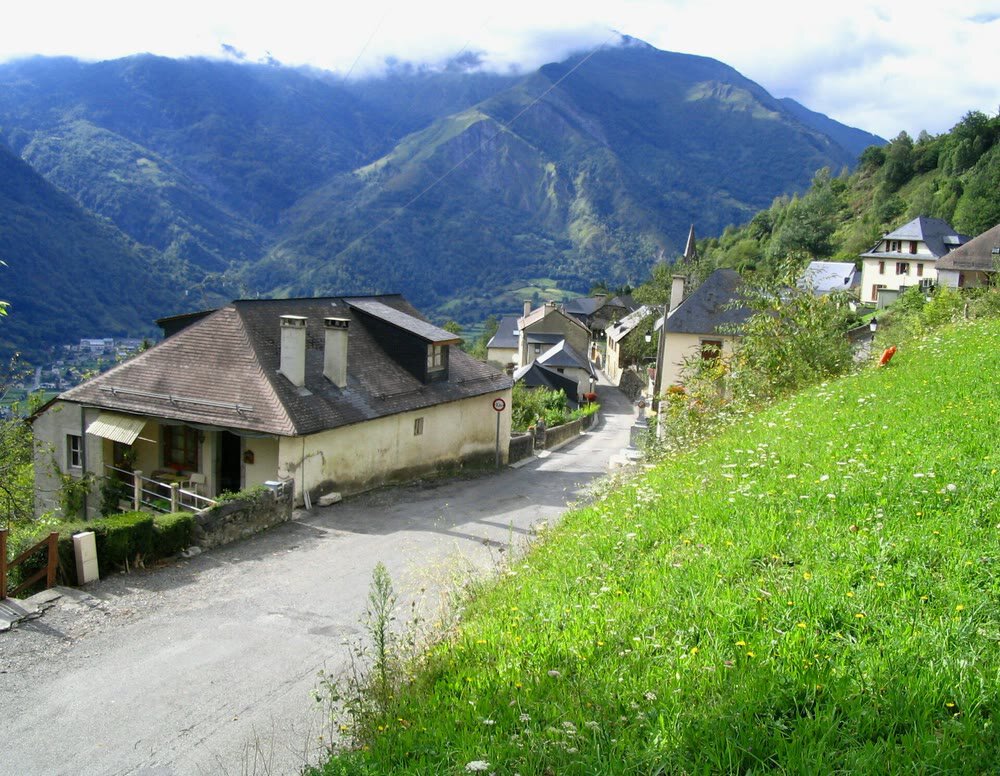
A lane in Aas, with the mountains of the Ossau valley behind, 2006. Photo: P. Charpiat, CC BY-SA 2.5, via Wikimedia Commons
Themes
The death of a language
The poem shows what’s left when the last speakers of a language are gone: memory survives, but memory isn’t speech.
That lands hard in Ireland. Ní Ghearbhuigh writes in Irish, a language whose future its poets have long worried about. Nuala Ní Dhomhnaill said the poem’s message would raise the hairs on the neck of anyone who works in Irish. Her own Ceist na Teangan (KESHT nuh TYANG-un), The Language Issue, from my list of famous Irish poets, likens trusting your hopes to Irish to setting the infant Moses adrift in a basket, not knowing who will find him.
Memory and place
The whistle belonged to one valley and one parish, and it faded as the old pastoral way of life changed. Kerry has its own story of a lost community: the Irish-speaking islanders of the Great Blasket, evacuated in 1953.
Courage in wartime
A language only locals understood became a shield for people in danger. A small language, the poem suggests, can do great things.
Silence
The poem ends in silence, and University College Cork lists silence among the themes of The Coast Road. Even the title of the poem’s Irish collection, Tost agus Allagar, sets silence against noise: tost (TOST) is silence, and allagar (AL-uh-gur) is loud talk or argument.
Imagery and techniques
In an Irish answer, poetic techniques are teicníochtaí fileata (TCHEK-nee-ukh-tee FIL-uh-tuh).
- The valley as an instrument: the landscape itself carries the sound, so the setting is part of the language.
- Repetition (athrá, AH-raw): fead, fead, feadaíl: three stanzas in a row begin with the whistle. The poem keeps whistling as long as it can.
- Contrast (codarsnacht, KUD-ur-snukht): ordinary life, news and farm work against war; sound against silence; long, flowing stanzas against one-line endings.
- Structure: the first four stanzas form one long sentence, like a whistle travelling across the glen. Two of the last three stanzas are a single line each, as if the poem runs out of breath.
- A list of three: in the war stanza, three verbs record three good deeds: keeping people safe, carrying news, guiding pilots.
- The autonomous verb (saorbhriathar, SEER-vree-uh-hur, or SAYR- in Munster): níor chualathas, “was not heard”, and níor deineadh, “was not made”, name nobody. No one heard it, no one recorded it: the people disappear from the grammar too.
- A borrowed word: the poem keeps the French word Résistance, a reminder of where we are.
- Teanga: in Irish it means both a language and a tongue. Fittingly, Busnel’s X-ray film showed the whistle was shaped mainly by the tip of the tongue.
- Plain language: free verse, no rhyme scheme, everyday words. It reads almost like a report, which makes the loss hit harder.
Tone and feelings
The tone is calm and matter-of-fact, with no exclamation marks and no self-pity. Underneath, the feelings, or mothúcháin (MUH-hoo-khawn; muh-HOO-khawn in Munster), run deep.
- Brón (BROHN), sorrow: for a language that’s gone for good.
- Ómós (OH-mohss), respect: for the shepherds and their wartime courage.
- Cumha (KOO-uh), lonely sorrow: for something remembered but out of reach.
- Finality: the last line is short and flat. There’s no comfort offered.
Key Irish words in Deireadh na Feide
Meanings come from Ó Dónaill’s dictionary on teanglann.ie, which has recordings in all three dialects, as I explain in my guide to learning Irish online. Respellings are rough.
- fead (FAD), genitive feide (FEDJ-uh): a whistle.
- feadaíl (FAD-eel; fa-DEEL in Munster): whistling. Teanga feadaíola is a whistled language.
- teanga (TYANG-guh): a language; also a tongue.
- aoire (EE-ruh), plural aoirí (EE-ree): a shepherd.
- gleann (GLAWN in Connacht, GLOWN in Munster, GLAN in Ulster): a glen or valley.
- féarach (FAY-rukh): pasture, grazing land.
- sráidbhaile (SRAWJ-val-yuh): a village.
- paróiste (PAR-ohsh-cha; puh-ROHSH-cha in Munster): a parish.
- Giúdach (GYOO-dukh), plural Giúdaigh (GYOO-dee): a Jew.
- faoi rún (fee ROON): in secret.
- ó bhéal go béal (oh VAYL guh BAYL; oh VEE-ul guh BEE-ul in Munster): by word of mouth.
- teorainn (CHOH-rin): a border.
- cuimhne (KIV-nyuh; KEE-nyuh in Munster): memory.
- aithris (AH-rish): imitating or reciting; here, reproducing the sounds.
- taifead (TAF-ud): a record or recording.
Kerry Irish in the poem
Ní Ghearbhuigh writes in Munster Irish. You’ll see deineadh, the Munster form of rinneadh, “was made” (Ó Dónaill lists dein as a form of déan, to make or do), and éinne, which the dictionary equates with aon duine, anyone. Copy these exactly when you quote the poem, but standard forms are fine in your own sentences.
Exam notes and useful Irish phrases
Deireadh na Feide is one of the five common prescribed poems for both levels in the Department of Education and Youth’s circular 0041/2026. Alongside it are Dínit an Bhróin by Máirtín Ó Direáin, Iníon by Áine Durkin, Glaoch Abhaile by Áine Ní Ghlinn and Úirchill an Chreagáin by Art Mac Cumhaigh. These replace the old list, which included An tEarrach Thiar. Check with your teacher, because schools can choose optional poems instead.
Nobody can predict the paper, but prepare:
- the main theme, and how the poem builds it;
- two or three images and techniques, such as the repeated fead and the one-line ending;
- the feelings, each backed by a short quote;
- the background, and a paragraph on the poet;
- your own response, and why.
Useful Irish phrases for your answer
- Is é bás teanga príomhthéama an dáin. (The main theme of the poem is the death of a language.)
- Cuireann an file béim ar an bhfead le hathrá. (The poet stresses the whistle through repetition.)
- Tá codarsnacht ghéar idir an saol síochánta sa ghleann agus an cogadh. (There’s a sharp contrast between peaceful life in the valley and the war.)
- Léiríonn an file meas ar mhisneach na n-aoirí. (The poet shows respect for the shepherds’ courage.)
- Tá deireadh an dáin gonta agus brónach. (The ending of the poem is terse and sad.)
- Is maith liom an dán mar baineann sé leis an nGaeilge freisin. (I like the poem because it’s about Irish too.)
Who is Ailbhe Ní Ghearbhuigh?
Ní Ghearbhuigh is a Tralee native, born in 1984, says the Portráidí writers’ archive. She studied Irish and French at NUI Galway, graduating in 2005, taught for a year in Bordeaux, then went to New York with a Fulbright award to teach Irish.
Her NUI Galway doctorate looked at how French ideas shaped the Gaelic Revival, says University College Cork, where she now teaches Modern Irish.
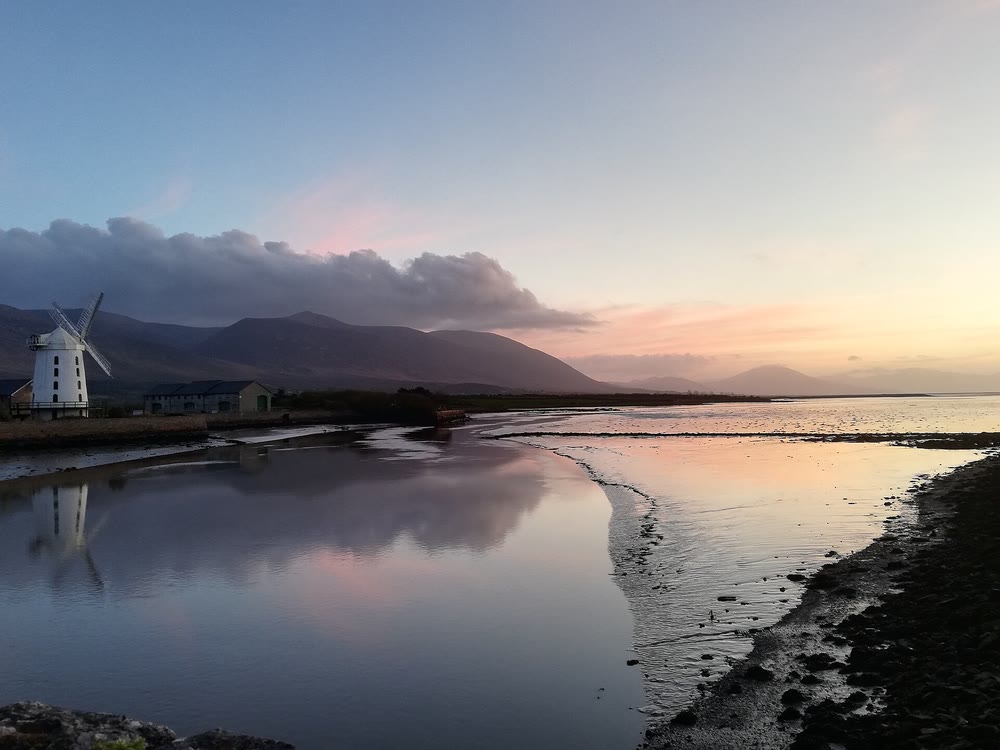
Blennerville windmill and Tralee Bay at dusk, Co. Kerry. Photo: CM Cogollo, CC BY-SA 4.0, via Wikimedia Commons
Her first collection, Péacadh (PAY-kuh, germination), came out with Coiscéim in 2008, followed by Tost agus Allagar in 2016, which took the 2019 Michael Hartnett Award. The Coast Road gathered poems from both with English versions by 13 writers, among them Paul Muldoon, Medbh McGuckian and Billy Ramsell. It won her the Lawrence O’Shaughnessy Award for Poetry in 2020.
Her poem Filleadh ar an gCathair (FIL-uh er un GAH-hir), Return to the City, was chosen as Ireland’s poem for its 2013 EU Presidency. Tonn Teaspaigh agus Dánta Eile (roughly TUN CHASS-puh AH-gus DAWN-tuh EL-uh), Heatwave and Other Poems, followed from Éabhlóid in 2022, and Gallery Press published a new bilingual selection, This Deep, in October 2026.
Deireadh na Feide FAQ
What is Deireadh na Feide about?
A whistled language once used by shepherds in Aas, in the French Pyrenees, that helped people in the Second World War. Locals remember it, but nobody can whistle it now.
What does Deireadh na Feide mean in English?
Literally, the end of the whistle. It also echoes the idiom i ndeireadh na feide, at the last gasp. The English translation is called Last Blast.
What are the main themes of Deireadh na Feide?
The death of a language, memory and place, courage in wartime, and silence.
Is Deireadh na Feide on the Leaving Cert in 2027?
Yes. It’s a common prescribed poem at both Higher and Ordinary Level for June 2027 and June 2028, unless your school picks its own poems under the optional course.
Is the whistled language of Aas real?
Yes. French scientists studied it from 1959, the last traditional whistler died in 1999, and it has been taught again in the Ossau valley since 2015.
Where can I read the full poem?
In The Coast Road (Gallery Press, 2016), the book named on the Department’s list. Specimen publishes it online with Billy Ramsell’s translation.
Love this? Save it to your Pinterest board for later.
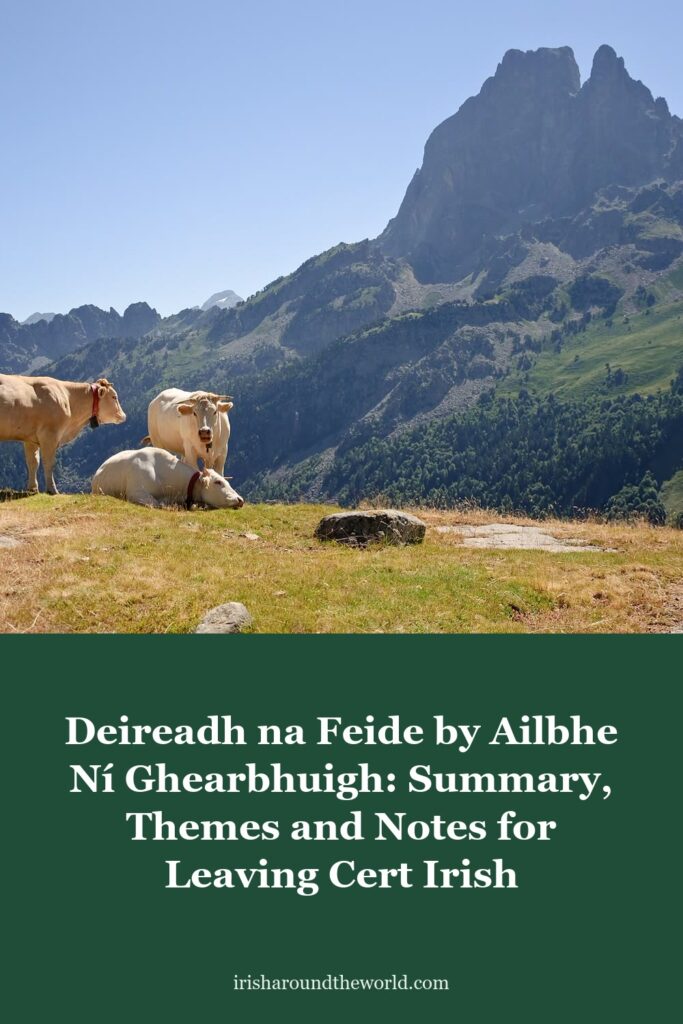
Pin image: Cattle on summer mountain pasture below the Pic du Midi d’Ossau, Pyrénées-Atlantiques. Photo: Myrabella, CC BY-SA 3.0, via Wikimedia Commons
A little bit of Ireland in your inbox every Friday ☘️
The free Weekly Dose of Irish: an Irish joke, a Celtic symbol, an Irish fact, a poem and the week’s best articles in one short email. Join 9,600+ readers.
Free. One short email every Friday. Unsubscribe any time.
More Irish poetry
- Leaving Cert Irish Poems 2027 and 2028: The Full List, Explained
- Dínit an Bhróin by Máirtín Ó Direáin: Summary, Themes and Notes for Leaving Cert Irish
- Úirchill an Chreagáin by Art Mac Cumhaigh: The Poem, a Translation and Leaving Cert Notes
- An tEarrach Thiar by Máirtín Ó Direáin: Spring in the West of Ireland
- Caoineadh Airt Uí Laoghaire: The Greatest Lament in the Irish Language
- Oíche Nollag na mBan by Seán Ó Ríordáin: The Women’s Christmas Poem
- Famous Irish Poets: The Greatest of All Time, in Order
- Great Blasket Island: Why Ireland’s Most Westerly Village Was Abandoned
Featured image: Cattle on summer mountain pasture below the Pic du Midi d’Ossau, Pyrénées-Atlantiques. Photo: Myrabella, CC BY-SA 3.0, via Wikimedia Commons.