
Glaoch Abhaile (A Call Home) is a short poem by Áine Ní Ghlinn from her 1996 collection Deora Nár Caoineadh / Unshed Tears. A young Irishman, Páidín, phones his mother from London. He tells her he has a warm, comfortable flat and promises to be home for Christmas, please God. Then he puts down the phone, picks up his bags and walks back to the box where he sleeps, behind Waterloo Station. It is one of five common prescribed poems for Leaving Cert Irish, at Ordinary and Higher Level, in June 2027 and June 2028.
Anyone who has lived far from home knows this kind of phone call. You keep your voice bright, tell the good bits and leave out the rest, because there’s no sense in having your mother worried sick.
Áine Ní Ghlinn’s Glaoch Abhaile packs that call into 21 short lines, then pulls the rug out from under it. With a Christmas promise at its heart, it’s a poem plenty of students, and the parents and grandparents helping them, will be reading this winter.
The poem is in copyright, so I won’t reprint it, but you can hear Áine Ní Ghlinn read it herself on TG4’s free Foghlaim site. Here’s a plain-English guide to the story, its meaning, the key Irish words and the points worth making in an exam. For the rest of the course, see my guide to Leaving Cert Irish poems for 2027 and 2028.
Jump to:
- Glaoch Abhaile at a glance
- What does Glaoch Abhaile mean?
- Summary in plain English
- Where the poem came from
- Themes
- Images, tone and style
- Key Irish words and phrases
- Exam notes
- About Áine Ní Ghlinn
- The other prescribed poems
- Glaoch Abhaile FAQ
- More Irish poetry and language reading
Glaoch Abhaile at a glance
- Poet: Áine Ní Ghlinn (roughly AWN-yuh nee GHLIN, or nee GHLEEN in Munster Irish; the gh is a soft, throaty g), born in Co. Tipperary in 1955.
- Collection: Deora Nár Caoineadh / Unshed Tears (Dedalus Press, 1996), with English translations by Pádraig Ó Snodaigh.
- Shape: two stanzas, 21 lines, most only two to four words long.
- Voices: Páidín (roughly PAW-jeen) speaks in stanza one; a narrator takes over in stanza two. His mother is never heard.
- On the course: Ordinary and Higher Level, June 2027 and June 2028, under Department of Education and Youth circular 0041/2026. Schools may pick optional poems instead, within the circular’s rules.
What does Glaoch Abhaile mean?
Glaoch (roughly gleekh in Connacht and Ulster, glaykh in Munster) means a call, and the ch is the throaty sound in Scottish loch. Abhaile (uh-WAL-yuh, or uh-VAL-yuh in Munster) means home, in the sense of homewards. So the title means A Call Home, or Calling Home.
Abhaile is the word for going home (dul abhaile); being at home is sa bhaile. Páidín’s call travels home, but in London he has no home at all.
Ó Dónaill’s dictionary also has glao, a call or shout, the word in glao gutháin, a phone call. Online, the poet’s name often loses its fadas (Aine Ni Ghlinn), and the book title turns up as Deora Nar, or even Nir, Caoineadh. The correct forms are Áine Ní Ghlinn and Deora Nár Caoineadh (roughly JOR-uh nawr KEEN-uh): tears that were never wept.
Glaoch Abhaile summary in plain English
Stanza one: the call
The poem opens in the middle of a phone call, and we only hear Páidín’s side. He’s a young Irishman in London, reassuring his mam that everything is going brilliantly. He describes a snug, properly heated flat, admits he hasn’t a phone of his own yet, and promises, twice, that he’ll be home for Christmas, adding the old safety clause: with God’s help.
We never hear his mother, but his answers tell us her questions. How is he getting on? Where is he living? Is there a number she can ring? Will he be home for Christmas?
Stanza two: the truth
A narrator now shows Páidín from the outside as he puts the phone down, slings a duffel bag over his shoulder, tucks a sleeping bag under his arm and walks back, in Ní Ghlinn’s closing words,
chuig a bhosca / taobh thiar de / Stáisiún Waterloo
That is, to his box behind Waterloo Station. (Áine Ní Ghlinn, Glaoch Abhaile, in Deora Nár Caoineadh / Unshed Tears, Dedalus Press, 1996.)
There is no flat. Everything in the first stanza was a kind lie. Páidín is sleeping rough (in a cardboard box, Ní Ghlinn has said), and his bags seem to hold everything he owns. The poem’s force comes from the gap between the two stanzas, which the reader has to cross alone.
Where the poem came from: Irish London in the 1990s
In an interview for TG4’s Foghlaim lesson on the poem, Ní Ghlinn explained that she lived in London in the mid-1990s, making radio programmes with Irish people there. Some were doing wonderfully. Others weren’t, and a good many, she said, were living in boxes on the streets.
She wrote a series of poems about Páidín there (the name, she says, has no special meaning, and he stands for many people) and tied him to a time when London’s building trade had collapsed. In her poetry, she says, she tries to give a voice to people who have lost theirs, and she has suggested readers today might think of asylum seekers and others living in tents in Ireland, with no home or work.
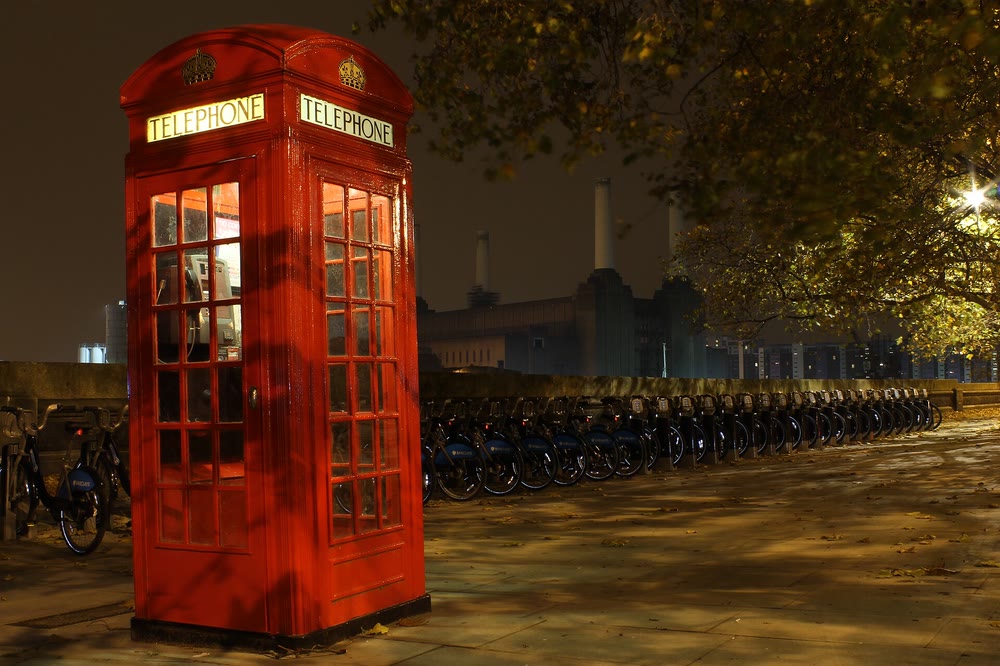
A red telephone box on Grosvenor Road, London, at night, with Battersea Power Station behind. Photo: Newfoundlandguy, CC BY-SA 4.0, via Wikimedia Commons
Behind the poem lies a long stretch of emigration. The Central Statistics Office says more than 185,000 more people left Ireland than arrived during the 1980s, and more kept leaving than arriving in most years until 1996.
Under the Bullring roundabout beside Waterloo Station was a camp of rough sleepers nicknamed Cardboard City. The BBC reported in 1998 that in the mid-1980s up to 200 people slept there in boxes; the site was later cleared for an IMAX cinema. The poem doesn’t name it, and Ní Ghlinn hasn’t said it was her model, so treat it as background, not the key.
The lonely Irishman in London is an old figure in Irish-language writing: Pádraic Ó Conaire’s novel Deoraíocht (Exile), first published in 1910, follows a struggling emigrant there. Higher Level papers can ask about a work’s place in Irish literary history, so that link is worth a sentence.
The themes of Glaoch Abhaile
Shame and despair
Asked what she sees in the poem, Ní Ghlinn named two feelings: náire (NAW-ruh), shame, and éadóchas (AY-doh-khus), despair. Páidín can’t admit to his family that London hasn’t worked out, so he talks up a flat that doesn’t exist. Underneath, she added, runs loneliness: a man says goodbye to his mother and walks home to a box.
Emigration: the dream and the reality
The warm, safe flat sounds like the life he hoped to find when he left, or the one his mother needs to picture; the second stanza shows what he found. Irish families have a long history of farewells to emigrants, as my piece on the American wake shows, and from the mid-1920s Irish emigration turned increasingly towards Britain. This poem asks what happens when the news from abroad is bad and nobody can say so.
Separation from home, Ní Ghlinn has said, wasn’t what she had in mind, though readers are free to find their own story in it.
Silence, love and kind lies
A phone call should bring two people closer; this one keeps them apart. Páidín controls what his mother learns and, with no number to give her, decides when they talk. Ní Ghlinn refers to it as his weekly call. Is he a liar or a good son? Probably both: he spares her pain but leaves himself utterly alone. Oide, the support service for teachers, even asks students to weigh up whether Páidín is a nice person at all, so argue your own view with evidence.
Home and Christmas
The title promises home; the poem ends at a box. Christmas sharpens the ache, and my piece on the Christmas candle in the window shows how emigration shadowed Irish Christmases, when few could get home. Páidín’s promise, with God’s help tacked on, sounds like one he can’t keep. For another lonely figure at Christmastime in Irish-language poetry, try Seán Ó Ríordáin’s Oíche Nollag na mBan.
Images, tone and style
The phone
Ní Ghlinn has pointed out that people didn’t carry mobile phones in the 1990s, so Páidín is ringing from a phone box. The phone should connect him to home; instead it’s where the lies are told, and with no phone of his own, he can’t be rung back. Old Irish phone boxes said Telefón; today’s standard spelling is teileafón (roughly TEL-yuh-fone), and fón and guthán are common too.
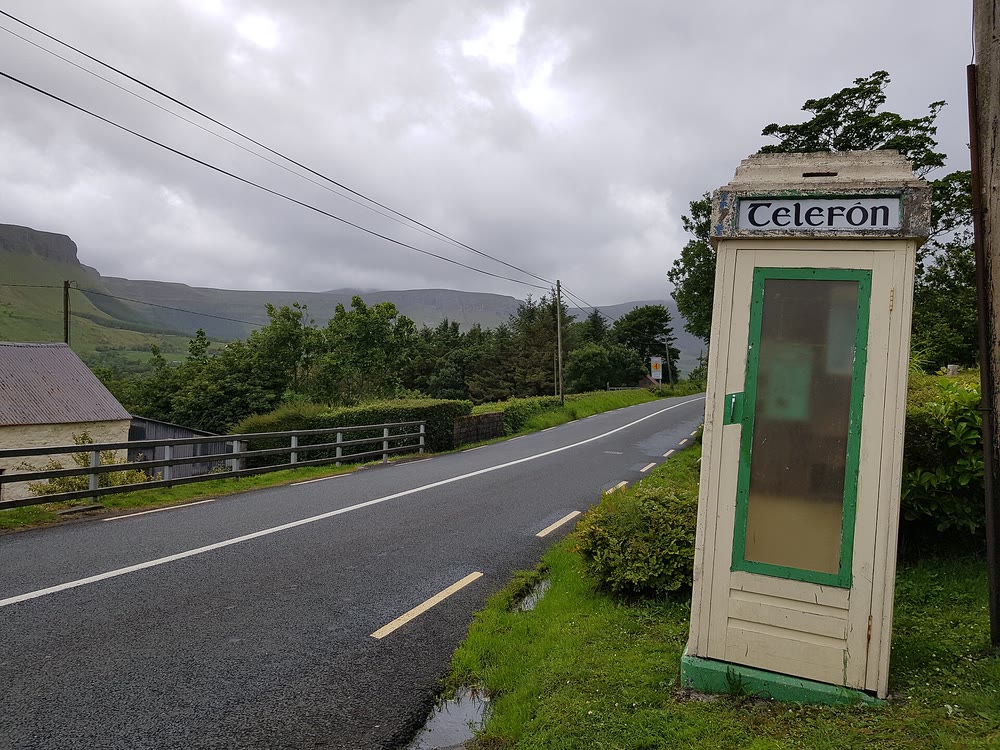
An old Irish phone box marked Telefón in the Glencar Valley, Co. Leitrim. Photo: NTF30, CC BY-SA 4.0, via Wikimedia Commons
The flat, the bags and the box
The flat is the dream: warm, private, safe. Páidín calls it cluthar (KLUH-hur), snug or sheltered, and Ó Dónaill’s dictionary gives the word a second meaning, secretive. Nothing suggests the poet intended that, but it’s a neat fit for a man keeping a secret.
The duffel bag and sleeping bag are the truth. Ní Ghlinn has said his whole life is in one small bag, and she compares him with asylum seekers who leave home carrying a single bag. The box behind Waterloo Station is the last and hardest image: a great railway station, built for arriving and leaving, where Páidín is going nowhere.
Structure, tone and technique
- Contrast: stanza one is speech, lies and warmth; stanza two is narration, truth and cold fact.
- A change of voice: first person, then third, as if a camera pulls back to show the whole scene.
- Everyday speech and free verse: chatty Irish, down to the repeated sea (shah), yes, in very short lines with no rhyme.
- Present tense: verbs like leagann (puts down), crochann (hangs) and siúlann (walks) feel immediate and can suggest a routine.
- Repetition: TG4’s notes point to the doubled yes, which they read as Páidín tiring of his mother’s questions, and the doubled Christmas. Ní Ghlinn herself said in her interview that repetition belongs to the wider Páidín series, not this poem.
- Irony and tone: a call home from a man with no home. The tone goes from bright and hurried to flat and bleak. Ní Ghlinn says she writes poems, not explanations of them.
Key Irish words and phrases
Pronunciations are rough guides. Meanings are checked against Ó Dónaill’s dictionary at teanglann.ie and against focloir.ie.
- a Mham (uh WAM; uh VAM in Munster): Mam, when you’re speaking to her. The little a used to address someone softens M to Mh.
- árasán (AW-ruh-sawn): a flat or apartment.
- beadsa chugaibh (roughly BYAD-suh KHUG-iv; some say BED-suh): I’ll be with you. Bead is a one-word form of beidh mé (I will be), common in Munster; -sa adds emphasis, and chugaibh is plural, taking in the whole family.
- bosca (BUS-kuh): a box; a cardboard box is bosca cairtchláir.
- bréag, plural bréaga (brayg, BRAY-guh): a lie, lies.
- faoina ascaill (FWEE-nuh ASK-il; FAY-nuh in Munster): under his arm.
- gan dídean (gun JEE-jun): homeless; literally, without shelter.
- go diail (guh JEE-ul): great, brilliant. Ó Dónaill’s meanings for diail run from devilish and terrible to wonderful.
- imirce (IM-ir-kuh): emigration; an emigrant is an imirceach or eisimirceach.
- le cúnamh Dé (leh KOO-nuv JAY): with God’s help, please God.
- mála codlata (MAW-luh KUL-uh-tuh): a sleeping bag, literally a bag of sleep. A mála dufail is a duffel bag.
- Nollaig (NULL-ig): Christmas. More festive words are in my guide to Merry Christmas in Irish.
- teas lárnach (tyass LAWR-nukh): central heating; teas is heat.
- uaigneas (OO-ig-nus): loneliness.
Exam notes: writing about Glaoch Abhaile
Sample questions from TG4 Foghlaim and Oide suggest you should be ready to:
- Name the main theme (shame, emigration) and back it with images: the flat, the bags, the box.
- Discuss the contrast between the life Páidín describes and the one he lives: stanza one against stanza two.
- Judge the title: it’s literally what happens, and ironic, because the man calling home has no home.
- Describe emotions and characters: Páidín proud, ashamed, loving and alone; his mother anxious and silent.
- Explain a technique (contrast, irony, direct speech, present tense) with a short quote, write a short note on the poet, and give an honest personal response.
A few sentences you could adapt (my own, not from any marking scheme):
- Is dán faoi imirce agus faoi náire é Glaoch Abhaile. (It’s a poem about emigration and shame.)
- Tá codarsnacht ghéar idir an chéad véarsa agus an dara véarsa. (There’s a sharp contrast between the two stanzas.)
- Insíonn Páidín bréaga dá mháthair mar go bhfuil náire air. (Páidín lies to his mother because he’s ashamed.)
- Tá íoróin sa teideal, mar níl baile ar bith ag Páidín. (The title is ironic, because Páidín has no home.)
Dusting off your own Irish to help? My guide to learning Irish online lists good free options.
About Áine Ní Ghlinn
Áine Ní Ghlinn was born in Co. Tipperary in 1955. She studied Irish and English at University College Dublin and taught secondary school before becoming a journalist with RTÉ and Raidió na Gaeltachta. She has since combined writing with school workshops and part-time lecturing (in 2020, at Dublin City University), and she has written for the TG4 drama Ros na Rún.
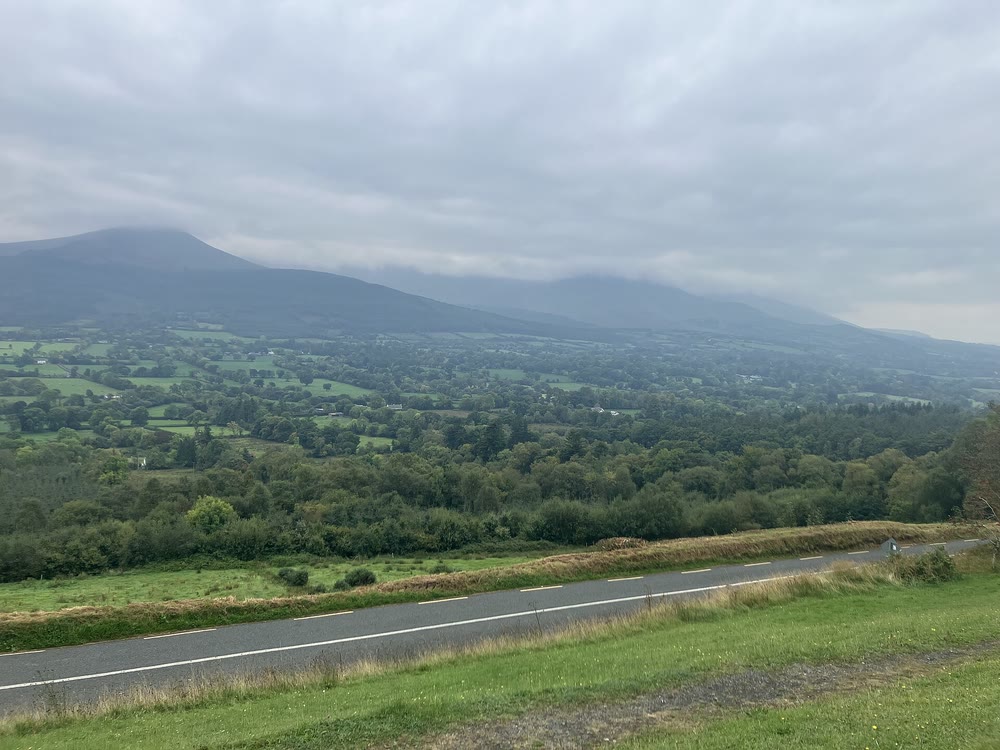
The Glen of Aherlow in Co. Tipperary, the county where Áine Ní Ghlinn was born. Photo: DaHuzyBru, CC BY-SA 4.0, via Wikimedia Commons
Her poetry collections include An Chéim Bhriste (1984), Gairdín Pharthais (1988), Deora Nár Caoineadh (1996), Tostanna (2006), An Guth Baineann (2013) and Rúin Oscailte (2021). Reviewing Deora Nár Caoineadh in the Irish Times in 1997, Victoria White noted that many of its poems deal with the hidden sexual abuse of a child before the book turns to other subjects, among them emigrants. She found some poems too close to journalism but praised the emigrant poems’ social observation.
Her website counts forty books, many for children and teenagers. Daideo won a Children’s Books Ireland Honour Award for Fiction in 2015, and the Gradam Réics Carló, the Oireachtas prize for the year’s best Irish-language book for young readers, has gone to her books at least four times, including Na Trí Mhuicín in 2024.
On 13 May 2020 she was named the sixth Laureate na nÓg (nuh NOHG), Ireland’s Children’s Literature Laureate, and the first writing only in Irish. She held the title until 2023, working to get children reading in Irish for pleasure, not just for school. She is also a member of Aosdána, whose members are elected by fellow artists. For more poets, see my list of famous Irish poets.
The other prescribed poems for 2027 and 2028
Circular 0070/2024 brought in an all-new list, first examined in June 2027. Glaoch Abhaile sits alongside four other poems:
- Dínit an Bhróin by Máirtín Ó Direáin
- Deireadh na Feide by Ailbhe Ní Ghearbhuigh
- Iníon by Áine Durkin
- Úirchill an Chreagáin by Art Mac Cumhaigh
Higher Level students also study either additional prose or five additional poems, one of them Anthony Daly by Antaine Raiftearaí. Ó Direáin’s An tEarrach Thiar, a favourite on the old course, is no longer on the list.
Glaoch Abhaile FAQ
What is Glaoch Abhaile about?
A young Irishman in London tells his mother on the phone that he has a warm flat and will be home for Christmas. When he hangs up, we learn he’s homeless and sleeps in a box behind Waterloo Station. Its main themes are shame, despair, emigration and the lies we tell to protect people we love.
What does Glaoch Abhaile mean in English?
A Call Home, or Calling Home. Glaoch means a call, and abhaile means home or homewards.
Who is Páidín in Glaoch Abhaile?
The young emigrant who makes the call. He’s a character, not a real person, but Ní Ghlinn has said he grew out of her time among Irish people in 1990s London.
Is Glaoch Abhaile on the Leaving Cert in 2027 and 2028?
Yes. It’s one of five common prescribed poems for Leaving Cert Irish, at Ordinary and Higher Level, in June 2027 and June 2028 (circular 0041/2026).
Where can I read or hear the full poem?
It’s in Deora Nár Caoineadh / Unshed Tears (Dedalus Press, 1996), the source the exam circular names. TG4’s free Foghlaim site has a recording of Áine Ní Ghlinn reading it, plus an interview, and the lesson’s notes (in Irish) print the full text.
Love this? Save it to your Pinterest board for later.
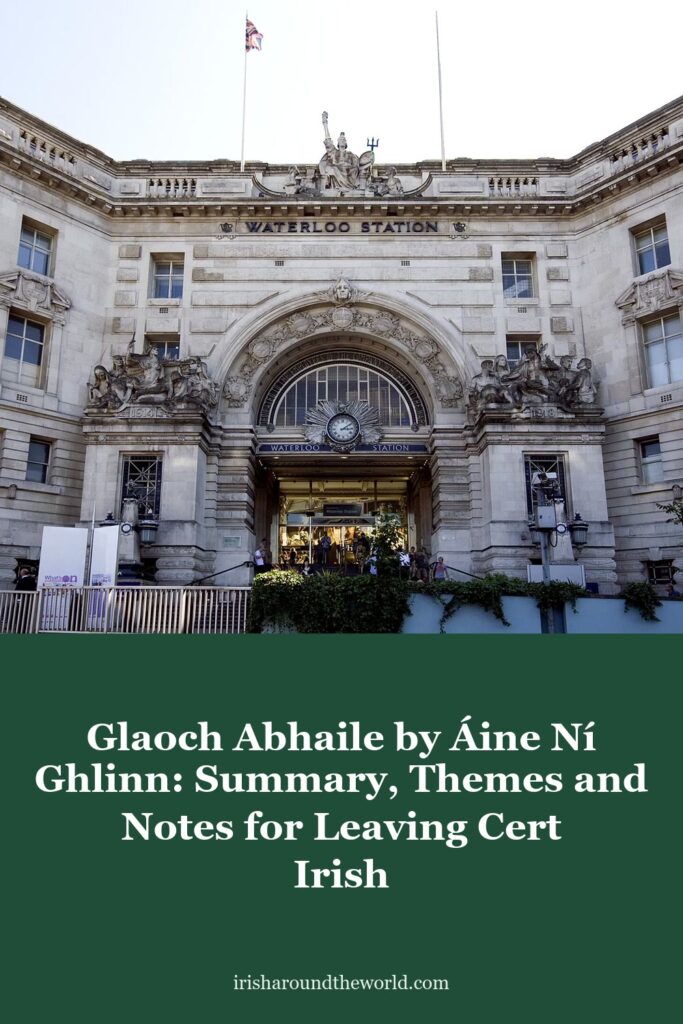
Pin image: The Victory Arch, the main entrance to Waterloo Station, London. Photo: Prioryman, CC BY-SA 3.0, via Wikimedia Commons
A little bit of Ireland in your inbox every Friday ☘️
The free Weekly Dose of Irish: an Irish joke, a Celtic symbol, an Irish fact, a poem and the week’s best articles in one short email. Join 9,600+ readers.
Free. One short email every Friday. Unsubscribe any time.
More Irish poetry and language reading
- Leaving Cert Irish Poems 2027 and 2028: The Full List, Explained
- An tEarrach Thiar by Máirtín Ó Direáin: Spring in the West of Ireland
- Oíche Nollag na mBan by Seán Ó Ríordáin: The Women’s Christmas Poem
- The American Wake: Ireland’s All-Night Farewell for Emigrants to America
- The Irish Christmas Candle in the Window: Why It’s Lit on Christmas Eve (and What It Really Meant)
Featured image: The Victory Arch, the main entrance to Waterloo Station, London. Photo: Prioryman, CC BY-SA 3.0, via Wikimedia Commons.