Brian Boru, Brian Bóruma mac Cennétig in medieval Irish (c. 941 to 1014), was a Dál gCais king from east Clare who became king of Munster and, in 1002, high king of Ireland. A Latin note in the Book of Armagh calls him “emperor of the Irish”. He died at the Battle of Clontarf on Good Friday, 23 April 1014, as his army beat Leinster, the Dublin Norse and their Viking allies. The O’Briens are named after him; the “Brian Boru harp” is centuries younger.
Picture the shore of Dublin Bay at first light on Good Friday, 1014. Viking ships ride the high tide and two armies close. Somewhere behind the lines, the old story says, an elderly king is kneeling in prayer.
By nightfall his side has won. He is dead.
That king was Brian Boru, and his death at Clontarf helped make him perhaps the best-known king Ireland ever had. Here’s how he rose, what happened at Clontarf, who really fought there, and where the O’Brien name and the famous harp fit in.
Jump to:
- Who was Brian Boru?
- What does Boru mean, and how do you say it?
- From the Dál gCais to king of Munster
- How Brian became High King of Ireland
- “Emperor of the Irish”: the Book of Armagh
- The Battle of Clontarf, 1014
- Who fought at Clontarf? Not simply Irish versus Vikings
- How Brian Boru died
- Cogad Gáedel re Gallaib: the O’Brien version
- Brian Boru and the O’Brien name
- The Brian Boru harp myth
- Brian Boru FAQ
- More Irish history reading
Who was Brian Boru?
Brian Boru was a Munster king who became high king of Ireland. The Annals of Inisfallen call him plain Brian mac Cennétig, son of Cennétig.
The annals record his birth under 941, but the Dictionary of Irish Biography (DIB) warns the entry may have been added later, once he was famous. If it’s right, he was about 73 at Clontarf, not in his 88th year, as later medieval writers claim.
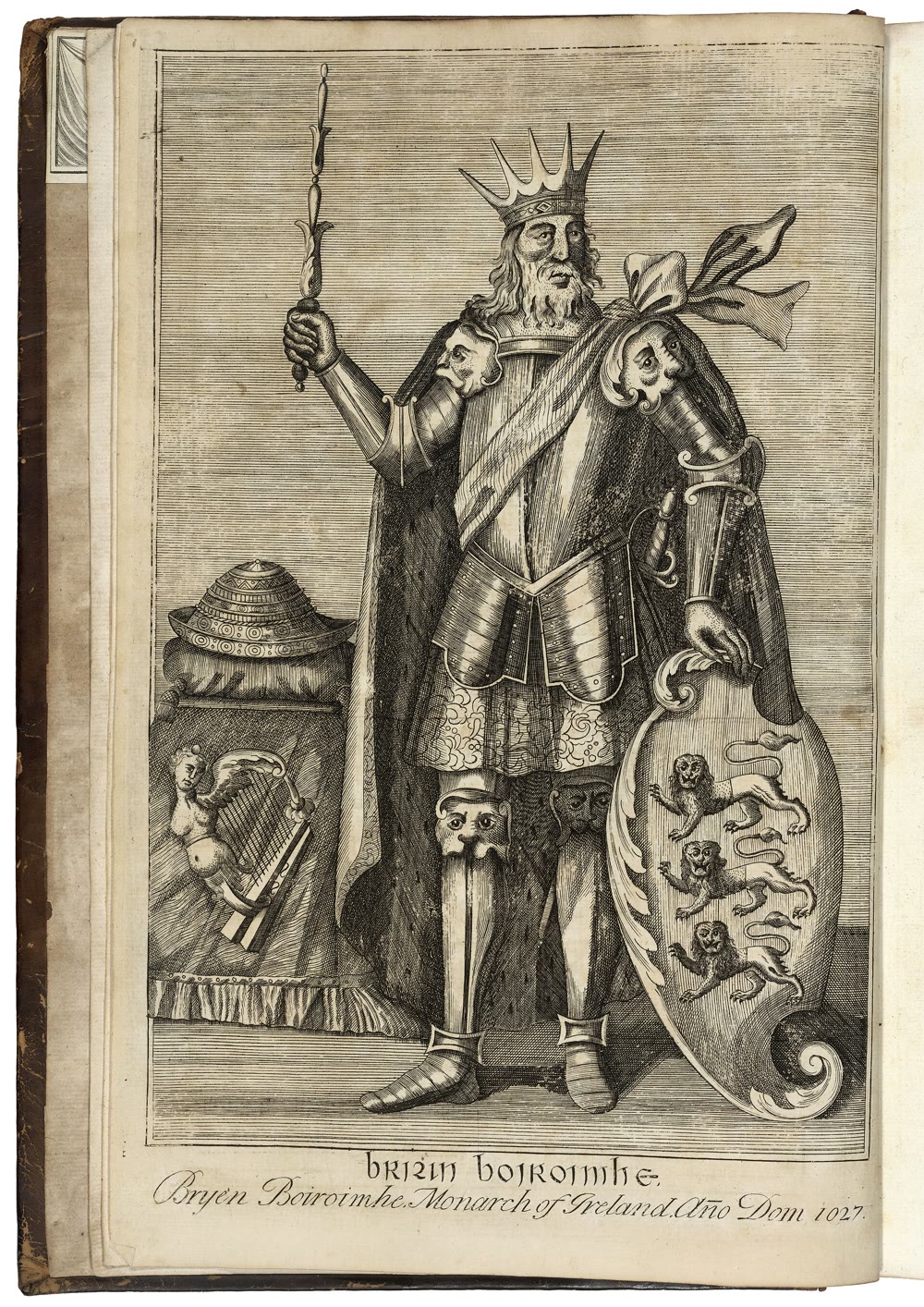
An imagined Brian Boru, dated 1027 because Keating’s history ran about 20 years late (it puts Clontarf in 1034). Frontispiece of The General History of Ireland (1723), Dermod O’Connor’s English translation of Geoffrey Keating. Public domain, via Wikimedia Commons
What does Boru mean, and how do you say it?
“Boru” was attached to him after his death, says the DIB. The medieval spellings are Bóruma and Bórama; modern Irish has Brian Bóramha.
The DIB links it to Béal Bóramha, just north of Killaloe, Co. Clare, at the centre of his family’s lands. A poem attributed to the 11th-century poet Cúán Ua Lothcháin calls him Brian of Ireland from Bórama.
You’ll also see Boru translated as “of the tributes”, from bórama, a cattle tribute (Ó Dónaill still lists bóramha as a literary word for a levy). The Trinity historian Seán Duffy thinks the place-name more likely.
- In English: Brian Boru (BRY-un buh-ROO), though many say (BOR-oo).
- In Irish: Brian Bóramha, roughly (BREE-un BOH-ruh-wuh), or (BOH-ruh-vuh) in some areas.
- His people: Dál gCais (dahl GASH), also written Dál Cais.
- High king: ardrí in Ó Dónaill, usually written Ard Rí (ard REE) in English.
From the Dál gCais to king of Munster
Brian’s people, the Dál gCais, held east Clare, in Thomond, or north Munster. They had only recently become a real power. His father, Cennétig, died in 951 as heir to Cashel, the kingship of Munster, the DIB says.
Brian’s older brother, Mathgamain (Mahon), did win Cashel, the seat of Munster’s kings on the Rock of Cashel. When Mathgamain was murdered in 976, Brian took over. In 977 he killed Ímar, king of the Limerick Norse, and two of his sons on Scattery Island, and in 978 he killed his brother’s killer, Máel Muad, at the battle of Belach Lechta.
His own base was Kincora, at Killaloe on the Shannon. P. W. Joyce explained it as Ceann Coradh, the head or hill of the weir. Just north of the town is Brian Boru’s Fort, a large ringfort excavated in 1961, usually identified with Béal Bóramha.
How Brian became High King of Ireland
For centuries the kingship of Tara, with its claim to all Ireland, belonged to the Uí Néill dynasties, descendants of Niall of the Nine Hostages. Even their legend of Niall and the hag at the well names Brian as one of the few outsiders to break their hold.
The Uí Néill king of Tara from 980 was Máel Sechnaill (Malachy) mac Domnaill. Brian wore him down.
In 997 the two met at Port Dá Chaineóc, placed by historians near Clonfert or on Lough Ree. According to the Munster-based Annals of Inisfallen, they split the island: the northern half, Leth Cuinn, for Máel Sechnaill, and the southern half, Leth Moga, for Brian, with the hostages of Leinster and Dublin.
Leinster and Dublin rebelled. On 30 December 999 Brian crushed them at Glenn Máma, west of Dublin, then entered the town and plundered it. Dublin’s king, Sitriuc (Sitric) Silkbeard, fled, then made peace, probably agreeing to marry Brian’s daughter Sláine, the DIB suggests.
In 1002 Brian took the hostages of Máel Sechnaill and of Connacht, and the high kingship was his. The north took longer, through failed marches in 1002 and 1004 and long circuits in 1005 and 1006. By 1011, Duffy writes, all Ireland had accepted his claim to be its king.
“Emperor of the Irish”: the Book of Armagh
In 1005 Brian brought his army to Armagh, Ireland’s leading church, and left 20 ounces of gold on St Patrick’s altar, the Annals of Ulster record.
Armagh’s great treasure was the Book of Armagh, made for its abbot Torbach around 807 and now in Trinity College Dublin. On folio 16v, a short Latin note backs Armagh’s claim to authority over the Irish church. Its writer signed himself Calvus Perennis, roughly “the forever tonsured”, a Latin rendering of the Irish name Máel Suthain.
He wrote it, he says, in the presence of Brian, imperator Scotorum: emperor of the Irish. Scoti then meant the Irish, not the Scots.
The title may echo the German emperors’ imperator Romanorum, as the historian Aubrey Gwynn suggested. Trinity’s library dates the note to around 1005. But the note itself carries no date, and Trinity’s Denis Casey and Bernard Meehan argue that it could come from a later visit, up to about 1010.
The Battle of Clontarf, 1014
By 1013 Brian’s grip was slipping. Leinster and Dublin rose again, and Brian’s siege of Dublin, from autumn to Christmas, failed. Over the winter Sitriuc found help overseas, from Viking lords as far away as Orkney, the DIB says.
The battle came on 23 April 1014, Good Friday that year, though the earliest Irish annals don’t give the day. An early witness is Marianus Scotus, an Irish monk in Germany who died in 1082. He already has Brian dying with hands and mind turned to God.
The early annals don’t mention Clontarf either. The first sure reference, in the 12th-century Book of Leinster, calls it the battle of Clontarf weir, Duffy writes in History Ireland. Cluain Tarbh (KLOO-in TAR-uv) means the meadow of the bulls. Some put the weir on the Tolka near Ballybough Bridge; Duffy suggests a fish trap on the Clontarf shore.
The fighting started at dawn and went on all day. Brian, in his seventies, probably didn’t fight; later writers put his son Murchad (Murrough) in command.
The tide mattered. In 1861 the Trinity geologist Samuel Haughton calculated high water at Clontarf that day, without being told why: about 5.30am and just before 6pm.
That fits Cogad Gáedel re Gallaib, a history of Brian’s wars written within a century of his death: the battle starts at sunrise with the tide in, and beaten Norsemen drown as the evening tide rises. It also has Brian’s 15-year-old grandson, Tairdelbach (Turlough), drowning at the weir in the pursuit.
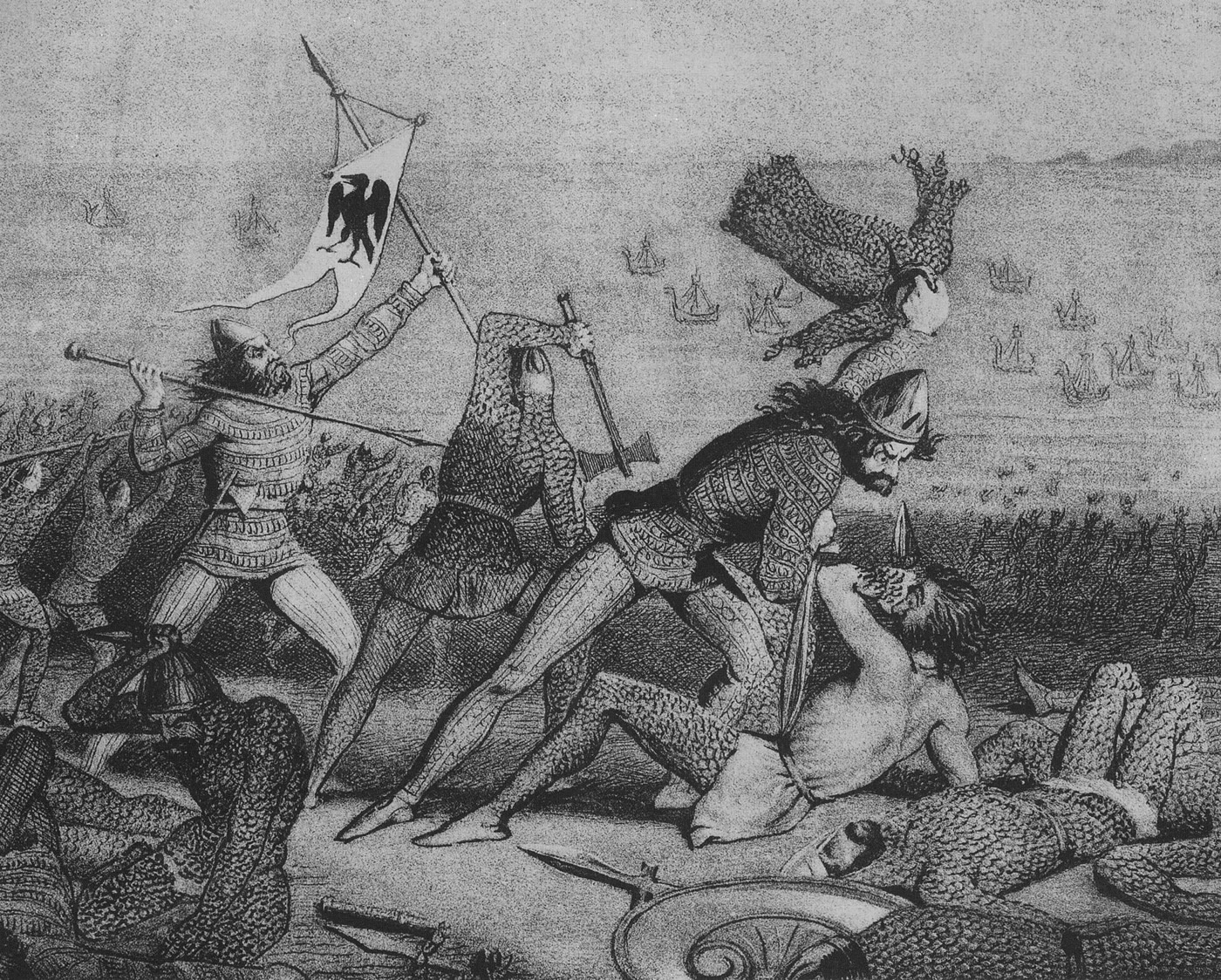
The Battle of Clontarf, April 23rd, 1014, by W. H. Holbrooke after a drawing by Henry MacManus, dedicated to William Smith O’Brien, MP for Co. Limerick. National Library of Ireland. Public domain, via Wikimedia Commons
Who fought at Clontarf? Not simply Irish versus Vikings
Later legend made Clontarf the Irish against the Vikings. The sources show something messier: Irish kings on both sides, Viking allies on one, and a few foreigners on the other.
Brian’s side
- Munster: the Dál gCais under Murchad, plus Munster kings who had once been Brian’s enemies.
- Connacht: the kings of Uí Maine and Aidne died fighting for him.
- Meath: Máel Sechnaill, the king Brian had pushed aside. The Cogad says he made a secret deal with the Norse and stood apart. The annals put him on Brian’s side, the Four Masters have him chasing the enemy to Dublin, and Charles Doherty’s DIB entry thinks he probably fought.
- Overseas: the Annals of Ulster list Domnall son of Eimen, earl of Mar in Scotland, among Brian’s dead. The Cogad gives Brian’s stewards “foreign auxiliaries”, and Njáls saga has a Viking named Óspakr fighting for him.
Against him
- Leinster: King Máel Mórda, whom Brian himself had made king of Leinster in 1003.
- Dublin: the Dublin Norse, led in the field by Sitriuc’s brother Dubgall. Sitriuc stayed behind his town’s defences.
- Overseas: Sigurd, jarl of Orkney, and a fleet commander called Bródar, or Brodir, who came from Man or possibly northern England.
Treat these lists with care: the DIB warns that chroniclers added some names later.
It was a family quarrel too. Sitriuc was Brian’s son-in-law. His mother, Gormlaith, had been Brian’s wife, and Máel Mórda was her brother. Duffy notes that some of Brian’s less loyal underkings kept out of it.
The DIB sees Brian trying to reassert control of Dublin and its lucrative trade; Duffy sees Sitriuc as the driving force, emboldened by the Danish conquest of England in 1013.
The Cogad blames a quarrel at Kincora. Gormlaith threw her brother’s tunic, a gift from Brian, into the fire and mocked him for bowing to Brian; then Murchad taunted him over a game of chess, and Máel Mórda rode off in a rage. A good story, and perhaps no more.
How Brian Boru died
The Annals of Ulster give the result: Brian’s side won, but Brian died, with his son Murchad and his grandson Tairdelbach. Máel Mórda, Sigurd and Dubgall died on the other side. A gloss in those annals names Bródar as Brian’s killer, though the DIB thinks Bródar’s role as the villain is probably fiction.
The Cogad’s version
Brian kneels on a cushion behind the lines with his psalter, while his attendant, Laidean, reports on the battle. When he hears that Murchad’s standard has fallen, he refuses to flee. Aibell of Craig Liath came to him in the night, he says, and told him he would die that day. Later folklore made her the Dál gCais banshee. He gives his last wishes, his body to go to Armagh, and tells the young man to go.
Before he can, Bródar and two warriors come by. Bródar takes him for a priest until one of them, once in Brian’s service, says this is the king. Brian strikes first and takes Bródar’s legs; Bródar’s axe splits Brian’s head.
The saga version
Njáls saga, written in Iceland in the 13th century, says Brian would not fight on Good Friday, so his men ringed him with shields. Brodir broke through and struck. Brian’s youngest son, Takt, lost his arm trying to shield him, Brian’s blood healed the stump, and Brian’s severed head grew back onto his body.
And the famous tent? The Cogad’s death scene and the Annals of Ulster have none. The Annals of Loch Cé, copied in 1588, put Brian in his tent before the battle, and Geoffrey Keating, writing in the 1630s, has fleeing Norsemen stumble on it.
Burial at Armagh
Máel Muire, head of the church of Armagh, came to Swords for the bodies of Brian and Murchad and buried them at Armagh in a new tomb. His clergy waked them for twelve nights, the Annals of Ulster say: a royal version of the Irish wake. A plaque on the north wall of St Patrick’s Church of Ireland Cathedral, Armagh, marks the approximate spot.
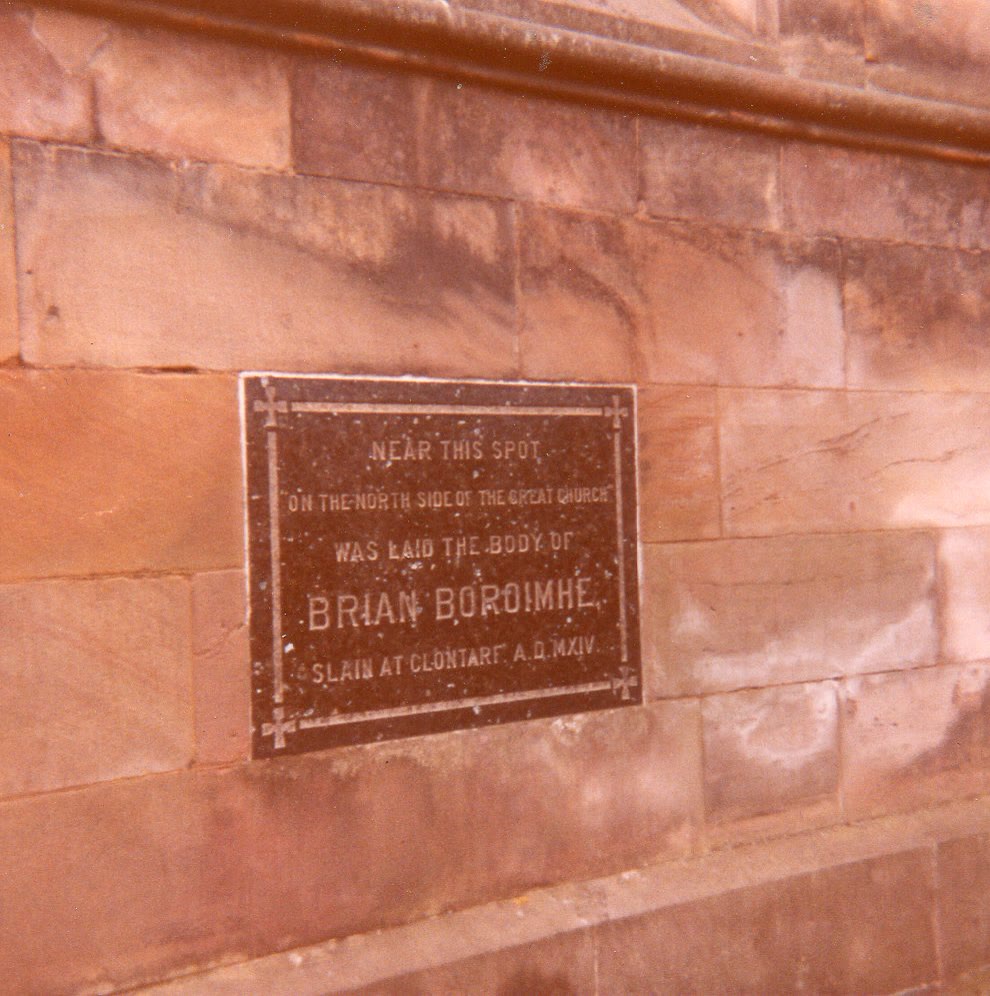
The plaque on St Patrick’s Church of Ireland Cathedral, Armagh, marking the burial place of Brian Boru. Photo: Stephen B Calvert (Clariosophic), CC BY-SA 3.0, via Wikimedia Commons
Clontarf did not end Viking Ireland. Máel Sechnaill took back the high kingship. Sitriuc ruled Dublin until 1036, and after a pilgrimage to Rome in 1028 he probably founded the cathedral that became Christ Church, the DIB says.
Cogad Gáedel re Gallaib: the O’Brien version
Most of the drama comes from one book, Cogad Gáedel re Gallaib, The War of the Irish with the Foreigners. A gall, in Ó Dónaill’s dictionary, is a foreigner, and in history a Norseman or later an Englishman. It’s why north Co. Dublin is Fingal: Fine Gall, the foreigners’ territory.
The DIB dates the Cogad to the early 12th century and says it was written for Brian’s great-grandson, Muirchertach Ua Briain. In it the Vikings are cruel pagans who can hardly be beaten, until Brian and his family save Ireland. One passage compares Brian to Augustus, Alexander, Solomon, David and Moses. In Iceland, Njáls saga made him a saintly martyr king. You can read the Cogad in Todd’s 1867 edition.
So the story most of us learned, that Brian drove the Vikings out of Ireland, is a myth, and this O’Brien book did most to spread it. Still, the DIB suggests Brian himself, with an eye on his own image, set his legend in motion.
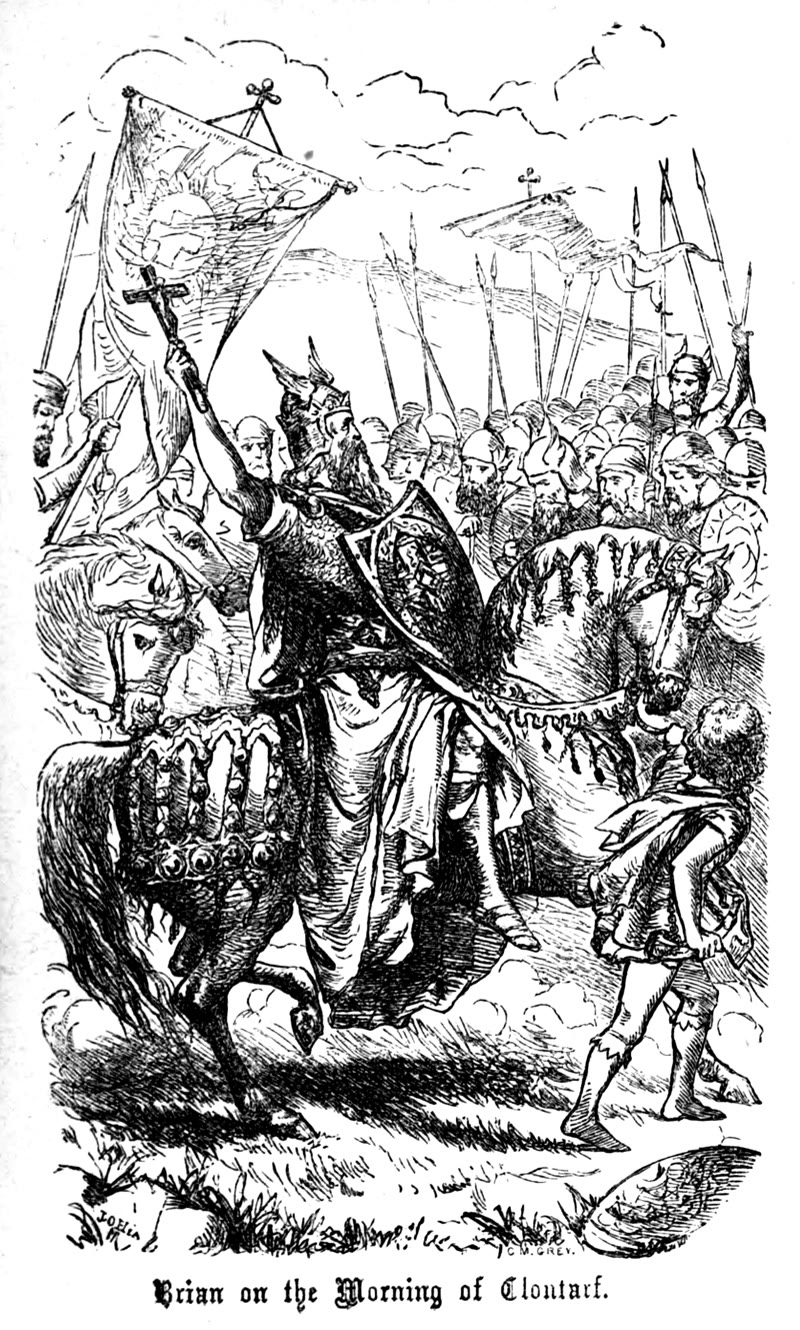
Brian on the Morning of Clontarf, the Victorian hero version, though Brian probably never rode into battle that day. Drawn by John Fergus O’Hea and engraved by C. M. Grey for A. M. Sullivan, The Story of Ireland (1867). Public domain, via Wikimedia Commons
Brian Boru and the O’Brien name
O’Brien, Ó Briain (oh BREE-in) in Irish, means descendant of Brian. Rev. Patrick Woulfe’s Irish Names and Surnames (1923) says the family takes its name and descent from Brian Boru. Within two generations they were Ua Briain: Brian’s grandson Tairdelbach Ua Briain (son of Tadc, not the boy drowned at Clontarf) died in 1086.
Brian’s descendants ruled Thomond for centuries, Woulfe says, and some were kings of Munster or of all Ireland. Ó Dónaill’s dictionary even has a phrase for it: Tháinig siad ó Bhrian Bóramha, they descended from Brian Boru.
O’Brien ranked sixth among all Irish surnames in Robert Matheson’s 1890 survey of births. The Kennedys of Ormond, Ó Cinnéide, take their name and descent from Brian’s nephew, Cinnéidigh son of Donnchuan. And the first name Brian? Woulfe says the king made it famous, and it has been common in Irish families ever since.
The Brian Boru harp myth
The harp on Irish coins, on the President’s seal and, facing the other way, on Guinness is often called the Brian Boru harp. The real instrument, now in Trinity College Dublin, is a willow-and-oak harp strung with 29 brass strings. Trinity’s library thinks the 15th century most likely; the government says the 14th. Either way, it is centuries younger than Brian.
So how did his name get attached? The harp reached Trinity in 1782. Four years later a story appeared in print: Brian’s son Donnchad had taken it to Rome, and it came back by way of Henry VIII and several Irish families, the harp historian Nancy Hurrell writes. In 1840 the antiquarian George Petrie called the story “a clumsy forgery”.
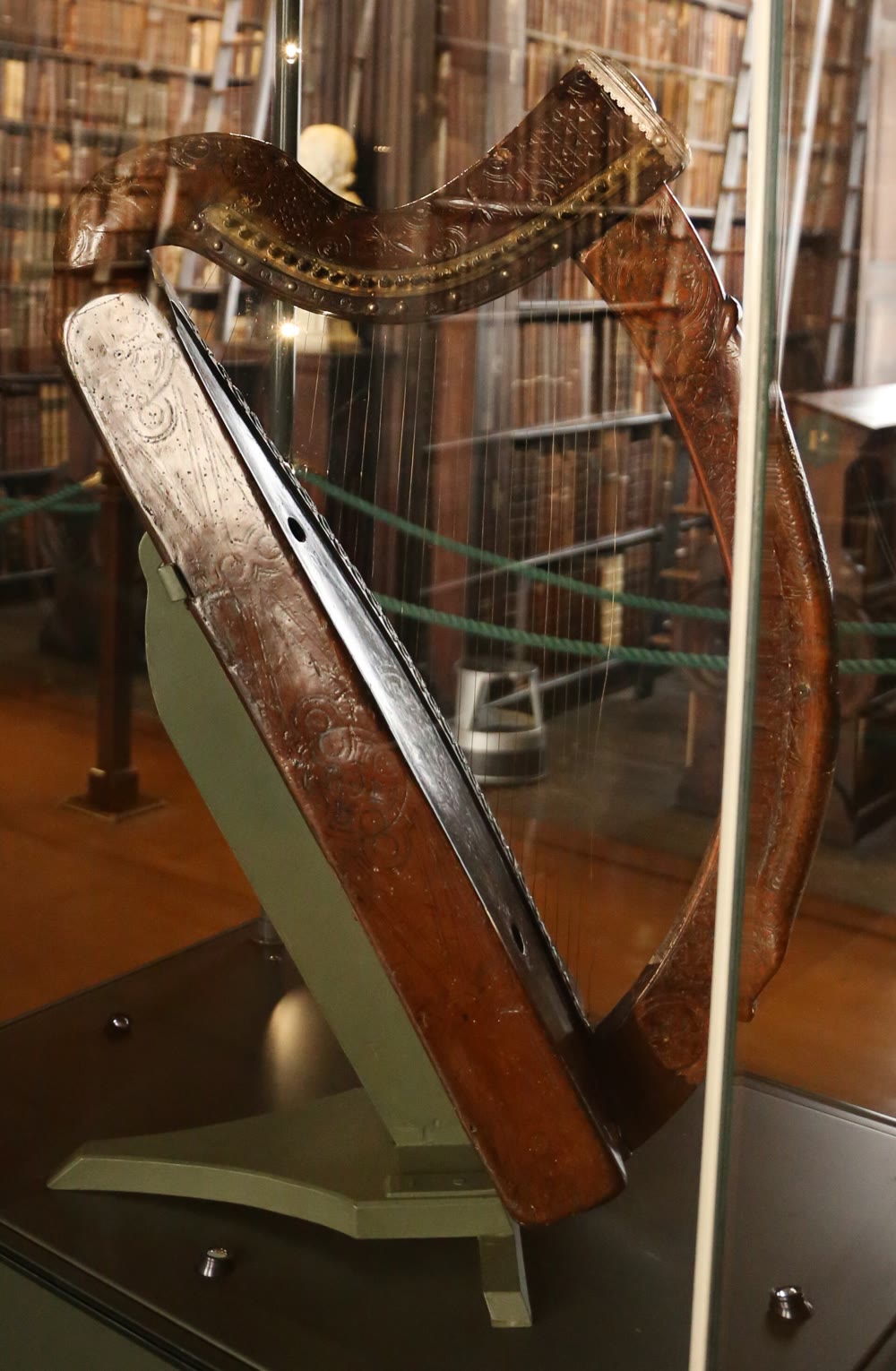
The Trinity College harp, long called the Brian Boru harp, in the Long Room of Trinity College Dublin. Photo: Sailko, CC BY 3.0, via Wikimedia Commons
It became Ireland’s emblem anyway. The State harp is based on it, and the Central Bank says Percy Metcalfe adapted it for the Free State’s first coins, issued on 12 December 1928. It has been on Irish coins ever since, euro coins included.
Guinness got there first. The harp went on its labels in 1862 and was trademarked in 1876, so when the Irish Free State adopted it in 1922, the State harp had to face the other way, the Guinness Storehouse says. There’s more in my guides to the Irish harp and the symbols of Ireland.
Brian Boru FAQ
Who killed Brian Boru?
A note in the Annals of Ulster and later tradition name Bródar (Brodir), a Viking fleet commander, though the DIB doubts it.
Did Brian Boru drive the Vikings out of Ireland?
No. His side won at Clontarf, but Norse kings kept Dublin and Waterford, and Dublin’s Sitriuc reigned until 1036.
Was Brian Boru the first High King of Ireland?
No. Uí Néill kings of Tara claimed all Ireland long before him; Brian, a Munster outsider, took the title from them in 1002.
Are the O’Briens descended from Brian Boru?
The family is, says Woulfe: Ó Briain means descendant of Brian. Whether your own O’Brien line goes back to him is a question for genealogy.
Where is Brian Boru buried?
At Armagh. A plaque on St Patrick’s Church of Ireland Cathedral marks the approximate spot.
Love this? Save it to your Pinterest board for later.
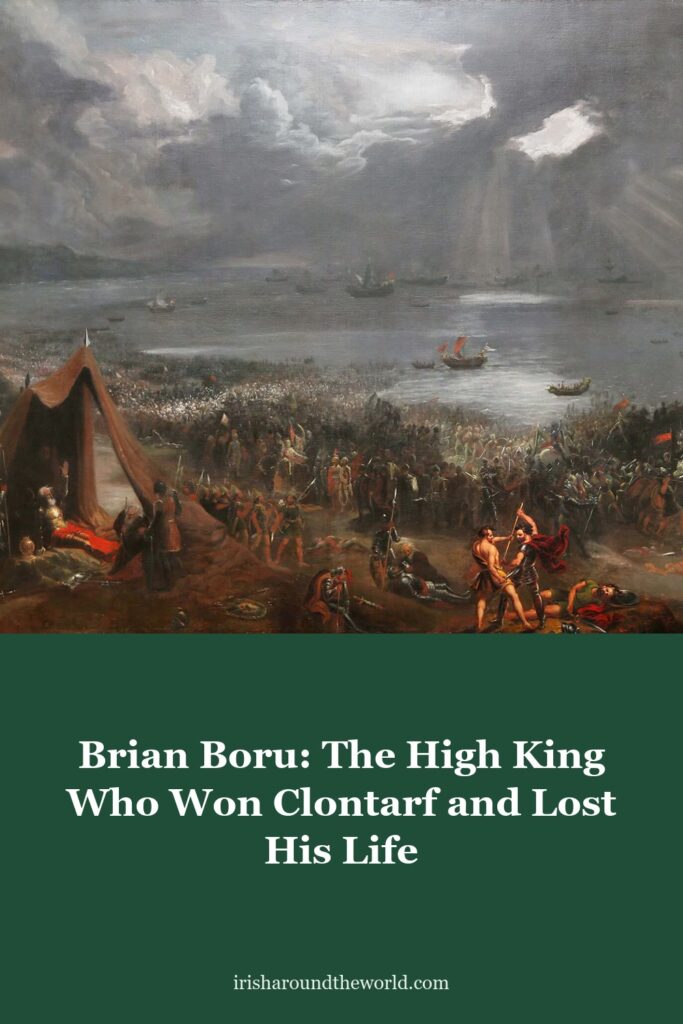
Pin image: Battle of Clontarf, oil on canvas by Hugh Frazer, 1826. Public domain, via Wikimedia Commons.
A little bit of Ireland in your inbox every Friday ☘️
The free Weekly Dose of Irish: an Irish joke, a Celtic symbol, an Irish fact, a poem and the week’s best articles in one short email. Join 9,600+ readers.
Free. One short email every Friday. Unsubscribe any time.
More Irish history reading
- Niall of the Nine Hostages: The King Who Kissed a Hag, and the 3 Million DNA Claim
- Irish Surnames: Meanings, Origins and the Top 100 Names in Ireland
- The Irish Harp: Why Ireland’s National Emblem Is a Musical Instrument
- The Rock of Cashel: Where the Devil Spat Out a Mountain
- Irish Wake and Funeral Traditions: Keening, Clay Pipes and What to Say
- What Is a Banshee? Bean Sí Meaning in Irish Folklore
Featured image: Battle of Clontarf, oil on canvas by Hugh Frazer, 1826. Public domain, via Wikimedia Commons.