
The Táin Bó Cúailnge (roughly tawn boh KOOL-nyuh), the Cattle Raid of Cooley, is the great epic of Ireland’s Ulster Cycle. Queen Medb of Connacht invades Ulster to seize the Brown Bull of Cooley while a curse leaves the Ulstermen too weak to fight. Seventeen-year-old Cú Chulainn holds the fords alone all winter and kills his foster-brother Ferdiad. It survives in Lebor na hUidre (before 1106) and the 12th-century Book of Leinster, though parts may be centuries older.
Picture a king and queen lying in bed at Cruachan, in what is now Co. Roscommon, arguing about which of them is richer. They send for their buckets, their rings, their sheep and their pigs, and count the lot.
They come out exactly even, except for one bull. By the end, the armies of four provinces have marched on the fifth, a teenage hero has held the river fords all winter, and two bulls have torn each other apart.
That’s the Táin, the most famous story of early Ireland. I’ve written about its hero in my guide to Cú Chulainn. Here’s the story, how old it is, which translation to read, and where to visit.
Jump to:
- What is the Táin?
- The story: pillow talk and two bulls
- Why the men of Ulster couldn’t fight
- Cú Chulainn holds the fords
- The fight with Ferdiad
- The last battle and the fight of the bulls
- How old is the Táin?
- Where the versions differ
- Reading the Táin in English
- Places from the Táin you can visit
- The Táin FAQ
- More Irish mythology reading
What is the Táin?
Táin Bó Cúailnge is the spelling scholars use for the Old Irish title. Say it roughly tawn boh KOOL-nyuh, though many English speakers say “toyn” for the first word. Most people just call it the Táin.
Ó Dónaill’s Irish dictionary defines táin in its literary sense as the act of driving off, and táin bó as cattle-driving or the story of a cattle raid. Bó is cow, here in the plural, and Cúailnge is Cooley, the mountainous peninsula in Co. Louth (Cuaille in modern Irish). So the title means the driving-off of the cows of Cooley.
Cattle were the main measure of wealth in early Ireland, the translator Joseph Dunn explained in 1914, and this raid was sometimes called “the Iliad of Ireland”. It’s the centrepiece of the Ulster Cycle, the tales of King Conchobar’s court at Emain Macha (roughly EV-in MAKH-uh) and his champion Cú Chulainn (koo KHULL-in).
The story: pillow talk and two bulls
This retelling is in my own words, from the public-domain translations by Winifred Faraday (1904, the older text) and Joseph Dunn (1914, the Book of Leinster).
Pillow talk at Cruachan
Only the Book of Leinster opens in bed. Ailill, king of Connacht, remarks that a woman does well when she marries a rich man. His wife Medb (usually said MAYV today, like the modern name Maeve, Méabh in Irish) bristles.
She was richer before she met him, she says. Her father, the high king, gave her a province, and she kept her own household of hired warriors. She chose Ailill because she wanted a husband who was not mean, not jealous and not afraid, and if anything, he lives on her wealth. So they count everything, and they’re dead level.
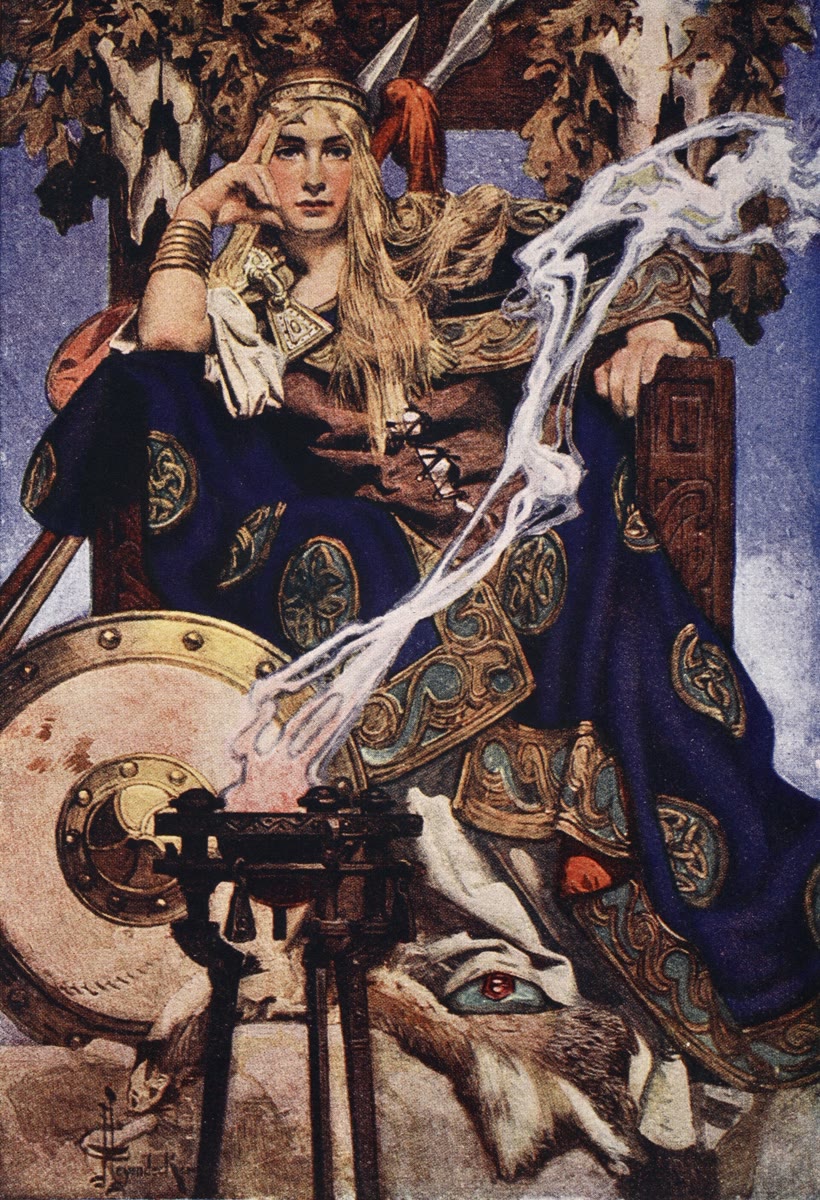
Queen Maev, by J. C. Leyendecker, from T. W. Rolleston, Myths and Legends of the Celtic Race (1911). Public domain, via Wikimedia Commons
The White-horned and the Brown Bull of Cooley
Except for one animal. Finnbennach (roughly FIN-ven-ukh), the White-horned, was born to one of Medb’s cows, but he didn’t fancy belonging to a woman and walked over to Ailill’s herd.
Medb’s messenger, mac Roth, knows the only match: the Donn Cúailnge, the Brown Bull of Cooley, owned by Dáire mac Fiachna in Ulster. Donn means brown (roughly DOWN in Munster, DOON in Connacht, closer to DON in Ulster).
Medb offers a generous fee for a year’s loan, and Dáire is so delighted that he leaps about until the seams of his mattress burst. Then the messengers get drunk and boast that Connacht would have taken the bull anyway. The answer in the morning is no. Fine, says Medb: what can’t be borrowed will be stolen.
“I see red”
In the older version, as the armies leave Cruachan, a prophetess named Fedelm, back from learning her art in Scotland, appears in Medb’s path. Asked how she sees the army, she answers, in Faraday’s translation, “I see very red, I see red.” Then she describes the young man who will do it: Cú Chulainn.
The army marches on the Monday after Samhain (SOW-in). Its guide is Fergus mac Róich, a former king of Ulster now in exile, and Medb’s lover.
Why the men of Ulster couldn’t fight
Medb has chosen her moment. Ulster’s king and warriors are laid low in what the Táin calls the cess noínden. The Electronic Dictionary of the Irish Language defines noínden as the period when the Ulstermen were debilitated and unable to fight. Rudolf Thurneysen read the word as “nine days”, but other scholars disagree.
The cause is told in Noínden Ulad, a short Book of Leinster tale that University College Cork’s Irish Sagas Online prints with a translation.
Crunniuc mac Agnomain, a rich widower in the mountains, finds a beautiful woman walking into his house and running it like her own. She warns him to say nothing foolish at the Ulster fair. There, the king’s horses win their race, and Crunniuc boasts that his wife is faster. The king seizes him: she races, or he dies.
She is heavily pregnant, and her labour starts at the racecourse. She begs the crowd to wait, since every one of them was born of a mother. They refuse. She names herself, Macha, daughter of Sainrith mac Imbaith, races the king’s chariot, wins, and gives birth at the finish to twins, a son and a daughter. Hence the name Emain Macha, the twins of Macha.
Her scream strikes down everyone who hears it for five days and four nights. To the ninth generation, whenever that time came on them, Ulster’s men would be no stronger than a woman giving birth. Only women, boys and Cú Chulainn were spared. This telling never says Macha died, though plenty of modern retellings have her die at the finish.
Cú Chulainn’s own chariot horse, the Grey of Macha, shares her name, as I mention in my piece on why Ireland is so mad about horses.
Cú Chulainn holds the fords
So Ulster is guarded by one teenager. “He is now seventeen years old,” Fergus tells Ailill and Medb in the older version.
Cú Chulainn starts with a warning. In the Book of Leinster he cuts an oak sapling with a single blow, bends it into a hoop, carves a message on it in ogham and rams it down over a standing stone in the army’s path. Then he starts killing. His sling takes a hundred men a night, until Medb agrees to his terms: one champion a day will fight him in single combat at a ford. While the fight lasts, the army may march.
Champion after champion dies at the ford, some of them old friends from his training under the warrior woman Scáthach. The Morrígan, the war goddess in my guide to Celtic gods, offers him her love. When he turns her down, she attacks him in the river as an eel, a grey she-wolf and a heifer.
He holds out from Samhain, the feast behind Halloween, to the start of February, barely sleeping and covered in wounds.
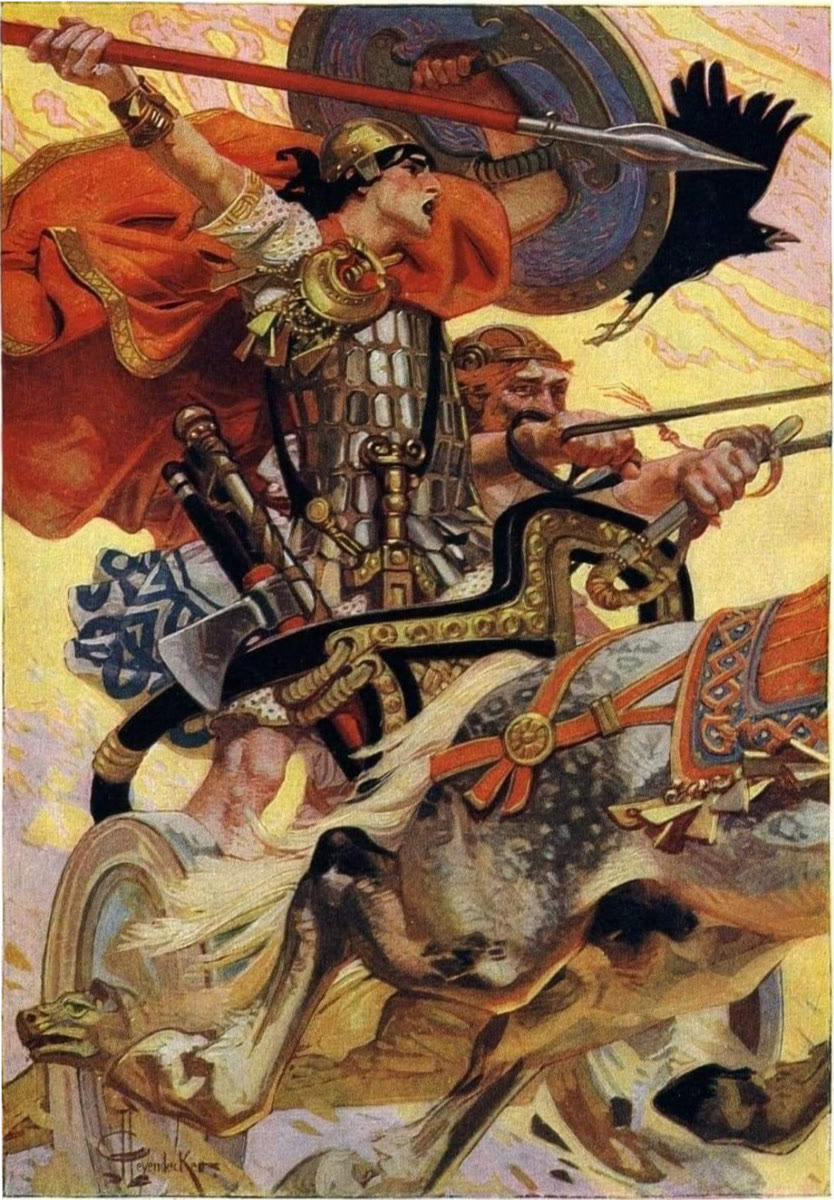
Cuchulain in Battle, by J. C. Leyendecker, from T. W. Rolleston, Myths and Legends of the Celtic Race (1911). Public domain, via Wikimedia Commons
The fight with Ferdiad
The saddest part of the Táin is the fight with Ferdiad, Fer Diad in Old Irish (roughly FER-dee-uh). He is Cú Chulainn’s foster-brother and his equal. They trained together under Scáthach, and the Book of Leinster says Ferdiad’s skin grew hard as horn in battle.
Ferdiad refuses to fight his friend, so Medb’s satirists threaten verses that would raise blisters of shame on his face. He would rather die by a spear than by mockery. At her tent he is plied with drink, kissed with every cup by her daughter Findabair, and promised rich rewards.
In the Book of Leinster they fight at the ford for four days. On the first two evenings they embrace, their horses share a field and their charioteers share a fire. Cú Chulainn sends Ferdiad an equal share of every healing herb and charm used on his own wounds, and Ferdiad sends back an equal share of his food and drink.
After the third day they part without a kiss. On the fourth, Cú Chulainn’s charioteer Láeg floats the gáe bolga, the barbed spear only Cú Chulainn can use, down the stream. Cú Chulainn throws it with his foot, and Ferdiad dies.
Cú Chulainn carries Ferdiad, armour and all, north across the ford, so the victory falls on Ulster’s side of the river and not among Medb’s army, then faints beside him. Tradition puts that ford at Ardee, Co. Louth: Baile Átha Fhirdhia in Irish, the town of Ferdiad’s ford.
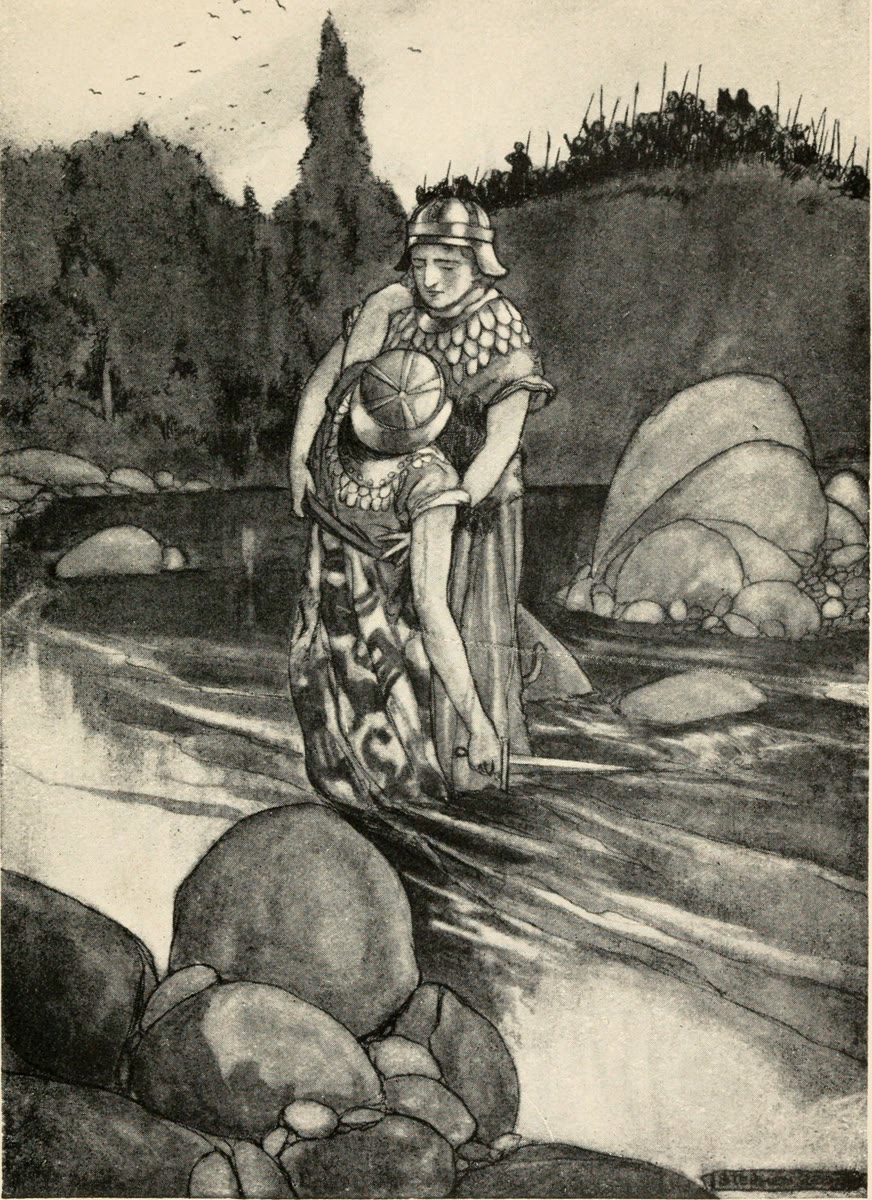
Ferdia falls by the hand of Cuchulain. Illustration by Stephen Reid, from Eleanor Hull, Cuchulain, the Hound of Ulster (1910). Public domain, via Wikimedia Commons
The last battle and the fight of the bulls
Cú Chulainn’s father, Sualtam, rides to Emain Macha shouting that Ulster’s people are being killed and its cattle driven off. Unsatisfied with the reply, he leaps away, falls on his shield, and its rim cuts off his head, which keeps shouting the warning. Ulster finally rises.
In the final battle, Fergus nearly kills his old rival Conchobar, but is talked into slicing the tops off three hills in Meath instead. Cú Chulainn, badly wounded, drags himself into the fight and calls in an old promise. Fergus keeps his word and leaves the field, and Connacht’s army breaks.
Cú Chulainn spares Medb, because he did not kill women. In the Book of Leinster he catches her behind her lines at a very private moment, when, in Dunn’s words, “the issue of blood came upon Medb”. He agrees to protect her retreating army until it crosses the Shannon at Athlone. Fergus’s verdict is sour: this is what happens to a herd that follows a mare.
Meanwhile Medb has sent the Brown Bull home to Connacht. On the plain of Mag Aí near Cruachan he meets the White-horned, and everyone who survived the battle comes to watch. They fight through the night across Ireland, and the Brown Bull wins, dropping pieces of his rival as he goes. Athlone, Áth Luain, is supposedly named after the loin left there, though Faraday warned that many such place-name stories were pure invention.
The Brown Bull heads home to Cooley. In the Book of Leinster he turns on the women and children of his own land, then his heart breaks inside him. He dies at Druim Tairb, the Bull’s Back. In the older version’s last lines, Ailill and Medb make peace with Ulster, and for seven years nobody is killed between them.
What the ending says about war
Look at what’s left. The bull everyone fought over is dead, his rival lies scattered across Ireland, Ferdiad and thousands more are dead, and Medb goes home with nothing. The storytellers never spell out a moral, but many modern readers see the Táin as both a heroic epic and a quiet argument against heroic war.
How old is the Táin?
Three main medieval manuscripts preserve it.
- Lebor na hUidre, the Book of the Dun Cow. The Royal Irish Academy says it was written at Clonmacnoise before 1106 and holds the oldest version of the Táin. Its text breaks off before the end. More in my guide to Clonmacnoise.
- The Yellow Book of Lecan, from the late 14th or early 15th century and now in Trinity College Dublin, with a closely related text that supplies the ending.
- The Book of Leinster, also in Trinity, from the 12th century. A note in it names Áed son of Crimthann as its writer and compiler. Its Táin is longer and more polished, and it is the earliest copy that tells the story from beginning to end.
The story is older than the books. Faraday argued in 1904 that old grammatical forms in the Yellow Book of Lecan text showed a version existed by the early 8th century, perhaps the 7th, and Garrett Olmsted later argued that 7th-century poems already refer to it. No text that early survives, so treat those dates as informed estimates.
A medieval legend says that when no poet could remember the whole Táin, the son of the chief poet Senchán Torpéist went to the grave of Fergus mac Róich, and Fergus himself appeared and recited it.
The scribe who finished the Book of Leinster’s Táin added two notes. In Irish, he blesses everyone who will “faithfully keep the Táin in memory as it stands here”, in Dunn’s translation. Then, in Latin, he says he doesn’t believe parts of it: some of it is the trickery of demons, some “poetic figments”, and some invented to amuse fools.
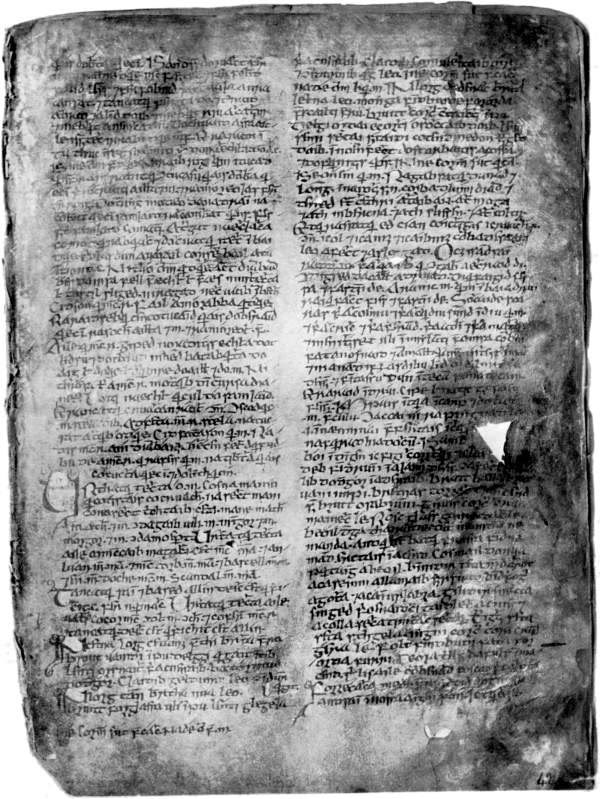
A page of the Táin in the Book of Leinster (page 55), from the facsimile in Joseph Dunn, The Ancient Irish Epic Tale Táin Bó Cúalnge (1914). Public domain, via Wikimedia Commons
Where the versions differ
Scholars call the older text Recension I and the Book of Leinster text Recension II.
- The opening. The pillow talk is only in the Book of Leinster. The older version starts with the armies gathering at Cruachan.
- Ferdiad. In the Yellow Book of Lecan the fight is short. The Book of Leinster stretches it out and leans hard on the friendship, Faraday noted.
- The Morrígan. Her meeting with Cú Chulainn is in Lebor na hUidre but missing from the Book of Leinster, where a leaf has been lost.
Reading the Táin in English
- Winifred Faraday (1904): the older version, plain and close to the Irish. Free on Project Gutenberg.
- Joseph Dunn (1914): the Book of Leinster version, filled out from other manuscripts. Wordy but complete; free on Project Gutenberg.
- Cecile O’Rahilly: the scholarly editions with translations, from the Dublin Institute for Advanced Studies: the Book of Leinster (1967) and Recension I (1976).
- Thomas Kinsella, The Táin (1969): Dolmen Press, with brush drawings by Louis le Brocquy; Oxford University Press followed in 1970. Based mainly on the older version, it’s probably the best-known modern translation.
- Ciaran Carson, The Táin (2007): a Penguin Classics translation by the Belfast poet, based on O’Rahilly’s editions.
Places from the Táin you can visit
Rathcroghan (Cruachan), Co. Roscommon
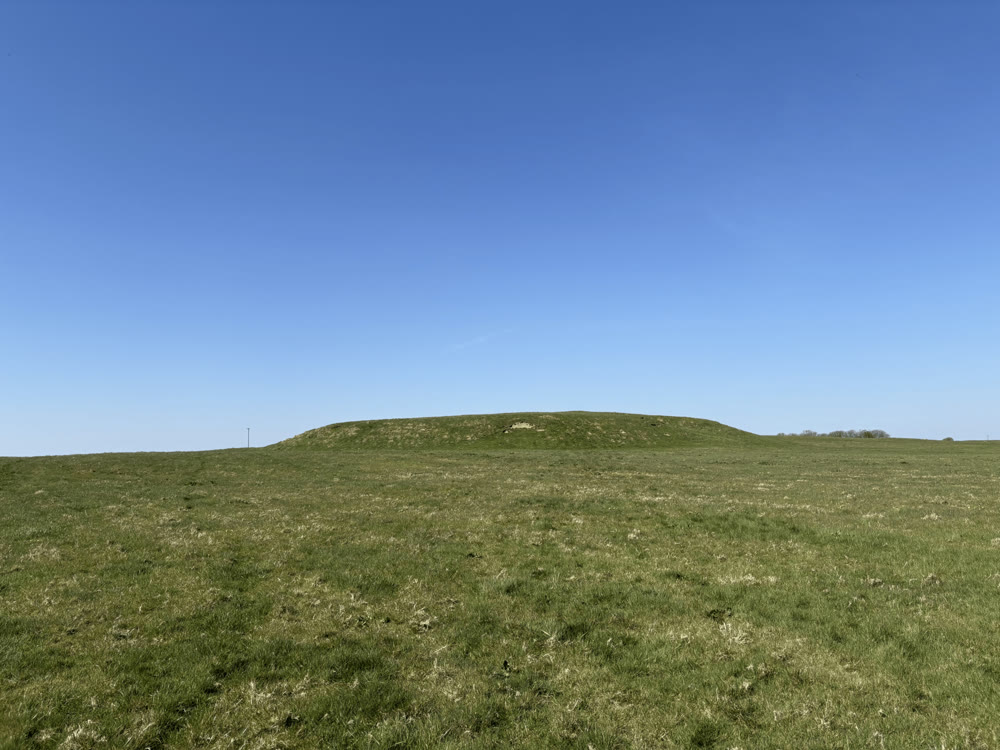
Medb’s royal seat, Cruachan, is usually identified with Rathcroghan, near Tulsk. The Rathcroghan Visitor Centre says the Táin begins and ends here, and counts 240 archaeological sites across 6.5 square kilometres, Oweynagat cave among them.
In October 2026 the visitor centre said it was open all year, Monday to Saturday, 9:15am to 5pm, with guided tours of about two and a half hours on weekday mornings. Its homepage also said entry into the cave on site tours was restricted until further notice. Check before you go.
The Cooley Peninsula, Co. Louth
Cooley juts about 19 km out from the Louth coast, with Carlingford Lough on one side and Dundalk Bay on the other. Sport Ireland’s Táin Way is a 40.3 km loop from Carlingford around Carlingford Mountain (590 m), graded moderate and usually walked over two days, with about 1,025 m of climbing. About half is on local roads, and Sport Ireland lists it as a no-dogs trail.
Ardee, Co. Louth, and Navan Fort, Co. Armagh
Ardee grew up at a ford on the River Dee, and Visit Louth says a bronze sculpture there by Ann Meldon-Hugh remembers the fight. Emain Macha, where the Ulstermen lay helpless, is Navan Fort, just west of Armagh city.
The Táin FAQ
What does Táin Bó Cúailnge mean?
The driving-off of the cows of Cooley, usually translated as the Cattle Raid of Cooley.
How do you pronounce the Táin?
Roughly tawn boh KOOL-nyuh for the full title. Many English speakers say “the toyn”.
Who wins the Táin?
Ulster wins the battle, but the Brown Bull reaches Connacht, kills the White-horned and dies. Nobody really wins.
Is the Táin a true story?
No, it’s a legend, though Cruachan, Cooley, Ardee and Emain Macha are real places you can visit.
Love this? Save it to your Pinterest board for later.
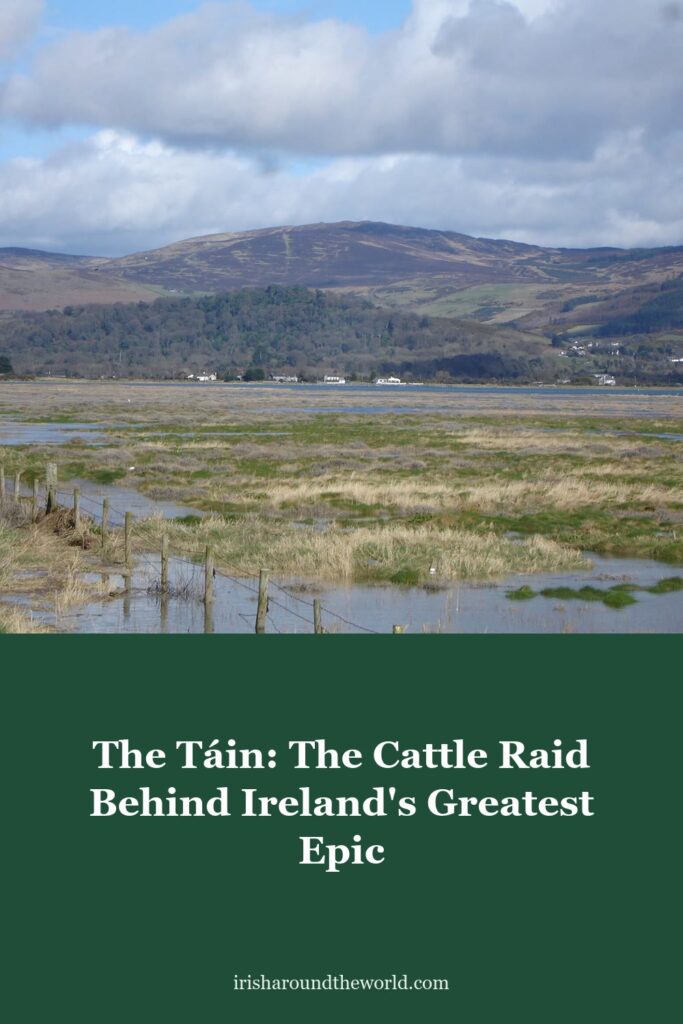
Pin image: Adapted from a photo by Eoghan OLionnain, CC BY-SA 2.0, via Wikimedia Commons.
A little bit of Ireland in your inbox every Friday ☘️
The free Weekly Dose of Irish: an Irish joke, a Celtic symbol, an Irish fact, a poem and the week’s best articles in one short email. Join 9,600+ readers.
Free. One short email every Friday. Unsubscribe any time.
More Irish mythology reading
- Cú Chulainn: The Teenage Warrior Who Held Off an Entire Army Alone
- Celtic Gods and Goddesses: 15 Irish Deities and Their Stories
- The Children of Lir: The Irish Legend of Four Swans and 900 Years
- Irish Mythological Creatures: 23 Fairies, Monsters and Death Omens to Know
- Clonmacnoise: The Monastic City on the Shannon Where High Kings Lie Buried
- Hy-Brasil: The Phantom Island Off Ireland That Mapmakers Drew for 500 Years
Featured image: The Cooley Mountains, Co. Louth, seen across the coastal marshes at Dundalk. Photo: Eoghan OLionnain, CC BY-SA 2.0, via Wikimedia Commons.