
Bram Stoker (1847 to 1912), who wrote Dracula, was born at No. 15 Marino Crescent in Clontarf, Dublin. A sickly child, he became a champion athlete at Trinity College, spent more than a decade in the civil service at Dublin Castle and reviewed plays unpaid for a Dublin paper part-owned by Sheridan Le Fanu. In December 1878 he married Florence Balcombe and left for London, where he managed the actor Henry Irving and his Lyceum Theatre for 27 years. Dracula followed in 1897. Le Fanu’s Carmilla is its clearest Irish influence; the claims linking Dracula to Abhartach and St Michan’s crypt are unproven.
For the first seven years of his life, Bram Stoker could barely stand. He spent much of that time in bed, where, biographers say, his mother filled his head with stories.
By his twentieth year he was the athletics champion of Dublin University. By thirty he was a Dublin Castle civil servant writing a manual for court clerks. Twenty years later he gave the world Count Dracula.
I’ve already untangled the Abhartach legend in my guide to the Irish vampire. This one is about the man: his Dublin life, the Irish influences scholars can document (and the ones they can’t), and where to follow his footsteps this Halloween.
Jump to:
- A sickly child in Clontarf
- Charlotte Stoker and the Sligo cholera
- Trinity: the invalid becomes an athlete
- Dublin Castle and the dullest book he wrote
- The unpaid critic, Le Fanu’s paper and Henry Irving
- Florence Balcombe, Oscar Wilde and the move to London
- Ireland in his fiction
- Dracula, 1897: what his notes prove
- Dracula’s Irish roots: documented or doubtful?
- Where to follow Bram Stoker in Dublin
- Bram Stoker FAQ
- More Irish Halloween reading
A sickly child in Clontarf
Bram (short for Abraham) Stoker arrived on 8 November 1847 at No. 15 Marino Crescent in Clontarf, then a village about three miles from the city centre. Clontarf already had one great story: Brian Boru was killed in the battle there in 1014.
The crescent itself has a good one. The National Inventory of Architectural Heritage says the builder, Charles ffolliot, reputedly put it up in the 1790s to block Lord Charlemont’s view from Marino House. Locals called it Spite Crescent.
His father, also Abraham, was a civil servant born in 1798. His mother, Charlotte Thornley, came from Sligo. Bram was one of their seven children.
What kept him in bed is still a mystery. Stoker wrote that he couldn’t stand upright until about the age of seven, then grew into a strong boy. Trinity’s Jarlath Killeen warns that his own account of his youth isn’t always reliable.
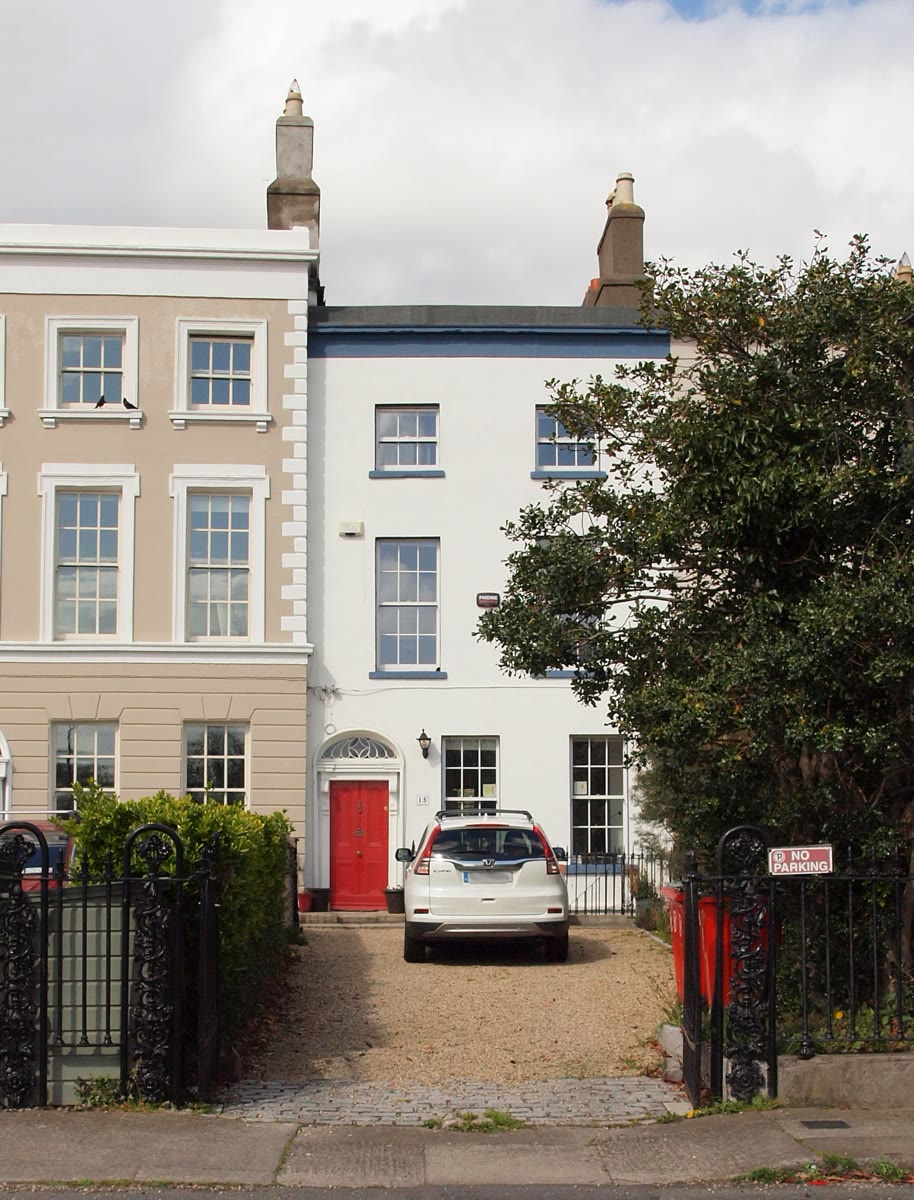
15 Marino Crescent, Clontarf, where Bram Stoker was born in November 1847. It’s a private home. Photo: Smirkybec, CC BY-SA 4.0, via Wikimedia Commons
Charlotte Stoker and the Sligo cholera
Charlotte was 14 and living in Sligo when cholera swept the town in 1832. Killeen describes a reform-minded, hard-working woman with a store of horror stories from the epidemic.
Her children grew up on those stories, and in 1873 she wrote them down as “Experiences of the Cholera in Ireland”. The manuscript is now among the Stoker papers in the library of Trinity College Dublin.
Bath Spa University’s William Hughes has traced the Sligo cholera through Under the Sunset, Bram’s book of fairy tales published at the end of 1881, in which “The Invisible Giant” is a plague that falls on a land. In 2022 Marion McGarry of Atlantic Technological University went further in the Journal of Medical Humanities, arguing that the Count can be read as Sligo’s cholera in human form. That’s an interpretation, not a proven source.
Charlotte was more than a teller of grim tales. She campaigned for deaf children’s schooling, reading a paper on state provision for it to Dublin’s Statistical and Social Inquiry Society in the 1860s.
Trinity: the invalid becomes an athlete
Stoker entered Trinity College Dublin in 1864, and the bedridden boy turned out to be big, strong and tireless. He played rugby for the university and rowed, and in 1867 he won prizes for weightlifting and for the five-mile and seven-mile walks.
He was busy off the field too. Trinity says he is the only person to have been both Auditor of the College Historical Society (the Hist) and President of the University Philosophical Society (the Phil). His Hist address in November 1872, “The Necessity for Political Honesty”, was given in the college Dining Hall, and part of it argued that Irish immigrants were making America stronger.
At the Phil on 4 May 1871 he opened the debate on Professor Edward Dowden’s paper about Walt Whitman, then a scandalous poet. In February 1876, after a night defending Whitman at a Dublin debating club, Stoker finally posted the American a long, gushing letter he had written four years earlier. Whitman replied, and the two met in Philadelphia on 20 March 1884.
He took his BA in 1870 and bought his MA in 1875. He later claimed honours in pure mathematics, which Killeen says doesn’t square with the record. Trinity also keeps the Book of Kells, so a Stoker walk there has a second reward.
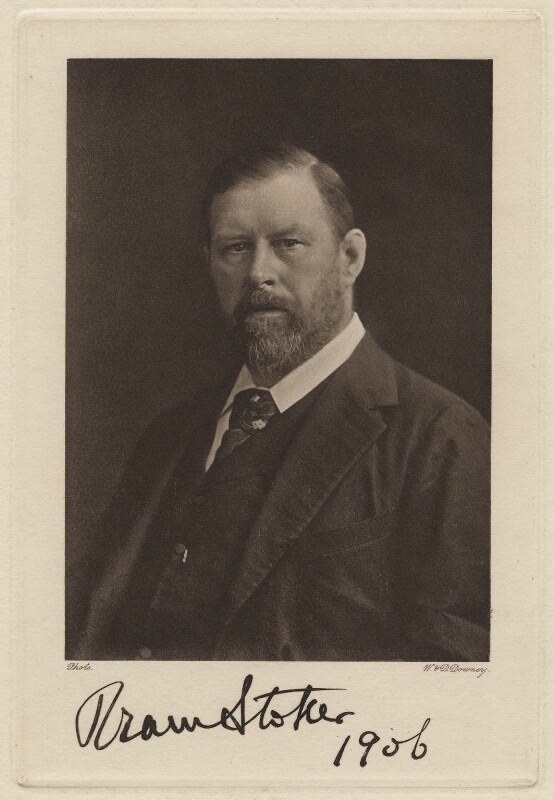
Bram Stoker in 1906, the year he published his memoir of Henry Irving. Photogravure by W. & D. Downey, signed by Stoker. Public domain, via Wikimedia Commons
Dublin Castle and the dullest book he wrote
From 1866, while still a student, Stoker worked in the civil service at Dublin Castle, the seat of British rule in Ireland, six and a half days a week. In 1876 he became Inspector of Petty Sessions, a newly created job that sent him around the country checking on the local magistrates’ courts.
Out of that came his first book, The Duties of Clerks of Petty Sessions in Ireland (1879). He admitted it was dull: petty sessions meant small cases, down to dog licences.
He also briefly edited a Dublin paper, the Irish Echo, and published his first fiction. “The Primrose Path” ran in the Shamrock in 1875: an Irish theatre carpenter emigrates to London, takes to drink and kills his wife. It’s a grim little story about the Irish abroad, years before Stoker became one.
The unpaid critic, Le Fanu’s paper and Henry Irving
In November 1871, annoyed that Dublin papers ignored the stage, Stoker asked Dr Maunsell, a proprietor of the Dublin Evening Mail, to let him review plays. The paper couldn’t pay, so he did it for nothing.
Half the Mail belonged to Joseph Sheridan Le Fanu, Dublin’s master of the ghost story, according to Alfred Webb’s Compendium of Irish Biography (1878). Le Fanu’s vampire novella Carmilla was appearing in the London magazine The Dark Blue in 1871 and 1872, just as Stoker started writing for his paper. Le Fanu died in February 1873. Some writers call him Stoker’s mentor. The shared newspaper is documented; a close friendship is not.
Stoker had first seen the English actor Henry Irving on 28 August 1867, in The Rivals at Dublin’s Theatre Royal. When Irving brought his Hamlet to Dublin in 1876, he liked Stoker’s review so much that he asked to meet him. At a Sunday dinner with a dozen friends, Irving recited Thomas Hood’s poem The Dream of Eugene Aram. Stoker, by his own account, burst into “something like a violent fit of hysterics”.
Irving went to his room and came back with a signed photograph, dated Dublin, 3 December 1876. On 11 December Trinity presented Irving with an address and filled the Theatre Royal for a University Night, and Stoker wrote it up for the Mail.
Many biographers think Irving’s looks and stage menace went into the Count. It’s a reading, not a fact, but his Lyceum Mephistopheles shows why.
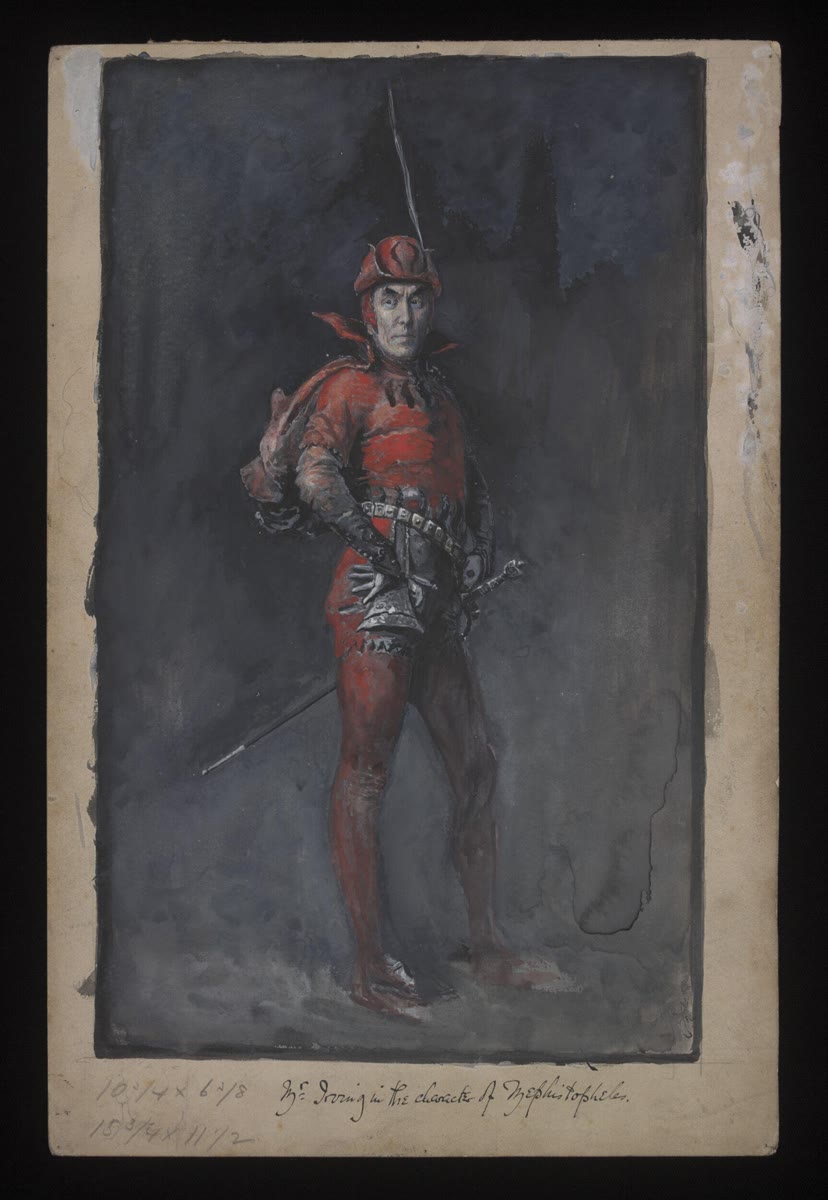
Henry Irving as Mephistopheles in Faust at the Lyceum, watercolour by Bernard Partridge, about 1885 (Victoria and Albert Museum). Public domain, via Wikimedia Commons
Florence Balcombe, Oscar Wilde and the move to London
Florence Balcombe, a colonel’s daughter born in 1858, had been courted by Oscar Wilde, who gave her a little gold cross on Christmas morning 1876. She chose Stoker instead.
When Irving asked Stoker to manage his Lyceum Theatre in London, the couple married on 4 December 1878, at St Ann’s Church on Dawson Street, and Stoker left Dublin for good. Wilde asked for his cross back, though he stayed friendly with Florence. (There’s more on Wilde in my guide to The Ballad of Reading Gaol.)
For 27 years he ran Irving’s business and the Lyceum. He wrote about half a million letters on Irving’s affairs, by Trinity’s estimate, and organised eight tours of the United States. Their only child, Noel, was born in 1879.
Florence outlived Bram by 25 years and guarded Dracula fiercely. When a German company made the unauthorised film Nosferatu (1922), she sued, and in 1925 a German court ordered the copies destroyed. Some survived anyway.
Ireland in his fiction
The Snake’s Pass (1890), his first novel, was begun while he still lived in Dublin, and Killeen calls it the last major work he set in Ireland. An English heir tours the west on his way to friends in Clare.
Locals tell him the legend of their hill. Before St Patrick drove out the snakes, they say, the King of the Snakes lived there with a golden crown, and defied the saint. There’s a shifting bog, a hard-hearted moneylender called Black Murdock who searches the hill for buried treasure. It’s Stoker’s own take on the story I trace in the St Patrick snakes legend.
In October 2023 Brian Cleary, a Stoker enthusiast, was reading old newspapers in the National Library of Ireland when he found a ghost story by Stoker that no bibliography listed. “Gibbet Hill” had appeared in the Dublin Daily Express Christmas supplement of 17 December 1890, the year Stoker began his notes for Dracula. It’s set in Surrey but was printed for Dublin readers.
According to the festival, sales of the 2024 book support the Rotunda Foundation’s Charlotte Stoker Fund, which pays for research into preventable deafness in newborns.
Politically, Stoker called himself a “philosophical Home-Ruler” in his memoir of Irving: a supporter of Irish self-government in principle.
Dracula, 1897: what his notes prove
Stoker’s working notes survive. The Rosenbach in Philadelphia holds more than 100 pages of outlines, plot ideas and research notes, built up over about seven years. After his death Florence sold his books, and the notes went for £2 and 2 shillings. They passed through the stock of the publisher Scribners and turned up at a Philadelphia bookseller in 1970, where the Rosenbach bought them.
On one early cast list, headed Historiae Personae, Stoker wrote “Dracula” across the top three times. The villain had begun as Count Wampyr. Characters were reshuffled (Lucy was engaged to Seward) and some were dropped, including a Detective Cotford and the Count’s mute servants. My Irish vampire guide shows how Stoker found the name Dracula in an 1820 account of Wallachia.
On 18 May 1897 the Lyceum staged a reading of his stage version, Dracula, or The Un-Dead. It was the only performance in his lifetime, and only two people paid to get in. Eight days later, on 26 May, Constable published the novel, bound in yellow cloth and priced at six shillings. Readers met a Count who hears the wolves howl and calls them “the children of the night. What music they make!”
The Rosenbach also owns the first Irish translation (1933).
Dracula’s Irish roots: documented or doubtful?
The story unfolds in Transylvania and England. Ireland’s fingerprints are real but mostly indirect, and some popular claims don’t hold up.
Carmilla: the strongest link
Le Fanu’s Carmilla has a female vampire in Styria, in Austria, who turns out to be a long-dead countess. Stoker was writing for Le Fanu’s paper while it was serialised, and critics have long counted it among Dracula’s sources.
The clearest wink came after Stoker’s death. In 1914 Florence published Dracula’s Guest, which she said was an episode cut from the novel for length. In it, a traveller near Munich shelters at a marble tomb inscribed to a “Countess Dolingen of Gratz in Styria”. Many readers see a nod to Le Fanu there.
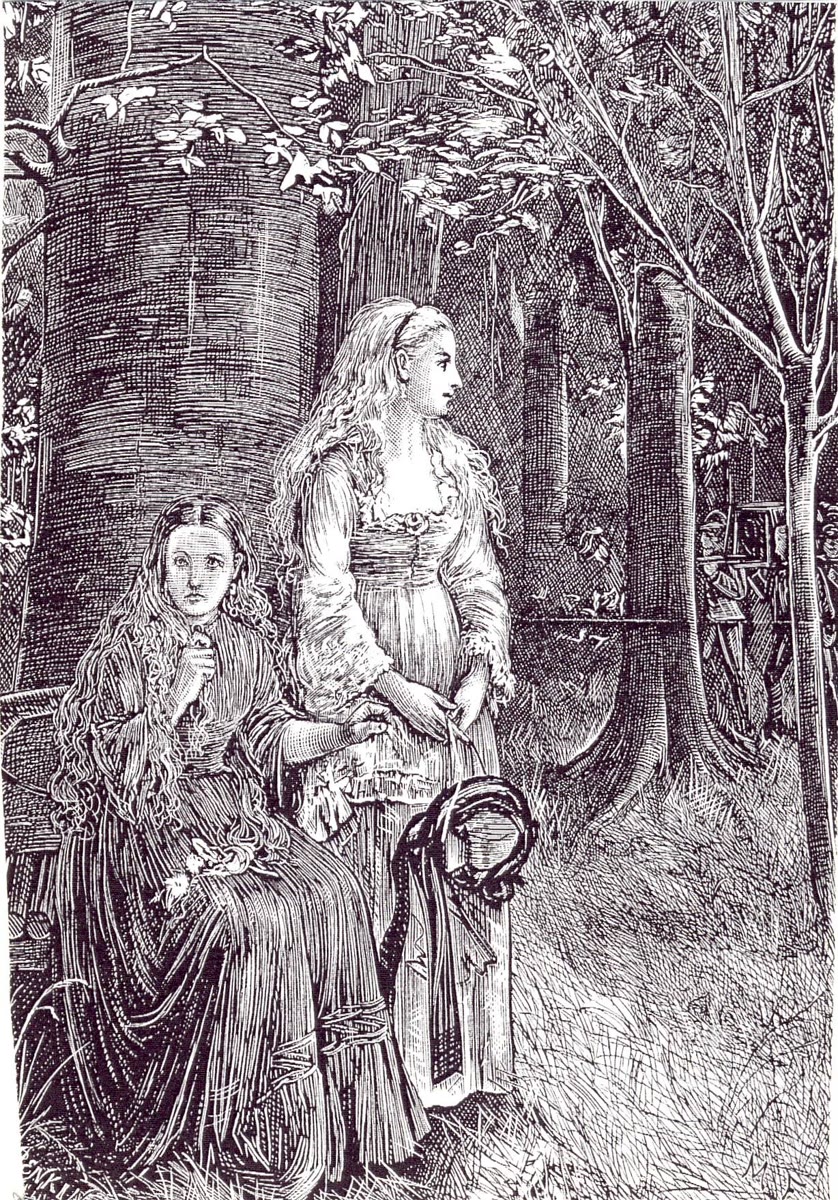
Laura and Carmilla watch a funeral pass, an illustration by Michael Fitzgerald for Le Fanu’s Carmilla in The Dark Blue, January 1872. Public domain, via Wikimedia Commons
His mother’s cholera stories: debated
Charlotte’s account is real. Its link to Under the Sunset is well argued; its link to Dracula is still being debated.
Irish folklore of the undead: thin
Irish tradition is full of the dead and the otherworld, from the banshee to the spirits loose at Samhain (see my hub on how the Irish invented Halloween). But an old Irish blood-drinking vampire is hard to find. When Stoker did use Irish legend, in The Snake’s Pass, he wrote about a snake king and a bog, not the undead.
Abhartach: no evidence
The Derry tale of a tyrant who wouldn’t stay buried is genuine 19th-century folklore. No version where he drinks blood has been found in print before 1997, a century after Dracula, and Stoker’s notes never mention him. The full story is in my Irish vampire guide.
St Michan’s crypt: local lore
Guides have long said a young Stoker visited the mummies in the vaults of St Michan’s Church and got the idea for Dracula there. It’s a good story, but nobody has produced a letter, diary entry or note of his that mentions them.
Where to follow Bram Stoker in Dublin
Details checked on 12 October 2026. Opening hours change, so check before you go.
- 15 Marino Crescent, Clontarf: his birthplace is a private home, so look from the street. The old communal garden opposite is now Bram Stoker Park. Dublin City Libraries’ Leslie Shepard Bram Stoker Collection, more than 230 books and pamphlets, is split between nearby Marino Library and the Dublin City Library and Archive on Pearse Street.
- Trinity College: walk through Front Square to the Dining Hall, scene of his 1872 Hist address. The library holds the Stoker papers, including his mother’s cholera account.
- Dublin Castle: where he spent his civil service years. The castle is open daily; State Apartments tickets are sold in the upper courtyard.
- 30 Kildare Street: a plaque calls him “Theatre Manager, Author of Dracula” and says he lived here. The National Library, where Gibbet Hill turned up, is on the same street.
- St Ann’s Church, Dawson Street: where he married Florence in 1878. It’s a working parish church.
- St Michan’s Church: an intruder set the crypt alight in June 2024, damaging the mummies, and tours stopped. There was no sign of them resuming when this was written. More in my list of haunted places in Ireland.
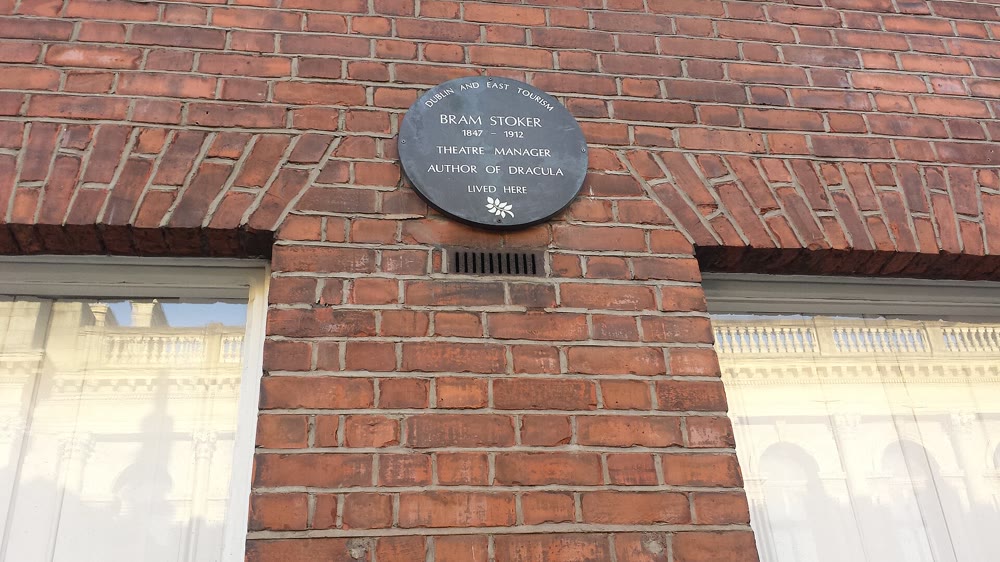
The Dublin and East Tourism plaque at 30 Kildare Street, where Stoker lived before London. Photo: Kinsie84, CC BY-SA 3.0, via Wikimedia Commons
Bram Stoker Festival 2026
Dublin City Council’s Bram Stoker Festival fills the October bank holiday weekend, Friday 23 to Monday 26 October 2026. For Stoker fans, the pick is the Bram Stoker Walking Tour of Dublin, which leaves Central Plaza on Dame Street at noon and 3pm each day. It takes about two hours and costs €15 plus a €1 booking fee, for ages 12 and up.
Over-16s can try On the Hunt, a research race in the National Library, on Saturday 24 October at 11am (free, but ticketed from 10am on 14 October). Families with younger children should head for Stokerland in St Patrick’s Park on 24, 25 and 26 October, and on Monday 26 October at 7pm the Macnas parade comes to the north east inner city. Both are free. Check the festival site before you travel. For other festivals, see my Halloween hub, and for more of the city, my Dublin guide.
Bram Stoker FAQ
Was Bram Stoker Irish?
Yes. A Dubliner from Clontarf, he went to Trinity, spent over a decade in the civil service and only moved to London at 31, in December 1878.
Where was Bram Stoker born?
In Clontarf, on Dublin’s north side, at No. 15 Marino Crescent, on 8 November 1847. It’s a private house facing Bram Stoker Park.
Was Dracula based on an Irish legend?
No Irish legend is documented as a source. Le Fanu’s Carmilla is the strongest Irish influence. The claims linking it to Abhartach or St Michan’s crypt are unproven.
Where are Bram Stoker’s notes for Dracula?
At the Rosenbach in Philadelphia, which bought them in 1970. A facsimile edition, Bram Stoker’s Notes for Dracula, came out in 2008.
When is the Bram Stoker Festival 2026?
Friday 23 to Monday 26 October 2026, across Dublin.
Love this? Save it to your Pinterest board for later.
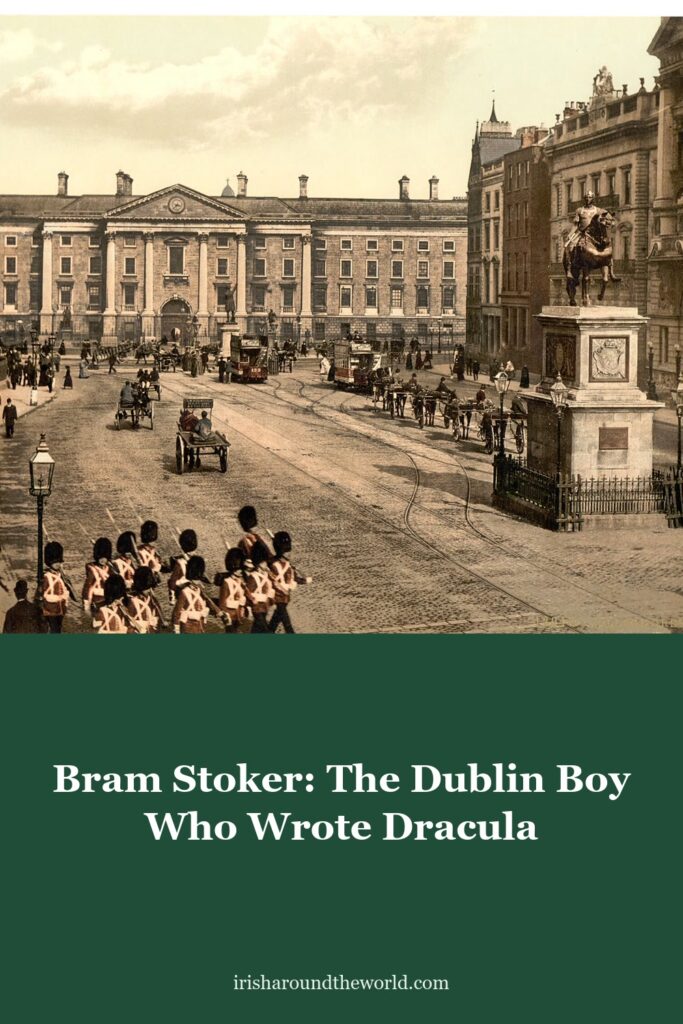
Pin image: Trinity College photochrom, Detroit Publishing Co., 1890 to 1900, Library of Congress. Public domain, via Wikimedia Commons.
A little bit of Ireland in your inbox every Friday ☘️
The free Weekly Dose of Irish: an Irish joke, a Celtic symbol, an Irish fact, a poem and the week’s best articles in one short email. Join 9,600+ readers.
Free. One short email every Friday. Unsubscribe any time.
More Irish Halloween reading
- Samhain: The Night the Fairy Mounds Opened and How It Became Halloween
- Stingy Jack: The Irishman Who Tricked the Devil and Gave the Jack-o’-Lantern Its Name
- Colcannon Recipe: The Irish Halloween Mash That Hides Your Fortune
- Irish Halloween Games: Snap Apple, Burning Nuts and the Old Spells to See Your Future Spouse
- How the Irish Invented Halloween: Samhain, Turnip Lanterns, Barmbrack and the Best Festivals in Ireland
- The Irish Vampire: Abhartach, the Dearg Due and Dracula’s Irish Roots
- 15 Haunted Places in Ireland: Ghost Stories, Real History and How to Visit
- The St Patrick Snakes Legend: Ireland Never Had Any. So Where Did the Story Come From?
- Things to Do in Dublin: 12 Best Sights, Day Trips and Tips (2026)
Featured image: College Green and the front of Trinity College, Dublin, in a photochrom print published by the Detroit Publishing Co. between 1890 and 1900. Library of Congress. Public domain, via Wikimedia Commons.