
The best-known Irish wedding blessing is “May the road rise up to meet you”, but the earliest printing of its English verse found so far is from 1945, in a St Patrick’s Day speech printed in the US Congressional Record. The wedding toasts in Ireland’s 1930s folklore records are simpler: good health and long life. In Irish, the classic card line is Go maire sibh bhur saol nua (guh MAR-uh shiv vur SEEL NOO-uh), “may you enjoy your new life”. For a reading, W. B. Yeats’s “He Wishes for the Cloths of Heaven” (1899) is out of copyright. Many “old Irish blessings” are anonymous and fairly modern: lovely to use, just don’t call them ancient.
Somewhere between the vows and the cake, someone usually stands up with a glass and an Irish blessing. It might be the road rising up to meet you, or a line of Irish the speaker practised all week.
Plenty of verses sold as “ancient Irish wedding blessings” turn out to be American, English or Scottish, and it’s easy to get the Irish slightly wrong on a card. Here are the blessings, toasts and readings worth using, each with an honest note on its origin, and the Irish with fadas and pronunciation.
Jump to:
- What Irish couples were really wished
- The best-known Irish wedding blessings in English
- Irish wedding wishes in Irish, with pronunciation
- Toasts for the best man and the father of the bride
- Public-domain readings for the ceremony
- The Claddagh ring and Celtic knots
- Which “Irish blessings” are modern or of unknown origin?
- How to choose one and word it
- Irish wedding blessings FAQ
- More Irish blessings and love reading
What Irish couples were really wished
Ireland’s folklore records keep wedding wishes short. Many are in the Schools’ Collection, where pupils wrote down local customs from older people between 1937 and 1939.
At Cor na Muclach school in Co. Leitrim, a pupil described the wedding feast at home. Once everyone had eaten, the drinking began, and the first of many toasts to the couple was simply “good health and long life”.
In Co. Meath, a Rathkenny pupil recorded an older custom. Some of the groom’s party raced for a bottle of whiskey, and the bride poured a round and broke the bottle on a stone. If it smashed at the first try, the crowd cheered “Long life to the Bride and Groom”.
A third account, from Mullach Dubh school, also in Co. Leitrim, says the bride and groom wanted the wind blowing at their backs, for luck and a long life for the bride. Sound familiar? All three come back to the wish still raised in every Irish toast: health and long life. In Irish, that’s sláinte agus saol (SLAWN-cha AH-gus SEEL).
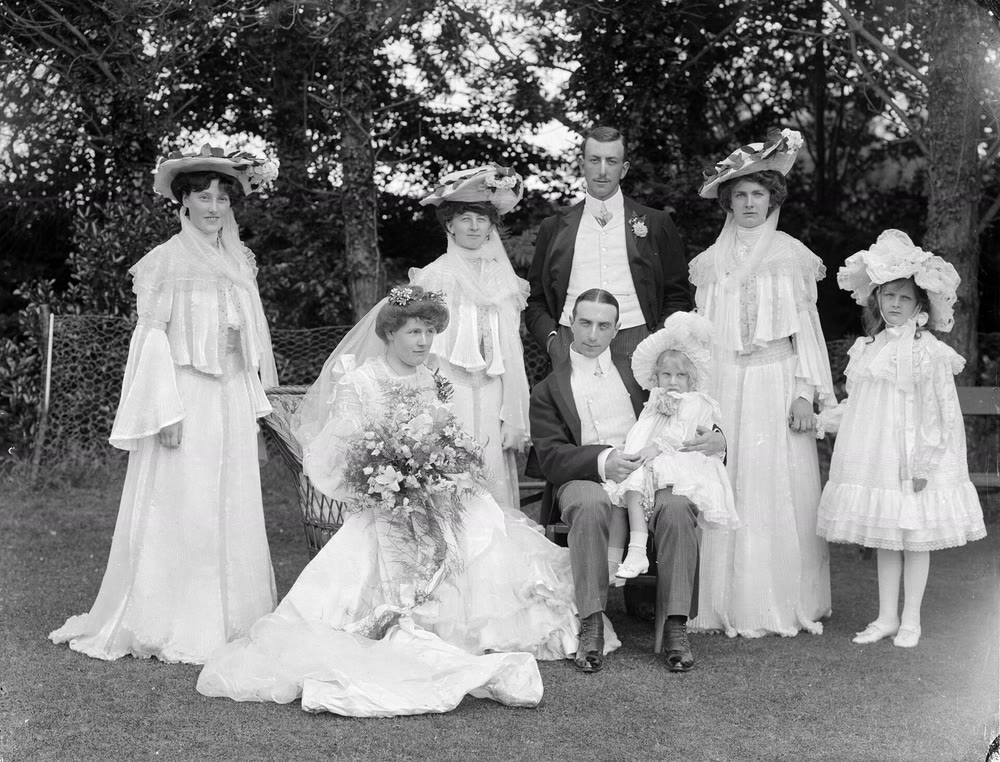
A wedding group at Fethard, Co. Wexford, on 6 August 1903, identified on the National Library of Ireland’s Flickr page as the wedding of Florence Taylor and Cecil Atkinson. Photo: A. H. Poole studio, National Library of Ireland. No known copyright restrictions, via Wikimedia Commons
The best-known Irish wedding blessings in English
May the road rise up to meet you
May the road rise up to meet you.
May the wind be always at your back.
May the sun shine warm upon your face,
and the rains fall soft upon your fields.
And until we meet again,
may God hold you in the palm of His hand.
Where it comes from: the first line is a real Irish farewell, Go n-éirí an bóthar leat, meaning “may your journey go well”. The earliest English version found so far is from 1945. On St Patrick’s Day that year Paul E. Fitzpatrick, the New York State Democratic chairman, closed a radio address broadcast across America with what he called “this simple, very old-fashioned Irish prayer”, and Senator Robert F. Wagner had the speech printed in the Congressional Record of 22 March 1945. A year later it turned up in a St Patrick’s Day newspaper column in Pittsburgh that offered it as an old Irish prayer. Nobody knows who wrote it. That early version ends in the “hollow” of God’s hand; the palm, the sun and the rain came later. The whole story is in my guide to what “May the road rise up to meet you” means.
It makes a fine last line for a speech, but it mentions God, which rules it out of a civil ceremony in Ireland.
The “Irish wedding blessing”
May God be with you and bless you.
May you see your children’s children.
May you be poor in misfortune,
rich in blessings.
May you know nothing but happiness
from this day forward.
Where it comes from: nobody knows. It’s widely printed as a traditional Irish wedding blessing, but no early printed source has turned up, so treat its age as unknown.
Its second line has deep roots, though: “thou shalt see thy children’s children” is Psalm 128 in the King James Bible (127 in Catholic Bibles), one of the Archdiocese of Dublin’s suggested wedding psalms.
Irish wedding wishes in Irish, with pronunciation
A line of Irish goes down well, as long as it’s right. Each one below comes from, or is built directly on, Ó Dónaill’s Irish-English Dictionary (on teanglann.ie), the New English-Irish Dictionary (focloir.ie) or Gaelchultúr, an Irish-language college in Dublin.
The respellings are rough guides. Saol (life) is SEEL in Connacht and Ulster but closer to SAYL in Munster.
- Go maire sibh bhur saol nua (guh MAR-uh shiv vur SEEL NOO-uh): “may you enjoy your new life”. Ó Dónaill’s dictionary glosses it “congratulations on your marriage”, under mair, “to live”. The classic card line.
- Comhghairdeas libh! (roughly KOH-ar-jus liv): “congratulations!” to the two of you. To one person, say comhghairdeas leat (lat). Add ó chroí (oh KHREE), “from the heart”.
- Go n-éirí bhur bpósadh libh (guh NYE-ree vur BOH-suh liv): “may your marriage be a success”. Ó Dónaill gives the one-person form, go n-éirí do phósadh leat.
- Sonas agus séan oraibh (SUN-us AH-gus SHAYN OR-iv): “may you be happy and prosperous”. Ó Dónaill gives the one-person form, ending in ort.
- Bail ó Dhia oraibh (BAL oh YEE-uh OR-iv): “God prosper you”. This is Ó Dónaill’s own plural form.
- Sliocht sleachta ar shliocht bhur sleachta (shlukht SHLAKH-tuh er HLUKHT vur SHLAKH-tuh): roughly “children’s children on your children’s children”, a wish for a long family line. Gaelchultúr lists it as a wedding tongue twister.
- Sláinte agus saol chugaibh (SLAWN-cha AH-gus SEEL HUG-iv): “health and long life to you”. Ó Dónaill gives it with chugat, for one person.
- Fáilte chuig ár mbainis (FAWL-cha hig awr MAN-ish): “welcome to our wedding”, from Gaelchultúr. On a sign, write ár mBainis: the added m stays small before a capital.
If someone congratulates you in Irish, the dictionary reply is go maire tú do shláinte (guh MAR-uh too duh LAWN-cha), “may you enjoy good health”.
Getting the Irish right
The easiest slip on a wedding card is mixing up “you” and “you both”:
- To one person: tú (you), do (your), leat (with you), ort (on you).
- To the couple: sibh (you), bhur (your), libh (with you), oraibh (on you).
Never mix them, as in “go maire tú bhur saol nua”. Little words change the next word too: do adds an h (do phósadh), while bhur and ár (our) add a letter in front (bhur bpósadh, ár mbainis, never “ár bainis”).
- Birthday or wedding? Go maire tú an lá is “many happy returns of the day”, a birthday wish. For newlyweds, use go maire sibh bhur saol nua.
- Fadas matter. Sláinte needs the accent on the á. Slàinte mhath, with the accent sloping the other way, is Scottish Gaelic; the Irish is sláinte mhaith.
- Anam cara is written as one word in standard Irish, anamchara, and mo shortens before a vowel, so “my soul friend” becomes m’anamchara (MAN-um-khar-uh).
- “My love”, said to someone, is a ghrá (uh GHRAW), never “a grá”. There are more in my Irish sayings about love.
Toasts for the best man and the father of the bride
Keep it short and kind enough for the grandparents’ table: one true story about the couple, one good line, then raise your glass.
Toasts in Irish
- Sláinte na lánúine nuaphósta! (SLAWN-cha nuh LAW-noon-yuh NOO-uh-fohs-tuh): “the health of the newlyweds”. It’s the wording focloir.ie gives for proposing a toast to the newlyweds.
- Sláinte na brídeoige! (SLAWN-cha nuh BREE-joh-gyuh): “the bride’s health”, also from focloir.ie, and a natural line for the father of the bride. Brídeog is another word for bride.
- Sláinte mhaith! (SLAWN-cha WAH, or VAH in Munster): “good health”. More in my guide to how to say cheers in Irish.
- Níl aon leigheas ar an ngrá ach pósadh (neel ayn LYE-us er un NGRAW okh POH-suh): “there’s no cure for love but marriage”. Gaelchultúr lists it as a proverb, and it was made for a best man’s speech.
Toasts in English, and where they come from
- “May the roof above us never fall in, and may we friends gathered below never fall out.” Good for the father of the bride, welcoming two families. It’s often called Irish, but the word historian Barry Popik found an earlier form printed in 1912 as an old English toast.
- “As you slide down the banister of life, may the splinters never point the wrong way.” Popik’s earliest version, from a Kansas newspaper in 1915, is a toast to a bride and groom. It was being called Irish by 1981.
Dozens more, with notes on which are really Irish, are in my collection of Irish toasts.
A poem to raise a glass to
For a toast to your new husband or wife, W. B. Yeats’s six-line “A Drinking Song” fits on a card:
A Drinking Song
Wine comes in at the mouth
And love comes in at the eye;
That’s all we shall know for truth
Before we grow old and die.
I lift the glass to my mouth,
I look at you, and I sigh.
It appeared in The Green Helmet and Other Poems, printed by his sister Elizabeth’s Cuala Press in 1910. It’s wistful rather than rowdy, so save it for a tender moment, and lift your glass on the fifth line.
Public-domain readings for the ceremony
These three are out of copyright, so you can print them in the order of service. Check the rules first. At a Catholic wedding Mass the readings come from the Bible, and the Catholic bishops’ Liturgy Office for England and Wales suggests a favourite poem may sit better at the reception. A civil ceremony in Ireland can include nothing religious or spiritual, says Citizens Information. Ask your priest, registrar or celebrant.
He Wishes for the Cloths of Heaven, by W. B. Yeats
Had I the heavens’ embroidered cloths,
Enwrought with golden and silver light,
The blue and the dim and the dark cloths
Of night and light and the half light,
I would spread the cloths under your feet:
But I, being poor, have only my dreams;
I have spread my dreams under your feet;
Tread softly because you tread on my dreams.
It first appeared in The Wind Among the Reeds (1899) as “Aedh Wishes for the Cloths of Heaven”. There’s more on what the poem means.
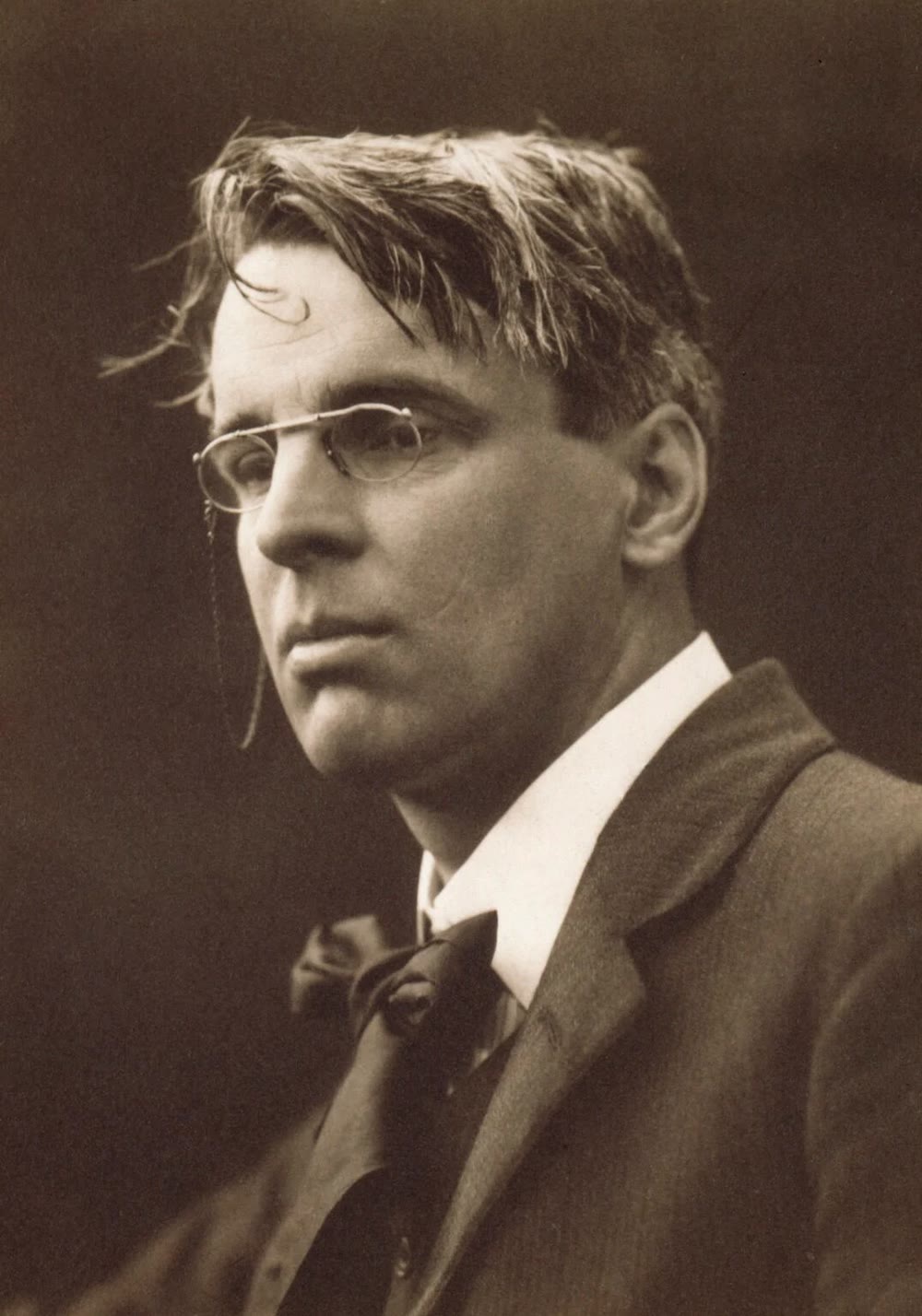
W. B. Yeats in 1911, photographed by George Charles Beresford. National Portrait Gallery, London. Public domain, via Wikimedia Commons
Had I a Golden Pound, by Francis Ledwidge
Had I a golden pound to spend,
My love should mend and sew no more.
And I would buy her a little quern,
Easy to turn on the kitchen floor.And for her windows curtains white,
With birds in flight and flowers in bloom,
To face with pride the road to town,
And mellow down her sunlit room.And with the silver change we’d prove
The truth of Love to life’s own end,
With hearts the years could but embolden,
Had I a golden pound to spend.
Francis Ledwidge was born in Slane, Co. Meath, in 1887. He dated this poem 5 February 1917 and marked it “after the Irish”. He was killed in Belgium on 31 July 1917, the first day of the Third Battle of Ypres, and it was published after his death in Last Songs (1918).
A quern is a hand mill for grinding grain. It’s a plain, tender poem about making a home together.
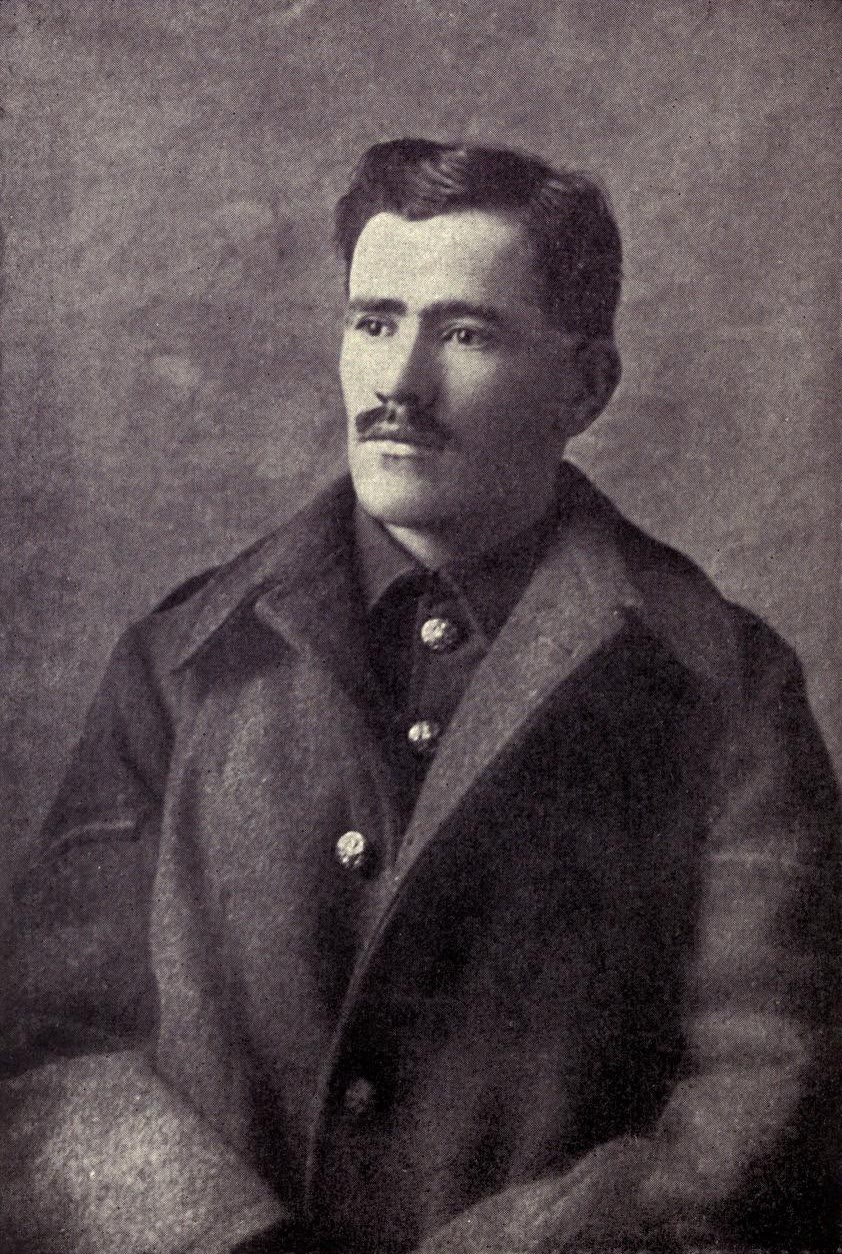
Francis Ledwidge in uniform, from the frontispiece of The Complete Poems of Francis Ledwidge (1919). Photographer unknown. Public domain, via Wikimedia Commons
Christ with me: from St Patrick’s Breastplate
Christ with me, Christ before me, Christ behind me,
Christ in me, Christ beneath me, Christ above me,
Christ on my right, Christ on my left,
Christ when I lie down, Christ when I sit down,
Christ when I arise,
Christ in the heart of every man who thinks of me,
Christ in the mouth of every one who speaks of me,
Christ in every eye that sees me,
Christ in every ear that hears me.
This is the heart of St Patrick’s Breastplate, or The Deer’s Cry, as the scholar Kuno Meyer printed it in 1911, adapting Whitley Stokes and John Strachan’s translation. Tradition credits Patrick, but Meyer wrote that the hymn in its surviving form “cannot be earlier than the eighth century”.
Popular readings still in copyright
- Seamus Heaney, “Scaffolding”: ten lines from Death of a Naturalist (1966) that picture love as a wall built so well the scaffolding can come down. Check permissions before printing it. More in my Irish love poems list.
- John O’Donohue, “For Marriage”: a blessing from his book Benedictus (2007), titled To Bless the Space Between Us in the US (2008). O’Donohue, who grew up in the west of Ireland, died in January 2008. For his words, go to the official John O’Donohue site, not copies pinned online.
The Claddagh ring and Celtic knots
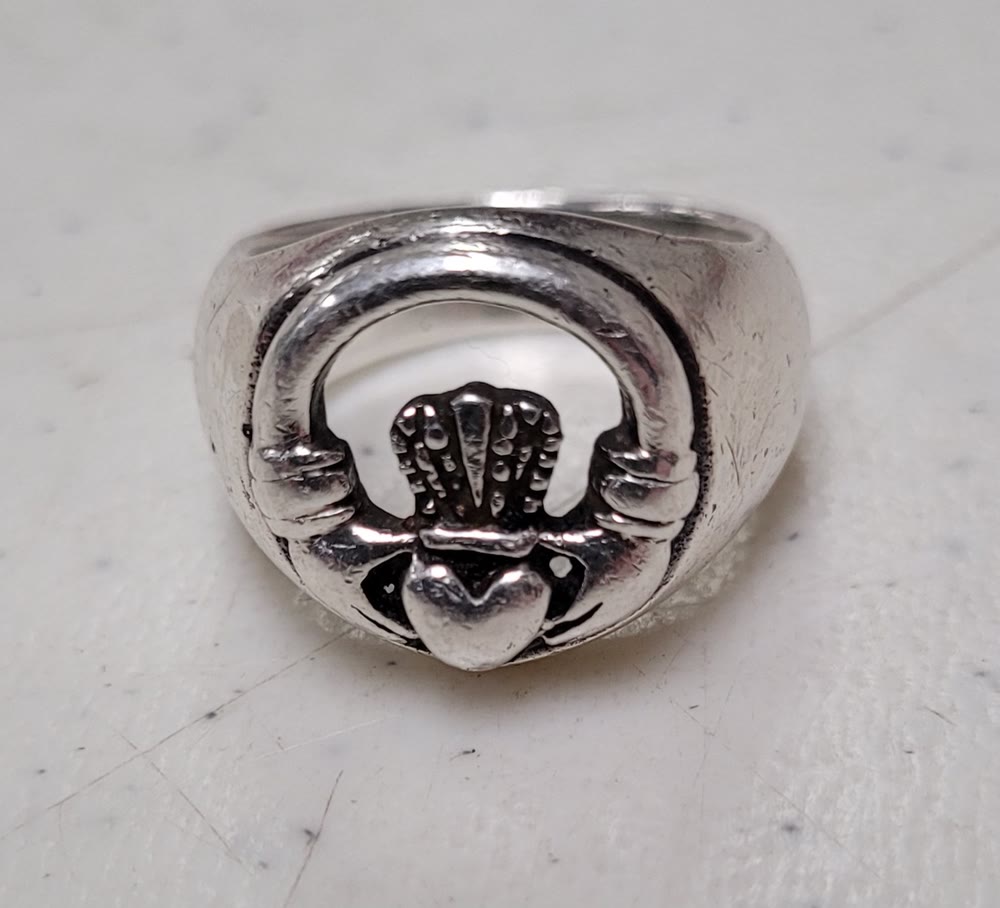
The Claddagh ring is Ireland’s best-known wedding ring. Rings in this style go back to about 1700, says the National Museum of Ireland, and Richard Joyce, a Galway goldsmith, usually gets the credit for the design. In the museum’s words, Claddagh rings “were used as marriage and betrothal rings”.
The design, a crowned heart held in two hands, is read as friendship, love and loyalty. The museum calls the customs about which hand to wear it on of uncertain origin, but by its account the left hand means married. My guide to the Claddagh ring meaning has the full story.
Celtic knots are the other favourite, on rings, invitations and cakes. The knotwork is genuinely old, filling the Book of Kells around 800, but the heart-shaped “Celtic love knot” is a modern design with no known early example, and no less lovely for it. See my guides to the Celtic love knot and Celtic symbols.
Which “Irish blessings” are modern or of unknown origin?
You can still use all of these. Just don’t print “ancient Irish blessing” above them.
- “May the road rise up to meet you”: the earliest printing of the English verse found so far is from 1945. Only the opening line is documented in Irish.
- “Deep peace of the running wave to you”: often sold as a Gaelic blessing, it comes from The Dominion of Dreams (1899) by the Scottish writer William Sharp, writing as Fiona Macleod, where it’s a charm of healing. John Rutter adapted it for his 1978 choral piece “A Gaelic Blessing”. Sharp’s text is out of copyright; Rutter’s words are not.
- Anam cara as “soulmate”: anamchara is an old word, but Ó Dónaill’s 1977 dictionary defines it as “spiritual adviser”. The “soulmate” sense caught on with John O’Donohue’s 1997 bestseller, Anam Cara, and focloir.ie now gives anamchara for soulmate.
- “Poor in misfortune”, and “May you always have walls for the winds”: anonymous, with no early source found. They may be old or quite new.
For any anonymous verse, the honest credit is “Irish blessing, author unknown” or simply “traditional”.
How to choose an Irish wedding blessing, and how to word it
- For the ceremony: keep it to a minute or two, and print the author and date in the programme, such as “W. B. Yeats (1899)”.
- For a card: pair a short line of Irish with its English meaning, such as “Go maire sibh bhur saol nua: may you enjoy your new life together”, then add a sentence of your own. Use the “you both” forms.
- For a toast: write the respelling of any Irish on your card, and leave the stage-Irish accent at home.
- For anything engraved: check every word on teanglann.ie and focloir.ie, or ask a fluent speaker, before you order.
Irish wedding blessings FAQ
What is the traditional Irish wedding blessing?
The best known is “May the road rise up to meet you”, though the earliest printing of its English verse found so far is from 1945. Ireland’s 1930s folklore records describe toasts to the couple’s health and long life. In Irish, the classic is Go maire sibh bhur saol nua.
How do you say congratulations on your wedding in Irish?
Say comhghairdeas libh (roughly KOH-ar-jus liv) to the couple, or go maire sibh bhur saol nua, “may you enjoy your new life”, the dictionary’s own wedding congratulation.
What is a good Irish toast for a wedding?
Tell a short story, then raise your glass with “Sláinte na lánúine nuaphósta!”, the health of the newlyweds. For a poem, try Yeats’s six-line “A Drinking Song” (1910).
Can you read an Irish blessing at a Catholic wedding?
The readings at Mass come from the Bible, so a poem or blessing usually goes in the speeches, or wherever your priest agrees.
Can you use an Irish blessing at a civil ceremony?
In Ireland, only if it has nothing religious or spiritual in it, so skip any verse that mentions God. Elsewhere, ask your officiant.
What is the Irish word for wedding?
Bainis (BAN-ish) is a wedding or wedding feast, and pósadh (POH-suh) is marriage. A bride is brídeach (BREE-jukh) and a wedding ring is fáinne pósta (FAWN-yuh POHS-tuh).
Love this? Save it to your Pinterest board for later.
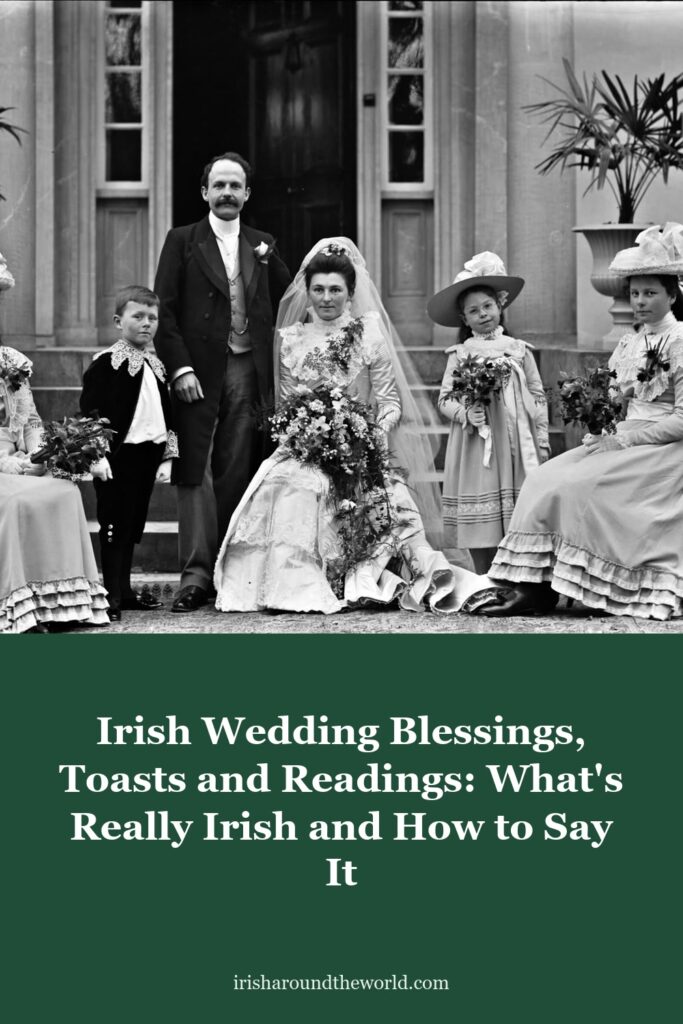
Pin image: A wedding group at Bruce Villa, Clonmel, Co. Tipperary, identified by the National Library of Ireland as the Grubb and Southall wedding of 12 April 1900. Photo: A. H. Poole studio, Poole Photographic Collection, National Library of Ireland. No known copyright restrictions, via Wikimedia Commons
A little bit of Ireland in your inbox every Friday ☘️
The free Weekly Dose of Irish: an Irish joke, a Celtic symbol, an Irish fact, a poem and the week’s best articles in one short email. Join 9,600+ readers.
Free. One short email every Friday. Unsubscribe any time.
More Irish blessings and love reading
- Irish Wedding Traditions: What’s Old, Borrowed and New
- Anam Cara Meaning: the Irish Soul Friend and How to Say It
- May the Road Rise Up to Meet You: Meaning, Full Blessing and Its Surprising Origin
- 63 Irish Toasts for Every Occasion, and Which Ones Are Really Irish
- Irish Sayings About Love: Phrases, Blessings and Quotes in Irish
- 12 Most Beautiful Irish Love Poems For Weddings, Valentine’s Day And More
- Claddagh Ring Meaning: Which Hand, Heart In or Out, and the Galway Legend Behind It
- Celtic Love Knot Meaning: The Real History Behind the Lovers’ Knot
Featured image: A wedding group at Bruce Villa, Clonmel, Co. Tipperary, identified by the National Library of Ireland as the Grubb and Southall wedding of 12 April 1900. Photo: A. H. Poole studio, Poole Photographic Collection, National Library of Ireland. No known copyright restrictions, via Wikimedia Commons.