Most Irish place names are English spellings of Irish words describing the land or the people on it. Bally is usually baile, a homestead or townland. Kil is usually cill, a church, but sometimes coill, a wood. Drum is droim, a ridge, and Knock is cnoc, a hill. The English spellings were fixed on 19th-century Ordnance Survey maps, and in the Republic the Irish forms are now official too. Below: 30 common words, all 32 counties in Irish, and the names that travelled to the US, Canada and Australia.
On a fingerpost near Craanford in Co. Wexford, one arm reads Ráth an Chuilinn, and underneath, in capitals, HOLLYFORT. The two names match word for word: a ráth (raw) is a fort, and cuileann (KWIL-un) is holly.
Another arm points to Craanford itself, Áth an Chorráin. Áth (aw) is a ford and a corrán (KUR-awn) is a sickle or hook, so this time the English seems to keep the sound of the Irish and translate only the ford.
Most Irish place names work like this: under the English spelling sits a short Irish description of a hill, a ford, a church or a family’s farm. I’ve written before about what Ireland itself means. Here’s how to read the rest of the map.
Jump to:
- Why Irish place names look so strange in English
- Irish place names decoder: 30 common words
- Bally, Kil, Drum and Knock
- Dún, ráth, lios and caiseal: all those forts
- What your county’s name means
- When the English name isn’t the Irish one
- Irish place names in the US, Canada and Australia
- How to look up your own townland
- Irish place names FAQ
- More Irish heritage reading
Why Irish place names look so strange in English
Almost all of Ireland’s older place names were coined in Irish. English-speaking clerks, landlords and surveyors wrote down what they heard. So Baile an Róba, the town of the River Robe, became Ballinrobe, and An Cnoc, the hill, became Knock.
Most of today’s spellings were settled by the Ordnance Survey. Its six-inch survey, made under the Boundary Survey Act of 1825, recorded the boundary of every townland, says Tailte Éireann, the state body that now publishes them. The names on those maps, with a townland index published alongside the 1851 census, became the country’s legal place names, the Placenames Commission told the United Nations.
The survey’s Irish-language expert, John O’Donovan, worked on it in the 1830s and 1840s. He sought out the oldest Irish speakers in each district and had them say the local names aloud, P. W. Joyce recorded in 1869. The Irish forms and O’Donovan’s meanings went into the survey’s Name Books.
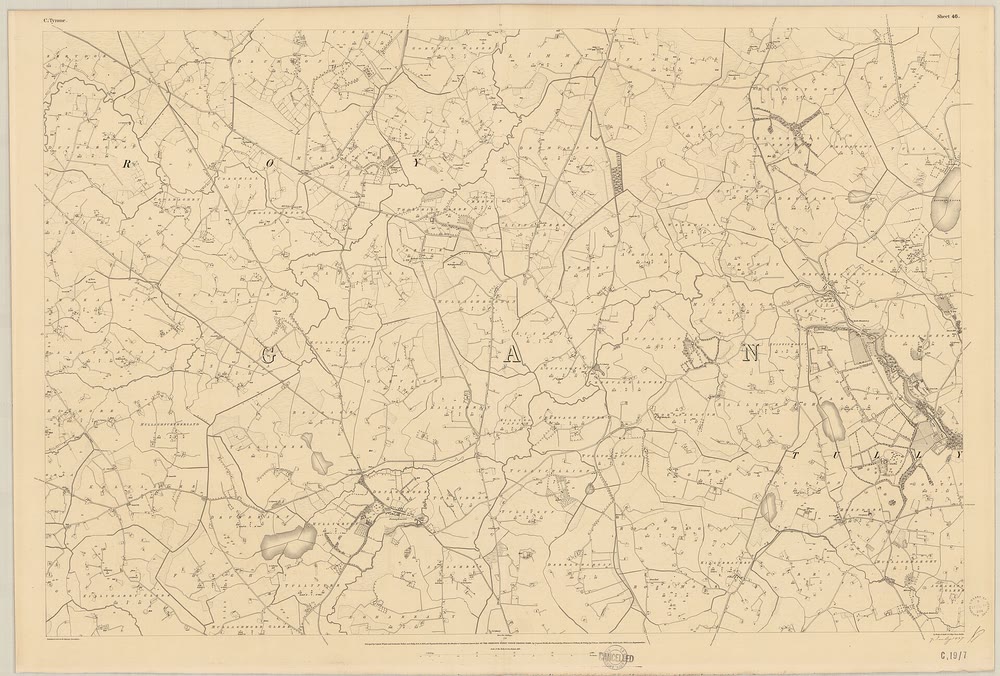
Ordnance Survey six-inch map of Co. Tyrone, sheet 46, published 1837. Scan: National Library of Scotland, CC BY 4.0, via Wikimedia Commons
The townland, the smallest official land division, ranges from about 1 acre to 7,000 acres. There are about 50,200 in the Republic alone, Tailte Éireann says, and Joyce counted about 62,000 across the whole island.
Under the Official Languages Act 2003, the Irish versions now have legal force too, with equal status to the English once a placenames order is made. In the Gaeltacht, the Irish-speaking districts, English versions can’t go on road signs or certain official maps, which is why road signs in Donegal’s Gaeltacht say Gaoth Dobhair, not Gweedore.
Irish place names decoder: 30 common words
The Placenames Database of Ireland, developed by the state’s Placenames Branch and Dublin City University, keeps a glossary of common words. Its automated count in October 2026 finds baile in 9,547 names, cill in 3,274 and cnoc in 2,365. Here are 30 of the most useful.
| You’ll see | Irish (say it) | Meaning | Example |
|---|---|---|---|
| Bally, Bal | baile (BAL-yuh) | homestead, townland, town | Ballinrobe, Co. Mayo: Baile an Róba |
| Kil, Kill, Kyle | cill (kill) | church | Kilkenny: Cill Chainnigh |
| Kil, Kyle | coill (kwill) | wood | Kiltimagh, Co. Mayo: Coillte Mach |
| Drum, Drom | droim (drim) | ridge | Leitrim: Liatroim, grey ridge |
| Knock, Crock | cnoc (k-NUCK; closer to kruk in Connacht and Ulster) | hill | Knock, Co. Mayo: An Cnoc, the hill |
| Dun, Doon | dún (doon) | fort | Dundalk: Dún Dealgan, Dealga’s fort |
| Rath | ráth (raw) | earthen ring-fort | Rathdrum, Co. Wicklow: Ráth Droma, fort of the ridge |
| Lis, Liss | lios (liss) | ring-fort, enclosure | Listowel, Co. Kerry: Lios Tuathail, Tuathal’s fort |
| Cashel | caiseal (KASH-ul) | stone fort | Cashel, Co. Tipperary: Caiseal |
| Inish, Ennis, Inch | inis, inse (IN-ish, IN-shuh) | island; river meadow | Ennis, Co. Clare: Inis |
| Ard | ard (ard) | height; high | Ardmore, Co. Waterford: Aird Mhór, great height |
| Clon, Cloon | cluain (KLOO-in) | meadow | Clonmacnoise: Cluain Mhic Nóis |
| Derry | doire (DIR-uh) | oak wood, grove | Derrybeg, Co. Donegal: Doirí Beaga, little oak woods |
| Agha, Augh | achadh (AKH-uh) | field | Aghamore, Co. Mayo: Achadh Mór, big field |
| Bel, Bella | béal (bayl) | mouth, approach | Belfast: Béal Feirste, mouth of the sandbank |
| Ath, Ah | áth (aw) | ford | Athlone: Baile Átha Luain, town of Luan’s ford |
| More | mór (more) | big, great | Lismore, Co. Waterford: Lios Mór, great enclosure |
| Beg | beag (byug) | small | Bunbeg, Co. Donegal: An Bun Beag, the little river mouth |
| Carrick, Carrig | carraig (KARR-ig) | rock | Carrick-on-Suir: Carraig na Siúire, rock of the Suir |
| Glen | gleann (glan; glown in Munster) | glen, valley | Glengarriff, Co. Cork: An Gleann Garbh, the rough glen |
| Lough | loch (lokh) | lake; sea inlet | Glendalough: Gleann Dá Loch, glen of two lakes |
| Tully | tulach (TUL-ukh) | hillock | Tullow, Co. Carlow: An Tulach |
| Mullagh | mullach (MUL-ukh) | hilltop | Mullaghmore, Co. Sligo: An Mullach Mór |
| Slieve | sliabh (SHLEE-uv) | mountain, moorland | Slievenamon: Sliabh na mBan, mountain of the women |
| Ross | ros (russ) | wood; headland | Roscommon: Ros Comáin, Comán’s wood |
| Tober, Tubber | tobar (TUB-ur) | well | Tobercurry, Co. Sligo: Tobar an Choire, well of the cauldron |
| Temple | teampall (TYAM-pul; TYOWM-pul in Munster) | church | Templemore, Co. Tipperary: An Teampall Mór |
| Gort | gort (gurt) | field | Gortahork, Co. Donegal: Gort an Choirce, oat field |
| Kin, Ken | ceann, cionn (kyan; kyown in Munster) | head, headland | Kinsale, Co. Cork: Cionn tSáile, head of the sea water |
| Shan | sean (shan) | old | Shankill, Co. Dublin: Seanchill, old church |
Bally, Kil, Drum and Knock: the big four
Bally: more homestead than town
The antiquarian William Reeves counted about 6,400 townlands beginning with Bally, more than a tenth of them all, Joyce reported. The Electronic Dictionary of the Irish Language gives baile’s older senses as a place, settlement or farmstead. Joyce noted it was used for the smallest hamlet, even a couple of houses, so “town” is a loose translation.
Many Bally names end in a family name; our guide to Irish surnames explains the Ó and Mac forms you’ll spot. On the east coast the word often shrinks to Bal, as in Balbriggan, Baile Brigín.
Now the catch: not every Bally is a baile. Ballina in Co. Mayo is Béal an Átha, the mouth of the ford. Ballyshannon is Béal Átha Seanaidh, and Ballinasloe is Béal Átha na Sluaighe, the ford-mouth of the host. English speakers heard béal átha (bayl AW-huh) and wrote Bally, a change Joyce called a corruption.
Freshford in Kilkenny went wrong the other way. Its Irish name, Achadh Úr, means fresh field, but the translators mistook achadh, a field, for áth, a ford, Joyce explained.
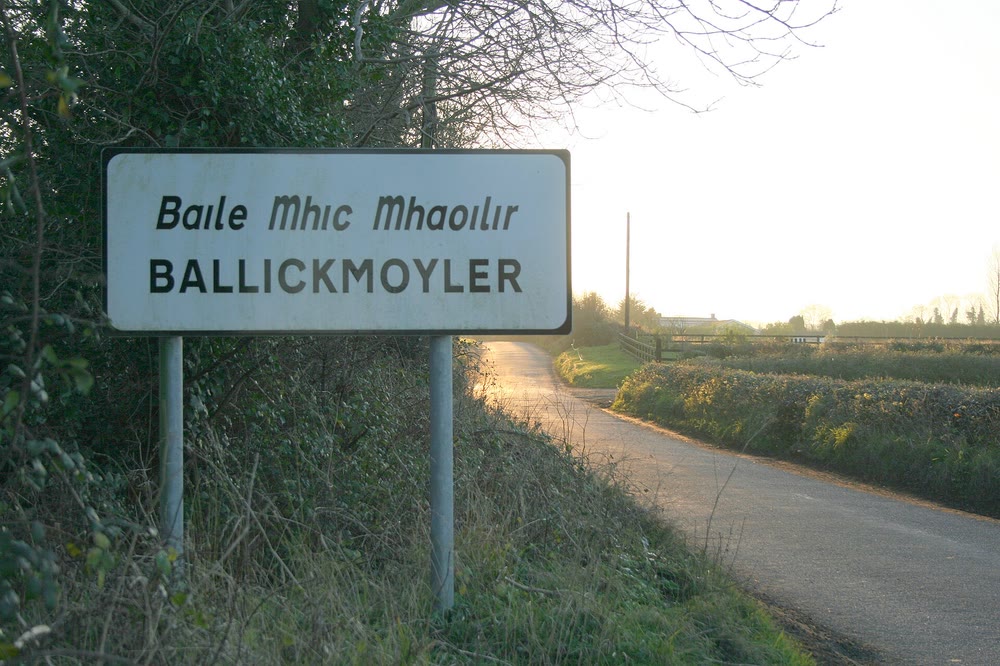
Baile Mhic Mhaoilir, Ballickmoyler, on the R429 in Co. Laois. Photo: Sarah777, public domain, via Wikimedia Commons
Kil: church or wood?
Cill comes from the Latin cella and usually means a church, says the Electronic Dictionary of the Irish Language. Joyce counted about 3,400 names beginning Kil, Kill, Kyle, Keel or Cal, and estimated that about a fifth came from coill, a wood, instead. Kiltimagh in Mayo is one: its Irish name, Coillte Mach, begins with coillte, woods.
Most church names add a saint: Joyce counted 35 places called Kilbride, Brigid’s church.
Drum: the ridge that gave English a word
Droim means a back, and in place names a long, low ridge. Joyce counted about 2,400 names beginning Drum, Drom or Drim, and it can hide mid-name too, as in Leitrim, Liatroim.
The word even reached English. Drumlin, the geologists’ term for an oval hill of glacial drift, comes from Irish druim, says Merriam-Webster, which dates it to 1812. It’s one more of the English words that come from Irish.
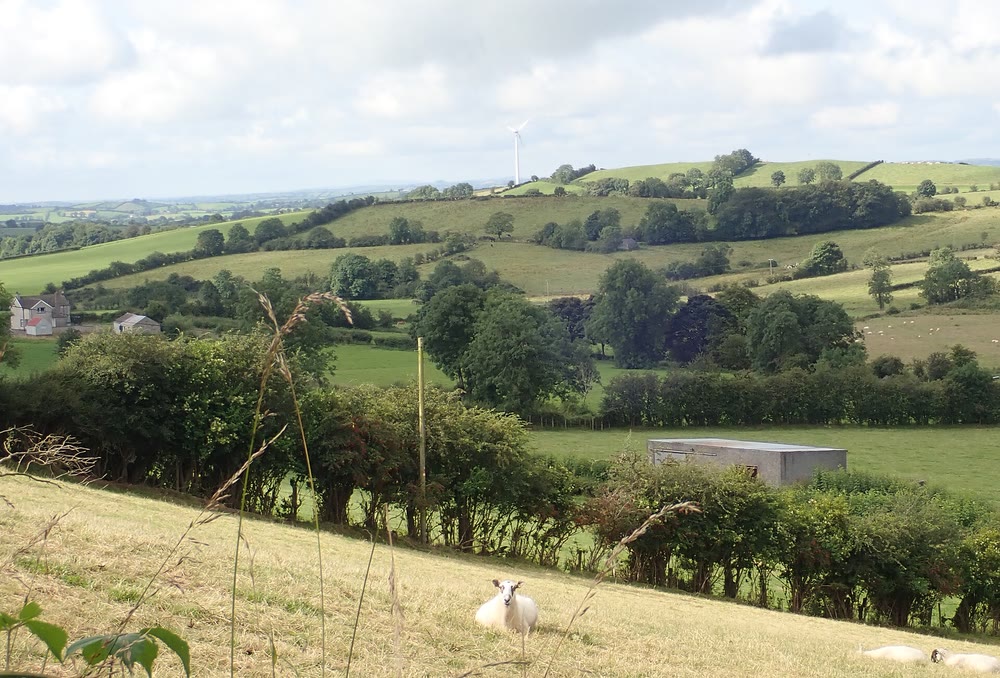
Drumlin country in Tullyvallen townland, Co. Armagh. Photo: Eric Jones, CC BY-SA 2.0, via Wikimedia Commons (Geograph)
Knock: a hill with a silent k
Cnoc is a hill. Joyce counted about 1,800 townland names beginning with Knock. The k is silent in English but sounded in Irish. In some northern counties, he noted, speakers turned cn into cr, so about 45 Crock townlands are really Knocks.
Dún, ráth, lios and caiseal: why so many names mean “fort”
Ráth, lios and dún all make the top 15 words in the logainm.ie glossary, and all mean a fort. No wonder: ringforts are the commonest monuments in the Irish landscape, and every county has them, according to Irish Field Monuments, a National Monuments Service guide. Most were 25 to 50 metres across, ringed by an earthen bank, and enclosed farmsteads built mostly between about AD 500 and 1100.
Ó Dónaill’s dictionary defines ráth first as an earthen rampart and lios as the enclosed ground around a dwelling, but in place names both simply mean a ringfort. In the stony west a stone wall did the job, giving caiseal and cathair: Cashel and Caher. Promontory forts on headlands usually have dún in their names, the guide adds.
Joyce counted about 1,400 townland names beginning Lis, about 700 beginning Rath and over 600 beginning Dun. Country people in his day often called the forts “Danish raths”, but he pointed out that they’re thickest where the Vikings never settled. Many survived later, probably helped by the belief that fairies lived in them.
Irish scholars of old explained Cashel in Tipperary as a “rent rock” where Munster’s kings collected their dues. Joyce dismissed this as “mere fancy”: caiseal simply means a stone fort, a word related to Latin castellum. See our Rock of Cashel guide.
Even the Cliffs of Moher, Aillte an Mhothair, are named after a fort. Joyce wrote that in Munster a mothar was a ruined fort, and that one near Hag’s Head gave the cliffs their name.
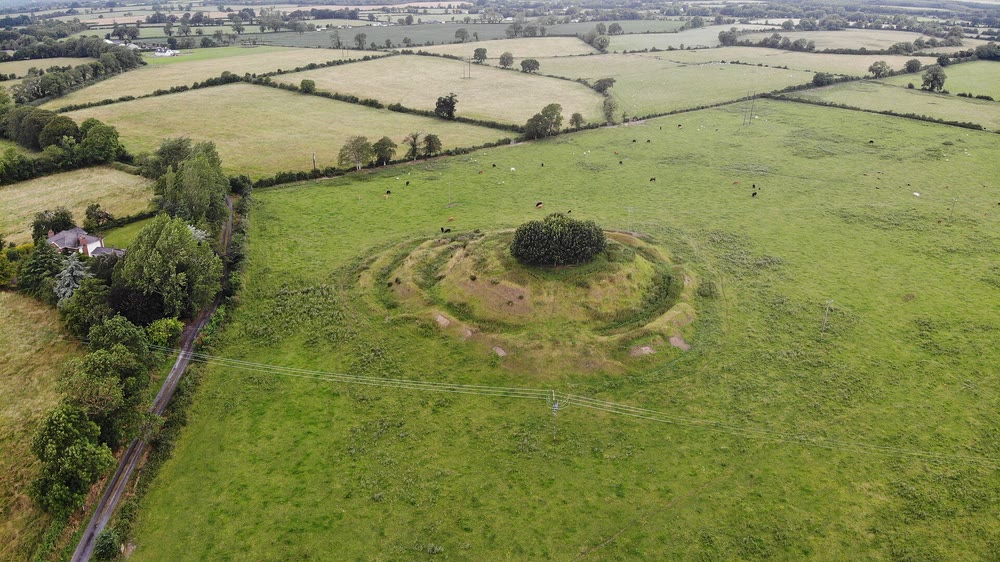
A ringfort in Rodanstown townland, seen from the air: the circular bank and ditch are still clear. Photo: Kmcnamee, CC BY-SA 4.0, via Wikimedia Commons
What your county’s name means: all 32 counties in Irish
Most counties are named after a town, and a few after an old territory or the people who held it. The Irish names of the 26 counties in the Republic were made official by the Placenames (Provinces and Counties) Order 2003. The six in Northern Ireland are given in their standard dictionary forms.
Online you’ll often see them without accents, as Baile Atha Cliath or Dun na nGall, but the fada matters: á is said “aw”.
| County | In Irish (say it) | What it means |
|---|---|---|
| Antrim | Aontroim (AYN-trim; EEN-trim in Ulster) | Looks like “one ridge”, but the Annals of Ulster call it Aentreb: “one house” or “one farm” |
| Armagh | Ard Mhacha (ard WAKH-uh) | Macha’s height |
| Carlow | Ceatharlach (KYAH-hur-lukh) | Uncertain; Joyce gave “four lakes”, from a local tradition |
| Cavan | An Cabhán (un KOW-awn) | The hollow; the town sits in one |
| Clare | An Clár (un KLAWR) | Flat land, or a plank bridge said to have crossed the Fergus |
| Cork | Corcaigh (KUR-kee) | Marsh, where St Finbarr founded his monastery |
| Derry | Doire (DIR-uh) | Oak wood; “London” was added under a charter of James I |
| Donegal | Dún na nGall (doon nuh NGAL) | Fort of the foreigners, probably Vikings |
| Down | An Dún (un DOON) | The fort: the great dún at Downpatrick |
| Dublin | Baile Átha Cliath (BAL-yuh AW-huh KLEE-uh, often shortened to blah KLEE-uh) | Town at the hurdle ford; “Dublin” is from Duibhlinn, black pool |
| Fermanagh | Fear Manach (far MAN-ukh) | The men of Manach, an early people |
| Galway | Gaillimh (GAL-iv) | Named from the river Gaillimh; meaning uncertain |
| Kerry | Ciarraí (KEER-ee) | Ciar’s people, said to descend from a son of Fergus mac Róich |
| Kildare | Cill Dara (kill DAR-uh) | Church of the oak, after a tree said to have sheltered St Brigid’s cell |
| Kilkenny | Cill Chainnigh (kill KHAN-ee) | St Cainneach’s church |
| Laois | Laois (leesh) | From a people descended from Lugaid; once Queen’s County |
| Leitrim | Liatroim (LEET-rim) | Grey ridge |
| Limerick | Luimneach (LIM-nukh) | First a name for a stretch of the Shannon; Joyce read it as a bare or barren spot |
| Longford | An Longfort (un LUNG-furt) | Fortress or camp: the O’Farrells’ stronghold |
| Louth | Lú (loo) | From Louth village, Lughmhadh in the annals; meaning uncertain |
| Mayo | Maigh Eo (my OH) | Plain of the yews |
| Meath | An Mhí (un VEE) | The middle: the old central kingdom of Mide |
| Monaghan | Muineachán (MWIN-uh-khawn) | Little thicket |
| Offaly | Uíbh Fhailí (eev AL-ee) | Descendants of Failge; once King’s County |
| Roscommon | Ros Comáin (russ KUM-awn) | Comán’s wood, after the saint of its monastery |
| Sligo | Sligeach (SHLIG-ukh) | Shelly place, named from the river |
| Tipperary | Tiobraid Árann (TIB-rid AW-run) | Well of Ára, an old territory |
| Tyrone | Tír Eoghain (teer OH-in) | Eoghan’s land, after a son of Niall of the Nine Hostages |
| Waterford | Port Láirge (purt LAWR-ig-uh) | Landing place of Láirge; the English name is Norse |
| Westmeath | An Iarmhí (un EER-vee) | West Meath |
| Wexford | Loch Garman (lokh GAR-mun) | Garman’s inlet; the English name is Norse |
| Wicklow | Cill Mhantáin (kill WAN-tawn) | Mantán’s church; the English name is probably Norse |
Medieval scholars preferred stories, collected in the place-lore called the Dindshenchas. Its verse version says Garman stole a queen’s golden crown and drowned when a spring burst out, forming Loch Garman. Limerick takes its name from warriors’ cloaks covering the estuary at high tide, and Waterford from the thigh-bone (láirig) of a prince lured to his death by mermaids. These are legends, not etymology, but they belong to the same Irish mythology that ties Armagh to a woman called Macha.
When the English name isn’t the Irish one
Some English names never came from Irish at all. Viking settlers gave Wexford, Waterford, Carlingford and Strangford their fjord endings, Joyce wrote. Strangford is Old Norse for “strong sea inlet”, says the Northern Ireland Place-Name Project.
Leixlip is Old Norse for salmon leap, and its Irish name, Léim an Bhradáin, means the same. Howth comes from a Norse word for a head, but in Irish it’s Binn Éadair. There’s more on the Norse towns in our guide to the Vikings in Ireland.
Other pairs simply grew up separately. Kenmare’s official Irish name is Neidín, Portarlington’s is Cúil an tSúdaire, the tanner’s nook, and Arklow’s is An tInbhear Mór, the big estuary. When a sign’s Irish looks nothing like the English, it usually isn’t a bad translation.
Irish place names in the US, Canada and Australia
Emigrants took their place names with them; the Northern Ireland Place-Name Project notes the many Belfasts and Derrys worldwide.
- United States: the Rev. James McGregor, a minister from Aghadowey in Co. Londonderry, settled at Nutfield, New Hampshire, in 1719 with 16 Ulster-Scots families, says the Ulster-Scots Agency. A 1722 charter named the township Londonderry, and Derry, NH later split from it. Scots-Irish families from Londonderry, NH settled Belfast, Maine, in 1770; James Miller suggested the name, and legend says a coin toss settled it, says the Belfast Historical Society. Dublin, Ohio, was named in 1810 by the surveyor John Shields after his home city, though the city says few early settlers were Irish.
- Canada: Listowel, Ontario, began as Mapleton. A government official renamed it after Listowel in Co. Kerry, says The Canadian Encyclopedia, so an Ontario town carries Lios Tuathail, Tuathal’s fort. Newfoundland itself is Talamh an Éisc in Irish, the land of the fish. But an Irish name isn’t proof of Irish settlers: Limerick, Saskatchewan, was settled by Romanians, the Encyclopedia of Saskatchewan notes.
- Australia: Port Fairy in Victoria was Belfast from the 1840s until 1887, named by the Armagh-born James Atkinson, probably after the Irish city, says Victorian Places. Kilmore, Victoria, was named in 1841 by William Rutledge from Co. Cavan. In Irish, cill mhór means the big church.
How to look up your own townland
- logainm.ie: the Placenames Database of Ireland, launched in 2008, gives the official Irish and English forms, with historical records and recordings of many names.
- PlacenamesNI: the Northern Ireland Place-Name Project at Queen’s University Belfast covers over 30,000 names and lets you search old spellings, handy for a name in a family letter or will.
- Joyce: The Origin and History of Irish Names of Places (1869) is free on the Internet Archive. It’s over 150 years old, so check his meanings against logainm.ie.
Tracing a family back to a townland? Our guide to Ancestry DNA kits explains what DNA can and can’t tell you. For first names, see what Irish names mean.
Irish place names FAQ
What does Bally mean in Irish place names?
Usually baile, a homestead, townland or settlement. But some Ballys, such as Ballina in Mayo, come from béal átha, the mouth of a ford.
What does Kil mean in Irish?
Usually cill, a church, often with a saint’s name. Sometimes it’s coill, a wood.
What does Derry mean?
Doire, an oak wood or grove. Joyce counted over 1,300 names beginning with it.
What is a townland in Ireland?
The smallest official land division. There are about 50,200 in the Republic, and they’re the names you’ll meet in old family records.
What is Dublin called in Irish?
Baile Átha Cliath, the town at the hurdle ford. The English name comes from Duibhlinn, the black pool.
Why are some road signs in Ireland only in Irish?
In Gaeltacht areas, the law keeps the English versions of official place names off road signs, so you’ll see only the Irish.
Love this? Save it to your Pinterest board for later.
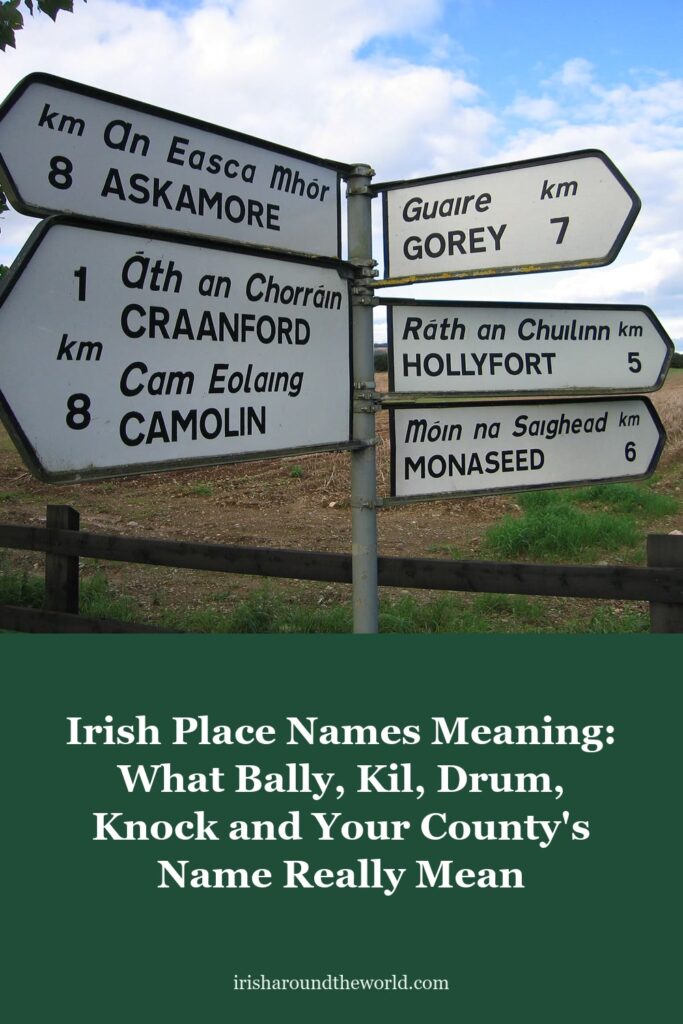
Pin image: A bilingual fingerpost near Craanford, Co. Wexford (2006). Photo: Sarah777, public domain, via Wikimedia Commons
A little bit of Ireland in your inbox every Friday ☘️
The free Weekly Dose of Irish: an Irish joke, a Celtic symbol, an Irish fact, a poem and the week’s best articles in one short email. Join 9,600+ readers.
Free. One short email every Friday. Unsubscribe any time.
More Irish heritage reading
- What Does Ireland Mean? The Meaning of Éire and Ireland’s Other Names
- Irish Surnames: Meanings, Origins and the Top 100 Names in Ireland
- Fairy Forts and Fairy Trees: The Irish Places You Never Disturb
- Clonmacnoise: The Monastic City on the Shannon Where High Kings Lie Buried
- English Words From Irish: 27 You Use Every Day (and the Famous Fakes)
Featured image: A bilingual fingerpost near Craanford, Co. Wexford, pointing to Áth an Chorráin (Craanford), Ráth an Chuilinn (Hollyfort) and Móin na Saighead (Monaseed). Photo: Sarah777, public domain, via Wikimedia Commons.