
Dínit an Bhróin (The Dignity of Grief) is a short poem in Irish by Máirtín Ó Direáin, the Aran Islands poet, first published in his collection Dánta Aniar in 1943. In two stanzas of eight short lines, he remembers two women dressed in black for mourning who walked silently away from a noisy crowd gathered around a tender just in from an ocean liner. Watching them, he understood that grief has a great dignity. It is one of the five common prescribed poems for Leaving Cert Irish, at Higher and Ordinary Level, in June 2027 and June 2028.
Some poems shout. Dínit an Bhróin barely raises its voice.
Almost nothing happens in it. Two women dressed in black walk away from a busy, noisy crowd without saying a word. That’s the whole story, told in 16 short lines.
It isn’t new to Irish classrooms. The poet Declan Collinge recalled in The Irish Times in November 2026 that he first studied Ó Direáin’s poems for his Intermediate Certificate, and found ones like this far easier to learn by heart than the old classics. From June 2027 it’s the Ó Direáin poem on the Leaving Cert Irish course, in place of An tEarrach Thiar.
The poem is still in copyright, so I won’t print it here. Instead, here’s a plain-English summary, the background, themes, techniques, key words and exam pointers, plus where to read it. For the whole course, see my guide to the Leaving Cert Irish poems.
Jump to:
- Dínit an Bhróin at a glance
- What happens in the poem
- The scene: a tender, a liner and a noisy crowd
- Themes: grief, dignity and silence
- Imagery and techniques
- Tone and feelings
- Key Irish words in the poem
- Exam notes and useful Irish phrases
- Who was Máirtín Ó Direáin?
- Dínit an Bhróin FAQ
- More Irish poetry
Dínit an Bhróin at a glance
- Title: Dínit an Bhróin, roughly JEE-nitch un VROHN in Connacht Irish, the poet’s own dialect; in Munster the d is softer, closer to DEE-nit. Dínit means dignity. Brón is sorrow or grief, and after the article in the genitive it becomes an bhróin, “of the grief”, with the bh said like a v. Translators call it The Dignity of Grief.
- Poet: Máirtín Ó Direáin (MAWR-cheen oh JIR-awn), 1910 to 1988, from Inis Mór (IN-ish MORE) in the Aran Islands.
- First published: in Dánta Aniar (DAWN-tuh uh-NEER), Poems from the West, his second book, in 1943.
- Length: 16 short lines in two stanzas of eight.
- Where to read it: Máirtín Ó Direáin: Na Dánta (An Clóchomhar, 2010), the collected poems named on the Department of Education and Youth’s list. The University of Galway Library’s online exhibition on Ó Direáin also shows it, with Peter Sirr’s English translation.
Spelling it right
Watch the fadas: it’s Dínit an Bhróin, not “Dinit an Bhroin”. You may also see Dignit an Bhróin, as in Collinge’s column, but the dictionary spelling, and the one on the Department’s list, is Dínit.
The surname is Ó Direáin, with no fada on the i. “Ó Díreáin” turns up a lot online, even in the book reference on the Department’s own circular, but the biographical dictionary ainm.ie, the University of Galway and his publishers use Ó Direáin.
What happens in Dínit an Bhróin (summary in plain English)
The poem opens with its conclusion. The poet tells us that, at one moment in his life, he suddenly saw how much dignity there can be in grief.
Then he shows us how. He noticed two women dressed in black for mourning leaving a crowd, and neither of them said a word. As they left the big, noisy crowd behind, the dignity went with them.
The second stanza steps back to show the scene. A liner is lying out at anchor, and its tender is in. Everyone is in a hurry, and there’s noise and loud talk. But the two silent women go off by themselves, still in their black, and the dignity leaves with them.
The key line, “D’imigh an dínit leo” (Máirtín Ó Direáin), appears in both stanzas and closes the poem. It means the dignity went off with them, and in Connacht Irish sounds roughly like JIM-ee un JEE-nitch lyoh.
Notice what he leaves out. We never learn who died, where the harbour is, or whether the women came in on the tender or were there to meet it. Everything we know about their grief comes from their black clothes, their silence and the way they walk away.
The scene: a tender, a liner and a noisy crowd
Three words in the second stanza set the scene:
- freastalán (FRASS-tuh-lawn): a tender, the boat that ferries passengers between the shore and a ship anchored in deeper water. Focloir.ie gives freastalán and bád freastail for this kind of tender; freastal means attendance or service.
- línéar (LEE-nyair): a liner, an ocean-going passenger ship.
- ród (rode): a road, but also a roadstead, a stretch of water where ships ride at anchor. Ó Dónaill’s dictionary gives bád a chur ar ród, to moor a boat.
Big ships calling at Irish ports often lay offshore while tenders carried passengers and mail out to them. The Illustrated London News pictured one such run off Queenstown, now Cobh, in 1864, and Galway worked the same way. A radio report from 1 June 1940, now in the RTÉ Archives, followed American citizens ferried out from Galway’s pier aboard the tender Cathair na Gaillimhe to the liner President Roosevelt.
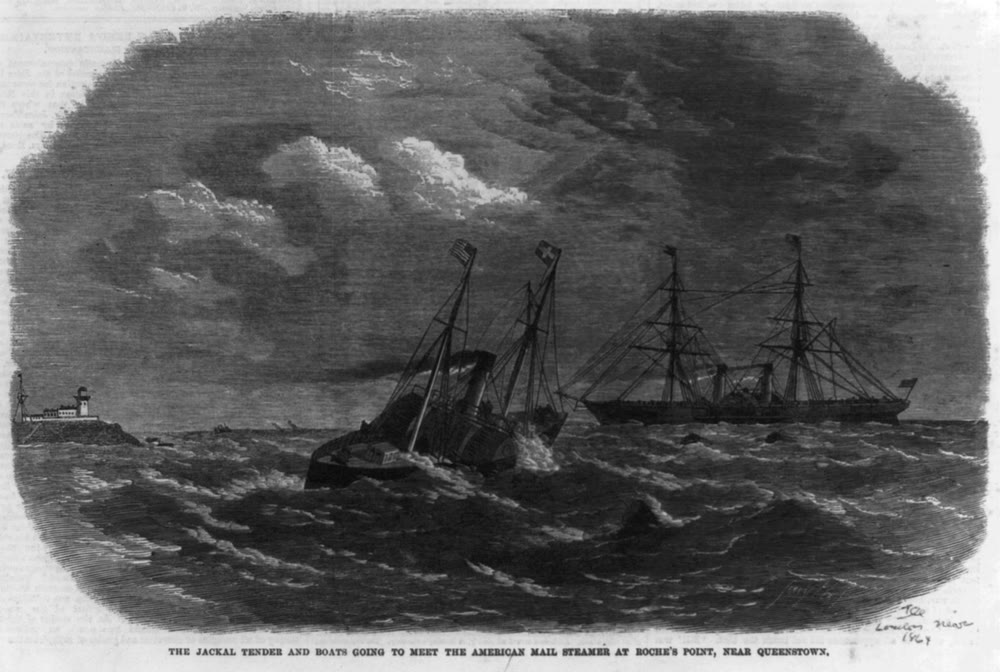
The tender Jackal and small boats heading out to the American mail steamer Scotia, lying off Roche’s Point near Queenstown (now Cobh). Wood engraving by Frederick James Smyth, The Illustrated London News, 2 July 1864. Library of Congress. Public domain, via Wikimedia Commons
The poem doesn’t name the port, so don’t state one as fact in an exam answer. But scenes like this were part of Ó Direáin’s world. He worked in Galway from 1928 to 1937, and the University of Galway’s exhibition records that he lodged with a woman from Aran on Merchants Road, beside the docks. His mother had spent years in America, ten of them in Dorchester, Boston, before she married his father, says ainm.ie.
For Irish people of his time, a liner usually meant America and long goodbyes, like those in my piece on the American wake.
Themes: grief, dignity and silence
The dignity of grief
The main theme is in the title. We usually think of grief as something to get through, hide or escape. Ó Direáin turns that around: in these two women, grief has a dignity, a kind of nobility, that the busy crowd lacks.
TG4 Foghlaim’s study notes call it an epiphany poem, a moment when the poet suddenly sees something familiar in a new way. The first word does that work. Nochtaíodh means “was revealed” or “was laid bare”, a form of the verb nocht (NUKHT), to bare, uncover or reveal. The insight simply arrives.
Silence against noise
The poem is built on one contrast: two silent women against a loud, rushing crowd. Ó Direáin plainly sides with the silence. Quiet, private grief comes across as deeper and more real than public bustle.
Old ways and the modern world
The liner belongs to the modern world of travel and business; the women in black belong to an older way of marking a death. That fits his wider work. The University of Galway’s exhibition says his uprooting from Aran’s settled world, and his life as an exile on the mainland, shaped much of his poetry. Eoghan Ó hAnluain, who edited his collected poems in 1980, saw it as an exact record of how life was changing, in Aran and across Ireland.
Women and grief
Women carry the grief here. At the old Irish wake, the keen was led by a bean chaointe (ban KHEEN-cha), a keening woman, as I explain in my guide to Irish wake traditions. The keen, caoineadh (KEEN-yuh), is even hidden inside the poem’s word for mourning clothes.
Yet these women don’t keen at all. Compare Pádraig Pearse’s Bean Sléibhe ag Caoineadh a Mhac, where a mother pours out her grief for her dead son. Ó Direáin’s women do the opposite, and that restraint is what he admires.
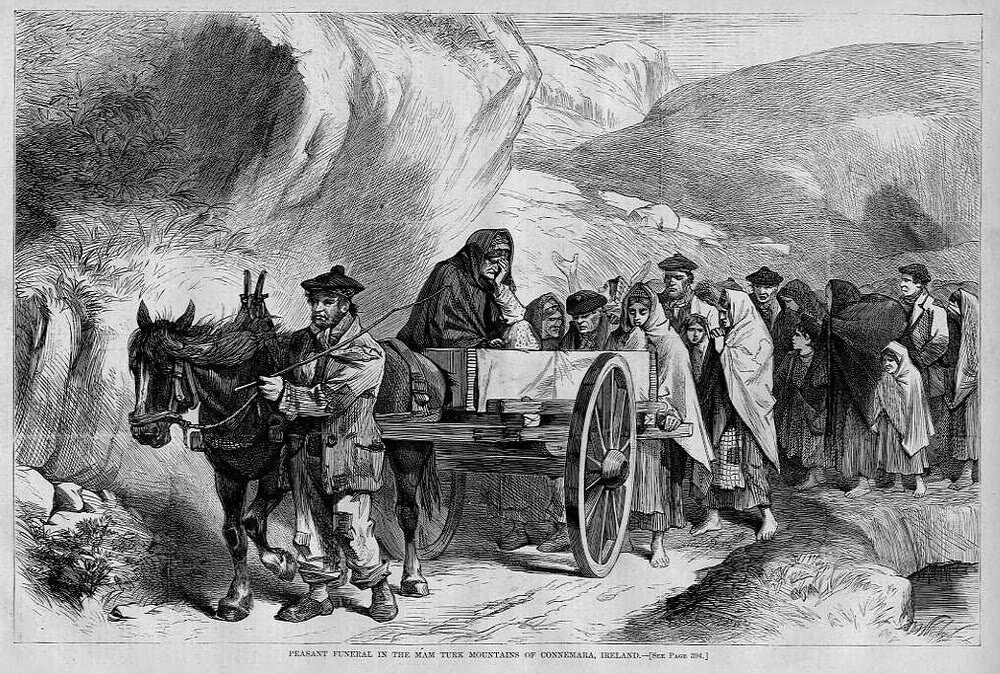
A funeral in the Maumturk Mountains of Connemara, from Harper’s Weekly, June 1870. Public domain, via Wikimedia Commons
Imagery and techniques (teicníochtaí fileata)
- Contrast (codarsnacht, KUD-ur-snukht): silence and noise, stillness and rush, two people and a crowd. The whole poem turns on it.
- Repetition (athrá, AH-raw): the line about the dignity leaving with them comes in both stanzas, and the black mourning clothes are mentioned twice. The repeats give the poem a slow, almost ritual feel.
- Colour: black (dubh, roughly DUV, or closer to DOO in Connacht Irish) is the only colour in the poem. It’s the colour of mourning, and it sets the women apart.
- The senses (na céadfaí, nuh KAYD-fee): the first stanza is about sight, as the poet watches the women. The second adds sound, the din and loud talk, against their silence. TG4’s notes trace the same move from the eye to the ear.
- Alliteration (uaim, OO-im): TG4’s notes point to beirt bhan, two women, and to the d sounds of the refrain, which tie the key word, dínit, to the line we remember.
- Sibilance (sioscadh, SHISK-uh): TG4 also hears soft, whispering s sounds in the line where the women walk out from the crowd, quiet sounds for quiet women.
- The autonomous verb (saorbhriathar, SEER-vree-uh-hur, or SAYR- in Munster): nochtaíodh, “was revealed”, has no doer; the truth simply comes to him. With tráth (TRAW), once, it also tells us he’s looking back.
- Structure: conclusion first, then the evidence, then the refrain again. The second stanza is a wider shot of the same moment, like a camera pulling back to show the harbour.
- Plain language: short lines and everyday words, with no fixed rhyme scheme, as quiet and restrained as the women.
TG4’s notes also read the crowd as a metaphor for worldly satisfaction that comes and goes. The poem doesn’t say so outright, but it’s a useful idea for a Higher Level answer.
Tone and feelings (mothúcháin)
The tone is calm, solemn and respectful. Ó Direáin never raises his voice, and there isn’t a single exclamation mark.
- Brón (BROHN), grief: the women’s, shown only through their clothes and silence.
- Ómós (OH-mohss), reverence or respect: the poet’s feeling for the two women.
- Iontas (EEN-tus), wonder: the surprise of a sudden insight.
- Distaste: a hint of disapproval for the crowd, which he calls callánach, noisy or clamorous.
Key Irish words in Dínit an Bhróin
Meanings are from Ó Dónaill’s Foclóir Gaeilge-Béarla on teanglann.ie, with plain respellings close to Connacht Irish, the Irish of Aran, where slender d and t can sound like English j and ch.
- dínit (JEE-nitch; DEE-nit in Munster): dignity.
- brón (BROHN), genitive bróin: sorrow, grief.
- nocht (NUKHT): to bare, uncover or reveal.
- tráth (TRAW): a time or occasion; once, at one time.
- beirt (BERTCH): two people. Beirt bhan means two women.
- slua (SLOO-uh): a crowd or throng; also a host or army.
- feisteas (FESH-tyus): dress, attire.
- caoineadh (KEEN-yuh): keening, lament, crying. Its genitive, caointe (KEEN-cha), means “of keening” or “of mourning”, as in bean chaointe, a keening woman.
- callánach (KAL-aw-nukh; Munster speakers stress the second syllable): noisy, clamorous.
- fuadar (FOO-uh-dur): rush, hurry, bustle.
- gleo (GLYOH): noise, din, uproar; it can also mean a fight.
- tost (TUST): silence. Ina thost or ina dtost means silent.
- imigh (IM-ee): to go or leave. D’imigh means went.
Exam notes and useful Irish phrases
Dínit an Bhróin is on the Department of Education and Youth’s list of common prescribed poems for both levels in circular 0041/2026. The other four are Deireadh na Feide by Ailbhe Ní Ghearbhuigh, Iníon by Áine Durkin, Glaoch Abhaile by Áine Ní Ghlinn and Úirchill an Chreagáin by Art Mac Cumhaigh.
This list first applies to the June 2027 exam, replacing the one in force since the current syllabus came in, in 2010. Check with your teacher: schools can choose optional poems instead of the prescribed five.
In June 2026, the Higher Level questions on An tEarrach Thiar asked about imagery, repetition and the poet’s life and work, according to the Institute of Education’s review of the paper. Nobody can predict the 2027 paper, but it makes sense to prepare:
- the theme, and how the poet gets it across;
- two or three images and two or three techniques;
- the feelings, with a short quote for each;
- a paragraph on Ó Direáin’s life and how this poem fits his work;
- your own response: why the poem did or didn’t work for you.
In the exam you can, and should, quote the poem briefly to back up each point.
Useful Irish phrases for your answer
- Is é príomhthéama an dáin ná dínit an bhróin. (The main theme of the poem is the dignity of grief.)
- Tá codarsnacht ghéar idir an bheirt bhan agus an slua callánach. (There’s a sharp contrast between the two women and the noisy crowd.)
- Úsáideann an file athrá chun béim a chur ar an dínit. (The poet uses repetition to emphasise the dignity.)
- Seasann an dath dubh don bhrón. (The colour black stands for grief.)
- Léiríonn an file ómós don bheirt bhan. (The poet shows reverence for the two women.)
- Is fearr leis an bhfile an ciúnas ná an callán. (The poet prefers silence to noise.)
- Is dán gearr é, ach tá léargas domhain ann. (It’s a short poem, but there’s deep insight in it.)
Who was Máirtín Ó Direáin?
Ó Direáin was born in Sruthán (SRUH-hawn), towards the western end of Inis Mór, the biggest of the three Aran Islands. Ainm.ie and the University of Galway give his birth date as 26 November 1910; some references say the 29th.
He was the eldest of four children. His father died of tuberculosis in 1917, and his widowed mother let out their small farm and made belts, criosanna (KRISS-un-uh), to sell. He was a quiet, sensitive boy who didn’t fish or go out in boats like other island boys.
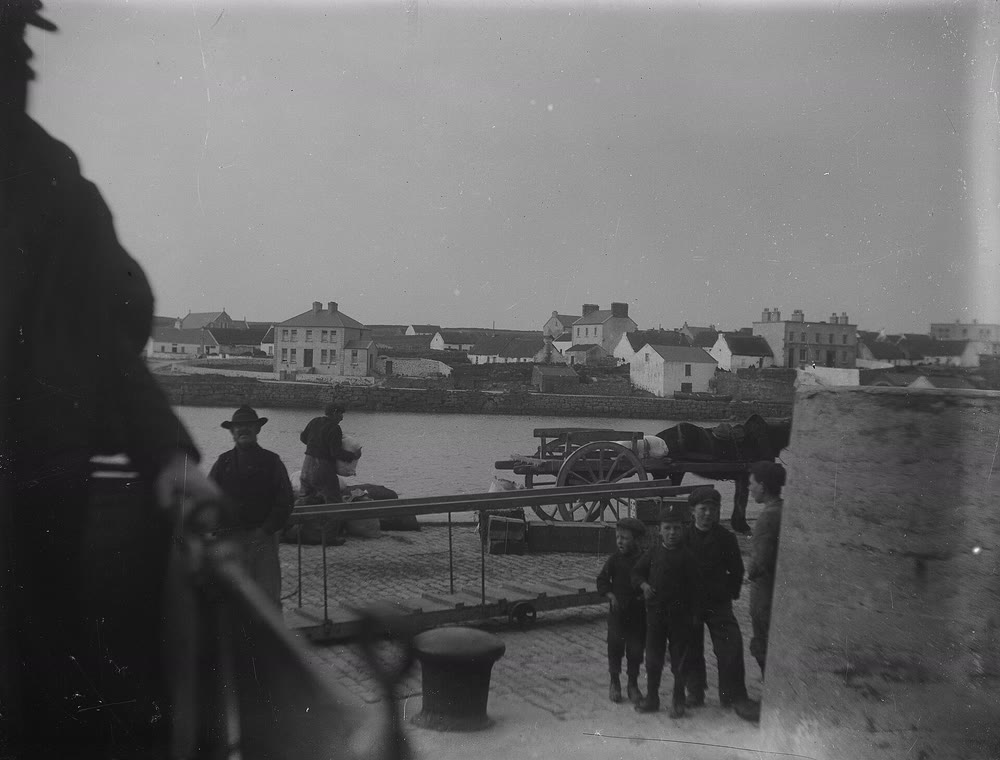
Kilronan Harbour, Inis Mór, around 1890 to 1909. Photo: Robert Stawell Ball, Commissioners of Irish Lights Photographic Collection, National Library of Ireland. Public domain, via Wikimedia Commons
A bout of flu in 1924 ended a plan to train for the priesthood, and he passed the Post Office exams instead. In January 1928 he started at Galway’s main post office, on Eglinton Street. After work he often walked down to Quay Street, where Aran and Connemara people gathered in the evenings. He also joined the new Irish-language theatre, An Taibhdhearc (un TIVE-yark), acting in its first production, Diarmuid agus Gráinne, on 27 August 1928.
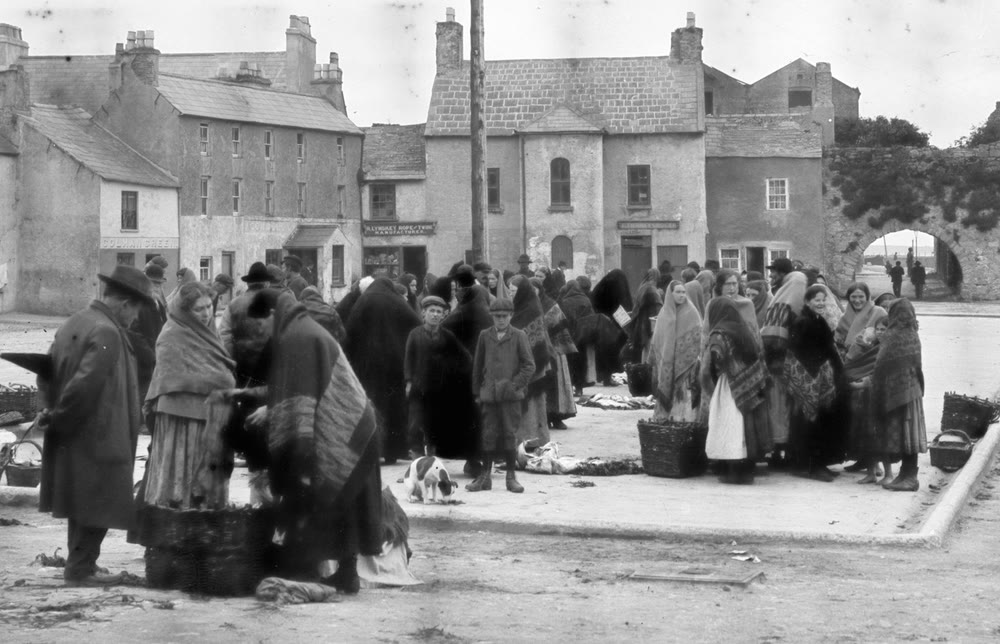
Women in Galway shawls at the fish market in Galway, around 1905. Photographer unknown, National Library of Ireland. Public domain, via Wikimedia Commons
In 1937 he moved to Dublin as a civil servant, and he stayed for the rest of his working life. His poem Réalt na hOíche appeared in Scéala Éireann (The Irish Press) on 23 December 1938, a date scholars such as Mícheál Mac Craith and Liam Prút treat as the start of a new era, and of free verse, in Irish poetry.
He paid to publish his first two books himself: Coinnle Geala (1942) and Dánta Aniar (1943). Writing in The Irish Times after his death, Tomás Mac Síomóin said modernism in Irish poetry was born with those first books. More followed, including Rogha Dánta (1949), Ó Mórna agus Dánta Eile (1957) and Ár Ré Dhearóil, Our Wretched Era (1962).
In 1977 he won the Ossian Prize from a Hamburg foundation, which The Irish Times called the biggest literary award for an Irish writer since Samuel Beckett’s Nobel. He was a member of Aosdána from its foundation. He married Áine Colivet in 1945, and they had one daughter, Niamh. He died on 19 March 1988 and is buried in Mount Jerome cemetery in Dublin.
He’s on my list of famous Irish poets. For another modern poet in Irish, try Seán Ó Ríordáin’s Oíche Nollag na mBan, and for the islands themselves, my guide to the Aran sweater.
Dínit an Bhróin FAQ
What is Dínit an Bhróin about?
The poet remembers two women in black mourning clothes walking silently away from a noisy crowd around a tender just in from a liner. Their quiet grief showed him that sorrow has a great dignity.
What does Dínit an Bhróin mean in English?
The Dignity of Grief, or The Dignity of Sorrow. Dínit is dignity, and brón is sorrow or grief.
Is Dínit an Bhróin on the Leaving Cert in 2027?
Yes. It’s one of five common prescribed poems for Leaving Cert Irish at Higher and Ordinary Level in June 2027 and June 2028, unless your school takes the optional poetry course instead.
Is An tEarrach Thiar still on the Leaving Cert?
Not as a prescribed poem. It was examined up to June 2026, and Dínit an Bhróin is the Ó Direáin poem on the new list.
When was Dínit an Bhróin written?
It was first published in his second collection, Dánta Aniar, in 1943.
What are the main techniques in Dínit an Bhróin?
Contrast between silence and noise, repetition, colour and sound imagery, alliteration, sibilance, an autonomous verb at the start, and plain, restrained language in short lines.
Where can I read the full poem?
In Máirtín Ó Direáin: Na Dánta (2010), the book named on the Department’s list, or in Frank Sewell’s bilingual Selected Poems / Rogha Dánta (Cló Iar-Chonnacht, 2018). The University of Galway Library’s online exhibition also shows it. In 2019 the composer Ana Sokolović set it for tenor and piano for the Irish Language Art Song Project.
Love this? Save it to your Pinterest board for later.
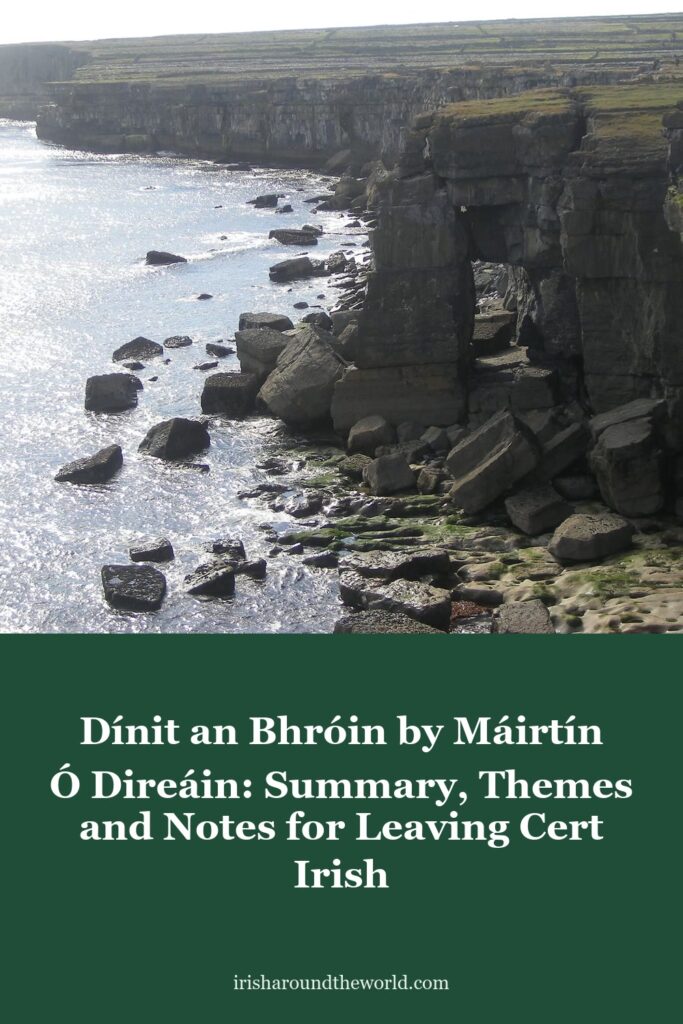
Pin image: Limestone cliffs, boulders and a sea arch on the Atlantic coast of Inis Mór, Aran Islands. Photo: Alvaro, CC BY-SA 3.0, via Wikimedia Commons
A little bit of Ireland in your inbox every Friday ☘️
The free Weekly Dose of Irish: an Irish joke, a Celtic symbol, an Irish fact, a poem and the week’s best articles in one short email. Join 9,600+ readers.
Free. One short email every Friday. Unsubscribe any time.
More Irish poetry
- Leaving Cert Irish Poems 2027 and 2028: The Full List, Explained
- An tEarrach Thiar by Máirtín Ó Direáin: Spring in the West of Ireland
- Bean Sléibhe ag Caoineadh a Mhac by Pádraig Pearse: A Mother’s Lament
- Oíche Nollag na mBan by Seán Ó Ríordáin: The Women’s Christmas Poem
- Irish Wake and Funeral Traditions: Keening, Clay Pipes and What to Say
- The American Wake: Ireland’s All-Night Farewell for Emigrants to America
- Famous Irish Poets: The Greatest of All Time, in Order
Featured image: Limestone cliffs, boulders and a sea arch on the Atlantic coast of Inis Mór, Aran Islands. Photo: Alvaro, CC BY-SA 3.0, via Wikimedia Commons.