
Iníon, Irish for daughter, is a short poem by Áine Durkin, a Connemara-born poet who has lived in Inishowen, Co. Donegal, since 1980. In four verses of four lines, a mother speaks to her teenage daughter straight after a row. She remembers thinking her own mother was a fool, sees that she has turned into that mother, and ends by telling the girl that her love has grown every day since she was born. It comes from Durkin’s first collection, Mise Áine: An Bhean Istigh (Cló Iar-Chonnacht, 2017), and is one of the five common prescribed poems for Leaving Cert Irish, at Ordinary and Higher Level, in June 2027 and June 2028.
Most families know this moment. A teenager says something sharp, her eyes fill with tears, and she turns her back on her mother.
Áine Durkin’s poem Iníon starts right there. Then, in just 16 lines, it goes back a generation to the mother’s own teenage battles, and forward again to a love that has never stopped growing. It’s a poem for students, and for any mother who remembers both sides of this argument.
Durkin’s poem is still in copyright, so you won’t find it printed here. What this page gives you is a plain-English summary, the themes and techniques, key Irish words, exam notes and where to read the poem in full. For the whole course, see my guide to the Leaving Cert Irish poems for 2027 and 2028.
Jump to:
- Iníon at a glance
- What happens in Iníon (summary in plain English)
- Who’s speaking? Three generations of women
- Themes in Iníon
- Imagery, tone and feelings
- Language, rhythm and rhyme
- Key Irish words in Iníon
- Exam notes and useful Irish phrases
- Who is Áine Durkin?
- Where to read Iníon and study it free
- Iníon FAQ
- More Irish poetry reading
Iníon at a glance
- Poet: Áine Durkin, born in 1958 in the Connemara Gaeltacht, living in Buncrana, Co. Donegal.
- Collection: Mise Áine: An Bhean Istigh (Cló Iar-Chonnacht, 2017), her first book of poems and songs.
- Form: 16 lines in four verses, spoken by a mother to her daughter, in everyday Connemara Irish with three English words.
- On the course: a common prescribed poem at Ordinary and Higher Level for June 2027 and June 2028.
- Big themes: conflict and love, history repeating itself, and the sense that only comes with age.
Spelling and saying it
Iníon is roughly in-EEN (in Connemara you’ll also hear IN-een), and Áine is roughly AWN-yuh. Both need their fadas: Inion and Aine, as they’re often written online, are misspellings.
Ó Dónaill’s Irish-English dictionary gives iníon as a daughter, a girl or young woman, and the Irish for Miss, as in Iníon Uí Bhriain, Miss O’Brien.
What happens in Iníon (summary in plain English)
Here’s the poem verse by verse, summed up in my own words.
Verse 1: the row. The poem opens at the tail end of an argument. The daughter is in tears after saying something cutting to her mother. Her parting shot is “Níl clue a’d, Mom!” (You haven’t a clue, Mom!), and then she turns her back in anger.
Verse 2: the memory. The mother doesn’t shout back. Instead she remembers being that age herself: a carefree teenager who was sure her own mother, the woman who stood in her way, was foolish.
Verse 3: the turn. Now that she has a daughter of her own, she understands what her mother was doing, and she finds herself following that same firm advice.
Verse 4: the love. She knows her daughter feels let down, and she tells her she understands, calling her a chroí, my heart. But she ends on what matters most: her love for the girl has grown every single day since she was born.
That’s the whole poem: one row, three generations of women and a love that keeps on growing.
Who’s speaking? Three generations of women
The mother speaks every line, even repeating her daughter’s angry words. The NCCA’s free teaching guide treats it as a conversation between mother and daughter, told by the mother. It counts three women, trí ghlúin (tree GHLOON), three generations:
- The daughter, a teenager now, upset and angry.
- The mother, middle-aged now, and also as she was at her daughter’s age.
- The grandmother, the mother’s own mother, there only in memory. In everyday Irish a granny is Mamó (MAM-oh).
Take two points from the guide into the exam. First, the voice in a poem isn’t always the poet’s own, and we don’t know whether Durkin is drawing on her own family. So write about an scéalaí (un SHKAY-lee), the narrator, or an mháthair (un WAW-hir), the mother, rather than “Áine”.
Second, the daughter has turned away and may already be gone. The guide invites students to discuss whether the mother keeps talking even when the girl isn’t there to hear. Either reading works if you back it up.
Themes in Iníon
Conflict and love
The poem travels from one feeling to its opposite. The first verse ends on anger, fearg (FAR-ug), and the last turns on love, grá (GRAW): the two feelings the poet actually names. Everything in between is how the mother gets from one to the other.
We never learn what the achrann (AKH-run), the row, was about. The guide’s role-play tasks imagine the daughter being refused permission for something, but the poem leaves it open, so it could be any family’s row.
History repeating itself
The mother sees her teenage self in her daughter, and her own mother in herself. That’s the irony, íoróin (EE-rone), at the heart of the poem: the woman she once wrote off as a fool is the woman she has become, and she now follows the advice she used to fight. The guide asks students to find this irony in verses two and three, so expect it in the exam.
It’s the same pattern behind so many Irish mammy sayings that turn out to be good life advice: what sounds like nagging at 16 can make perfect sense at 40.
Sense comes with age
The guide links the poem to the proverb Ní thagann ciall roimh aois (nee HOG-un KEE-ul riv EESH): sense doesn’t come before age. Ó Dónaill’s dictionary pairs it with the English saying about youth having its fling, and it’s one of the old sayings in my Irish proverbs guide.
Another from the same dictionary fits too: Is deacair ceann críonna a chur ar cholainn óg (iss JAK-ir KYOWN KREE-nuh uh KHUR er KHUL-in OHG), it’s hard to put a wise head on young shoulders. The NCCA guide gives it with Ní féidir, you can’t.
Understanding, not winning
In the last verse the mother neither backs down nor lectures. She says she understands, then tells her daughter she loves her. Whether she gives in on the row itself is one of the statements the guide asks students to weigh up; one fair reading is that she holds her ground, as her own mother did, but more tenderly.
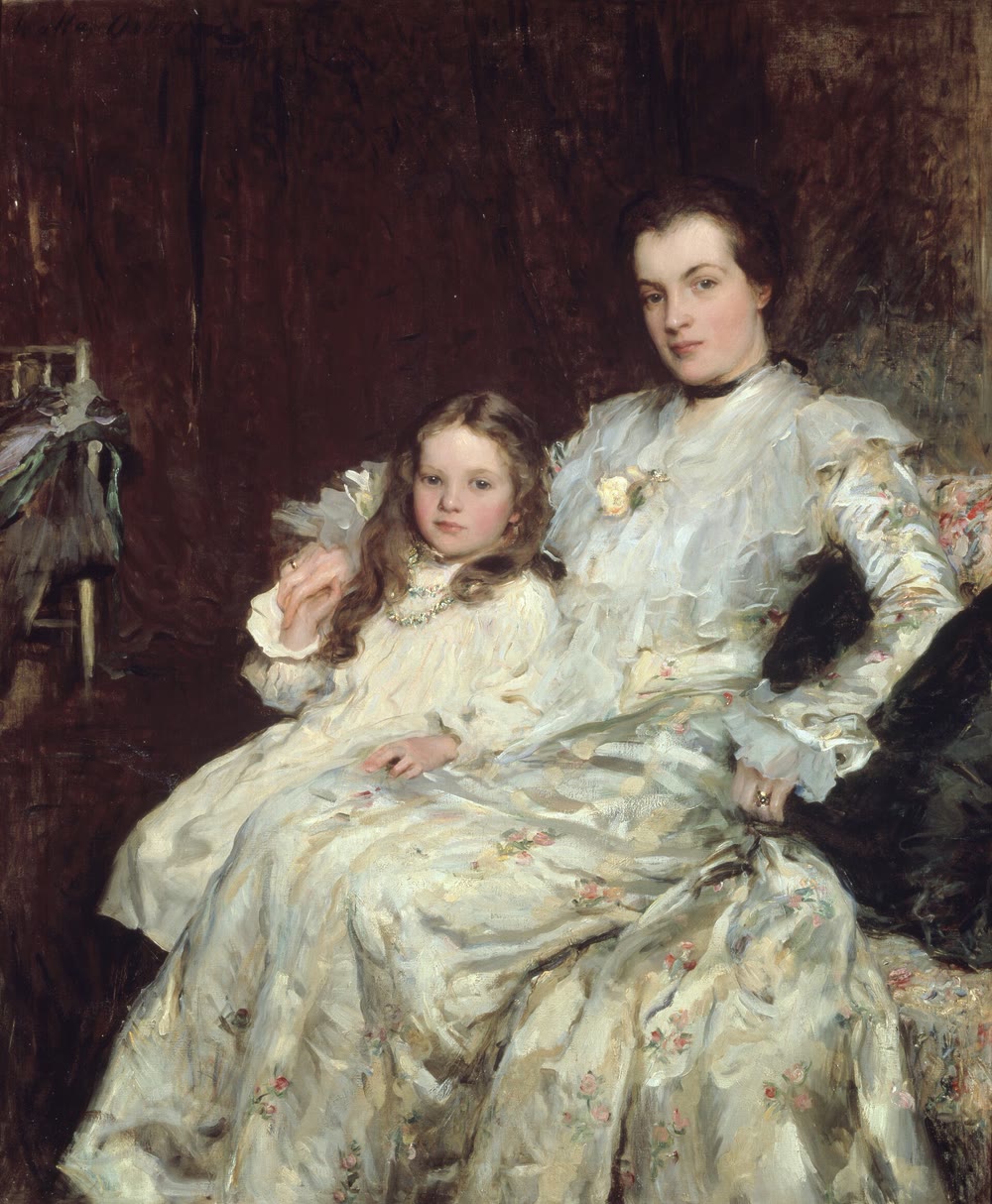
Walter Osborne, Portrait of Mrs Chadwyck-Healey and her Daughter, 1900. National Gallery of Ireland. Public domain, via Wikimedia Commons (CC BY 4.0)
For mother-and-child poems in English, see Eavan Boland’s Night Feed, a mother feeding her baby daughter at dawn, and Seamus Heaney’s Clearances, his sonnets for his mother.
Imagery, tone and feelings
Durkin’s images are small, everyday pictures that any family will know:
- Tears and a turned back. The daughter cries even as she lashes out: hurt on both sides.
- The cool teenager. The mother, years ago, full of fun and sure she knew best.
- Feet planted firmly. The grandmother, who wouldn’t budge. Irish has an idiom for it, do chosa a chur i dtaca (duh KHUSS-uh uh khur ih DOCK-uh), to dig your heels in.
- Love that grows. The closing picture is of love increasing every day since the girl’s birth.
The tone shifts as it goes: tense and raw at the start, reflective and a little self-mocking in the middle, warm and tender at the end.
Besides the anger and love the poet names, the guide gives students a list of other feelings to test against the poem, such as frustrachas (FRUS-trukh-us), frustration; díomá (JEE-maw), disappointment; comhbhá (KOH-waw), sympathy; and tuiscint (TISH-kintch), understanding.
Language, rhythm and rhyme
Everyday Connemara Irish
The poem is written in the poet’s own Connemara dialect. The guide points out shortened forms such as a’m for agam (AG-um), at me or I have, and a’d for agat (AG-ut), at you. It then asks students to spot more, such as fhéin for féin (self) and dhom for dom (to me). These aren’t mistakes, so don’t “correct” them when you quote.
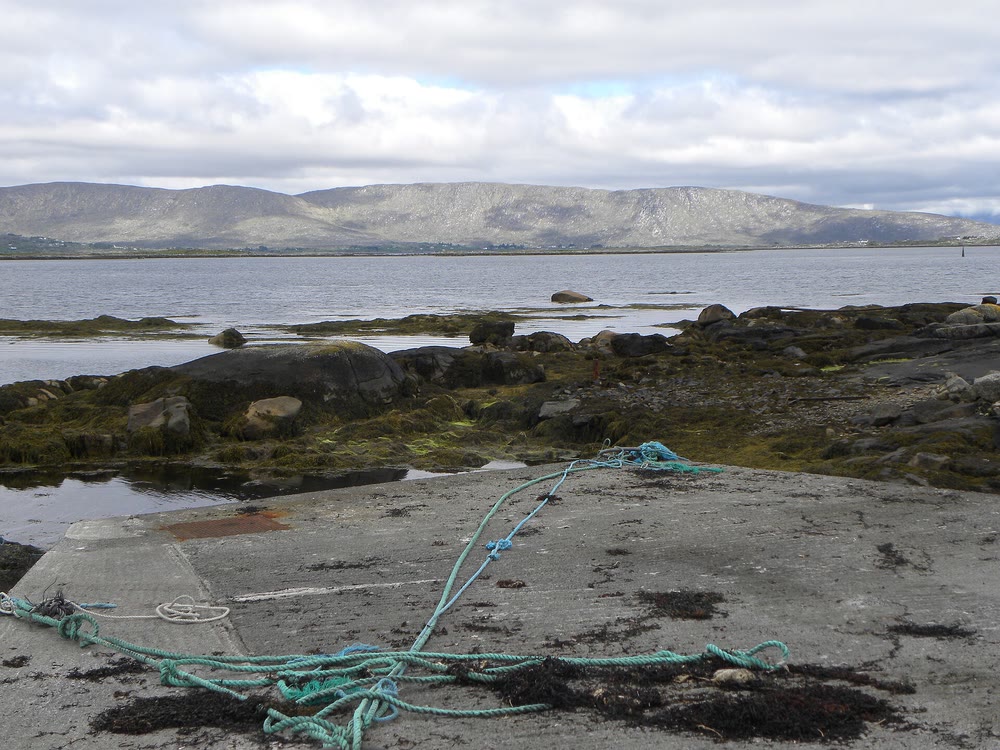
The quay at Eanach Mheáin (Annaghvaan) in south Connemara, the island where Áine Durkin was born. Photo: Gordon Hatton, CC BY-SA 2.0, via Wikimedia Commons
English words in an Irish poem
Three English words turn up: clue, Mom and cool. Slipping words from another language into your speech like this is called code-mixing, and the guide’s Irish term for it is códmheascadh (roughly KOHD-vas-kuh). In the printed poem the English words are set apart from the Irish, and the guide asks students to notice how.
They make the voices believable, because people really do mix languages. And look at who uses them: the daughter says clue and Mom, but it’s the mother who calls her own younger self cool. Teenage slang, like the row itself, runs in the family. It’s worth asking, too, why the girl says Mom rather than Mam or Mamaí.
Rhythm
Read it aloud and count the beats. In most verses the lines swing between four beats and three, the long-short pattern of a ballad. The guide sets the beat count as a question, so try it yourself.
Rhyme and assonance
The poem doesn’t rhyme strictly. Instead, the second and fourth lines of each verse echo each other, usually through assonance, comhfhuaim (KOH-oo-im), where the vowel sounds match. The guide’s example is searbh (SHAR-uv), bitter, and fearg, anger, in the first verse.
Dialect matters here. In Connemara Irish, the guide notes, romham sounds much like the English word room, so it chimes with cool in verse two, and ao is said like í, which helps the last verse’s line endings match too. There’s internal rhyme as well: in the second-last line, lá (LAW), day, rings against grá, love.
Key Irish words in Iníon
Here are words worth knowing, in their dictionary forms, with meanings from Ó Dónaill’s dictionary on teanglann.ie, where you can hear all three main dialects. The respellings are rough guides, and Connemara, Donegal and Munster speakers differ.
- déagóir (JAY-gore): teenager
- deoir (JORE), plural deora (JORE-uh): tear, tears
- gontach (GUN-tukh): wounding, hurtful
- searbh (SHAR-uv): bitter, sour
- fearg (FAR-ug): anger
- meidhreach (MY-rukh): merry, frisky
- óinseach (OHN-shukh): a foolish woman, a fool
- cosa i dtaca (KUSS-uh ih DOCK-uh): feet planted firmly, as in do chosa a chur i dtaca, to refuse to budge
- ciall (KEE-ul): sense
- comhairle (KOOR-luh in Connemara, KORE-luh in Munster): advice
- tréan (TRAYN): strong, powerful
- teip ar (TEP er): to fail someone, let them down
- a chroí (uh KHREE): my heart, darling; there are more pet names in my guide to I love you in Irish
- méadaigh (MAY-dee): to increase, grow
- saol (SAYL; in Connemara closer to SEEL): life, the world; teacht ar an saol, to come into the world, is to be born
Exam notes and useful Irish phrases
Iníon is one of five common prescribed poems for Ordinary and Higher Level in the Department of Education and Youth’s circular 0041/2026, for June 2027 and June 2028. The others are Dínit an Bhróin by Máirtín Ó Direáin, Deireadh na Feide by Ailbhe Ní Ghearbhuigh, Glaoch Abhaile by Áine Ní Ghlinn and Úirchill an Chreagáin by Art Mac Cumhaigh.
Schools can take the optional course instead (at least five poems of their own choosing, at least one of them written before 1850), so check with your teacher. And if you’ve inherited an older sibling’s notes on An tEarrach Thiar, note that none of the old common poems is on the new list, though schools may pick old ones for the optional course.
Nobody can predict the paper, but recent ones are a guide. In June 2025, Higher Level Paper 2 had one 30-mark poetry question: on the prescribed side, students picked one of two poems, printed on the paper, and answered parts worth 15, 6 and 9 marks: a discussion question, a technique, and the metre or the poet’s life. At Ordinary Level, poetry was worth 50 marks, with two of three questions to answer.
So prepare the main themes, the feelings and who has them, two or three techniques (contrast, codarsnacht, roughly KUD-ur-snukht; irony; dialect; the English words; rhyme; images), a paragraph on Durkin’s life and work, and your own response. Back each point with a brief quote. For revision, the NCCA guide suggests a diary entry by the daughter, mother or grandmother on the night of a row, or a debate on Ní thagann ciall roimh aois.
Useful Irish phrases for your answer
- Is dán é seo faoin gcaidreamh idir máthair agus a hiníon. (This is a poem about the relationship between a mother and her daughter.)
- Tosaíonn an dán le fearg agus críochnaíonn sé le grá. (The poem begins with anger and ends with love.)
- Tá íoróin sa dán, mar tá an mháthair anois cosúil lena máthair féin. (There’s irony in the poem, because the mother is now like her own mother.)
- Úsáideann an file caint laethúil agus cúpla focal Béarla, rud a fhágann go bhfuil an comhrá réalaíoch. (The poet uses everyday speech and a few English words, which makes the conversation realistic.)
- Léiríonn an dán nach dtagann ciall roimh aois. (The poem shows that sense doesn’t come before age.)
Who is Áine Durkin?
Áine Durkin was born in 1958 on Eanach Mheáin (roughly AN-ukh VAWN), or Annaghvaan, one of the islands of Ceantar na nOileán (KYAN-tur nuh NIL-awn), the islands district of the Connemara Gaeltacht, says Portráidí, the online portrait archive of Irish-language writers. She has lived in Buncrana, in Inis Eoghain (IN-ish OH-in), or Inishowen, Co. Donegal, since 1980.
She took a first-class degree in Irish at the University of Ulster in 2007, then diplomas in television skills and translation at Acadamh na hOllscolaíochta Gaeilge in Gaoth Dobhair (Gweedore).
Her blog, Mise Áine (MISH-uh AWN-yuh), I am Áine, won an Oireachtas literary prize in 2010. As a songwriter, she won the Pan Celtic Festival’s national song contest in 2013 and 2019, says IMRO, the Irish music rights organisation, and her 2019 song went on to win at the International Pan Celtic Festival.
Mise Áine: An Bhean Istigh (un VAN ish-TEE) came out from Cló Iar-Chonnacht in December 2017, after winning first prize in the new writers’ competition at that year’s Oireachtas literary awards. Istigh means inside, indoors or at home, so the subtitle, roughly The Woman Inside, can be read more than one way. The publisher describes it as memories and reflections gathered over the years.
Another poem in it, Ciara na Gruaige Rua (Red-Haired Ciara), remembers her sister Ciara, who died in 2007. It featured in an RTÉ Raidió na Gaeltachta programme that won silver at the New York Festivals radio awards in 2008, and you can hear Durkin read it on Portráidí.
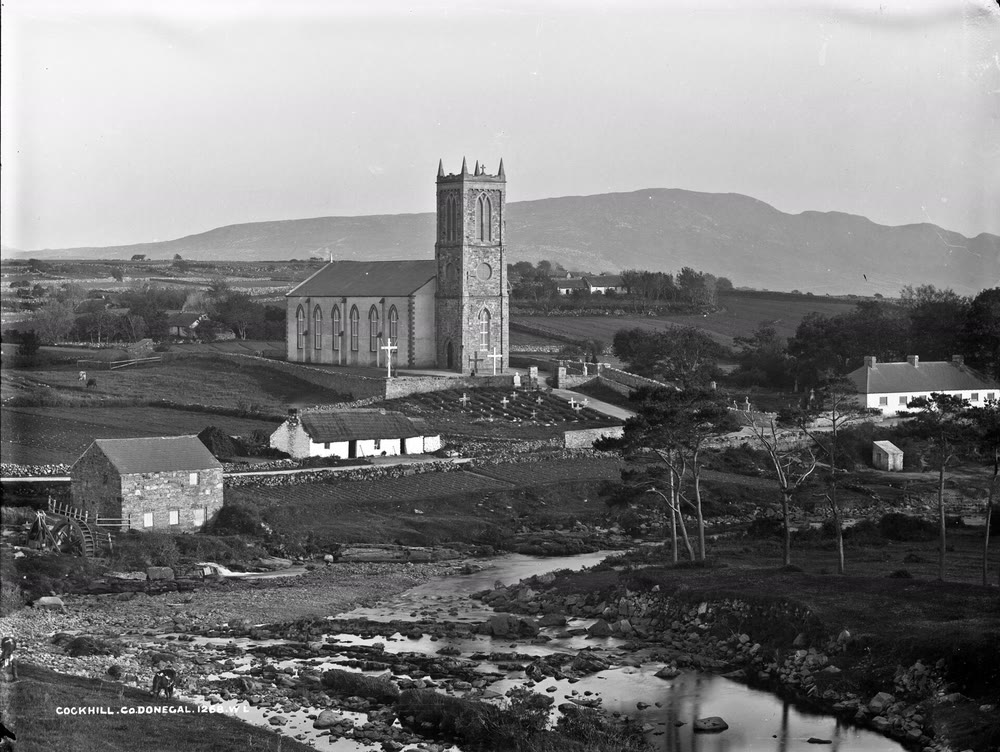
Cockhill, near Buncrana, Co. Donegal, photographed by Robert French between 1880 and 1900. Lawrence Collection, National Library of Ireland. Public domain, via Wikimedia Commons
Where to read Iníon and study it free
- The book: Mise Áine: An Bhean Istigh (Cló Iar-Chonnacht, 2017, ISBN 9781784441609), the source named on the Leaving Cert list, is still on sale from the publisher (checked November 2026).
- The NCCA guide: the free teaching guide to Iníon on curriculumonline.ie, the NCCA’s curriculum website. It’s in Irish, a PDF of about 10 MB, and works through the poem verse by verse, with vocabulary, grammar, discussion questions and exam-style tasks.
- The poet’s page: Durkin’s entry on Portráidí has her biography, photograph and a recording of her reading.
- Dictionaries: Teanglann.ie for meanings and pronunciation, and more free tools in my guide to learning Irish online.
Iníon FAQ
What is the poem Iníon about?
A mother speaks to her teenage daughter just after a row. She remembers scorning her own mother the same way, realises she has become that mother, and tells her daughter that her love has grown every day since the girl was born.
Who wrote Iníon?
Áine Durkin, a poet, songwriter and blogger born in Connemara in 1958, who lives in Buncrana, Co. Donegal. It’s from her first collection, Mise Áine: An Bhean Istigh (2017).
What does iníon mean in Irish?
Daughter. It can also mean a girl or young woman, and it’s the Irish for Miss.
Is Iníon on the Leaving Cert in 2027?
Yes, at both Ordinary and Higher Level, for June 2027 and June 2028, unless your school takes the optional poetry course.
What are the main themes of Iníon?
Conflict and love between mother and daughter, history repeating itself across three generations, and the idea that sense only comes with age.
Why are there English words in Iníon?
The daughter says clue and Mom, and the mother calls her younger self cool. They make the speech sound real and hint that the mother once talked the same way.
Where can I read the full poem?
In Mise Áine: An Bhean Istigh, and in the NCCA’s free guide, which quotes it verse by verse.
Love this? Save it to your Pinterest board for later.
Pin image: Sunset at Buncrana Pier on Lough Swilly, Co. Donegal. Photo: Greg Clarke, CC BY 2.0, via Wikimedia Commons
A little bit of Ireland in your inbox every Friday ☘️
The free Weekly Dose of Irish: an Irish joke, a Celtic symbol, an Irish fact, a poem and the week’s best articles in one short email. Join 9,600+ readers.
Free. One short email every Friday. Unsubscribe any time.
More Irish poetry reading
- Leaving Cert Irish Poems 2027 and 2028: The Full List, Explained
- Dínit an Bhróin by Máirtín Ó Direáin: Summary, Themes and Notes for Leaving Cert Irish
- Deireadh na Feide by Ailbhe Ní Ghearbhuigh: Summary, Themes and Notes for Leaving Cert Irish
- Glaoch Abhaile by Áine Ní Ghlinn
- Úirchill an Chreagáin by Art Mac Cumhaigh: The Poem, a Translation and Leaving Cert Notes
- Night Feed by Eavan Boland: A Beautiful Poem for New Parents
- Clearances by Seamus Heaney: His Sonnets for His Mother
- A Prayer for My Daughter by W.B. Yeats: Poem and Meaning
Featured image: Sunset at Buncrana Pier on Lough Swilly, Co. Donegal, the town where Áine Durkin has lived since 1980. Photo: Greg Clarke, CC BY 2.0, via Wikimedia Commons.