
After the Titanic is a short poem by the Belfast poet Derek Mahon, spoken by J. Bruce Ismay, the White Star Line’s chairman, who escaped the sinking Titanic in a lifeboat in April 1912 while about 1,500 people died. Blamed and shamed, Ismay insists that he suffered as much as the dead, and asks for a share of the mourning. It is on the Leaving Cert English course for June 2027 at Higher and Ordinary Level, but not in 2028.
After the Titanic sank, one survivor became the public’s scapegoat. Joseph Bruce Ismay ran the company that owned the ship, and he stepped into a lifeboat as she went down.
Derek Mahon, who grew up in the city that built the Titanic, gave that man a voice. The result makes you feel sorry for someone the press of 1912 painted as a monster, and then makes you ask whether you should.
The poem is in copyright, so I won’t print it here: read it on the Poetry Foundation website, which carries it by permission of Mahon’s publisher, The Gallery Press. For the whole course, see my guide to Leaving Cert English poetry for 2027 and 2028.
Jump to:
- After the Titanic at a glance
- The real story: Bruce Ismay and the Titanic
- What happens in the poem
- Why Ismay? Mahon, Belfast and the Titanic
- Themes: guilt, shame, memory and isolation
- Imagery and techniques
- The last line, and the Irish keen
- The Irish thread: Belfast, Queenstown and Connemara
- Poems to pair it with
- Leaving Cert 2027: levels and years
- Who was Derek Mahon?
- After the Titanic FAQ
- More Leaving Cert poetry and Titanic reading
After the Titanic at a glance
- Poet: Derek Mahon (1941 to 2020), born in Belfast.
- Speaker: J. Bruce Ismay (1862 to 1937), head of the Titanic’s owner, the White Star Line. The Poetry Foundation text never names him.
- Collected in: Night-Crossing (Oxford University Press, 1968), his first full collection, under a different title.
- Form: a dramatic monologue in free verse. The Poetry Foundation text has 21 lines in one block, every second line indented. Mahon revised his poems often, so your anthology may differ slightly.
The real story: Bruce Ismay and the Titanic
The White Star Line’s Titanic was built by Harland and Wolff at its Queen’s Island yard in Belfast and launched on 31 May 1911, says the Public Record Office of Northern Ireland (PRONI). Her maiden voyage began at Southampton on 10 April 1912, calling at Cherbourg and at Queenstown, now Cobh, in Co. Cork.
At 11.40pm on 14 April she hit an iceberg, and in under three hours she was gone. The British inquiry counted 1,490 dead; PRONI gives 1,503.
Ismay was on board as the line’s managing director. As the ship sank, he got into Collapsible C, which the British inquiry’s report calls the last boat on the starboard side, as it was being lowered.
The press cast him as a monster who had saved himself ahead of women and children, the US National Archives’ Prologue magazine recalls. The story that he got into the boat dressed as a woman is a myth, the Irish Times notes, but a stubborn one.
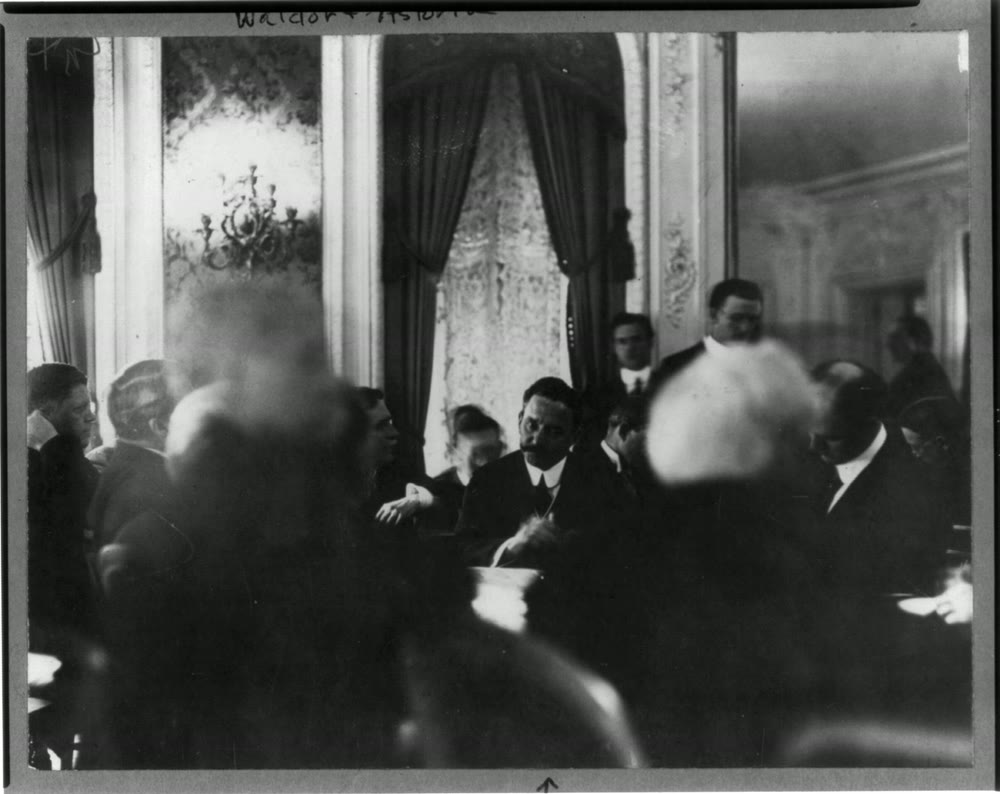
J. Bruce Ismay being questioned by the US Senate subcommittee at the Waldorf-Astoria Hotel, New York, 1912. Library of Congress. Public domain, via Wikimedia Commons
On 19 April 1912 a US Senate subcommittee under Senator William Alden Smith opened hearings at the Waldorf-Astoria Hotel in New York, with Ismay among the first witnesses. He told the senators that from the lifeboat he hadn’t wanted to watch the ship go down.
In London, Lord Mersey’s Wreck Commissioner’s inquiry sat from May to July, and Ismay gave evidence on 4 and 5 June. Mersey found the ship was lost because she struck an iceberg while going too fast. He also rejected the idea that Ismay had a moral duty to stay aboard: nobody else was waiting at that boat, there was room, and staying would only have added one more death.
The verdict didn’t rescue his name. Ismay left public life, gave up the chairmanship of the White Star Line in 1913, and never recovered his reputation, says the Irish Times. He died in 1937, in London.
What happens in After the Titanic (summary in plain English)
Ismay speaks throughout, in four movements. This is the gist, not a line-by-line version.
1. The accusation
Ismay opens on the defensive, answering the charge that he saved himself and still smarting from the inquiry. His reply: that night, he suffered as much as anyone who died.
2. The night of the sinking
He relives the disaster mostly through sound, as the ship’s whole expensive world, his own fortune with it, crashes into the sea.
3. Shut away
Now he lives hidden on the coast, where reminders of the wreck still turn up. The seasons can’t lift his mood, and the only outside view we get is gossip from his own household, which paints a broken old recluse.
4. Drowning again
On bad nights he goes down again in his mind among the drowned, people whose lives were always a mystery to him. Then he ends with a one-line plea to be included in the mourning.
Remember that this is Mahon’s imagined Ismay. The gardener, the drug habit and the daily routine come from the poem; none of the sources used on this page records them.
Why Ismay? Mahon, Belfast and the Titanic
Mahon’s father worked at Harland and Wolff, rising to become an engine inspector, and before her marriage his mother had a job at the York Street Flax Spinning Company, says Tom Walker’s profile for Trinity College Dublin’s Trinity Writers. Brian Burton’s 2004 Durham University doctoral thesis on Mahon adds that his grandfather worked at the yard too.
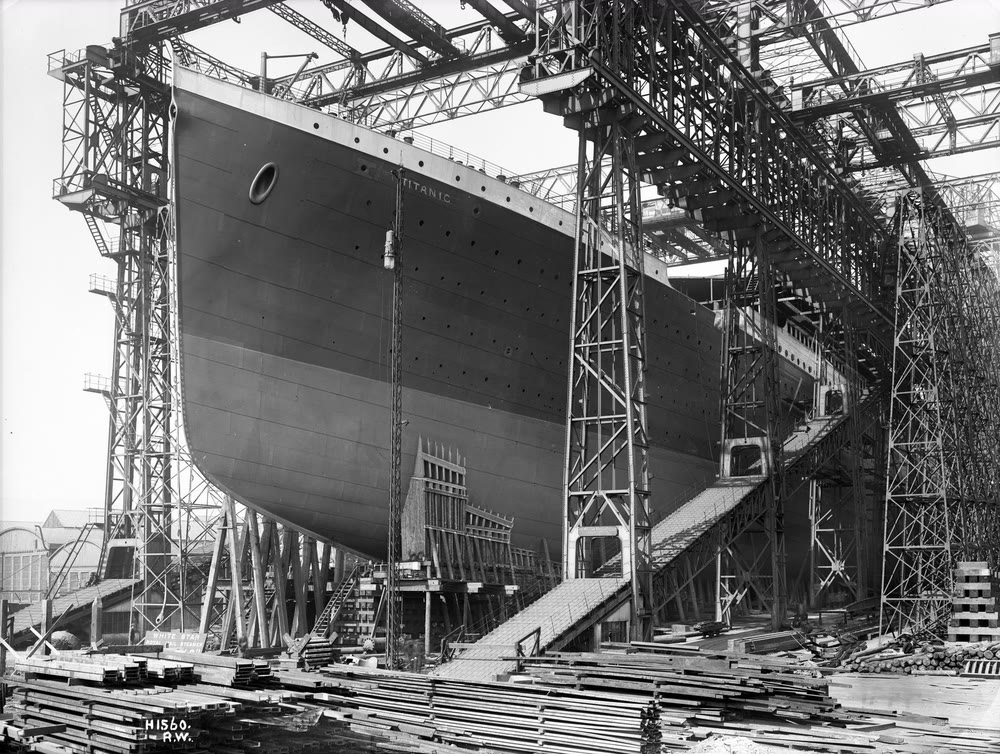
The Titanic ready for launch beneath the gantry at Harland and Wolff’s shipyard in Belfast, May 1911. Photo: Robert John Welch. Public domain, via Wikimedia Commons
The poem was published in Night-Crossing in 1968. Burton says it was called As God is my Judge then, and that Ismay’s name went with it, as if he had signed it. Mahon later revised it and renamed it twice, first as Bruce Ismay’s Soliloquy and then as After the Titanic. Burton calls Mahon a habitual reviser of his texts and titles.
Why speak as a survivor the press vilified? Walker notes that several Night-Crossing poems link the artist with the pariah, and the Poetry Foundation’s profile says isolation, loneliness and alienation run through Mahon’s work.
Themes in After the Titanic: guilt, shame, memory and isolation
- Guilt and the survivor: Ismay lived when about 1,500 others died, and the poem is full of what we now call survivor’s guilt. Yet he never admits blame; he claims a share of the suffering instead. Honest grief or self-pity? The poem leaves that with you.
- Public shame and isolation: the poem begins with what other people said, and even in hiding he is talked about. Lord Mersey cleared him of any duty to go down with the ship, but the press had already judged him.
- Memory and trauma: time has stopped for him. The seasons change without touching him, and the sinking replays on bad nights, lived again and again.
- Wealth, class and strangers: his lost life was an expensive one, and the dead who come back to him stay strangers. One reading, not stated in the poem, is that the chairman never had to know the people travelling below decks, such as the emigrants who boarded at Queenstown.
- Sympathy for the outcast: you needn’t forgive Ismay, but Mahon makes it hard to see him only as a villain.
Imagery and techniques in After the Titanic
- Dramatic monologue: an invented voice for a real person, speaking to an unseen listener, perhaps a jury. He reveals more than he intends, defending himself and exposing his self-pity in the same breath.
- Double meanings: the opening phrase for escaping by lifeboat can also mean getting away with something, as if he’d committed a crime, a pun Burton points out. His claim to have sunk plays on the word too: his body was saved, but his name and spirit went under.
- Listing and sound: the crash is a pile-up of nouns separated by commas, home comforts beside heavy machinery, with hard p and b sounds (alliteration) and words that imitate the roar (onomatopoeia). His present life is quiet by contrast. Loud past, quiet present.
- The music: ragtime, which he hears torn apart, was America’s leading popular style between roughly 1899 and 1917 (Encyclopaedia Britannica), and the ship’s band became a legend by playing on as she sank (NPR).
- Ice and sea: in the lifeboat he freezes, almost becoming the iceberg himself. Near the end, a simile makes his own heart fall the way the ship did.
- The calendar: April, May and June pass him by, the months of the sinking and the two inquiries, and bring no comfort.
- Form: no rhyme scheme, long run-on lines (enjambment) and, in the Poetry Foundation text, alternate lines indented, so the poem seems to rock like a boat.
The last line, and the Irish keen
After all the noise and drowning, the poem closes on one short request: “Include me in your lamentations.” (Derek Mahon, After the Titanic)
Ismay wants to be mourned alongside the victims, as if he had died too. Is that moving, or outrageous? Both readings are open to you. Notice that he never asks to be forgiven, only to be included.
In the 1968 version, Burton’s thesis shows, the request was stranger still: Ismay asked to be included on an honorary basis, using the Latin phrase found on honorary degrees.
Irish has old words for this. Caoineadh (KEEN-yuh) is a keen or lament, the cry for the dead at a wake, and can also mean an elegy; olagón (roughly OL-uh-gohn) is a wail or dirge, says Ó Dónaill’s dictionary, and focloir.ie gives it for lamentation. There’s more in my guide to Irish wake traditions.
The Irish thread: Belfast, Queenstown and Connemara
Belfast: where she was built
Belfast is Béal Feirste in Irish (roughly bayl FAIR-shtuh). Ó Dónaill’s dictionary gives béal as a mouth or approach, and fearsaid (feirste is one of its forms) as a tidal ford or sandbank. The Titanic Belfast museum stands on the slipways where she was built, as my guide to things to do in Belfast explains.
Queenstown: the last call
On 11 April 1912 the Titanic anchored off Roches Point, outside Queenstown, her final port of call. Two tenders, the PS Ireland and the PS America, carried 123 passengers out to her. At 1.30pm she raised anchor while a steerage passenger, Eugene Daly, played Erin’s Lament on the bagpipes, says Titanic Belfast. A tender is a bád freastail (bawd FRASS-til) in Irish, says focloir.ie.
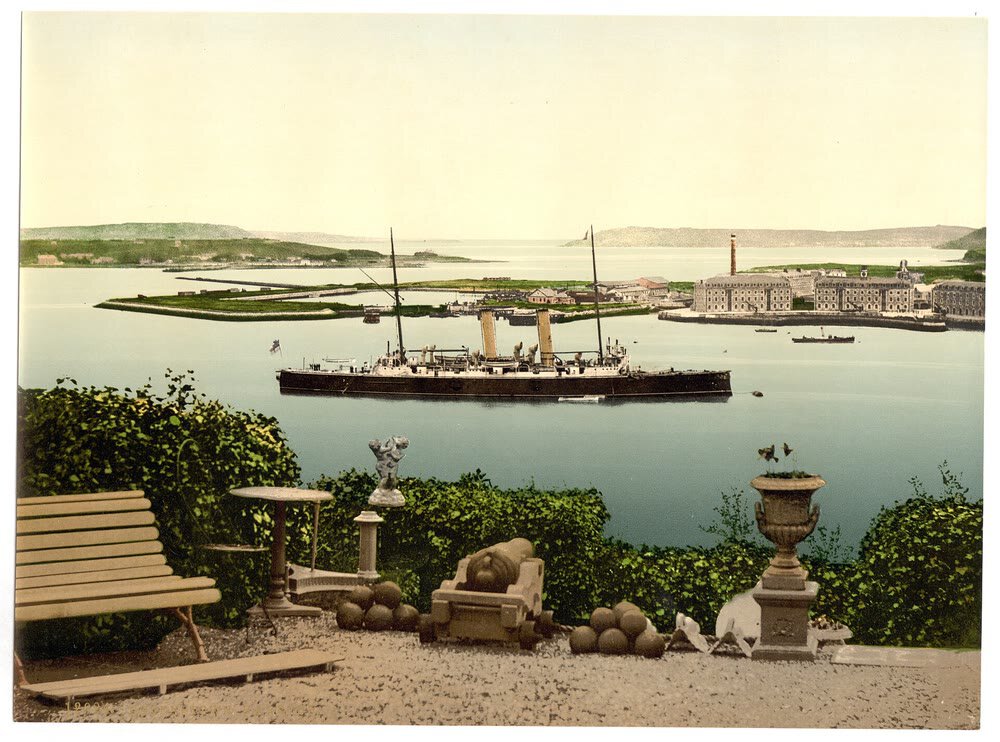
Queenstown Harbour, Co. Cork, now Cobh, in a photochrom print dated between 1890 and 1900. Library of Congress. Public domain, via Wikimedia Commons
Millions of Irish emigrants left from Queenstown, now Cobh (said Cove), as I explain in my piece on the American wake; the town’s Titanic story is in my facts about Cork. Sitting Leaving Cert Irish too? Máirtín Ó Direáin’s Dínit an Bhróin is also set around a tender and an ocean liner.
Connemara: the real Ismay’s retreat
Here history and poem part ways. In 1913 Ismay bought Costelloe Lodge, an ocean-front house at Costelloe, Co. Galway, drawn by its isolation and its fishing for salmon and trout, Rosita Boland reported in the Irish Times in 2012. He came back for several months of every year until he died. The National Inventory of Architectural Heritage records that the lodge was burned in an arson attack in 1922 and rebuilt in 1925.
He had left public life, but Costelloe remembered him kindly. Locals told Boland the Ismays gave work in a very poor area, held fishing parties and a yearly Christmas party, and were liked and respected. One neighbour recalled an Irish nickname for him, Brú síos mé (roughly broo sheess MAY), a pun on his name meaning push me down, into the lifeboat. Brú is a push or shove and síos means down, says Ó Dónaill.
His widow put up a memorial stone in the garden. It now stands in Cobh’s Titanic Memorial Garden, which opened on 11 April 2014 with a glass wall naming the 123 passengers who boarded at Queenstown, TheCork.ie reported. A plaque on its base says it came from Ismay’s estate at Casla (roughly KASS-luh), Connemara. Casla is the official Irish name for Costelloe in the Placenames (Ceantair Ghaeltachta) Order 2004.
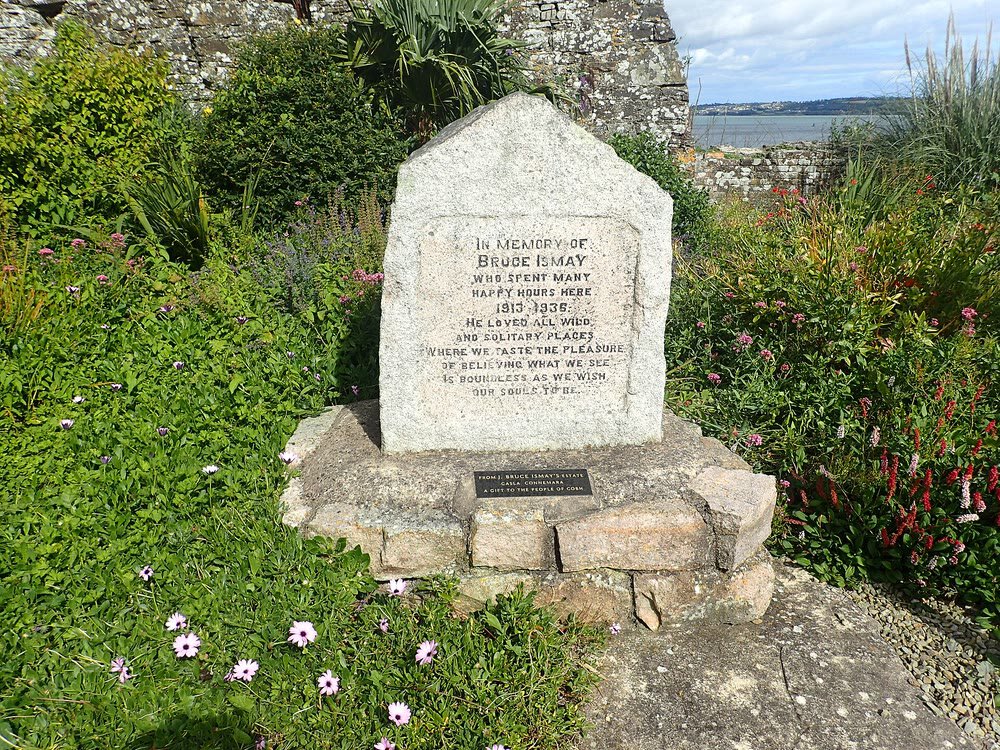
The memorial stone to Bruce Ismay, brought from his Connemara estate, in the Titanic Memorial Garden, Cobh. Photo: Marathon, CC BY-SA 2.0, via Wikimedia Commons
Poems to pair with After the Titanic
These pairings are by theme and image, to help you link poems your own way. They are not sample answers.
- Grandfather (Higher and Ordinary Level): also in Night-Crossing, Burton notes: a portrait of a mischievous grandfather at home, impossible to pin down. Compare two old men in their houses, one watched with affection by his family, the other the subject of his gardener’s gossip. See my guide to Grandfather by Derek Mahon.
- Antarctica (Higher and Ordinary Level; spelt Antartica on the Ordinary Level list): built around Captain Lawrence Oates of Scott’s polar expedition, who, frostbitten and slowing his companions, walked out of their tent into a blizzard and died in 1912 (Royal Collection Trust). Oide’s teaching resource calls the poem a villanelle and reads Oates’s act as self-sacrifice. Same year, same cold: one man walked out, the other took a lifeboat seat and was branded a monster.
- A Disused Shed in Co. Wexford (Higher Level only): Mahon’s most celebrated poem, Walker says, gives a voice to forgotten things that plead not to be forgotten. Pair them for voices of the lost and a closing appeal. My notes are on A Disused Shed in Co Wexford.
Leaving Cert English 2027: levels and years
- Higher Level 2027: Mahon is one of eight poets, with Elizabeth Bishop, Emily Dickinson, John Donne, Patrick Kavanagh, Paula Meehan, Adrienne Rich and W.B. Yeats. Ten Mahon poems are listed, and you’re expected to have studied at least six by each poet.
- Ordinary Level 2027: this poem is on the list of 36, alongside Mahon’s Grandfather and Antarctica.
- 2028: Mahon isn’t on either list, so this poem is for June 2027 only.
The official list is the Department of Education’s circular 0021/2025. This page is an independent study guide, not an official source, so check anything important with your teacher. Nobody can tell you what will come up, but the State Examinations Commission puts past papers and marking schemes online for free in its exam material archive.
Who was Derek Mahon?
Mahon, born on 23 November 1941 in Belfast, grew up in north Belfast and then Glengormley, says his Irish Times obituary. He entered Trinity College Dublin in 1960, spent long spells in London and, from 1990, New York (Walker), and won the Irish Times/Aer Lingus Poetry Prize in 1992 for his Selected Poems. He settled in Kinsale, Co. Cork, in 2003 (Kinsale is also one of his Higher Level poems) and died on 1 October 2020. There’s more in my guide to Derek Mahon’s poems for Leaving Cert English.
After the Titanic FAQ
Who is the speaker in After the Titanic?
J. Bruce Ismay, who ran the Titanic’s owner, the White Star Line. The Poetry Foundation text doesn’t name him, but Burton records an earlier title, Bruce Ismay’s Soliloquy.
Is After the Titanic on the Leaving Cert in 2027?
Yes, at Higher and Ordinary Level. Mahon isn’t on the 2028 lists.
When was After the Titanic written?
By 1968: it appeared in Night-Crossing that year under the title As God is my Judge, according to Burton.
Did Bruce Ismay really live in Ireland?
For part of each year. He bought Costelloe Lodge in Co. Galway in 1913 and returned for part of every year until he died in 1937, the Irish Times reported.
Is After the Titanic also a book?
Yes. Stephen Ennis’s life of Mahon, After the Titanic: A Life of Derek Mahon (Gill and Macmillan, 2014), takes the poem’s title, Walker’s Trinity Writers profile records.
Where can I read the full poem?
On the Poetry Foundation website (by permission of The Gallery Press) or in your anthology. It’s in copyright, so it isn’t printed here.
Love this? Save it to your Pinterest board for later.
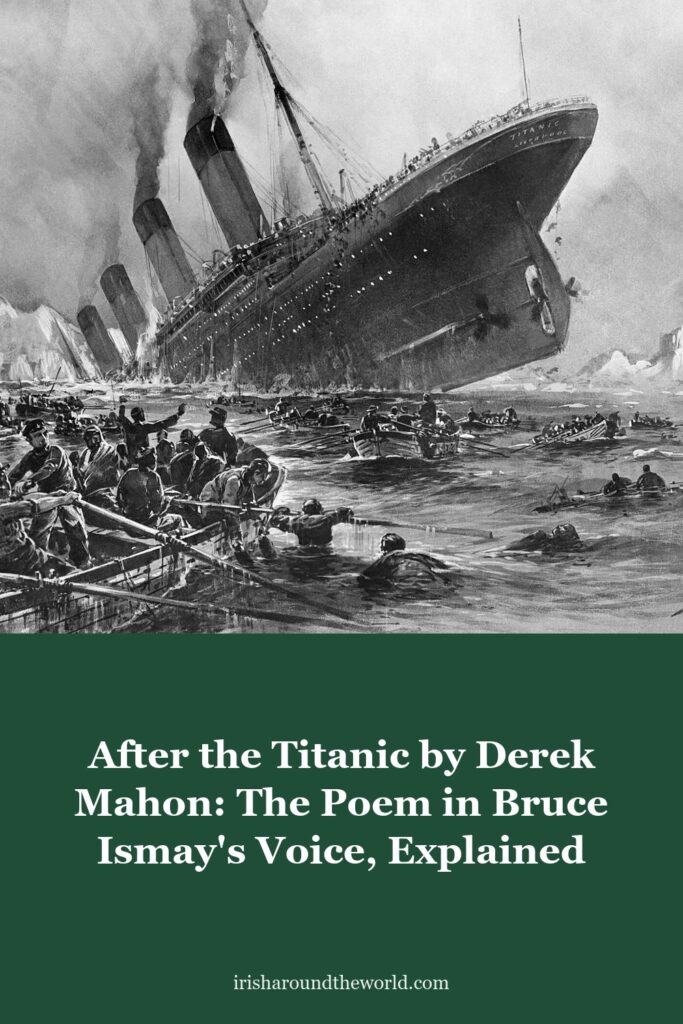
Pin image: The sinking of the Titanic, drawn by Willy Stöwer for the German magazine Die Gartenlaube, 1912. Public domain, via Wikimedia Commons
A little bit of Ireland in your inbox every Friday ☘️
The free Weekly Dose of Irish: an Irish joke, a Celtic symbol, an Irish fact, a poem and the week’s best articles in one short email. Join 9,600+ readers.
Free. One short email every Friday. Unsubscribe any time.
More Leaving Cert poetry and Titanic reading
- A Disused Shed in Co Wexford by Derek Mahon: Meaning and Analysis
- Shancoduff by Patrick Kavanagh: Summary, Themes and Notes for Leaving Cert English
- Paula Meehan Poems for Leaving Cert English 2027 and 2028: Summaries and Themes
- Leaving Cert Irish Poems 2027 and 2028: The Full List, Explained
- The American Wake: Ireland’s All-Night Farewell for Emigrants to America
- Facts About Cork, Ireland: Why We Call It the Real Capital
- Things to Do in Belfast: 10 Best Sights and Day Trips (2026)
Featured image: The sinking of the Titanic, drawn by Willy Stöwer for the German magazine Die Gartenlaube, 1912. Public domain, via Wikimedia Commons.