
Derek Mahon (1941 to 2020), the Belfast-born poet who spent his last years in Kinsale, Co. Cork, is one of eight poets prescribed for Leaving Cert English at Higher Level in June 2027. His ten poems are Grandfather, Day Trip to Donegal, Ecclesiastes, After the Titanic, As It Should Be, A Disused Shed in Co. Wexford, Rathlin, The Chinese Restaurant in Portrush, Kinsale and Antarctica. Grandfather, After the Titanic and Antarctica are on the 2027 Ordinary Level list too. Mahon is not on the course for June 2028.
Derek Mahon could find a poem almost anywhere: a shed full of mushrooms in Wexford, a Chinese restaurant in Portrush before the tourists arrive, a tent in a polar blizzard.
Half of his ten Leaving Cert poems name an Irish place in the title, from Donegal and Rathlin to Kinsale. Most of the others carry Ireland too, from the Belfast shipyard that built the Titanic to the shadow of the Troubles.
His poems are still in copyright, so I won’t print them here. Instead, here’s each one in plain English, with the places and history behind it. This is an independent guide, not an official source: the circular and your teacher have the final word.
Jump to:
- Which Mahon poems are on the Leaving Cert in 2027?
- Who was Derek Mahon?
- The ten poems, explained
- Mahon’s Ireland: the places behind the poems
- Themes and style
- Study tips and poem pairings
- Derek Mahon Leaving Cert FAQ
- More Leaving Cert poetry
Which Derek Mahon poems are on the Leaving Cert in 2027?
The Department of Education’s circular 0021/2025 sets the prescribed material for the June 2027 exam. Mahon is one of eight Higher Level poets, and the circular expects Higher Level students to have studied six or more of each poet’s poems. Ordinary Level has a separate list of 36 poems, three of them his.
| Poem | Where it’s set | First book it appeared in | Level (2027) |
|---|---|---|---|
| Grandfather | A family home (no place named) | Night-Crossing (1968) | Higher and Ordinary |
| Day Trip to Donegal | The Donegal coast | Night-Crossing (1968) | Higher |
| Ecclesiastes | The North; the Antrim hills are named | Ecclesiastes, a 1970 pamphlet | Higher |
| After the Titanic | Ismay’s house on the coast (not named) | Night-Crossing (1968), titled As God is my Judge | Higher and Ordinary |
| As It Should Be | Not named | Lives (1972) | Higher |
| A Disused Shed in Co. Wexford | Co. Wexford | The Snow Party (1975) | Higher |
| Rathlin | Rathlin Island, Co. Antrim | The Hunt by Night (1982), titled Rathlin Island | Higher |
| The Chinese Restaurant in Portrush | Portrush, Co. Antrim | Poems 1962-1978 (1979) | Higher |
| Kinsale | Kinsale, Co. Cork | Antarctica (1985) | Higher |
| Antarctica | Antarctica, 1912 | Antarctica (1985) | Higher and Ordinary |
Book details: Brian Burton’s Durham University thesis and Peter Denman’s study of Mahon’s revisions (Maynooth University). Two small things to watch: the Ordinary Level list spells the last poem Antartica, but it’s the same poem. And Mahon is a 2027 poet only: he isn’t on circular 0024/2026, which sets the course for June 2028.
Where to read the poems
Mahon kept revising his poems, changing titles, words and dedications, as Trinity College Dublin’s Trinity Writers essay explains, so learn your quotations from your class anthology. His final versions are in The Poems (1961-2020), from his publisher, The Gallery Press.
Five of the ten are free on publisher or official sites. The Poetry Foundation has After the Titanic and A Disused Shed, reprinted with Gallery’s permission. The Arts Council of Northern Ireland’s Troubles Archive has As It Should Be, Ecclesiastes and A Disused Shed. Gallery’s preview of New Selected Poems includes Day Trip to Donegal.
Who was Derek Mahon?
Mahon was born in Belfast on 23 November 1941, an only child in a working-class Protestant family. Home was Salisbury Avenue in north Belfast, then the suburb of Glengormley. His father was a Harland and Wolff man who rose to inspector of engines, and before her marriage his mother had a job with the York Street Flax Spinning Company, says Trinity College Dublin. The Arts Council of Northern Ireland’s Troubles Archive adds that his grandfather also worked for Harland and Wolff.
After the Royal Belfast Academical Institution, known as Inst, he went to Trinity College Dublin in 1960 to read English and French. There he met Michael Longley, and Longley and Seamus Heaney became lifelong friends. His first full collection, Night-Crossing, came out in 1968.
He moved often, from Paris and North America to London and New York, before settling in Kinsale in 2003. He admitted that he had never found a way to tackle the Troubles head-on in his poems, says the Irish Times obituary that Trinity republished.
In the 2020 lockdown, his short poem Everything Is Going to Be All Right struck a chord across Ireland. He died in Cork after a short illness on the night of Thursday 1 October 2020, aged 78, RTÉ and The Irish Times reported. He was a member of Aosdána (roughly EES-daw-nuh), the Irish artists’ association.
The ten Derek Mahon poems, explained
1. Grandfather (Higher and Ordinary)
What happens: Mahon sketches his grandfather in old age. Home from a working life among boilers and gantries, the old man refuses to slow down. He turns as busy, secretive and mischievous as a small child. The poem admires a man who stays free, and a little unknowable, to the end.
- Background: boiler-rooms and gantries belong to the shipyard world. Mahon’s grandfather, like his father, worked at Harland and Wolff, the Belfast yard that built the Titanic.
- Themes: old age and independence; childhood; family; time and death.
- Form: a 14-line sonnet: eight lines on his busy days, then six that follow him into the night.
2. Day Trip to Donegal
What happens: a group from the city drive to the Donegal coast for the day. At the pier they watch the boats unload a catch of fish dying on deck. That night the sea follows the speaker into his sleep, and the dream leaves him helpless and alone on open water.
- Background: in Night-Crossing (1968) the poem had an extra stanza linking the dying fish to mass killing. Mahon cut it for Poems 1962-1978, and the scholar Peter Denman links the cut to A Disused Shed in Co. Wexford, written in between.
- Themes: city and country; the power and indifference of nature; guilt; isolation and anxiety.
- Images to know: the catch on the deck; the sea wearing at the harbour wall in the dream.
3. Ecclesiastes
What happens: Mahon speaks to someone who could easily settle into the life of a grim Northern preacher: dressed in black, cut off from warmth, women and children, and ready to lead people who will believe anything. The person addressed may be a type Mahon grew up among, or Mahon himself, tempted by the certainty he walked away from.
- Background: Ecclesiastes is the Old Testament book whose speaker calls himself the Preacher and declares that all is vanity. Mahon’s last line twists its claim that there is nothing new under the sun. The Troubles Archive reads the poem as contempt for rigid puritan thinking that wins power over trusting followers.
- Images to know: silent streets and a quiet shipyard; winter rain soaking the Antrim hills; washing hung out on the estates.
- Themes: religion and certainty; Northern Protestant identity; home as a trap.
4. After the Titanic (Higher and Ordinary)
What happens: the speaker is J. Bruce Ismay, head of the White Star Line, which owned the Titanic. He survived the sinking in a lifeboat, was branded a coward, and now lives hidden away on the coast, haunted by that night. The poem lets him plead his case: he suffered too, and he wants a share of the mourning.
- Background: the Titanic was built at Harland and Wolff in Belfast. She struck an iceberg on her maiden voyage on the night of 14 April 1912, and about 1,500 people died, says Royal Museums Greenwich. Ismay lived largely in seclusion afterwards, says Brian Burton’s thesis, which also traces the poem’s titles: As God is my Judge, then Bruce Ismay’s Soliloquy, then After the Titanic.
- Themes: guilt and blame; survivor’s trauma; the outsider. Is it self-pity or real suffering? You decide.
- Images to know: the ship’s contents crashing into the deep; wreckage washed up at his door; the faces of the drowned.
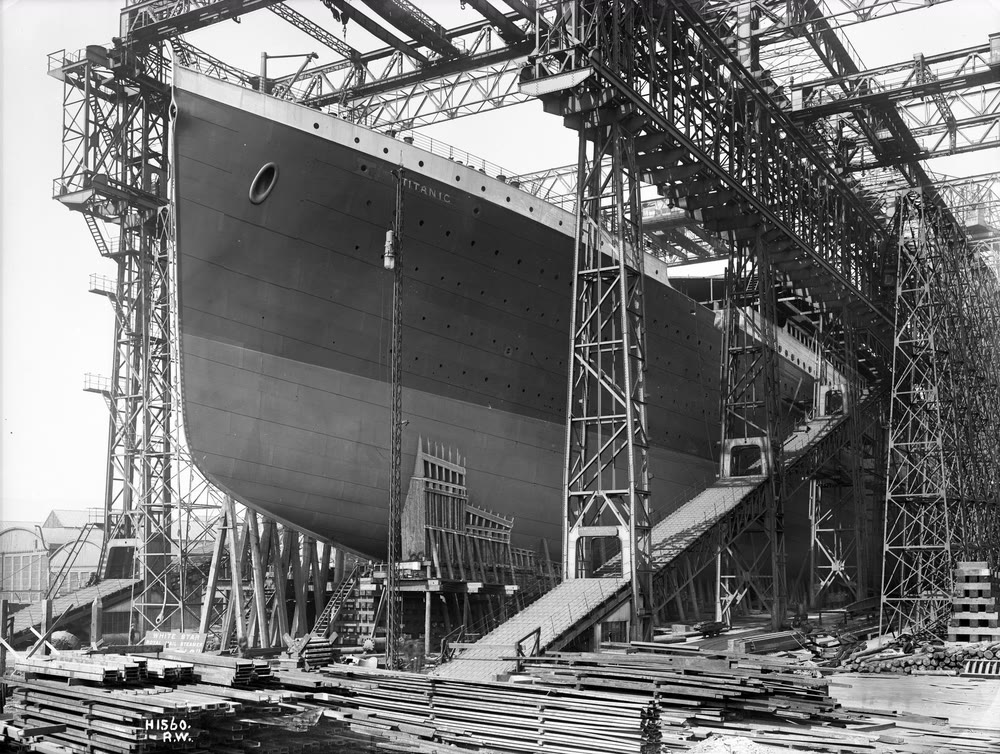
The Titanic in the gantry at Harland and Wolff, Belfast, ready for launch in May 1911. Photo: Robert Welch. Public domain, via Wikimedia Commons
5. As It Should Be
What happens: in a dramatic monologue, one of a gang who have hunted down and shot a man they call mad explains why it was right. He sounds calm and sensible, sure the killing has made the world better for the next generation, and that calm is what makes the poem chilling.
- Background: it comes from Lives (1972), published as the Troubles took hold. The Troubles Archive says the poem mocks the idea that direct violence solves problems.
- Themes: political violence and the excuses made for it; power; irony.
6. A Disused Shed in Co. Wexford
What happens: the poem starts far away, in worked-out mines and empty compounds, then homes in on a locked shed behind a ruined Wexford hotel. Mushrooms have sat there in the dark for decades, reaching for the light of the keyhole. When visitors open the door and a flash goes off, the mushrooms seem to beg for rescue, and Mahon makes them stand for the lost and forgotten people of history.
- Background: dedicated to J.G. Farrell, the novelist, it closed The Snow Party (1975). John Banville rated it the finest Irish poem since Yeats died, Mahon’s Irish Times obituary recalled. My guide to A Disused Shed in Co. Wexford has more.
- Themes: memory and the forgotten; suffering in history; speaking for those without a voice.
- Images to know: the keyhole as their one source of light; the camera flash compared to a firing squad; the cry linking them to Treblinka and Pompeii.
7. Rathlin
What happens: visitors cross by motorboat to Rathlin, now a peaceful refuge for seabirds. The island’s quiet hides a massacre from long ago, while on the mainland the violence of the present lies in wait. As the boat heads back through the spray, the poem ends in real doubt about which way history is heading.
- Background: in July 1575 a force sent by the Earl of Essex under John Norris killed hundreds of people on Rathlin, many of them women and children hidden in caves, records Alfred Webb’s Compendium of Irish Biography (1878). Sorley Boy MacDonnell had sent part of his family there for safety, and watched from the mainland. Mahon uses the Irish form of his name, Somhairle Buí (buí, said BWEE, means yellow).
- Themes: violence and silence; the Troubles in the background; nature’s peace; time.
- Images to know: the shearwaters; the outboard motor breaking the quiet; the lighthouse; the sleeping bombs.
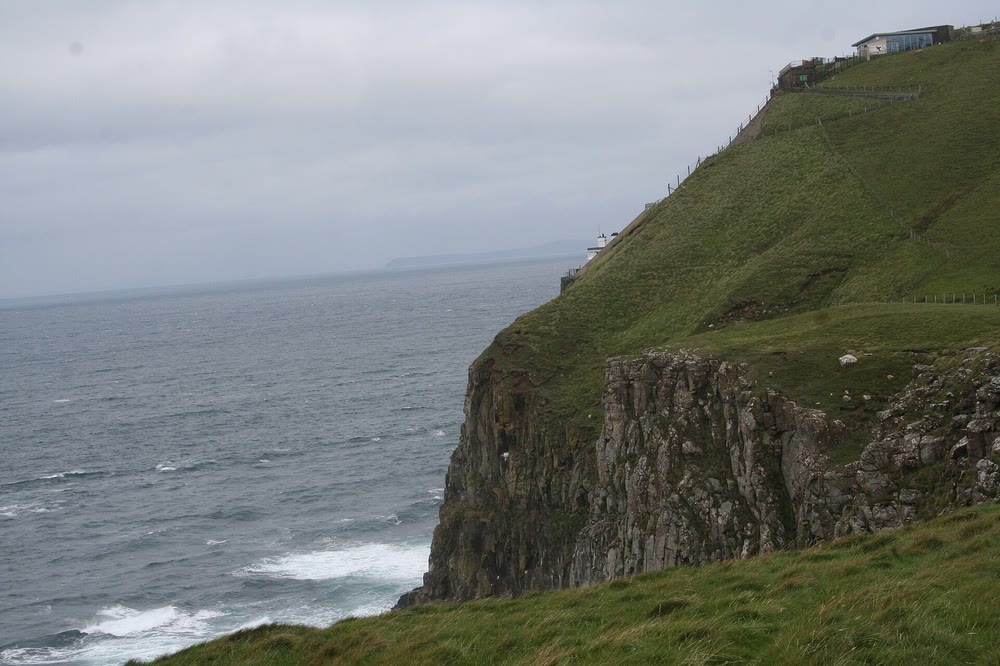
Cliffs at the western end of Rathlin Island, Co. Antrim, near the West Lighthouse. Photo: Mainlymazza, CC BY-SA 4.0, via Wikimedia Commons
8. The Chinese Restaurant in Portrush
What happens: it’s early spring in Portrush, before the summer crowds, and for once the seaside town feels gentle and welcoming. The speaker eats in a Chinese restaurant while the owner looks out from the doorway towards Donegal, thinking of the home he left far away.
- Background: it is one of the new poems at the end of Poems 1962-1978 (1979), Peter Denman notes. Mahon knew the town: Brian Burton’s thesis mentions his unhappy spell at the university in nearby Coleraine and his essay on Portrush and Portstewart.
- Themes: exile and home; two outsiders in one room; hope; the seaside out of season.
- Images to know: the Northern Counties Hotel; the dozing wolfhound; the yacht’s sail; the framed photo of Hong Kong.
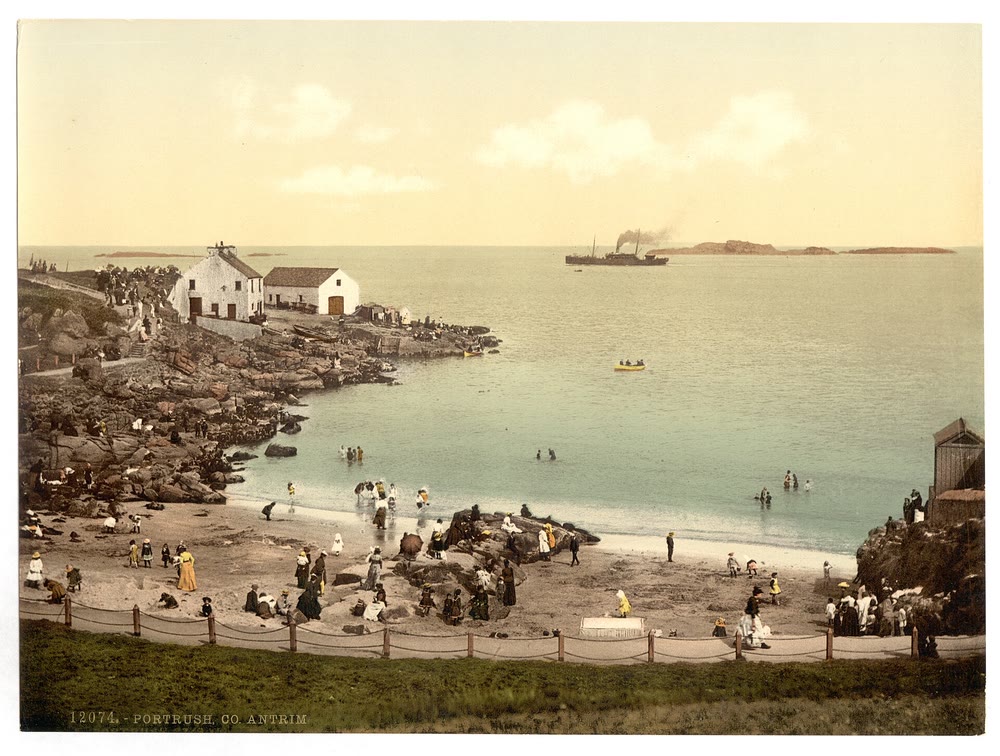
Portrush, Co. Antrim, in a photochrom print made between 1890 and 1900. Library of Congress. Public domain, via Wikimedia Commons
9. Kinsale
What happens: in just seven lines, Mahon sets the dark, heavy rain of the past against a bright, busy present in the Cork harbour town, and ends on a future open to everyone.
- Background: it appeared in Antarctica (1985), nearly two decades before Kinsale became Mahon’s home.
- Themes: change and hope; Ireland’s past and future; weather as mood.
- Think about: what that old rain over church spires and bogs might stand for.
10. Antarctica (Higher and Ordinary)
What happens: on the way back from the South Pole, Captain Lawrence Oates, too weak to keep up, leaves the tent and walks into the blizzard so as not to hold his companions back. In Mahon’s telling, they nod and act as if they don’t understand. Mahon asks whether this quiet self-sacrifice could be called a crime, answers no, and keeps circling back to his refrain: “At the heart of the ridiculous, the sublime” (Derek Mahon, Antarctica).
- Background: Captain Scott’s party reached the Pole on 17 January 1912, after the Norwegian expedition. Scott’s journal, published in Scott’s Last Expedition (1913), records Oates telling his companions he was stepping outside and might be gone for a while. His words are the poem’s other refrain.
- Form: a villanelle: 19 lines built on two repeating refrains.
- Themes: self-sacrifice; heroism and absurdity; dignity in death.
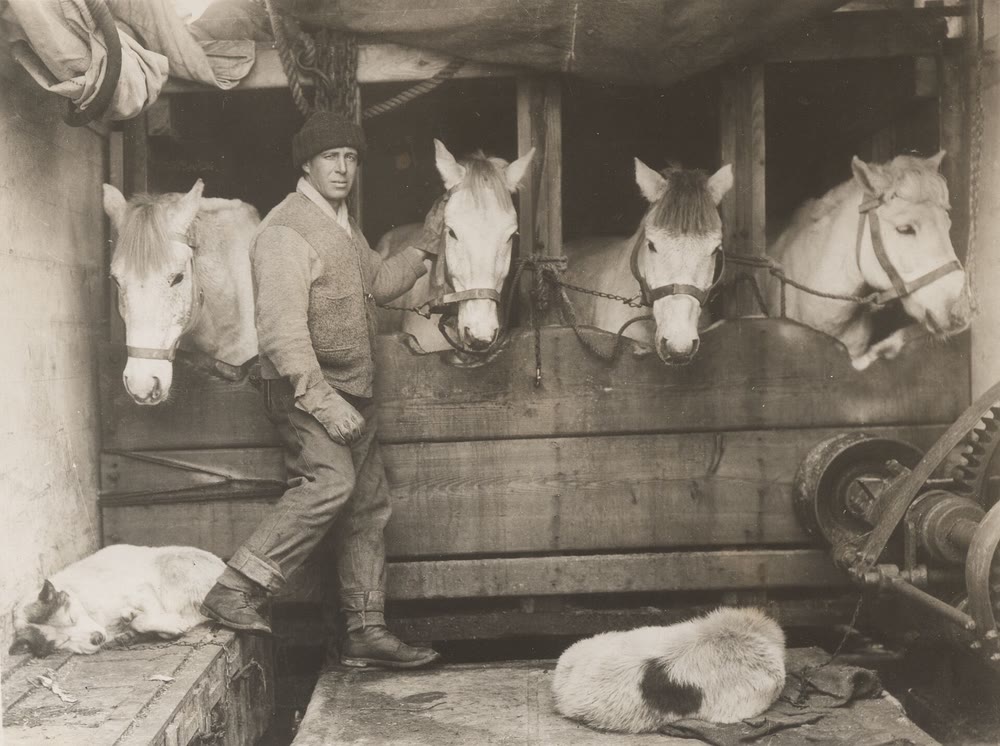
Captain Lawrence Oates with ponies of Scott’s expedition, December 1910. Photo: Herbert Ponting. Public domain, via Wikimedia Commons
Mahon’s Ireland: the places behind the poems
Irish names are from the Placenames Database of Ireland (logainm.ie) and Foclóir.ie, word meanings from Ó Dónaill’s dictionary.
- Belfast, Béal Feirste (roughly bayl FAIR-shtuh): béal is a mouth or approach and fearsaid a sandbank ford in tidal water, so the name means roughly the approach to the tidal ford, the placenames database explains. Mahon’s city, and the shipyard behind Grandfather and After the Titanic. My Belfast guide covers Titanic Belfast, on the slipways where the ship was built.
- Donegal, Dún na nGall (roughly doon nuh NGAHL): dún is a fort and gall a foreigner, so the fort of the foreigners. The setting of Day Trip to Donegal, and the direction the restaurant owner gazes from Portrush.
- Portrush, Port Rois: the name joins port (a landing place, bank or fort) and ros (a headland or promontory). It was the starting point of a pioneering hydroelectric tramway, opened in 1883 and later extended to the Giant’s Causeway.
- Rathlin Island, Reachlainn (roughly RAKH-lin): off the north Antrim coast. The placenames database gives no meaning for the name.
- Wexford, Loch Garman (roughly lukh GAR-mun): the county of the disused shed.
- Kinsale, Cionn tSáile (roughly kyun TAWL-yuh): the name joins cionn (from ceann, a head or headland) and sáile (sea-water). Mahon’s home from 2003. See my County Cork guide.
One for map lovers: the Wild Atlantic Way runs from Donegal’s Inishowen Peninsula to Kinsale, so both of its ends turn up in Mahon’s course poems.
Derek Mahon’s themes and style
- The outsider: Mahon said solitude and community were his great subject, and that he worked best from the margins, his obituary recalls. Think of Ismay, the restaurant owner and the dreamer adrift at sea.
- History’s forgotten victims: the mushrooms in the shed, the Rathlin women, the drowned of the Titanic.
- Violence, told sideways: As It Should Be, Rathlin and Ecclesiastes circle the Troubles without reporting them. For the background, see why Ireland is divided.
- Quiet exits and hope: the grandfather slipping away from everyone and Oates walking into the snow; Kinsale and Portrush in spring.
On style, the obituary called Mahon a strict formalist with little patience for loose free verse. Look at the sonnet in Grandfather, the villanelle in Antarctica, the dramatic monologues in After the Titanic and As It Should Be, and endings that leave a question hanging, as in Rathlin.
Study tips and poem pairings
Nobody can tell you what will come up. The State Examinations Commission publishes past papers and marking schemes free in its exam material archive, so look there to see how poetry questions are asked.
- The forgotten: A Disused Shed in Co. Wexford, Rathlin and After the Titanic.
- Northern voices of certainty: Ecclesiastes and As It Should Be.
- Sea and place: Day Trip to Donegal, The Chinese Restaurant in Portrush and Kinsale.
- Two men of 1912: After the Titanic and Antarctica. One saved himself; the other gave himself up.
- Across the course: set As It Should Be beside Yeats’s The Stare’s Nest by My Window (violence close to home), Rathlin beside Kavanagh’s Epic (big history seen from a small place), and A Disused Shed beside Paula Meehan’s Them Ducks Died for Ireland (history’s overlooked victims).
Every poet on the course is in my Leaving Cert English poetry guide. Doing Irish too? See my guide to the Leaving Cert Irish poems.
Derek Mahon Leaving Cert FAQ
Is Derek Mahon on the Leaving Cert in 2028?
No. He’s a Higher Level poet for June 2027 only. His poems aren’t on the 2028 Higher or Ordinary Level lists (circular 0024/2026).
Which Derek Mahon poems are on Ordinary Level?
Grandfather, After the Titanic and Antarctica, for June 2027. The Ordinary Level list spells the last one Antartica.
How many Mahon poems should I learn?
The circular says Higher Level students should have studied a minimum of six poems per poet. Knowing one or two more gives you extra choice.
What is Derek Mahon’s most famous poem?
A Disused Shed in Co. Wexford. His Irish Times obituary called it his most celebrated poem, and the Poetry Foundation singles it out as the standout of The Snow Party.
Who is the speaker in After the Titanic?
J. Bruce Ismay, who ran the White Star Line. He survived the sinking in a lifeboat and lived much of his later life in seclusion.
Love this? Save it to your Pinterest board for later.
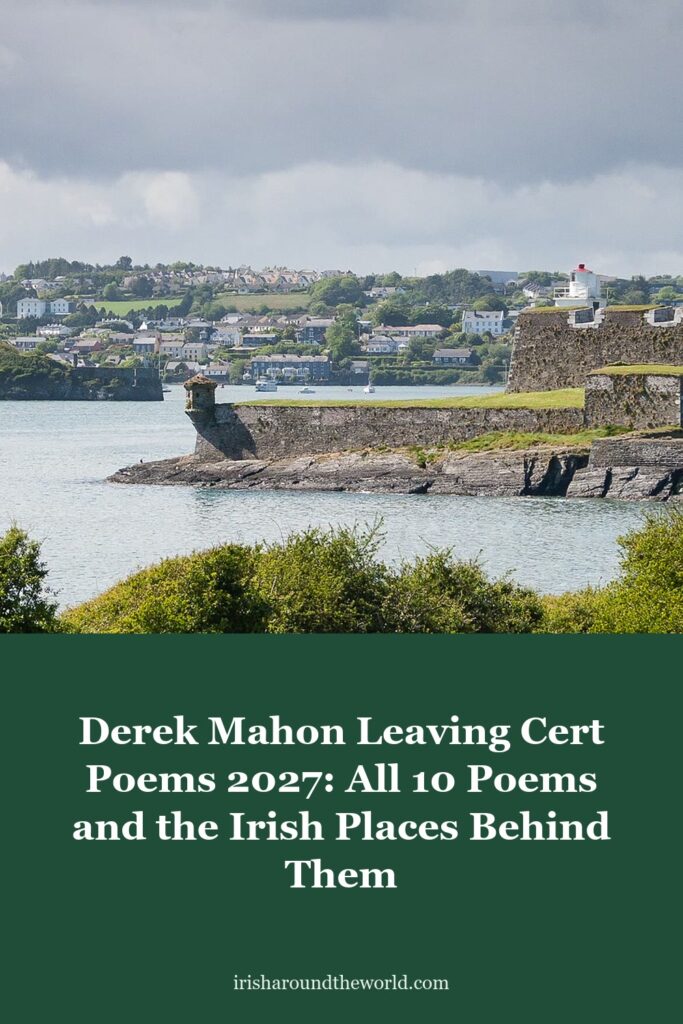
Pin image: Charles Fort, with Kinsale in the background, Co. Cork. Photo: JoachimKohler-HB, CC BY-SA 4.0, via Wikimedia Commons
A little bit of Ireland in your inbox every Friday ☘️
The free Weekly Dose of Irish: an Irish joke, a Celtic symbol, an Irish fact, a poem and the week’s best articles in one short email. Join 9,600+ readers.
Free. One short email every Friday. Unsubscribe any time.
More Leaving Cert poetry
- Leaving Cert English Poetry 2027 and 2028: Every Poet and Poem, Explained
- After the Titanic by Derek Mahon: The Poem in Bruce Ismay’s Voice, Explained
- Yeats Leaving Cert Poems 2027 and 2028: All 13 Poems, With Notes
- Paula Meehan Poems for Leaving Cert English 2027 and 2028: Summaries and Themes
- Leaving Cert Irish Poems 2027 and 2028: The Full List, Explained
Featured image: Charles Fort, with Kinsale in the background, Co. Cork. Photo: JoachimKohler-HB, CC BY-SA 4.0, via Wikimedia Commons.