
Dublin coddle is a one-pot stew of pork sausages, rashers (back bacon), onions and potatoes, simmered gently in water with parsley and pepper. It’s the capital’s own dish, traditionally a Saturday-night supper, and Dubliners still argue over pale “white” coddle versus “brown” coddle made with a stock cube. This Dublin coddle recipe serves 4 to 6 and takes about 1 hour 40 minutes. Oven, slow cooker and Dutch oven methods follow it.
Nobody ever made coddle for its looks. It’s pale sausages and soft potatoes in a cloudy broth, and plenty of Dubliners will tell you that’s exactly how it should be.
Máirtín Mac Con Iomaire, then a lecturer in culinary arts at the Dublin Institute of Technology, told the Dublin Inquirer in 2017 that coddle is “a city man’s Irish stew”, made with rashers and sausages where the country used mutton or lamb. Here’s how to make it four ways, followed by the arguments, the odd name and the tenement history. For the country cousin, see my Irish stew recipe.
Jump to:
- Dublin coddle recipe
- Browned, oven, slow cooker and Dutch oven coddle
- Pale or browned? The great coddle argument
- Barley, carrots and cabbage: the disputed extras
- What does coddle mean?
- Coddle history: tenements, Thursdays and Saturday nights
- Swift, O’Casey and Joyce: what’s true?
- Storing and reheating coddle
- Dublin coddle FAQ
- More Irish recipes
Dublin coddle recipe
This is a classic pale coddle made on the hob, in metric and US measures. A quick boil firms up the sausages and gives you a light broth for the pot.
Prep: 20 minutes | Cook: 1 hour 20 minutes | Serves: 4 to 6
Ingredients
- 8 Irish-style pork sausages (about 450g, 1 lb)
- 8 back rashers (about 300g, 10 oz), each cut into 3 pieces
- 2 large onions, thinly sliced
- 1kg (2¼ lb) floury or all-purpose potatoes, such as Rooster in Ireland or Yukon Gold in the US, peeled
- A large handful of fresh parsley, chopped
- Black or white pepper, and salt to taste
- 1 litre (about 4 US cups) water
Method
- Put the sausages and rasher pieces in a large pan, cover with the water and bring to the boil. Simmer for 5 minutes, skimming off any froth, then lift out the meat and keep the cooking liquid.
- Cut the potatoes into large chunks, about the size of an egg. Leave a few smaller pieces: they’ll break down and thicken the broth.
- In a heavy pot or casserole, layer half the onions, half the potatoes and half the meat, with a good scattering of parsley and pepper. Repeat with the rest.
- Pour in enough of the cooking liquid to almost cover, about 750ml (3 US cups). Lay a sheet of baking paper (parchment) on top, then the lid.
- Bring just to a simmer, then turn the heat right down so it barely bubbles. Cook for 1 hour to 1 hour 15 minutes, until the potatoes are soft and the sausages are cooked through.
- Taste the broth and add salt only now, as rashers can be salty. Serve in wide bowls with plenty of broth and more parsley.
Tips
The rashers. Irish back rashers have an eye of lean loin with a strip of fat. In the US, back bacon or thick Canadian-style bacon is closest; heavily smoked streaky bacon takes over the pot. My full Irish breakfast guide explains rashers versus American bacon, and where to find Irish rashers abroad.
The sausages. Use mild pork sausages, not maple or spicy ones. Some Irish butchers sell ready-made coddle packs.
Keep it gentle. To coddle is to cook just below the boil; a hard boil turns the potatoes to mush. Theresa Daly of T.J.’s Coffee Bar on Parnell Street, who made coddle for winter regulars, warned that potatoes added too early leave you with sausage soup. If yours are very floury or small, tuck them in 20 minutes into the simmer.
Is it cooked? Coddled sausages stay pale and can look a little pink. Check one is piping hot in the middle: the Food Safety Authority of Ireland says the core of cooked food should reach 75°C (167°F).
To serve. Dublin City Libraries says Dubliners like it with soda bread and a pint of Guinness. Try my Irish soda bread recipe or Irish brown bread, with plenty of butter.
Browned, oven, slow cooker and Dutch oven coddle
Browned coddle
Skip the 5-minute boil. Brown the sausages in a tablespoon of oil for 8 to 10 minutes, add the rashers for 2 or 3 minutes, then soften the onions in the fat. Layer as above and pour over 750ml (3 US cups) of hot water or light stock. A crumbled beef stock cube gives you the darker “brown coddle” some Dubliners grew up with.
Oven coddle
Layer it in a casserole with a tight lid, pour in the hot cooking liquid and cook at 150°C (130°C fan, 300°F, gas 2) for 1½ to 2 hours, until the potatoes are tender.
Slow cooker coddle
Boil or brown the sausages and rashers first, and use them straight away. Put the potatoes in the bottom, then the onions and meat, and add hot liquid to just below the top layer. Keep the cooker half to two-thirds full and the lid on. University of Maine Extension advises starting on high for the first hour; then cook on low for 5 to 6 hours, until the potatoes are tender.
Dutch oven coddle
Brown the meat and onions in the Dutch oven itself, then layer, add hot water and cover. Simmer on the lowest heat for about 1 hour 15 minutes, or bake at 150°C (300°F) for 1½ hours.
Pale or browned? The great coddle argument
In 2017 the Dublin Inquirer’s Cónal Thomas went looking for the “right” coddle and found three.
- White coddle is the plain version: sausages, rashers, onions and potatoes in water, with no stock. Theresa Daly browned her sausages and bacon slightly, and hers still counted as a classic white.
- Brown coddle adds an Oxo cube, beef stock or oxtail soup. Bernie Pierce, who managed a day centre on Sean McDermott Street, made hers brown from her mother’s recipe, partly to hide the pale, poached look, and cooked a pot every Christmas morning before a day of visiting graves.
- Black coddle was never a choice. In tenement rooms, soot from the fire sometimes fell into the pot, said Terry Fagan of the North Inner City Folklore Project, and hungry people ate it anyway.
It even divides neighbourhoods. To wind up a Ringsend docker, said Declan Byrne of the Dublin Dockworkers Preservation Society, you only had to mention brown coddle. At one city council coddle night, East Wall people leaned brown and Ringsend people white.
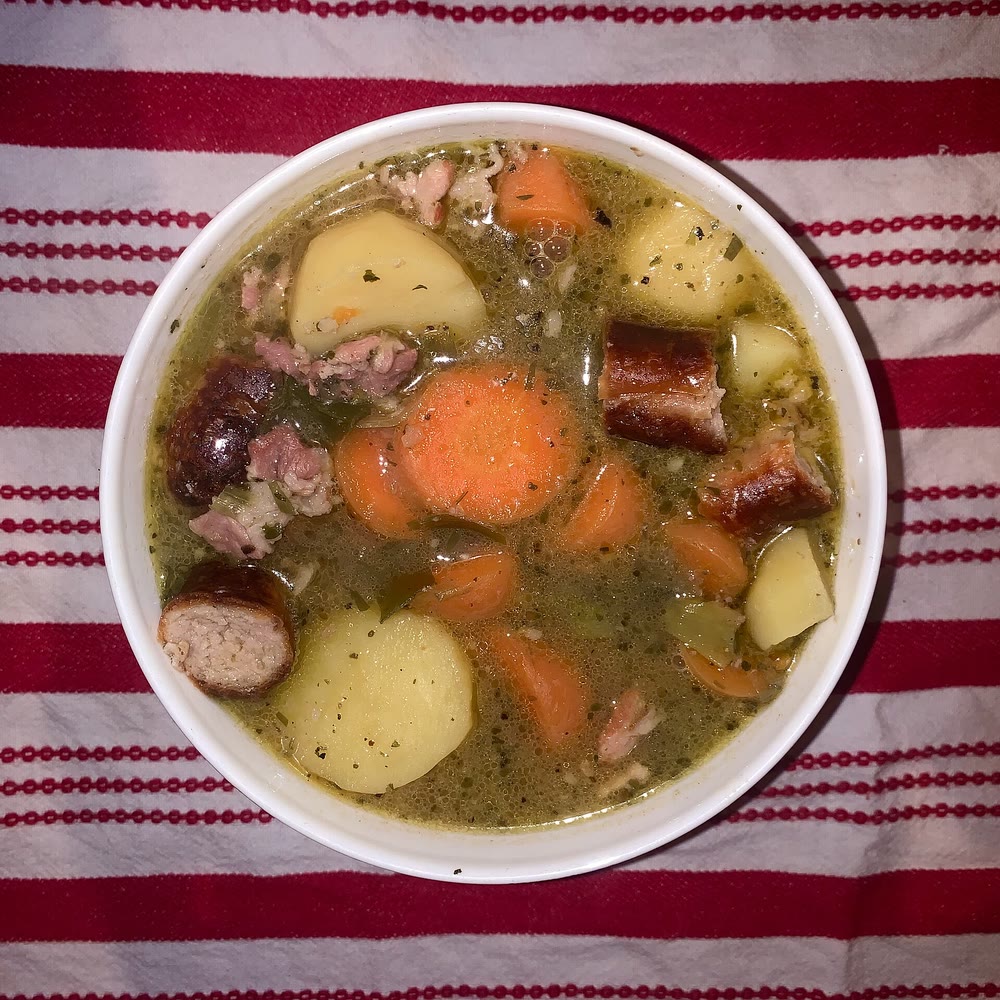
So the real dividing line is the stock cube, not the frying pan. The recipe above works either way, and as Pierce put it, people cook what they were reared with.
Barley, carrots and cabbage: the disputed extras
Carrots. Dublin City Libraries’ history blog says traditional coddle had no carrots. Plenty of cooks add them anyway: Theresa Daly put little carrots in hers, and Mac Con Iomaire’s recipe had carrots and celery, finished with leeks and a drop of cream. Irish stew has its own carrot argument, as it happens.
Barley. Mac Con Iomaire mentioned versions with pearl barley or dumplings. To try it, rinse 50g (¼ US cup) of pearl barley and add it with the liquid and an extra 250ml (1 US cup) of water.
Cabbage. A schools worksheet from the 14 Henrietta Street tenement museum describes coddle with sausages, bacon and cabbage. And the word wasn’t always a Dublin one. In Maura Laverty’s 1942 novel Never No More, set in a village modelled on her native Rathangan, Co. Kildare, washing-day coddle is thick pieces of bacon, cabbage hearts, carrots and potatoes left to simmer in the pot oven, with no sausage at all. For that mix, there’s always bacon and cabbage.
Tomatoes and ribs. Pierce said some cooks add these too.
What does coddle mean?
In English cookery, to coddle is to cook something gently in liquid just below the boil, the sense Merriam-Webster gives first. Older cookbooks used it for fruit: Sarah Jackson’s The Director (1754) tells you to coddle soft apples and gooseberries.
Merriam-Webster suggests the verb may come from caudle, a warm drink of ale or wine thickened with bread or gruel for invalids, ultimately from the Latin calidus, warm. The pampering sense may be unrelated, it adds.
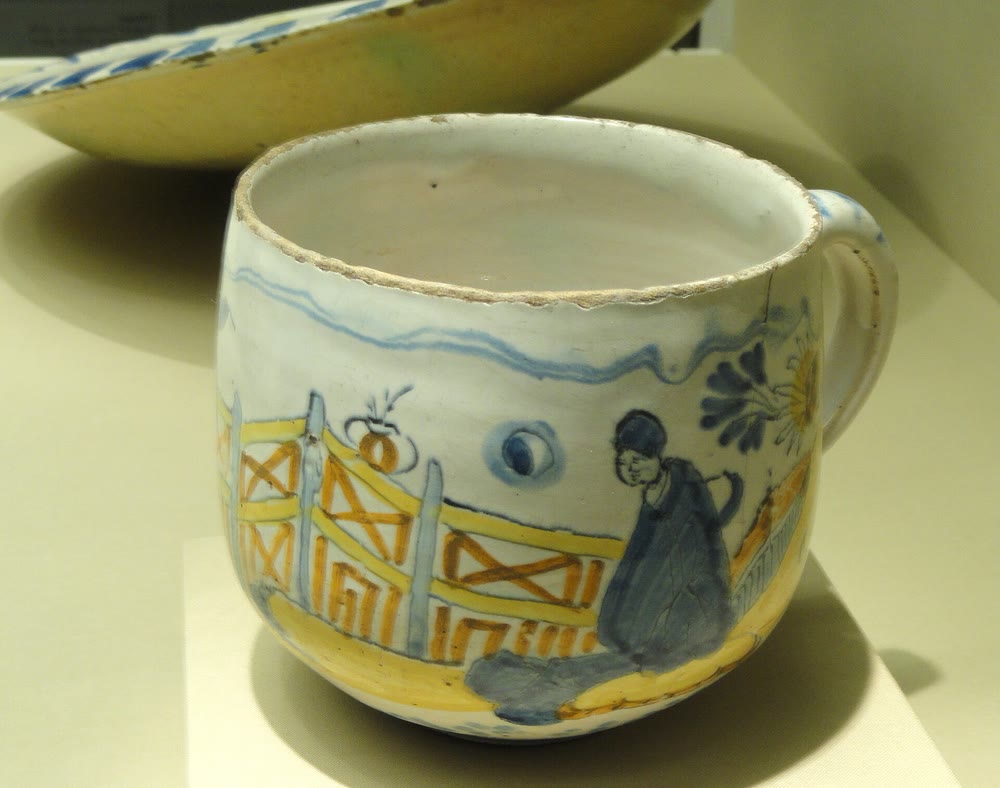
A pottery caudle cup made in London about 1685, in the Nelson-Atkins Museum of Art. Photo: Daderot, CC0, via Wikimedia Commons
In Irish, the Dublin dish is cadal (roughly KAD-ul), the word focloir.ie gives, and its example is babhla de chadal Bhaile Átha Cliath, a bowl of Dublin coddle (roughly BOW-luh deh KHAD-ul WAL-yeh AW-ha KLEE-uh; Munster speakers say VAL-yeh). Cadal isn’t in Ó Dónaill’s 1977 dictionary, so it looks like a recent borrowing from English. A sausage is ispín (ISH-peen, or ish-PEEN in Munster) and a rasher is slisín (SHLISH-een, or shlish-EEN in Munster).
Coddle history: tenements, Thursdays and Saturday nights
In a 2010 paper, The Pig in Irish Cuisine and Culture, Mac Con Iomaire calls coddle the city’s most famous dish, built on Dubliners’ long love of sausages and rashers.
Coddle, he writes, was by tradition a Saturday-night meal, ready for the men coming home from the pubs, probably after a few pints of plain. Dublin City Libraries adds a Thursday version: a way to use up the last of the meat before the Catholic meatless Friday. Either way, it was often made early in the day and reheated later.
One pot, one fire
It suited the tenements. At 14 Henrietta Street, a Georgian townhouse carved into 19 flats in 1876, about 100 people lived there by 1911, often a family to a room, sharing an outside tap and toilet. Former residents’ memories collected by the museum include coddle.
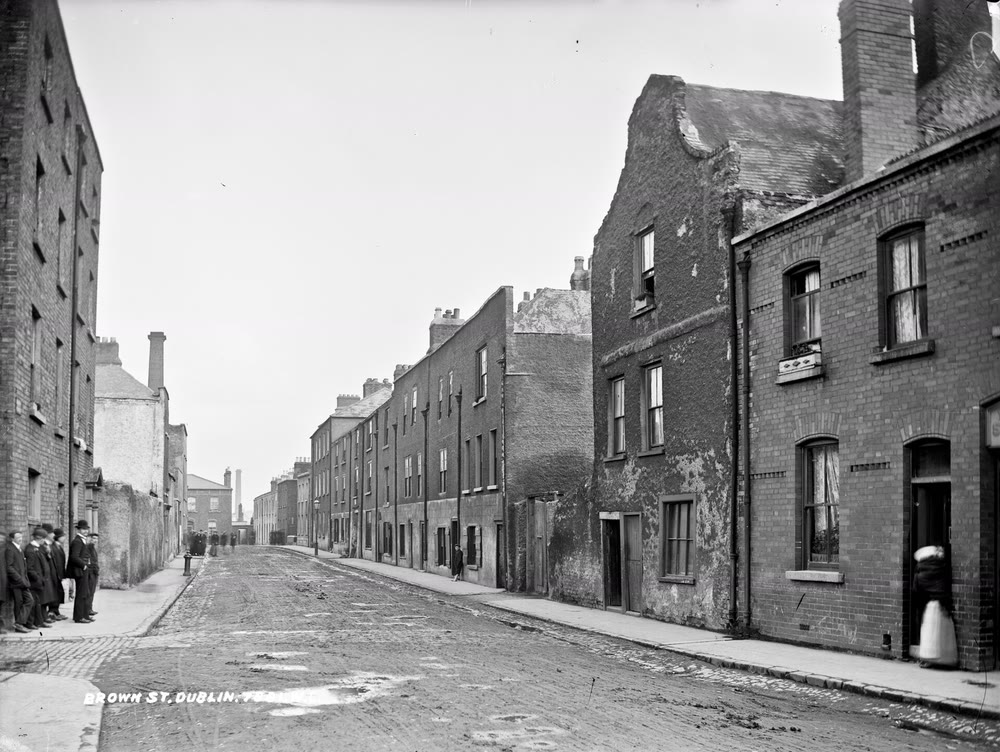
Brown Street, Dublin, photographed for the Lawrence Collection between about 1865 and 1914. Photo: Robert French, National Library of Ireland, public domain, via Wikimedia Commons
It wasn’t always the bottom of the barrel, though. In 1980 the National Folklore Collection’s Urban Folklore Project recorded Mary Spencer of Ringsend describing her coddle: bacon bits, because ham rashers cost too much, big beef sausages and two Spanish onions, simmered together. Potatoes went in only if you could afford them; otherwise you ate it with bread. Tea was often just bread and butter, so “if you had a coddle you were well off”. Her words are quoted in the free, open-access Irish Food History: A Companion (2024). Another chapter recalls very salty coddle sold in pubs in Dublin’s markets district, probably to make drinkers thirstier.
For others it brought back hard times. Mac Con Iomaire first learned coddle about 30 years before he spoke to the Dublin Inquirer, from the mother of a friend, raised near Sheriff Street. She rarely cooked it, he said: it reminded her too much of being poor.
How old is coddle?
Nobody really knows. Word has it the dish began among sailors in Ringsend, Mac Con Iomaire said, but that’s lore. So is the claim, repeated on the Dublin City Libraries blog without a source, that it dates from a famine in the 1700s. Theodora FitzGibbon, in A Taste of Ireland (1968), assumed the earliest coddles used leeks and oatmeal, with potatoes and onions taking over from the 1700s: a reasonable guess, not a documented fact.
By the 1960s, at least, it was firmly an old-Dublin dish. Monica Sheridan’s The Art of Irish Cooking (1965) calls it the dish of families who had lived in Dublin for generations, and adds that Brendan Behan’s mother still made it.
Swift, O’Casey and Joyce: what’s true?
Coddle is often called a favourite of Jonathan Swift, Seán O’Casey and James Joyce. Here’s what holds up.
- Swift: the story goes back at least to Sheridan, who wrote that Dean Swift ate coddle in the deanery of St Patrick’s Cathedral. That’s a 1960s cookbook claim, made over 200 years after Swift died in 1745: Dublin lore.
- O’Casey: Sheridan says he ate it, and Dublin City Libraries calls coddle a reputed favourite of his. Neither quotes O’Casey himself.
- Joyce: Dublin City Libraries says coddle turns up in his works, but the dish isn’t in Dubliners or Ulysses; a search of both finds only “mollycoddle” in Ulysses. It does have Denny’s sausages, on the shopping list of the girl next door at the pork butcher’s where Leopold Bloom buys his breakfast kidney, and Mac Con Iomaire says Joyce would only welcome callers from Ireland who arrived with Irish sausages and whiskey. Finnegans Wake plays with the word, including a “coddle pot” on page 593, but that’s wordplay, not supper.
Storing and reheating coddle
Coddle was made to be reheated, so it keeps well. Safefood advises getting leftovers covered and into the fridge within 2 hours of cooking. The FSAI says to use them within 2 to 3 days and reheat them only once, to 70°C (158°F) or higher, letting a stew’s liquid boil for 3 to 5 minutes. Use a pan, not a slow cooker: University of Maine Extension says slow cookers shouldn’t be used for reheating.
Dublin coddle FAQ
What is Dublin coddle made of?
Pork sausages, rashers (back bacon), onions and potatoes, layered with parsley and pepper and simmered in water. Some cooks add carrots, barley or a stock cube.
Why is it called coddle?
From the cooking verb to coddle, meaning to cook gently just below the boil. It may come from caudle, an old warm drink for invalids.
Should you brown the sausages for coddle?
It’s up to you. The old white coddle is simply simmered, but plenty of cooks brown the sausages lightly. In Dublin’s white-versus-brown argument, it’s a stock cube that makes a coddle “brown”.
Can you make Dublin coddle in a slow cooker?
Yes. Boil or brown the meat first, start on high for an hour, then cook on low for 5 to 6 hours.
What’s the difference between coddle and Irish stew?
Irish stew is lamb or mutton with potatoes and onions. Coddle swaps in sausages and rashers: the city man’s version, as Mac Con Iomaire put it.
What do you serve with Dublin coddle?
Soda bread or brown bread and butter, for the broth. A pint is traditional, but tea does fine.
Love this? Save it to your Pinterest board for later.
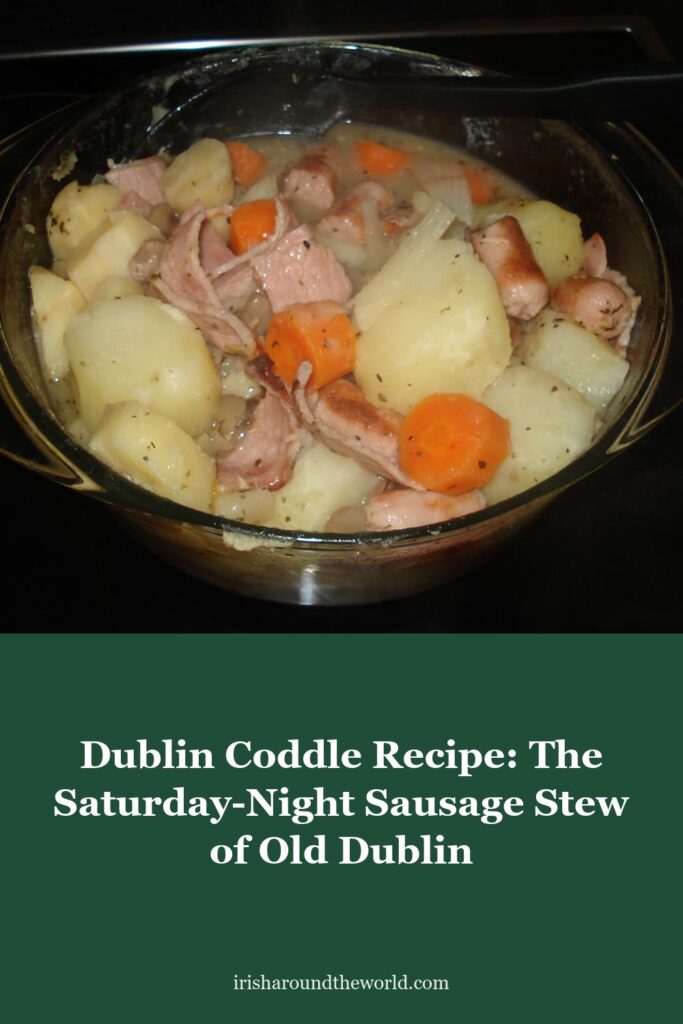
Pin image: Coddle baked in the oven, with carrots. Photo: Coddle head at English Wikipedia, CC BY-SA 3.0, via Wikimedia Commons
A little bit of Ireland in your inbox every Friday ☘️
The free Weekly Dose of Irish: an Irish joke, a Celtic symbol, an Irish fact, a poem and the week’s best articles in one short email. Join 9,600+ readers.
Free. One short email every Friday. Unsubscribe any time.
More Irish recipes
- Irish Stew Recipe: The Real Lamb-and-Potato Stew (and the Great Carrot Argument)
- Full Irish Breakfast: What Goes on the Plate and How to Get It All Hot at Once
- What Is Black Pudding? Ireland’s Blood Sausage, White Pudding and How to Cook Them
- Irish Soda Bread Recipe: The 4-Ingredient Loaf With a Cross to Keep the Fairies Away
- Irish Brown Bread Recipe: The No-Yeast Wholemeal Loaf (Plus a Guinness and Treacle Version)
- Colcannon Recipe: The Irish Halloween Mash That Hides Your Fortune
- Boxty Recipe: The Irish Potato Pancake That Came With a Marriage Warning
- Traditional Irish Bacon and Cabbage (With a Wonky Twist)
Featured image: Coddle baked in the oven, with carrots. Photo: Coddle head at English Wikipedia, CC BY-SA 3.0, via Wikimedia Commons.