
The Celtic cross meaning starts with faith: it’s a Christian cross with a ring around the point where the arms meet. Ireland’s great stone high crosses were made for monasteries from about the 8th to the 12th century, covered in Bible scenes. Nobody knows for sure why the ring is there. Today the shape stands for faith, Irish heritage and remembrance.
Drive through any Irish town and you’ll pass a Celtic cross before you pass a chipper, our word for a chip shop. They’re on headstones, church gables and the necks of half the country’s grandmothers.
Most of us grow up with them and never ask what they mean. So I asked. This page covers what a Celtic cross is, where the shape came from and the medieval high crosses you can still stand beside in Ireland.
I’ve marked clearly what is known, what is theory and what is pure legend. There’s a fair bit of all three.
Jump to:
- What is a Celtic cross?
- Ireland’s high crosses
- Celtic cross meaning: what does it symbolise?
- Why the ring? Four theories
- The St Patrick legend
- The Celtic Revival and Irish graves
- Celtic cross tattoos and jewellery
- Celtic cross or sun cross? A note on misuse
- Where to see high crosses in Ireland
- Celtic cross FAQ
- More Celtic symbols and Irish reading
What is a Celtic cross?
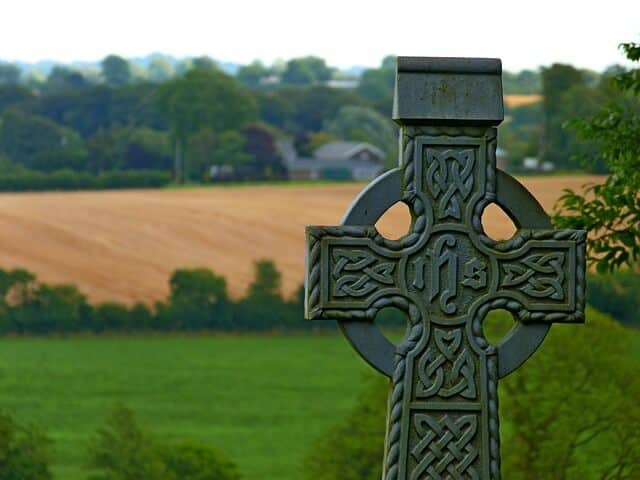
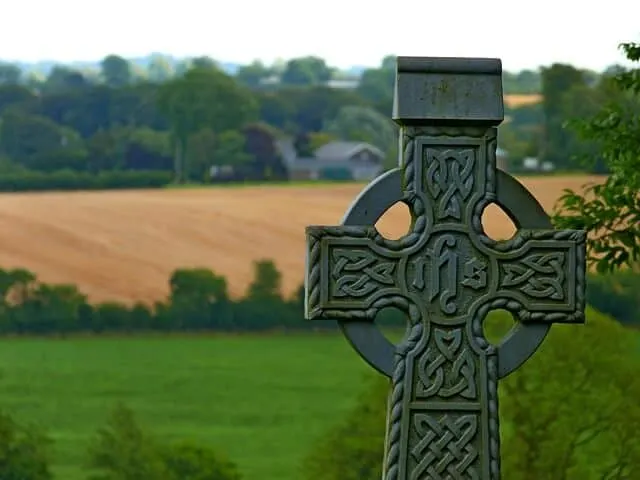
A Celtic cross headstone with knotwork and the IHS monogram, looking out over Irish farmland
A Celtic cross is a Latin cross with a ring around the crossing. A Latin cross is the ordinary Christian cross, with a long lower shaft and shorter arms.
The ring joins the four arms where they meet. Scholars call it the nimbus, the Latin word for a halo.
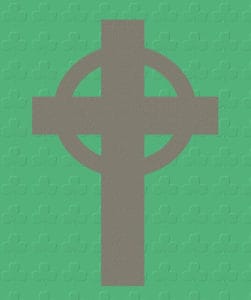
The basic shape: a long shaft with a ring around the crossing
A full stone cross usually has three parts. There’s a base, often stepped or shaped like a small pyramid. Then comes the shaft, and finally the head with its ring. Knotwork, spirals and carved figures are common, but none are required.
Why “Celtic”?
The people who made the originals didn’t call them Celtic crosses. That name seems to have caught on during the 19th-century Celtic Revival. In Ireland the big medieval ones are called high crosses.
Ringed crosses also turn up in Scotland, Wales and Cornwall. Iona, the island monastery off western Scotland, has some fine early examples.
Ireland’s high crosses
A high cross is a large, freestanding stone cross from early medieval Ireland. The Office of Public Works (OPW), the Irish state body that minds national monuments, says about 250 survive.
According to its Heritage Ireland site, they appeared from around the 9th century and carried on into the 12th. The Anglo-Norman arrival in the late 12th century marked, in its words, “the beginning of the end”.
The tallest stands over six metres, more than 20 feet.
One thing surprises people. The originals were never grave markers. Heritage Ireland says they marked the bounds of sacred land, showed off the power of kings and abbots, and taught the Bible in stone.
Most stood at monastic sites. Some historians compare the bigger early monasteries to small towns.
Ahenny, Co. Tipperary
First, a quick note for overseas readers: Co. is short for County.
Two sandstone crosses stand in the old graveyard at Kilclispen, about 7km (4 miles) from Carrick-on-Suir. The OPW dates them to the 8th century, though other experts place them later. “8th or 9th century” is the honest answer.
The North Cross is 3.65m (12 ft) and the South Cross 3.35m (11 ft). Each wears a cone-shaped cap. The OPW says the taller one, on the North Cross, may represent a bishop’s mitre, his tall pointed hat.
The carving copies metalwork, with raised bosses like studs and patterns like binding strips. Heritage Ireland calls them metalwork crosses “translated into stone”. The OPW says they replaced earlier wooden crosses.
Moone, Co. Kildare
Moone stands out from the crosses above. It’s carved from granite, like several crosses in the Barrow valley. Its figures are charmingly simple, almost like cartoons.
The OPW believes it dates to the 8th century and gives its height as 5.4m (nearly 18 ft).
Its base shows the 12 Apostles in three neat rows beneath a Crucifixion. Daniel in the lions’ den and the loaves and fishes are there too.
Its pieces were found in 1835 and 1893, and the rebuilt cross now stands under a glass roof.
Kells, Co. Meath
Yes, that Kells, of the Book of Kells. The Iona community moved here after Viking raids on their island. The OPW says Columba’s relics came from Iona in 878.
The OPW counts five crosses at Kells, one now little more than a base. The South Cross, or Cross of Patrick and Columba, stands in St Columba’s churchyard.
Its base is said to carry a Latin inscription naming Patrick and Columba. The weather has worn it badly, so you’ll have to take that on trust.
The Market Cross has had a rough few centuries. A school bus once hit its base. After conservation, it was moved to stand in front of the old courthouse.
Clonmacnoise, Co. Offaly
St Ciarán founded Clonmacnoise on the River Shannon shortly before his death in 549, says the National Monuments Service. It became one of Ireland’s great monasteries.
Its star is the Cross of the Scriptures. Abbot Colmán and Flann Sinna, high king of Ireland, commissioned it around 909. A high king was the most powerful of Ireland’s many kings, at least on paper.
Weather was eating the sandstone, so the original was moved into the visitor centre. The National Monuments Service calls the replica outside “a convincing copy”, which is about as warm as archaeologists get.
Monasterboice, Co. Louth
If you see one high cross, make it this one. Muiredach’s Cross at Monasterboice is 5.5m (18 ft) tall, complete and crowded with carved Bible scenes.
The inscription at its base asks for a prayer for Muiredach. He was most likely the abbot Muiredach, who died in 923 or 924. The OPW gives 924. So the cross probably dates from the early 900s.
Look out for the two cats at the foot of the shaft.
Its neighbour, the Tall Cross, is 6.5m (21 ft). The OPW says it’s the tallest high cross in Ireland. The National Monuments Service gives 7m, so even the experts measure differently.
Celtic cross meaning: what does it symbolise?
It’s a Christian cross first. The high crosses were made for monasteries and paid for by abbots and kings. The cross stood for Christ’s death and resurrection. Everything else is extra.
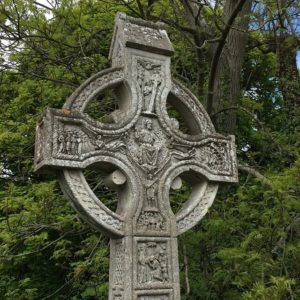
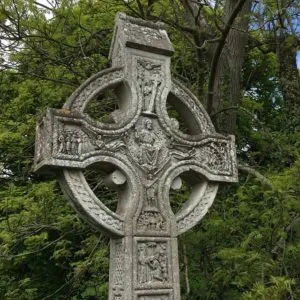
A carved ringed cross head with biblical figure panels, Christ at the centre
Most high crosses show Bible stories, such as Adam and Eve, Cain and Abel, and the Crucifixion.
Were they preaching crosses?
You’ll often read that monks used high crosses to teach the Bible to people who couldn’t read. Heritage Ireland does say their main purpose was “to teach the Bible’s message”.
Not everyone agrees on who was being taught. The art historian Roger Stalley of Trinity College Dublin has argued that the carvings were made for an educated audience. On that view, the picture of crowds gathered round a cross is more Victorian than medieval.
The modern meanings
Heritage Ireland says high crosses “have become an emblem of Celtic identity”. For many Irish families abroad, a Celtic cross says faith and home in one shape.
You’ll also see claims that the ring means eternity, or that the arms mean the four elements. These are modern readings. They may mean something to you, which is fine, but no medieval source backs them.
Why the ring? Four theories
Everyone asks this. Nobody knows. Heritage Ireland says plainly that “opinions still remain divided”. Treat each of these as a theory.
1. It holds the arms up
Stone arms sticking out sideways can snap. The ring cuts down the length of stone arm with nothing under it. Heritage Ireland accepts the ring had a structural purpose.
2. It’s left over from wooden crosses
Early crosses were often wood or metal. A wooden cross might need struts to brace its arms, and the theory says the ring copies them in stone. The OPW says Ahenny’s crosses replaced wooden ones, which at least shows wooden crosses came first.
3. It’s a halo or the heavens
The scholars Michael Herren and Shirley Ann Brown link the ring to earlier Christian ringed crosses and a cosmic cross in early church writing. One such work, Sedulius’s poem Carmen Paschale, was known in Ireland by the 7th century.
Heritage Ireland suggests the ring may also have stood for the cosmos, with the Crucifixion at its centre.
4. It’s a sun symbol
This is the popular favourite. It says the ring is a pagan sun brought into Christian art. At Moone, the OPW does describe a spiral sun and a lozenge on the head as pre-Christian sun symbols.
But a few sun motifs don’t prove the whole ring is a sun. Heritage Ireland favours a structural purpose, perhaps combined with a symbol of the cosmos.
The St Patrick legend
The story goes like this. St Patrick was preaching to pagans who worshipped the sun. To win them over, he drew a cross through a sun circle, joining the old belief to the new.
It’s a lovely story, and it’s on plenty of gift-shop labels.
It’s a legend, not history. Patrick’s mission was in the 5th century. The earliest stone ringed high crosses date from the 8th or 9th century, some 300 years later.
For the real man, see my piece on the real story behind St Patrick’s Day.
The Celtic Revival and Irish graves
So how did a medieval monument end up on every second headstone? Blame the Victorians, in the nicest way.
In the 19th century, the Celtic Revival brought a surge of interest in early Irish art, language and history. The high crosses became a national emblem as well as a religious one.
Artists and antiquarians drew and recorded the old crosses. In 1857 the artist Henry O’Neill published Illustrations of the Most Interesting of the Sculptured Crosses of Ancient Ireland.
Glasnevin Cemetery, Dublin
Glasnevin opened in 1832 after a campaign by Daniel O’Connell. More than 1.5 million people are buried there, according to Glasnevin Trust.
The National Inventory of Architectural Heritage says its Celtic crosses reflect a style that grew “in the context of developing scholarship and nationalist sentiment”. In other words, a quiet statement of Irishness.
Walk its older paths and you’ll see ringed crosses in every direction. It’s the Revival in stone.
From monument to headstone
The medieval crosses weren’t grave markers, but the Revival made the shape Ireland’s favourite headstone. Emigrants carried the habit around the world.
In the US, the Department of Veterans Affairs lists two versions among its emblems of belief for government headstones: a Celtic Cross and a Catholic Celtic Cross.
Celtic cross tattoos and jewellery
The Celtic cross has been popular jewellery since the Revival. On Iona, Alexander and Euphemia Ritchie made jewellery from about 1899, based on the island’s carved stones.
Today you’ll find Celtic cross pendants and rings in every Irish gift shop. If you’re shopping, my guide to Irish gifts has ideas.
Celtic cross tattoo meaning
There’s no official meaning, whatever some websites claim. But people tend to choose one for a few common reasons.
- Faith. It’s a Christian cross first.
- Heritage. It’s a strong sign of Irish, Scottish or Welsh roots.
- Remembrance. Because of its place on headstones, many use it to remember a parent or grandparent.
Many designs mix in other symbols.
The thistle is Scotland’s national flower, so this one points to Scottish roots.
This one puts a trinity knot, or triquetra, at the centre.
One tip if you’re getting inked: choose a cross with a clear long shaft. The next section explains why.
Celtic cross or sun cross? A note on misuse
A sun cross, or wheel cross, is a circle with an equal-armed cross inside it. It’s far older than Christianity. A Celtic cross has a long shaft, with the ring only around the crossing.
Some say the sun cross is the Celtic cross’s ancestor. That’s another theory, not a proven one.
Pendants often shorten the shaft to fit, as on the right. The giveaway is that the arms break out past the ring.
Now the uncomfortable bit. White supremacists have misused a version of the symbol. The ADL (Anti-Defamation League), the American anti-hate group, lists it in its Hate Symbols database.
The ADL describes the hate version as a square cross interlocking with or surrounded by a circle. It says Norwegian Nazis used a version of the symbol in the 1930s and 1940s, and white supremacist groups adopted it after the war.
The ADL calls the traditional Celtic cross “a traditional Christian symbol”, also used to show Irish pride. It does not mean white supremacy unless other hate symbols appear with it.
So don’t let the creeps have it. A Celtic cross on your granny’s headstone means what it always meant. Just know that the ADL says the short, square version is the one white supremacists more often use. Even then, it says context decides.
Where to see high crosses in Ireland
Most high crosses are easy to visit. Many are at what the OPW calls “unguided” sites: state-owned monuments in open graveyards or ruins, with no guide and no ticket desk. You visit at your own risk.
| Site | County | Don’t miss | Access |
|---|---|---|---|
| Monasterboice | Louth | Muiredach’s Cross, Tall Cross | Free, unguided |
| Kells | Meath | South Cross, Market Cross | Unguided; closed for conservation at time of writing, check heritageireland.ie |
| Moone | Kildare | 12 Apostles on the base | Free, unguided |
| Ahenny | Tipperary | Two capped crosses | Free, unguided |
| Clonmacnoise | Offaly | Cross of the Scriptures | Paid; see below |
| Kilfenora | Clare | Doorty Cross, under glass | Check locally |
| Dysert O’Dea | Clare | 12th-century cross | Check locally |
| Drumcliff | Sligo | Virgin and Child carving | Churchyard; mind the busy road |
As of 2 October 2026, the OPW lists the Kells monastic site as closed for conservation works. The Market Cross outside the old courthouse is on the street.
Monasterboice is about an hour’s drive north of Dublin, so it’s an easy half day out.
These crosses have stood outdoors for over a thousand years, and the stone wears. Admire the carving, but don’t climb on them.
Clonmacnoise: check before you go
As of 2 October 2026, the OPW says the visitor centre, home of the original crosses, is closed for essential works. The whole site is due to close from mid-October 2026 (exact date to be confirmed) until 1 January 2027 for car park works.
Check heritageireland.ie before you travel. When it’s open, adults pay €8, seniors €6, children and students €4, and families €20.
When it reopens, go. The OPW counts three high crosses, two round towers, nine churches and over 700 early Christian grave slabs.
Celtic cross FAQ
What does the Celtic cross symbolise?
It’s a Christian cross first, standing for Christ’s death and resurrection. Since the 19th century it has also become a symbol of Irish and Celtic identity. On headstones it often means remembrance too.
Is the Celtic cross pagan?
No. The high crosses were made for Christian monasteries. Some believe the ring borrows from an older sun symbol, but that’s a theory, not established fact.
Is the Celtic cross Catholic or Protestant?
Both. It comes from the early Irish church, long before the Reformation split Catholics and Protestants. Today you’ll see it on Catholic and Church of Ireland (Anglican) graves alike.
Is a Celtic cross tattoo offensive?
A traditional Celtic cross, with its long shaft, is not a hate symbol. The ADL says it does not denote white supremacy unless other hate symbols appear with it. If you want to avoid any confusion, choose a design with a long shaft rather than a short, square cross in a circle.
What is the oldest Celtic cross in Ireland?
Ahenny in Co. Tipperary and Moone in Co. Kildare are often dated to the 8th century, though some experts say later. The Kinnitty cross in Co. Offaly carries an inscription that dates it to 846 to 862. That’s one of the earliest firm dates for any Irish high cross.
Where is the tallest high cross in Ireland?
It’s the Tall Cross, or West Cross, at Monasterboice in Co. Louth. The OPW gives its height as 6.5m, about 21 feet.
Can you visit Muiredach’s Cross for free?
Yes. Monasterboice is an unguided OPW site in an open graveyard, with no ticket desk.
More Celtic symbols and Irish reading
- Celtic Symbols and Their Meanings
- The Celtic Knot and Its Meanings
- The Celtic Shield Knot
- The Triquetra, or Trinity Knot
- The Triskelion, or Celtic Triskele
- The Celtic Tree of Life Symbol
- St Brigid’s Cross
- Irish Gifts
- Clonmacnoise: The Monastic City on the Shannon Where High Kings Lie Buried
- Irish Round Towers: Bell Towers, Viking Hideouts or Fire Temples? The Real Story
Love this? Save it to your Pinterest board for later.
A little bit of Ireland in your inbox every Friday ☘️
The free Weekly Dose of Irish: an Irish joke, a Celtic symbol, an Irish fact, a poem and the week’s best articles in one short email. Join 9,600+ readers.
Free. One short email every Friday. Unsubscribe any time.
Caroline Palmer
Monday 16th of March 2020
The history behind the Celtic cross came from St Patrick. At that time everyone were pagans with no knowledge of the heavens. St Patrick used the shamrock to teach the people how there were three Devine persons in the one God. Three leaves on one stem. He then talked about the heavens. Most pagans were sun worshipers. So he explained the heavens and how through the Father and the Son he explained how the earth was formed. On a true Celtic cross there are writings that help with this. St Patrick likened the sun to the heavens and put it around the cross so they could understand it was where the Three Divine Persons lived there and made things all possible on this earth. St Partrick brought Christianity to ireland through his lesson on the three Divine persons and how the world was formed. Most Irish wear it as a religious sign but also for what it stood for...including luck. It is not a crucifix as some believe. Hope this helps you understand a little more. From a 70 yr old irish person who was thought this from a 76yr old teacher.
Nana Zurg
Tuesday 25th of February 2020
There may be additional meaning, but it looks like it has the practical use of protecting the cross from deterioration by shedding rain from the top.
Deborah S Randle
Saturday 19th of October 2019
I have been trying to find out what the house on top of these beautiful grave markers represents. Can you provide the meaning? Many thanks!