Niall of the Nine Hostages, Niall Noígíallach in Irish, is the legendary king of Tara claimed as ancestor by the Uí Néill dynasties, the O’Neills and the O’Donnells. If he lived, it was probably in the 5th century. Legend says he won the kingship by kissing a hag at a well. A 2006 Trinity College Dublin study linked a common Y-chromosome pattern to his dynasty, but later research shows the wider lineage behind it, R-M222, is far older than Niall.
Picture a well in a strange wood, guarded by an old woman so ugly that four princes in a row would rather stay thirsty than kiss her. The fifth brother kisses her. When he looks again, she is the most beautiful woman in the world, and she tells him he will be king.
That brother is Niall of the Nine Hostages, the most famous ancestor in Irish genealogy. In 2006 he got a second life, when headlines claimed more than three million men alive today descend from him.
Here’s the man behind the O’Neills and other Irish surnames: the legend, the hostages and what the DNA really shows.
Jump to:
- Who was Niall of the Nine Hostages?
- How did Niall get his name?
- The hag at the well: how Niall became king
- What the story is really about
- Raids on Britain, St Patrick and Niall’s death
- Niall’s sons and the Uí Néill dynasties
- Surnames that claim descent from Niall
- The 2006 Trinity College Dublin DNA study
- Where the “3 million descendants” claim comes from
- What later research found: R-M222
- What DNA tests say about Niall today
- How to pronounce Niall Noígíallach
- Niall of the Nine Hostages FAQ
- More Irish history and mythology reading
Who was Niall of the Nine Hostages?
In Irish tradition, Niall Noígíallach was a king of Tara and the ancestor of the Uí Néill (ee NAYL), “descendants of Niall”, the dynasties that dominated much of early medieval Ireland.
His father was said to be Eochaid Mugmedón, a king of the Connachta whom later writers made king of Tara. His mother, Cairenn, was of British birth, a princess in some sources and a slave in others, says the Dictionary of Irish Biography (DIB).
Was he real? Possibly, but most of his story is legend. The 17th-century Annals of the Four Masters have him reign from 379 to 405, yet the Annals of Ulster record his sons Lóegaire and Éogan dying in 462 and 465. The DIB suggests a death around the middle of the 5th century might be more reasonable, and suspects some of his “sons” were grafted onto the family tree later.
His seat in the stories was Tara, Co. Meath, home of the Lia Fáil, the coronation stone: the Fál of Inis Fáil, one of the names in my guide to what Ireland means.
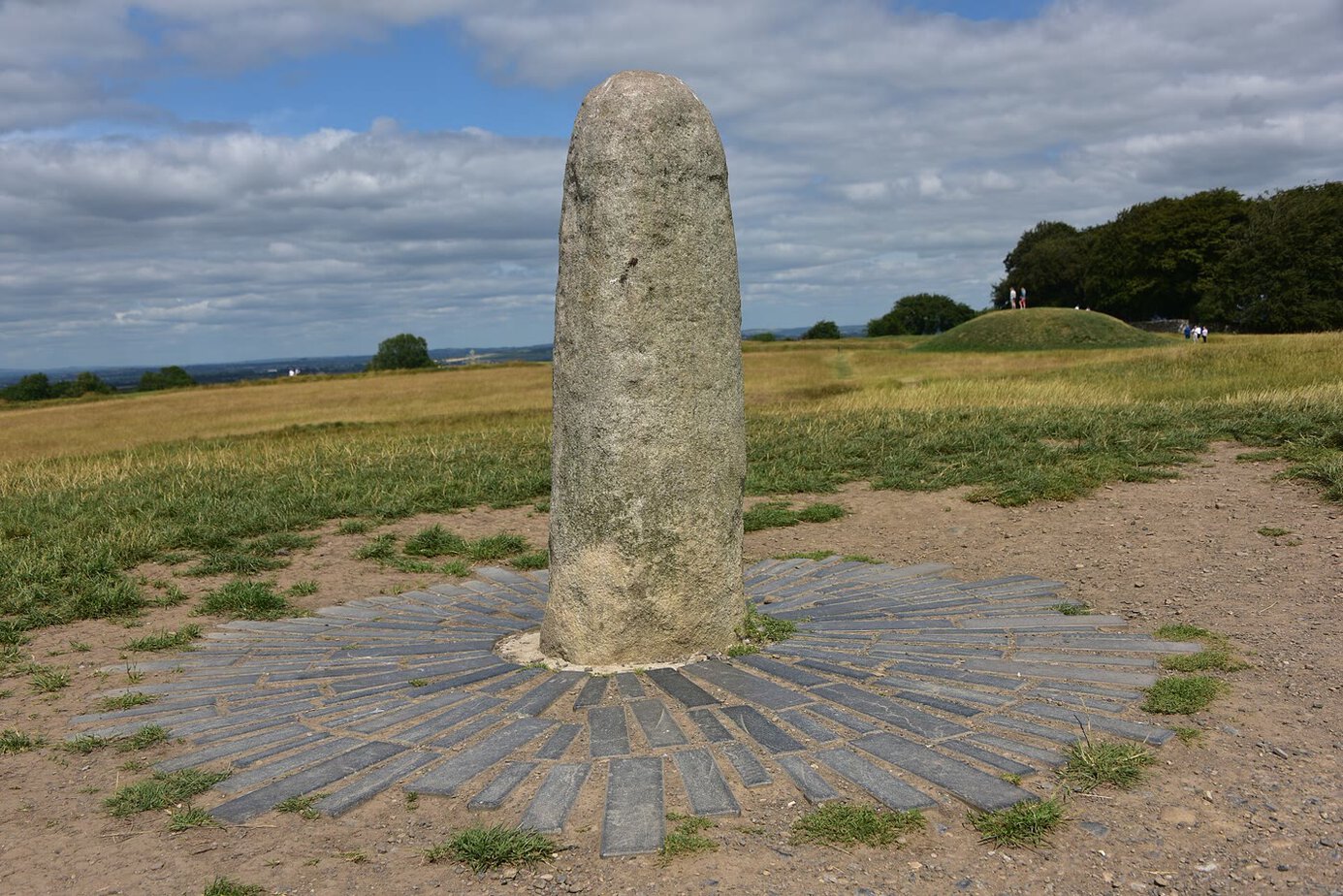
The standing stone known as the Lia Fáil, or Stone of Destiny, on the Hill of Tara, Co. Meath. Photo: August Schwerdfeger, CC BY 4.0, via Wikimedia Commons
How did Niall get his name?
Noígíallach means “having nine hostages”: noí is nine and gíall a hostage. Ó Dónaill’s modern Irish dictionary still gives giall (GEE-ul) as a hostage or human pledge, and also, confusingly, a jaw.
A hostage was a living guarantee of loyalty, handed to a stronger king. Everyone agreed Niall had nine. Nobody agreed whose.
- Five from Ireland, four from Alba. A poem in the tale of Niall’s death, quoted again in the medieval “Fitness of Names” (Cóir Anmann), gives him one from each of Ireland’s five provinces and four from Alba. Geoffrey Keating repeated it in the 1630s.
- Five from Ireland, four from four peoples. The prose of the same texts makes the outsiders one each from Alba, the Saxons, the Britons and the Franks.
- Nine from Airgialla. The DIB notes Niall was also pictured taking hostages from the nine Cruthin kingdoms of mid-Ulster that later formed Airgialla. The “Fitness of Names”, without mentioning Niall, explains Airgialla itself through gialla, hostages: their king once gave nine to the king of Tara.
Which Alba? In the oldest texts, the scholar Kuno Meyer noted in 1900, it meant Great Britain, not just Scotland. Confusion with Elpa, the Alps, may be how Niall’s raids grew into European campaigns.
And the Mound of the Hostages at Tara, pictured at the top of this page? Its Irish name, Duma na nGiall, suits the legend, but it’s a Stone Age passage tomb whose earliest dated burials go back to about 3350 to 3100 BC, according to University College Dublin.
The hag at the well: how Niall became king
The best-known story about Niall is Echtra mac nEchach Muigmedóin, The Adventure of the Sons of Eochaid Mugmedón. This retelling follows Whitley Stokes’s 1903 translation, in my own words. University College Cork’s Irish Sagas Online sets the Irish beside it.
A baby left on the green of Tara
King Eochaid had four sons by his queen, Mongfind: Brian, Ailill, Fiachra and Fergus. A fifth, Niall, was born to Cairenn, whom the tale makes a Saxon king’s daughter.
Mongfind set the pregnant Cairenn to haul water at Tara, hoping the work would kill the child. Cairenn gave birth beside her bucket and, terrified of the queen, left the baby on the green for the birds.
Only Torna, a poet, dared pick him up. He foresaw the boy’s future and raised him away from court. Years later Niall walked into Tara, found his mother still carrying water, ended her drudgery and dressed her in purple.
The burning forge
Mongfind demanded an heir be named. Eochaid left the choice to Sithchenn, a druid and smith, who set fire to a forge with the boys inside.
Brian came out with the sledgehammers, Fiachra with a bucket of ale and the bellows, Ailill with the weapons chest and Fergus clutching an armful of dry kindling. Niall carried out the anvil. The anvil won.
The hag at the well
Mongfind wouldn’t accept it, so Sithchenn armed the brothers and sent them hunting. They got lost and grew desperately thirsty. Fergus came on a well kept by a hideous old woman: black from head to foot, with a grey mane like a horse’s tail and green teeth reaching to her ears. Water, she said, would cost a kiss.
Fergus refused. So did Ailill and Brian, the eldest. Fiachra only haggled and came back dry too, but she told him, “Thou shalt visit Tara.” The storyteller explains: his line would give Ireland two kings, Nath Í and Ailill Molt.
Then Niall went. He offered to lie with her as well as kiss her, then kissed her. When he looked again, she was the loveliest woman in the world, pale as snow, in a purple cloak with a silver brooch, her lips red as rowan berries.
“I am the Sovranty”
“I am the Sovranty,” she told him in Stokes’s English: Misi in Flaithius, the right to rule. Kingship would stay with Niall’s descendants for ever, with three exceptions: Fiachra’s two kings and one Munster king, Brian Boru.
Sovereignty, she explained, is like her: ugly at first and seldom won without battles, but beautiful once it’s yours. She told him to keep the water from his brothers until they granted him seniority. They did, and back at Tara Sithchenn ruled that the bargain would stand for ever.
What the story is really about
The woman at the well is the personification of sovereignty, as the DIB puts it. Ériu, who gave Ireland its name, and her sisters Banba and Fódla were sovereignty goddesses too: see my guide to Celtic gods and goddesses.
The story is also propaganda. The DIB calls the forge contest “doubtless invented” to explain the power Niall’s descendants later held. And by naming Brian Boru, who died at Clontarf in 1014, the hag dates the tale: this version can’t be older than Brian’s time. It’s in Middle Irish, and its oldest copies are in the Yellow Book of Lecan and the Book of Ballymote, both from around 1400.
Chaucer fans know the plot from The Wife of Bath’s Tale, where a knight’s hideous bride turns beautiful, and English poets told it of Arthur’s nephew Gawain. She’s the loathly lady.
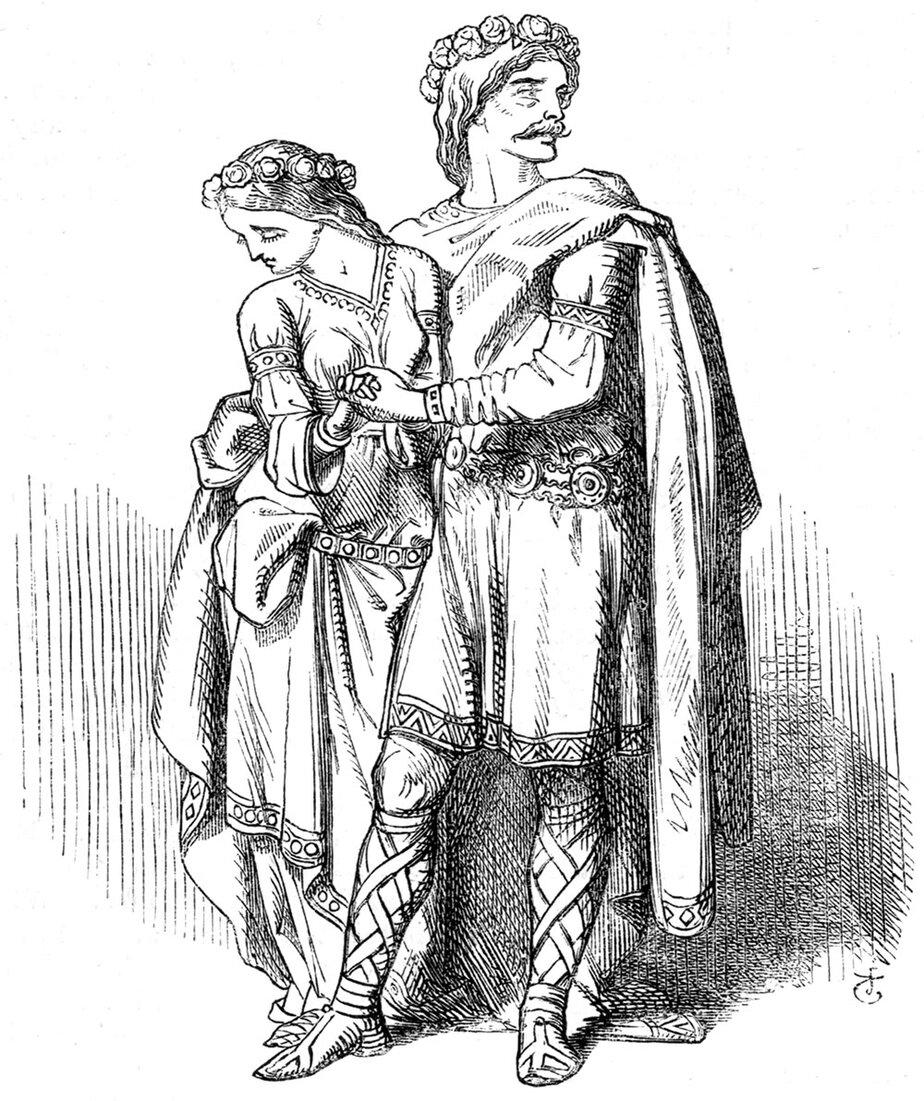
Sir Gawain and his bride, the “loathly lady” of Arthurian legend, after her transformation. John Tenniel, for George Meredith’s poem “The Song of Courtesy”, Once a Week, 9 July 1859. Scan: Levana Taylor, CC BY-SA 4.0, via Wikimedia Commons
Mongfind brings a Halloween twist. In a companion tale she dies on Samhain eve, and Stokes’s translation says ordinary people called Samhain “Mongfind’s feast” and prayed to her that night. More in how the Irish invented Halloween.
Raids on Britain, St Patrick and Niall’s death
Meyer thought the tales probably remember real Irish raids on Britain around the year 400. A poem on Niall’s grave at Ochann, attributed to Cináed Ua hArtacáin (died 975), has Niall cross the sea seven times before he’s killed on the Ictian Sea, the English Channel.
The killer is always Eochaid, son of the Leinster king Énnae Cennselach. The tale of Niall’s death has Niall camped by “the Loire of the Alps”, awaiting Roman hostages, then admits others put his death in Alba, among the poets of the Picts, where the exiled Eochaid shoots him from across a glen. Keating chose the Loire. In both tale and poem, Niall’s men win seven battles with their dead king held up before them.
Then there’s St Patrick. Keating, citing a Latin life, wrote that Patrick was captured at 16 by a fleet Niall sent raiding. Patrick’s own Confessio names no king, though: he says only that he was taken with thousands of others. More in the real history of St Patrick’s Day.
Niall’s sons and the Uí Néill dynasties
Niall is credited with 14 sons, eight of whom founded dynasties, says the DIB.
- Northern Uí Néill: Éogan, whose Cenél nÉogain, first based in Inishowen (Inis Eoghain), gave Tyrone its name, Tír Eoghain (teer OHN); Conall Gulban, founder of Cenél Conaill in Donegal, nicknamed from Benn Gulban, the Benbulben of Diarmuid and Gráinne; and Énnae.
- Southern Uí Néill: Lóegaire, the king at Tara who confronts Patrick in the saint’s early lives, plus Cairpre, Conall Cremthainne, Fiachu and Maine.
Eoghan is one syllable in Irish, roughly OHN (nearer AWN in Ulster), but OH-in, like Owen, in English: see my guide to pronouncing Irish boy names. Colum Cille, the saint of Iona, was claimed as Niall’s great-great-grandson.
The Echtra boasts that Niall’s descendants held the kingship of Ireland, barring a few contested reigns, down to Máel Sechnaill son of Domnall, who died in 1022. In the north, Cenél nÉogain kings ruled from Ailech, the stone fort now called the Grianán of Aileach. Heritage Ireland says it may date from before 800, and that a Munster king’s army carried off stones from its rampart in 1101.
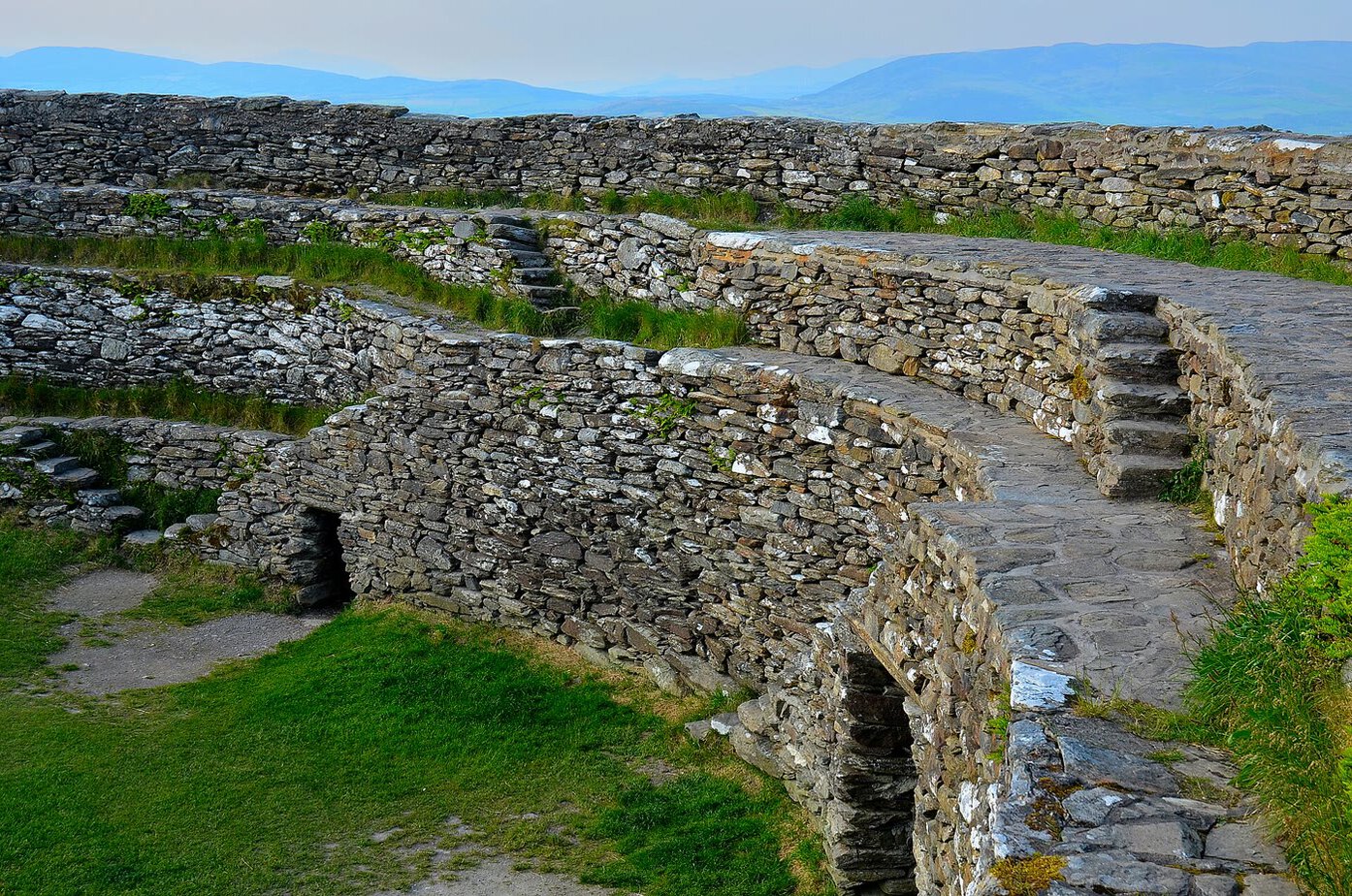
The Grianán of Aileach, Co. Donegal, royal centre of the Cenél nÉogain kings, largely rebuilt in the 1870s. Photo: Guyw4444, CC BY-SA 4.0, via Wikimedia Commons
Surnames that claim descent from Niall
Irish surnames arrived from the 10th century on, many growing out of the old dynasties. Ó means grandson or descendant, so Ó Néill (oh NAYL) is “descendant of Niall”, though not this Niall.
Rev. Patrick Woulfe’s Irish Names and Surnames (1923) traces the Ulster O’Neills to Niall Glúndub, a king killed fighting the Norse near Dublin in 919. Woulfe links these families, in his older Irish spellings, to Niall’s sons:
- Cenél nÉogain (Tyrone and Derry): O’Neill, O’Kane (Ó Catháin) and O’Donnelly (Ó Donnghaile).
- Cenél Conaill (Donegal): O’Donnell (Ó Domhnaill), O’Doherty (Ó Dochartaigh) and O’Boyle (Ó Baoighill). The Donegal O’Gallaghers (Ó Gallchobhair) are traced to Máel Coba, a 7th-century king.
Read the small print: Woulfe also lists unrelated O’Neill, O’Donnell and O’Kane families. And the Trinity team warned that Gaelic genealogies were often altered, or even forged, to suit the politics of the day. A surname is a clue, not proof.
The 2006 Trinity College Dublin DNA study
In February 2006, Laoise T. Moore, Brian McEvoy, Eleanor Cape, the historian Katharine Simms and the geneticist Dan Bradley, of Trinity College Dublin, published A Y-Chromosome Signature of Hegemony in Gaelic Ireland in the American Journal of Human Genetics.
The Y chromosome passes from father to son almost unchanged, like a surname. The team read 17 short repeating markers (STRs) on the Y chromosomes of 796 Irish men and found a pattern they called the Irish modal haplotype.
- With its closest variants, it made up 8.2% of the sample: the one in 12 Irish men of the headlines.
- In north-west Ireland it reached 21.5%, about one man in five.
- On a shorter six-marker comparison, counting close variants, it reached 16.7% at some Scottish sites. About 2% of European American New Yorkers carried that shorter version.
- Of 59 men with surnames the genealogies link to the Uí Néill, 52.5% fell in the cluster. The biggest groups were Gallaghers, Boyles, Dohertys and O’Donnells. There wasn’t one O’Neill.
They dated the cluster’s common ancestor to about 1,730 years ago, give or take 670 years, and concluded that their results seemed to confirm a single early medieval founder of the Uí Néill. Niall himself they called “possibly mythological”.
Where the “3 million descendants” claim comes from
The paper said only that, given emigration, the men carrying this lineage worldwide might number perhaps two to three million.
By the time Reuters reported it on 17 January 2006, Niall was Ireland’s most prolific ancestor, “with more than 3 million men worldwide among his offspring”. Bradley compared it to the genetic legacy of Genghis Khan in Central Asia. The comparison stuck, and so did the round number.
What later research found: R-M222
STR markers can point to a group but can’t firmly define it. Genetic genealogists soon linked the pattern to M222, a SNP, or single-letter change in the DNA. The volunteer administrators of FamilyTreeDNA’s R-M222 project say a test they commissioned confirmed the link in March 2006.
Full Y-chromosome sequencing then caused a problem. The project now says plainly: “The haplogroup existed long before Niall.” The YFull tree estimates that the M222 branch formed about 4,100 years ago, and that today’s carriers share a common ancestor about 2,100 years ago, centuries before Niall.
- It does show that one male line became unusually common in north-west Ireland and western Scotland, strongly linked to surnames the genealogies tie to the Uí Néill.
- It doesn’t show that Niall carried M222. There are no remains to test, and nobody knows what his Y-DNA was.
- It doesn’t make every M222 man his descendant. The branch is older than him, and plenty of M222 families have no known Uí Néill link.
If the Uí Néill did spring from one man, M222 may well have been his line. That’s as far as the evidence goes.
What DNA tests say about Niall today
Testing companies still love the story. 23andMe’s page for paternal haplogroup R-M222 has a whole section on Niall, admits he may be more legend than history and repeats the two to three million estimate.
- Only the male line counts. M222 is on the Y chromosome, so a woman would ask her father, a brother, or her father’s brother or his son to test.
- Pick the right test. FamilyTreeDNA sells dedicated Y-DNA tests, 23andMe reports a paternal haplogroup and MyHeritage added Y-DNA haplogroups in August 2026. AncestryDNA’s kit is built for finding cousins on every side, as I explain in how Ancestry DNA kits work.
How to pronounce Niall Noígíallach
- Niall: NEE-ul in Irish. In English it’s often NYE-ul, rhyming with Nile.
- Noígíallach: Old Irish, roughly NOY-yee-ul-ukh. The modern Irish Naoighiallach (Keating’s spelling) is NEE-yee-ul-ukh.
- Uí Néill: ee NAYL. Ó Néill: oh NAYL.
- giall (hostage): GEE-ul, with a hard g as in “gear”.
- flaitheas (modern Irish for sovereignty): FLAH-hus.
Niall of the Nine Hostages FAQ
Was Niall of the Nine Hostages a real person?
Possibly. The DIB treats him as only putatively king of Tara, perhaps dying in the mid-5th century rather than the annals’ 404 or 405.
Why is he called Niall of the Nine Hostages?
Medieval writers gave him five hostages from Ireland and four from Britain or other peoples. Another explanation links them to the nine kingdoms of Airgialla in mid-Ulster.
What surnames come from Niall of the Nine Hostages?
By tradition, O’Neill, O’Donnell, O’Doherty, O’Boyle, Gallagher, O’Kane and O’Donnelly, among others, though not every family with those names shares the descent.
Am I descended from Niall of the Nine Hostages?
Nobody can prove it. R-M222 is older than Niall, and there’s no DNA from him to compare.
Love this? Save it to your Pinterest board for later.
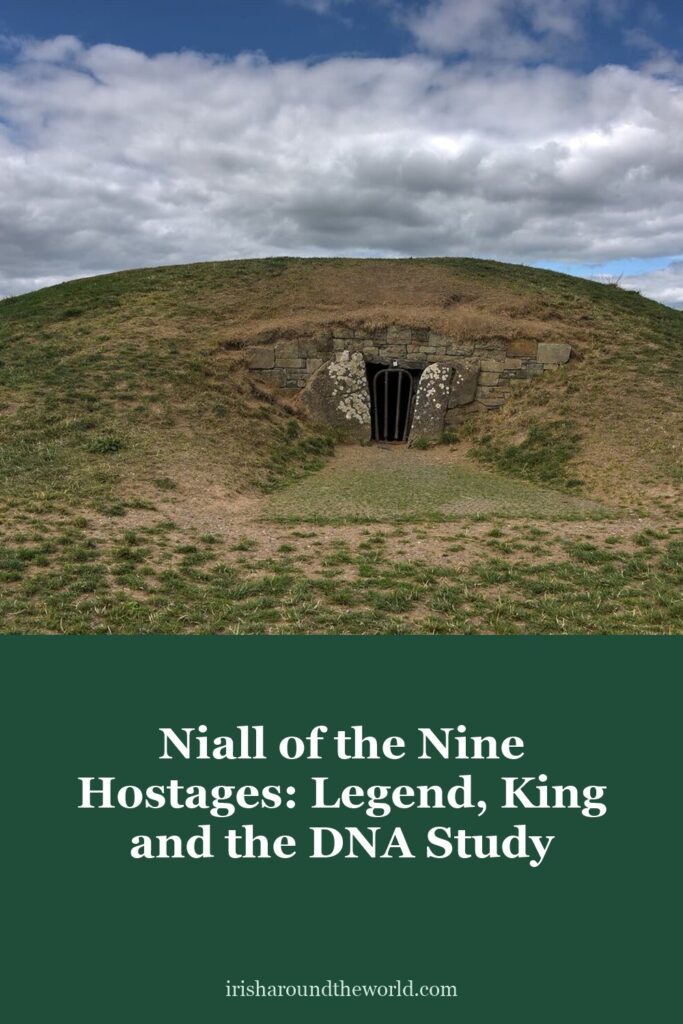
Pin image: the Mound of the Hostages, Hill of Tara. Photo: August Schwerdfeger, CC BY 4.0, via Wikimedia Commons.
A little bit of Ireland in your inbox every Friday ☘️
The free Weekly Dose of Irish: an Irish joke, a Celtic symbol, an Irish fact, a poem and the week’s best articles in one short email. Join 9,600+ readers.
Free. One short email every Friday. Unsubscribe any time.
More Irish history and mythology reading
- Irish Surnames: Meanings, Origins and the Top 100 Names in Ireland
- How Do Ancestry DNA Kits Work? Accuracy, Privacy and Tracing Your Irish Roots
- Diarmuid and Gráinne: Ireland’s Great Runaway Love Story
- Celtic Gods and Goddesses: 15 Irish Deities and Their Stories
- The History of St Patrick’s Day: The Real Story
Featured image: the Mound of the Hostages (Duma na nGiall), a Stone Age passage tomb on the Hill of Tara, Co. Meath. Photo: August Schwerdfeger, CC BY 4.0, via Wikimedia Commons.