
The usual way to say I love you in Irish is Tá grá agam duit (taw GRAW AG-um ditch), literally “there is love at me for you”. To more than one person, say Tá grá agam daoibh (taw GRAW AG-um deev). Mo ghrá thú and Is tú mo ghrá mean “you are my love”, and Tá mé i ngrá leat means “I’m in love with you”. Is breá liom thú is good Irish but usually lighter, because is breá liom is mostly used for loving things. Favourite pet names include a stór (darling), a chroí (heart), a ghrá (love) and a chuisle (pulse).
Three little words, and in Irish they don’t work the way you’d expect.
Irish does have a verb meaning “to love”, gráigh (GRAW, or GRAWG in Munster), but the everyday way to say it uses a noun instead: love is something that is “at” you, for another person. Once you see that, the rest falls into place.
Here are the main ways to say it, which is stronger, 27 terms of endearment, the film that misspelled one, and what to write in a card. Every Irish word here was looked up in Ó Dónaill’s Irish-English dictionary (teanglann.ie) and the New English-Irish Dictionary (focloir.ie), and the longer phrases follow their examples.
Jump to:
- How to say I love you in Irish
- Tá grá agam duit or Is breá liom thú: which is stronger?
- Saying it to the whole family
- Mo ghrá thú, Is tú mo ghrá and Tá mé i ngrá leat
- 27 Irish terms of endearment
- Mo chuisle and Million Dollar Baby’s “Mo Cuishle”
- Grá, searc, cion and gean: the Irish words for love
- Asthore, mavourneen and acushla: Irish love words in English
- How to sign a card or text in Irish
- Common mistakes and the right forms
- I love you in Irish: FAQ
- More Irish love and language reading
How to say I love you in Irish
The respellings are rough guides; Kerry, Connemara and Donegal each say things a little differently.
| Irish | Say it | Meaning |
|---|---|---|
| Tá grá agam duit | taw GRAW AG-um ditch | I love you. The standard phrase. |
| Tá grá agam ort | taw GRAW AG-um urt | I love you. Same meaning, different little word. |
| Is tú mo ghrá | iss TOO muh GHRAW | You are my love. |
| Mo ghrá thú! | muh GHRAW hoo | You’re my love! Ó Dónaill translates it I love you! |
| Mo chroí thú! | muh KHREE hoo | I love you dearly. Literally “my heart, you”. |
| Tá mé i ngrá leat | taw may ih NGRAW lyat | I’m in love with you. |
| Tá mo chroí istigh ionat | taw muh KHREE ish-TEE UN-ut | I’m mad about you. Literally “my heart is inside you”. |
| Tá grá mór agam duit | taw GRAW MORE AG-um ditch | I love you very much. |
| Beidh grá agam duit go deo | bay GRAW AG-um ditch guh JOH | I’ll love you forever. |
| Tá grá agamsa duit freisin | taw GRAW AG-um-suh ditch FRESH-in | I love you too. |
Why love is “at” you
Tá grá agam duit breaks down like this:
- Tá (taw): is, or there is.
- grá (GRAW): love.
- agam (AG-um): at me. It’s ag (eg), at, and mé (may), me, joined into one word.
- duit (ditch): to you, or for you. It’s do (duh), to, and tú (too), you, joined.
So the sentence says “love is at me for you”. Irish has no verb “to have”, so feelings and belongings work like this all the time: you don’t “have” a car, a car is “at” you.
It’s the same phrase for a husband, wife, child or grandchild.
Duit or ort?
Both are right. Ó Dónaill’s dictionary pairs grá with both do (to) and ar (on) for “to love someone”, and the New English-Irish Dictionary lists both versions as “I love you”.
Hearing it said
Teanglann.ie has recordings of single words in Connacht, Munster and Ulster Irish. Abair.ie, from the Phonetics and Speech Laboratory at Trinity College Dublin, will read a whole sentence aloud in a synthetic Irish voice.
- In Cork and Waterford, agam is stressed on the second syllable: uh-GUM.
- Munster speakers often say táim (TAWM) for tá mé, so Táim i ngrá leat.
- The gh in ghrá is a soft, throaty sound, but a plain “graw” is understood.
To go further, see my guide to learning Irish online.
Tá grá agam duit or Is breá liom thú: which is stronger?
You’ll find Is breá liom thú (iss BRAW lum hoo) on mugs, cards and plenty of websites as “I love you”. It’s good Irish, but not quite the same thing.
Breá means fine or lovely, and is breá liom is how Irish usually says “I love” about things, places and pastimes. Focloir.ie translates “she loves football” as is breá léi an pheil (iss BRAW lay un FEL), and uses the same phrase for loving a song or loving Ireland.
When focloir.ie translates “I love you” to a partner, it gives tá mé i ngrá leat, tá grá agam duit, tá grá agam ort and grá mo chroí thú (GRAW muh KHREE hoo). Is breá liom thú isn’t on the list.
A fair rule of thumb:
- Tá grá agam duit for the real thing: a partner, a spouse, your children.
- Is breá liom thú for warm affection, closer to “I’m very fond of you”. Some speakers use it romantically and others hear it as lighter, so for a proposal, tá grá agam duit is the safer choice.
- Is maith liom thú (iss MAH lum hoo) is simply “I like you”.
Saying it to the whole family: daoibh
Duit means “to you” for one person. For two or more, it becomes daoibh (deev):
- Tá grá agam daoibh (taw GRAW AG-um deev): I love you (to two or more).
- Tá grá agam daoibh go léir (taw GRAW AG-um deev guh LAYR): I love you all.
- Tá grá agam oraibh (taw GRAW AG-um OR-iv): the ort version.
Mo ghrá thú, Is tú mo ghrá and Tá mé i ngrá leat
In Mo ghrá thú, mo ghrá is “my love” and thú is “you”, so it’s “you’re my love”. Ó Dónaill translates it simply as I love you!
The dictionary gives it a second meaning, “Bravo!”, and records a wry line about fair-weather friends: Mo ghrá thú is rud agat (muh GHRAW hoo iss RUD AG-ut), roughly “you’re my love as long as you’ve something to hand out”.
Is tú mo ghrá says the same as a full sentence: “you are my love”.
Tá mé i ngrá leat means “I’m in love with you”. After i (in), grá picks up an n at the front, so it’s i ngrá, said ih NGRAW. To say you fell in love, use Thit mé i ngrá leat (hitch may ih NGRAW lyat), “I fell in love with you”.
27 Irish terms of endearment
Irish pet names do the work of love, dear and darling. Focloir.ie notes that a stór, a chroí and a thaisce are even used to strangers.
The little “a” and the extra “h”: when you speak to someone directly, Irish puts a small word, a (said “uh”), before the name or pet name, and it softens most consonants by adding an h, so grá becomes a ghrá and croí becomes a chroí. Masculine names and some masculine nouns also change their ending, which is why focloir.ie writes Seán as a Sheáin (uh HYAWN) when he’s addressed, while Caoimhe simply becomes a Chaoimhe (uh KHEE-vuh).
Two quirks: words starting with st, like stór, never take the h, and Ó Dónaill prints a stór, a rún and a leanbh unchanged, though you’ll also meet a rúin, as in the song title Siúil a Rúin (SHOOL uh ROON).
When you’re talking about someone rather than to them, swap a for mo (my): mo stór (my treasure), mo chroí (my heart), mo ghrá (my love). Mo adds the same h.
Everyday pet names
| Irish | Say it | Meaning |
|---|---|---|
| 1. a ghrá | uh GHRAW | my love, dear |
| 2. a stór | uh STORE | darling. Stór is a store, or treasure. |
| 3. a chroí | uh KHREE | my heart, dear |
| 4. a stóirín | uh STOH-reen | little treasure, sweetheart |
| 5. a thaisce | uh HASH-kuh | my dear. Taisce is a hoard of treasure, and also a bank deposit. |
| 6. a rún | uh ROON | my dear. Rún also means a secret. |
| 7. a mhuirnín | uh VOOR-neen (Munster: uh voor-NEEN) | my darling, sweetheart |
| 8. a chuisle | uh KHISH-luh (Ulster: uh KHUSH-luh) | darling. Literally “pulse”. |
| 9. a leanbh | uh LAN-uv | my child, my darling |
| 10. a pheata | uh FAT-uh | my pet |
Heart-of-my-heart phrases
| Irish | Say it | Meaning |
|---|---|---|
| 11. grá mo chroí | GRAW muh KHREE | love of my heart |
| 12. a chuisle mo chroí | uh KHISH-luh muh KHREE | pulse of my heart, my beloved |
| 13. a stór mo chroí | uh STORE muh KHREE | treasure of my heart |
| 14. a rún mo chroí | uh ROON muh KHREE | love of my heart |
| 15. mo mhíle stór | muh VEE-luh STORE | my dearest love. Literally “my thousand treasures”. |
| 16. mo mhuirnín dílis | muh VOOR-neen JEE-lish | my own true love |
| 17. mo ghrá geal | muh GHRAW GYAL | my sweetheart. Literally “my bright love”. |
| 18. m’anam ionat | MAN-um UN-ut | my dearest. Literally “my soul in you”. |
Older and rarer ones
| Irish | Say it | Meaning |
|---|---|---|
| 19. mo shearc | muh HARK | my love, my beloved |
| 20. mo chéadsearc | muh HYAYD-shark | my first love |
| 21. a chumann | uh KHUM-un | my darling. Cumann also means a club or society. |
| 22. a mhaoineach | uh WEE-nyukh | my dear one. Literally “treasured possession”. |
| 23. a lao | uh LAY (Connacht and Ulster: uh LEE) | my dear. Literally “calf”. Mo lao thú (muh LAY hoo) means “you are my darling”. |
| 24. a chiallaigh | uh HEE-uh-lee | my dear |
| 25. plúr na mban | PLOOR nuh MAN | flower of women, a compliment |
For friends
| Irish | Say it | Meaning |
|---|---|---|
| 26. a chara | uh KHAR-uh | my friend. Also the “Dear…” at the top of a letter. |
| 27. m’anamchara | MAN-um-khar-uh | my soul friend, my soulmate |
A word on anam cara: the dictionaries spell it as one word, anamchara. Ó Dónaill (1977) gives only “spiritual adviser”, while focloir.ie now offers it for “soulmate”. That romantic sense owes a great deal to John O’Donohue’s 1997 book Anam Cara. Since mo shortens to m’ before a vowel, “my soul friend” is m’anamchara, not mo anam cara. More in my guide to Irish words with no English translation.
Mo chuisle and Million Dollar Baby’s “Mo Cuishle”
In Clint Eastwood’s Oscar-winning boxing film Million Dollar Baby (2004), trainer Frankie Dunn gives his fighter, Maggie Fitzgerald, a nickname stitched on her emerald-green robe: Mo Cuishle.
Crowds cheer her into the ring with it, and only near the end does Frankie say what it means: “my darling, my blood”, in the words of the American Film Institute catalog.
The spelling isn’t Irish, though. The standard form is mo chuisle (muh KHISH-luh, or muh KHUSH-luh in Ulster), “my pulse, my darling”, or a chuisle when you’re speaking to the person. The full phrase is a chuisle mo chroí, “pulse of my heart”.
The film’s version drops the h that mo puts after the c, and adds an h after the s that Irish doesn’t need: before an i, that s already sounds like “sh”. Its spelling was already being questioned in print within weeks of the film’s wide release.
And “my blood”? Ó Dónaill gives cuisle as a vein, a pulse or the wrist, so “my blood” is a poetic stretch; “my pulse” is the literal meaning.
Grá, searc, cion and gean: the Irish words for love
Grá (GRAW) is the everyday word, and the widest. Ó Dónaill uses it for love of a person, of God (grá Dé, graw JAY), of country and language, even of sweets.
Love of country is tírghrá (TEER-ghraw), a love song is an amhrán grá (OW-rawn GRAW), and a love letter is a litir ghrá (LITCH-ir GHRAW). Two proverbs from focloir.ie: tá an grá dall (taw un GRAW DOWL), love is blind, and ní fheiceann leannán locht (nee EK-un LAN-awn LUKHT), a sweetheart sees no fault.
Searc (SHARK) also means love, and a beloved. It sounds more poetic, and turns up in set phrases: mo shearc (my love), mo chéadsearc (my first love) and searc mo chléibh (SHARK muh KHLAYV), love of my bosom. A true-love knot is a snaidhm seirce (SNIME SHER-kuh), a nice detail if you’re choosing a Celtic love knot. For longer lines, see the best Irish love poems.
For fondness rather than romance, Irish has cion (KYUN) and gean (GYAN). Tá cion agam ort (taw KYUN AG-um urt) and tá gean agam ort (taw GYAN AG-um urt) both mean “I’m fond of you”. You can also say Tá mé an-cheanúil ort (taw may AN-hyan-ool urt), “I’m very fond of you”.
Asthore, mavourneen and acushla: Irish love words in English
If anyone in your family called you asthore or alanna, they were using Irish words. In 1910 the scholar P. W. Joyce published English As We Speak It in Ireland, and its glossary records Irish endearments living on inside Irish English:
- asthore: a stór, “my treasure”
- agra or agraw: a ghrá, “my love”
- alanna: a leanbh, “my child”
- aroon: a rún, “my love, my dear”, as in the old air Eileen Aroon (Eibhlín a Rún, EYE-leen uh ROON)
- avourneen and mavourneen: a mhuirnín and mo mhuirnín, “my love”. Joyce says mavourneen was used all over Ireland.
- acushla and cushlamochree: a chuisle and cuisle mo chroí, “pulse of my heart”
Joyce also noted gra on its own, meaning love or fondness. When he asked a man back from America why he’d come home, the answer was: “I have great gra for the old country.”
In 1877 the French painter James Tissot called a portrait of his companion Kathleen Newton Mavourneen, after Kathleen Mavourneen, a popular love song of the Victorian era. Christie’s says the etching he made of it was his most popular print in his lifetime.
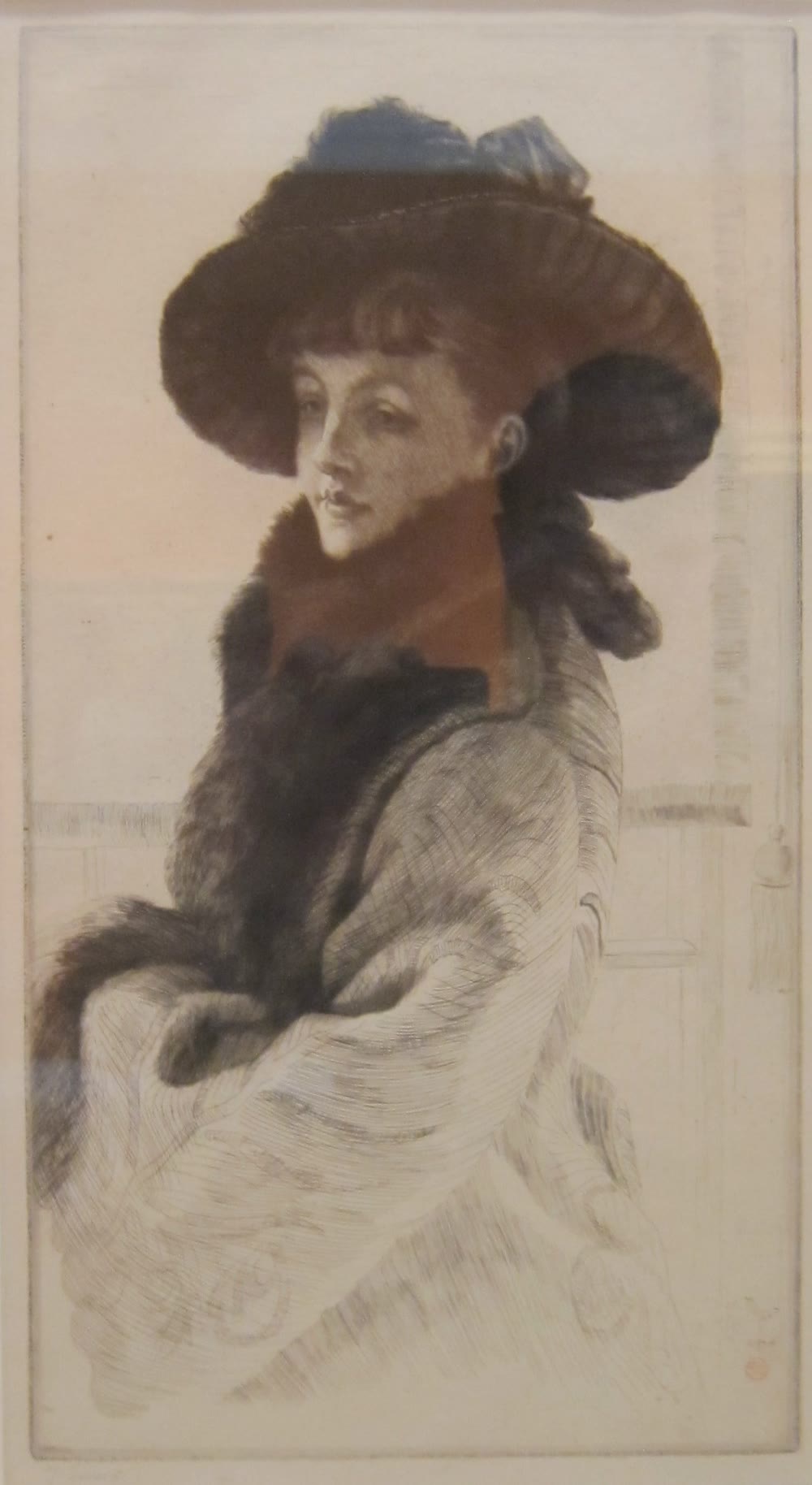
Mavourneen (1877), James Tissot’s etching and drypoint of his companion Kathleen Newton, titled after the song Kathleen Mavourneen. Honolulu Museum of Art. Public domain, via Wikimedia Commons (CC0)
For Irish English slang, see the Irish phrases that baffle everyone else.
How to sign a card or text in Irish
Keep it short, copy the fadas exactly, and add the English underneath.
Sign-offs
- Le grá (leh GRAW): with love.
- Le grá ó (leh GRAW oh): love from.
- Le grá mór ó Mham (leh GRAW MORE oh VAM): “with all my love, Mam”, focloir.ie’s own example.
- Grá mór (GRAW MORE): lots of love.
- Le gean ó (leh GYAN oh): with affection from.
- Póg (POGE): a kiss. Póga (POH-guh): kisses. Barróga (BAR-oh-guh): hugs. For the little kiss at the bottom of a letter, focloir.ie uses póigín (POH-geen).
Texts and messages
- Oíche mhaith, a stóirín (EE-huh WAH, uh STOH-reen): goodnight, love.
- Tá grá agam duit, a chroí (taw GRAW AG-um ditch, uh KHREE): I love you, my heart.
- Braithim uaim thú (BRAH-him OO-um hoo) or Cronaím thú (KRUN-eem hoo): I miss you.
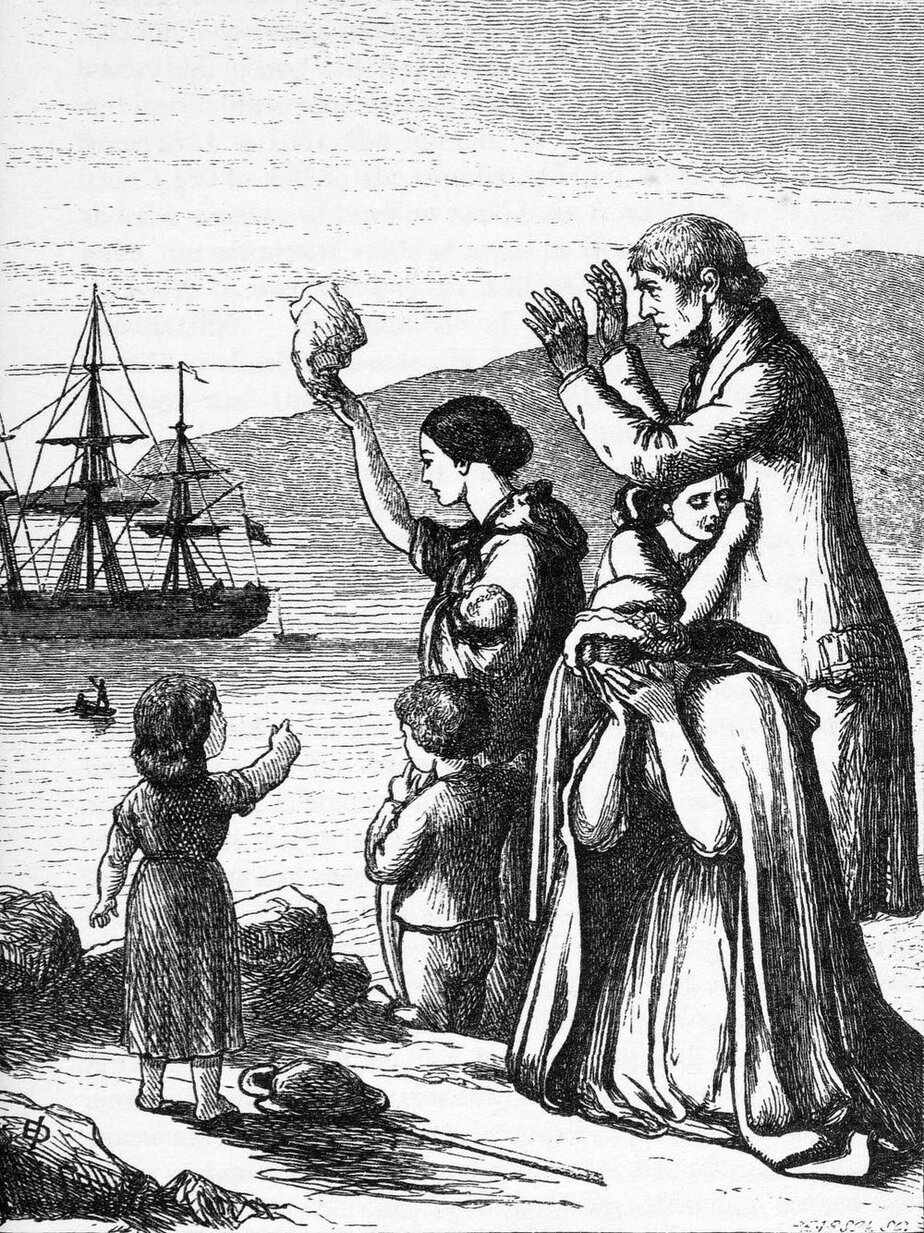
Emigrants Leave Ireland, an engraving by Henry Doyle for Mary Frances Cusack’s An Illustrated History of Ireland (1868). Public domain, via Wikimedia Commons
Valentine’s Day is Lá Fhéile Vailintín (law AY-luh VAL-in-teen), and a valentine card is a cárta vailintín (KAWR-tuh VAL-in-teen). See my Valentine’s Day wishes with an Irish touch, and for wedding lines and blessings, my Irish sayings about love.
Engraving a ring or choosing a tattoo
Short is safest: mo chroí, a chuisle, grá mo chroí or m’anamchara. Check every fada before you pay. The fada always slants up to the right, like the accent in café.
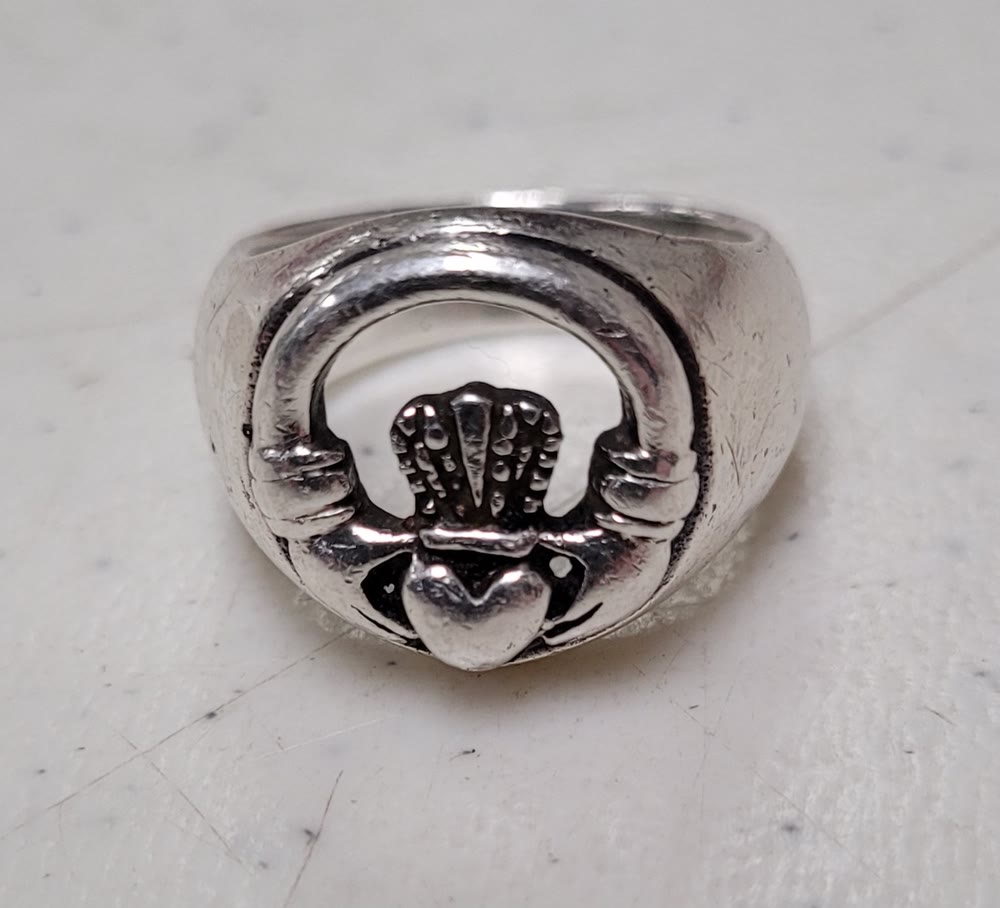
A Claddagh ring says love, loyalty and friendship without words. My guide to the Claddagh ring meaning explains which hand it goes on and which way the heart should point.
Common mistakes and the right forms
- Mo Cuishle: write mo chuisle.
- mo grá: write mo ghrá. And a grá without the h means “her love”; to speak to your love, write a ghrá.
- Tá grá agam tú: write Tá grá agam duit. You need duit (to you), not tú.
- i grá leat: write i ngrá leat.
- mo anam cara: write m’anamchara.
- Missing fadas: a fada can change the word. Sean (SHAN) means old; Seán (SHAWN) is the name.
- asthore, machree: fine in English, but in Irish write a stór and mo chroí.
I love you in Irish: FAQ
How do you say I love you in Irish?
Tá grá agam duit (taw GRAW AG-um ditch). To more than one person, say Tá grá agam daoibh (taw GRAW AG-um deev).
What’s the difference between tá grá agam duit and is breá liom thú?
Tá grá agam duit is the dictionary’s romantic “I love you”. Is breá liom is mostly used for loving things, so Is breá liom thú usually sounds lighter.
What does mo chuisle mean?
Literally “my pulse”. It’s a term of endearment meaning “my darling”, spelled “Mo Cuishle” in Million Dollar Baby.
How do you say “my love” in Irish?
Mo ghrá (muh GHRAW). When you’re speaking to the person, say a ghrá (uh GHRAW).
How do you say soulmate in Irish?
Focloir.ie gives anamchara (AN-um-khar-uh) and cara cléibh (KAR-uh KLAYV), a bosom friend. “My soulmate” is m’anamchara.
How do you say “I miss you” in Irish?
Braithim uaim thú (BRAH-him OO-um hoo), roughly “I feel you gone from me”, or Cronaím thú (KRUN-eem hoo).
Is it the same in Scottish Gaelic?
Close. Scottish Gaelic, a sister language, usually says tha gaol agam ort, though tha gràdh agam ort is used too: the same “love is at me” pattern.
Love this? Save it to your Pinterest board for later.
Pin image: Lough Ouler, the heart-shaped lake below Tonelagee in the Wicklow Mountains. Photo: Rob Hurson, CC BY-SA 2.0, via Wikimedia Commons
A little bit of Ireland in your inbox every Friday ☘️
The free Weekly Dose of Irish: an Irish joke, a Celtic symbol, an Irish fact, a poem and the week’s best articles in one short email. Join 9,600+ readers.
Free. One short email every Friday. Unsubscribe any time.
More Irish love and language reading
- Anam Cara Meaning: the Irish Soul Friend and How to Say It
- Irish Wedding Traditions: What’s Old, Borrowed and New
- Irish Sayings About Love: Phrases, Blessings and Quotes in Irish
- 12 Most Beautiful Irish Love Poems For Weddings, Valentine’s Day And More
- Claddagh Ring Meaning: Which Hand, Heart In or Out, and the Galway Legend Behind It
- Celtic Love Knot Meaning: The Real History Behind the Lovers’ Knot
- Irish Words With No English Translation: 20 Real Ones and the Viral Fakes
- Valentine’s Day Wishes With an Irish Touch (for Your Wife, Husband or Partner)
Featured image: Lough Ouler, the heart-shaped lake below Tonelagee in the Wicklow Mountains. Photo: Rob Hurson, CC BY-SA 2.0, via Wikimedia Commons.