
The Tuatha Dé Danann (roughly TOO-uh day DAN-un) are the godlike people of medieval Irish legend, usually called “the peoples of the goddess Danu”, though nobody is sure who Danu was. In the Book of Invasions they arrive in a magic mist, beat the Fir Bolg and the Fomorians at the two battles of Mag Tuired, then lose Ireland to the sons of Míl and retreat into the fairy mounds. Most scholars see them as Ireland’s pagan gods, recast as ancient settlers by Christian writers; folklore remembered them as the aos sí, the fairies.
Picture a fleet running ashore in Connemara. The newcomers set fire to their own ships, so nobody can think of sailing home, and the smoke rolls inland so thick that later storytellers said they had come wrapped in mist.
That’s one medieval account of how the Tuatha Dé Danann came to Ireland. Another has them sweep in through the air on dark clouds.
They brought a stone that cried out under the true king, a spear no army could stand against and a cauldron nobody left hungry. Then they lost Ireland and went into the hills, where, in the stories, they never quite went away.
I’ve written about several of them in my guide to the Celtic gods and goddesses. Here’s the whole people, and what became of them.
Jump to:
- Who were the Tuatha Dé Danann?
- What the name means, and how to say it
- How they came to Ireland: the Book of Invasions
- The four treasures of the Tuatha Dé Danann
- The two battles of Mag Tuired
- The main gods of the Tuatha Dé Danann
- Defeat by the Milesians and the move into the hills
- From gods to fairies: the aos sí
- Newgrange: the Brú of the Dagda and Aengus
- Were the Tuatha Dé Danann real? What scholars think
- Where to see Tuatha Dé Danann places today
- Tuatha Dé Danann FAQ
- More Irish mythology reading
Who were the Tuatha Dé Danann?
The Tuatha Dé Danann are the magical race at the heart of the Mythological Cycle, the medieval tales of Ireland’s legendary past. Christian scholars wrote their stories down, mostly between the 9th and 12th centuries, above all in Lebor Gabála Érenn, the Book of Invasions, and Cath Maige Tuired, the Second Battle of Mag Tuired. Elizabeth Gray’s translation of the battle tale is free on CELT, University College Cork’s online text library.
What the name means, and how to say it
Tuatha is the plural of túath, a people or tribe, and Dé means “of god” or “of the gods”, from día, god. So Tuatha Dé means the tribes of the gods, and the early texts often call them just that.
Danann is the puzzle. It’s a genitive, “of” someone, and the Electronic Dictionary of the Irish Language (eDIL) says the plain form was “probably” Danu. No medieval text actually uses the name Danu.
Medieval scholars disagreed about her. Versions of Lebor Gabála make Danann the mother of Brian, Iuchar and Iucharba, “the three gods of Danu”, or another name for the Morrígan. Cormac’s Glossary, credited to Cormac mac Cuilennáin, a king of Cashel killed in 908, calls a goddess named Ana “mater deorum hibernensium”, mother of the gods of Ireland.
One version of Lebor Gabála already links the two, naming both the Tuatha Dé Danann and the Paps of Ana after Danann. Modern writers often merge them into Danu, the great mother goddess. Maybe so, but the stories tell us almost nothing about her.
How to pronounce Tuatha Dé Danann
Most English speakers say TOO-uh day DAN-un or TOO-ah day DAH-nun. Closer to the Irish is TOO-uh-huh jay DAN-un: tuatha has three syllables, and the d of Dé is soft, close to a j in Connacht and Ulster Irish (nearer “dyay” in Munster).
You’ll often see Tuatha De Dannan online. The standard spelling is Tuatha Dé Danann, with a fada on Dé and the double n at the end.
How they came to Ireland: the Book of Invasions
Lebor Gabála Érenn (roughly LEV-or GAV-aw-luh AY-ren), the Book of the Taking of Ireland, was put together in the 11th century as medieval Ireland’s national prehistory. It runs through a chain of settlers: Cessair before the Flood, then Partholón, Nemed, the Fir Bolg and the Tuatha Dé, and finally the Gaels, the sons of Míl.
Versions differ on how the Tuatha Dé arrived. In what the book’s editor, R. A. S. Macalister, took to be the original story, they fly in on dark clouds, land on a mountain in Conmaicne Rein, now south Co. Leitrim, and darken the sun for three days. Another version brings them by sea, burning their ships, with Sliabh an Iarainn in Leitrim as their goal. Cath Maige Tuired lands them in Connemara and blames the mist story on the smoke.
The four treasures of the Tuatha Dé Danann
They had learned their druidry, says Cath Maige Tuired, in four cities in the islands of the north, and from each they brought one treasure:
- The Lia Fáil (LEE-uh FAWL), from Falias: the Stone of Fál, kept at Tara, which gave a cry under each man destined to be king of Ireland. A pillar on the Hill of Tara carries the name today.
- The spear of Lugh, from Gorias: no fighter or army could stand up to it.
- The sword of Nuada, from Findias: once drawn, it let no enemy escape.
- The Dagda’s cauldron, from Murias: nobody who ate from it went home hungry.
Lebor Gabála lists the same four, and the Office of Public Works still introduces the Lia Fáil to Tara’s visitors as one of them.
The two battles of Mag Tuired
Mag Tuired, Moytura in English, is where the stories set two great battles, 27 years apart according to Lebor Gabála.
The first battle: the Fir Bolg
The Fir Bolg ruled Ireland when the Tuatha Dé arrived. In a separate tale, The First Battle of Mag Tuired, each side first sends a champion, Sreng for the Fir Bolg and Bres for the newcomers, to size up the other’s weapons.
The Tuatha Dé won. The last Fir Bolg king, Eochaid mac Eirc, was killed, but Sreng cut off the hand of Nuada, king of the Tuatha Dé. Versions differ on the losers: Cath Maige Tuired sends the survivors to the Fomorians in Arran, Islay, Man and Rathlin, while in the First Battle tale Sreng chooses Connacht for his people.
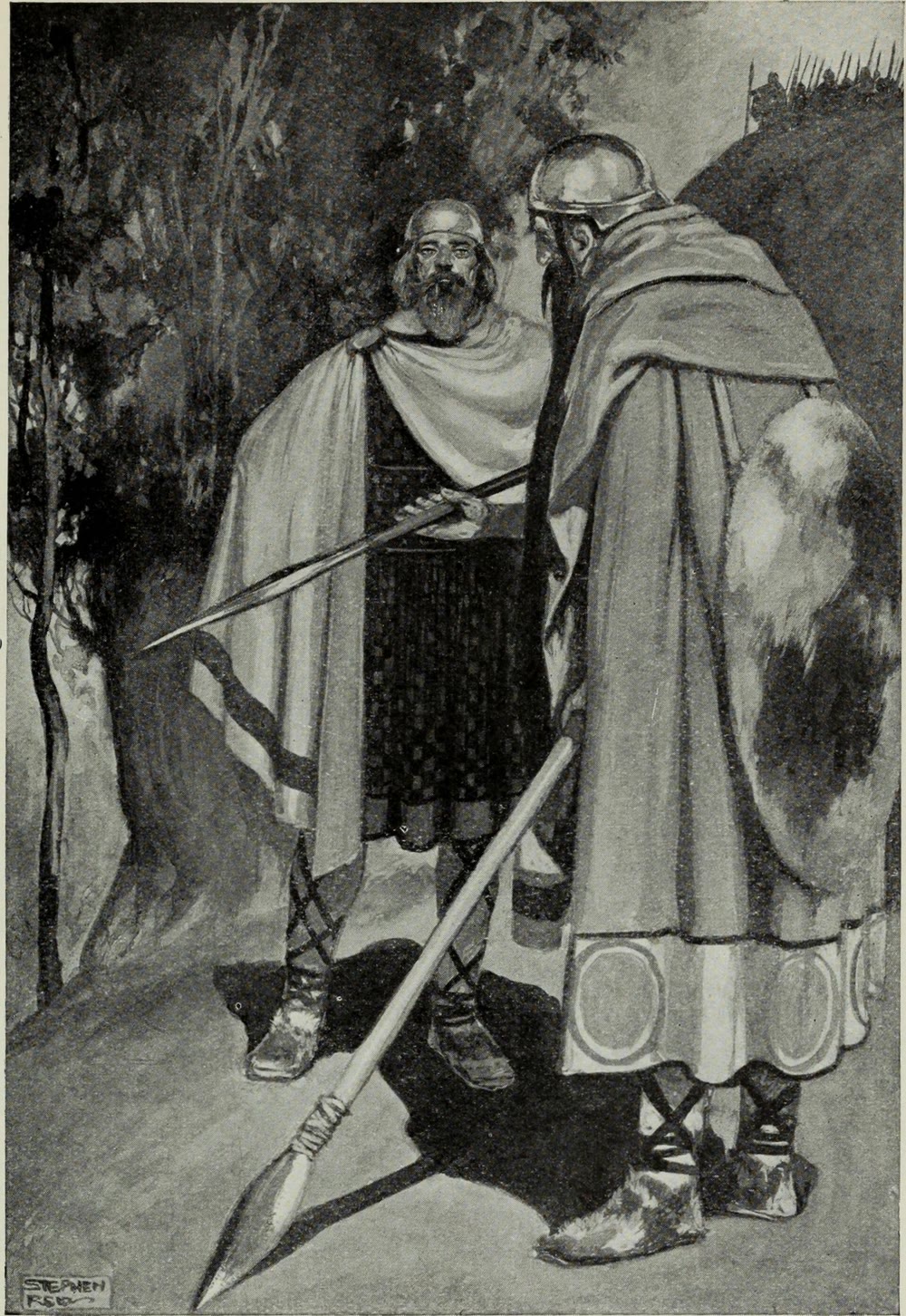
“The Two Ambassadors”: Sreng of the Fir Bolg and Bres of the Tuatha Dé Danann size each other up before the first battle of Mag Tuired. Illustration by Stephen Reid for T. W. Rolleston, Myths and Legends of the Celtic Race (1911). Public domain, via Wikimedia Commons
Bres, Nuada and the silver hand
A maimed king couldn’t rule, so Nuada stepped down. The Tuatha Dé chose Bres, son of Ériu, one of their own, and of Elatha, a Fomorian king. Under Bres, the Fomorians, a hostile people from over the sea, piled tribute on Ireland. When the poet Coirpre was given three small, dry cakes at Bres’s house, he answered with what Cath Maige Tuired calls the first satire made in Ireland.
Meanwhile Dian Cécht, the physician, gave Nuada a silver hand that moved like a real one. His son Míach did better, restoring Nuada’s own hand, and his father, angry at being outdone, killed him. Nuada took back the throne, and Bres went to the Fomorians to raise an army.
Lugh comes to Tara
A young stranger came to the gate of Tara, where nobody got in without a craft. Builder, smith, harper, poet, physician: each time, the doorkeeper said Tara already had one. But did the king have one man who could do them all? Nobody could.
He was Lugh, grandson of Dian Cécht and, through his mother, Ethniu, of the Fomorian Balor. Nuada gave him the king’s seat, and Lugh led the war.
Balor’s eye
Cath Maige Tuired sets the great battle around Samhain. Beforehand, the Dagda met the Morrígan at the river Unshin in Co. Sligo, and she promised to destroy Indech, the Fomorian king.
Then came Balor, whose poisoned eye left any army that looked at it unable to fight; it took four men to lift the lid. Balor killed Nuada, but when the lid rose again, Lugh slung a stone that knocked the eye clean through Balor’s head, so that it glared at his own army instead. He fell and crushed 27 Fomorians.
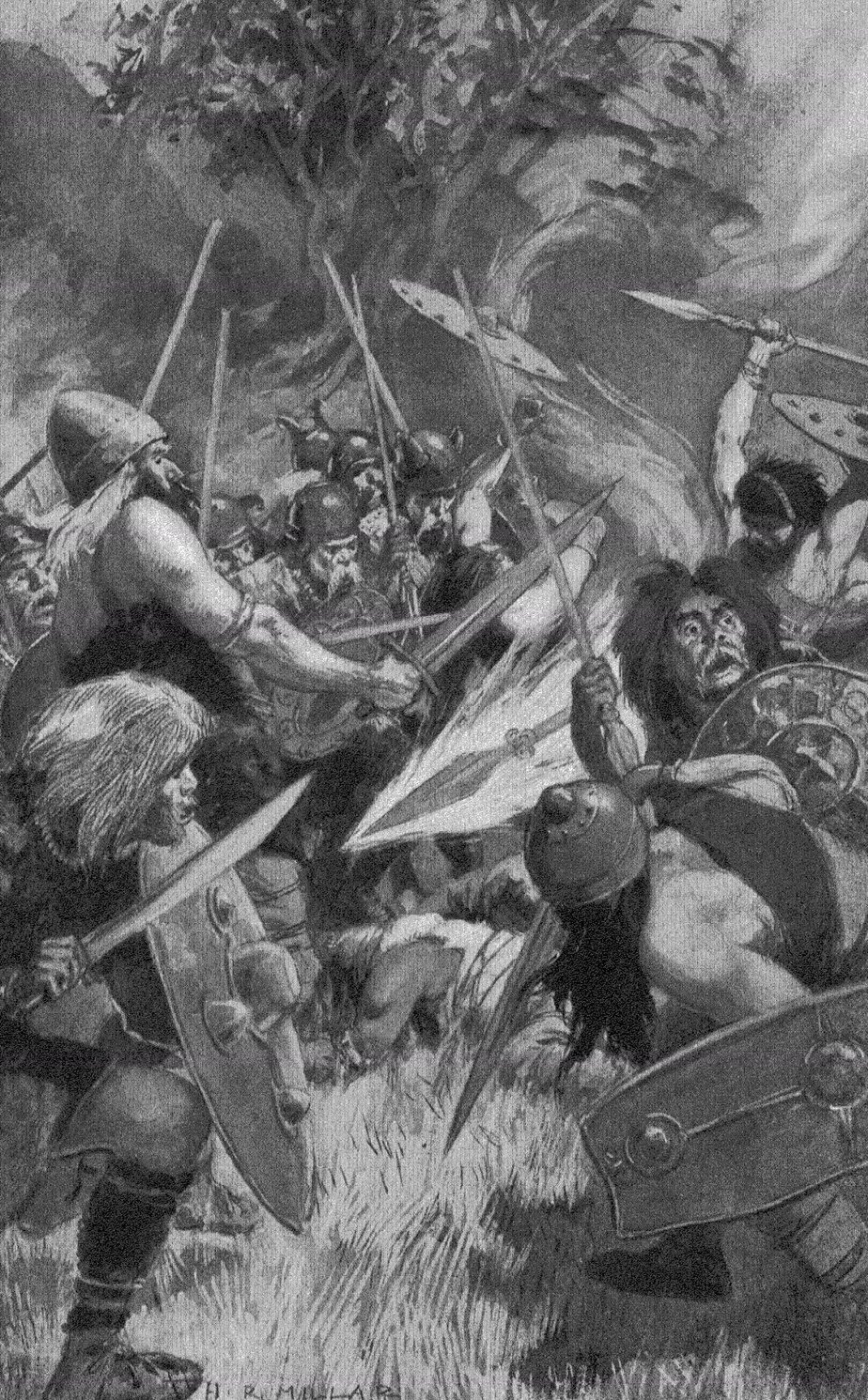
“Lugh’s Magic Spear”: the spear blazes through the thick of a battle. Drawing by H. R. Millar for Charles Squire, Celtic Myth and Legend, Poetry and Romance (about 1910). Public domain, via Wikimedia Commons
The Fomorians were driven to the sea. Bres bought his life with advice on ploughing, sowing and reaping; the Dagda called his captured harp down off a Fomorian wall; and the Morrígan proclaimed the victory and foretold the end of the world.
The main gods of the Tuatha Dé Danann
A quick who’s who, with more in my Celtic gods guide:
The Dagda (DAG-duh). The “good god”: the name stuck, Cath Maige Tuired says, when he promised to wield all the powers the others had boasted of. Good here probably means capable, not saintly. Lebor Gabála also calls him Eochu Ollathair, the great father.
Lugh (LOO). Samildánach, master of all the arts, also called Lugh Lámhfhada (LOO LAWV-ah-duh), of the long arm. Lebor Gabála says he held yearly games at Tailtiu in memory of his foster-mother, and that the festival of Lughnasa takes its name from him. Lúnasa (LOO-nuh-suh) is still the Irish for August.
Brigid. Cormac’s Glossary calls her a daughter of the Dagda and a goddess whom poets worshipped, with two sisters also named Brigid, a physician and a smith. How much of her passed to St Brigid of Kildare is still argued over.
The Morrígan (MOR-ee-gun). A goddess of war, fate and prophecy. Her name may share a root with the “mare” in nightmare, though medieval writers read it as mór rígan, great queen. She turns up again in the Táin.
Nuada (NOO-uh-duh). Nuada Airgetlám, of the silver hand, their king when they arrived.
Manannán mac Lir (MAN-uh-nawn mock LEER). The sea god; mac Lir means son of the sea. Cormac’s Glossary, oddly, calls him a merchant of the Isle of Man, which it says took his name. In the Voyage of Bran, he drives a chariot over waves that, to him, are a plain of flowers.
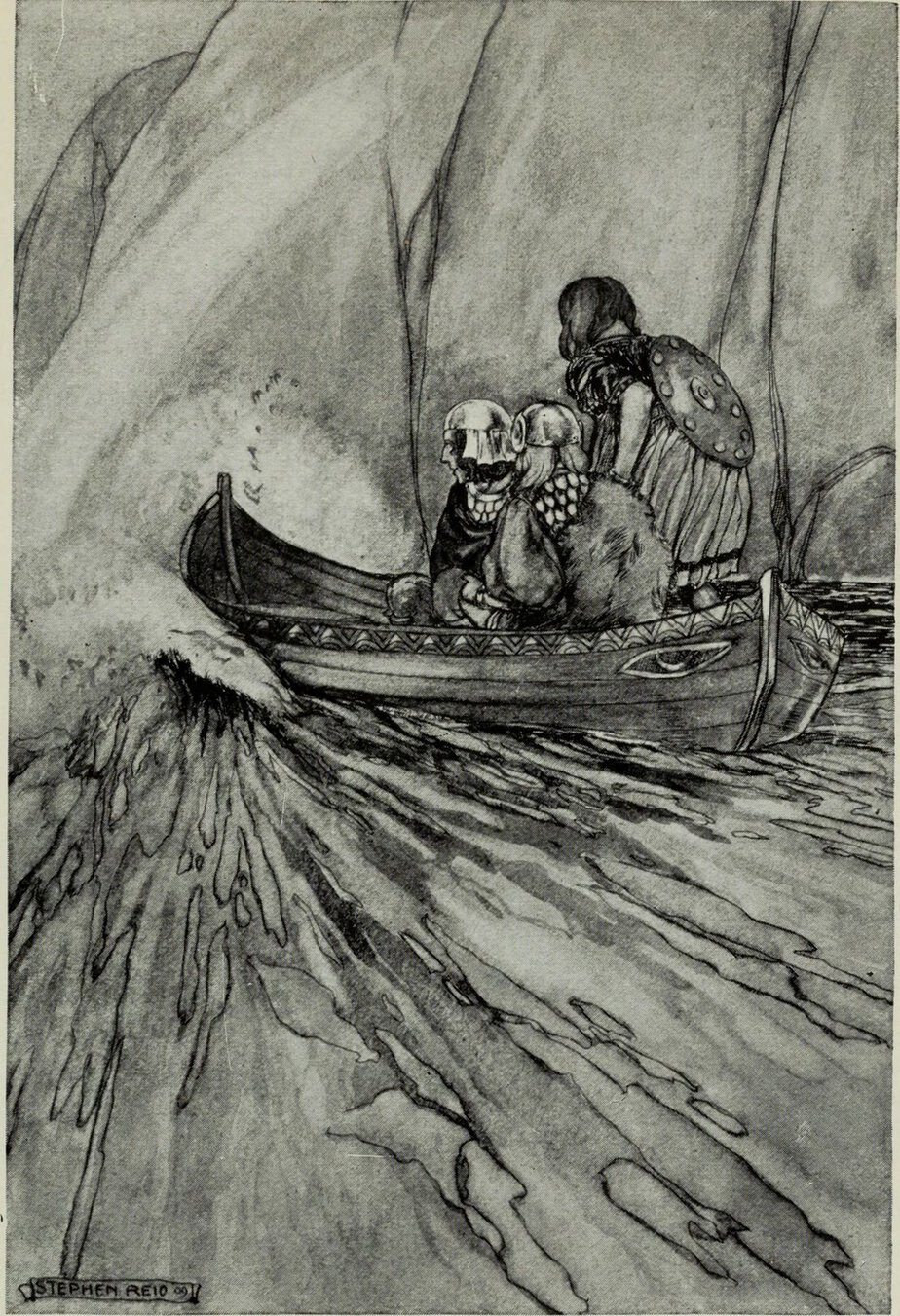
“The Boat of Mananan”: Brian, Iuchar and Iucharba, the sons of Tuireann, set out in the sea god’s magic boat. Illustration by Stephen Reid for T. W. Rolleston, Myths and Legends of the Celtic Race (1911). Public domain, via Wikimedia Commons
Goibniu (GOV-nyoo). The smith, his name linked to the old word for a smith, gabha (GOW-uh) in modern Irish. At Mag Tuired he forged spearheads with three blows, and none of his spears missed.
Aengus Óg (AYN-gus OHG). Son of the Dagda and Boann, known as the Mac Óc, the young son: one tale has him conceived and born on the same day.
Boann (BOH-un). Goddess of the Boyne, an Bhóinn in Irish. A Dindshenchas poem says she walked around a forbidden well, whose waters burst out and chased her to the sea, becoming the river. There’s more in my Salmon of Knowledge story.
Defeat by the Milesians and the move into the hills
Lebor Gabála’s last invaders are the sons of Míl Espáine, Míl of Spain. Heading inland, they meet three goddesses, Banba, Fódla and Ériu, and each asks for the island to bear her name. The poet Amairgen promises Ériu hers will be the chief one, and it lives on in Éire, as I explain in what Ireland means.
Amairgen also rules that the Milesians must go back out beyond nine waves and land again. A druidic wind drowns Donn, son of Míl, but the rest come ashore. At the battle of Tailtiu, the three kings of the Tuatha Dé, Mac Cuill, Mac Cecht and Mac Gréine, grandsons of the Dagda, are killed with their queens, Ériu, Banba and Fódla.
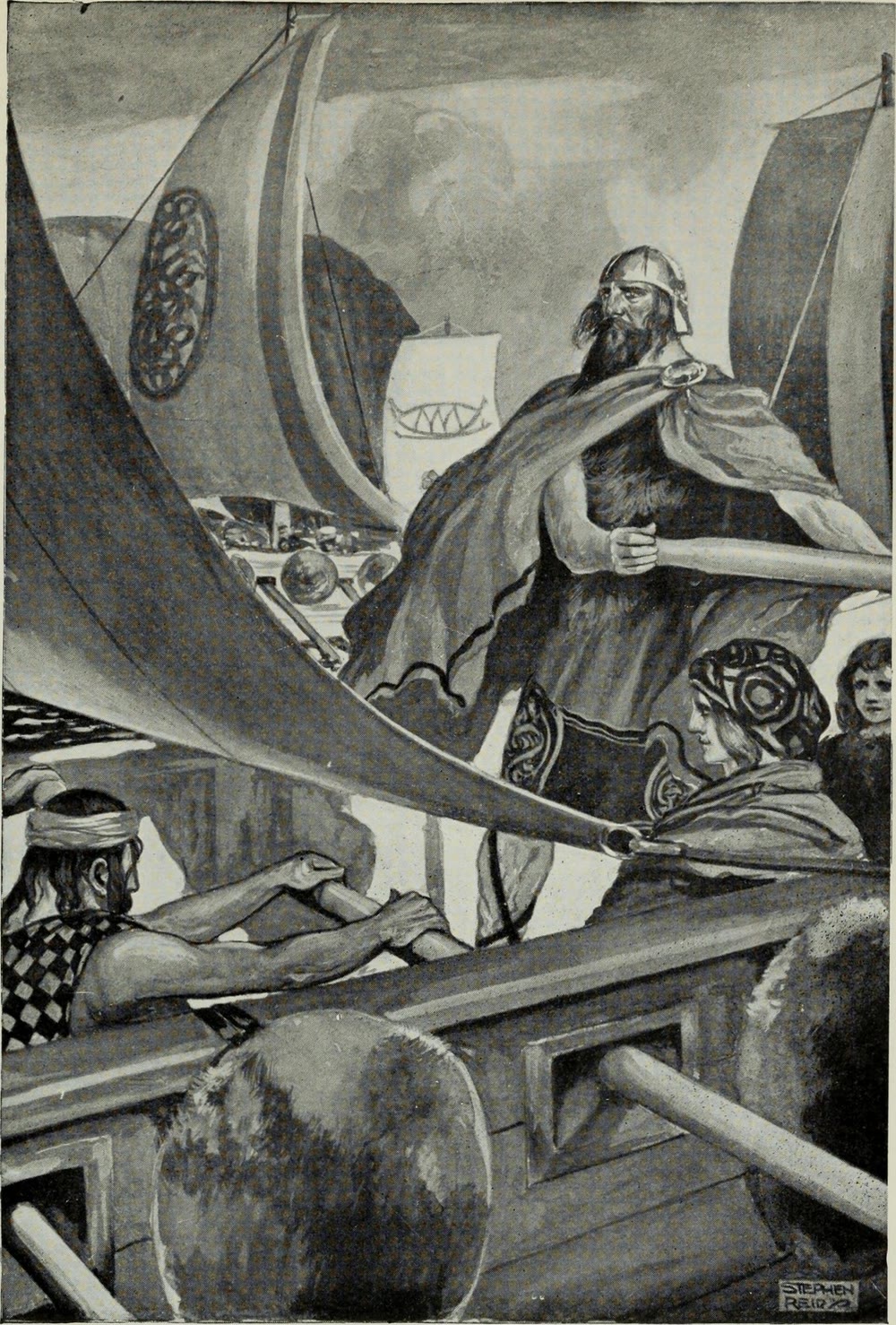
“The Coming of the Sons of Miled”: the Milesian fleet reaches Ireland. Illustration by Stephen Reid for T. W. Rolleston, Myths and Legends of the Celtic Race (1911). Public domain, via Wikimedia Commons
In Mesca Ulad, Amairgen divides Ireland and gives the Tuatha Dé the half under the ground, so they withdraw into the hills and the síde. In De Gabáil in t-Sída, the Taking of the Fairy Mound, the newcomers can’t raise crops or herds until they make peace with the Tuatha Dé, and the Dagda gives each of his people a mound to live in.
A later tale in the Book of Fermoy makes Bodb Derg the new king, as in the Children of Lir, and has Manannán hide the mounds behind a wall that only the Tuatha Dé can see through.
From gods to fairies: the aos sí
Old Irish síd, sí (shee) in modern Irish, means a fairy hill or mound, and its people were the áes síde, modern aos sí (eess SHEE; in Munster, ays SHEE): the fairies.
The link is old. In the late 600s, Tírechán wrote that King Lóegaire’s daughters met Patrick’s party at a well and wondered whether they were men of the síde or “deorum terrenorum”, gods of the earth. An Old Irish hymn on Patrick, Fiacc’s Hymn, says the peoples of Ireland “used to worship síde” before he came.
One version of Lebor Gabála insists they can’t have been demons or síd-folk, because their arts were good. Over the centuries, though, the gods in the mounds blurred into the fairies of folk belief, na daoine maithe (nuh DEE-nyuh MAH-huh), the good people, whose homes were said to be the ringforts known as fairy forts. Even the banshee is the bean sí (ban SHEE), the woman of the síd.
The old name lasted, too. In the 1930s, a Carrickmacross pupil in Co. Monaghan wrote down Mrs Mee’s account of a custom from the days of the Tuatha Dé Danann: children under seven stayed indoors before sunrise and after sunset, so the fairies couldn’t swap them. It’s in the National Folklore Collection.
Newgrange: the Brú of the Dagda and Aengus
The most famous mound of all is the Brú (broo) of medieval tales, usually identified with the passage tomb we call Newgrange, in the bend of the Boyne known as Brú na Bóinne (broo nuh BOH-nyuh). It was built around 3200 BC, thousands of years before anyone wrote about the Tuatha Dé.
Medieval writers made it a home of the gods, though the details clash: a Dindshenchas poem says the Dagda built it, Lebor Gabála that it was raised over him as his grave. In Tochmarc Étaíne, the Wooing of Étaín, Aengus wins it from Elcmar by asking to be king there for a day and a night, then claiming that time itself is nothing but days and nights. In De Gabáil in t-Sída he tricks the Dagda out of it the same way.
Were the Tuatha Dé Danann real? What scholars think
Medieval writers were uneasy. The Story of Tuán, older than Lebor Gabála, says learned men thought they might be exiles from heaven, and the poet Flann Mainistrech listed as many of their deaths as he could to prove they were mortal. Yet the texts keep giving the game away: the Dagda is the good god, and Ana is the mother of the gods.
As the Celticist John Carey puts it in The Irish National Origin-Legend (1994), “The Tuatha Dé are the old gods”. Christian historians turned them into an ancient people, fitted into a timeline running back to the Bible. Scholars call this euhemerism: turning gods into figures from history.
Some names reach beyond Ireland. Since at least 1889, scholars have linked Lugh with Lugus, a Continental Celtic god remembered in Lugdunum, the Roman name of Lyon. Nuada has long been matched with Nodens, named in inscriptions from a Roman-era temple at Lydney Park in Gloucestershire.
What they almost certainly weren’t is a real band of invaders. The Annals of the Four Masters, put together in the 1630s, give them dates, but those are learned calculations, not history. Theories that make them aliens or a lost tribe have no basis in the texts.
Where to see Tuatha Dé Danann places today
- Hill of Tara, Co. Meath: the Lia Fáil stands on the mound called the Forradh. The OPW says the site is open all year; its guides have finished for the 2026 season, so check before you go.
- Brú na Bóinne, Co. Meath: Newgrange is seen only on guided tours from the visitor centre, and booking ahead is essential.
- Moytura, near Cong, Co. Mayo: the Four Masters call the first battle Magh Tuireadh Conga, and Sir William Wilde’s book Lough Corrib tied local cairns and stone circles to it.
- Moytirra and Lough Arrow, Co. Sligo: Whitley Stokes, the tale’s first editor (1891), placed the second battle at Moytirra, a townland near Lough Arrow. Moytirra East has a well-preserved court tomb, a National Monument.
- Tory Island, Co. Donegal: where a folk tale recorded in the 19th century has Balor lock his daughter in a tower.
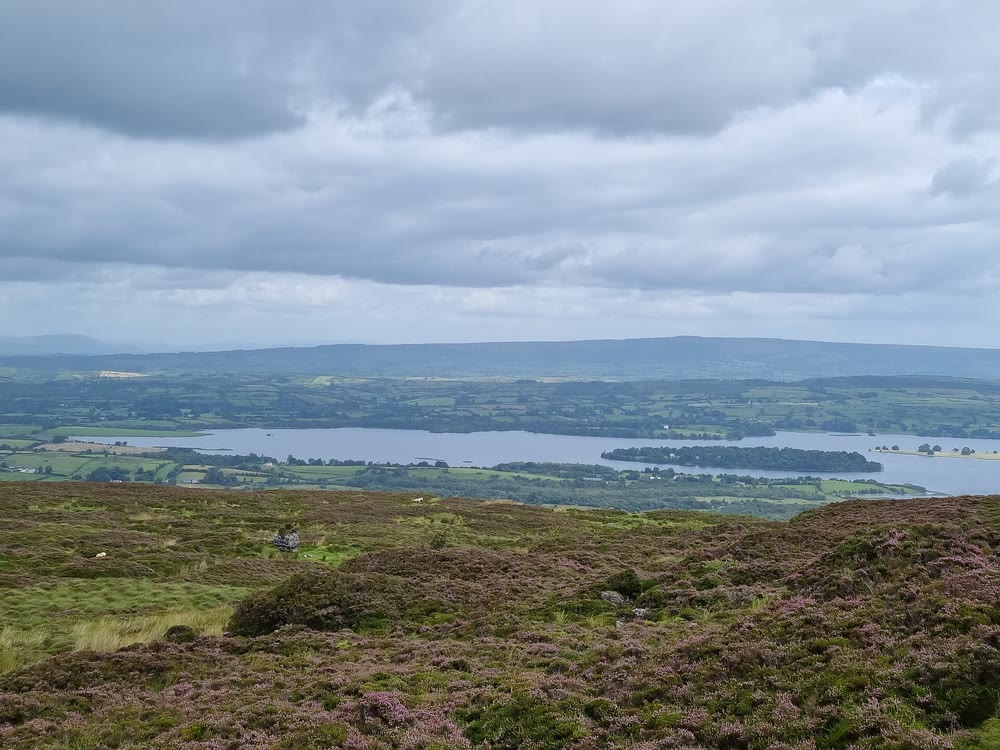
Lough Arrow, Co. Sligo, seen from Carrowkeel. Cath Maige Tuired places the healing well of the second battle east of this lake. Photo: Enter, CC BY-SA 4.0, via Wikimedia Commons
Tuatha Dé Danann FAQ
Were the Tuatha Dé Danann gods?
In origin, yes, according to most scholars. Medieval writers presented them as an ancient people, but the texts still call several of them gods.
Who was the king of the Tuatha Dé Danann?
Lebor Gabála lists Nuada, then Bres while Nuada was maimed, Nuada again, Lugh for 40 years, the Dagda for 80, Delbáeth and his son Fiacha, and finally the Dagda’s three grandsons, who ruled when the sons of Míl arrived.
Are the Tuatha Dé Danann the same as the fairies?
In folk belief, largely yes. Medieval tales send them into the fairy mounds, and later tradition saw the aos sí, the people of the mounds, as the same folk.
Are Irish people descended from the Tuatha Dé Danann?
Not according to Lebor Gabála, which traces the Gaels to the sons of Míl. But John Carey notes a 9th-century poem by Mael Muru of Fahan in which the first Gaelic settlers take wives from the Tuatha Dé.
Love this? Save it to your Pinterest board for later.
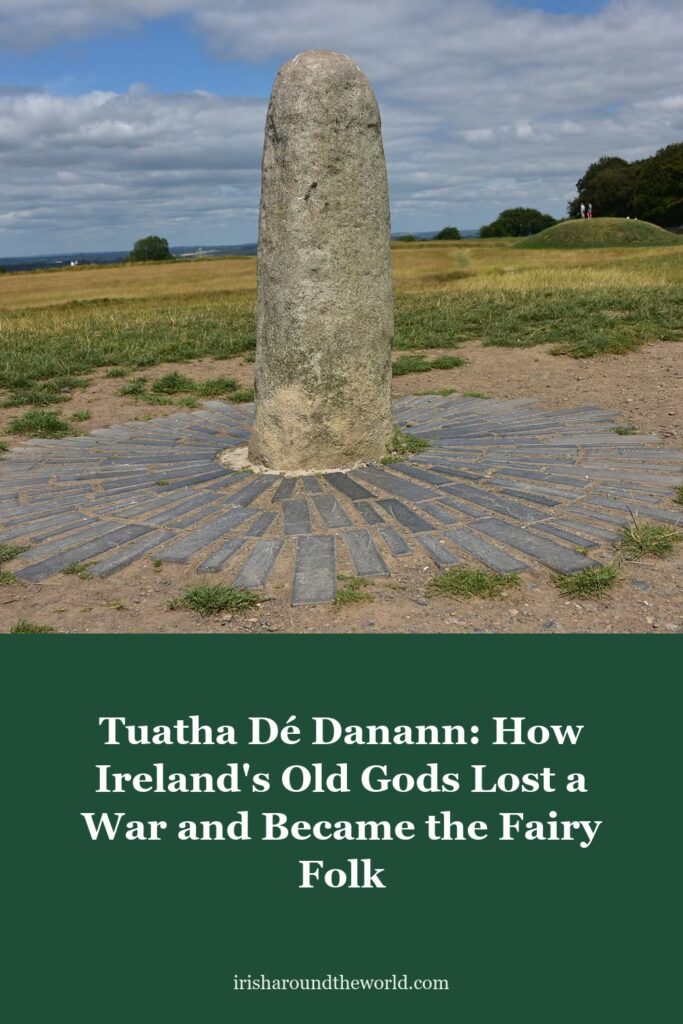
Pin image: The Lia Fáil, the Stone of Destiny, on the Hill of Tara, Co. Meath. Photo: August Schwerdfeger, CC BY 4.0, via Wikimedia Commons
A little bit of Ireland in your inbox every Friday ☘️
The free Weekly Dose of Irish: an Irish joke, a Celtic symbol, an Irish fact, a poem and the week’s best articles in one short email. Join 9,600+ readers.
Free. One short email every Friday. Unsubscribe any time.
More Irish mythology reading
- Celtic Gods and Goddesses: 15 Irish Deities and Their Stories
- Newgrange: The Irish Tomb Older Than Stonehenge and the Pyramids
- The Hill of Tara: Ireland’s Hill of Kings, a Roaring Stone and a Hunt for the Ark
- The Children of Lir: The Irish Legend of Four Swans and 900 Years
- Fairy Forts and Fairy Trees: The Irish Places You Never Disturb
- Samhain: The Night the Fairy Mounds Opened and How It Became Halloween
Featured image: The Lia Fáil, the Stone of Destiny, on the Hill of Tara, Co. Meath. Photo: August Schwerdfeger, CC BY 4.0, via Wikimedia Commons.