
Black pudding is a blood sausage: blood (pig’s, cow’s or sheep’s), fat, oatmeal, onion and spices, packed into a casing and boiled. Most of it is sold ready-cooked, so you slice it and fry it until crisp. White pudding is its bloodless cousin, made with pork, oatmeal and spices. Cork has its own soft blood pudding, drisheen. In Irish, black pudding is putóg dhubh.
It’s the dark round slice beside the sausages on a full Irish breakfast, crisp at the edges and soft in the middle. And yes, it’s made with blood. People in Ireland have been eating it for centuries.
My full Irish breakfast guide gives puddings one short section. This is the long version, with a scallop and apple recipe to finish.
Jump to:
- What is black pudding?
- What is black pudding made of?
- What does black pudding taste like?
- White pudding vs black pudding
- Drisheen: Cork’s own blood pudding
- A short history of black pudding
- Clonakilty and Ireland’s pudding makers
- Irish vs British black pudding
- How to cook black pudding: pan, oven and air fryer
- Recipe: seared scallops with black pudding and apple
- Buying black pudding in the US
- Black pudding FAQ
- More Irish food reading
What is black pudding?
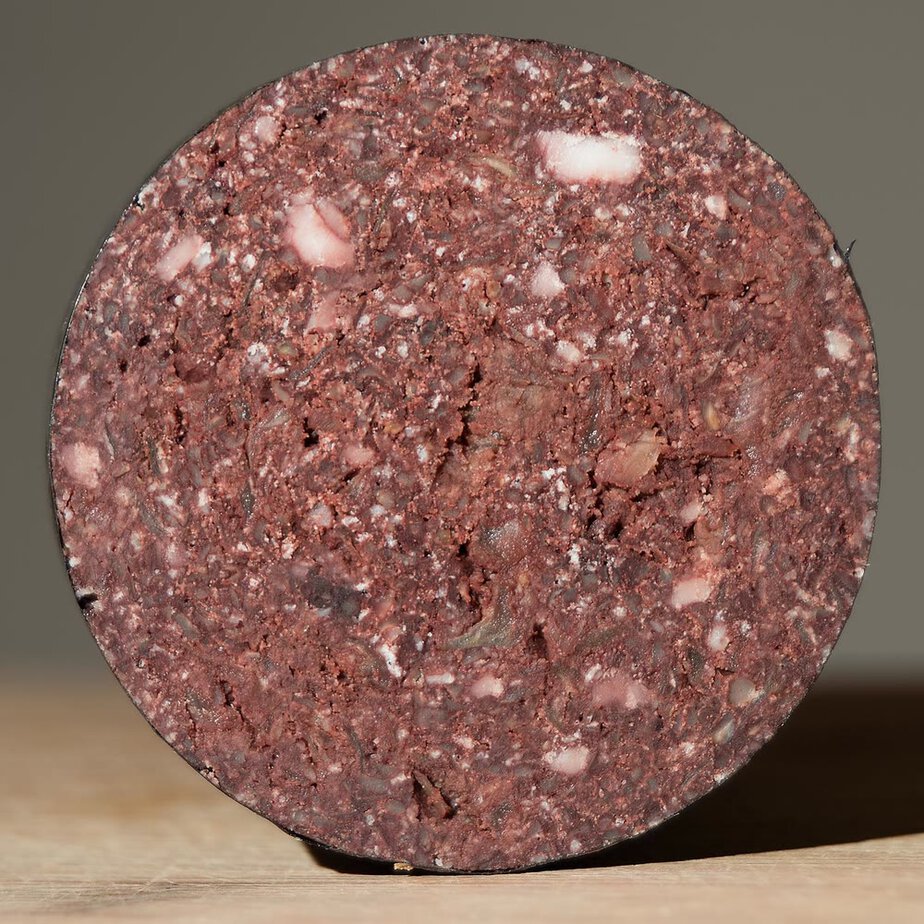
Black pudding is a sausage made with blood, fat and a cereal, usually oatmeal, seasoned with onion and spices. Americans generally call it blood sausage, the name the USDA’s food database uses, and its close relatives include French boudin noir and Spanish morcilla.
Why “pudding”? The word keeps an older meaning: something packed into a sausage skin, as the Oxford Companion to Food explains. Irish works the same way. Ó Dónaill’s dictionary gives putóg first as a gut or intestine, and second as a pudding.
- Putóg dhubh (PUT-ohg GHUV; puh-TOHG in Munster, and dhubh closer to “ghoo” in Connacht and Ulster): black pudding.
- Lúbán dubh (LOO-bawn DUV, or DOO in Connacht and Ulster): another name in Ó Dónaill; lúbán means a loop or coil.
- Putóg bhán (PUT-ohg WAWN): white pudding.
You’ll see “putog dubh” or “putóg bán” online, but putóg is feminine, so the adjective after it gains an h: dhubh, bhán. Lúbán is masculine, so dubh stays as it is.
What is black pudding made of?
In his paper The Pig in Irish Cuisine and Culture (2010), food historian Máirtín Mac Con Iomaire sets out the old farmhouse method: blood mixed with onions, oatmeal, lard, flour and spices, stuffed into cleaned intestines, then boiled for roughly an hour.
- Blood: pig’s blood was the usual choice in Irish homes. Clonakilty uses beef blood, and only about 3 to 4% of its pudding is blood, Great British Chefs reports.
- Fat: pork fat or lard in most recipes; beef fat in Clonakilty’s.
- Cereal: oatmeal above all, with barley, flour or breadcrumbs in some recipes. It soaks up the blood and gives the crumbly texture.
- Seasoning: onion, salt and a spice blend, often secret. Ballymaloe cook Darina Allen’s family recipe uses allspice, white pepper, nutmeg, thyme and cayenne.
- Casing: traditionally the animal’s own cleaned guts. Many commercial puddings come in plastic casings, which you peel off.
Most puddings now use blood dried to a powder, the Irish Farmers Journal reported in September 2026, and much of it is imported. Fresh-blood makers are in danger of disappearing, the Irish Examiner warned the same month, after Inch House Pudding in Co. Tipperary closed in summer 2026.
Is black pudding already cooked?
Usually, yes. Puddings are boiled when they’re made, and Cork food writer Kate Ryan points out that it’s already cooked, so you’re only heating it. If a label says it must be cooked, follow its instructions.
What does black pudding taste like?
Black pudding tastes savoury, rich and spiced, something like a peppery, oaty sausage. Texture depends on the maker: Great British Chefs describes Clonakilty’s as very crumbly, with warmth from the spices.
It loves sweet and sharp partners, so you’ll meet it with apple, scallops, mustard or a fried egg, and alongside potato dishes like boxty and colcannon.
White pudding vs black pudding: what’s the difference?
White pudding is black pudding’s pale twin, made without blood. Irish white pudding is usually pork meat and fat, oatmeal, onion and spices, so it’s lighter and milder. Clonakilty launched its white pudding in 1986, and Great British Chefs notes its peppery kick. Darina Allen remembers thriftier 1960s home-made white pudding: minced scraps of meat, liver, lungs (lights) and oatmeal.
| Black pudding | White pudding | Drisheen | |
|---|---|---|---|
| Blood? | Yes: pig’s, cow’s or sheep’s | No | Yes: sheep’s and beef, or beef alone today |
| Also in it | Fat, oatmeal, onion, spices | Pork, fat, oatmeal, onion, spices | Salt; recipes differ |
| Looks and feels | Dark and crumbly | Pale and oaty | Brownish-grey, soft like blancmange |
| Where | Ireland and Britain | Ireland and Scotland | Cork city |
On an Irish breakfast plate you’ll usually get a slice of each. In A Portrait of the Artist as a Young Man (1916), James Joyce gives Stephen Dedalus that kind of breakfast to look forward to after communion: “White pudding and eggs and sausages and cups of tea.”
Drisheen: Cork’s own blood pudding
Drisheen takes its name from the Irish drisín (DRISH-een; drish-EEN in Munster), which Ó Dónaill’s dictionary defines first as an animal’s intestine and then as drisheen itself.
It’s a very different pudding. The Oxford Companion to Food describes a blend of sheep’s and beef blood, lightly salted and left to set overnight; the watery serum that separates goes into beef casings, which are boiled for only a few minutes. The result is brownish-grey and as soft as blancmange. Darina Allen, though, says drisheen is now made from beef blood.
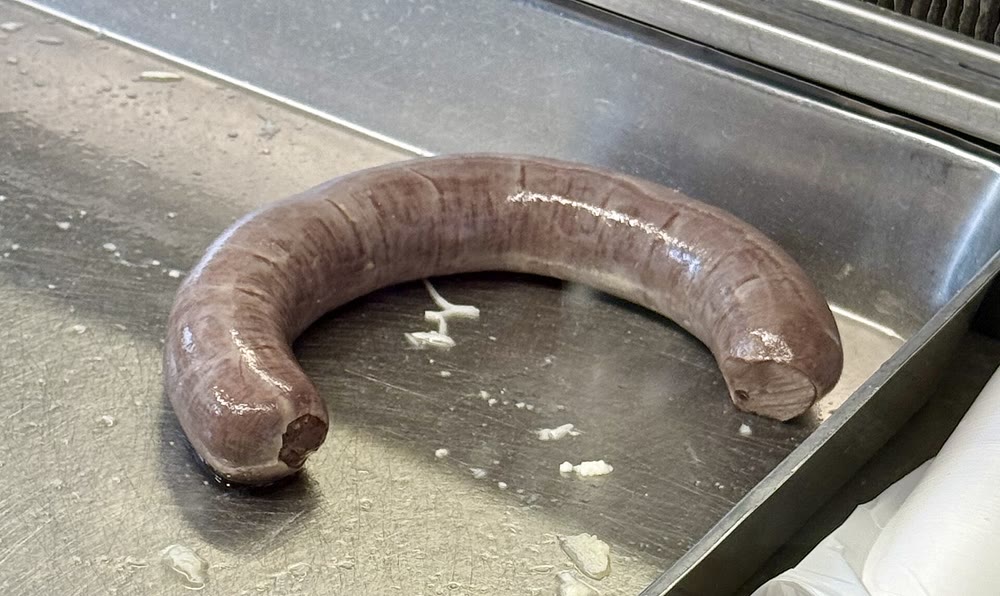
A length of drisheen in the English Market, Cork. Photo: Alison Cassidy, CC BY-SA 4.0, via Wikimedia Commons
In Cork it’s traditionally eaten with tripe simmered in milk and onions, with sliced drisheen added at the end just to heat through, as in the Farmgate Café recipe the Irish Examiner printed in 2023.
To buy it, head for A. O’Reilly’s stall in the English Market, started by brothers John and Maurice O’Reilly in the early 1900s, says Cork City Council; the family says no one else in Ireland produces tripe and drisheen. Donagh O’Reilly told the Irish Examiner that it was once a staple and is now more of a delicacy.
The market also sells Cork spiced beef; there’s more in my Cork facts.
A short history of black pudding
Blood puddings are ancient. The Oxford Companion to Food suggests black pudding may be the oldest sausage of all, and points to Homer’s Odyssey, where the prize in a fight is goats’ paunches “which we have filled with blood and fat” (Samuel Butler’s 1900 translation).
Puddings in medieval Ireland
Puddings star in Aislinge Meic Con Glinne (roughly ASH-ling-eh mek kon GLIN-eh), The Vision of Mac Conglinne, a 12th-century satire in which a scholar rids a king of a demon of gluttony by describing a land made of food. In Kuno Meyer’s 1892 translation, one house has “Puddings fresh-boiled” for thatch-rods, and the doorkeeper, “Bacon-lad, son of Butter-lad, son of Lard”, carries a whip with 29 puddings for cords.
Bleeding cattle
In the 1600s, English observers wrote that the Irish bled live cattle and ate the blood, set like jelly or salted and worked with butter into puddings, the Oxford Companion notes. Darina Allen argues that colonisers used this to paint the rural Irish as savage, when it was a sophisticated practice. During the Famine, she adds, tenant farmers who had to give up their animals to the landlord sometimes secretly bled them on Sundays, which gave rise to the saying “The Kerry cow knows it’s Sunday”.
The pig killing
Most home puddings came from the pig killing, which Mac Con Iomaire describes as both a ritual and a social event in rural Ireland. The blood was caught in a bucket for puddings, everyone who helped went home with some pudding and fresh pork, and nothing was wasted. A 1930s account from Ednacarnon, Co. Donegal, describes the blood of a slaughtered cow or bullock mixed with oatmeal while still warm, poured into the washed guts from a jug and boiled in rings.
Making the puddings was women’s work, Darina Allen remembers. She made them with her great-aunt in Tipperary in the 1960s, while the men butchered the pig and neighbours helped as a meitheal (roughly MEH-hul), a working party.
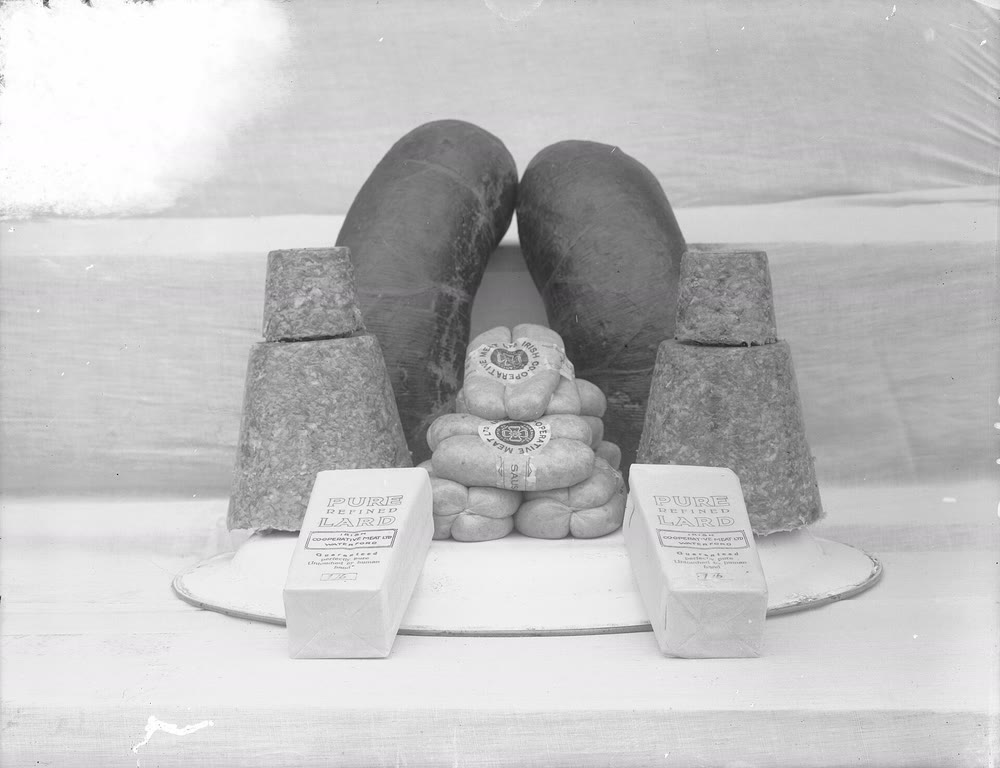
Sausages, black and white pudding and lard from Irish Co-operative Meat Ltd, Waterford, photographed for Christmas on 12 December 1930. Poole Collection, National Library of Ireland (P_WP_3770). Public domain, via Wikimedia Commons
From farmhouse to state banquet
In the late 1980s, Mac Con Iomaire writes, chef Michael Clifford made Clonakilty black pudding fashionable by serving it as a starter at Clifford’s, his restaurant in Cork. By 2011 black pudding was state-banquet food: for Queen Elizabeth II’s state dinner, chef Ross Lewis worked with McCarthy’s of Kanturk, Co. Cork, known for fresh-blood puddings, on a pudding for the occasion.
Clonakilty and Ireland’s pudding makers
The name most people know is Clonakilty, from the West Cork market town; the company bills it as Ireland’s favourite black pudding. The company’s history begins with Johanna O’Brien of Sam’s Cross, a farmer’s wife who made black pudding for Philip Harrington’s butcher’s shop to add to the household income. The company dates its recipe to the 1880s, and 1880 is the year usually given, as in a 2006 Irish Times profile. Michael Collins, incidentally, was born at Woodfield, Sam’s Cross, in 1890.
The recipe and its secret spice mix passed down through the Harrington family. In 1969 the shop was sold to Patrick McSweeney, and in 1976 his nephew, Edward Twomey, bought it, recipe and all. Edward nearly stopped making the pudding until customers made it clear they wanted it. He and his wife, Colette, who owns the company today, were the only ones who mixed the spices.
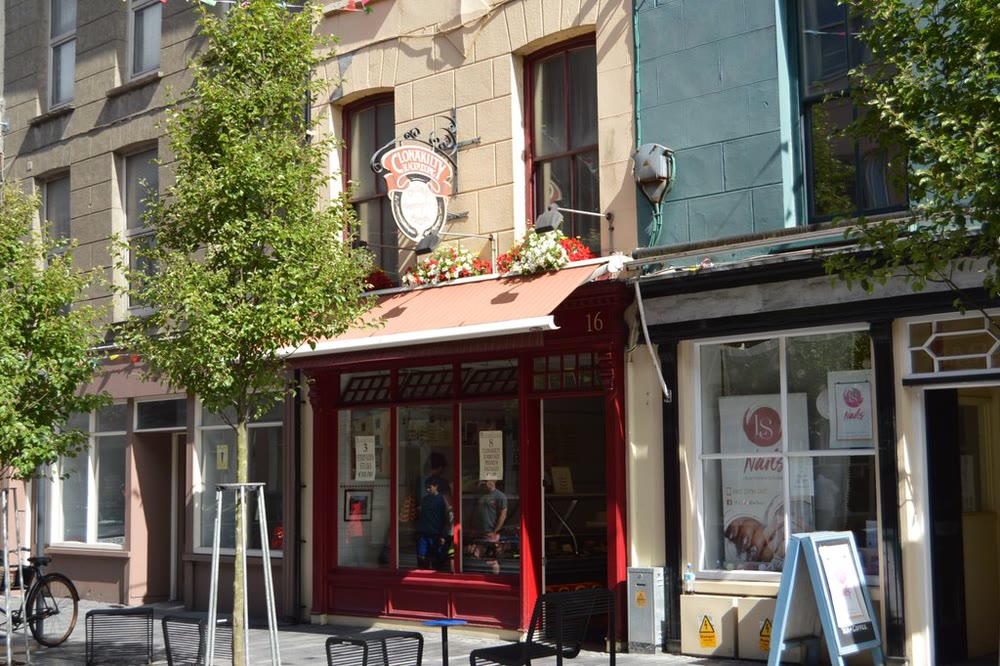
The Twomey butcher’s shop at 16 Pearse Street, Clonakilty, in 2018. Photo: N Chadwick, CC BY-SA 2.0, via Wikimedia Commons
The company’s visitor centre on Western Road, Clonakilty, offers a self-guided tour and tastings, Monday to Saturday (adults €10 in October 2026). For more of the county, see my guide to things to do in County Cork.
Other makers are worth seeking out. Kate Ryan’s favourites, named in the Irish Farmers Journal, include M. J. O’Neill & Sons’ fresh beef-blood pudding in Clonakilty, Co. Kerry’s Annascaul pudding and Hugh Maguire’s smoked pudding from Co. Meath.
Irish vs British black pudding
There’s no single Irish or British recipe, so it’s fairest to compare particular puddings.
- Stornoway, Scotland: this Isle of Lewis pudding has had protected (PGI) status since 2013. Its specification allows only beef suet, oatmeal, onion, blood (sheep’s, cow’s or pig’s), salt and pepper, with suet the largest ingredient at 37 to 50%, which it says sets Stornoway apart; most regional puddings, it adds, use pig’s blood. Expect a moist, firm, oaty pudding.
- Bury, Greater Manchester: Chadwick’s Original Black Puddings, founded in 1865, has had a Bury Market stall since 1972, says Bury Council.
- Ireland: oatmeal is the usual cereal, and makers use pig’s or beef blood. The real giveaway is white pudding, a regular on Irish breakfast plates, as my full Irish guide explains.
How to cook black pudding: pan, oven and air fryer
You’re really heating the pudding through and crisping the outside. Slice it about 1 to 1.5cm (½ inch) thick and peel off any plastic casing. White pudding cooks the same way.
- Frying pan: warm a little oil or butter on a medium heat, as Clonakilty’s own breakfast recipe advises, and give the slices 2 to 3 minutes on each side, until the edges crisp and the middle is hot.
- Oven: bake on a lined tray at 200°C (400°F; 180°C fan) for 10 to 12 minutes, turning once.
- Air fryer: arrange in a single layer, not touching, and air fry at 180°C (350°F) for 8 to 10 minutes, turning halfway. Air fryers vary, so check that a slice is piping hot in the middle.
- Crumbled: fry crumbled pudding in a dry pan for 4 to 5 minutes, stirring, until crisp, and scatter over salads, soup or mash.
Recipe: seared scallops with black pudding and apple
After Clifford’s, Mac Con Iomaire notes, black pudding spread to menus as a starter, often with caramelised apple. Add seared scallops and you have a restaurant-style plate that’s easy at home, ready in about 35 minutes.
Prep: 15 minutes | Cook: 20 minutes | Serves: 2 as a main, 4 as a starter
Ingredients
- 8 large scallops (king scallops in Ireland and Britain, sea scallops in the US), about 350g (12 oz)
- 4 slices of black pudding, about 1.5cm (½ inch) thick (about 160g, 5½ oz), casing removed
- 1 large crisp, tart eating apple, such as Granny Smith or Braeburn
- 30g (2 US tbsp) butter
- 1½ tablespoons rapeseed (canola) or vegetable oil
- 1 teaspoon sugar
- 4 tablespoons (60ml) dry Irish cider, or apple juice with 1 teaspoon cider vinegar
- ½ lemon
- A small handful of flat-leaf parsley or chives, chopped
- Salt and black pepper
Method
- Pull off the small, tough side muscle from each scallop if it’s attached. Pat the scallops very dry with kitchen paper and chill them while you cook the rest.
- Core the apple (no need to peel it) and cut it into 12 wedges. Melt half the butter in a large frying pan over a medium heat, add the apple and sprinkle over the sugar. Cook for 3 to 4 minutes a side, until golden and just tender.
- Pour in the cider and let it bubble for about a minute, until syrupy. Tip the apple and juices into a warm bowl and cover. Wipe out the pan.
- Add ½ tablespoon of the oil and fry the black pudding over a medium heat for 2 to 3 minutes on each side, until crisp and hot through. Add it to the apple, breaking the slices into chunks if you like.
- Wipe the pan again and heat the remaining oil over a high heat until it shimmers. Season the scallops with salt and lay them flat side down in a clockwise circle, so you know which went in first. Leave them alone for 1½ to 2 minutes, until a deep golden crust forms.
- Turn the scallops in the same order, add the rest of the butter and cook for 1 to 1½ minutes more, spooning the foaming butter over them, until just opaque at the sides and slightly springy. Squeeze over the lemon and take the pan off the heat.
- Divide the apple and black pudding between warm plates, top with the scallops and spoon over the pan butter. Scatter with herbs and black pepper and serve at once.
Tips
Buy dry scallops. America’s Test Kitchen advises asking for “dry” scallops. “Wet” ones are treated with a preservative such as sodium tripolyphosphate, and they’re hard to dry well enough to brown. Frozen scallops are fine: thaw them in the fridge and dry them well. In a small pan, sear them in two batches.
Variations
- Brunch: skip the scallops and serve the pudding and apple with a poached egg and soda bread.
- Softer apple: stew a chopped Bramley, the cooking apple in my Irish apple cake, with a little sugar until it collapses, and spoon it under the scallops.
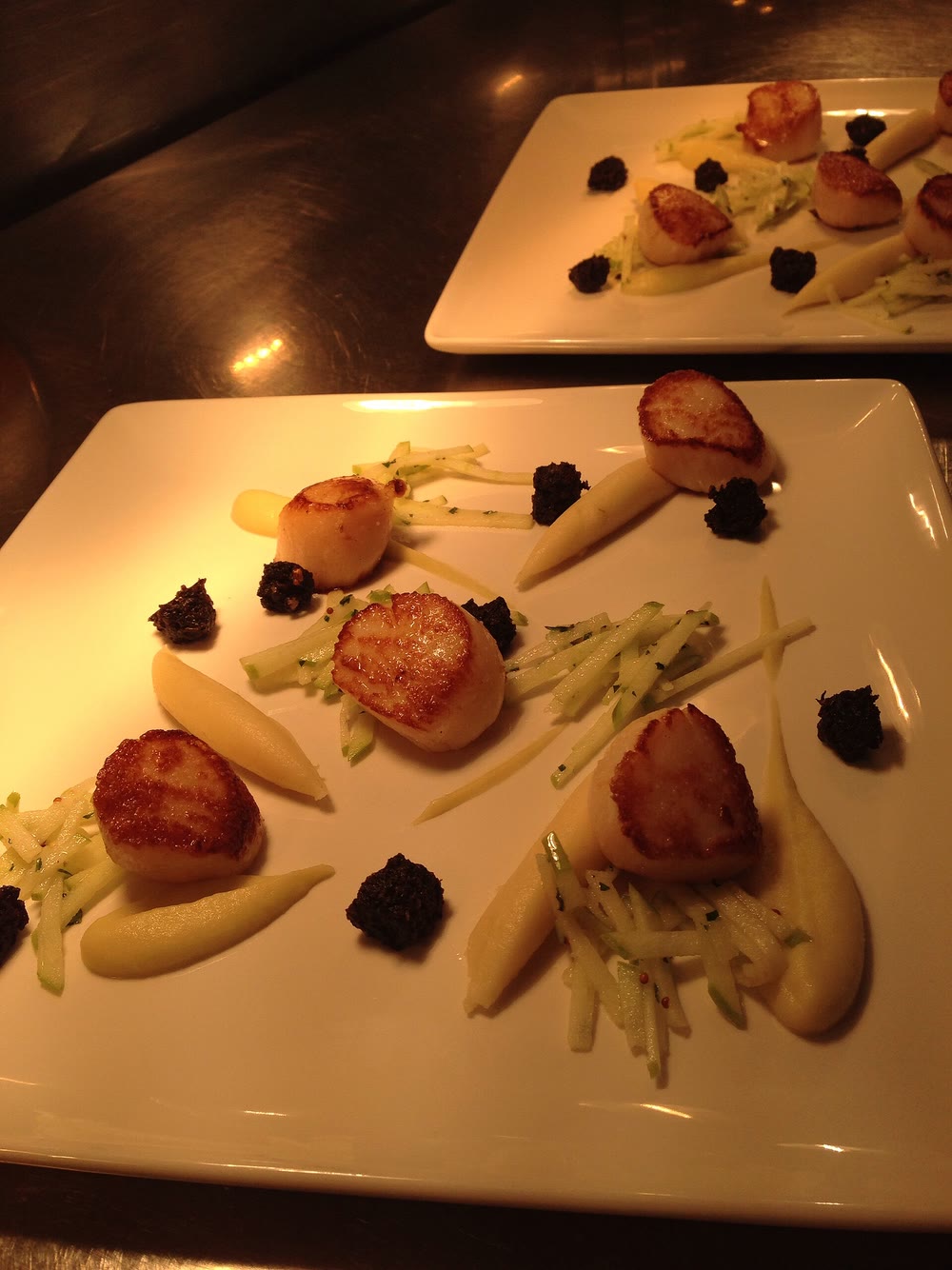
A restaurant version: hand-dived scallops with black pudding and apple, a dish by chef Jose Dalto. Photo: Haggis35, CC BY-SA 3.0, via Wikimedia Commons
Buying black pudding in the US
Is black pudding banned in the US?
No, whatever you read online. US federal meat rules allow blood from inspected and passed animals to be saved as food (9 CFR 310.20). The famous ban is on lungs, barred as human food since 1971 (9 CFR 310.16), which is why traditional Scottish haggis isn’t sold in the US. Black pudding has no lungs in it.
Why Irish brands are hard to find
Importing is the problem. Clonakilty says on its website that, because of strict rules on importing meat products into the US and Canada, it can’t export to either country for now.
Instead, look for Irish-style puddings made in the US. The online grocer Food Ireland, for example, describes the Donnelly puddings it sells as made in the USA with Irish ingredients. In a pinch, use Spanish morcilla or French boudin noir.
Can I bring black pudding home from Ireland?
It’s safest not to. US Customs and Border Protection says many meat products are prohibited and all meats must be declared; failing to declare a prohibited item can cost up to $1,000 for a first offence. Agriculture specialists at the airport decide what gets in, so eat your pudding in Ireland.
Black pudding FAQ
Is black pudding healthy?
It’s rich in iron, but also in fat and salt. USDA figures for a generic blood sausage give 6.4mg of iron per 100g (3.5 oz), with 34.5g of fat and 680mg of sodium; oaty Irish puddings vary, so check the label. Much of that iron is haem iron, the kind found in animal foods, which the body absorbs more readily than iron from plants, the Irish Examiner notes.
Is black pudding gluten-free?
Don’t assume so: some recipes add wheat flour or breadcrumbs. A few makers sell gluten-free versions, Clonakilty among them, so check the label.
Does white pudding have blood in it?
No. Irish white pudding is pork, fat, oatmeal, onion and spices, with no blood.
Love this? Save it to your Pinterest board for later.
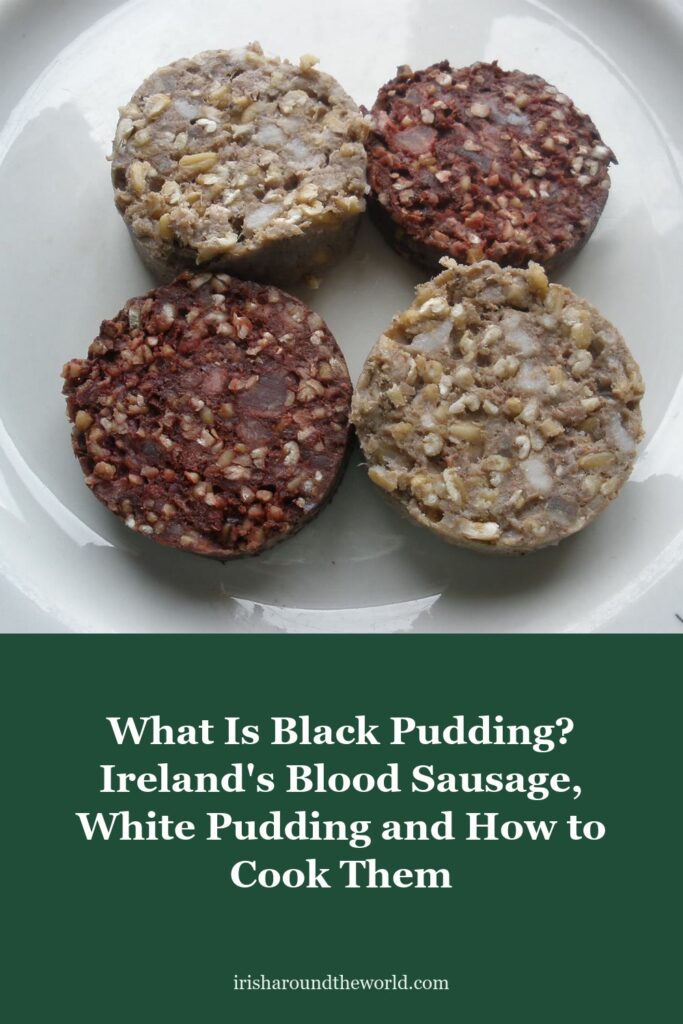
Pin image: Uncooked slices of Irish black and white pudding. Photo: © O’Dea at Wikimedia Commons, CC BY-SA 4.0
A little bit of Ireland in your inbox every Friday ☘️
The free Weekly Dose of Irish: an Irish joke, a Celtic symbol, an Irish fact, a poem and the week’s best articles in one short email. Join 9,600+ readers.
Free. One short email every Friday. Unsubscribe any time.
More Irish food reading
- Full Irish Breakfast: What Goes on the Plate and How to Get It All Hot at Once
- Boxty Recipe: The Irish Potato Pancake That Came With a Marriage Warning
- Colcannon Recipe: The Irish Halloween Mash That Hides Your Fortune
- Irish Stew Recipe: The Real Lamb-and-Potato Stew (and the Great Carrot Argument)
- Irish Spiced Beef: The Cork Christmas Classic (and How to Cure Your Own)
- Irish Soda Bread Recipe: The 4-Ingredient Loaf With a Cross to Keep the Fairies Away
- Facts About Cork, Ireland: Why We Call It the Real Capital
Featured image: Uncooked slices of Irish black and white pudding. Photo: © O’Dea at Wikimedia Commons, CC BY-SA 4.0.