The Leaving Cert Irish poems for June 2027 and June 2028 are ten poems, and none of them was on the list for 2024 to 2026. Five common poems are set for Ordinary and Higher Level: Dínit an Bhróin, Deireadh na Feide, Iníon, Glaoch Abhaile and Úirchill an Chreagáin. Higher Level students who take the poetry option in Section 3 study five more: Trén bhFearann Breac, Eanáir 1991, Ag Tiomáint Siar, Dijeridiú and Anthony Daly. The official list is in Department of Education and Youth circular 0041/2026. An tEarrach Thiar and the rest of the old list are gone.
If your Irish notes are full of An tEarrach Thiar and Caoineadh Airt Uí Laoghaire, you can put them to one side. For students sitting the Leaving Cert in June 2027 or June 2028, every poem on the Irish course has been replaced.
Here’s the new list in plain English, with what changed and the rules for choosing your own poems. This is an independent guide, not an official source, so check anything important with your teacher and the circulars below.
Our guides to the five common poems and to Raftery’s Anthony Daly are linked in the tables.
Jump to:
- How the poetry course works
- The five common poems (Ordinary and Higher)
- The five additional poems (Higher only)
- What changed from the 2024 to 2026 list
- Choosing your own poems: the 2(b) rules
- Prose, film and play for 2027 and 2028
- The oral and the literature history questions
- Official sources and free help
- How to use our poem pages
- Leaving Cert Irish poems FAQ
- More Irish poetry reading
How the poetry course works
Two numbered sections of the course involve poetry.
- Section 2, for Ordinary and Higher Level. Students study either 2(a), the five common prescribed poems, or 2(b), five poems their school chooses under the optional-course rules.
- Section 3, for Higher Level only. Students study one of five prose works under 3(a), or all five poems under 3(b). The Irish-language circulars call the 3(b) poems the Dánta Breise (DAWN-tuh BRESH-uh), the additional poems. Students may study both 3(a) and 3(b), but only one section is answered in the exam.
In Irish, Higher Level is Ardleibhéal (ARD-lev-ayl) and Ordinary Level is Gnáthleibhéal (GRAW-lev-ayl, or g’NAW-lev-ayl in Munster). Foundation Level, Bonnleibhéal (roughly BOON-lev-ayl; BOWN in Munster), has its own exam, but the circulars set prose and poetry for Ordinary and Higher Level only.
The five common poems for Ordinary and Higher Level
| Poem | Poet | Level | Source named in the circular | Our guide |
|---|---|---|---|---|
| Dínit an Bhróin | Máirtín Ó Direáin | Ordinary and Higher | Na Dánta (An Clóchomhar, 2010) | Dínit an Bhróin |
| Deireadh na Feide | Ailbhe Ní Ghearbhuigh | Ordinary and Higher | The Coast Road (Gallery Press, 2016) | Deireadh na Feide |
| Iníon | Áine Durkin | Ordinary and Higher | Mise Áine, An Bhean Istigh (Cló Iar-Chonnacht, 2017) | Iníon |
| Glaoch Abhaile | Áine Ní Ghlinn | Ordinary and Higher | Unshed Tears / Deora Nár Caoineadh (Dedalus, 1996) | Glaoch Abhaile |
| Úirchill an Chreagáin | Art Mac Cumhaigh | Ordinary and Higher | Duanaire na hArdteistiméireachta (no edition given) | Úirchill an Chreagáin |
Dínit an Bhróin by Máirtín Ó Direáin
Dínit an Bhróin (roughly JEE-nitch un VROHN; in Munster the d is softer, closer to DEE-nit) means the dignity of grief. Dínit is dignity, and bróin is the genitive of brón, sorrow.
Ó Direáin (1910 to 1988) was born on Inis Mór, the largest of the Aran Islands, and later worked in Galway and Dublin, says ainm.ie.
In the poem, the speaker sees two women in black mourning clothes walking out from a crowd, and for the first time grief strikes him as something with its own dignity. That’s how TG4’s study guide reads it. Ó Direáin was on the old course too, with An tEarrach Thiar.
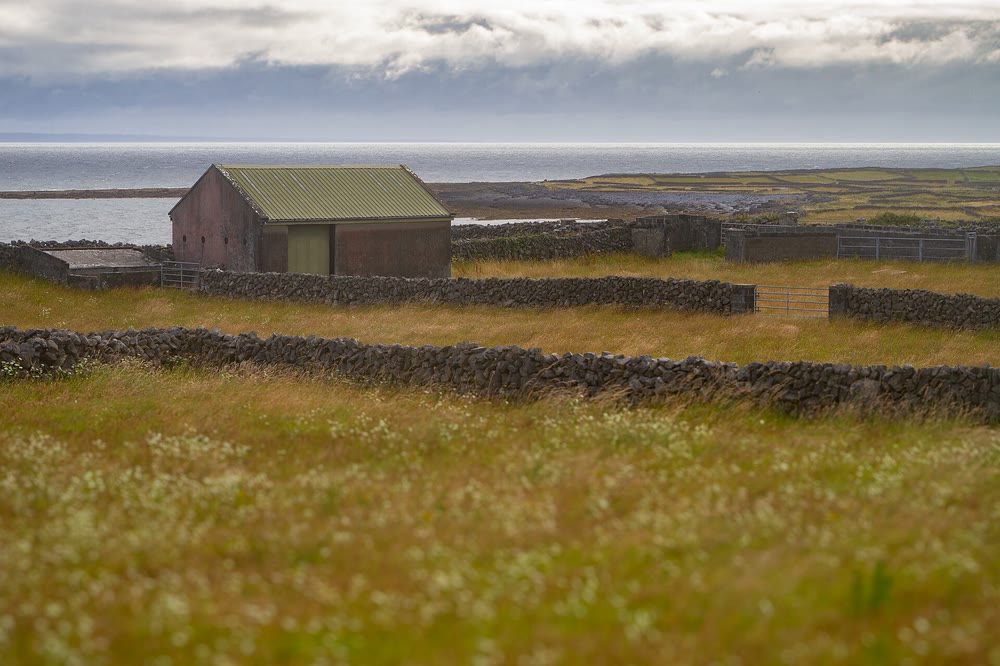
Inis Mór, Aran Islands, where Máirtín Ó Direáin was born. Photo: Redheadish, CC BY-SA 4.0, via Wikimedia Commons
Deireadh na Feide by Ailbhe Ní Ghearbhuigh
Deireadh na Feide is roughly JERR-uh nuh FEDJ-uh. Fead (roughly FAD) is a whistle and feide is its genitive, so the words mean the end of the whistle. Note there’s no fada on Feide, so don’t write Féide. The words are also part of an idiom: Ó Dónaill’s dictionary gives i ndeireadh na feide as “at the last gasp”.
That suits the subject: TG4 Foghlaim explains that the poem is about a whistled language, once used by a mountain community in France, that has since died out.
Ní Ghearbhuigh, a Tralee woman born in 1984, saw the poem win the O’Neill Poetry Prize for new Irish and Scottish Gaelic poetry in 2012, says the Portráidí writers’ archive.
Iníon by Áine Durkin
Iníon (roughly in-EEN) means daughter.
The NCCA’s free teaching guide reads the poem as a conversation between a mother and her teenage daughter, with the mother as the speaker. She realises she was once like her daughter, and that she has now become like her own mother. The guide also reminds students that the speaker of a poem isn’t necessarily the poet.
Durkin is from Ceantar na nOileán, the islands district of south Connemara, and has lived in Inis Eoghain (Inishowen), Co. Donegal, since 1980, says Portráidí.
Glaoch Abhaile by Áine Ní Ghlinn
Glaoch Abhaile (roughly GLEEKH uh-WAL-yuh; in Munster, glaoch sounds closer to GLAYKH) means a call home.
TG4 Foghlaim describes it as the story of a man who emigrates to London, doesn’t do well there, and is ashamed of it.
Ní Ghlinn was born in Co. Tipperary in 1955. In 2020 she was named Laureate na nÓg (LOR-ee-ut nuh NOAG, “of the young”), Ireland’s children’s literature laureate, and RTÉ reported that she was the first writer working only in Irish to hold the title.
Úirchill an Chreagáin by Art Mac Cumhaigh
Úirchill an Chreagáin (roughly OOR-hil un KHRAG-awn, with kh as in loch) is usually translated The Churchyard of Creggan. Úir is earth, the clay of the grave, and cill is a church or churchyard. Creagán means stony ground or a rocky hill, and Creggan is a parish in south Armagh. You’ll also see the title spelled Úrchill an Chreagáin.
It’s the oldest poem on the list. Art Mac Cumhaigh, also known as Art McCooey, lived from about 1738 to 1773. The circular spells his name Airt Mac Cumhaidh.
The poem is an aisling (ASH-ling), a vision poem. After a night of sorrow in Creggan churchyard, the poet is visited at daybreak by a spéirbhean (SPAYR-van, literally a sky woman), the beautiful woman of the vision. She urges him to leave with her for a rich, happy country where foreigners have no power. The Royal Irish Academy’s Doegen Records project points out that, unlike many Munster aislings of the time, she brings no promise of help from France or Spain.
Local tradition says he made it while sheltering in the O’Neill family vault in the graveyard. In the early 1900s, the editor Énrí Ó Muirgheasa called it “the national anthem of South Ulster”, ainm.ie notes. For another great Ulster poem of the same century, see An Bonnán Buí.
The circular names the source only as Duanaire na hArdteistiméireachta (a duanaire, DOO-un-uh-ruh, is an anthology of poems), with no editor or year, and old poems survive in different versions. Learn the text your class uses.
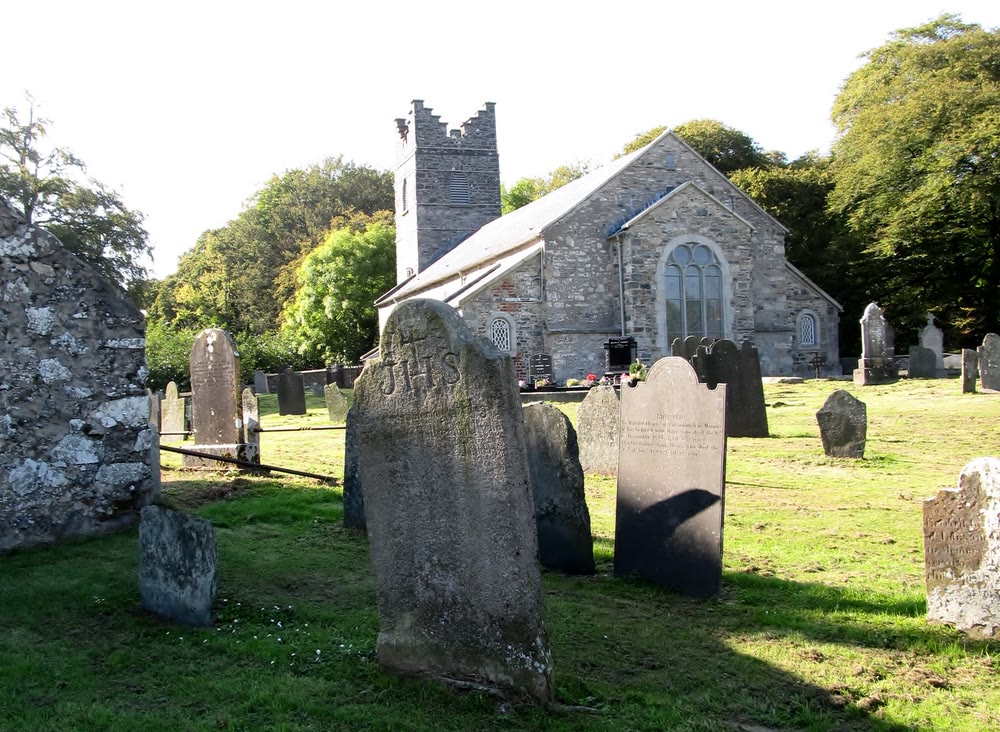
Creggan churchyard in south Armagh, setting of Úirchill an Chreagáin, seen from the direction of the O’Neill vault. Photo: Eric Jones, CC BY-SA 2.0, via Wikimedia Commons (Geograph)
The five additional poems for Higher Level
These are the 3(b) poems: Higher Level students who take the poetry option study all five.
| Poem | Poet | Level | Source named in the circular | Our guide |
|---|---|---|---|---|
| Trén bhFearann Breac | Colm Breathnach | Higher only | Tírdhreacha (Leabhair COMHAR, 2015) | Coming later |
| Eanáir 1991 | Biddy Jenkinson | Higher only | Leabhar na hAthghabhála, ed. Louis de Paor (Bloodaxe Books, 2016) | Coming later |
| Ag Tiomáint Siar | Nuala Ní Dhomhnaill | Higher only | Pharaoh’s Daughter (Gallery Press, 1990) | Coming later |
| Dijeridiú | Louis de Paor | Higher only | Leabhar na hAthghabhála, ed. Louis de Paor (Bloodaxe Books, 2016) | Coming later |
| Anthony Daly | Antoine Ó Raifteirí (Raftery) | Higher only | Raiftearaí: Amhráin agus Dánta, ed. Ciarán Ó Coigligh (An Clóchomhar, 1987) | Anthony Daly |
- Trén bhFearann Breac (roughly trayn VAR-un BRAK): through the speckled land. Trén is a shortened form of “through the”, fearann is land or territory, and breac means speckled. Colm Breathnach, born in 1961 near Carrigrohane in Co. Cork, has taken the main Oireachtas poetry prize four times, says Portráidí.
- Eanáir 1991 (AN-awr in Connacht and Ulster, uh-NAWR in Munster): January 1991. Biddy Jenkinson is a pen name. She was born in Dublin in 1949, and Portráidí notes that she doesn’t want her work translated into English, so this site won’t translate her poem.
- Ag Tiomáint Siar (roughly eg CHUM-awnch SHEE-ur; Munster speakers stress the second syllable, chum-AWNCH): driving west. Nuala Ní Dhomhnaill was born in Lancashire in 1952, moved to Ireland at five, and held the post of Ireland Professor of Poetry from 2001 to 2004. There’s more on her in my guide to famous Irish poets.
- Dijeridiú (DIJ-er-ee-DOO): didgeridoo. Louis de Paor was born in Cork in 1961 and lived in Australia from 1987 to 1996, teaching at the University of Sydney and presenting an Irish programme on Melbourne radio. The dictionary at focloir.ie spells the instrument didiridiú, but keep the circular’s spelling, Dijeridiú, for the title.
- Anthony Daly by Antoine Ó Raifteirí (1779 to 1835), the blind travelling poet whom the circular calls Antaine Raiftearaí. In the story Douglas Hyde printed in 1903, Anthony O’Daly was a carpenter and “a captain of the Whiteboys”, an agrarian secret society. He was hanged at Seefin in April 1820, on evidence that local people believed was false, and Raftery made a song about him. Hyde called the part he pieced together only a fragment, so learn the text in your class edition.
Raftery was born near Kiltimagh, Co. Mayo, was blinded by smallpox as a child, and died around Christmas 1835. He’s buried at Killeeneen, Co. Galway. Two of his best-known poems are on this site: Anois Teacht an Earraigh and Mise Raifteirí an File.
What changed from the 2024 to 2026 list
Everything. None of the ten poems on the 2024 to 2026 list, set out in circular 0026/2024, carries over to 2027, and the prose is all new as well. That older list had been in place since the current syllabus began in 2010.
The old common poems were:
- An Spailpín Fánach (verses 1 to 3)
- Géibheann, by Caitlín Maude
- An tEarrach Thiar, by Máirtín Ó Direáin
- Mo Ghrá-sa (idir lúibíní), by Nuala Ní Dhomhnaill
- Colscaradh, by Pádraig Mac Suibhne
The old Higher Level additional poems were:
- Caoineadh Airt Uí Laoghaire, by Eibhlín Dubh Ní Chonaill
- Fill Arís, by Seán Ó Ríordáin
- A Chlann, by Máire Áine Nic Gearailt
- Colmáin, by Cathal Ó Searcaigh
- Éiceolaí, by Biddy Jenkinson
Three poets survive the change with different poems: Ó Direáin, Ní Dhomhnaill and Jenkinson. If you’re repeating the year or borrowing an older sibling’s notes, check every title against the new list.
Choosing your own poems: the 2(b) rules
A school can choose its own five poems instead of the common ones, under section 2(b). The rules below follow circular 0041/2026 and the Irish text of 0071/2025; the older 0070/2024 words some of them differently, so go by the later two.
- How many: five poems, with at least one composed before 1850. The English circular says “at least five”; the Irish circulars say five in all.
- Standard: the common prescribed poems are the guide for length, type, level and quality of language.
- Old Leaving Cert poems: poems previously prescribed for Leaving Cert Irish may be chosen, but only if they meet all the other criteria.
- Themes: interesting and relevant to students, a mix of serious and light-hearted, gender balance among the poets, and attention to music and lyricism.
These are not allowed:
- the five common 2(a) poems themselves;
- translations, or anything that isn’t an original Irish-language text, published and easy for anyone to get hold of;
- anything from Duanaire na Meánteistiméireachta, the old Intermediate Certificate anthology, with one exception: the verses of An Spailpín Fánach that were prescribed before (verses 1 to 3 on the 2024 to 2026 list);
- any text currently or previously prescribed or recommended for Junior Cycle Irish;
- Irish-language texts currently prescribed or recommended for another Leaving Cert subject, such as Drama, Film and Theatre Studies.
A caution for the pre-1850 slot: Mise Raifteirí an File carries Raftery’s name, but scholars now think it was put together by Seán Ó Ceallaigh and first printed in 1882, as ainm.ie and my page on the poem explain. Your teacher makes the final choice.
Prose, film and play for 2027 and 2028
For Ordinary and Higher Level, the common prose under 1(a) is:
- Clann Lir (the Children of Lir), by Séamus Ó Searcaigh, from Laochas (An Gúm, 2009). My Children of Lir guide tells the old legend.
- One of: Athair (Father), by Mícheál Ó Conghaile; Glantóir (Cleaner), by Seán Ó Muireagáin; or An Bóthar go Santiago (The Road to Santiago), an extract from Mícheál de Barra’s travel diary.
- Cuairteoir (Visitor), by Orna Ní Choileáin.
- An tIriseoir (The Journalist), by Michelle Nic Pháidín.
- One of: the short film Eoinín na nÉan (ROSG, 2013), which the circular says is on the TG4 Player, or the play An Féileacán agus an Crann Úll (The Butterfly and the Apple Tree), by Mícheál Mac Cárthaigh.
As with poetry, schools may choose an optional prose course, 1(b), instead: five extracts, one each of folklore, a short story, a novel, an autobiography, and a play or Irish film.
For the Higher Level 3(a) option, students study one of: Cóirín na dTonn, a play by Celia de Fréine; An Nollaig Thiar, by Breandán Ó hEithir; Deirdre, Darach Ó Scolaí’s illustrated retelling of the Deirdre tale; Dordán, by Éilís Ní Dhuibhne; or five named stories from Bláth na dTulach, edited by Réaltán Ní Leannáin.
The oral and the literature history questions
The oral exam, an bhéaltriail (un VAYL-tree-ul), is common to Higher and Ordinary Level. Up to 2026 it included Léamh na Filíochta (LAYV nuh FIL-ee-ukh-tuh), a reading from one of your studied poems chosen by the examiner, worth 35 of the oral’s 240 marks, RTÉ Learn reported in March 2026.
For 2027 and 2028 the oral comes under a new State Examinations Commission circular, S76/25, so ask your teacher how the poetry reading works for your year.
At Higher Level there’s no longer a stand-alone question on the history of Irish literature. But circular 0041/2026 says short questions may be asked about a writer, and about the background and context of their work. That’s why my poem pages tell the poet’s story as well as the poem’s.
Official sources and free help
- Circular 0041/2026 (English, April 2026): the current list for June 2027 and June 2028.
- Circular 0071/2025 (Irish, October 2025): the same list, extended to 2028.
- Circular 0070/2024 (Irish, September 2024): the first announcement, for 2027 only.
- NCCA teaching guide to Iníon: free, in Irish, a large PDF of about 10 MB.
- TG4 Foghlaim: free senior cycle videos, including readings and analyses of several of the new poems in its Idir na Línte (IDJ-ir nuh LEEN-chuh, “between the lines”) series.
- Portráidí na Scríbhneoirí Gaeilge: bilingual profiles of contemporary Irish-language writers, recommended in the NCCA guide.
How to use our poem pages
Each page explains the title, gives a rough pronunciation, tells the poet’s story and walks through the poem’s themes, images and language.
- Get the text from your book. Eight of the ten poems are modern and still in copyright, so I don’t print those in full or translate them. Úirchill an Chreagáin and Anthony Daly are old enough to be in the public domain.
- Check pronunciation by ear. The respellings here are rough. Teanglann.ie has recordings in Munster, Connacht and Ulster Irish, and my guide to learning Irish online lists more free tools.
- Your teacher wins. If anything here differs from what your teacher or the circular says, go with them.
Leaving Cert Irish poems FAQ
Is An tEarrach Thiar still on the Leaving Cert?
No. It was a common poem up to 2026 but isn’t on the 2027 or 2028 list; Ó Direáin is now on the course with Dínit an Bhróin. Old Leaving Cert poems can be chosen under the 2(b) optional course only if they pass every other rule there, including the Junior Cycle ban, so ask your teacher.
Which poems are on Ordinary Level?
The five common poems: Dínit an Bhróin, Deireadh na Feide, Iníon, Glaoch Abhaile and Úirchill an Chreagáin. The exception is a school that takes the 2(b) optional course and picks its own five.
How many poems do I need for Higher Level?
Five for Section 2, either the common poems or your school’s own five. For Section 3 you need either one additional prose work or all five additional poems. A Higher Level student who takes the poetry option studies ten poems in all.
Is the list the same for 2027 and 2028?
Yes. Circular 0041/2026 covers both years and says the list is the same as in 0070/2024 and 0071/2025.
Is Caoineadh Airt Uí Laoghaire still on the course?
No. It was Higher Level additional poetry up to 2026, and it isn’t on the 2027 or 2028 list.
Has a list for 2029 been published?
Not when I checked in November 2026. Keep an eye on the Department of Education and Youth circulars on gov.ie.
Love this? Save it to your Pinterest board for later.
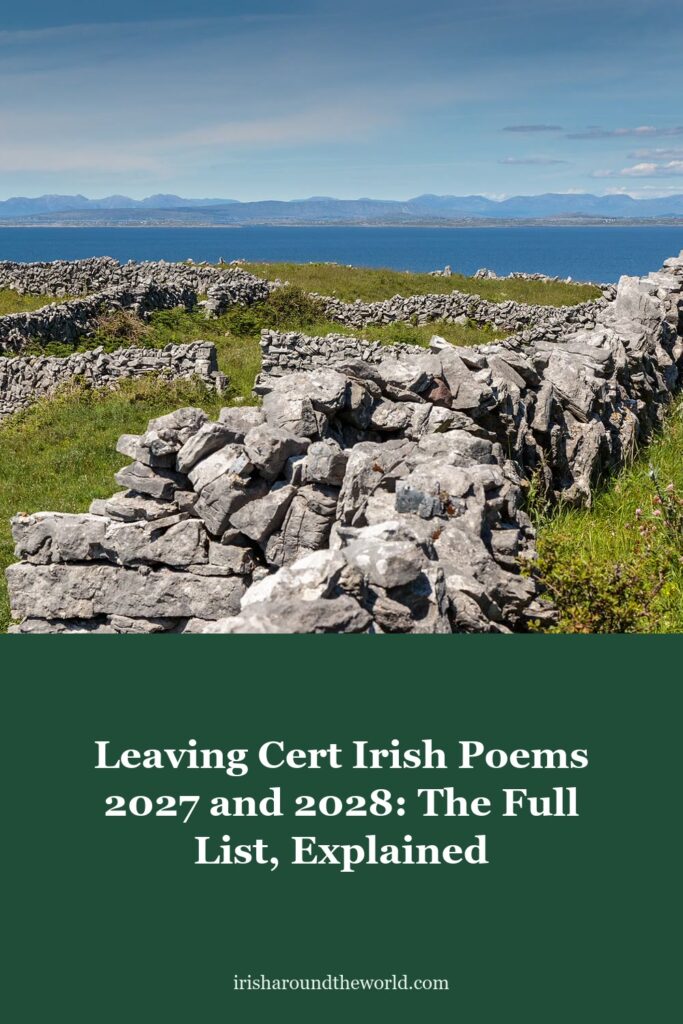
Pin image: Dry stone walls on Inis Mór, Aran Islands, with the Connemara coast beyond. Photo: JoachimKohler-HB, CC BY-SA 4.0, via Wikimedia Commons
A little bit of Ireland in your inbox every Friday ☘️
The free Weekly Dose of Irish: an Irish joke, a Celtic symbol, an Irish fact, a poem and the week’s best articles in one short email. Join 9,600+ readers.
Free. One short email every Friday. Unsubscribe any time.
More Irish poetry reading
- An tEarrach Thiar by Máirtín Ó Direáin: Spring in the West of Ireland
- Caoineadh Airt Uí Laoghaire: The Greatest Lament in the Irish Language
- Famous Irish Poets: The Greatest of All Time, in Order
- Top 100 Irish Poems Ranked, With an Analysis of Each Poem
- Anois Teacht an Earraigh by Raifteirí: Irish Text and Meaning
Featured image: Dry stone walls on Inis Mór, Aran Islands, with the Connemara coast beyond. Photo: JoachimKohler-HB, CC BY-SA 4.0, via Wikimedia Commons.