Patrick Kavanagh is one of eight Higher Level poets for Leaving Cert English in June 2027, with ten prescribed poems: Inniskeen Road: July Evening, Shancoduff, The Great Hunger (Section I only), Advent, A Christmas Childhood, Epic, Canal Bank Walk, Lines Written on a Seat on the Grand Canal, The Hospital and On Raglan Road. Shancoduff and A Christmas Childhood are on the Ordinary Level list too. He isn’t on the 2028 course at either level. Every one of the ten has its own guide on this site, linked below.
Patrick Kavanagh (KAV-uh-nuh) spent his first thirty-odd years on small farms in south Co. Monaghan and most of the rest of his life in Dublin, where a summer by the Grand Canal gave him some of his best sonnets. The ten Patrick Kavanagh Leaving Cert poems for 2027 follow that road almost step by step.
Here are the ten poems, his life in the order they came, his big themes and some pairings, with a link to each poem’s own guide.
It’s an independent guide, not an official source. If anything here differs from the Department of Education’s circular or from what your teacher says, go with them.
Jump to:
- Which Kavanagh poems are on the Leaving Cert in 2027?
- Kavanagh’s life, in the order of the poems
- The ten poems in brief
- Kavanagh’s big themes and style
- Poem pairings by theme
- More Kavanagh poems on this site
- Patrick Kavanagh Leaving Cert FAQ
- More Leaving Cert poetry reading
Which Kavanagh poems are on the Leaving Cert in 2027?
The Department of Education’s circular 0021/2025, dated 27 February 2025, sets eight poets for Higher Level in June 2027 and expects students to have studied six or more poems by each. Kavanagh has ten, shown here in the circular’s order.
| Poem | Where it’s set | Written or first published | Level | Our guide |
|---|---|---|---|---|
| Inniskeen Road: July Evening | A country road near Inniskeen, Co. Monaghan | In his first book, 1936 | Higher | Inniskeen Road |
| Shancoduff | His family’s hill farm at Shancoduff, near Inniskeen | First printed 1937 | Higher and Ordinary | Shancoduff |
| from The Great Hunger Section I | A small farm and its fields | 1942 | Higher (Section I only) | The Great Hunger |
| Advent | The dark weeks before Christmas | Collected in A Soul for Sale, 1947 | Higher | Advent |
| A Christmas Childhood | His childhood home in Inniskeen parish | Early 1940s | Higher and Ordinary | A Christmas Childhood |
| Epic | A neighbours’ row over a scrap of land, in 1938 | Early 1950s | Higher | Epic |
| Canal Bank Walk | The Grand Canal, Dublin | Late 1950s | Higher | Canal Bank Walk |
| Lines Written on a Seat on the Grand Canal | A memorial bench on the Grand Canal | Late 1950s | Higher | Lines Written on a Seat |
| The Hospital | A chest hospital in Dublin | After his 1955 operation | Higher | The Hospital |
| On Raglan Road | Raglan Road and the streets of Dublin | 1946 | Higher | On Raglan Road |
Ordinary Level: the 2027 list has 36 poems by many poets. Kavanagh’s two are Shancoduff and A Christmas Childhood.
2028: Kavanagh isn’t anywhere in circular 0024/2026, the list for June 2028.
The other 2027 poets: Elizabeth Bishop, Emily Dickinson, John Donne, Derek Mahon, Paula Meehan, Adrienne Rich and W.B. Yeats. My Leaving Cert English poetry guide covers the whole course for both years.
Nobody can tell you which poets will come up. The State Examinations Commission puts past papers and marking schemes online for free in its exam material archive, so look there to see how poetry questions have been asked.
Kavanagh’s life, in the order of the poems
The facts here come from his Dictionary of Irish Biography entry (DIB), by his biographer Antoinette Quinn, unless another source is named.
Mucker, Inniskeen and the small fields
Kavanagh was born in October 1904 in Mucker, a townland in the parish of Inniskeen, Co. Monaghan (Muineachán in Irish, roughly MWIN-uh-khawn). His father, James, was a cobbler, and his mother was Bridget Quinn.
After sixth class at Kednaminsha National School, he went to work at home, learning his father’s trade and helping on the family’s few acres. In 1925 the family added a second farm of sixteen acres, a few miles away at Shancoduff. Its official Irish name is An Seanchuach Dubh (roughly un SHAN-khoo-ukh DUV): sean means old and dubh black, and my Shancoduff guide unpicks the rest.
Inniskeen itself is Inis Caoin (IN-ish KEEN) in Irish. The Placenames Database of Ireland glosses inis as an island or river meadow, and caoin as pleasant or fair.
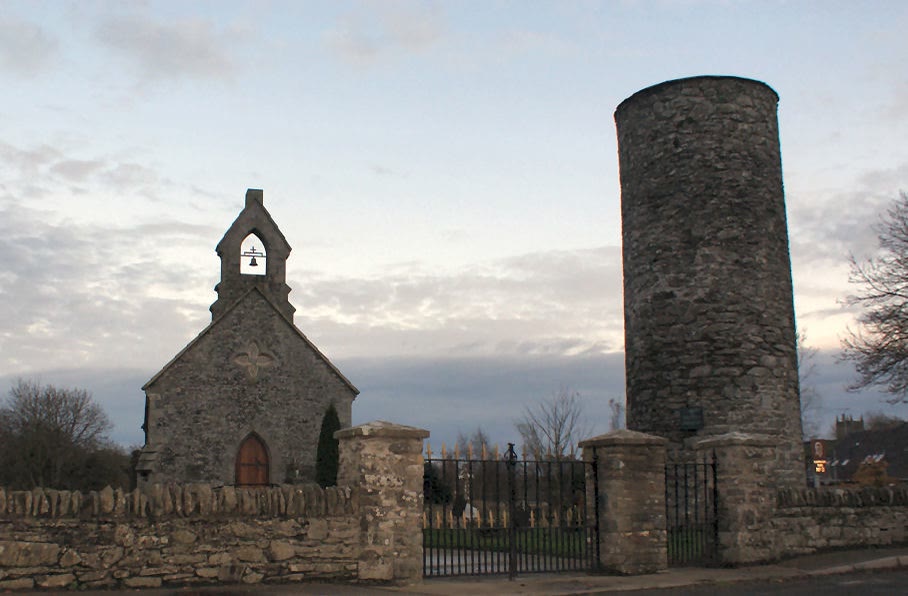
The round tower in Inniskeen, Co. Monaghan, the village at the centre of Kavanagh’s home parish. Photo: Cathar11, CC0, via Wikimedia Commons
After his father died in 1929, Patrick ran both farms under his mother’s direction. Like the other farmers’ sons, he went to Mass, played Gaelic football, and bought and sold at the fairs and markets in Carrickmacross and Dundalk.
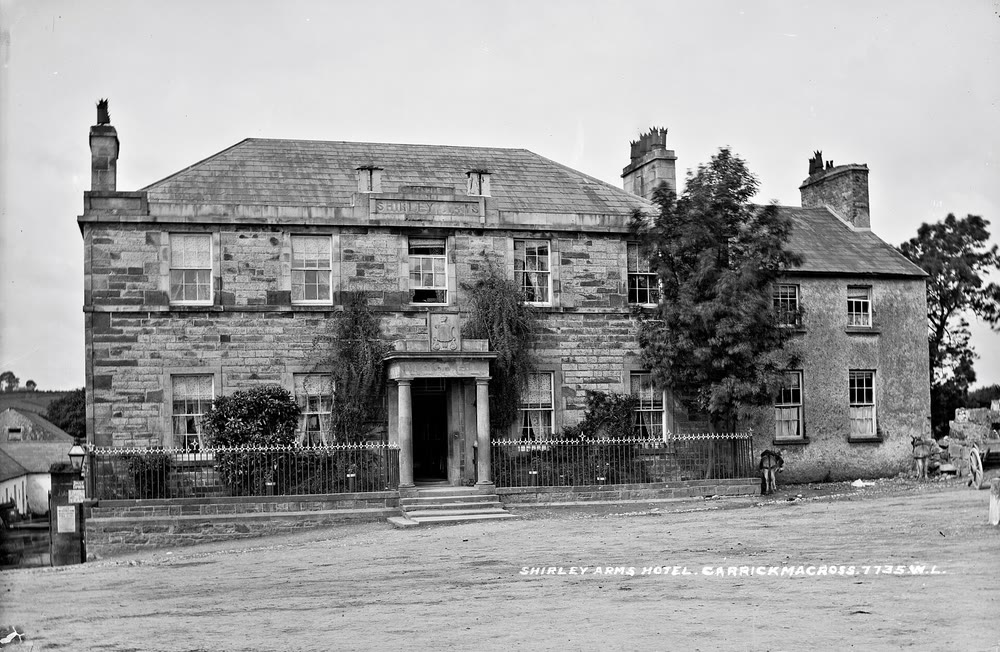
The Shirley Arms Hotel in Carrickmacross, Co. Monaghan, one of the market towns where the young Kavanagh bought and sold. Photo: Robert French (1841 to 1917), Lawrence Collection, National Library of Ireland, taken no later than 1914. Public domain, via Wikimedia Commons
He was writing poems all the while. By the end of 1929 George Russell’s Dublin weekly, the Irish Statesman, had printed three of them, and in December 1931 he walked to Dublin in his work clothes to call on Russell, unannounced.
His first book, Ploughman and Other Poems (Macmillan, 1936), includes Inniskeen Road: July Evening, which the DIB rates as his best early poem. Shancoduff was first printed in 1937, in The Dublin Magazine, says the Museum of Literature Ireland (MoLI).
Dublin and The Great Hunger
He tried London in 1937, then settled in Dublin in August 1939, planning a short stay. The Second World War kept him there for good.
In the early 1940s he turned to his country childhood, and A Christmas Childhood comes from those years. So does The Great Hunger (1942), a bleak poem of more than 750 lines about an ageing bachelor farmer, Patrick Maguire. The Patrick and Katherine Kavanagh Trust, which holds the rights to his work, says it appeared in the London magazine Horizon and as a Cuala Press pamphlet in Dublin, and that the police and the censors seem to have taken an interest too.
Advent appeared in A Soul for Sale (1947), his second collection. On Raglan Road, written in 1946, grew out of his unreturned feelings for Hilda Moriarty, a medical student from Dingle, Co. Kerry. RTÉ says The Irish Press printed it that year under another title, Dark-haired Miriam Ran Away.
Money was always short. He lived on journalism, and in 1952 he and his brother Peter ran Kavanagh’s Weekly for 13 issues. Epic belongs to these years: the DIB places it among his early 1950s lyrics about where his poems come from.
1955: the hospital and the canal
In 1954 he lost a stressful High Court libel case against a Dublin paper. By March 1955 he had lung cancer, and on 31 March, says the RTÉ Archives, surgeons at the Rialto Hospital removed a lung and a rib. The Hospital is the sonnet he made from that ward.
That warm summer he spent long days recovering beside the canal between Baggot Street and Leeson Street bridges, as he recalled in Self Portrait, a 1962 television talk now in the RTÉ Archives. About two years later, the DIB says, a burst of new sonnets arrived, among them Canal Bank Walk and Lines Written on a Seat on the Grand Canal, both looking back on that summer. They were collected in Come Dance with Kitty Stobling (Longmans, 1960).
Last years
His Collected Poems (1964) was a success, and On Raglan Road, in a book for the first time there, became one of Ireland’s best-known songs once Luke Kelly of The Dubliners began singing it. By then, the DIB says, he was treated as Ireland’s poet laureate in all but name, a hero to young poets and students.
He married Katherine Barry Moloney on 19 April 1967 and died on 30 November that year, in Dublin. He’s buried in Inniskeen. A granite seat in his honour was unveiled by the canal near Baggot Street Bridge in March 1968, and since 1991 a life-size bronze Kavanagh has sat on a bench across the water from it.
Parents who sat the Leaving Cert between 1970 and 2000 may remember him from Soundings, the poetry anthology of those years. Seamus Heaney, a 2028 course poet, was one of his great champions, and Kavanagh is on my list of famous Irish poets too.
The ten poems in brief
A few lines on each, in the circular’s order. Kavanagh’s poems are in copyright until the end of 2037, so I don’t print them here: read each in your anthology, then click through to its guide.
1. Inniskeen Road: July Evening (Higher Level)
A sonnet set on a July evening as the local young people make for a dance in a neighbour’s barn, leaving the poet alone on the empty road. It’s a wry look at the price of being the village poet. Read my Inniskeen Road: July Evening guide.
2. Shancoduff (Higher and Ordinary Level)
Kavanagh shows off his family’s cold, north-facing hill farm as if it were the Alps, until passing cattle drovers decide its owner must be poor. Proud, comic and a little bruised. Read my Shancoduff guide.
3. The Great Hunger, Section I (Higher Level)
Only the first section of this long poem is on the course. It introduces Patrick Maguire, a bachelor farmer whose world is bound up in his small fields. Read my Great Hunger guide.
4. Advent (Higher Level)
A poem for the dark weeks before Christmas, about losing the knack of wonder by knowing too much. It hopes a season of penance and plain living will bring that wonder back, so that ordinary country sights look new again. Read my Advent guide.
5. A Christmas Childhood (Higher and Ordinary Level)
A grown man remembers one Christmas on the farm when he was six. The small sights and sounds of that morning take on the glow of the Nativity, as if Bethlehem were a Monaghan townland. Read my A Christmas Childhood guide.
6. Epic (Higher Level)
Two neighbouring families square up over a scrap of stony ground in 1938, as the Munich crisis grips Europe. Kavanagh calls on Homer, whose Iliad also grew out of a small fight, to argue that a parish row can be as worthy of a poem as world events. Read my Epic guide.
7. Canal Bank Walk (Higher Level)
A sonnet of rebirth from the Grand Canal, looking back on the summer he spent recovering there. Plain towpath sights become signs of grace, and the sonnet works almost as a prayer. Read my Canal Bank Walk guide.
8. Lines Written on a Seat on the Grand Canal (Higher Level)
Kavanagh took the title from a real memorial bench by the canal. He asks to be remembered the same way, beside water, not with a grand monument, and he got his wish within months of his death. Read my Lines Written on a Seat guide.
9. The Hospital (Higher Level)
A love poem to a hospital ward. Looking back on the Dublin chest hospital where he lost a lung, he praises its plainest corners and argues that putting ordinary things into a poem is a way of loving them. My Hospital guide has the full background.
10. On Raglan Road (Higher Level)
A poem about falling for someone you know you can’t keep, walking the Dublin streets of a love that was never going to last. Kavanagh wrote it to fit an old Irish air, Fáinne Geal an Lae (roughly FAWN-yuh gyal un LAY), known in English as The Dawning of the Day. Ó Dónaill’s dictionary gives fáinne an lae as break of day, and geal as bright.
Luke Kelly made it famous, and in 2019 a public vote in an RTÉ series named it Ireland’s favourite folk song. Read my On Raglan Road guide.
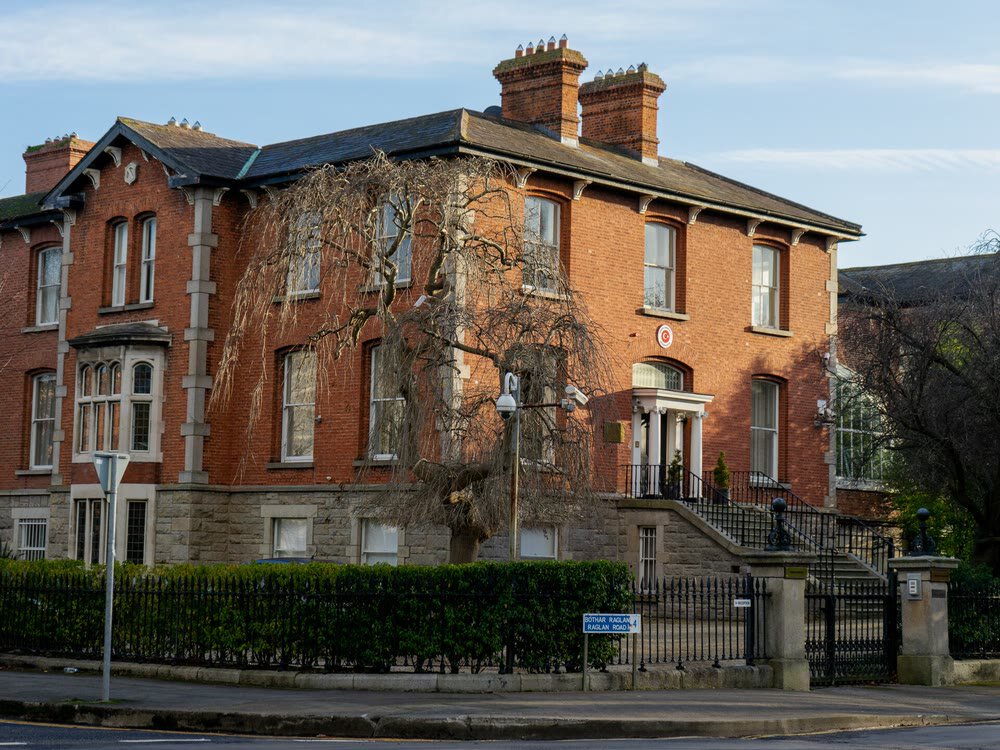
A red-brick house on Raglan Road, Dublin 4, now the Turkish embassy. The street sign reads Bóthar Raglan: bóthar (BOH-har) is the Irish for road. Photo: David Kernan, CC BY 4.0, via Wikimedia Commons
Kavanagh’s big themes and style
The parish against the world
Kavanagh believed a small place could be as big a subject as any capital city. In a May 1952 editorial in Kavanagh’s Weekly, MoLI explains, he contrasted the provincial mind, which takes its opinions from the capital, with the parochial mind, which is sure its own parish matters. He often stands a little apart too: the farmer who writes, the man alone on the road. Poems: Epic, Shancoduff, Inniskeen Road: July Evening.
Wonder, faith and seeing like a child
Again and again he tries to see ordinary things with a child’s fresh eyes, and he finds God in them rather than in clever argument. Poems: Advent, A Christmas Childhood, Canal Bank Walk.
The ordinary made holy
The sonnets he wrote after his illness celebrate and bless everyday sights of town and country, the DIB says. Nothing is too humble for a poem: a towpath, a hospital yard, a bench by the water. Poems: The Hospital, Canal Bank Walk, Lines Written on a Seat on the Grand Canal.
Hard land and hungry lives
He knew small-farm life from the inside and refused to make it pretty. Poverty, poor land and loneliness run through the early poems, with comedy in some and despair in others. Poems: The Great Hunger (Section I), Shancoduff, Inniskeen Road: July Evening.
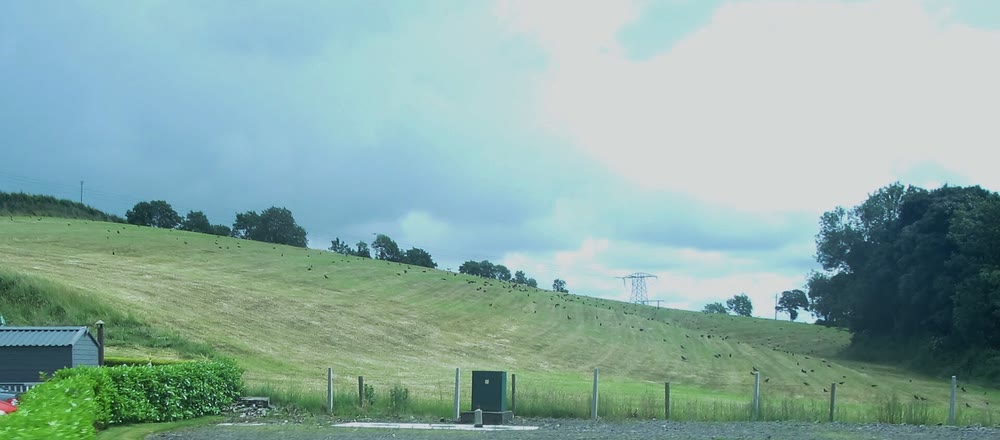
Crows feeding on a mown hayfield at Edenamo, Inniskeen, Co. Monaghan, in June 2016. Photo: Eric Jones, CC BY-SA 2.0, via Wikimedia Commons (Geograph)
His style in brief
- Sonnets, loosely worn: Inniskeen Road, Canal Bank Walk, Lines Written on a Seat and The Hospital are all sonnets, but chatty, relaxed ones.
- Real place names: townlands, roads and bridges, named as if they deserve a poem, because to him they did.
- Plain talk with big words: everyday, even slangy words sit beside religious and abstract ones.
- Humour: mock-heroic jokes, like small hills turned into the Alps, keep the poems from turning solemn.
Poem pairings by theme
These groups share a theme, a place or a turning point. They’re revision ideas, not predictions about the paper.
- Home ground: Shancoduff, Inniskeen Road: July Evening and Epic, three poems that name his own small world and dare it to matter.
- Wonder regained: Advent and A Christmas Childhood, two Christmas-season poems about getting a child’s eyes back.
- Rebirth by the canal: The Hospital, Canal Bank Walk and Lines Written on a Seat on the Grand Canal, all from the years after his 1955 operation.
- Early and late Kavanagh: The Great Hunger (1942) beside The Hospital. The same eye for ordinary things, first in near despair, then in gratitude.
- Love and memory: On Raglan Road with Lines Written on a Seat on the Grand Canal: a love he couldn’t keep, and how he’d like to be remembered.
Whatever you pair, learn quotations from the text your class uses.
More Kavanagh poems on this site (not on the course)
These five aren’t prescribed, but they help you see the whole poet.
- Stony Grey Soil: his bitter farewell to the Monaghan land he felt had robbed him of his youth. A sharp contrast with Shancoduff.
- Spraying the Potatoes: a hot summer day on the farm, spraying the crop against blight.
- Pegasus: his soul pictured as an old horse that nobody will buy at the fairs.
- In Memory of My Mother: a tender tribute to his mother, Bridget.
- On an Apple-Ripe September Morning: a young farmer crossing the fields to a neighbour’s threshing.
Several also feature in my Top 100 Irish poems, and my Old Ireland on Film clips show everyday Irish life from the 1930s to the 1980s.
Doing Irish too? My guide to the Leaving Cert Irish poems for 2027 and 2028 covers the full list.
Patrick Kavanagh Leaving Cert FAQ
Is Patrick Kavanagh on the Leaving Cert in 2028?
No. He’s a Higher Level poet for June 2027, but the 2028 list in circular 0024/2026 doesn’t include him at either level.
Which Kavanagh poems are on Ordinary Level in 2027?
Two: Shancoduff and A Christmas Childhood. All ten are on the Higher Level list.
Is the whole of The Great Hunger on the course?
No. The circular lists it as from The Great Hunger Section I, so you only study the first section of the long poem.
Is The Great Hunger about the Famine?
No. The Famine of the 1840s is also called the Great Hunger, but Kavanagh’s poem is set in his own century. Its hunger is for love, faith and a fuller life, in a farmer who gives everything to his fields.
How many Kavanagh poems do I need for Higher Level?
The circular lists ten and expects you to have studied six or more poems by each poet. Your teacher decides which ones your class covers.
Where can I read Kavanagh’s poems online?
The Kavanagh Trust publishes four of the ten on its Ten poems by Patrick Kavanagh page: Inniskeen Road: July Evening, Shancoduff, Lines Written on a Seat on the Grand Canal, Dublin and The Hospital. For the rest, use your anthology or his Collected Poems, edited by Antoinette Quinn (Allen Lane, 2004).
Is On Raglan Road a poem or a song?
Both. Kavanagh wrote it as a poem in 1946, to fit the old air The Dawning of the Day, and Luke Kelly made it one of Ireland’s best-loved songs. On the Leaving Cert, you study it as a poem.
Love this? Save it to your Pinterest board for later.
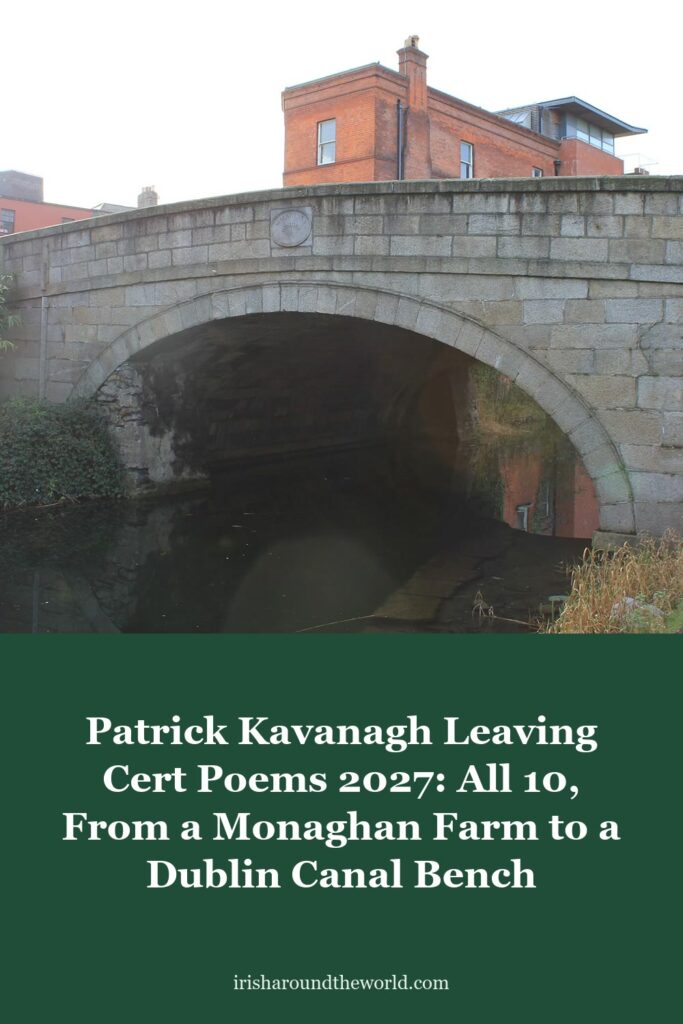
Pin image: Macartney Bridge, better known as Baggot Street Bridge, on the Grand Canal in Dublin. Photo: Deitel55, CC BY-SA 3.0, via Wikimedia Commons
A little bit of Ireland in your inbox every Friday ☘️
The free Weekly Dose of Irish: an Irish joke, a Celtic symbol, an Irish fact, a poem and the week’s best articles in one short email. Join 9,600+ readers.
Free. One short email every Friday. Unsubscribe any time.
More Leaving Cert poetry reading
- Leaving Cert English Poetry 2027 and 2028: Every Poet and Poem, Explained
- Paula Meehan Poems for Leaving Cert English 2027 and 2028: Summaries and Themes
- Leaving Cert Irish Poems 2027 and 2028: The Full List, Explained
- Famous Irish Poets: The Greatest of All Time, in Order
Featured image: Macartney Bridge, better known as Baggot Street Bridge, on the Grand Canal in Dublin. Kavanagh spent the summer of 1955 recovering on the canal bank between this bridge and Leeson Street Bridge. Photo: Deitel55, CC BY-SA 3.0, via Wikimedia Commons.