The Celtic tree zodiac splits the year into 13 lunar months of 28 days, each with a tree and a letter of ogham, the early Irish alphabet. It runs from Birch (from 24 December) through Rowan, Ash, Alder, Willow, Hawthorn, Oak, Holly, Hazel, Vine, Ivy and Reed to Elder (to 22 December), leaving 23 December with no tree. The ogham letters and their tree names are genuinely old and Irish, but the calendar isn’t: the English poet Robert Graves created it in his 1948 book The White Goddess. A separate tree horoscope with 21 or 22 trees was invented for the French magazine Marie Claire in 1971.
Find your birthday in the table below and you get a tree instead of a star sign. Born in late January? You’re a Rowan. Mid-August? A Hazel.
Plenty of websites credit the druids, some as far back as 1000 BC. In truth, the trees and the ogham letters are genuinely Irish, but the calendar joining them was published in 1948, by a poet.
Here are all 13 signs with their dates, meanings and ogham letters, plus the true history, checked the way I checked the Dara knot.
Jump to:
- What is the Celtic tree zodiac?
- Find your Celtic tree sign
- The 13 Celtic tree signs and their meanings
- How old is the Celtic tree zodiac? The honest history
- The other one: the “Celtic tree horoscope”
- So is any of it Celtic?
- Celtic tree zodiac FAQ
- More Celtic symbols and folklore
What is the Celtic tree zodiac?
The Celtic tree zodiac, also sold as Celtic tree astrology or the Celtic tree calendar, has 13 signs, not 12, each a lunar month of 28 days. That makes 364 days, so 23 December belongs to no tree.
Each tree is tied to a letter of ogham (roughly OHM in Irish), the alphabet of notches cut along the edges of standing stones in Ireland from about the fourth century AD. My guide to ogham shows how it works and how to write your name in it.
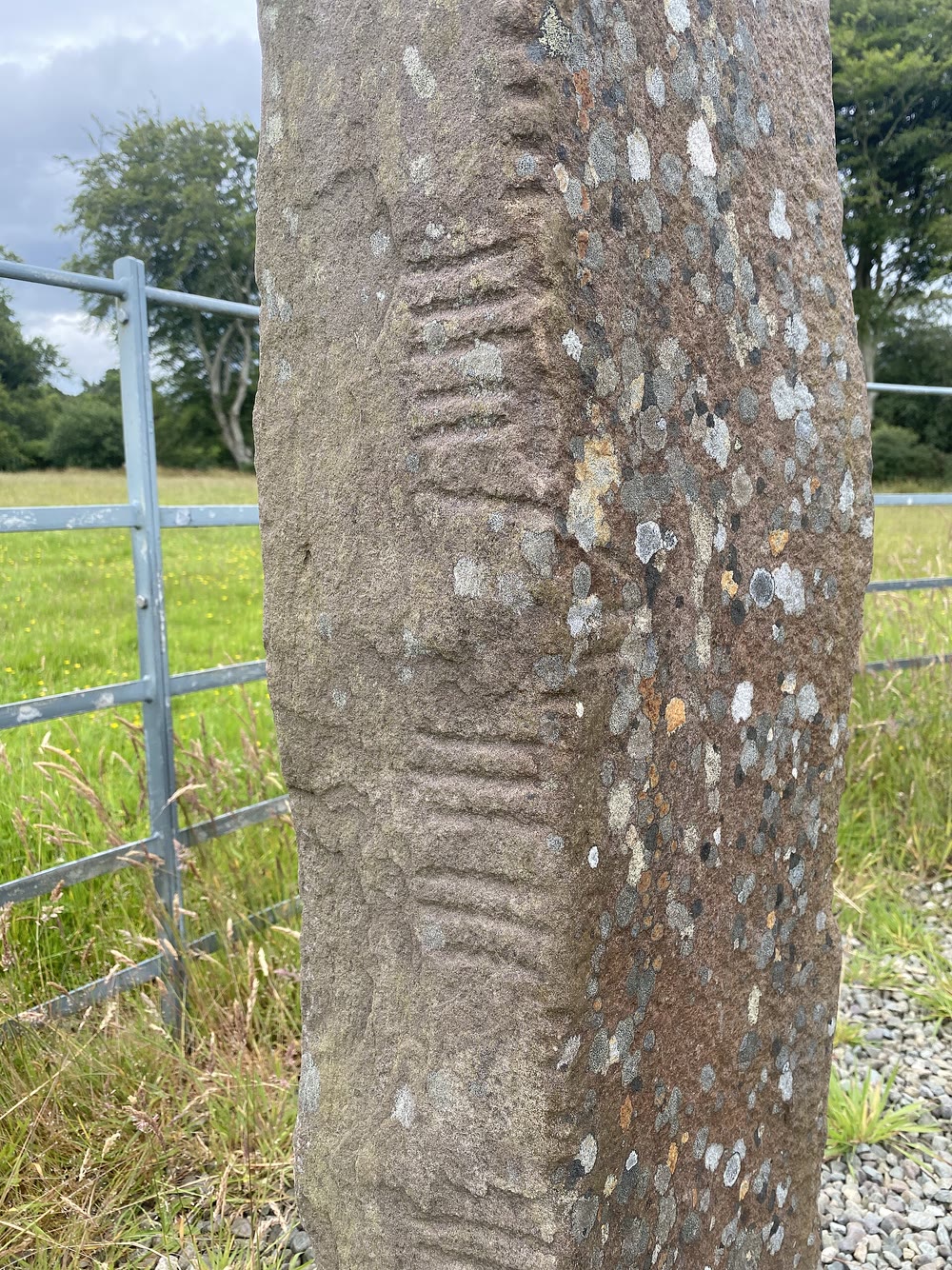
Ogham strokes cut along the edge of one of the Dunloe Ogham Stones, Co. Kerry. Photo: HKath74, CC0, via Wikimedia Commons
Find your Celtic tree sign
The ogham letter is given in Old Irish, with Graves’s spelling in brackets where it differs.
| Your birthday | Tree sign | Irish name | Ogham letter |
|---|---|---|---|
| 24 Dec to 20 Jan | Birch | beith | B: beithe (Beth) |
| 21 Jan to 17 Feb | Rowan | caorthann | L: luis |
| 18 Feb to 17 Mar | Ash | fuinseog | N: nin (Nion) |
| 18 Mar to 14 Apr | Alder | fearnóg | F: fern (Fearn) |
| 15 Apr to 12 May | Willow | saileach | S: sail (Saille) |
| 13 May to 9 Jun | Hawthorn | sceach gheal | H: úath (Uath) |
| 10 Jun to 7 Jul | Oak | dair | D: dair (Duir) |
| 8 Jul to 4 Aug | Holly | cuileann | T: tinne |
| 5 Aug to 1 Sep | Hazel | coll | C: coll |
| 2 Sep to 29 Sep | Vine | fíniúin | M: muin |
| 30 Sep to 27 Oct | Ivy | eidhneán | G: gort |
| 28 Oct to 24 Nov | Reed | giolcach | NG: gétal (Ngetal) |
| 25 Nov to 22 Dec | Elder | trom | R: ruis |
| 23 Dec | No tree | The spare day |
Born on a boundary day? Websites often shift the edges by a day. In a leap year, 29 February simply falls in Ash.
The spellings all over the internet, such as Beth, Nion, Saille, Duir and Ngetal, are the ones Graves used; the medieval forms are beithe, nin, sail, dair and gétal.
The 13 Celtic tree signs and their meanings
Each sign gives the personality reading from modern tree-sign guides (no medieval source has these), then the much older Irish story behind the tree. Pronunciations are rough guides.
Birch: 24 December to 20 January
Ogham letter: B, beithe, which really did mean birch. Irish: beith (beh). Modern meaning: ambitious and driven, good at fresh starts.
Birch comes first for a reason. Auraicept na nÉces, the medieval scholars’ primer, says the first ogham message brought into Ireland was written on birch: a warning to Lug (usually spelled Lugh, Lú in modern Irish, said loo) that his wife would be taken unless he watched her. That, it says, is why B still leads the alphabet. Early Irish law counted birch among the “commoners of the wood”, and the early Irish law scholar Fergus Kelly notes that early poets admired its grace.
Rowan: 21 January to 17 February
Ogham letter: L, luis, which probably first meant “flame” or “herb”. Irish: caorthann (KEER-hun; closer to KAIR-hun in Munster). Modern meaning: an independent thinker, idealistic and quietly intuitive.
The medieval key calls rowan “delight of eye”, for the beauty of its berries, in George Calder’s 1917 translation, and Kelly counts it among the trees most linked with the supernatural in early texts. A 1930s Schools’ Collection account from Drumgownagh, Co. Leitrim, says the old people hung rowan branches over each cow’s head before sunset on May Eve, so that nobody could take their butter. My guide to druid symbols has more on rowan as protection.
Ash: 18 February to 17 March
Ogham letter: N, nin, whose first meaning is unclear; the medieval key made it ash. Oddly, the letter that really meant ash is onn, the O, which the medieval key and Graves both made gorse. Irish: fuinseog (FWIN-shohg; fwin-SHOHG in Munster). Modern meaning: creative and imaginative, with a strong feel for nature.
Ash was one of the “lords of the wood” in early Irish law, prized for furniture and spear-shafts, and the medieval riddle “a check on peace” means the spear that breaks it. Today ash means hurling: the state agency Teagasc calls ash timber one of the toughest hardwoods, prized for hurleys. Ash dieback, first noticed in Ireland in 2012, now threatens the tree.
Alder: 18 March to 14 April
Ogham letter: F, fern, a genuine alder name. Irish: fearnóg (FYAR-nohg; fyar-NOHG in Munster), or fearn (fyarn). Modern meaning: bold and confident, quick to take the lead.
The medieval riddle calls alder “the van of the warrior-bands”, because shields were made of it. Kelly lists alder wood for shields, masts and tent-poles, and Ó Dónaill’s dictionary still gives sciath fearna (SHKEE-uh FYAR-nuh), a shield of alder.
Willow: 15 April to 12 May
Ogham letter: S, sail, which really meant willow. Irish: saileach (SAL-yukh). Modern meaning: sensitive, patient and perceptive.
Kelly finds willow in early texts for light houses, and its rods for baskets, wattling and tying up cattle. In 1938 the Lanesborough school in Co. Longford recorded that people made their own baskets and creels from sally rods. In Ireland a willow is often a sally or salley, as in Yeats’s Down by the Salley Gardens.
Hawthorn: 13 May to 9 June
Ogham letter: H, úath. The medieval key made it whitethorn, but úath could also mean “horror”, and scholars argue over which came first. Irish: sceach gheal (shkyakh YAL). Modern meaning: calm on the surface, with hidden depths.
This is Ireland’s fairy tree, and a lone thorn in a field is often still left uncut; see my guide to fairy forts and fairy trees. Kelly notes that its magic belongs mostly to later folklore. In 1930s Doolough, Co. Clare, a schools’ account said Christ’s crown of thorns was whitethorn, so nobody should carry a whitethorn walking stick.
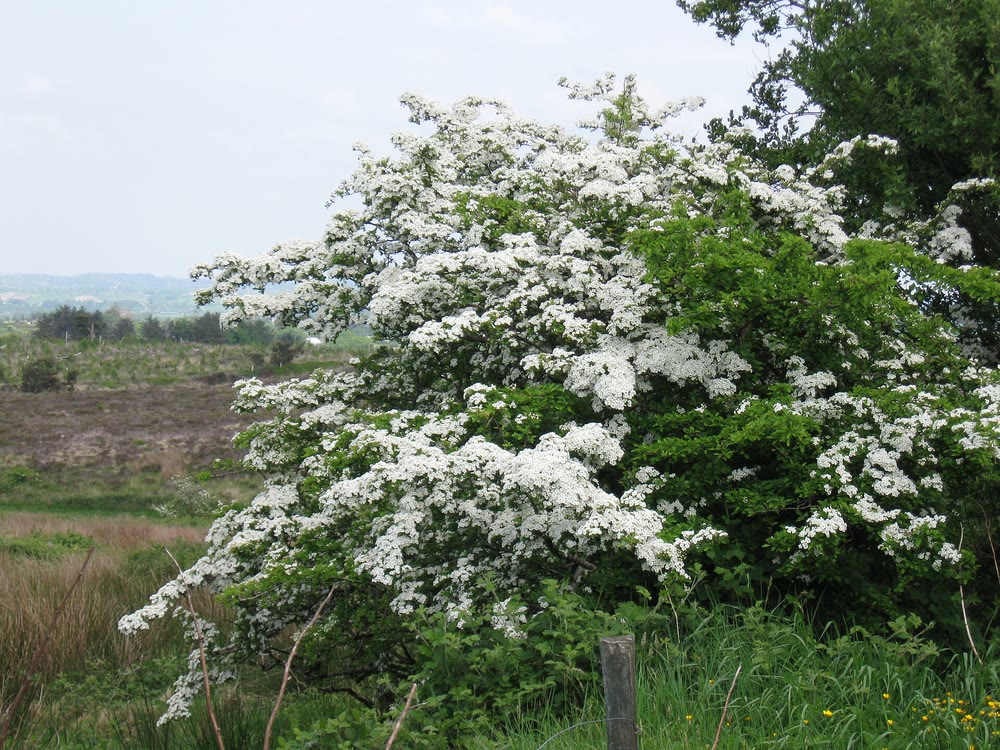
A hawthorn in full blossom in Ireland, May 2008. Photo: Grandpa David, CC BY 3.0, via Wikimedia Commons
Oak: 10 June to 7 July
Ogham letter: D, dair, which really meant oak. Irish: dair (roughly “dar”, with a soft r). Modern meaning: steady, protective and generous, the one everyone leans on.
Oak headed the “lords of the wood”. A 12th-century legal commentator reckoned that in a good year one oak’s acorns could fatten a pig, and Irish oak was even exported for beams and rafters in the roof of Salisbury Cathedral, tree-ring dated to 1222. Kildare is Cill Dara (kill DAR-a), the church of the oak, and Derry comes from doire (DIR-eh), an oak wood. For more names like these, see my guide to Irish place names.
Holly: 8 July to 4 August
Ogham letter: T, tinne, which seems to have meant a bar of metal. The medieval key made it holly, “a third of a wheel”, since holly was one of three woods in a chariot wheel. Irish: cuileann (KIL-un). Modern meaning: a natural leader: confident, determined and competitive.
Holly was a lord of the wood too, and Kelly writes that its upper, less prickly branches were fed to cattle in winter, in Kerry within living memory. It’s also on my list of Irish Christmas traditions. Ó Dónaill even lists cuileann Muire (KIL-un MWIR-uh), Mary’s holly, for withered Christmas holly.
Hazel: 5 August to 1 September
Ogham letter: C, coll, which really meant hazel. Irish: coll (roughly KOWL; nearer KOLL in Mayo and KAL in Ulster). Modern meaning: clever, organised and good with detail.
Hazel is the tree of wisdom in Irish myth. Medieval place-lore poems on the Shannon describe Connla’s well under the sea, where nine hazels belonging to Crimall the sage drop their nuts into the water and the salmon eat them. Later tellers gave that wisdom to Fionn’s Salmon of Knowledge. Hazel was also a lord of the wood, valued for its nuts and rods, and the Annals of Ulster record a crop of nuts and acorns in 836 so heavy that it blocked the streams. Slat choill (slat KHILL), a hazel rod, also means a dowsing rod.

The White Route through a hazel wood in Burren National Park, Co. Clare. Photo: Humphrey Bolton, CC BY-SA 2.0, via Wikimedia Commons
Vine: 2 September to 29 September
Ogham letter: M, muin, which meant the upper back or neck. The medieval key made it a vine, “highest of beauty”, because it grows aloft. Irish: fíniúin (FEEN-yoon), a grapevine. Modern meaning: charming and refined, good at seeing both sides but slow to decide.
The grapevine isn’t native to Ireland, so there’s little Irish story here. Graves himself saw it as the odd one out, the only plant on his list that isn’t a native British forest tree, and suggested his sequence came from the Black Sea coast of what is now Turkey, where vines grew wild. Yet wild vines once grew along river valleys across much of Europe, as Heiss and Leskovar (below) point out.
Ivy: 30 September to 27 October
Ogham letter: G, gort, which meant a field. The medieval key made it ivy, with the riddle “greener than pastures”, which suits a field just as well. Irish: eidhneán (EYE-nyawn; eye-NYAWN in Munster). Modern meaning: loyal, kind and resilient, hard to shake off.
Kelly notes that early Irish legal material even mentions a special hook for cutting holly and ivy, probably for winter fodder. In 1930s Croom, Co. Limerick, a cap of ivy leaves stitched together was said to cure bald patches.
Reed: 28 October to 24 November
Ogham letter: NG, gétal, which meant “slaying”. The medieval key says broom, or fern, and the zodiac says reed. They’re closer than they look: the key’s Irish word survives as giolcach (GYUL-kukh), which Ó Dónaill gives as reeds, while giolcach shléibhe (GYUL-kukh HLAY-vuh) is broom. Modern meaning: curious and discreet, good at getting to the truth.
The medieval lawyers put broom in their lowest rank, the “bushes of the wood”. Damaging one cost a single sheep, and a ninth-century glossator added that cutting one stem cost nothing.
Elder: 25 November to 22 December
Ogham letter: R, ruis, which meant redness. The medieval key made it elder: “the redness of shame is ruis”. Irish: trom (roughly TRUM; TROOM in Connemara, TROWM in Munster), spelled just like the Irish for “heavy”. Modern meaning: free-spirited, honest and restless, with a philosophical streak.
Early law put elder in its third rank, the “lower divisions of the wood”. Later folklore was wary of it: a 1930s account from Kilrush, Co. Clare, says it was unlucky in East Clare to burn elder, and that the Cross was believed to be made of it. It’s one of countless Irish superstitions.
How old is the Celtic tree zodiac? The honest history
Short answer: it was first published in 1948. It appears in no ancient writer and no medieval Irish manuscript, and there’s no evidence the early Irish named their months after trees.
The real part: ogham’s tree names
Medieval Irish scholars really did give every ogham letter a tree. But Damian McManus of Trinity College Dublin concluded that only some letter names began as trees, and the compilers fitted trees to the rest; the “tree alphabet” section of my ogham guide has the details.
Of the zodiac’s 13 letters, only five certainly began as tree names: birch, alder, willow, oak and hazel. Hawthorn’s úath may make six, but it’s disputed, and the other sure tree, onn (ash), isn’t in the zodiac at all. That’s the reading of the Ogham in 3D project at the Dublin Institute for Advanced Studies. No medieval tract gives the trees months.
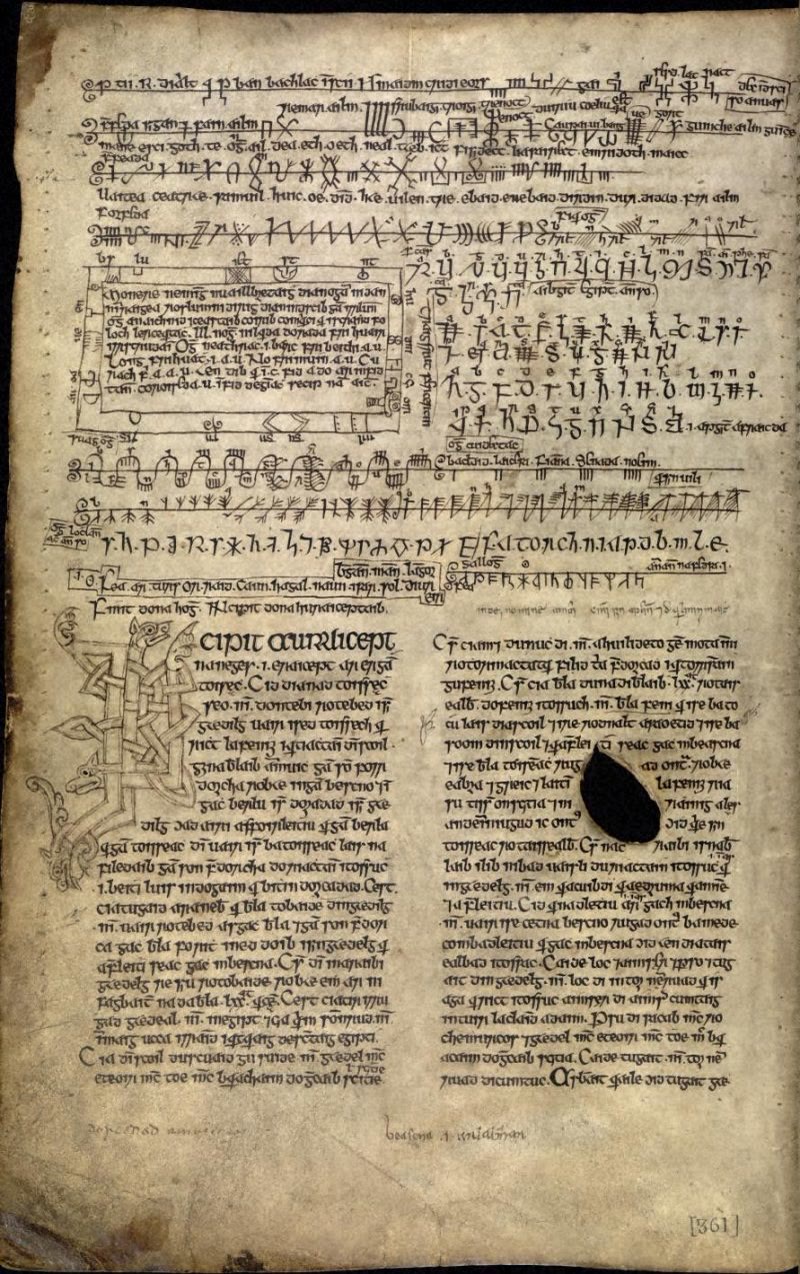
Ogham variants and the opening of Auraicept na nÉces, the scholars’ primer, on folio 170v of the Book of Ballymote (late 14th century), Royal Irish Academy. Public domain, via Wikimedia Commons
Robert Graves and The White Goddess (1948)
The calendar comes from Robert Graves (1895 to 1985), the English poet and novelist best known for I, Claudius (1934). He drafted The White Goddess, a sprawling book about poetry, myth and an ancient goddess, in a three-week burst in wartime Devon in 1944, and it came out in 1948.
He had Irish roots. His father was the folklorist Alfred Perceval Graves, author of the song “Father O’Flynn”, and his grandfather Charles Graves, Bishop of Limerick, was a leading ogham scholar.
Graves named his source as Ogygia (1685), Roderic O’Flaherty’s history of Ireland. The ogham in O’Flaherty’s book has 13 consonants and five vowels, in an order beginning B, L, N, which gave Graves’s system its name: Beth-Luis-Nion. The medieval tracts have 15 consonants, in the order B, L, F, S, N.
Graves wrote that he saw straight away a calendar hidden in those consonants. So he gave each one a month of 28 days, starting just after the winter solstice, and wove the calendar into his theories about the goddess. For the real old gods, start with my guide to Irish mythology.
Within a decade or so, witches were adopting the calendar. The historian Ronald Hutton says it never became a formal part of Gardnerian Wicca, but it clearly made its mark on individual Wiccans, chiefly in the later 1960s. Neopagan books and birthday-tree websites followed.
Even a modern druid order, the Order of Bards, Ovates and Druids, has published an essay by Luke Eastwood calling any tree calendar “an entirely modern invention”.
The other one: the “Celtic tree horoscope”
If a site gives you two date ranges and trees like cypress, cedar or olive, that’s a different system. It has no link to ogham, and it shares only nine plants with Graves’s tree alphabet.
Two Austrian researchers, Andreas G. Heiss of the University of Vienna and Jutta Leskovar of the Upper Austrian State Museum, traced its origin in a 2013 paper (in German). The French journalist and film director Paula Delsol invented it in 1971 for the fashion magazine Marie Claire, as “Gaulish horoscopes”, alongside Arab, Tibetan and Chinese horoscopes of her own devising.
It has 21 or 22 trees, depending on the version. Most rule two stretches of about ten days, six months apart, while oak, birch, olive and beech each get a single day at an equinox or solstice.
In the mid-1980s a German book presented it as a manuscript found in a Polish monastery. A licensing dispute reached Germany’s Federal Court of Justice in 1991, and the case records showed the “manuscript” was invented: the real source was a translation of Delsol’s horoscope.
One tree gives the game away. Delsol’s list had the hackberry, a small tree common in warm southern Europe, and she even warned readers not to expect the cedar, which reached Gaul much later. Yet German versions all include a cedar, and so do popular English ones. Heiss and Leskovar suspect that a handwritten translation turned Celtis, the hackberry’s scientific name, into Cedrus, the cedar.
So is any of it Celtic?
The trees are Irish, all but the vine, and the ogham letters and their medieval tree names are real. The calendar isn’t: a poet built it in the 1940s, and a fashion magazine built its cousin in 1971.
That doesn’t make your tree worthless. A symbol means what people bring to it, and if you’re a Hazel, the nuts of wisdom really are a medieval Irish idea. Just don’t let anyone tell you the druids picked your tree for you.
Celtic tree zodiac FAQ
What is my Celtic tree sign?
Find your birthday in the table above, which works like any online calculator. St Patrick’s Day (17 March) is the last day of Ash, Christmas Day is Birch and Halloween is Reed.
Is the Celtic tree zodiac real? Did the druids use it?
It’s real as a modern custom, not as an ancient one. The 13 signs come from Robert Graves (1948) and the tree horoscope from Marie Claire (1971). No ancient writer describes a druid tree calendar, and the medieval ogham tracts never give the trees months.
What tree is 23 December in the Celtic tree zodiac?
None. Thirteen months of 28 days add up to 364, so 23 December is left over. Some websites give it to Elder.
How many Celtic tree signs are there?
Thirteen in the lunar tree zodiac that follows Graves. The separate tree horoscope has 21 or 22 trees, most with two date ranges a year.
Love this? Save it to your Pinterest board for later.
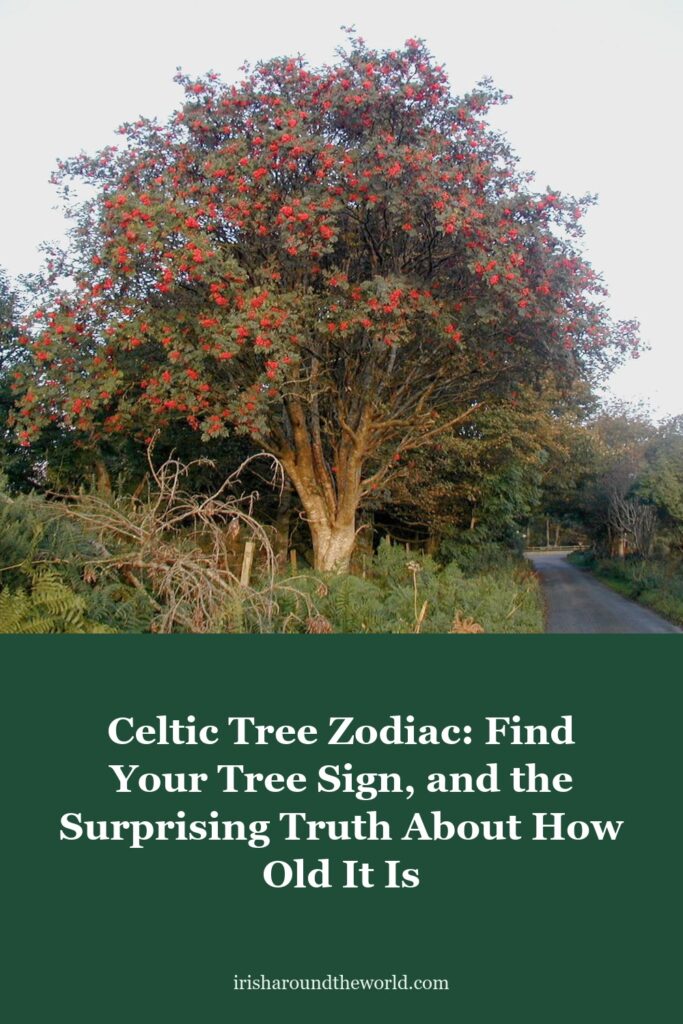
Pin image: A rowan laden with berries beside a lane in Co. Wicklow, October 2008. Photo: Eeno11, CC BY-SA 3.0, via Wikimedia Commons
A little bit of Ireland in your inbox every Friday ☘️
The free Weekly Dose of Irish: an Irish joke, a Celtic symbol, an Irish fact, a poem and the week’s best articles in one short email. Join 9,600+ readers.
Free. One short email every Friday. Unsubscribe any time.
More Celtic symbols and folklore
- Ogham: How to Read Ireland’s Ancient Alphabet and Write Your Own Name
- The Dara Knot: The “Ancient” Celtic Symbol That’s Younger Than You Think
- 20+ Celtic Symbols and Their Meanings Explained
- Fairy Forts and Fairy Trees: The Irish Places You Never Disturb
- The Salmon of Knowledge: How One Burnt Thumb Made Fionn mac Cumhaill a Legend
- Druid Symbols and Meanings: What’s Really Old and What’s Modern
Featured image: A rowan laden with berries beside a lane in Co. Wicklow, October 2008. Photo: Eeno11, CC BY-SA 3.0, via Wikimedia Commons.