
The Great Silkie of Sule Skerry is Child Ballad 113, a seven-verse Shetland song first printed in 1852. A mortal nurse learns her baby’s father is a silkie, a man on land and a seal in the sea. He pays gold for their son, promises to take the boy to sea, and foretells that her future husband, a gunner, will shoot them both. Orkney versions add a gold chain.
The Great Silkie of Sule Skerry is one of the best-known selkie songs. It’s short, strange and very sad.
It isn’t Irish. It comes from the Northern Isles of Scotland, Shetland and Orkney. But the seal-folk it sings about swim in Irish folklore as well, and the Irish singer Áine Furey has recorded it.
If you try and read the poem at first glance, it isn’t the easiest poem to read. So below you’ll find the old words, then a plain-English guide, verse by verse.
Jump to:
- The words of Child Ballad 113
- The meaning, verse by verse
- The ending, and the gold chain
- Where the ballad comes from
- Where is Sule Skerry?
- The tunes: an Orkney air and a 1950s melody
- Who sang it
- Selkies and seal-folk in Ireland
- FAQ
- More reading
The words of Child Ballad 113
This is the traditional text, as Francis James Child printed it in The English and Scottish Popular Ballads (1882 to 1898). It’s long out of copyright. I’ve copied it from the Wikisource and Project Gutenberg transcriptions of Child’s book.

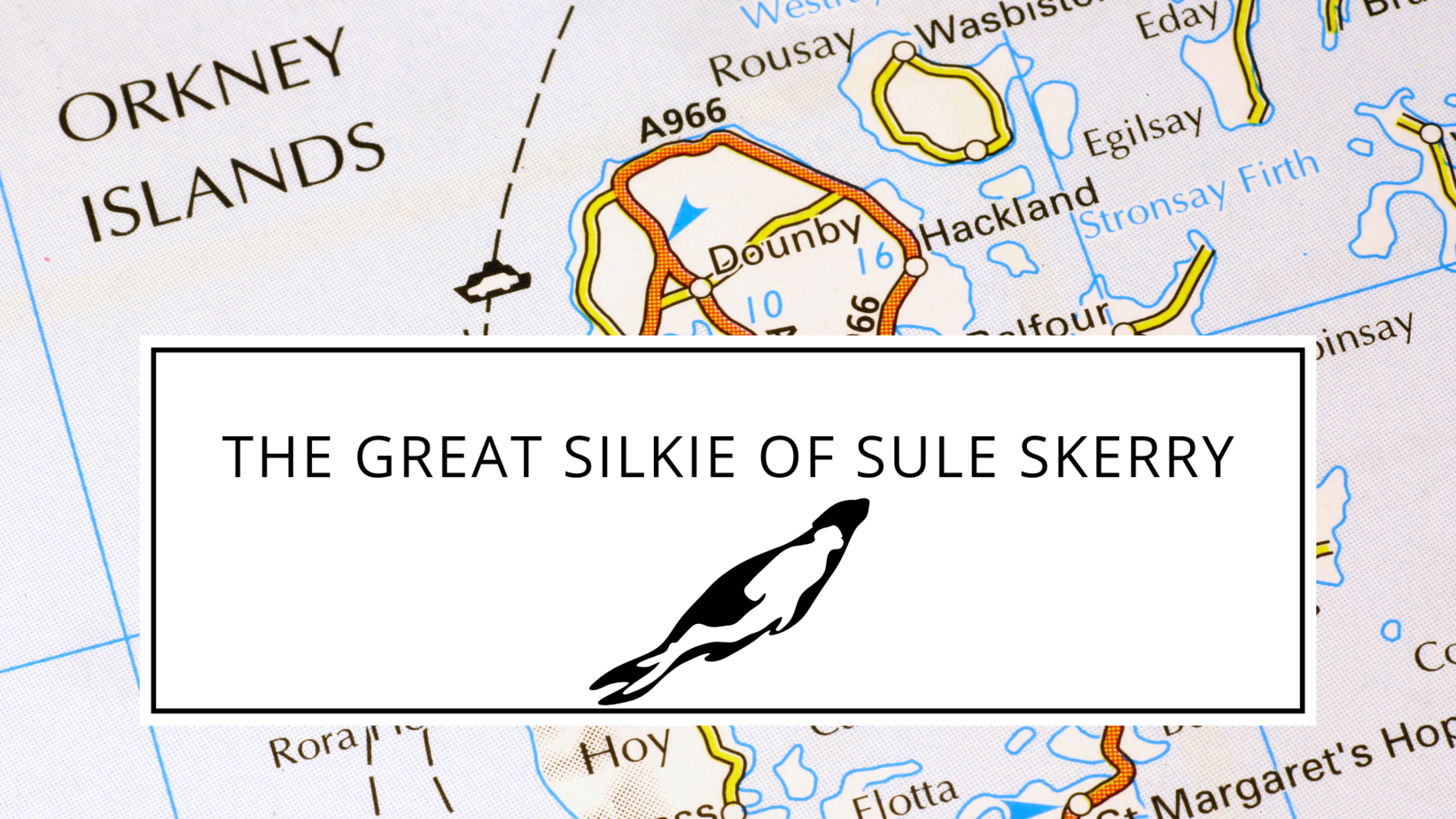
A map of the Orkney Islands. Flotta, where one of the old tunes was collected, is near the bottom. Sule Skerry is off the map, far out to the west.
1
An eartly nourris sits and sings,
And aye she sings, Ba, lily wean!
Little ken I my bairnis father,
Far less the land that he staps in.
2
Then ane arose at her bed-fit,
An a grumly guest I’m sure was he:
‘Here am I, thy bairnis father,
Although that I be not comelie.
3
‘I am a man, upo the lan,
An I am a silkie in the sea;
And when I’m far and far frae lan,
My dwelling is in Sule Skerrie.’
4
‘It was na weel,’ quo the maiden fair,
‘It was na weel, indeed,’ quo she,
‘That the Great Silkie of Sule Skerrie
Suld hae come and aught a bairn to me.’
5
Now he has taen a purse of goud,
And he has pat it upo her knee,
Sayin, Gie to me my little young son,
An tak thee up thy nourris-fee.
6
An it sall come to pass on a simmer’s day,
When the sin shines het on evera stane,
That I will tak my little young son,
An teach him for to swim the faem.
7
An thu sall marry a proud gunner,
An a proud gunner I’m sure he’ll be,
An the very first schot that ere he schoots,
He’ll schoot baith my young son and me.
Source: F. J. Child, The English and Scottish Popular Ballads, No. 113 (en.wikisource.org/wiki/The_English_and_Scottish_Popular_Ballads/Part_4/Chapter_113; Project Gutenberg ebook 47692).
Very easy to read, right? Don’t worry. Here’s the key to the Scots words first.
| Word | Meaning |
|---|---|
| silkie (selkie, selchie) | seal |
| eartly nourris | earthly (mortal) nurse; often read as a wet nurse |
| bairn, wean | child, little child |
| ken | know |
| staps in | probably “stays in” or lives in |
| bed-fit | foot of the bed |
| grumly | grim or gloomy-looking |
| aught a bairn to me | fathered a child on me |
| goud | gold |
| simmer, sin, het, stane | summer, sun, hot, stone |
| faem | foam; the sea |
| baith | both |
Most of these come from the Dictionary of the Scots Language (dsl.ac.uk). “Ba” is a lullaby sound, like “hush”. The folklorist Alan Bruford noted “ba loo lillie” as old Scots lulling syllables.
The Great Silkie of Sule Skerry meaning, verse by verse
Verse 1: the nurse and her baby
A mortal woman sits singing a lullaby to her baby. She admits she hardly knows who the child’s father is. She knows even less about the land he lives in.
Verse 2: a stranger at the foot of the bed
A grim-looking visitor rises up at the foot of her bed. He tells her he is the baby’s father, even if he’s no oil painting.
Verse 3: a man on land, a seal in the sea
This is the heart of the song. He is a man on land and a seal in the water. When he’s far from shore, he lives on Sule Skerry, a lonely rock out in the Atlantic.
Verse 4: her reply
She isn’t impressed. It was no good thing, she says, that the Great Silkie came and gave her a child. You can hear the shame and the shock in it.
Verse 5: the purse of gold
He lays a purse of gold on her knee. That’s her nurse’s fee, payment for minding the child. Then he asks her to hand over his young son.
Verse 6: teaching the boy to swim
He makes a promise. On some hot summer’s day, when the sun beats down on the stones, he’ll take the boy and teach him to swim the foam. Bruford points out that this verse is spoken by the father, whatever the punctuation suggests.
Verse 7: the gunner
Then comes the prophecy. She will marry a proud gunner, a man with a gun. And the very first shot he fires will kill both the silkie and their son.
What the ending means, and the gold chain
In Child’s Shetland text, the song stops on the prophecy. We never see it come true. The silkie simply knows how it ends, and so do we.
That’s the sting. The woman’s future husband is a gunner. Sooner or later he will shoot her own child without knowing it.
Plenty of websites say the silkie gives the woman a gold chain. That isn’t in Child 113. Child’s version has only the purse of gold.
The chain comes from the longer Orkney versions, which run to 14 or 15 verses. Bruford’s 1974 study in the University of Edinburgh journal Scottish Studies sets them out. Those versions often open with a maid “in the Norway lands”.
In most of them, a gold chain goes round the boy’s neck, usually put there by the silkie, so the mother will know him.
Years later the gunner comes home from the hunt and shows her a gold chain he took from a seal. She knows at once what it means. One Orkney text even gives the seal-man a name, Hyne Malair.
Some modern singers use those longer Orkney versions, which is where the chain comes from.
Where the ballad comes from
A naval officer and surveyor, Captain F. W. L. Thomas, wrote it down in Shetland. He took it from the dictation of “a venerable lady of Snarra Voe”, in Child’s words.
It appeared in the Proceedings of the Society of Antiquaries of Scotland, volume 1, which Child dates to 1852. Thomas noted it was sung to a tune “sufficiently melancholy”. As far as I can find, nobody wrote that tune down.
Child added it at the very end of his second volume, as No. 113. In a footnote he says it would have come straight after No. 40, “The Queen of Elfan’s Nourice”, had he known of it earlier. That explains why a supernatural ballad turns up so late in his collection.
Child’s note also explains the belief behind it. Child calls the seal-folk “Finns”. They came up from under the sea wearing seal-skins, he writes, then took the skins off on land. In the wider folklore, a seal-person who loses that skin can’t go back to the sea.
It is Roud 197 in the Roud Folk Song Index.
Where is Sule Skerry?
Sule Skerry is a tiny island, about 40 miles west of Orkney and 35 miles north of the Scottish mainland. It covers roughly 35 acres, according to the Northern Lighthouse Board.
A skerry is a rocky islet. Sule Skerry is a long way from anywhere. The lighthouse there was first lit in 1895 and automated in 1982.
Some sites mix it up with Sula Sgeir. That’s a different rock, off the Isle of Lewis. If you’ve ever wanted proof that seals choose their homes for the peace and quiet, Sule Skerry is it.
The tunes: an Orkney air and a 1950s melody
The ballad has been sung to more than one tune. Two matter most.
The old Orkney air. In 1938 the Finnish folklorist Otto Andersson noted down a tune from John Sinclair of Flotta, Orkney. He wrote that its pentatonic form showed it was very old. Bertrand Bronson later printed it in The Traditional Tunes of the Child Ballads.
The James Waters tune. The melody most people know is not traditional at all. An American, James Waters, wrote it in the 1950s. It’s still in copyright, which is why I’m not printing it or the modern sung words here.
Waters’ tune spread so widely that many people assume it’s old. Pete Seeger later borrowed it for “I Come and Stand at Every Door”. The Byrds recorded that song in 1966.
Who sang The Great Silkie of Sule Skerry
Here are some of the recordings I could confirm. Titles vary a lot, so watch for “Selchie”, “Shule”, “Silky” and “Grey Silkie”.
| Singer | Title and album | Year |
|---|---|---|
| Cynthia Gooding | “Great Selchie of Shule Skerry”, Faithful Lovers and Other Phenomena | 1957 |
| Joan Baez | “Silkie”, Joan Baez, Vol. 2 | 1961 |
| John Sinclair | “The Grey Silkie”, Sailormen and Servingmaids (The Folk Songs of Britain, Vol. 6), BBC field recording | 1961 |
| Judy Collins | “Great Selchie of Shule Skerry”, Golden Apples of the Sun | 1962 |
| Jean Redpath | “The Grey Silkie”, Jean Redpath | 1975 |
| Áine Furey | “Silky”, Sweetest Summer Rain | 1999 |
| June Tabor | “The Great Selkie of Sule Skerry”, Ashore | 2011 |
| The Unthanks | “The Great Silkie of Sule Skerry”, Sorrows Away | 2022 |
Baez used the Waters tune, and so do many revival recordings. June Tabor sang the version collected from John Sinclair of Flotta in 1938. It’s worth a listen if you only know the Baez version.
Selkies and seal-folk in Ireland
The word “selkie” is Scots. But Ireland has its own seal-folk stories, and they’re close cousins of this ballad. I’ve gathered the bigger picture in my guide to selkie mythology.
In Connemara, the Conneely family was linked with seals. James Hardiman’s 1846 notes to Roderic O’Flaherty’s H-Iar Connaught record the story. Some Coneelys (Hardiman’s spelling), he wrote, were by “Art magick” turned into seals.
According to Hardiman, some believers would no more kill a seal than kill a human Coneely. He adds that the story led some of the family to change their name to Conolly.
Closer to my own home, the Schools’ Collection on Dúchas has a story from Crookhaven, Co. Cork. A Glavin man marries a sea-woman. She warns him never to kill a seal. One Sunday, while she’s at Mass, he kills and skins one.
The story calls her a mermaid. But her rule about seals is pure selkie lore. And like the gunner in the ballad, the man’s killing of a seal is what brings the trouble.
Cartoon Saloon in Kilkenny made Song of the Sea (2014), directed by Tomm Moore, about a little girl who is a selkie. It was nominated for an Oscar for Best Animated Feature.
The Great Silkie of Sule Skerry FAQ
What is the meaning of The Great Silkie of Sule Skerry?
A mortal woman has a child by a silkie, a seal-man. He pays her in gold, claims their son, promises to teach him to swim the sea, and foretells that her future husband, a gunner, will shoot them both.
What is a silkie?
Silkie is a rare spelling of selkie, the Scots word for a seal. Most versions say selkie or selchie. In folklore, selkies are seals that can shed their skins and live on land as people.
Is The Great Silkie of Sule Skerry Irish or Scottish?
Scottish. Child’s text was written down in Shetland, and the longer versions come from Orkney. Ireland has similar seal-folk stories, especially along the west coast.
Who wrote the music for The Great Silkie of Sule Skerry?
Nobody knows who made the traditional Orkney air, collected in 1938. The famous modern tune was written by the American James Waters in the 1950s. Joan Baez sang it to that tune.
What happens at the end of the ballad?
In Child 113 it ends on the prophecy that the gunner will shoot the seal and his son. In the Orkney versions the gunner brings home a gold chain, and the mother recognises it.
What is Child Ballad 113?
Child Ballad 113 is The Great Silkie of Sule Skerry, No. 113 in Francis James Child’s collection. It’s also Roud 197. Child placed it at the end of his second volume because he found it late.
More reading
- Selkie Mythology
- Irish Mythological Creatures
- The Great Blasket Island
- Leprechauns in Irish Folklore
- Celtic Symbols and Their Meanings
- The Wild Atlantic Way
A little bit of Ireland in your inbox every Friday ☘️
The free Weekly Dose of Irish: an Irish joke, a Celtic symbol, an Irish fact, a poem and the week’s best articles in one short email. Join 9,600+ readers.
Free. One short email every Friday. Unsubscribe any time.