Irish proverbs, or seanfhocail (SHAN-uk-il), meaning “old words”, are short traditional sayings in the Irish language that pass on folk wisdom about life, family, love, work, the weather and death. The most famous is Ar scáth a chéile a mhaireann na daoine: people live in each other’s shelter. Below are 160 of them with their meanings and how to say them. Each one was checked against Ó Dónaill’s dictionary, focloir.ie or an old printed collection, and the one I couldn’t find in any of them is flagged.
Long before anyone printed them on tea towels, Irish proverbs did real work. People used them to win an argument, warn a child, tease a neighbour or comfort a family at a wake. A good seanfhocal could say in six words what a sermon took twenty minutes to say.
Search for Irish proverbs today and you’ll find hundreds of lines in English, and plenty of them were never Irish at all. This page is different. Every proverb below exists in the Irish language. You get the Irish, a rough guide to saying it, a word-for-word translation and what it really means, sorted by theme, plus an occasion finder for weddings, funerals, birthdays and tattoos.
A quick word on terms. A proverb gives advice or states a truth about life. A blessing wishes someone well, like “May the road rise up to meet you”. A saying can be almost anything. For blessings, toasts and everyday sayings, see my Irish sayings and blessings.
Unless I say otherwise, every proverb here is printed in Niall Ó Dónaill’s Foclóir Gaeilge-Béarla (1977), the standard Irish-English dictionary, free to search on teanglann.ie. The translations and explanations are my own.
Jump to:
- The 10 most famous Irish proverbs
- How to say Irish proverbs
- Irish proverbs about life and wisdom
- Irish proverbs about love and marriage
- Irish proverbs about friendship
- Irish proverbs about family and home
- Irish proverbs about death, grief and remembrance
- Irish proverbs about strength, hard times and luck
- Irish proverbs about work and money
- Irish proverbs about travel and the road
- Irish proverbs about health, food, youth and age
- Irish proverbs about drink
- Irish proverbs about talk, silence and gossip
- Irish proverbs about the weather, the land and the sea
- Funny Irish proverbs
- Irish triads: proverbs in threes
- Irish proverbs for every occasion
- Famous lines that aren’t really Irish proverbs
- Using Irish proverbs today (and spelling mistakes to avoid)
- Where Irish proverbs come from
- Find proverbs from your family’s county
- Irish proverbs FAQ
- More Irish sayings and language
The 10 most famous Irish proverbs
If you only learn a handful, learn these. They’re the ones Irish people still say, teachers still teach and printers still put on cards.
- People live in each other’s shelter (Ar scáth a chéile a mhaireann na daoine, er SKAW uh HAY-luh uh WAH-run nuh DEE-nuh): we all depend on one another, and nobody gets through life alone. Scáth means shadow as well as shelter. It’s the same spirit as the old idea of the anam cara, the soul friend. Ó Dónaill prints it with mhaireas, an older way of saying mhaireann.
- Health is better than herds (Is fearr an tsláinte ná na táinte, iss FAR un TLAWN-chuh naw nuh TAWN-chuh): health is worth more than wealth. Táinte were herds of cattle, the old measure of a rich man. Énrí Ó Muirgheasa also recorded it in Ulster in 1907.
- A good start is half the work (Tús maith leath na hoibre, TOOS MAH LAH nuh HIB-ruh): well begun is half done.
- Praise youth and it will come on (Mol an óige agus tiocfaidh sí, MUL un OH-gyuh AG-us CHUK-ee SHEE): encourage young people and they’ll blossom. Ó Dónaill writes is for agus; both mean “and”.
- There’s no strength until we pull together (Ní neart go cur le chéile, nee NYART guh KUR leh HAY-luh): unity is strength, and a favourite club motto.
- Green are the hills far away from us (Is glas na cnoic i bhfad uainn, iss GLOSS nuh KNICK ih VOD OO-in): the grass is always greener. Every emigrant knows this one from both sides.
- Two people shorten a road (Giorraíonn beirt bóthar, GIRR-een BERCH BOH-hur): company makes any journey, or any hard stretch of life, feel shorter. Ó Muirgheasa’s Seanfhocla Uladh (1907) has it as number 1466.
- There’s no hearth like your own hearth (Níl aon tinteán mar do thinteán féin, neel AYN CHIN-chawn mor duh HIN-chawn FAYN): there’s no place like home.
- The rare thing is the wonderful thing (An rud is annamh is iontach, un RUD iss AN-uv iss OON-tukh): what’s seldom is wonderful. We treasure the treat, or the sunny day, because it’s rare.
- A friend is recognised in hardship (Aithnítear cara i gcruatan, AH-nee-chur KOR-uh ih GROO-uh-tan): a friend in need is a friend indeed. Source: focloir.ie, the modern English-Irish dictionary, which labels it a proverb.
Here are the same ten at a glance, in Irish and English:
| In Irish (how to say it) | In English | What it means |
|---|---|---|
| Ar scáth a chéile a mhaireann na daoine (er SKAW uh HAY-luh uh WAH-run nuh DEE-nuh) | People live in each other’s shelter | We all depend on one another |
| Is fearr an tsláinte ná na táinte (iss FAR un TLAWN-chuh naw nuh TAWN-chuh) | Health is better than herds | Health is worth more than wealth |
| Tús maith leath na hoibre (TOOS MAH LAH nuh HIB-ruh) | A good start is half the work | Well begun is half done |
| Mol an óige agus tiocfaidh sí (MUL un OH-gyuh AG-us CHUK-ee SHEE) | Praise youth and it will come on | Encourage the young and they’ll blossom |
| Ní neart go cur le chéile (nee NYART guh KUR leh HAY-luh) | There’s no strength until we pull together | Unity is strength |
| Is glas na cnoic i bhfad uainn (iss GLOSS nuh KNICK ih VOD OO-in) | Green are the hills far away from us | The grass is always greener |
| Giorraíonn beirt bóthar (GIRR-een BERCH BOH-hur) | Two people shorten a road | Company makes any journey feel shorter |
| Níl aon tinteán mar do thinteán féin (neel AYN CHIN-chawn mor duh HIN-chawn FAYN) | There’s no hearth like your own hearth | There’s no place like home |
| An rud is annamh is iontach (un RUD iss AN-uv iss OON-tukh) | The rare thing is the wonderful thing | What’s seldom is wonderful |
| Aithnítear cara i gcruatan (AH-nee-chur KOR-uh ih GROO-uh-tan) | A friend is recognised in hardship | A friend in need is a friend indeed |
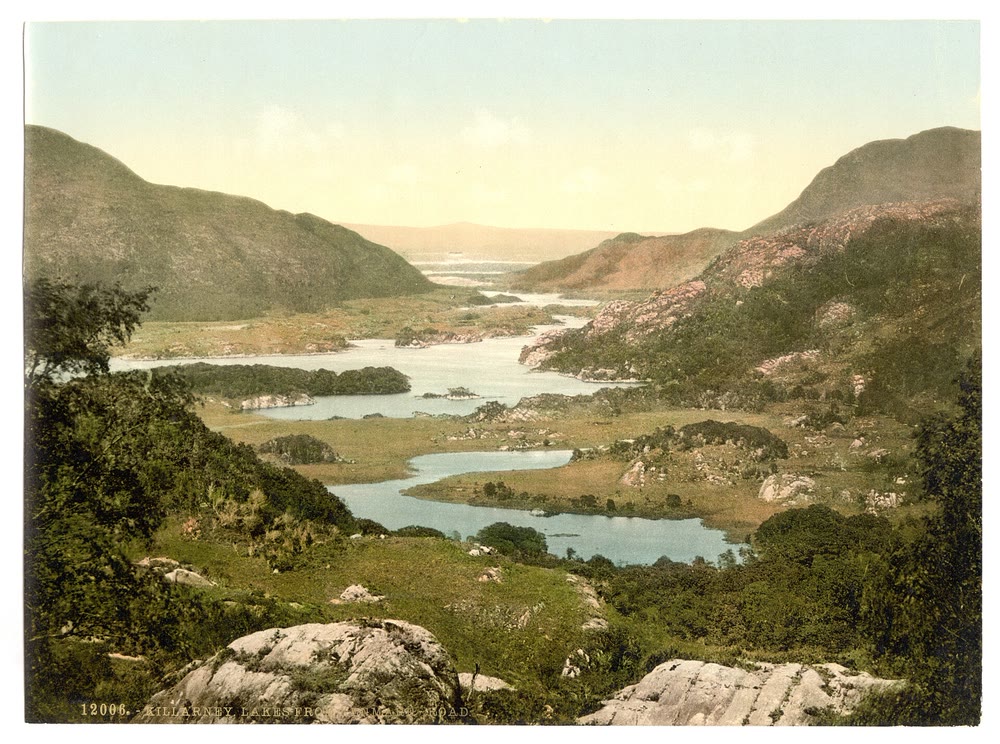
Is glas na cnoic i bhfad uainn: the lakes of Killarney from the Kenmare road, a photochrom print from the 1890s. Library of Congress, public domain, via Wikimedia Commons
How to say Irish proverbs
Irish has three main dialects, Connacht, Munster and Ulster, and a proverb can sound quite different in Kerry and Donegal. My respellings are rough, middle-of-the-road guides, not gospel.
- CAPITALS show the stress, usually on the first syllable. Munster often moves it later, and a few words, like inniu (today) and amárach (tomorrow), are stressed on the second syllable everywhere.
- “kh” is the throaty sound in Scottish “loch”. “gh” is a softer version of the same sound.
- ch next to e or i is softer, written “hy” or “h” here: chéile is HAY-luh.
- t and d next to e or i sound close to “ch” and “j”: tinteán is CHIN-chawn, Dé is JAY.
- “uh” is a quick, unstressed vowel, like the “a” in “about”.
- bh and mh sound like “v” or “w”; th and sh sound like “h”.
- ao sounds like “ay” in Munster and “ee” in Connacht and Ulster (saol is SAYL or SEEL). I’ve used the Munster sound.
- cn at the start of a word sounds like “cr” in Connacht and Ulster: cnoic is KNICK in Munster, KRICK in the west and north.
- A letter added in front changes the sound: gcruatan starts with “g”, bPaorach with “b”.
Six little words unlock most Irish proverbs:
- Is (iss): “is”, as in Is maith, “it’s good”.
- Ní / Níl (nee / neel): “not” / “there isn’t”.
- Is fearr (iss FAR): “is better”. Dozens of proverbs follow the pattern Is fearr X ná Y, “X is better than Y”.
- Maith (MAH): “good”.
- Is minic (iss MIN-ick): “often”, as in “many a time”.
- Bíonn (BEEN): “is” in the sense of “always is” or “usually is”, for things that are always true.
To hear a word said properly, look it up on focloir.ie, which has recordings in all three dialects, or use the pronunciation database on teanglann.ie.
Irish proverbs about life and wisdom
11. Is ait an mac an saol. (iss ATCH un MOK un SAYL)
“Life is a strange son.”
Life is strange, and full of surprises.
12. Is maith an scéalaí an aimsir. (iss MAH un SHKAY-lee un AM-shir)
“Time is a good storyteller.”
Time will tell.
13. Ní bhíonn saoi gan locht. (nee VEEN SEE gon LUKHT)
“There is no wise man without a fault.”
Even the cleverest person slips up. T. F. O’Rahilly’s 1922 collection has it as number 136.
14. An té nach bhfuil láidir, ní foláir dó a bheith glic. (un CHAY nokh WIL LAW-jir, nee FUL-awr doh uh VEH GLICK)
“Whoever isn’t strong had better be clever.”
Brains can beat brawn. Most of Irish history, really.
15. Níl sa saol ach gaoth is toit. (neel suh SAYL okh GWAY iss TITCH)
“Life is nothing but wind and smoke.”
Nothing lasts, so don’t get too attached.
16. As a chéile a dhéantar na caisleáin. (oss uh HAY-luh uh YAYN-tur nuh KASH-lawn)
“Castles are built bit by bit.”
Rome wasn’t built in a day.
17. Is fearr clú ná conách. (iss FAR KLOO naw KUN-awkh)
“Reputation is better than wealth.”
Your reputation is worth more than money, and outlasts it.
18. Is treise dúchas ná oiliúint. (iss TRESH-uh DOO-khus naw IL-yoonch)
“Nature is stronger than rearing.”
What’s born in you beats what’s taught to you. Dúchas means inborn nature or heritage, not landscape.
19. Ní bhíonn an sonas gan an donas ina orlaí tríd. (nee VEEN un SUN-us gon un DUN-us IN-uh OR-lee TREEJ)
“Happiness never comes without misfortune running through it in inches.”
No rose without a thorn.
20. Is fearr amharc amháin romhat ná dhá amharc i do dhiaidh. (iss FAR OW-urk uh-WAWN ROH-ut naw GHAW OW-urk ih duh YEE-uh)
“One look ahead is better than two looks behind.”
Foresight beats hindsight.
21. Ní lia tír ná gnás. (nee LEE-uh CHEER naw GNAWSS)
“There are as many customs as countries.”
Every place has its own ways. Handy for any emigrant.
22. Is fearr glas ná amhras. (iss FAR GLOSS naw OW-rus)
“A lock is better than suspicion.”
Better safe than sorry.
23. Mol an t-áth mar a gheobhair. (MUL un TAW mor uh YOH-ir)
“Praise the ford as you find it.”
Judge things, and people, by your own experience, not by what others tell you.
Irish proverbs about love and marriage
Old Irish proverbs about love are more practical than romantic, and often very funny. For tender lines to write in a card, see my Irish sayings about love.
24. Folaíonn grá gráin. (FUL-een GRAW GRAWN)
“Love hides ugliness.”
Love is blind. Ó Muirgheasa’s Ulster version adds that hate sees plenty of faults.
25. Nochtann grá gnaoi. (NUKH-tun GRAW GNEE)
“Love reveals beauty.”
Beauty is in the eye of the beholder. Love makes the loved one lovely. Source: focloir.ie.
26. Ní heolas go haontíos. (nee HOH-lus guh HAYN-cheess)
“There’s no knowing until living together.”
You don’t really know someone until you share a roof. Ask any newlyweds.
27. Ní féasta go rósta, ní céasadh go pósadh. (nee FAY-stuh guh ROH-stuh, nee KAY-suh guh POH-suh)
“No feast without a roast, no torment like marriage.”
A rhyming joke: a party needs good food, and marriage brings its own trials. Ó Dónaill gives the two halves separately.
28. Is minic a chealg briathra míne cailín críonna. (iss MIN-ick uh HYAL-ug BREE-uh-hruh MEE-nuh KAL-een KREE-nuh)
“Smooth words have often beguiled a sensible girl.”
Sweet talk has led many a wise woman astray. Mind the charmers.
29. Níl aon leigheas ar an ngrá ach pósadh. (neel AYN LYE-us er un NGRAW okh POH-suh)
“There’s no cure for love but marriage.”
Romantic or a warning, depending on the company. It’s popular in modern collections, but I couldn’t find it in Ó Dónaill, O’Rahilly or Ó Muirgheasa, so I can’t vouch for its age. It’s in my Irish wedding blessings too.
30. Ná gabh bean gan locht. (naw GOW BAN gon LUKHT)
“Don’t take a woman without a fault.”
Nobody is perfect, and anyone who seems to be is hiding something. Ó Muirgheasa recorded it in Ulster in 1907 (number 121).
31. Pós bean sléibhe is pósfaidh tú an sliabh uilig. (POHSS BAN SHLAY-vuh iss POHSS-ee too un SHLEE-uv IL-ig)
“Marry a mountain woman and you’ll marry the whole mountain.”
Marry into a close community and you marry all her relations. Ó Muirgheasa’s number 114, from Armagh, with the Ulster word uilig, “all”.
32. Is fearr an troid ná an t-uaigneas. (iss FAR un TRIDGE naw un TOOG-nyus)
“Fighting is better than loneliness.”
A row now and then beats living alone.
33. Pósadh inniu, picil amárach. (POH-suh in-YOO, PICK-il uh-MAW-rukh)
“Married today, in a pickle tomorrow.”
Marry in haste, repent at leisure. Source: focloir.ie.
34. Ní dhéanann breá brachán. (nee YAY-nun BRAW BRA-khawn)
“Fine looks don’t make porridge.”
Beauty won’t feed a family. A cousin of this one says Ní hí an bhreáthacht a bhruitheann na prátaí: it isn’t good looks that boil the potatoes (focloir.ie).
Irish proverbs about friendship
35. Is fearr focal sa chúirt ná bonn sa sparán. (iss FAR FUK-ul suh KHOORCH naw BUN suh SPAR-awn)
“A word in the court is better than a coin in the purse.”
A friend in the right place is worth more than money. O’Rahilly’s number 71; Ó Dónaill also allows punt, a pound.
36. Ní buan cogadh na gcarad. (nee BOO-un KUG-uh nuh GAR-ud)
“The war of friends doesn’t last.”
Rows between friends soon blow over. O’Rahilly (number 173) adds that no war is more bitter while it lasts.
37. Cogadh carad, caoi namhad. (KUG-uh KAR-ud, KWEE NOW-ud)
“Friends at war, the enemy’s chance.”
When friends fall out, their enemies win.
38. Is fearr uaigneas maith ná droch-chuideachta. (iss FAR OOG-nyus MAH naw drukh-KHIJ-ukh-tuh)
“Good loneliness is better than bad company.”
Better alone than with the wrong crowd.
39. Togh do chuideachta sula suífidh tú. (TOW duh KHIJ-ukh-tuh SUL-uh SEE-hee too)
“Choose your company before you sit down.”
O’Rahilly’s number 22, in modern spelling.
40. Cuairt ghearr is a déanamh go hannamh. (KOO-urch YAR iss uh JAY-nuv guh HAN-uv)
“A short visit, and make it seldom.”
Don’t wear out your welcome. Useful when the in-laws are coming.
41. Is bách iad lucht aon cheirde. (iss BAWKH EE-ud LUKHT AYN HYAIR-juh)
“People of the one trade are fond of each other.”
Birds of a feather stick together. O’Rahilly (number 128) gives an older version about kin, “people of the one stock”, with this trade version as a variant.
42. Aithníonn ciaróg ciaróg eile. (AH-neen KEER-ohg KEER-ohg EL-uh)
“One beetle knows another.”
Like knows like, usually said about two rogues.
43. Is fearr seanfhiacha ná seanfhala. (iss FAR SHAN-ee-ukh-uh naw SHAN-al-uh)
“Old debts are better than old grudges.”
An unpaid debt does less harm than a grudge you keep alive. O’Rahilly (number 3) calls it one of the oldest proverbs in the language.
44. An té a bhuailfeadh mo mhadra, bhuailfeadh sé mé féin. (un CHAY uh VOO-il-hukh muh WAD-ruh, VOO-il-hukh SHAY may FAYN)
“Whoever would hit my dog would hit me.”
Love me, love my dog. Hurt one of mine and you hurt me.
45. Is maith an scáthán súil charad. (iss MAH un SKAW-hawn SOOL KHAR-ud)
“A friend’s eye is a good mirror.”
A real friend shows you yourself honestly, faults and all. It’s old: Alexander Nicolson’s Collection of Gaelic Proverbs (1882 edition) gives it in Scottish Gaelic, Is math an sgàthan sùil caraide, and notes the same proverb in Irish.
Irish proverbs about family and home
46. Is fearr beagán den ghaol ná mórán den charthanas. (iss FAR BYUG-awn jen GHAYL naw MOH-rawn jen KHAR-huh-nus)
“A little kinship is better than a lot of charity.”
Blood is thicker than water. Family will do for you what strangers won’t.
47. Mar a bhíos an cú mór, bíonn an coileán. (mor uh VEESS un KOO MOHR, BEEN un KIL-awn)
“As the big hound is, so is the pup.”
Like father, like son.
48. Cad é a dhéanfadh mac an chait ach luch a mharú? (kod AY uh YAYN-hukh MOK un KHATCH okh LUKH uh WAR-oo)
“What would the cat’s son do but kill a mouse?”
The apple doesn’t fall far from the tree.
49. Is geal leis an bhfiach dubh a ghearrcach féin. (iss GAL lesh un VEE-ukh DUV uh YAR-kukh FAYN)
“The raven thinks its own chick is white.”
Every parent thinks their own child is beautiful. O’Rahilly’s number 166.
50. Beireann cearc dhubh ubh bhán. (BEH-run KYARK GHUV UV VAWN)
“A black hen lays a white egg.”
Don’t judge anyone by looks or by family. Ó Muirgheasa’s number 848, in standard form (he prints the Ulster Beiridh).
51. Briseann an dúchas trí shúile an chait. (BRISH-un un DOO-khus tree HOO-luh un KHATCH)
“Nature breaks out through the cat’s eyes.”
What’s bred in the bone will show.
52. Gach dalta mar a oiltear. (gokh DAL-tuh mor uh IL-chur)
“Every foster child as it’s reared.”
Children turn out the way they’re raised. In old Ireland children were often fostered by another family, so the saying was meant literally.
53. Is maol gualainn gan bhráthair. (iss MWAYL GOO-uh-lin gon VRAW-hir)
“Bare is the shoulder without a brother.”
It’s hard to face the world without family at your side. O’Rahilly (number 61) notes that the Annals of the Four Masters quote it under the year 1583.
54. Is deise do dhuine a léine ná a chóta. (iss JESH-uh duh GHIN-uh uh LAY-nuh naw uh KHOH-tuh)
“A person’s shirt is closer to them than their coat.”
Family comes before friends, and friends before strangers.
55. Sciurdann éan as gach ealta. (SHKUR-dun AYN oss gokh AL-tuh)
“Every flock has one bird that bolts.”
Every family has one who goes their own way.
56. Is olc an t-éan a shalaíonn a nead féin. (iss ULK un CHAYN uh HAL-een uh NAD FAYN)
“It’s a bad bird that dirties its own nest.”
Don’t run down your own family or your own home place.
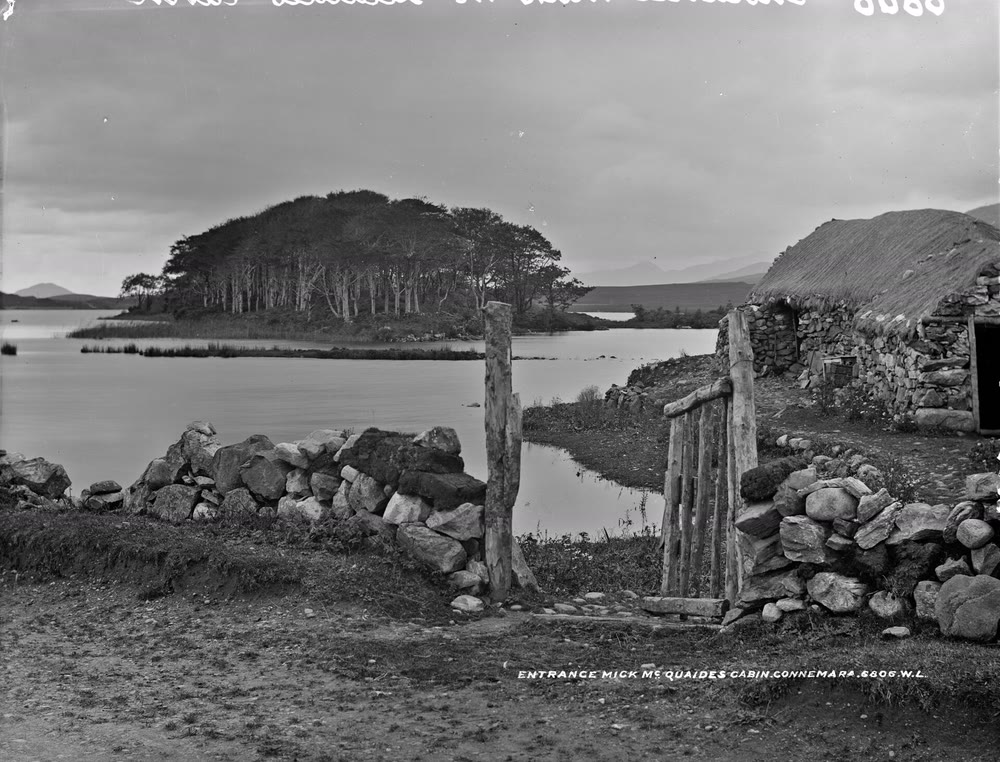
Níl aon tinteán mar do thinteán féin: a thatched cabin beside a lake in Connemara, photographed by Robert French for the Lawrence Collection. National Library of Ireland, public domain, via Wikimedia Commons
57. Is fearr bothán biamhar ná caisleán gortach. (iss FAR BUH-hawn BEE-uh-wur naw KASH-lawn GUR-tukh)
“Better a cabin with a full pot than a castle where people go hungry.”
A warm, well-fed home beats a grand, mean one.
58. An té a bhíos amuigh, fuaraíonn a chuid. (un CHAY uh VEESS uh-MWIG, FOO-uh-reen uh KHIJ)
“Whoever stays out, their dinner goes cold.”
Out of sight, out of mind. Be home for dinner.
Irish proverbs about death, grief and remembrance
These are honest, sometimes stark and often consoling. For words to say at a funeral, see my Irish funeral blessings.
59. Níl luibh ná leigheas in aghaidh an bháis. (neel LIV naw LYE-us in EYE un VAWSH)
“There’s no herb or cure against death.”
Some things can’t be fixed.
60. Bíonn súil le muir ach ní bhíonn súil le huaigh. (BEEN SOOL leh MWIR okh nee VEEN SOOL leh HOO-ee)
“There’s hope from the sea, but no hope from the grave.”
Someone lost at sea might still come home, but the dead won’t. A hard one for coastal families.
61. Is iomaí lá ag an uaigh orainn. (iss UM-ee LAW eg un OO-ee OR-in)
“The grave has many a day on us.”
Make the most of today: we’ll have plenty of time in the grave. A churchyard version says ag an gcill instead.
62. Más fada an lá, tig an oíche. (mawss FOD-uh un LAW, CHIG un EE-huh)
“However long the day, the night comes.”
Everything ends. A gentle line for a long life. Tig is the northern and older form of tagann, “comes”.
63. Is buaine bladh ná saol. (iss BOO-in-yuh BLY naw SAYL)
“Fame lasts longer than life.”
A good name lives on after you. O’Rahilly (number 134) says it was used to urge people to brave deeds.
64. Is beag an rud is buaine ná an duine. (iss BYUG un RUD iss BOO-in-yuh naw un DIN-uh)
“Even a small thing outlasts a person.”
A ring or a letter can outlive its owner.
65. Níor bhlais an bia nach mblaisfidh an bás. (neer VLASH un BEE-uh nokh MLASH-hee un BAWSS)
“Nobody has tasted food who won’t taste death.”
Everyone who lives will die.
66. Dearbhráthair don bhás an codladh. (JAR-uv-raw-hir dun VAWSS un KUL-uh)
“Sleep is death’s brother.”
O’Rahilly’s number 169.
67. Is minic a mhaolaigh béile maith brón. (iss MIN-ick uh WAY-lee BAY-luh MAH BROHN)
“A good meal has often softened sorrow.”
Grief sits lighter on a full stomach. That’s why every Irish wake has sandwiches.
One phrase you’ll hear at an Irish funeral isn’t a proverb at all. People say someone has gone ar shlí na fírinne (er HLEE nuh FEER-in-yuh), “on the way of truth”, meaning they have died. And Ar dheis Dé go raibh a anam (er YESH JAY guh RAV uh AN-um) means “may his soul be at God’s right hand” (a hanam for a woman).
Irish proverbs about strength, hard times and luck
68. Beidh lá eile ag an bPaorach. (beh LAW EL-uh eg un BAY-rukh)
“Power will have another day.”
There’ll be another chance. Power is a family name, and the line is handy after any lost match. More in my ways to wish someone good luck in Irish.
69. Níor chaill fear an mhisnigh riamh. (neer KHAL FAR un VISH-nee REE-uv)
“The man of courage never lost.”
Fortune favours the brave. focloir.ie gives bean, woman, as well as fear.
70. Ní bhíonn uasal ná íseal ach thuas seal is thíos seal. (nee VEEN OO-uh-sul naw EE-shul okh HOO-us SHAL iss HEE-us SHAL)
“There’s no high or low, only up a while and down a while.”
Fortune keeps turning. This is the focloir.ie form; Ó Dónaill has Ní íseal ná uasal ach thíos seal thuas seal.
71. Is fearr foighne ná imreas. (iss FAR FINE-yuh naw IM-rus)
“Patience is better than quarrelling.”
Count to ten.
72. Mair, a chapaill, agus gheobhaidh tú féar. (MAR, uh KHAP-il, AG-us YOH-ee too FAYR)
“Live, horse, and you’ll get grass.”
Hang in there and better times will come. Often said wryly.
73. Chrom Dia an droim don ualach. (KHRUM JEE-uh un DRIM dun OO-uh-lukh)
“God bent the back to suit the load.”
We’re given the strength to carry what we must.
74. Is giorra cabhair Dé ná an doras. (iss GIR-uh KOW-ir JAY naw un DUR-us)
“God’s help is nearer than the door.”
Help is closer than you think.
75. Níor dhún Dia doras riamh nár oscail Sé ceann eile. (neer GHOON JEE-uh DUR-us REE-uv nawr US-kil SHAY KYOWN EL-uh)
“God never shut one door but He opened another one.”
When one chance goes, another comes.
76. Is minic a rinne bromach gioblach capall cumasach. (iss MIN-ick uh RIN-yuh BRUM-ukh GIB-lukh KAP-ul KUM-uh-sukh)
“A scruffy foal has often grown into a fine strong horse.”
Never write off the awkward youngster.
77. Níor cailleadh leath dá ndeachaigh i gcontúirt. (neer KAL-yuh LAH daw NYAKH-ee ih GUN-toorch)
“Not half of those who went into danger were lost.”
Nothing ventured, nothing gained.
78. Is minic a bhí cú mall sona. (iss MIN-ick uh VEE KOO MOWL SUN-uh)
“A slow hound was often lucky.”
Slow and steady can still win. O’Rahilly (number 36) lists several versions.
79. An té a mbíonn an t-ádh ar maidin air, bíonn sé air maidin agus tráthnóna. (un CHAY uh MEEN un TAW er MAJ-in er, BEEN SHAY er MAJ-in AG-us traw-NOH-nuh)
“Whoever has luck in the morning has it morning and evening.”
Start the day well and the luck carries.
80. Ní bhíonn an rath ach mar a mbíonn an smacht. (nee VEEN un RAH okh mor uh MEEN un SMOKHT)
“There’s no prosperity except where there’s discipline.”
Luck follows hard work and good order.
81. Níl tuile dá mhéad nach dtránn. (neel TIL-uh daw VAYD nokh DRAWN)
“There’s no flood, however great, that doesn’t ebb.”
This too shall pass.
Irish proverbs about work and money
82. Den cheird an cleachtadh. (jen HYAIRJ un KLAKH-tuh)
“Practice is part of the trade.”
Practice makes perfect.
83. Is fearr lán doirn de cheird ná lán mála d’ór. (iss FAR LAWN DUR-in jeh HYAIRJ naw LAWN MAW-luh DOHR)
“A fistful of trade is worth more than a sackful of gold.”
Money runs out. A trade lasts a lifetime.
84. Múineann gá seift. (MOON-un GAW SHEFT)
“Need teaches a plan.”
Necessity is the mother of invention.
85. Is olc an chearc nach scríobann di féin. (iss ULK un HYARK nokh SHKREE-bun jih FAYN)
“A hen that won’t scratch for her own feed is a sorry hen.”
Look after your own interests.
86. Ní dhíolann dearmad fiacha. (nee YEE-lun JAR-uh-mud FEE-ukh-uh)
“Forgetting doesn’t pay debts.”
A debt you forget is still a debt. O’Rahilly’s number 168.
87. Is maith an cairde go dtaga an cuntas. (iss MAH un KAR-juh guh DOG-uh un KOON-tus)
“Credit is good until the bill comes.”
Buy now, pay later feels great, until later.
88. Ní thuigeann an sách an seang. (nee HIG-un un SAWKH un SHANG)
“The well-fed don’t understand the lean.”
People who have never gone without can’t imagine hardship.
89. Molann an obair an saor. (MUL-un un UB-ir un SAYR)
“The work praises the craftsman.”
Judge people by what they make and do. Saor sounds closer to “seer” in Connacht and Ulster.
90. An té nach gcuirfidh greim, cuirfidh sé dhá ghreim. (un CHAY nokh GIR-hee GREM, KIR-hee SHAY GHAW YREM)
“Whoever won’t put in one stitch will put in two.”
A stitch in time saves nine.
91. An punt a chailleadh ag lorg na pingine. (un PUNT uh KHAL-yuh eg LUR-ug nuh PING-in-uh)
“Losing the pound looking for the penny.”
Penny wise, pound foolish.
92. Ní fhaigheann cos ina cónaí dada. (nee EYE-un KUSS IN-uh KOH-nee DOD-uh)
“A foot at rest gets nothing.”
Go out and find your chances.
93. Is fearr leath ná meath. (iss FAR LAH naw MAH)
“Half is better than failure.”
Half a loaf is better than none.
94. Is fearr breac sa lámh ná bradán sa linn. (iss FAR BRAK suh LAWV naw BRAD-awn suh LIN)
“A trout in the hand is better than a salmon in the pool.”
Ireland’s own bird in the hand. Source: focloir.ie.
95. Ní bheathaíonn na briathra na bráithre. (nee VA-heen nuh BREE-uh-hruh nuh BRAW-hruh)
“Words don’t feed the friars.”
Talk is cheap. O’Rahilly (number 356) said in 1922 that it was still well known.
Irish proverbs about travel and the road
96. Bíonn siúlach scéalach. (BEEN SHOO-lukh SHKAY-lukh)
“A traveller is a teller of tales.”
Those who roam come home with stories.
97. Is fada an bóthar nach bhfuil casadh ann. (iss FOD-uh un BOH-hur nokh WIL KOSS-uh OWN)
“It’s a long road that has no turn in it.”
Hard times don’t last forever; sooner or later the road bends. Ó Muirgheasa recorded it in Ulster in 1907 (number 769), alongside a version with ród for road: Is fada an ród nach mbíonn casadh ann.
98. Castar na daoine ar a chéile, ach ní chastar na cnoic ná na sléibhte. (KOSS-tur nuh DEE-nuh er uh HAY-luh, okh nee KHOSS-tur nuh KNICK naw nuh SHLAY-chuh)
“People meet each other, but the hills and mountains never do.”
It’s a small world, so part on good terms. Ó Muirgheasa has it too (number 171).
99. Is fearr an cú atá sa siúl ná an cú atá sa lúb. (iss FAR un KOO uh-TAW suh SHOOL naw un KOO uh-TAW suh LOOB)
“The hound on the move is better than the hound in the noose.”
Better free than tied down.
100. Bíonn cosa crua ar chapall iasachta. (BEEN KUSS-uh KROO-uh er KHAP-ul EE-uh-sukh-tuh)
“A borrowed horse has hard hooves.”
People are rough on what isn’t theirs.
101. Is fearr marcaíocht ar ghabhar ná coisíocht dá fheabhas. (iss FAR MAR-keekht er GHOW-ur naw KUSH-eekht daw OW-us)
“Riding a goat is better than the best of walking.”
Any lift beats walking. A proverb for anyone who has waited for a rural bus.
102. Ní thagann caonach ar chloch reatha. (nee HOG-un KWAY-nukh er KHLUKH RA-huh)
“Moss doesn’t grow on a running stone.”
A rolling stone gathers no moss.
Irish proverbs about health, food, youth and age
103. Is maith an t-anlann an t-ocras. (iss MAH un TAN-lun un TUK-rus)
“Hunger is a good sauce.”
Everything tastes good when you’re starving.
104. Tosach sláinte codladh. (TUS-ukh SLAWN-chuh KUL-uh)
“Sleep is the beginning of health.”
When a sick person finally sleeps, they’re on the mend.
105. Dhá dtrian galair le hoíche. (GHAW DREE-un GAL-ir leh HEE-huh)
“Two-thirds of an illness comes with the night.”
Sickness and worry feel worst in the small hours.
106. Bíonn blas ar an mbeagán. (BEEN BLOSS er un MYUG-awn)
“A little has a lovely taste.”
Enough is as good as a feast.
107. Níor ordaigh Dia béal gan bhia. (neer OR-dee JEE-uh BAYL gon VEE-uh)
“God never made a mouth without food for it.”
An old comfort in lean times.
108. Maith an mustard an sliabh. (MAH un MUS-turd un SHLEE-uv)
“The mountain is good mustard.”
A day on the hill gives you an appetite. O’Rahilly’s number 94.
109. Ní thagann ciall roimh aois. (nee HOG-un KEE-ul riv EESH)
“Sense doesn’t come before age.”
Wisdom arrives with the grey hairs.
110. Is cuma leis an óige cá gcroithfidh sí a cos. (iss KUM-uh lesh un OH-gyuh kaw GRUH-hee shee uh KUSS)
“Youth doesn’t care where it shakes its leg.”
Youth must have its fling.
111. Is deacair ceann críonna a chur ar cholainn óg. (iss JAK-ir KYOWN KREE-nuh uh KHUR er KHUL-in OHG)
“It’s hard to put an old head on a young body.”
The young must earn their own experience.
112. Níor eitigh páipéar bán dúch riamh. (neer ETCH-ee PAW-payr BAWN DOOKH REE-uv)
“White paper never refused ink.”
Children soak up everything, so be careful what you teach them.
113. Is minic duine liath lúfar. (iss MIN-ick DIN-uh LEE-uh LOO-fur)
“A grey-haired person is often nimble.”
Grey hair doesn’t mean slowing down.
Irish proverbs about drink
The old proverbs are surprisingly wary of the bottle. For something to raise a glass to, see my Irish toasts.
114. Sceitheann fíon fírinne. (SHKEH-hun FEEN FEER-in-yuh)
“Wine spills the truth.”
Drink loosens tongues, and secrets come out.
115. Is túisce deoch ná scéal. (iss TOOSH-kuh JUKH naw SHKAYL)
“A drink comes before a story.”
Give a visitor a drink before you ask for the news. O’Rahilly (number 357) gives an older form, Is giorra deoch ná scéal, from the verse of Dáibhí Ó Bruadair in about 1663. Giorra can mean “nearer” as well as “shorter”, and O’Rahilly says the usual sense was the same: the drink comes first.
116. Is milis á ól ach is searbh á íoc é. (iss MIL-ish aw OHL okh iss SHAR-uv aw EEK AY)
“It’s sweet to drink but bitter to pay for.”
The night out is lovely; the bill is not.
117. Is maith an t-ól go dtaga an t-íoc. (iss MAH un TOHL guh DOG-uh un CHEEK)
“Drinking is good until the paying comes.”
Every round is paid for in the end.
118. Leigheas na póite a hól arís. (LYE-us nuh POH-chuh uh HOHL uh-REESH)
“The cure for a hangover is to drink it again.”
The hair of the dog. Recorded, not recommended.
119. Is fearr mac le himirt ná mac le hól. (iss FAR MOK leh HIM-irch naw MOK leh HOHL)
“Better a son given to gambling than a son given to drink.”
A gambler might win it back.
120. Sceitheann meisce mírún. (SHKEH-hun MESH-kuh MEER-oon)
“Drunkenness spills spite.”
Drink lets out the ill will people normally keep hidden.
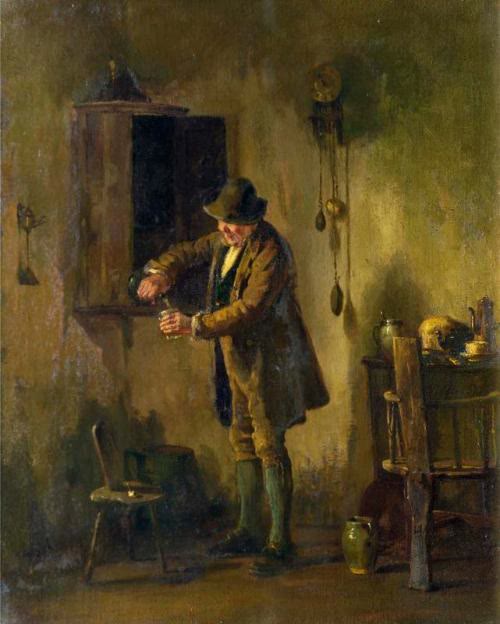
Is túisce deoch ná scéal: Interior of an Irish Cottage, an oil painting by Howard Helmick (died 1907). Aberdeen Art Gallery, public domain, via Wikimedia Commons
Irish proverbs about talk, silence and gossip
For a nation famous for talking, we have a lot of proverbs telling us to stop.
121. Is binn béal ina thost. (iss BEEN BAYL IN-uh HUST)
“A silent mouth is sweet.”
Silence is golden. O’Rahilly (number 29) gives this as the Connacht form.
122. Is minic a bhí ciúin ciontach. (iss MIN-ick uh VEE KYOON KYUN-tukh)
“The quiet one was often guilty.”
Watch the quiet ones.
123. Bíonn cluasa ar na claíocha. (BEEN KLOO-uh-suh er nuh KLEE-ukh-uh)
“The ditches have ears.”
Walls have ears. In rural Ireland, so do the hedges.
124. Is maith an coisí an bhréag. (iss MAH un KUSH-ee un VRAYG)
“A lie is a good walker.”
A lie travels far, and fast.
125. Níor bhris focal maith fiacail riamh. (neer VRISH FUK-ul MAH FEE-uh-kil REE-uv)
“A kind word never broke a tooth.”
A kind word costs nothing.
126. Éist mórán agus can beagán. (AYSHT MOH-rawn AG-us KON BYUG-awn)
“Listen a lot and say little.”
You learn more with your ears.
127. Tuigeann fear léinn leathfhocal. (TIG-un FAR LAYN LAH-uk-ul)
“A learned man understands half a word.”
A word to the wise is enough.
128. Is ciúin iad na linnte lána. (iss KYOON EE-ud nuh LIN-chuh LAW-nuh)
“Full pools are quiet.”
Still waters run deep.
129. An áit a mbíonn toit, bíonn tine. (un AWTCH uh MEEN TITCH, BEEN CHIN-uh)
“Where there’s smoke, there’s fire.”
Rumours usually start somewhere.
130. Is beag an rud a shalaíonn stocaí bána. (iss BYUG un RUD uh HAL-een STUK-ee BAW-nuh)
“It takes very little to dirty white stockings.”
A good name is easily stained.
131. Téann focal le gaoth ach téann buille le cnámh. (CHAYN FUK-ul leh GWAY okh CHAYN BWIL-uh leh KNAWV)
“A word goes with the wind but a blow goes to the bone.”
Actions speak louder than words.
132. Bíonn an fhírinne searbh. (BEEN un EER-in-yuh SHAR-uv)
“The truth is bitter.”
The truth can hurt. O’Rahilly (number 52) records a Waterford version that adds “said Cloch Labhrais, splitting”: a great boulder near Stradbally which, the story goes, burst apart when someone told a lie on it.
Irish proverbs about the weather, the land and the sea
A country of farmers and fishermen was always going to have plenty of these.
133. Ní hé lá na gaoithe lá na scolb. (nee HAY LAW nuh GWEE-huh LAW nuh SKUL-ub)
“The windy day isn’t the day for scollops.”
Fix the roof before the storm. Scollops are the bent rods that pin down thatch.
134. Is olc an ghaoth nach séideann do dhuine éigin. (iss ULK un GHWAY nokh SHAY-jun duh GHIN-uh AY-gin)
“It’s a bad wind that doesn’t blow for somebody.”
It’s an ill wind that blows nobody good.
135. Is maith an comharthaí an cat. (iss MAH un KOH-ur-hee un KOT)
“The cat is a good weather forecaster.”
Watch the cat and you’ll know what’s coming. Cheaper than Met Éireann. Cats, birds and luck crop up in plenty of old Irish superstitions too.
136. Is minic a bádh long láimh le cuan. (iss MIN-ick uh BAW LUNG LAWV leh KOO-un)
“Many a ship sank beside the harbour.”
Don’t celebrate too early.
137. Ní fhanann muir le fear sotail. (nee AN-un MWIR leh FAR SUT-il)
“The sea won’t wait for an arrogant man.”
Time and tide wait for no one.
138. Mol gort is ná mol geamhar. (MUL GURT iss naw MUL GYOW-ur)
“Praise the crop, not the young corn.”
Don’t count your chickens before they hatch.
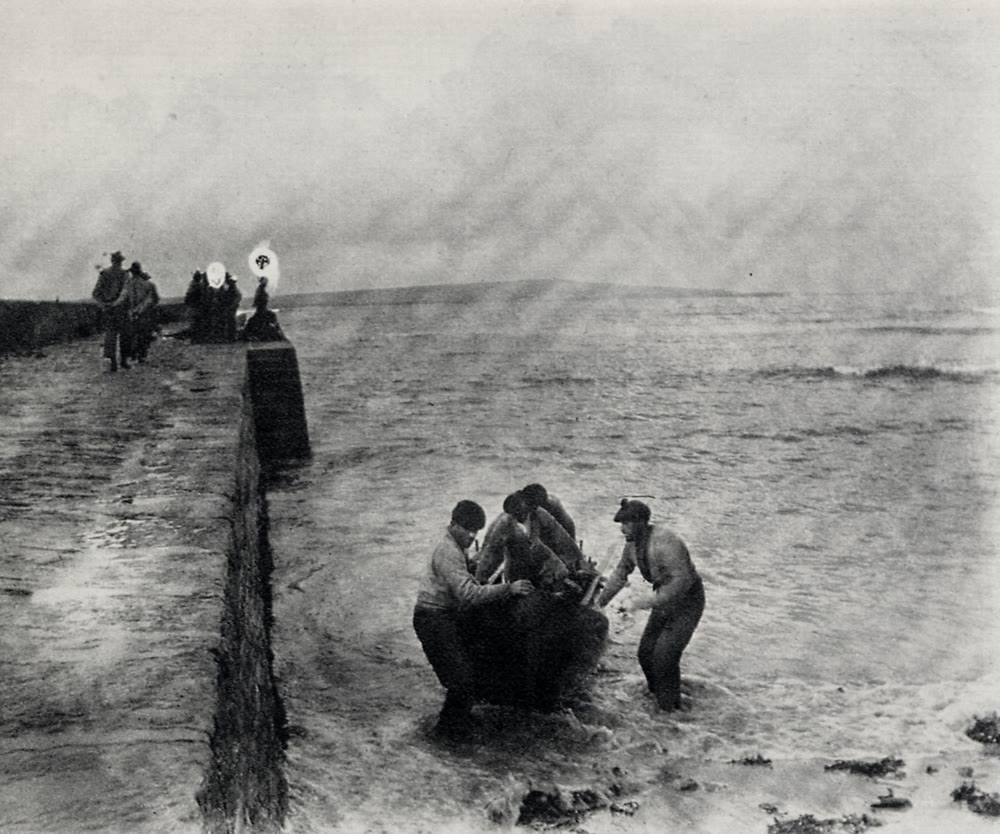
Bainfidh an fharraige a cuid féin amach: men bringing a currach ashore on the Aran Islands, photographed by J. M. Synge in 1898. Public domain, via Wikimedia Commons
139. Bainfidh an fharraige a cuid féin amach. (BWAN-hee un AR-ig-uh uh KIJ FAYN uh-MOKH)
“The sea will take its own share.”
A grim acceptance from fishing families.
140. Cothú na doininne soineann na hoíche. (KUH-hoo nuh DIN-in-yuh SIN-yun nuh HEE-huh)
“A calm night feeds the storm.”
The calm before the storm.
141. Is fearr suí ar an scáth ná suí ar an mblár folamh. (iss FAR SEE er un SKAW naw SEE er un MLAWR FUL-uv)
“Better to sit in the shelter than out on the bare field.”
Any shelter beats none, even a poor one.
Funny Irish proverbs
Our ancestors had a dry, sharp sense of humour. If you like your wisdom with a sting, try these alongside some old Irish curses.
142. Is maith an t-iománaí an fear ar an gclaí. (iss MAH un CHUM-aw-nee un FAR er un GLEE)
“The best hurler is the one sitting on the ditch.”
The loudest experts are always on the sideline.
143. Níl neart ar an mbás (ach pósadh arís). (neel NYART er un MAWSS, okh POH-suh uh-REESH)
“There’s no help for death (except to marry again).”
Life goes on. The bit in brackets is optional, depending on the company.
144. Más maith leat do mholadh, faigh bás. (mawss MAH lat duh WUL-uh, FY BAWSS)
“If you want to be praised, die.”
Nobody gets a good word until the funeral.
145. Ní bhíonn cóisir ar bith gan amadán. (nee VEEN KOH-shir er BIH gon OM-uh-dawn)
“There’s no party without a fool.”
If you can’t spot him, it might be you.
146. Cuir síoda ar ghabhar agus is gabhar i gcónaí é. (KIR SHEE-duh er GHOW-ur AG-us iss GOW-ur ih GOH-nee AY)
“Put silk on a goat and it’s still a goat.”
Fine clothes don’t change what’s underneath.
147. Is teann gach madra ag a dhoras féin. (iss CHOWN gokh MOD-ruh eg uh GHUR-us FAYN)
“Every dog is bold at its own door.”
Everyone is brave on home ground. See any county final.
148. Is fearr greim de choinín ná dhá ghreim de chat. (iss FAR GREM jeh KHUN-een naw GHAW YREM jeh KHOT)
“One bite of a rabbit is better than two bites of a cat.”
Quality beats quantity. I won’t ask how anyone found out.
149. Ní dhéanfadh an saol capall rása d’asal. (nee YAYN-hukh un SAYL KAP-ul RAW-suh DOSS-ul)
“The whole world couldn’t make a racehorse of a donkey.”
Some things can’t be changed.
150. Dearmad bhean an tí ag an gcat. (JAR-uh-mud VAN un CHEE eg un GOT)
“The woman of the house’s forgetting is the cat’s gain.”
Somebody always profits from a slip.
151. Ar mhaithe leis féin a bhíonn an cat ag crónán. (er WAH-huh lesh FAYN uh VEEN un KOT eg KROH-nawn)
“When the cat purrs, it’s purring for itself.”
Beware of flattery.
152. Mura mbeadh agat ach gabhar, bí i lár an aonaigh leis. (MUR-uh MAKH AG-ut okh GOW-ur, BEE ih LAWR un AY-nee lesh)
“Even if you’ve only a goat, stand in the middle of the fair with it.”
Be proud of what you have, however small.
153. Is minic a tháinig an magadh go leaba an dáiríre. (iss MIN-ick uh HAW-nig un MOG-uh guh LA-buh un DAWR-ee-ruh)
“The joke has often ended up in the bed of earnest.”
Many a true word is spoken in jest.
154. Más peaca a bheith buí, tá na mílte damanta. (mawss PAK-uh uh VEH BWEE, TAW nuh MEEL-chuh DOM-un-tuh)
“If a sallow face is a sin, thousands are damned.”
Looks don’t matter, or most of us would be in trouble. Source: focloir.ie.
155. Nuair a bhíonn an cat amuigh, bíonn an luch ag rince. (NOO-ur uh VEEN un KOT uh-MWIG, BEEN un LUKH eg RIN-kuh)
“When the cat is out, the mouse is dancing.”
When the cat’s away, the mice will play. Source: focloir.ie.
Irish triads: proverbs in threes
Irish loves things in threes, and O’Rahilly’s 1922 collection includes a run of proverbs built that way. I’ve given them in modern spelling, with rough respellings. They’re long, so take them a phrase at a time, and check single words on focloir.ie.
156. Trí nithe a bhíos geal ina dtosach, breac ina lár agus dubh ina ndeireadh: comhar, cleamhnas agus aontíos.
(TREE NIH-huh uh VEESS GAL IN-uh DUS-ukh, BRAK IN-uh LAWR AG-us DUV IN-uh NYER-uh: KOH-ur, KLOW-nus AG-us AYN-cheess)
“Three things that are bright at the start, speckled in the middle and black at the end: a farming partnership, a matchmade marriage and sharing a house.”
Every arrangement starts well. O’Rahilly’s number 237.
157. Trí nithe nach iontaoibh: lá breá sa gheimhreadh, saol duine chríonna nó focal duine mhóir gan scríbhinn.
(TREE NIH-huh nokh OON-teev: LAW BRAW suh YEV-ruh, SAYL DIN-uh HREE-nuh noh FUK-ul DIN-uh WOHR gon SHKREE-vin)
“Three things not to trust: a fine day in winter, the life of an old person or the word of an important man that isn’t in writing.”
Get it in writing. Number 244.
158. Trí nithe a bhaineas le hól: é a ól, é a iompar agus díol as.
(TREE NIH-huh uh WAN-us leh HOHL: AY uh OHL, AY uh UM-pur AG-us JEEL OSS)
“Three things that go with drink: drinking it, carrying it and paying for it.”
Number 242. The second one is the hard part.
159. Faobhar, gaoth agus grá: trí nithe nach bhfeictear go brách.
(FWAY-wur, GWAY AG-us GRAW: TREE NIH-huh nokh VECK-chur guh BRAWKH)
“An edge, the wind and love: three things never seen.”
You only know them by what they do. Number 268, and a lovely line for a wedding card.
160. Lá ó scoil, Domhnach ó Aifreann agus lá ó cheird: trí nithe nach féidir leo casadh go brách.
(LAW oh SKUL, DOW-nukh oh AF-run AG-us LAW oh HYAIRJ: TREE NIH-huh nokh FAY-jir LYOH KOSS-uh guh BRAWKH)
“A day away from school, a Sunday away from Mass and a day away from your trade: three things that can never come back.”
Lost time is lost for good. Number 253.
Irish proverbs for every occasion
Looking for one line for a card, a speech or a toast? These fit.
| Occasion | Proverb | Why it fits |
|---|---|---|
| Wedding speech | Ní heolas go haontíos No knowing someone until you live with them |
Warm, funny and true |
| Wedding or anniversary card | Giorraíonn beirt bóthar Two people shorten the road |
Life’s road feels shorter side by side |
| Love note | Faobhar, gaoth agus grá: trí nithe nach bhfeictear go brách An edge, the wind and love: three things never seen |
Love is never seen, only felt |
| Sympathy card | Ar scáth a chéile a mhaireann na daoine People live in each other’s shelter |
We shelter each other through grief |
| Eulogy | Is buaine bladh ná saol Fame lasts longer than life |
A good name outlives a life |
| Remembrance keepsake | Is beag an rud is buaine ná an duine Even a small thing outlasts a person |
A keepsake carries the memory on |
| Retirement | Molann an obair an saor The work praises the craftsman |
The work speaks for the worker |
| Birthday (later years) | Is minic duine liath lúfar A grey-haired person is often nimble |
Grey hair, quick feet |
| New job or graduation | Tús maith leath na hoibre A good start is half the work |
Wishes them a strong beginning |
| New home | Níl aon tinteán mar do thinteán féin There’s no hearth like your own hearth |
There’s no place like home |
| Going away or emigrating | Castar na daoine ar a chéile People meet each other |
People meet again; hills never do |
| Get well soon | Tosach sláinte codladh Sleep is the beginning of health |
Rest is where healing starts |
| Hard times | Níl tuile dá mhéad nach dtránn There’s no flood, however great, that doesn’t ebb |
This too shall pass |
| Coach or teacher | Mol an óige agus tiocfaidh sí Praise youth and it will come on |
Praise the young and they flourish |
| Friendship card | Aithnítear cara i gcruatan A friend is recognised in hardship |
A friend shows up in hard times |
| Toast | Is fearr an tsláinte ná na táinte Health is better than herds |
Health is better than wealth |
| Tattoo | Níor chaill fear an mhisnigh riamh The man of courage never lost |
Courage never loses (check the spelling first) |
Famous lines that aren’t really Irish proverbs
Plenty of lines shared as Irish proverbs are really something else: a poet’s line, a novelist’s quip, a blessing or a saying from another country. That doesn’t make them bad advice. It just means they aren’t seanfhocail. Here’s where some of the most shared ones really come from.
| Line shared as an “Irish proverb” | Where it really comes from |
|---|---|
| “Beware the fury of a patient man.” | John Dryden, the English poet, in Absalom and Achitophel (1681). |
| “I complained that I had no shoes until I met a man who had no feet.” | A story in the Gulistan (1258) by the Persian poet Saadi. |
| “There is only one thing in the world worse than being talked about…” | Oscar Wilde, The Picture of Dorian Gray (first published 1890). Irish, but a novelist’s line, not folk wisdom. |
| “There are no strangers here, only friends you haven’t yet met.” | Not Yeats, and not a proverb. A similar idea appears in a 1915 poem by the American Edgar Guest. |
| “It is better to light a candle than to curse the darkness.” | Made famous as the motto of The Christophers, an American Catholic group founded in 1945. Often called Chinese; not Irish. |
| “A calm sea never made a skilled sailor.” | An English proverb, usually given as “a smooth sea never made a skilful mariner”. I found no Irish original. |
| “Lose an hour in the morning and you’ll spend all day looking for it.” | Usually credited to Richard Whately, the English-born Archbishop of Dublin. No Irish-language original that I could find. |
| “May the road rise up to meet you.” | A blessing, not a proverb. The English verse first turns up in print in 1945 and 1946, called an old Irish prayer; only its first line has a documented history in Irish. |
| “A good friend is like a four-leaf clover: hard to find and lucky to have.” | Greeting-card verse, with no trace in the Irish collections. The shamrock has three leaves, anyway. |
Two more favourites, “It’s a lonely washing that has no man’s shirt in it” and “You’ll never plough a field by turning it over in your mind”, are shared everywhere as Irish, but I can’t find either in Ó Dónaill, O’Rahilly or Ó Muirgheasa. They may be genuine sayings recorded in Ireland, but I can’t call them seanfhocail until an older source turns up.
For dozens more famous lines checked against their sources, see my guide to famous Irish quotes and who really said them.
Using Irish proverbs today (and spelling mistakes to avoid)
People raise a glass with Is fearr an tsláinte ná na táinte, write Giorraíonn beirt bóthar in wedding cards and put Ar scáth a chéile a mhaireann na daoine in sympathy cards. Two modern mottos turn up everywhere too, so it’s worth knowing they’re new:
- Is fearr Gaeilge bhriste ná Béarla cliste (iss FAR GAYL-gyuh VRISH-chuh naw BAYR-luh KLISH-chuh), “broken Irish is better than clever English”, is a rhyming slogan used to encourage learners. Barack Obama quoted it, in English, at College Green in Dublin on 23 May 2011, just before trying out a line of Irish.
- Tír gan teanga, tír gan anam (CHEER gon CHANG-uh, CHEER gon AN-um), “a country without a language is a country without a soul”, is linked with Patrick Pearse and the Gaelic League, though I can’t find its exact source.
Before you print, engrave or tattoo any Irish, check the spelling. A missing fada (the accent mark) or a missing h can change a word or break the grammar. These mistakes all appear on popular websites, and some have been copied into AI answers:
| Often seen online | Correct | Why |
|---|---|---|
| Is fearr Gaeilge briste ná Béarla clíste | Is fearr Gaeilge bhriste ná Béarla cliste | Gaeilge is feminine, so briste takes an h; cliste has no fada |
| Is fearr an sláinte | Is fearr an tsláinte | After an, a feminine noun starting with s plus a vowel, l, n or r takes a t (an tsláinte, but an scoil) |
| Fillean an feall | Filleann an feall | The verb “returns” has a double n |
| Is búaine | Is buaine | No fada on the u |
| Buail an iarann te | Buail an t-iarann te | Iarann is masculine and starts with a vowel, so it takes t- |
| Níl uasak ná íseal | uasal | A simple typo, but it’s on a lot of quote cards |
| eiroidh | éireoidh | “Will rise” needs its fada and its second e |
| bhíónn | bhíonn | Only one fada, on the i |
| Ni bhíonn | Ní bhíonn | Ní (“not”) always has its fada |
| bíonn an ciall amuigh | bíonn an chiall amuigh | Ciall (sense) is feminine, so it takes an h after an |
For a tattoo, copy the Irish from a dictionary such as teanglann.ie or focloir.ie, not from a quote card or an online translator, and ask a fluent speaker to check it before the needle comes out.
Where Irish proverbs come from
The Irish word for a proverb is seanfhocal (SHAN-uk-ul), from sean (old) and focal (word). The plural is seanfhocail (SHAN-uk-il).
Nobody wrote most of them. They were passed down by word of mouth, in Irish, for centuries. We have them because a handful of people wrote them down.
T. F. O’Rahilly, A Miscellany of Irish Proverbs (1922). Its core is a set of proverbs noted by the scribe Mícheál Óg Ó Longáin around 1800. O’Rahilly added more from a thousand years of earlier writing, numbered them up to 418 and translated each one. He wrote that native speakers drew on proverbs to “clench an argument or drive home an opinion”, and he quotes Ní sáraítear an seanfhocal: nothing can beat a proverb. The book is free on archive.org.
O’Rahilly is refreshingly honest. He thought that most proverbs shared by Irish and English were probably borrowed from English, and that some go back to Latin. But he also traced some astonishingly old ones. “Old debts are better than old grudges” appears among sayings attributed to Flann Fína, the Irish name of Aldfrith, a seventh-century king of Northumbria who had an Irish mother. “Bare is the shoulder without a brother” is quoted in the Annals of the Four Masters under 1583. And Is giorra deoch ná scéal, an older form of “a drink comes before a story”, turns up in the verse of Dáibhí Ó Bruadair around 1663.
Énrí Ó Muirgheasa, Seanfhocla Uladh (1907). A big collection of Ulster proverbs, published in Dublin by the Gaelic League, with English translations and notes. It’s free on archive.org too. Before it, Robert Shipboy MacAdam printed some 600 Ulster proverbs in Irish in instalments in the Ulster Journal of Archaeology, which he edited until 1862.
Later collections. An Seabhac’s Seanfhocail na Muimhneach (1926) gathered Munster proverbs, and Tomás S. Ó Máille’s Seanfhocla Chonnacht (two volumes, 1948 and 1952) did the same for Connacht. Cois Life reissued Ó Máille in one volume in 2010, edited by Donla uí Bhraonáin. Both are still in copyright, so I cite them rather than quote them.
Scotland. Scottish Gaelic shares many of the same proverbs. Alexander Nicolson’s Collection of Gaelic Proverbs and Familiar Phrases (1881) is the classic source, and its 1882 second edition is free on archive.org. Nicolson often gives the Irish form alongside the Scottish one. O’Rahilly reckoned that a native proverb found in both Ireland and Scotland is at least 300 years old, which is why “Irish proverbs” and “Gaelic proverbs” overlap so much.
Find proverbs from your family’s county
This is the part I’d love every reader with Irish roots to try. In 1937 to 1939, schoolchildren across the 26 counties wrote down the folklore of their own townlands for the Irish Folklore Commission, and proverbs were one of the topics. Their copybooks, known as the Schools’ Collection, are now kept in the National Folklore Collection at University College Dublin. In 2017 UNESCO added the Irish Folklore Commission’s collection, 1935 to 1970, to its Memory of the World Register.
You can search the whole lot free on dúchas.ie. Browse by county and parish, look for the proverbs (seanfhocail) pages, and you’ll see the child’s name, the school and often the neighbour or grandparent who told them. Some pages are in Irish, some in English. Your own great-grandparent’s handwriting might be in there.
Irish proverbs FAQ
What is the Irish word for proverb?
Seanfhocal, pronounced SHAN-uk-ul, from sean (old) and focal (word). The plural is seanfhocail (SHAN-uk-il). An Irish proverb is literally an “old word”, wisdom handed down so long that nobody remembers who said it first.
What is the most famous Irish proverb?
Probably Ar scáth a chéile a mhaireann na daoine, “people live in each other’s shelter”, meaning we all depend on one another. Close behind are Is fearr an tsláinte ná na táinte (health is better than wealth) and Tús maith leath na hoibre (a good start is half the work).
What are some ancient Irish proverbs?
Is fearr seanfhiacha ná seanfhala (old debts are better than old grudges) is linked with a seventh-century king, and Is maol gualainn gan bhráthair (bare is the shoulder without a brother) appears in the Annals of the Four Masters under 1583. Most others are old but impossible to date, because they lived by word of mouth.
What is an Irish proverb about life?
Is ait an mac an saol means “life is strange”. Is maith an scéalaí an aimsir, “time is a good storyteller”, means time will tell. And Ní bhíonn uasal ná íseal ach thuas seal is thíos seal says everyone has their ups and downs.
What is an Irish proverb for hard times or strength?
Try Níl tuile dá mhéad nach dtránn: there’s no flood, however great, that doesn’t ebb. For courage, Níor chaill fear an mhisnigh riamh means “the man of courage never lost” (focloir.ie also gives bean, woman). For hanging on through a bad stretch, Mair, a chapaill, agus gheobhaidh tú féar: live, horse, and you’ll get grass.
What do the Irish say when someone dies?
The most common phrase is Ar dheis Dé go raibh a anam, “may his soul be at God’s right hand” (a hanam for a woman). People also say the person has gone ar shlí na fírinne, “on the way of truth”. Proverbs about death include Níl luibh ná leigheas in aghaidh an bháis: there’s no herb or cure against death.
What is the famous Irish proverb about alcohol?
Sceitheann fíon fírinne, “wine spills the truth”, is the best known. Is túisce deoch ná scéal, “a drink comes before a story”, is the hospitable one: offer a visitor a drink before you ask for the news. Most old drink proverbs are warnings, not toasts.
What do the Irish say when drinking?
The everyday toast is Sláinte (SLAWN-chuh), “health”, or Sláinte mhaith (SLAWN-chuh WAH), “good health”. When a visitor walks in, the old rule is Is túisce deoch ná scéal: the drink comes before the news. For longer toasts, see my Irish toasts for every occasion.
What is the best Irish proverb about friendship?
Aithnítear cara i gcruatan, “a friend is recognised in hardship”, the Irish version of a friend in need is a friend indeed. For a card, Giorraíonn beirt bóthar, “two people shorten the road”, is hard to beat.
What is a good Irish proverb for a wedding?
For a card, Giorraíonn beirt bóthar (two people shorten the road). For a speech with a laugh, Ní heolas go haontíos (there’s no knowing someone until you live together). For something romantic, the old triad Faobhar, gaoth agus grá: an edge, the wind and love are never seen.
Are Irish proverbs and Gaelic proverbs the same?
Mostly. “Gaelic” can mean Irish or Scottish Gaelic, and the two languages share many proverbs, often with small differences in spelling. O’Rahilly gives Scottish versions for many Irish ones. Here’s more on Irish and Scottish Gaelic.
Is “May the road rise up to meet you” a proverb?
No, it’s a blessing, and the English verse is only traced back to the 1940s. Blessings wish someone well; proverbs give advice or state a truth. Here’s my guide to what “May the road rise up to meet you” means and where it really comes from.
Is “broken Irish is better than clever English” an old proverb?
No. Is fearr Gaeilge bhriste ná Béarla cliste is a modern rhyming motto used to encourage learners. Barack Obama quoted it in English in his Dublin speech in 2011.
What is the Irish for “health is wealth”?
Is fearr an tsláinte ná na táinte, said “iss FAR un TLAWN-chuh naw nuh TAWN-chuh”. It means health is better than wealth. Táinte literally means herds of cattle, which is what wealth meant in old Ireland.
Love this? Save it to your Pinterest board for later.
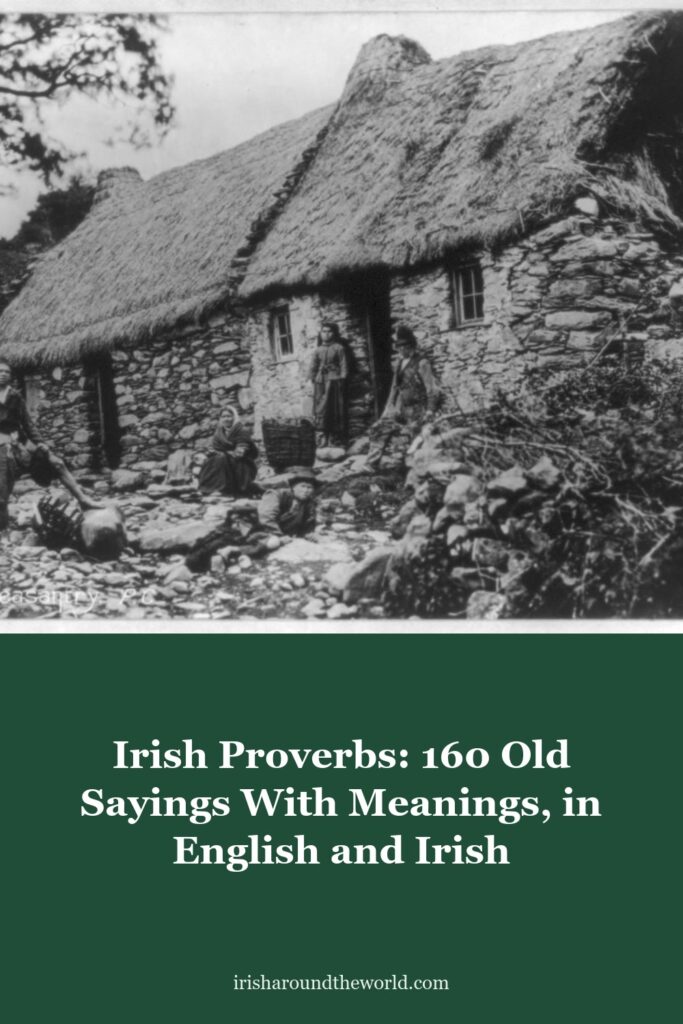
Pin image: A family outside a thatched stone cottage in Ireland, an old print that Wikimedia Commons dates to about 1880. Library of Congress, public domain, via Wikimedia Commons
A little bit of Ireland in your inbox every Friday ☘️
The free Weekly Dose of Irish: an Irish joke, a Celtic symbol, an Irish fact, a poem and the week’s best articles in one short email. Join 9,600+ readers.
Free. One short email every Friday. Unsubscribe any time.
More Irish sayings and language
- 125 Irish Sayings and Blessings for Every Occasion
- 63 Irish Toasts for Every Occasion, and Which Ones Are Really Irish
- Irish Sayings About Love: Phrases, Blessings and Quotes in Irish
- Irish Quotes: 50 Famous Lines and Who Really Said Them
- Old Irish Curses: Cursing Stones, the Widow’s Curse and ‘May the Cat Eat You’
- Irish Funeral Blessings and Prayers: Words of Comfort in English and Irish
- Anam Cara Meaning: How Ireland’s Soul Friend Went From Confessor to Soulmate
Featured image: A family outside a thatched stone cottage in Ireland, an old print that Wikimedia Commons dates to about 1880. Library of Congress, public domain, via Wikimedia Commons.
Lorraine Taggart Measor
Sunday 5th of February 2023
I like dont chew your cabbage twice! My favorite growing up!
Irish Around The World
Thursday 9th of February 2023
No that is a good one!
Patrick McCusker
Saturday 4th of February 2023
One of my favorite Irish Proverbs is:
Irish diplomacy is the ability to tell a man to go to hell so he looks forward to the trip!
Irish Around The World
Thursday 9th of February 2023
Good one!
MAX MOHAN
Saturday 19th of November 2022
LOVE THEM ALL! Attended a boarding school in India run by Irish Catholic brothers. That makes me an honorary Irish!?
Irish Around The World
Sunday 20th of November 2022
Indeed it does, Max! :)
Ellen Lyons-White
Friday 25th of February 2022
I love all the Irish proverbs. I miss hearing my mother's voice, a very Irish Clare accent, she never lost it, lived in England a long time. One thing she used to say was of money.... "you can't have it and spend it" I've never heard anyone else say that!
Irish Around The World
Sunday 27th of February 2022
She was very wise!
Deborah Dolan
Friday 25th of February 2022
My favorite is "It's a lonely washing that has no mans shirt in it" Beautiful thank you Stephen.
Irish Around The World
Sunday 27th of February 2022
Yes, that is one of my favourites as well. Glad you enjoyed it.