An Irish blessing is a short spoken wish for someone’s good, usually calling on God: for a journey, a new home, a baby, a meal, a birthday or the dead. The Irish word is beannacht (BAN-ukht). The most famous, “May the road rise up to meet you”, is an English verse first found in print in 1945, and only its first line, Go n-éirí an bóthar leat, is a documented Irish saying. Below are 100 Irish blessings in English and Irish, each labelled with where it really comes from. Find one for your occasion.
Walk into a farmhouse kitchen almost anywhere in Ireland a hundred years ago and you wouldn’t say hello. You’d say “God save all here”, and whoever sat by the fire would answer “God save you kindly”.
Blessings were everywhere in that world. People blessed a baby as they praised it, and blessed a neighbour’s work, a sneeze, a meal, a journey and the dead. Most of those blessings were in Irish, and many are still said today.
Then there are the blessings on plaques and cards, plenty of them written in English in the 20th century, often in America, by someone nobody remembers. That doesn’t make them less precious. But you deserve to know which is which, so every blessing below carries a label:
- TRADITIONAL IRISH: in the Irish language, and found in a standard dictionary, a folklore collection or an old manuscript.
- TRADITIONAL: in English, and written down from Irish people, mostly between the 1880s and the 1930s.
- MODERN: verse in the Irish style, or a modern greeting, first found in print in the 1800s or 1900s. I give the earliest printing I could find.
- NOT IRISH IN ORIGIN: much loved in Ireland, but it came from Latin, England or Scotland.
Unless I say otherwise, the Irish comes from Niall Ó Dónaill’s Foclóir Gaeilge-Béarla (1977), the standard Irish-English dictionary, free to search on teanglann.ie, or from focloir.ie, the modern English-Irish dictionary. There’s a key to the pronunciations below.
Jump to:
- The 10 most famous Irish blessings
- Find a blessing for your occasion
- Short Irish blessings for cards and texts
- Irish blessings in Gaelic (Irish), with pronunciation
- Irish blessings for family and home
- Irish blessings for friends
- Irish blessings for a new baby
- Irish blessings for travel, farewells and family far away
- Irish blessings for luck, work and new beginnings
- Irish blessings for health, strength and protection
- Christmas, weddings, birthdays, St Patrick’s Day, grace and sympathy
- Funny Irish blessings (and blessings with a sting)
- Famous “Irish blessings” that aren’t what they seem
- Where traditional Irish blessings really come from
- Using an Irish blessing: cards, prints and tattoos
- Irish blessings FAQ
- More Irish blessings
The 10 most famous Irish blessings
These are the blessings people search for, say and print most, plus the everyday Irish ones you’d actually hear in Ireland. Two of the ten are younger than you might think.
- May the road rise up to meet you
May the road rise up to meet you.
May the wind be always at your back.
May the sun shine warm upon your face,
and the rains fall soft upon your fields.
And until we meet again,
may God hold you in the palm of His hand.
The best-loved Irish blessing in the world. Only the first line has an Irish history (number 2); the verse is anonymous. The earliest printing found is a four-line version that the New York politician Paul E. Fitzpatrick called “this simple, very old-fashioned Irish prayer” on St Patrick’s Day radio, printed in the US Congressional Record on 22 March 1945. Here’s where “May the road rise up to meet you” really comes from, line by line.
MODERN: author unknown; earliest print 1945, USA. - Go n-éirí an bóthar leat (guh NYE-ree un BOH-har lat)
“May the road rise with you”: may your journey go well.
The real Irish behind number 1. Éirigh le means “succeed”, so it wishes you a road that goes well, not one that climbs: Ó Dónaill gives D’éirigh a bhóthar leis, “he prospered on his way”. In the 1930s, Co. Cork schoolchildren recorded it as the old people’s prayer for a journey, and it turns up in a Mayo folktale too. In Munster the stress moves: guh nye-REE.
You’ll find the whole six-line verse “in Gaelic” on cards, tattoos and plenty of websites. Those are modern translations of the English. No Irish original of the full verse has been found; only this first line is an old Irish saying. If you want Irish on a card, use this line, or number 48 or 49.
TRADITIONAL IRISH: Schools’ Collection (1937 to 1939); Ó Dónaill (1977). - Dia duit (JEE-uh ditch), answered Dia is Muire duit (JEE-uh iss MWIR-uh ditch)
“God to you” and “God and Mary to you”: hello, God save you.
The everyday Irish hello is a blessing, short for Go mbeannaí Dia duit, “may God bless you”. It’s often written and said Dia dhuit (JEE-uh gwitch); to more than one person, it’s daoibh (DEEV). More in my guide to Irish greetings.
TRADITIONAL IRISH: Ó Dónaill (1977). - Bail ó Dhia ort (bal-yoh YEE-uh urt)
“Prosperity from God on you”: God bless you.
Said in greeting, in praise and as warm thanks. To two or more people, it’s Bail ó Dhia oraibh (OR-iv). In Ardpatrick, Co. Limerick, a teacher told the Schools’ Collection in the 1930s that people said it to each other and blessed their animals too, partly to guard against ill wishes.
TRADITIONAL IRISH: Ó Dónaill (1977); focloir.ie; Schools’ Collection. - Mo sheacht mbeannacht ort (muh HYAKHT MAN-ukht urt)
“My seven blessings on you”
Said in praise (Ó Dónaill translates it “Bravo! Good for you!”), or with leat (lat) as a farewell: “my blessings go with you”. In Irish, seven can simply mean “ever so much”, and this is the most likely source of the “seven Irish blessings” (see the FAQ).
TRADITIONAL IRISH: Ó Dónaill (1977). - God save all here, or God bless all here
Said from the doorway as you walked into a house, and answered “God save you kindly”, where kindly meant “the same to you”. P. W. Joyce wrote in 1910 that it was used all over Ireland except the far north. In Co. Meath in 1938, a road-worker gave a schoolgirl “God bless all in here”, answered “God and Mary bless you”. The Irish is number 31.
TRADITIONAL: P. W. Joyce (1910); Schools’ Collection. - Christ with me, Christ before me
Christ with me, Christ before me, Christ behind me,
Christ in me, Christ beneath me, Christ above me,
Christ on my right, Christ on my left,
Christ when I lie down, Christ when I sit down, Christ when I arise,
Christ in the heart of every man who thinks of me,
Christ in the mouth of every one who speaks of me,
Christ in every eye that sees me,
Christ in every ear that hears me.
From St Patrick’s Breastplate, or The Deer’s Cry: legend says Patrick sang it when King Lóegaire’s men lay in ambush, and all they saw pass were wild deer. Kuno Meyer, who printed this translation in 1911 (adapting Whitley Stokes and John Strachan’s), judged that in its surviving form it could not be earlier than the eighth century, so it’s credited to Patrick rather than proved to be his.
TRADITIONAL IRISH: Old Irish hymn; translation by Stokes and Strachan, as revised by Kuno Meyer (1911). - May you be in heaven half an hour before the devil knows you’re dead
The cheekiest Irish blessing, usually a toast. It has always been called Irish, but the earliest printings found by the quotation researcher Barry Popik are American. In 1869 the soul got “a fortnight” in glory in one book and “three weeks” in a Boston paper, which already called it “a benediction from your Emerald Isle”; by 1879 it was six months. “Half an hour”, the version you’ll see today, doesn’t turn up in Popik’s list until 1998. There are dozens more in my Irish toasts.
MODERN: toast credited to the Irish; first printed 1869, USA. - Go mbeirimid beo ar an am seo arís (guh MER-im-id byoh er un AWM shuh uh-REESH)
“May we be alive at this time again”
The loveliest thing to say at Christmas, New Year, a birthday or any gathering: may we all be here this time next year. In Connacht you’ll hear Go mbeire muid beo (guh MER-uh mwid byoh).
TRADITIONAL IRISH: Ó Dónaill (1977). - Ar dheis Dé go raibh a anam (er yesh JAY guh rev uh AN-um)
“May his soul be at God’s right hand”
The Irish for “may he rest in peace”. For a woman it’s a hanam (uh HAN-um), and for more than one person a n-anamacha (uh NAN-um-ukh-uh). Many add dílis (JEE-lish), “faithful, dear”: a anam dílis, a hanam dílis, and for more than one person a n-anamacha dílse (JEEL-shuh).
TRADITIONAL IRISH: Ó Dónaill (1977); RIP.ie.
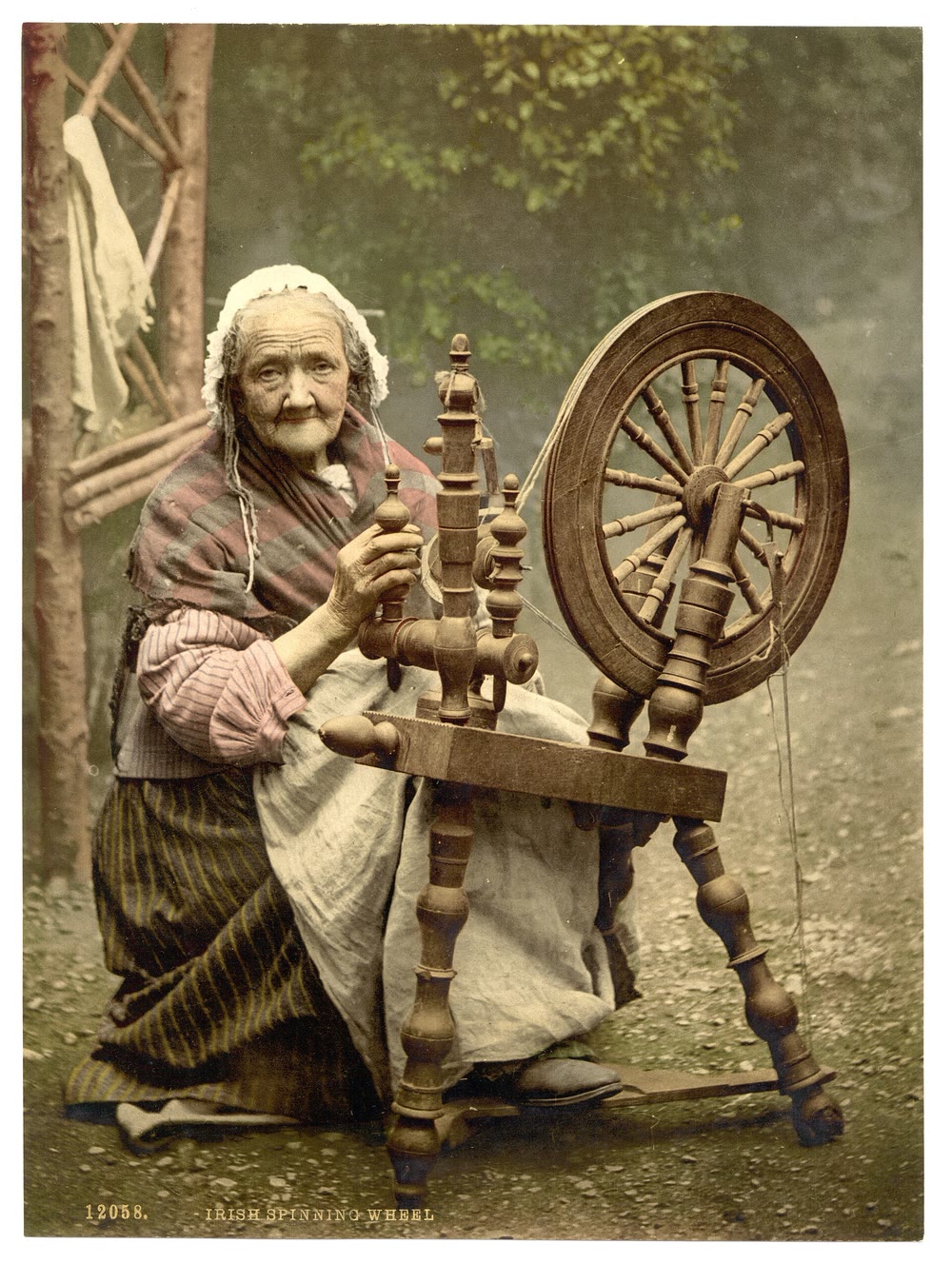
An older woman at her spinning wheel in Co. Galway, in a photochrom print from the 1890s. Library of Congress, public domain, via Wikimedia Commons
Find a blessing for your occasion
Pick a line, then jump to its section for the pronunciation and more choices.
| Occasion | A short blessing | In Irish |
|---|---|---|
| Christmas card | May we all be here this time next year | Go mbeirimid beo ar an am seo arís |
| New Year | A prosperous New Year to you | Athbhliain faoi mhaise duit |
| Birthday | Many happy returns | Go maire tú an lá |
| New baby | God grant him (her) long life | Go saolaí Dia é (í) |
| Wedding | May you enjoy your new life | Go maire sibh bhur saol nua |
| Anniversary | May you be ever thus | Go raibh sibh riamh amhlaidh |
| New home | May you be lucky in your new home | Go n-éirí bhur n-imirce libh |
| A journey | Safe journey | Go dté tú slán |
| Family far away | God keep him, wherever he is | Slán beo leis, cibé áit a bhfuil sé |
| Exam or interview | May it go well for you | Go n-éirí leat |
| New job or retirement | Every success to you from now on | Gach rath ort amach anseo |
| Thank you | May God increase your store | Go méadaí Dia do stór |
| Get well | God grant you health | Go lige Dia do shláinte leat |
| Sympathy card | May his (her) soul be at God’s right hand | Ar dheis Dé go raibh a anam (a hanam) |
| A toast | Health and long life to you | Sláinte agus saol chugat |
| St Patrick’s Day | St Patrick’s Day blessings on you all | Beannachtaí na Féile Pádraig oraibh |
| Before a meal | Bless us, O God, bless our food and drink | Beannaigh sinn, a Dhia, beannaigh ár mbia is ár ndeoch |
| Signing off to a friend | A farewell and a blessing | Slán agus beannacht |
Short Irish blessings for cards and texts
A card, a text or a toast only needs one line. These are short, genuine and easy to say.
- Beannacht Dé ort: God bless you
- Slán abhaile: safe home
- Go n-éirí leat: good luck
- God mark you with His Holy Grace
- Go maire tú!: long life to you
- Sláinte agus saol chugat: health and long life to you
- Beir bua agus beannacht: my best wishes
- Go gcumhdaí Dia thú: may God keep you
- Rath Dé ort: God prosper you
- God raise a friend for you
11. Beannacht Dé ort (BAN-ukht JAY urt)
“God’s blessing on you”: God bless you.
To someone setting off, say Beannacht Dé leat (lat), “God speed you”. Ó Dónaill even records a teasing use: Beannacht Dé ort, ní raibh mé ach ag magadh, “bless your innocence, I was only joking”.
TRADITIONAL IRISH: Ó Dónaill (1977).
12. Slán abhaile (slawn uh-WAL-yuh)
“Safe home”
Still said every night at the pub door and the end of a family visit. Slán means safe and sound, so every Irish goodbye is a small wish for safety.
TRADITIONAL IRISH: Ó Dónaill (1977); focloir.ie.
13. Go n-éirí leat (guh NYE-ree lat; to a group, libh, liv)
“May it go well with you”: good luck.
For exams, interviews and driving tests. It’s the road blessing without the road.
TRADITIONAL IRISH: focloir.ie; Ó Dónaill (1977).
14. God mark you with His Holy Grace.
Written down simply as “A blessing” by Maureen Walker of Gallow school, Co. Meath, on 13 June 1938. Beautiful in a christening or confirmation card.
TRADITIONAL: Schools’ Collection, Co. Meath (1938).
15. Go maire tú! (guh MAR-uh too)
“May you live!”: long life to you, congratulations.
The polite reply is Go maire tú do shláinte (duh HLAWN-chuh), “may you enjoy good health”.
TRADITIONAL IRISH: Ó Dónaill (1977).
16. Sláinte agus saol chugat (SLAWN-chuh AG-us SEEL HUG-ut)
“Health and long life to you”
To a couple or a group, say chugaibh (HUG-iv). For a quick toast, just Sláinte! or Sláinte mhaith! (SLAWN-chuh WAH), “good health”.
TRADITIONAL IRISH: Ó Dónaill (1977); focloir.ie.
17. Beir bua agus beannacht (ber BOO-uh AG-us BAN-ukht)
“Victory and blessing”
Ó Dónaill translates it “I send you my best wishes”. A fine sign-off for a card or a letter.
TRADITIONAL IRISH: Ó Dónaill (1977).
18. Go gcumhdaí Dia thú (guh GOO-dee JEE-uh hoo)
“May God keep you”
To more than one person, say sibh (shiv) instead of thú. For the whole family, Dia ár gcumhdach (JEE-uh awr GOO-dukh), “God protect us”.
TRADITIONAL IRISH: Ó Dónaill (1977), which prints the sibh form.
19. Rath Dé ort (rah JAY urt)
“God’s prosperity on you”: God prosper you.
The fuller form is Go gcuire Dia an rath ort (guh GWIR-uh JEE-uh un RAH urt).
TRADITIONAL IRISH: Ó Dónaill (1977).
20. God raise a friend for you.
Said to a person in trouble, and written down at Gallow, Co. Meath, in 1938. Exactly what you’d wish anyone going through a hard time.
TRADITIONAL: Schools’ Collection, Co. Meath (1938).
Irish blessings in Gaelic (Irish), with pronunciation
Everyday Irish is full of blessings. In 1910 the scholar P. W. Joyce wrote that most everyday greetings in Irish English were translations of them; his book, English As We Speak It in Ireland, is free on archive.org.
Irish or Gaelic? In Ireland the language is called Irish, or Gaeilge (GAYL-gyuh). “Gaelic” is fine, especially in America, but it can also mean Scottish Gaelic, a sister language with its own spellings. More in my guide to Irish and Scottish Gaelic.
How to read the pronunciations:
- CAPITALS show the stress, usually on the first syllable. Munster Irish often moves it later.
- Dia (God) and Dé (of God) start with a sound close to English “j”: JEE-uh, JAY. In Munster it’s lighter, nearer DEE-uh.
- “kh” is the throaty sound in Scottish “loch”. “uh” is a quick vowel, like the “a” in “about”.
- bh and mh sound like “v” or “w”; th and sh like “h”; dh and gh like a soft “y” or “g”.
- ao is “ee” in Connacht and Ulster and “ay” in Munster, so saol (life) is SEEL or SAYL. I’ve used “ee”.
- A letter added at the front changes the sound: in mbeannacht you say the m, not the b (MAN-ukht).
To hear a native speaker, look the word up on focloir.ie, which has recordings in all three main dialects.
21. Go mbeannaí Dia duit (guh MAN-ee JEE-uh ditch)
“May God bless you”
The full, formal form of Dia duit. Joyce said the Irish-English greeting “God bless you” was its translation.
TRADITIONAL IRISH: Ó Dónaill (1977); Joyce (1910).
22. Dia linn (JEE-uh LEEN; in Ulster, lin)
“God (be) with us”
What you say when someone sneezes. Dia leat (JEE-uh lat), “God with you”, is also a warm thank-you: focloir.ie gives Dia leat, a thaisce!, “bless you, dear!”
TRADITIONAL IRISH: focloir.ie; Ó Dónaill (1977).
23. Dia idir sinn agus an anachain (JEE-uh ID-ir SHEEN AG-us un AN-ukh-in)
“God between us and all harm”
Said on hearing bad news or any talk of danger. Joyce called the English version, “The Lord between us and harm!”, a very common exclamation in case of danger, and wrote that nearly all such pious sayings in Irish English were direct translations from Irish.
TRADITIONAL IRISH: Ó Dónaill (1977); Joyce (1910).
24. Go bhfóire Dia orainn (guh WOH-ruh JEE-uh OR-in)
“God help us”
Also said in pity: “that poor woman, God help her”. Joyce found “God help us” “continually in the mouths of the people”.
TRADITIONAL IRISH: Ó Dónaill (1977); Joyce (1910).
25. Go méadaí Dia do stór (guh MAY-dee JEE-uh duh STORE)
“May God increase your store”
Thanks to someone who has fed you or helped you. A perfect thank-you to a host.
TRADITIONAL IRISH: Ó Dónaill (1977).
26. Go gcúití Dia leat é (guh GOO-chee JEE-uh lat AY)
“May God reward you for it”
For a kindness too big for a plain thank-you.
TRADITIONAL IRISH: Ó Dónaill (1977).
27. Go bhfága Dia do shláinte agat (guh WAW-guh JEE-uh duh HLAWN-chuh AG-ut)
“May God leave you your health”
An old thank-you, handy for whoever buys the round.
TRADITIONAL IRISH: Ó Dónaill (1977); focloir.ie.
28. Nár lagaí Dia thú (nawr LAG-ee JEE-uh hoo)
“May God not weaken you”: more power to you!
Said to someone doing a hard job well, or as thanks. You’ll often see Nár laga Dia do lámh (duh LAWV), “may God not weaken your hand”. More in my guide to thank you in Irish.
TRADITIONAL IRISH: Ó Dónaill (1977); focloir.ie.
29. Go ndéana a mhaith duit (guh NAY-nuh uh WAH ditch)
“May it do you good”
A kindly reply when someone thanks you, especially for food or drink.
TRADITIONAL IRISH: focloir.ie.
The same blessing in Irish English: God save you
30. God save you. Reply: God save you kindly.
Joyce called it “the commonest of all our salutes”. He also wrote that “The top of the morning to you” was used everywhere, north and south. It sounds stage-Irish now, but it was real.
TRADITIONAL: Joyce (1910).
Irish blessings for family and home
The Irish home was blessed at the door, at the fire and at bedtime.
31. Dia anseo, sa teach (JEE-uh un-SHUH, suh CHAKH)
“God here, in the house”: God bless all here.
The Irish of number 6, said as you step inside. Fuller: Go mbeannaí Dia anseo (guh MAN-ee JEE-uh un-SHUH).
TRADITIONAL IRISH: Ó Dónaill (1977).
32. Céad míle fáilte (KAYD MEE-luh FAWL-chuh)
“A hundred thousand welcomes”
Joyce called it “universal in Ireland as a salute”. Lovely over a door; just keep all three fadas, the accent marks.
TRADITIONAL IRISH: Ó Dónaill (1977); Joyce (1910).
33. May Brigid bless the house
May Brigid bless the house wherein you dwell,
Bless every fireside, every wall and floor,
Bless every heart that beats beneath the roof,
And every tongue and mind for evermore.
Bless every hand that toils to bring it joy,
And every foot that walks its portals through.
This is my wish today, my constant prayer:
May Saint Brigid bless the house that shelters you.
Written down as an “Old Prayer” at Ballinakill, Co. Laois, for the Schools’ Collection in the 1930s. Shorter versions on cards drop two lines; the author is unknown. A favourite on St Brigid’s Day, 1 February.
TRADITIONAL: Schools’ Collection, Co. Laois (1930s).
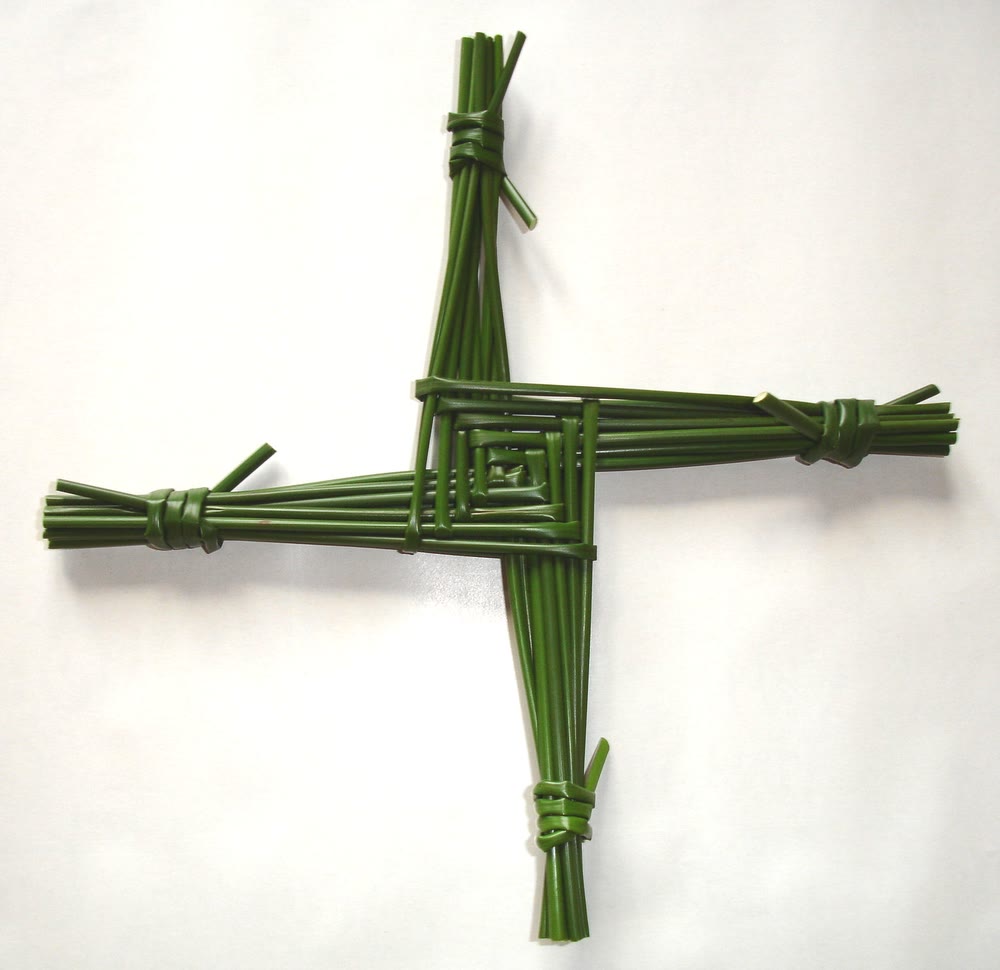
A St Brigid’s cross made from rushes from County Down. Photo: Culnacreann, CC BY 3.0, via Wikimedia Commons
34. As I save this fire
As I save this fire to-night
Even so may Christ save me,
On the top of the house let Mary,
Let Bride in its middle be.
Let eight of the mightiest angels
Round the throne of the Trinity
Protect this house and its people
Till the dawn of the day shall be.
At bedtime every house “saved” (raked) the fire, burying live coals under the ashes for the morning. Douglas Hyde, later Ireland’s first President, wrote in 1906 that a prayer went with it wherever Irish was still spoken. This one is from Inis Meáin in the Aran Islands, and in Irish it opens Coiglím an tine seo (KIG-leem un CHIN-uh shuh), “I save this fire”.
TRADITIONAL IRISH: Douglas Hyde, The Religious Songs of Connacht (1906), his translation.
35. Codladh sámh duit (KUL-uh SAWV ditch)
“Sound sleep to you”: may you sleep well.
For a child at bedtime, or a goodnight text to anyone you love.
TRADITIONAL IRISH: Ó Dónaill (1977).
36. I lie down with God
I lie down with God, and may God lie down with me,
The Heart of God with me, the two hands of God with me,
Jesus and Mary with me, and the Court of the Angels.
The opening of a night prayer that Father Eugene O’Growney, the Irish-language pioneer, found in the Aran Islands.
TRADITIONAL IRISH: Hyde (1906), his translation.
37. May Thy holy angels
May Thy holy angels, O Christ, son of living God,
Guard our sleep, our rest, our shining bed.
The opening of “An Even-Song”, headed “Patrick sang this”. Kuno Meyer, who translated it in 1911, noted that “though ascribed to Patrick, the piece cannot be older than the tenth century”. Gorgeous on a nursery wall.
TRADITIONAL IRISH: medieval Irish, translated by Kuno Meyer (1911).
38. Go n-éirí bhur n-imirce libh (guh NYE-ree vur NIM-ir-kuh liv)
“May your move go well with you”: may you be lucky in your new home.
For people moving house, or emigrating: imirce means both. To one person, Go n-éirí d’imirce leat (JIM-ir-kuh lat).
TRADITIONAL IRISH: Ó Dónaill (1977); the one-person form follows regular grammar.
39. Bless the four corners of this house
Bless the four corners of this house,
And be the lintel blest;
And bless the hearth and bless the board
And bless each place of rest…
Sold on plaques as an old Irish house blessing, it’s “House Blessing” by the American poet Arthur Guiterman, from The Mirthful Lyre (1918). He died in 1943 and the poem is now public domain, but he deserves the credit.
MODERN: Arthur Guiterman (1918), USA.
For housewarming customs, new-home gifts and the real story of “bread, salt and wine” (it first turns up in the 1946 film It’s a Wonderful Life), see my full guide to Irish house blessings.
Irish blessings for friends
Old Irish has very few blessings just for friends. Friends got the same blessings as everyone else, plus plenty of thanks (numbers 25 to 28). My favourites for a friend are number 5, Mo sheacht mbeannacht ort, and number 20, “God raise a friend for you”.
The anam cara (in the dictionary one word, anamchara, “spiritual adviser”), or soul friend, is an old idea from the early Irish church, but the anam cara blessings people share today are by the poet John O’Donohue, from his 1997 book Anam Cara and later writing. They’re in copyright, so I won’t reprint them; his books are well worth buying.
40. Slán agus beannacht (SLAWN AG-us BAN-ukht)
“A farewell and a blessing”
A warm sign-off for a letter, card or message to a friend.
TRADITIONAL IRISH: Ó Dónaill (1977).
41. Here’s to the roof we are under; may it never fall in, and may those that are under it never fall out.
Printed among “Old English toasts” in American newspapers in 1912, credited to a London paper. Today’s version, with “we friends gathered below”, turns up by 1978.
NOT IRISH IN ORIGIN: earliest known printing credited to a London paper (1912), billed as an old English toast.
42. May the hinges of friendship never grow rusty.
Dean Edward Ramsay listed “May the hinges o’ friendship never rust” among Scottish toasts in his Reminiscences of Scottish Life and Character (editions from 1871).
NOT IRISH IN ORIGIN: Scottish toast, printed by 1871.
Irish blessings for a new baby
In old Ireland you never praised a baby without blessing it in the same breath. Lady Wilde, the folklore-collecting mother of Oscar Wilde, wrote in 1887 that if you admired a child and left out “God bless it”, you could be suspected of putting the evil eye on it.
43. Bail ó Dhia air (bal-yoh YEE-uh err)
“God bless him”
Ó Dónaill’s example: Is breá an leanbh é, bail ó Dhia air, “he’s a fine child, God bless him”. For a girl, bail ó Dhia uirthi (ER-hee). Or Leanbh breá, Dia á bheannú (LAN-uv BRAW, JEE-uh aw VAN-oo), “a fine child, God bless him”.
TRADITIONAL IRISH: Ó Dónaill (1977); focloir.ie.
44. God bless it.
Said at once, by anyone, whenever a child was praised, so that no ill luck could follow the compliment.
TRADITIONAL: Lady Wilde, Ancient Legends of Ireland (1887).
45. Go saolaí Dia é (guh SEE-lee JEE-uh AY)
“God grant him long life”
For a girl, Go saolaí Dia í (EE). To the person in front of you, Go saolaí Dia thú (hoo).
TRADITIONAL IRISH: Ó Dónaill (1977); the girl’s form follows regular grammar.
46. God break hard fortune before every creature’s rearing.
Marked “very old prayer” and said of children at Gallow, Co. Meath, in 1938. “Rearing” means growing up: may nothing hard stand in this child’s way.
TRADITIONAL: Schools’ Collection, Co. Meath (1938).
47. Comhghairdeas faoi shaolú bhur mic (KOH-ar-jus fwee HEE-loo vur MIK)
“Congratulations on the birth of your son”
For a daughter, faoi shaolú bhur n-iníne (vur NIN-ee-nyuh). A modern congratulation, not an old blessing, but just right for a card.
MODERN: focloir.ie; the daughter’s form follows regular grammar.
For a christening card, numbers 7, 14, 36 and 37 are lovely too.
Irish blessings for travel, farewells and family far away
Irish families have said goodbye more often than most. Before emigrants left for America, neighbours gathered for an American wake, a night-long farewell, and blessings like these went with them.
48. Go n-éirí do thuras leat (guh NYE-ree duh HUR-us lat)
“May your journey go well”: pleasant journey!
TRADITIONAL IRISH: Ó Dónaill (1977).
49. Go dté tú slán (guh JAY too SLAWN)
“May you go safely”: safe journey, safe travels.
TRADITIONAL IRISH: focloir.ie.
50. Go dtuga Dia slán abhaile thú (guh DUG-uh JEE-uh SLAWN uh-WAL-yuh hoo)
“May God bring you safe home”
focloir.ie gives the shorter Go dtuga Dia slán thú; the “home” version is in a 1930s prayer from Rylane, Co. Cork.
TRADITIONAL IRISH: focloir.ie; Schools’ Collection, Co. Cork.
51. Go soirbhí Dia duit (guh SER-uh-vee JEE-uh ditch)
“May God make your way easy”: Godspeed.
TRADITIONAL IRISH: Ó Dónaill (1977).
52. Slán leat (slawn lat) and Slán agat (slawn AG-ut)
“Safe with you” and “safe at you”: goodbye.
Say slán leat to the one leaving and slán agat to the one staying.
TRADITIONAL IRISH: Ó Dónaill (1977).
53. God be with you.
Said on leaving a house. When someone went away for ever, or died, people said “God be with him”, from the Irish Dia leis (JEE-uh lesh). Joyce called it “the concentration of human affection and regret, and also a prayer”.
TRADITIONAL: Joyce (1910); Schools’ Collection.
54. Prayer before a journey
In the name of the Father, with victory
And of the Son who suffered the pain,
That Mary and her Son may be with me on my travel.
A Mr Lyons wrote it down “from the mouth of somebody from Tyrone”. The prayer goes on to ask Mary to meet the traveller at the port.
TRADITIONAL IRISH: Hyde (1906), his translation.
55. Slán beo leis, cibé áit a bhfuil sé (slawn BYOH lesh, KIB-ay AWTCH uh WIL shay)
“God keep him, wherever he is”
For a woman, Slán beo léi, cibé áit a bhfuil sí (LAY … shee). Perfect for a son or daughter abroad.
TRADITIONAL IRISH: Ó Dónaill (1977); the woman’s form follows regular grammar.
56. Slán beo lenar imigh uainn (slawn BYOH LEN-ur IM-ee OO-in)
“A fond farewell to all who have gone away from us”
A toast to the absent, at Christmas or any family gathering.
TRADITIONAL IRISH: Ó Dónaill (1977).
57. Ár mbeannacht leis an am a bhí (awr MAN-ukht lesh un AWM uh VEE)
“Our blessing with the time that was”: God be with the good old days.
TRADITIONAL IRISH: Ó Dónaill (1977).
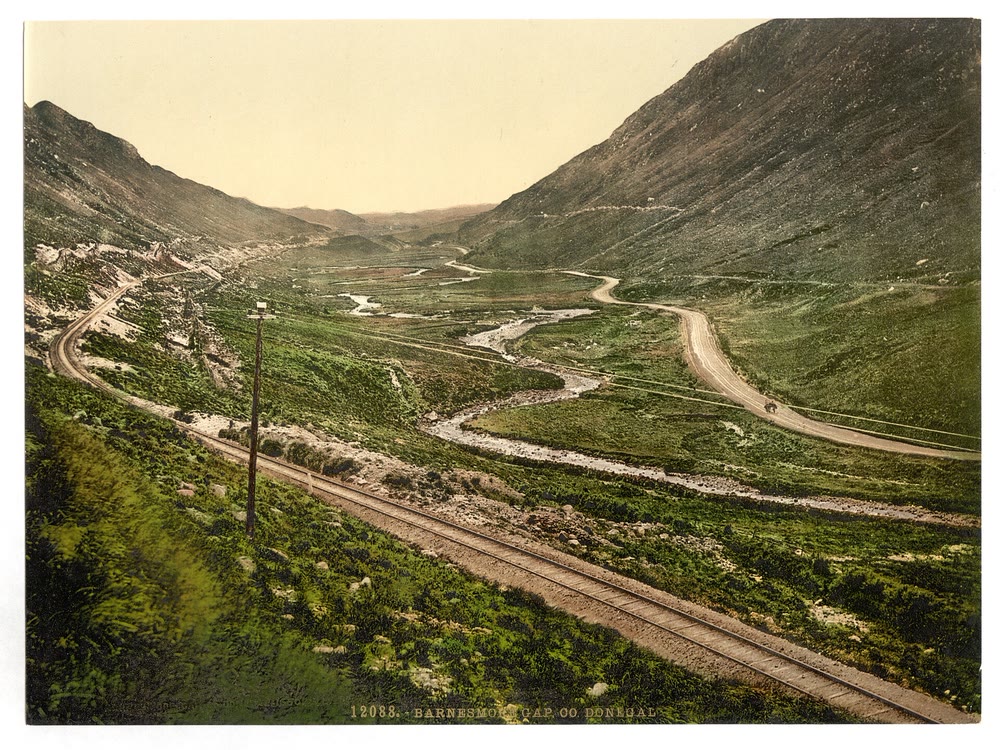
The road and railway through Barnesmore Gap, Co. Donegal, in a photochrom print from the 1890s. Library of Congress, public domain, via Wikimedia Commons
Irish blessings for luck, work and new beginnings
To pass someone at work without a blessing was bad manners, and in some places bad luck.
58. Bail ó Dhia ar an obair (bal-yoh YEE-uh er un OB-ir)
“God bless the work”
Said to anyone you find working. In Co. Meath in 1938, “God bless your work” was answered “God bless you kindly”. In a 1930s Schools’ Collection record from Co. Mayo, a visitor who walked in on butter-making had to say it, or the butter wouldn’t come.
TRADITIONAL IRISH: Ó Dónaill (1977); Joyce (1910); Schools’ Collection.
59. The blessing of God be on you and on all your labours.
Lady Wilde recorded it as the blessing for passing a farmyard where cows were gathered for milking. Leaving it out was thought to invite the evil eye.
TRADITIONAL: Lady Wilde (1887).
60. Go n-éirí an t-ádh leat (guh NYE-ree un TAW lat)
“Good luck attend you”
Or simply Ádh mór (aw MORE), “great luck”, and Guím an t-ádh leat (GEEM un TAW lat), “I wish you luck”. There are 30 more in my guide to good luck in Irish.
TRADITIONAL IRISH: Ó Dónaill (1977); focloir.ie.
61. Go maire tú do phost nua (guh MAR-uh too duh FUST NOO-uh)
“May you live to enjoy your new job”
For a leaving or retirement card, Gach rath ort amach anseo (gokh RAH urt uh-MOKH un-SHUH), “every success to you from now on”.
MODERN: focloir.ie; built on the traditional Go maire tú (number 15).
62. The luck of God and the prosperity of Patrick
The luck of God and the prosperity of Patrick on all I shall see, and on all I shall touch, from the time I rise at morning until I sleep at night.
A little prayer that Douglas Hyde printed among prayers that mention Patrick.
TRADITIONAL IRISH: Hyde (1906), his translation.
Irish blessings for health, strength and protection
For protection, see also St Patrick’s Breastplate (number 7) and “the Lord between us and harm” (number 23).
63. Go lige Dia do shláinte leat (guh LIG-uh JEE-uh duh HLAWN-chuh lat)
“God grant you health”
The one for a get-well card.
TRADITIONAL IRISH: Ó Dónaill (1977).
64. Fad saoil duit in aice na sláinte (fod SEEL ditch in AK-uh nuh SLAWN-chuh)
“Length of life to you, beside health”: long life and good health to you.
TRADITIONAL IRISH: Ó Dónaill (1977).
65. I arise to-day through the strength of heaven
I arise to-day
Through the strength of heaven:
Light of sun,
Radiance of moon,
Splendour of fire,
Speed of lightning,
Swiftness of wind,
Depth of sea,
Stability of earth,
Firmness of rock.
The great Irish prayer for strength, from another part of St Patrick’s Breastplate. Read it aloud on a hard morning.
TRADITIONAL IRISH: Old Irish hymn; translation by Stokes and Strachan, as revised by Kuno Meyer (1911).
Irish blessings for Christmas, weddings, birthdays and other big days
Each of these has its own full guide on this site. Here are the best few, with the link to the rest.
Christmas and New Year
The best-known “Irish Christmas blessing” online, about peace and plenty lifting the latch, has no known author, date or Irish original, though it draws on the real custom of a candle in the window on Christmas Eve. These are older.
66. Nollaig shona duit (NUL-ig HUN-uh ditch)
“Happy Christmas to you”
To a group, daoibh (DEEV). It’s often written dhuit, as many people say it; the standard spelling is duit, and both are fine. For a card, Beannachtaí na Nollag ort (BAN-ukh-tee nuh NUL-ug urt), “the blessings of Christmas on you”. Here’s how to say Merry Christmas in Irish.
TRADITIONAL IRISH: Ó Dónaill (1977); focloir.ie.
67. Nollaig faoi shéan agus faoi shonas duit (NUL-ig fwee HAYN AG-us fwee HUN-us ditch)
“A prosperous and happy Christmas to you”
TRADITIONAL IRISH: Ó Dónaill (1977).
68. Athbhliain faoi mhaise duit (AH-vlee-in fwee WASH-uh ditch)
“A prosperous New Year to you”
The reply is Gurab amhlaidh duit (GUR-ub OW-lee ditch), “the same to you”.
TRADITIONAL IRISH: focloir.ie.
69. Go mbeire bliain ó inniu faoi mhaise orainn (guh MER-uh BLEE-in oh in-YOO fwee WASH-uh OR-in)
“May a year from today find us flourishing”
TRADITIONAL IRISH: Ó Dónaill (1977).
70. If it is well off we are to-night
If it is well off we are to-night, that it may be seven thousand times better we shall be a year from to-night, ourselves and our possessions together, in life and in health, in love and in luck.
From a blessing a Co. Galway man gave the Jesuit J. C. MacErlean, printed by Hyde. A wonderful New Year’s Eve toast.
TRADITIONAL IRISH: Hyde (1906), his translation.
Number 9, Go mbeirimid beo ar an am seo arís, and number 56, the toast to absent family, belong on the Christmas table too. For 20 more, see my Irish Christmas blessings, and for the night itself, my Irish New Year blessings.
Weddings and anniversaries
71. Go maire sibh bhur saol nua (guh MAR-uh shiv vur SEEL NOO-uh)
“May you enjoy your new life”
Ó Dónaill adds the meaning: “congratulations on your marriage”.
TRADITIONAL IRISH: Ó Dónaill (1977).
72. Sonas agus séan oraibh (SUN-us AG-us SHAYN OR-iv)
“Happiness and prosperity on you both”
To one person, ort (urt).
TRADITIONAL IRISH: Ó Dónaill (1977), which prints the one-person form.
73. Go n-éirí do phósadh leat (guh NYE-ree duh FOH-suh lat)
“May your marriage be a success”
To the couple together, Go n-éirí bhur bpósadh libh (vur BOH-suh liv).
TRADITIONAL IRISH: Ó Dónaill (1977); the couple’s form follows regular grammar.
74. Good health and long life to the bride and groom.
The first toast after the wedding feast in Co. Leitrim in the 1930s. In Co. Meath, the crowd shouted “Long life to the Bride and Groom!” once the bride had smashed the whiskey bottle the groom’s men had raced for. In Irish, use number 16 with chugaibh.
TRADITIONAL: Schools’ Collection, Co. Leitrim and Co. Meath (1930s).
75. Go raibh tú riamh amhlaidh (guh rev too REE-uv OW-lee)
“May you be ever thus”
Lovely in an anniversary card. To the couple, Go raibh sibh riamh amhlaidh (shiv).
TRADITIONAL IRISH: Ó Dónaill (1977); the couple’s form follows regular grammar.
The verse sold as “the Irish wedding blessing”, beginning “May God be with you and bless you”, is lovely, but no early source or Irish original has turned up, and one line echoes Psalm 128. For readings, toasts and how to word your own, see my Irish wedding blessings, and for romance, my Irish sayings about love.
Birthdays
76. Lá breithe sona duit (law BREH-huh SUN-uh ditch)
“Happy birthday to you”
A modern greeting modelled on the English; Breithlá sona duit (BREH-law SUN-uh ditch) works too. Here’s how to say happy birthday in Irish, and sing it.
MODERN: focloir.ie.
77. Go maire tú an lá (guh MAR-uh too un LAW)
“May you live (to see) the day”: many happy returns.
For a big birthday, Go maire tú an céad (un KAYD), “may you live to be a hundred”.
TRADITIONAL IRISH: Ó Dónaill (1977).
78. Go maire tú is go gcaithe tú é (guh MAR-uh too iss guh GAH-huh too AY)
“May you live to wear it”: may you live to enjoy it.
The old wish for someone in new clothes. Perfect with a birthday present.
TRADITIONAL IRISH: Ó Dónaill (1977).
79. Croí folláin agus gob fliuch (KREE FUL-awn AG-us GUB FLYUKH)
“A sound heart and a wet beak!”
An all-purpose toast straight out of the dictionary, and a fun one for a birthday.
TRADITIONAL IRISH: Ó Dónaill (1977).
80. Your health; may you live all the days of your life.
A character raises this toast in Jonathan Swift’s Polite Conversation (1738). Swift was born in Dublin, but he was mocking the stock phrases of fashionable London.
NOT IRISH IN ORIGIN: English society toast, recorded by Swift (1738).
For a hundred more, see my Irish birthday blessings.
St Patrick’s Day
81. Beannachtaí na Féile Pádraig oraibh (BAN-ukh-tee nuh FAY-luh PAW-drig OR-iv)
“The blessings of St Patrick’s Day on you all”
To one person, ort (urt). The plain greeting is Lá Fhéile Pádraig sona duit (law AY-luh PAW-drig SUN-uh ditch), “happy St Patrick’s Day”.
MODERN: everyday greeting, used for example by the Diocese of Derry; same pattern as focloir.ie’s Beannachtaí na Cásca ort (Happy Easter).
82. God’s blessing upon Munster
God’s blessing upon Munster,
Men, women, children!
A blessing on the land
Which gives them fruit!
The opening of a poem from the medieval Tripartite Life of Patrick, which Kuno Meyer dated “not earlier than the ninth century”. Read the whole of Patrick’s Blessing on Munster.
TRADITIONAL IRISH: medieval Irish, translated by Kuno Meyer (1911).
83. I bind unto myself today
I bind unto myself today
The strong Name of the Trinity,
By invocation of the same,
The Three in One and One in Three.
Cecil Frances Alexander, the Irish hymn writer behind “All Things Bright and Beautiful”, turned the Breastplate into this hymn in 1889. Charles Villiers Stanford set it to Irish tunes in 1902.
MODERN: hymn by Cecil Frances Alexander (1889), from the Old Irish.
84. A health let us drink
A health let us drink. Our glass we clink it,
May the King of the Graces to us be near.
We will drink this glass as Patrick would drink it,
With a grace made salt by a mingled tear,
Without sadness or sorrow or passion or pain,
None knowing to-morrow that we were here.
“A curious health from the County Mayo”, Hyde called it, from Philip Waldron of Drombaun, near Ballyhaunis. The last line means that tomorrow nobody will remember we ever existed.
TRADITIONAL IRISH: Hyde (1906), his translation.
For 39 more, see my St Patrick’s Day blessings.
Grace before meals
85. Bail na gcúig arán
Bail na gcúig arán agus an dá iasc,
mar a roinn Dia ar na cúig mhíle fear.
Rath ón Rí a rinne an roinn
ar ár gcuid is ar ár gcomhroinn.
(BAL nuh GOO-ig uh-RAWN AG-us un daw EE-usk, mar uh RIN JEE-uh er nuh KOO-ig VEE-luh FAR. RAH OHN REE uh RIN-yuh un RIN, er awr GWIJ iss er awr GOH-rin.)
“The good of the five loaves and the two fishes, as God divided them among the five thousand men. Luck from the King who made the division, on our share and on our sharing.”
Hyde thought this grace “must be very old” because of its strict metre. A Co. Cavan man recorded it in 1931.
TRADITIONAL IRISH: Hyde (1906); Doegen Records (1931).
86. Beannaigh sinn, a Dhia
Beannaigh sinn, a Dhia,
beannaigh ár mbia is ár ndeoch.
Ós tú a cheannaigh sinn go daor,
saor sinn ó gach uile olc.
(BAN-ee SHEEN, uh YEE-uh, BAN-ee awr MEE-uh iss awr NYUKH. Ohs TOO uh HYAN-ee SHEEN guh DEER, SEER SHEEN oh gokh IL-uh ULK.)
“Bless us, O God, bless our food and our drink. Since you bought us at a dear price, free us from every evil.”
The best-loved grace in Irish; it rhymes, so children learn it fast. In the 1930s a schoolchild in Co. Donegal wrote down an older spelling of it for the Schools’ Collection, right before the loaves-and-fishes grace (number 85). The author is unknown.
TRADITIONAL IRISH: Schools’ Collection, Co. Donegal (1930s); Intercom, Irish Catholic Bishops’ Conference (2019).
87. Moladh leis an Rí
Moladh leis an Rí nach gann,
moladh gach am le Dia,
céad moladh agus buíochas le hÍosa Críost
ar son ar itheamar is a n-íosfaimid de bhia.
(MUL-uh lesh un REE nokh GAWN, MUL-uh gokh AWM leh JEE-uh, KAYD MUL-uh AG-us BWEE-ukh-us leh HEE-suh KREEST, er SUN er IH-uh-mur iss uh NEES-fuh-mid juh VEE-uh.)
“Praise to the King who is never scant, praise to God at all times, a hundred praises and thanks to Jesus Christ for all the food we have eaten and all we will eat.” A grace for after the meal. Schoolchildren in Mayo, Kerry and other counties wrote down versions of it in the 1930s; the author is unknown.
TRADITIONAL IRISH: Schools’ Collection (1930s); Intercom (2019); Cumann na Sagart.
88. Bless us, O Lord, and these thy gifts
Bless us, O Lord, and these thy gifts, which we are about to receive from thy bounty, through Christ our Lord. Amen.
Said in Irish and Irish-American homes for generations, but it’s the English of a Latin grace, Benedic, Domine. In Irish it begins Beannaigh sinn, a Thiarna (BAN-ee SHEEN, uh HEER-nuh).
NOT IRISH IN ORIGIN: Latin Catholic grace.
89. I should like a great lake of ale
I should like a great lake of ale
For the King of the Kings;
I should like the family of Heaven
To be drinking it through time eternal.
The first verse of a medieval Irish poem credited to St Brigid, which Eugene O’Curry translated in 1861 from a manuscript in Brussels. Heaven as an endless party: very Irish.
TRADITIONAL IRISH: medieval Irish, translated by Eugene O’Curry (1861).
For grace after meals, a Thanksgiving grace and pronunciations, see my Irish grace before meals.
Funerals, sympathy and remembrance
Number 10, Ar dheis Dé go raibh a anam, is the one most people want. These are the other old words of comfort.
90. Suaimhneas síoraí dá anam (SOO-iv-nyus SHEE-ree daw AN-um)
“Eternal rest to his soul”
For a woman, dá hanam (daw HAN-um).
TRADITIONAL IRISH: built on Ó Dónaill’s suaimhneas síoraí, “eternal rest” (1977).
91. Go ndéana Dia trócaire ar a anam (guh NAY-nuh JEE-uh TROH-kar-uh er uh AN-um)
“May God have mercy on his soul”
Ó Dónaill prints the plural, Go ndéana Dia trócaire orthu (OR-hoo), “God rest their souls”. Or say Beannacht Dé lena anam (BAN-ukht JAY LEN-uh AN-um), “God rest his soul”.
TRADITIONAL IRISH: Ó Dónaill (1977), which prints the orthu (them) form.
92. Go soilsí solas na bhflaitheas orthu (guh SIL-shee SUL-us nuh VLAH-hus OR-hoo)
“May the light of heaven shine upon them”
For one man, air (err); for one woman, uirthi (ER-hee).
TRADITIONAL IRISH: Ó Dónaill (1977).
93. Ní maith liom do thrioblóid (nee MAH lum duh HRIB-lohj)
“I’m sorry for your trouble”
The Irish for the phrase you’ll hear at Irish wakes and funerals. For a card, Táimid páirteach leat i do thrioblóid (TAW-mid PAWR-chukh lat ih duh HRIB-lohj), “we share in your sorrow”.
TRADITIONAL IRISH: Ó Dónaill (1977).
94. God rest his soul. The Lord have mercy on him.
Joyce wrote that Catholics “invariably” said one of these whenever they mentioned someone who had died. Many still do.
TRADITIONAL: Joyce (1910).
95. God’s blessing with the soul of our fathers
God’s blessing with the soul of our fathers, our mothers, our brothers, our sisters; and the blessing of God be with our own soul at the last day.
From the same Galway prayer as number 70. Lovely for an anniversary Mass card or All Souls’ Day.
TRADITIONAL IRISH: Hyde (1906), his translation.
96. Eternal rest grant unto him, O Lord
Eternal rest grant unto him, O Lord, and let perpetual light shine upon him. May he rest in peace. Amen.
Said at every Irish graveside, but it’s the English of the Latin Requiem aeternam. In Irish it begins Suaimhneas síoraí tabhair dóibh, a Thiarna (“to them”; for one man dó, for one woman di), as recorded in Co. Kerry in the 1930s.
NOT IRISH IN ORIGIN: Latin Catholic prayer.
97. Deep peace of the running wave to you
Deep peace of the running wave to you.
Deep peace of the flowing air to you.
Deep peace of the quiet earth to you.
Deep peace of the sleeping stones to you!
Shared as an “old Gaelic blessing”, but the Scottish author William Sharp wrote it, as Fiona Macleod, in The Dominion of Dreams (1899). John Rutter adapted it for his choral “A Gaelic Blessing” (1978).
NOT IRISH IN ORIGIN: William Sharp, Scotland (1899).
For wake customs, card wording and poems for a funeral, see my Irish funeral blessings and prayers.
Funny Irish blessings (and blessings with a sting)
The Irish blessing has a wicked twin, the curse, and some of the best “blessings” have a sting in the tail. For the real thing, see my old Irish curses.
98. God save all here, except the cat.
Lady Wilde claimed in 1887 that this was the usual greeting on entering a house, because cats were thought uncanny: “no one says, God bless the cat”. I haven’t found it anywhere else, so take it with a pinch of salt.
TRADITIONAL: reported by Lady Wilde (1887).
99. May those who love us, love us
May those who love us, love us. And those that don’t love us, may the Lord turn their hearts. And if the Lord doesn’t turn their hearts, may he turn their ankles so that we’ll recognize them by their limping.
President Ronald Reagan raised this at the Speaker’s St Patrick’s Day lunch in 1987, as “something that is labeled as an old Irish curse or blessing”. I haven’t found it in print any earlier.
MODERN: earliest record 1987, USA.
100. A clean shirt, a clean conscience and a guinea
Here’s that we may always have a clane shirt, a clane conscience, and a guinea in our pocket.
Joyce heard it given as a toast “by a fine old gentleman of the old times”. “Clane” is his spelling of the old Irish-English way of saying clean.
TRADITIONAL: Joyce (1910).
Famous “Irish blessings” that aren’t what they seem
Some of these are beautiful. They just aren’t what the plaque says. Most newspaper dates come from Barry Popik’s research.
| Shared as an “old Irish blessing” | Where it really comes from |
|---|---|
| “May you always have walls for the winds…” | Anonymous card verse. No early printing or Irish original found. |
| “May God be with you and bless you, may you see your children’s children…” | Sold as the Irish wedding blessing. No early source found; it echoes Psalm 128. |
| “May your home always be too small to hold all your friends” | First found in an American “Hints from Heloise” column, 1966. |
| “May your pockets be heavy and your heart be light…” | An earlier form was one of “five Irish wishes” in a New York paper in 1986; the good-luck wording dates from 1999. |
| “May the luck of the Irish lead to happiest heights…” | A 1976 book from Denver. Its highway of green traffic lights gives its age away. |
| “For each petal on the shamrock…” | A Connecticut newspaper recipe column, 1988. (Shamrocks have leaves, not petals.) |
| “May your troubles be less and your blessings be more…” | Earliest record: The New York Times, 1991, framed on a living-room wall in the Bronx. |
| “May peace and plenty be the first to lift the latch…” | No author, date or Irish original found. |
| “May you live as long as you want…” and “May the Lord keep you in His hand…” | Anonymous. No early printing or Irish original found. |
| “Here’s to a long life and a merry one…” | The toast of the Clover Club, a Philadelphia dining club, printed in 1890. |
| “Death is nothing at all” | A sermon by Henry Scott Holland, an English priest, at St Paul’s Cathedral, London, in 1910. |
| “Do not stand at my grave and weep” | Usually credited to Mary Elizabeth Frye, an American, who said she wrote it in 1932. |
| “Give me a sense of humour, Lord…” | Usually traced to Chester Cathedral in England, and often wrongly credited to Thomas More. |
| “The seven Irish blessings” | There’s no fixed set. See the FAQ. |
Numbers 1, 8, 41, 42 and 97 above have their true stories too. For dozens more famous lines checked against their sources, see my guide to famous Irish quotes and who really said them.
Where traditional Irish blessings really come from
The Irish word for a blessing, beannacht, came into Irish from the Latin benedictio with the early Church. The blessings themselves reached us by five roads.
Everyday speech. Most genuine Irish blessings are short phrases built into ordinary talk: hello, thanks, goodbye, a sneeze, bad news. Nobody composed them and nobody can date them. They were protective as well as kind: praise without a blessing could bring bad luck or the evil eye, so “God bless it” followed every compliment to a child, a cow or a churn of butter.
The Schools’ Collection. In 1937 to 1939, schoolchildren across the 26 counties wrote down folklore from their parents, grandparents and neighbours, including blessings, prayers and charms. Their copybooks are in the National Folklore Collection at University College Dublin, free to search on dúchas.ie. Look up your family’s parish: the blessings your great-grandparents said may be there, in a child’s handwriting.
Old manuscripts and the collectors. A few blessings survive from medieval Ireland, like St Patrick’s Breastplate and Patrick’s Blessing on Munster, which scholars such as the German Celticist Kuno Meyer translated a century ago. In 1906 Douglas Hyde published hundreds of prayers taken down from Irish speakers in The Religious Songs of Connacht, free on archive.org.
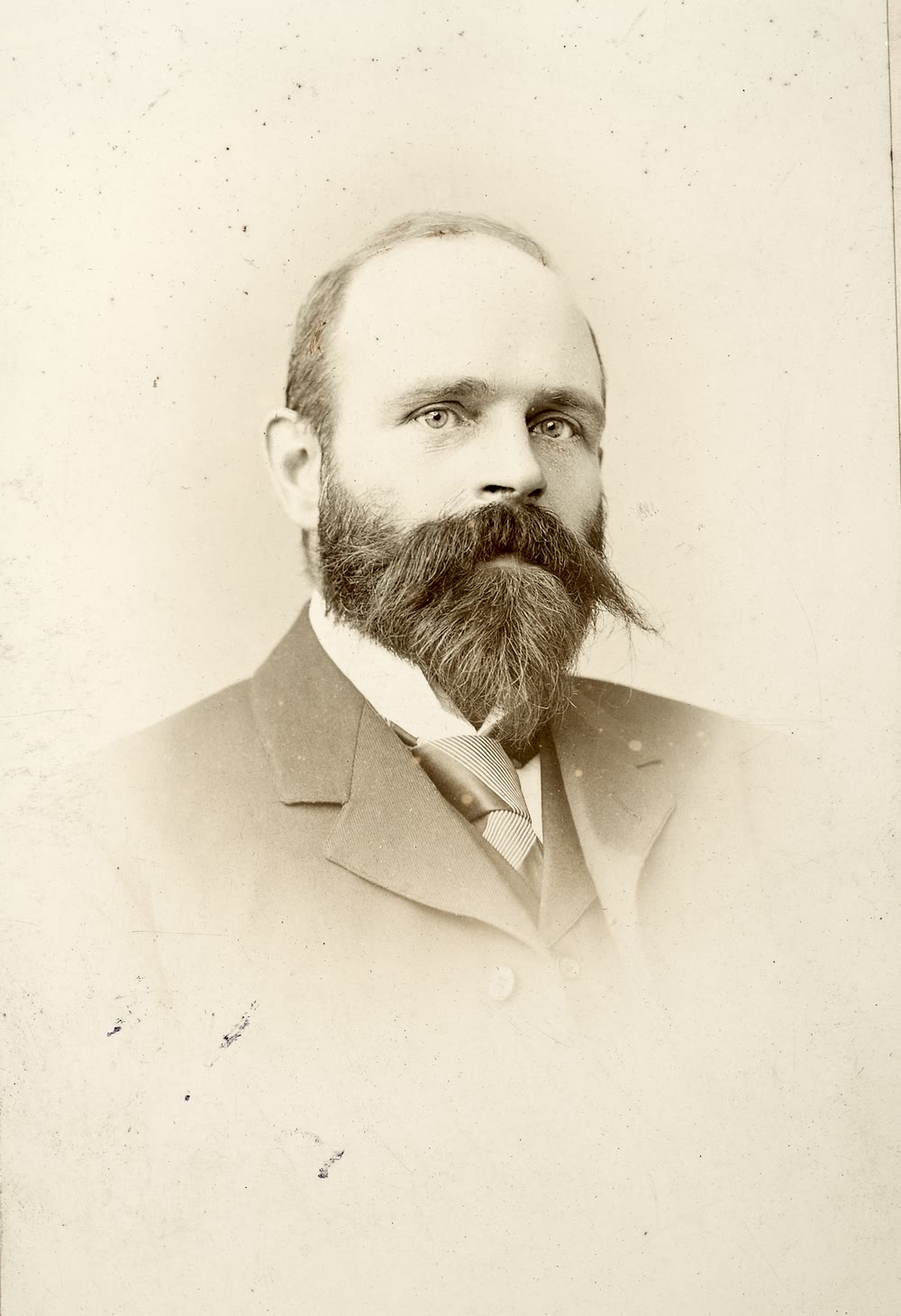
Kuno Meyer, whose 1911 book Selections from Ancient Irish Poetry gives the translations of St Patrick’s Breastplate and Patrick’s Blessing on Munster quoted here. National Library of Ireland, public domain, via Wikimedia Commons
Scotland. Many “Celtic” or “Gaelic” blessings online are Scottish. Alexander Carmichael’s Carmina Gadelica (1900) collected prayers and charms from the Highlands and Islands, and “Deep peace” is by William Sharp. Ireland and Scotland share a great deal (Hyde found the fire-saving prayer in both): close cousins, just not twins.
America. Most English verses on plaques and cards first turn up in American newspapers, speeches and gift books between the 1940s and the 1990s: the road blessing in 1945, the home too small for your friends in 1966, the shamrock petals in 1988, “May your troubles be less” in 1991. Irish-American families have treasured them for generations. That’s a real tradition too, just a younger one.
Using an Irish blessing: cards, prints and tattoos
- Cards: one short line is plenty. Write the Irish first and the English underneath.
- Him, her or them: Irish changes with who you mean. A anam is his soul and a hanam her soul; air is on him and uirthi on her; duit is to you and daoibh to you all.
- Prints and plaques: a modern verse is still lovely. Just leave “ancient” off the frame.
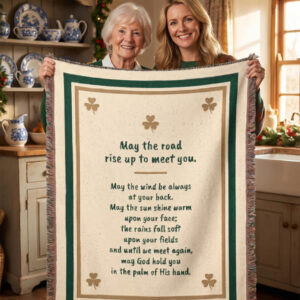
May the road rise up to meet you, on a blanket
The road blessing, woven into a cotton throw with fringe. A cosy gift for someone far from home.
From our own little Etsy shop. Or see all the proverb and blessing prints.
Tattoos and engraving: copy the Irish from a dictionary such as teanglann.ie or focloir.ie, not from a quote card or an online translator, and ask a fluent speaker to check it. These slips are all over the internet:
| Often seen | Correct | Why |
|---|---|---|
| Go n-eirí, Go neiri | Go n-éirí | Both fadas, and the hyphen after the n |
| Slainte, Slainté | Sláinte | One fada, on the a (not the e) |
| slàinte mhath | sláinte mhaith | The first is Scottish Gaelic spelling |
| Cead mile failte | Céad míle fáilte | Three fadas |
| Ar dheis De, Beannacht De | Ar dheis Dé, Beannacht Dé | Dé (of God) needs its fada |
| adh mor | ádh mór | Two fadas |
| Ar dheis Dé go raibh a anam (for a woman) | Ar dheis Dé go raibh a hanam | “Her soul” takes an h |
Two things that aren’t mistakes: in a capitalised title, Go n-éirí is written Go nÉirí, with no hyphen; and dhuit, as in Dia dhuit and Nollaig shona dhuit, is a common spelling that follows the way many people say duit. The standard spelling is duit, but neither is wrong.
Sung blessings: in 2020, singers from about 300 churches in every county on the island recorded “The Irish Blessing”, inspired by that year’s worldwide videos of the worship song “The Blessing” (by Kari Jobe, Cody Carnes and Elevation Worship, from the Book of Numbers). The Irish version weaves together Be Thou My Vision and lines in the spirit of St Patrick’s Breastplate. Watch 300 churches singing The Irish Blessing.
Irish blessings FAQ
What is the most famous Irish blessing?
“May the road rise up to meet you.” Only its first line, Go n-éirí an bóthar leat (guh NYE-ree un BOH-har lat), “may your journey go well”, is a documented Irish saying. The full English verse is anonymous, and the earliest printing found is in the US Congressional Record in March 1945. The six-line Irish versions on cards are modern translations of the English.
What is the Irish (Gaelic) word for blessing?
Beannacht (BAN-ukht), plural beannachtaí (BAN-ukh-tee), from the Latin benedictio. To bless is beannaigh (BAN-ee), as in Go mbeannaí Dia duit, “may God bless you”, and Mo bheannacht ort (muh VAN-ukht urt) means “my blessing on you”.
What are the seven Irish blessings?
There’s no fixed set, so any list of “seven Irish blessings” is someone’s modern selection. The idea most likely comes from Mo sheacht mbeannacht ort, “my seven blessings on you”, where seven simply means “all my”. Ó Dónaill translates it “Bravo! Good for you!”
Irish often uses seven to mean “ever so much”: mo sheacht ndícheall is “the very best I could”. And the Irish for the Beatitudes is na hocht mbeannacht: the eight blessings.
What is a short Irish blessing?
Try Beannacht Dé ort (BAN-ukht JAY urt), “God bless you”, or Slán abhaile (slawn uh-WAL-yuh), “safe home”. In English, “God mark you with His Holy Grace” was written down in Co. Meath in 1938. There are more in the short blessings section.
How do Irish people say good luck?
Go n-éirí leat (guh NYE-ree lat), “may it go well with you”, or Ádh mór (aw MORE), “great luck”. For a bigger occasion, Go n-éirí an t-ádh leat (guh NYE-ree un TAW lat): good luck attend you.
How do you say “God bless you” in Irish?
Beannacht Dé ort (BAN-ukht JAY urt) or Go mbeannaí Dia duit (guh MAN-ee JEE-uh ditch). As warm thanks, say Bail ó Dhia ort (bal-yoh YEE-uh urt). After a sneeze, say Dia linn (JEE-uh LEEN), “God with us”.
Are Irish blessings really ancient?
Some are. Everyday Irish blessings like Bail ó Dhia ort are old and still in use, and a few prayers, like St Patrick’s Breastplate, survive in medieval manuscripts. But most English verses on plaques and cards, including “May the road rise up to meet you”, were first printed in the 20th century, usually in America.
What is the oldest Irish blessing?
The oldest you can still read are medieval prayers. Kuno Meyer judged that St Patrick’s Breastplate, in its surviving form, could be no earlier than the eighth century, and Patrick’s Blessing on Munster no earlier than the ninth. Both are credited to Patrick, but neither can be proved to be his.
What’s the difference between an Irish blessing, a toast and a proverb?
A blessing wishes someone well: may your journey go well. A toast is a blessing with a glass in your hand: Sláinte agus saol chugat. A proverb, or seanfhocal, states a truth about life: two people shorten a road. See my Irish proverbs (seanfhocail), and for everyday expressions, my Irish sayings.
What is the Irish prayer for strength?
St Patrick’s Breastplate, especially the lines “I arise to-day / Through the strength of heaven”. It’s a medieval Irish hymn credited to Patrick. Numbers 7 and 65 give two parts of it in the translation Kuno Meyer printed in 1911.
What is the traditional Irish blessing for a new baby?
Bail ó Dhia air (bal-yoh YEE-uh err), “God bless him”, or for a girl bail ó Dhia uirthi (ER-hee). In old Ireland anyone who praised a baby added “God bless it” straight away, Lady Wilde wrote in 1887, so the compliment couldn’t bring bad luck. Go saolaí Dia é wishes the child long life.
What is the traditional Irish toast for friendship?
Sláinte agus saol chugat (SLAWN-chuh AG-us SEEL HUG-ut), “health and long life to you”, or just Sláinte! To sign off to a friend, Slán agus beannacht, “a farewell and a blessing”. The popular “Here’s to the roof we are under” is lovely too, but it was first printed as an old English toast, in 1912.
What do Irish people say when someone dies?
To the family: “I’m sorry for your trouble”, in Irish Ní maith liom do thrioblóid (nee MAH lum duh HRIB-lohj). Of the person who has died: Ar dheis Dé go raibh a anam (er yesh JAY guh rev uh AN-um), “may his soul be at God’s right hand”, or a hanam for a woman. In English, “God rest his soul”.
What is a traditional Irish farewell blessing?
Slán agus beannacht (SLAWN AG-us BAN-ukht), “a farewell and a blessing”, or Beannacht Dé leat (BAN-ukht JAY lat), “God speed you”. For safe travels, say Go dté tú slán (guh JAY too SLAWN), “may you go safely”, and at the end of a night out, Slán abhaile (slawn uh-WAL-yuh): safe home.
Love this? Save it to your Pinterest board for later.
Pin image: The road through the Pass of Ballaghbeama, Co. Kerry, in a photochrom print from the 1890s. Library of Congress, public domain, via Wikimedia Commons.
A little bit of Ireland in your inbox every Friday ☘️
The free Weekly Dose of Irish: an Irish joke, a Celtic symbol, an Irish fact, a poem and the week’s best articles in one short email. Join 9,600+ readers.
Free. One short email every Friday. Unsubscribe any time.
More Irish blessings
- May the Road Rise Up to Meet You: Meaning, Full Blessing and Its Surprising Origin
- St Patrick’s Day Blessings: 39 Irish Blessings, Prayers and Toasts
- Irish Wedding Blessings, Toasts and Readings: What’s Really Irish and How to Say It
- Irish Funeral Blessings and Prayers: Words of Comfort in English and Irish, and Their True Origins
- Irish House Blessing: New Home Blessings, Housewarming Customs and Where ‘Bread, Salt and Wine’ Comes From
- Irish Grace Before Meals: Table Blessings in Irish and English, and Where They Really Come From
- 20 Irish Christmas Blessings and How to Say Merry Christmas in Irish
- 100+ Irish Birthday Blessings, Wishes and Toasts (with Irish Translations)
- 63 Irish Toasts for Every Occasion, and Which Ones Are Really Irish
- Irish Proverbs: 160 Old Sayings With Meanings, in English and Irish
Featured image: The road through the Pass of Ballaghbeama, Co. Kerry, in a photochrom print from the 1890s. Library of Congress, public domain, via Wikimedia Commons.