The Morrígan (MOR-ee-gun) is the best-known war goddess of medieval Irish literature, a shape-shifter who foretells battle and death and sometimes appears as a bird, usually pictured as a crow. Her name is often explained as “phantom queen”, though medieval scribes read it as “great queen”. With Badb and Macha she makes up a trio of war goddesses. In Cath Maige Tuired she meets the Dagda at the River Unshin before a battle at Samhain, and in the Táin she attacks Cú Chulainn as an eel, a she-wolf and a heifer. The “maiden, mother and crone” label is modern.
A woman is washing in a river in Co. Sligo. She stands astride it, one foot on the south bank and one on the north, her hair hanging loose in nine tresses.
A god has come to meet her there, shortly before Samhain, with a war about to begin. He is the Dagda. She is the Morrígan, and before they part she has promised him the heart’s blood of the enemy king.
She is one of the most frightening figures in Irish myth, and one of the most misunderstood. Here’s what the medieval texts really say about her, and which parts of her modern image are much newer than they look.
Jump to:
- Who is the Morrígan?
- What her name means and how to say it
- Badb, Macha and Nemain: the three Morrígna
- The Dagda, the Unshin and Samhain
- The Morrígan and Cú Chulainn in the Táin
- The bird on Cú Chulainn’s shoulder
- Her cave at Cruachan
- Morrígan symbols and tattoo meanings
- Is she evil? Is she a triple goddess?
- The Morrígan FAQ
- More Irish mythology reading
Who is the Morrígan?
The Morrígan is a goddess of battle, fate and prophecy, one of the Tuatha Dé Danann, the old gods of medieval Irish legend. My guide to the Celtic gods and goddesses introduces the rest of the family.
She is seldom the hero of a story, turning up instead at fords and on battlefields, usually just before somebody dies.
Nearly everything we know comes from medieval Irish writing by Christian monks and scholars, mostly in manuscripts copied from about 1100 onwards, though some tales are centuries older. They show how medieval writers imagined her, not how, or whether, anyone worshipped her before Christianity. The Irish scholar W. M. Hennessy pulled the evidence together in an 1870 essay, The Ancient Irish Goddess of War.
What her name means and how to say it
In Old Irish she is the Morrígan, or in another medieval form the Morrígu, the spelling Lady Gregory used. Medieval writers often put the article before her name, which is why she is usually “the” Morrígan. The plural, Morrígna (roughly MOR-eeg-nuh), covers her and her sisters, and sometimes frightening spirits in general.
Rígan means queen. The first part is harder. The Electronic Dictionary of the Irish Language, eDIL, reports the view of Whitley Stokes and others that mor- is related to the “mare” in English nightmare, hence names like Phantom Queen. By the Middle Irish period, though, writers commonly took the first syllable as mór, great, and often wrote Mórrígan, the Great Queen.
Pronunciation: MOR-ee-gun, stressed on the first syllable, and plenty of English speakers say MOR-ih-gan. In Old Irish the g was a soft, throaty sound, closer to MOR-ree-ghun.
Spelling: write the Morrígan, with a fada on the í; Morrigan without it is the usual English form. Morrighan isn’t an internet invention either: eDIL records it in a later manuscript. But Morrígna is a plural, not her name. Some writers have tried to link her with Morgan le Fay of the Arthurian tales, eDIL notes, but it ties Morgan’s name to a different word, mor, the sea.
Badb, Macha and Nemain: the three Morrígna
The Book of Leinster’s copy of Lebor Gabála Érenn (roughly LEV-or GAV-aw-luh AY-ren), the medieval Book of Invasions, names three daughters of Ernmas, a woman of the Tuatha Dé: Badb, Macha and the Morrígan, whose own name, it adds, was Anand. Other passages bring in a fourth war spirit, Nemain, and the sisters often blur into one another.
Badb (roughly BAV) is a goddess and a bird at once. eDIL defines the word as both a war goddess and the hooded crow, or scald-crow, whose shape she took: a spirit who stirs up fighting, foretells slaughter and gloats over the dead. Hennessy, who gave the later spelling badhbh the sound “bov” or “bav”, insisted the bird was the grey-backed hooded crow, not the raven.
Macha (MAKH-uh, the ch as in Scottish loch) is the name behind Emain Macha (roughly EV-in MAKH-uh), Navan Fort near Armagh, though Irish tradition remembered several women called Macha. O’Mulconry’s Glossary calls Macha a badb, or one of the three Morrígna, and explains “Macha’s mast” (mast being the nuts that fattened pigs) as the heads of men cut down in battle.
In the tale told in my guide to the Táin, a pregnant Macha is forced to race the king’s chariot and curses the men of Ulster. The medieval tale makes her the daughter of Sainrith mac Imbaith, not Ernmas, but Eleanor Hull’s 1904 retelling for children turns her into one of the three war goddesses.
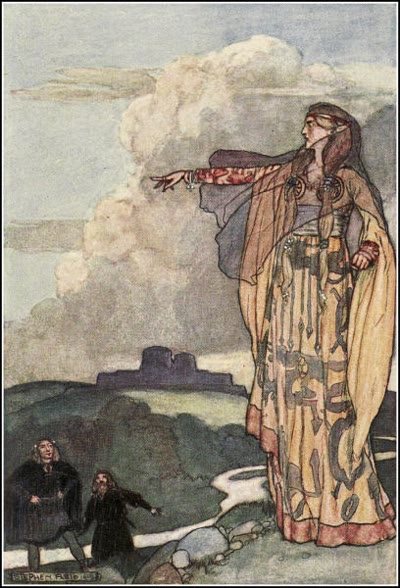
“Macha Curses the Men of Ulster”, by Stephen Reid, from Eleanor Hull’s The Boys’ Cuchulain (1904). Public domain, via Wikimedia Commons
Nemain (roughly NEV-in) was also an ordinary noun meaning battle frenzy. eDIL makes her the war-goddess wife of Néit, a battle god, and sometimes the same as Badb. In the Táin she falls on Queen Medb’s army in the night, and a hundred warriors die of terror.
The trio is medieval, but the battle crow may be far older. A Gallo-Roman stone from Haute-Savoie, in the French Alps, published in 1867, honours a goddess whose damaged name Adolphe Pictet restored as Cathubodua, and Hennessy matched it with the Irish badb catha, the battle crow.
The Dagda, the Unshin and Samhain
Cath Maige Tuired, the Second Battle of Mag Tuired (Moytura), tells how the Tuatha Dé beat the Fomorians. Its only manuscript is from the 1500s, but the scholar Gerard Murphy judged it an 11th- or 12th-century reworking of mostly ninth-century material.
A year earlier, the Dagda (DAG-duh) had made a date with a woman for around Samhain (SOW-in), the season of the coming battle. He found her washing in the Unshin, a river in Co. Sligo, standing astride the water; the text even names the places under each foot. They slept together, and the place took the name the Bed of the Couple. Only then does the narrator tell us she was the Morrígan.
She told him the Fomorians would land at Mag Céidne, and promised to hunt down their king, Indech, and take from him, in Elizabeth Gray’s translation, “the blood of his heart and the kidneys of his valour”. Later she carried two handfuls of Indech’s blood to the army waiting at the ford, which became the Ford of Destruction.
After the battle she announces the victory to Ireland’s royal heights, fairy hosts, waters and river mouths, then makes two prophecies: one of peace and plenty, and one of the end of the world, with summers without blossom, cows without milk and treachery even between fathers and sons.
You’ll often read that she and the Dagda meet every Samhain. The text describes one meeting, arranged a year ahead, before one battle, and never makes it a yearly date. My guide to Samhain has the other old stories set on that night.
The Morrígan and Cú Chulainn in the Táin
Her feud with Cú Chulainn (koo KHULL-in) starts before the Cattle Raid of Cooley. In a short prequel, Táin Bó Regamna, a cry in the night draws him out to meet a red-browed woman in a chariot pulled by a one-legged chestnut horse, with a big man driving a cow beside her.
He challenges them over the cow. She answers with riddling names and a mocking poem, then vanishes, and he sees her as a black bird on a branch. Too late, he knows her. She is guarding his death, she tells him; the cow came from the síd (modern sí, said “shee”), the fairy mound, at Cruachan to be bred by the Brown Bull of Cooley, and he will live only while its calf is a yearling. Then she names three shapes she will take against him. (One manuscript names her Badb instead.)
In the older version of the Táin, she comes to him as a beautiful king’s daughter, offering herself, her treasures and her cattle. Hard-pressed at the ford, he turns her down. So, while he fights a champion called Lóch, she coils round his feet as an eel, drives cattle at him as a grey she-wolf and leads the stampede as a hornless red heifer. He breaks the eel’s ribs, the wolf’s eye and the heifer’s leg.
Later she appears as a one-eyed old woman milking a three-teated cow. He asks for a drink, blesses her after each of three draughts, and each blessing heals one of her wounds. When she reveals herself, he says he’d never have healed her had he known.
The bird on Cú Chulainn’s shoulder
The Book of Leinster, a 12th-century manuscript, tells how Cú Chulainn died; Whitley Stokes published an abridged translation, Cuchulainn’s Death, in the late 1870s. The Morrígan’s last act there is almost tender: the night before his final battle she breaks his chariot, because she knows he will never come back to Emain Macha. He goes anyway.
Mortally wounded, he drinks and washes at a lake, then ties himself to a standing stone with his belt so he can die on his feet. His enemies hang back while his horse, the Grey of Macha, guards him. Then birds settle on his shoulder, and Erc, one of the enemy leaders, remarks that this pillar isn’t used to birds. Only then does Lugaid step in and take his head.
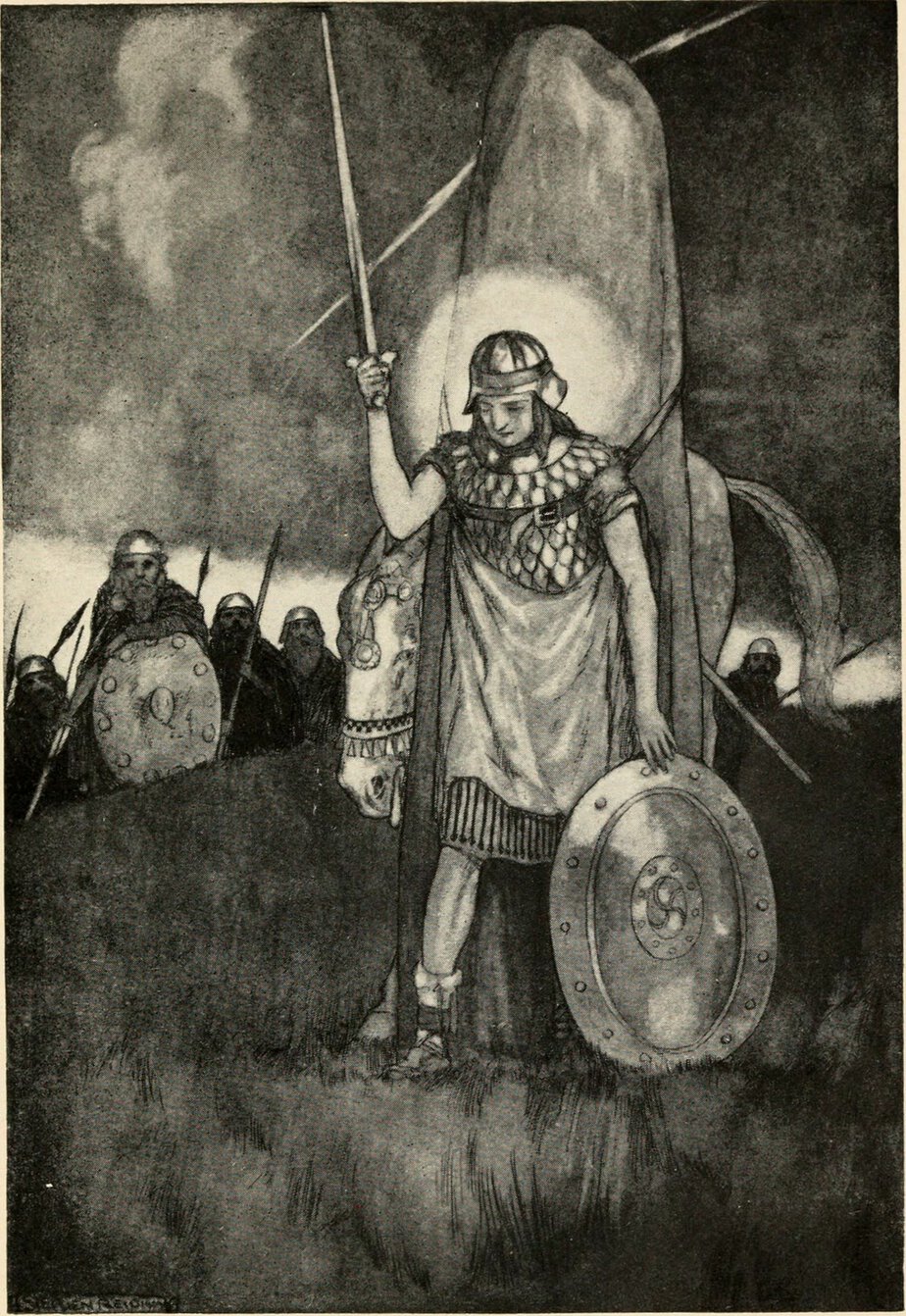
“Cuchulain comes at last to his Death”, by Stephen Reid, from Eleanor Hull’s Cuchulain, the Hound of Ulster (New York, 1910). Public domain, via Wikimedia Commons
Notice what the old text doesn’t say. Stokes has “the Birds”, unnamed: no crow, no raven. Lady Gregory’s 1902 version has a single bird, and Eleanor Hull’s 1904 retelling has carrion birds hovering round his shoulders. Reading the bird as the Morrígan or Badb in crow form fits everything else we know about her, but it’s a reading, not the medieval wording.
Later versions add another omen on his last ride: a girl at a ford washing his bloodstained clothes, whom Hull calls the daughter of the war goddess. eDIL even cites a medieval poem that makes the Morrígan herself the washer at the ford. The banshee belongs to the same family of omens.
The statue in the GPO
A bronze bird still sits on Cú Chulainn’s shoulder in Dublin. Oliver Sheppard modelled his Death of Cúchulainn in plaster in 1911 and showed it at the Royal Hibernian Academy in 1914, writes the art historian Paula Murphy, but no patron came forward to cast it. In the early 1930s Éamon de Valera chose it to commemorate the 1916 Rising. It was cast in Brussels, installed in the General Post Office, the rebels’ headquarters in the Easter Rising, and unveiled on Easter Sunday, 21 April 1935.
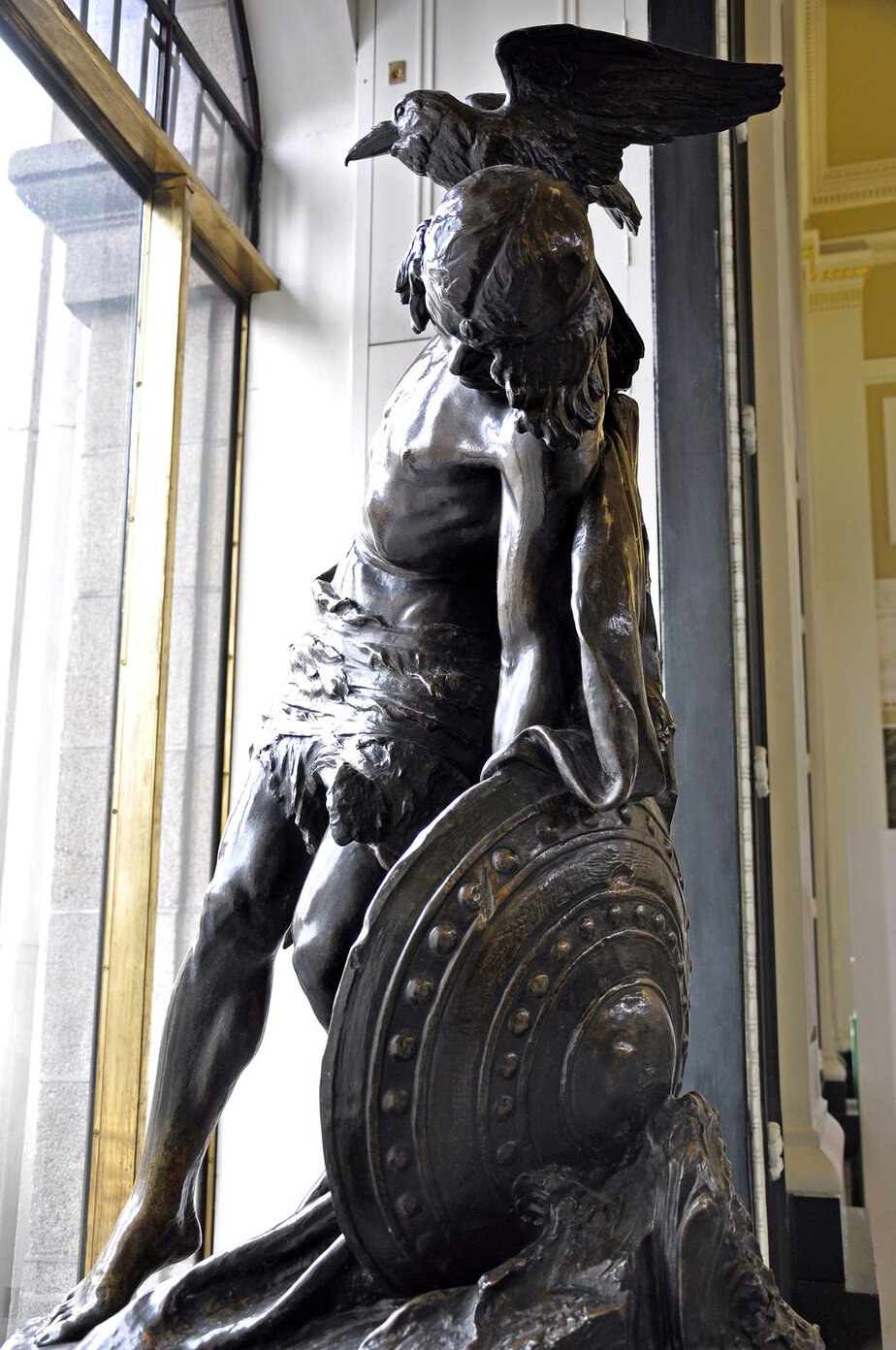
Oliver Sheppard’s bronze Death of Cúchulainn in the General Post Office, Dublin. Photo: Jennifer Boyer, CC BY 2.0, via Wikimedia Commons
The plaque beneath calls the bird a raven: his enemies dared approach only once it landed. W. B. Yeats called it “a bad statue” in a 1938 letter, yet wrote it into his last play. It’s free to see inside the GPO on O’Connell Street.
Her cave at Cruachan
The Metrical Dindshenchas, medieval verse on the lore of places, gives her a home. In its poem on the River Odras, in Edward Gwynn’s 1924 translation, she is the Dagda’s wife and a “raven-caller” who carries off a bull. A woman named Odras follows to win it back and falls asleep, and the Morrígan comes “out of the cave of Cruachu, her fit abode”, chants spells over her and melts her into a stream.
Cruachan (KROO-uh-khun), now Rathcroghan near Tulsk in Co. Roscommon, was Queen Medb’s royal seat in the Táin. Its cave is usually identified as Oweynagat, in Irish Uaimh na gCat (roughly OO-iv nuh GAT), the Cave of the Cats. Ogham-inscribed stones were built into its entrance around 500 to 700, says the Rathcroghan Visitor Centre.
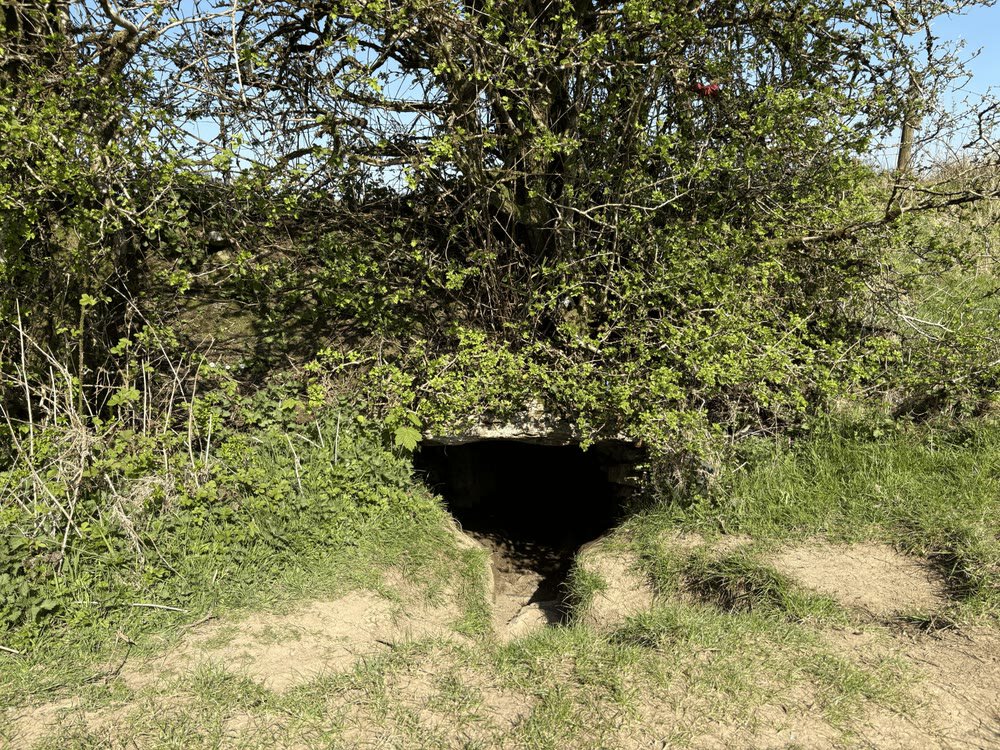
The entrance to Oweynagat, the Cave of the Cats, at Rathcroghan, Co. Roscommon. Photo: Sawyer777, CC BY-SA 4.0, via Wikimedia Commons
The centre runs weekday guided tours that take in Oweynagat, and a seasonal Origins of Samhain tour to the cave mouth around Halloween. In October 2026 its website said entry into the cave was restricted after a health and safety review, so check Rathcroghan’s Halloween page before you go.
Morrígan symbols and tattoo meanings
No ancient knot or sigil belongs to the Morrígan. The stories give her creatures instead.
- The hooded crow: the badb itself, her best-known shape. Modern Irish calls it feannóg (roughly FYAN-ohg; in Munster the stress moves to the end, fyuh-NOHG), the grey or scald-crow.
- The raven: fiach dubh (roughly FEE-ukh DUV; in Connacht and Ulster dubh sounds closer to “doo”), the carrion bird of her battle prophecies.
- The eel, the grey she-wolf and the hornless red heifer: her three shapes against Cú Chulainn.
- Cattle, the ford and the number three: stolen cows, washing and blood, three sisters, three shapes and three drinks.
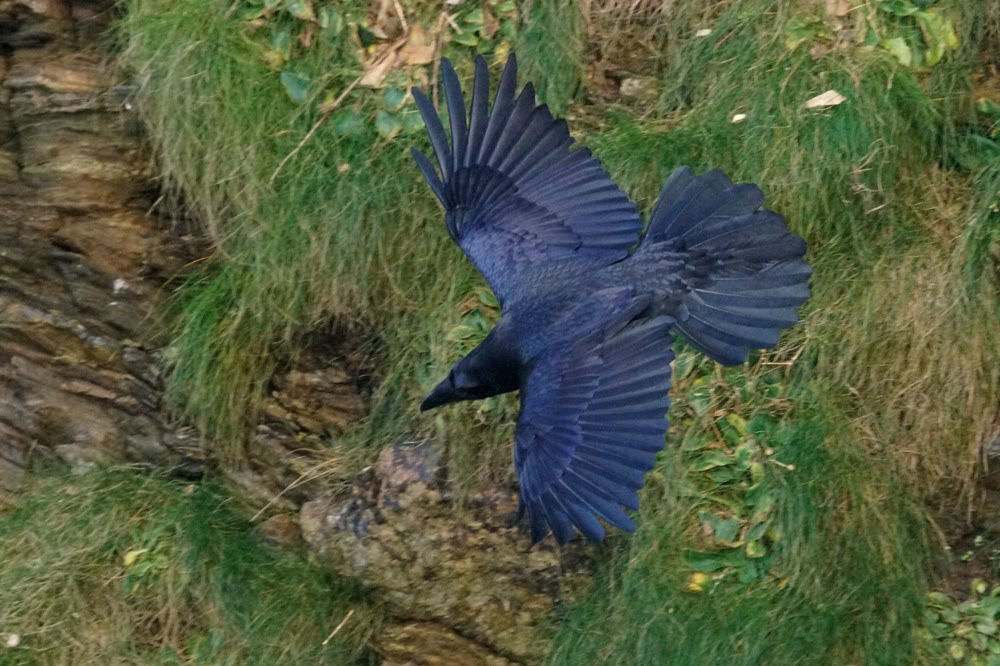
A raven in flight at Skaw, Unst, Shetland. Photo: Mike Pennington, CC BY-SA 2.0, via Wikimedia Commons
The crow kept its reputation. Hennessy found it still regarded with dislike in the Irish countryside in 1870, and Ó Dónaill’s dictionary, on teanglann.ie, records the saying Ná creid feannóg agus ná creid fiach (roughly naw KREJ FYAN-ohg AH-gus naw KREJ FEE-ukh): don’t believe the hooded crow or the raven; in other words, put no faith in omens. There are more in my guide to Irish superstitions.
The triple moon belongs to the modern lunar Triple Goddess, below; none of the medieval texts here links her with the moon. A triquetra or triple spiral labelled as her symbol is a modern pairing too; my guide to the triquetra explains where those three-part meanings come from.
For a tattoo rooted in the stories, try a bird on a shoulder for facing your fate standing up, as Cú Chulainn did; three crows for Badb, Macha and the Morrígan; or a woman washing at a ford for warning and prophecy. These are modern readings of old images, not ancient meanings. If you add her name, spell it Morrígan, fada and all.
Is she evil? Is she a triple goddess?
Was the Morrígan evil?
Not in her own stories. In Cath Maige Tuired she fights for her people and prophesies peace as well as ruin. She turns on Cú Chulainn after he spurns her, yet warns him of his death and later tries to keep him from riding out to it.
The darker reputation began early, with Christian scholars. An Old Irish gloss on Isaiah 34:14 uses morigain for lamia, the night-monster of the Latin Bible. Cormac’s Glossary explains “false demons” as spectres and morrígna, and translators regularly used badb for the Furies of classical myth, eDIL notes. Modern Irish still uses badhbh for a scold, and an older text hurls it as an insult meaning witch, a side of things I cover in my post on Irish witches.
Is the Morrígan a triple goddess?
Yes and no. The medieval texts group her with two sisters and let their names blur. But these are three war spirits, not three ages of a woman.
The maiden, mother and crone Triple Goddess is modern. In a 2025 Gresham College lecture, the historian Ronald Hutton points to the Cambridge classicist Jane Ellen Harrison, who in 1903 pictured a prehistoric goddess with three aspects, starting with maiden and mother. Robert Graves’s The White Goddess (1948) made her lunar, her three aspects the stages of life mirrored in the moon’s phases, and occult writers such as Gerald Gardner helped put a great goddess at the heart of modern Paganism. Any maiden, mother and crone Morrígan is younger than all of that.
Other modern layers
- Stone Age worship: you’ll read that people worshipped her in the Neolithic. No writing survives from Neolithic Ireland, so nobody can name its gods.
- Modern Paganism: she is popular with neopagans and Wiccans, a new relationship with an old figure.
- Horror films: in The Morrigan, a horror film set in Ireland (Galway Film Fleadh selection 2025, released on digital platforms in 2026), she is a vengeful goddess freed from a tomb. Nothing like that happens in the medieval tales.
For more spirits and omens, see my guide to Irish mythological creatures.
The Morrígan FAQ
What is the Morrígan the goddess of?
War, fate and prophecy. She foretells battles and deaths, drives warriors on and takes the shape of a bird, usually pictured as a crow.
How do you pronounce Morrígan?
MOR-ee-gun, stressed on the first syllable; MOR-ih-gan is the common English version. Old Irish was closer to MOR-ree-ghun.
Who was the Morrígan’s husband?
The Dagda. They sleep together in Cath Maige Tuired, and a Dindshenchas poem calls her his wife. Badb and Nemain are named as wives of Néit, a battle god.
Is the Morrígan the same as the banshee?
No, though both are female omens of death. Ó Dónaill’s dictionary lists badhbh chaointe, a “keening badhbh”, among its words for banshee.
Love this? Save it to your Pinterest board for later.
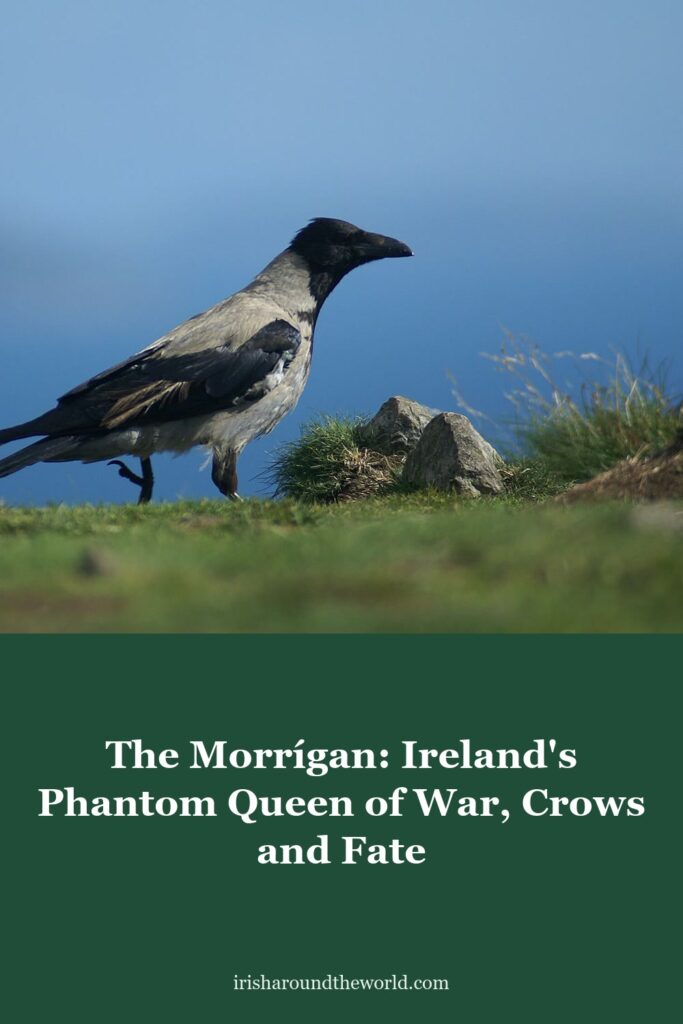
Pin image: A hooded crow at Bray Head, Co. Wicklow. Photo: Tony Brierton, CC BY-SA 2.0, via Wikimedia Commons
A little bit of Ireland in your inbox every Friday ☘️
The free Weekly Dose of Irish: an Irish joke, a Celtic symbol, an Irish fact, a poem and the week’s best articles in one short email. Join 9,600+ readers.
Free. One short email every Friday. Unsubscribe any time.
More Irish mythology reading
- Celtic Gods and Goddesses: 15 Irish Deities and Their Stories
- Tuatha Dé Danann: How Ireland’s Old Gods Lost a War and Became the Fairy Folk
- The Táin: How a Royal Bedtime Row Over a Bull Started Ireland’s Greatest Epic
- Cú Chulainn: The Teenage Warrior Who Held Off an Entire Army Alone
- Samhain: The Night the Fairy Mounds Opened and How It Became Halloween
- What Is a Banshee? The Wailing Woman of Irish Folklore and the Families She Follows
- Irish Mythological Creatures: 23 Fairies, Monsters and Death Omens to Know
Featured image: A hooded crow, the scald-crow of the old tales, at Bray Head, Co. Wicklow. Photo: Tony Brierton, CC BY-SA 2.0, via Wikimedia Commons.